Data Structures
FJWU
Dept.
BS Software Engineering
Sparse Matrix and
Polynomials
Aroosa
Neelum Raffique
Saba Arshad
Group Members
3
Sparse Matrix
•
A matrix is sparse if many of its elements are zero
•
A matrix that is not sparse is dense
•
The boundary is not precisely defined
•
Diagonal and tridiagonal matrices are sparse
•
We classify triangular matrices as dense
•
Two possible representations
•
array
•
linked list
SPARSE MATRIX
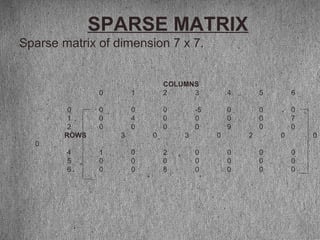
Sparse matrix of dimension 7 x 7.
COLUMNS
0 1 2 3 4 5 6
0 0 0 0 -5 0 0 0
1 0 4 0 0 0 0 7
2 0 0 0 0 9 0 0
ROWS 3 0 3 0 2 0 0
0
4 1 0 2 0 0 0 0
5 0 0 0 0 0 0 0
6 0 0 8 0 0 0 0
SOURCE CODE:
/*Program to demonstrate addition and multiplication of Two Sparse Matrix */
#include < iostream.h >
#include < conio.h >
#define x 25
class sparce
{
private:
int a [ x ] [ x ], b [ x ] [ x ], c [ x ] [ x ], m, n, p, q;
public:
void init ( );
void input ( );
void add ( );
void mul ( );
void display ( int [25][25], int, int );
void convert( int [25][25], int, int );
};
void sparce :: init ( )
{
int i, j;
for(i = 0; i < x;i + + )
for( j = 0; j < x; j + +)
c [ i ] [ j ] = 0;
}
cont...
void sparce :: input()
{
int i,j;
cout<<"nEnter order Of First matrix::";
cin>>m>>n;
cout<<"nEnter order Of Second matrix::";
cin>>p>>q;
cout<<"nEnter"<<m*n<<"Elements Into First Matrixn";
for(i=0;i<m;i++)
for( j = 0; j < n; j + + )
cin>> a[ i ] [ j ];
cout<<"nEnter"<<p*q<<"Elements Into Second Matrixn";
for(i = 0; i < p ; i + + )
for ( j = 0; j < q ; j + + )
cin>>b [ i ] [ j ];
}
void sparce :: add ( )
{
int i, j;
if( m = = p && n = = q )
{
for( i = 0 ; i < m ; i + + )
for( j = 0; j < n; j + + )
c[ i ] [ j ] = a [ i ][ j ] + b [ i ] [ j ];
convert( c, m, n);
}
else
cout<<"nAddition Is Not Possible";
}
continue...
void sparce :: mul ( )
{
int i, j, k;
if(n = = p)
{
for( i = 0; i < m; i + +)
for( j = 0; j < q; j + + )
for( k = 0; k < n; k + + )
c[ I ] [ j ] + = a [ I ] [ k ] * b [ k ] [ j ];
convert(c, m, n);
}
else
cout<<"n Multiplecation Is Not Possible";
}
void sparce :: display(int c[25][25], int m, int n)
{
int i,j;
for( i = 0 ;i < m; i + + )
{
for( j = 0 ; j < n ; j + + )
cout<<c [ i ] [ j ]<<"t";
cout<<"n";
}
}
void sparce :: convert(int c[25][25], int m, int n)
{
int i, j, k = 1,t = 0;
int sp[25][25];
for( i = 0 ; i < m ; i + +)
for( j = 0 ; j < n ; j + + )
if(c [ i ] [ j ] ! = 0 )
{
sp [ k ] [ 0 ] = i;
sp [ k ] [ 1 ] = j;
sp [ k ] [ 2 ] = c [ i ] [ j ];
k + + ;
t + + ;
}
sp[ 0 ] [ 0 ] = m;
sp[ 0 ] [ 1 ] = n;
sp[ 0 ] [ 2 ] = t;
display( sp, k, 3);
}
void main ( )
{
sparce ob;
clrscr ( );
ob.init ( );
ob.input ( );
cout<<"nAddition of Two Sparce Matrixn";
ob.add ( );
ob.init ( );
cout<<"nMultiplecation Of Two Sparce Matrixn";
ob.mul ( );
getch ( );
}
OUTPUT:
Polynomials
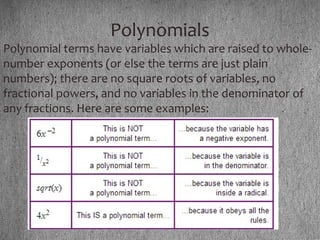
Polynomial terms have variables which are raised to whole-
number exponents (or else the terms are just plain
numbers); there are no square roots of variables, no
fractional powers, and no variables in the denominator of
any fractions. Here are some examples:
Polynomial:
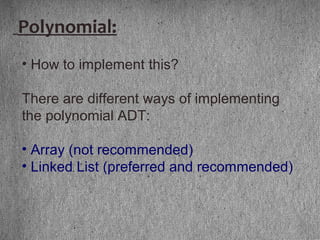
• How to implement this?
There are different ways of implementing
the polynomial ADT:
• Array (not recommended)
• Linked List (preferred and recommended)
Polynomial:
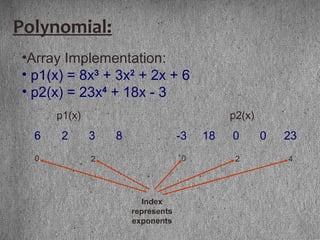
•Array Implementation:
• p1(x) = 8x3
+ 3x2
+ 2x + 6
• p2(x) = 23x4
+ 18x - 3
6 2 3 8
0 2
Index
represents
exponents
-3 18 0 0 23
0 42
p1(x) p2(x)
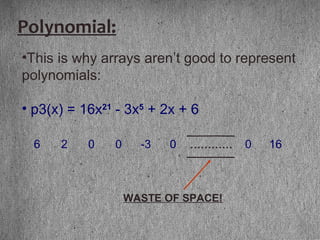
•This is why arrays aren’t good to represent
polynomials:
• p3(x) = 16x21
- 3x5
+ 2x + 6
Polynomial:
6 2 0 0 -3 0 0 16…………
WASTE OF SPACE!
• Advantages of using an Array:
• only good for non-sparse polynomials.
• ease of storage and retrieval.
• Disadvantages of using an Array:
• have to allocate array size ahead of
time.
• huge array size required for sparse
polynomials. Waste of space and runtime.
Polynomial:
• Linked list Implementation:
• p1(x) = 23x9
+ 18x7
+ 41x6
+ 163x4
+ 3
• p2(x) = 4x6
+ 10x4
+ 12x + 8
23 9 18 7 41 6 18 7 3 0
4 6 10 4 12 1 8 0
P1
P2
NODE (contains coefficient & exponent)
TAIL (contains pointer)
Polynomial:
• Advantages of using a Linked list:
• save space (don’t have to worry about
sparse polynomials) and easy to maintain
• don’t need to allocate list size and can
declare nodes (terms) only as needed
• Disadvantages of using a Linked list :
• can’t go backwards through the list
• can’t jump to the beginning of the list
from the end.
Polynomial:
SOURCE CODE:
/*Program To Demonstrate Addition And Multiplication Of Two Polynomial Expression */
#include < iostream.h >
#include < conio.h >
#define n 100
class poly
{
private:
int a[n], b[n], add[n], mul[n], p, q, at;
public:
void init ( );
void input ( );
void process ( );
void display ( );
};
void poly :: init ( )
{
int i;
for( i = 0; i < n; i + + )
a[ i ] = b [ i ] = add[ i ] = mul[ i ] = 0;
}
void poly :: input ( )
{
int i;
cout<<"nEnter Degree Of First Polynomial::";
cin>>p;
cout<<"nEnter Degree Of Second
Polynomial::";
cin>>q;
cout<<"nEnter Values First
Polynomialn";
for( i = 0; i <= p; i + + )
{
cout<<"nEnter X^"<<i<<" Th
Coefficient";
cin>>a[ i ];
}
cout<<"nEnter Values First
Polynomialn";
for( i = 0; i <= q; i + + )
{
cout<<"nEnter X^"<<i<<" Th
Coefficient";
cin>>b[ i ];
}
}
void poly :: process ( )
{
int i, j;
if( p > q )
at = p;
else
at = q;
for ( i = 0; i <= at; i + +)
add[ i ] = a[ i ] + b[ i ];
for( i = 0; i <= p; i + + )
for( j = 0; j <= q; j + + )
mul [ i + j ] + = a [ i ] * b [ j ];
}
void poly :: display ( )
{
int i;
cout<<"Addition Of Two Polynomial Expressions Arenn";
for( i = at; i >=0 ; i - -)
cout<<add[i]<<"X^"<<i<<"+";
cout<<"nnMultiplecation Of Two Polynomial Expressions Arenn";
for( i = p + q; i > = 0; i - -)
cout<<mul[i]<<"X^"<< i <<"+";
}
void main()
{
poly ob;
clrscr ( );
ob.init ( );
ob.input ( );
ob.process ( );
ob.display ( );
getch ( );
}
OUTPUT:

Sparse Matrix and Polynomial

  • 1.
    Data Structures FJWU Dept. BS SoftwareEngineering Sparse Matrix and Polynomials
  • 2.
  • 3.
    3 Sparse Matrix • A matrixis sparse if many of its elements are zero • A matrix that is not sparse is dense • The boundary is not precisely defined • Diagonal and tridiagonal matrices are sparse • We classify triangular matrices as dense • Two possible representations • array • linked list
  • 4.
    SPARSE MATRIX Sparse matrixof dimension 7 x 7. COLUMNS 0 1 2 3 4 5 6 0 0 0 0 -5 0 0 0 1 0 4 0 0 0 0 7 2 0 0 0 0 9 0 0 ROWS 3 0 3 0 2 0 0 0 4 1 0 2 0 0 0 0 5 0 0 0 0 0 0 0 6 0 0 8 0 0 0 0
  • 5.
    SOURCE CODE: /*Program todemonstrate addition and multiplication of Two Sparse Matrix */ #include < iostream.h > #include < conio.h > #define x 25 class sparce { private: int a [ x ] [ x ], b [ x ] [ x ], c [ x ] [ x ], m, n, p, q; public: void init ( ); void input ( ); void add ( ); void mul ( ); void display ( int [25][25], int, int ); void convert( int [25][25], int, int ); }; void sparce :: init ( ) { int i, j; for(i = 0; i < x;i + + ) for( j = 0; j < x; j + +) c [ i ] [ j ] = 0; }
  • 6.
    cont... void sparce ::input() { int i,j; cout<<"nEnter order Of First matrix::"; cin>>m>>n; cout<<"nEnter order Of Second matrix::"; cin>>p>>q; cout<<"nEnter"<<m*n<<"Elements Into First Matrixn"; for(i=0;i<m;i++) for( j = 0; j < n; j + + ) cin>> a[ i ] [ j ]; cout<<"nEnter"<<p*q<<"Elements Into Second Matrixn"; for(i = 0; i < p ; i + + ) for ( j = 0; j < q ; j + + ) cin>>b [ i ] [ j ]; } void sparce :: add ( ) { int i, j; if( m = = p && n = = q ) { for( i = 0 ; i < m ; i + + ) for( j = 0; j < n; j + + ) c[ i ] [ j ] = a [ i ][ j ] + b [ i ] [ j ]; convert( c, m, n); } else cout<<"nAddition Is Not Possible"; }
  • 7.
    continue... void sparce ::mul ( ) { int i, j, k; if(n = = p) { for( i = 0; i < m; i + +) for( j = 0; j < q; j + + ) for( k = 0; k < n; k + + ) c[ I ] [ j ] + = a [ I ] [ k ] * b [ k ] [ j ]; convert(c, m, n); } else cout<<"n Multiplecation Is Not Possible"; } void sparce :: display(int c[25][25], int m, int n) { int i,j; for( i = 0 ;i < m; i + + ) { for( j = 0 ; j < n ; j + + ) cout<<c [ i ] [ j ]<<"t"; cout<<"n"; } }
  • 8.
    void sparce ::convert(int c[25][25], int m, int n) { int i, j, k = 1,t = 0; int sp[25][25]; for( i = 0 ; i < m ; i + +) for( j = 0 ; j < n ; j + + ) if(c [ i ] [ j ] ! = 0 ) { sp [ k ] [ 0 ] = i; sp [ k ] [ 1 ] = j; sp [ k ] [ 2 ] = c [ i ] [ j ]; k + + ; t + + ; } sp[ 0 ] [ 0 ] = m; sp[ 0 ] [ 1 ] = n; sp[ 0 ] [ 2 ] = t; display( sp, k, 3); } void main ( ) { sparce ob; clrscr ( ); ob.init ( ); ob.input ( ); cout<<"nAddition of Two Sparce Matrixn"; ob.add ( ); ob.init ( ); cout<<"nMultiplecation Of Two Sparce Matrixn"; ob.mul ( ); getch ( ); }
  • 9.
  • 10.
    Polynomials Polynomial terms havevariables which are raised to whole- number exponents (or else the terms are just plain numbers); there are no square roots of variables, no fractional powers, and no variables in the denominator of any fractions. Here are some examples:
  • 11.
    Polynomial: • How toimplement this? There are different ways of implementing the polynomial ADT: • Array (not recommended) • Linked List (preferred and recommended)
  • 12.
    Polynomial: •Array Implementation: • p1(x)= 8x3 + 3x2 + 2x + 6 • p2(x) = 23x4 + 18x - 3 6 2 3 8 0 2 Index represents exponents -3 18 0 0 23 0 42 p1(x) p2(x)
  • 13.
    •This is whyarrays aren’t good to represent polynomials: • p3(x) = 16x21 - 3x5 + 2x + 6 Polynomial: 6 2 0 0 -3 0 0 16………… WASTE OF SPACE!
  • 14.
    • Advantages ofusing an Array: • only good for non-sparse polynomials. • ease of storage and retrieval. • Disadvantages of using an Array: • have to allocate array size ahead of time. • huge array size required for sparse polynomials. Waste of space and runtime. Polynomial:
  • 15.
    • Linked listImplementation: • p1(x) = 23x9 + 18x7 + 41x6 + 163x4 + 3 • p2(x) = 4x6 + 10x4 + 12x + 8 23 9 18 7 41 6 18 7 3 0 4 6 10 4 12 1 8 0 P1 P2 NODE (contains coefficient & exponent) TAIL (contains pointer) Polynomial:
  • 16.
    • Advantages ofusing a Linked list: • save space (don’t have to worry about sparse polynomials) and easy to maintain • don’t need to allocate list size and can declare nodes (terms) only as needed • Disadvantages of using a Linked list : • can’t go backwards through the list • can’t jump to the beginning of the list from the end. Polynomial:
  • 17.
    SOURCE CODE: /*Program ToDemonstrate Addition And Multiplication Of Two Polynomial Expression */ #include < iostream.h > #include < conio.h > #define n 100 class poly { private: int a[n], b[n], add[n], mul[n], p, q, at; public: void init ( ); void input ( ); void process ( ); void display ( ); }; void poly :: init ( ) { int i; for( i = 0; i < n; i + + ) a[ i ] = b [ i ] = add[ i ] = mul[ i ] = 0; }
  • 18.
    void poly ::input ( ) { int i; cout<<"nEnter Degree Of First Polynomial::"; cin>>p; cout<<"nEnter Degree Of Second Polynomial::"; cin>>q; cout<<"nEnter Values First Polynomialn"; for( i = 0; i <= p; i + + ) { cout<<"nEnter X^"<<i<<" Th Coefficient"; cin>>a[ i ]; } cout<<"nEnter Values First Polynomialn"; for( i = 0; i <= q; i + + ) { cout<<"nEnter X^"<<i<<" Th Coefficient"; cin>>b[ i ]; } }
  • 19.
    void poly ::process ( ) { int i, j; if( p > q ) at = p; else at = q; for ( i = 0; i <= at; i + +) add[ i ] = a[ i ] + b[ i ]; for( i = 0; i <= p; i + + ) for( j = 0; j <= q; j + + ) mul [ i + j ] + = a [ i ] * b [ j ]; } void poly :: display ( ) { int i; cout<<"Addition Of Two Polynomial Expressions Arenn"; for( i = at; i >=0 ; i - -) cout<<add[i]<<"X^"<<i<<"+"; cout<<"nnMultiplecation Of Two Polynomial Expressions Arenn"; for( i = p + q; i > = 0; i - -) cout<<mul[i]<<"X^"<< i <<"+"; }
  • 20.
    void main() { poly ob; clrscr( ); ob.init ( ); ob.input ( ); ob.process ( ); ob.display ( ); getch ( ); } OUTPUT: