Seismic Data Processing
Lecture 15
Kirchhoff Migration
Prepared by
Dr. Amin Khalil
School of Physics, USM
2014
What is Kirchhoff migration?
Kirchhoff-type migration methods are widely used in
the current oil and gas industry for both depth imaging
and iterative velocity analysis. For migrating a single
event on a single trace, a full-aperture KM smears the
event energy to all possible subsurface points in the
model space. After smearing all samples on all traces,
a KM image is obtained by stacking all individual
contributions. Both the obliquity factor and the
geometric spreading factor are compensated in the KM
algorithm.
Kirchhoff Migration of a Single Trace
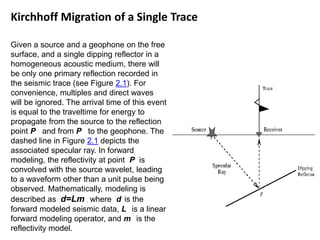
Given a source and a geophone on the free
surface, and a single dipping reflector in a
homogeneous acoustic medium, there will
be only one primary reflection recorded in
the seismic trace (see Figure 2.1). For
convenience, multiples and direct waves
will be ignored. The arrival time of this event
is equal to the traveltime for energy to
propagate from the source to the reflection
point P and from P to the geophone. The
dashed line in Figure 2.1 depicts the
associated specular ray. In forward
modeling, the reflectivity at point P is
convolved with the source wavelet, leading
to a waveform other than a unit pulse being
observed. Mathematically, modeling is
described as d=Lm , where d is the
forward modeled seismic data, L is a linear
forward modeling operator, and m is the
reflectivity model.
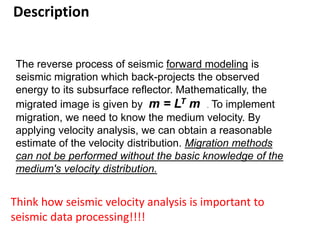
The reverse process of seismic forward modeling is
seismic migration which back-projects the observed
energy to its subsurface reflector. Mathematically, the
migrated image is given by m = LT m . To implement
migration, we need to know the medium velocity. By
applying velocity analysis, we can obtain a reasonable
estimate of the velocity distribution. Migration methods
can not be performed without the basic knowledge of the
medium's velocity distribution.
Think how seismic velocity analysis is important to
seismic data processing!!!!
Description
KM steps:
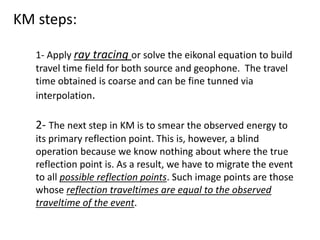
1- Apply ray tracing or solve the eikonal equation to build
travel time field for both source and geophone. The travel
time obtained is coarse and can be fine tunned via
interpolation.
2- The next step in KM is to smear the observed energy to
its primary reflection point. This is, however, a blind
operation because we know nothing about where the true
reflection point is. As a result, we have to migrate the event
to all possible reflection points. Such image points are those
whose reflection traveltimes are equal to the observed
traveltime of the event.
What is ray tracing?
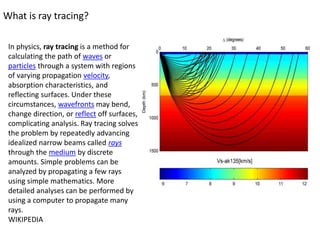
In physics, ray tracing is a method for
calculating the path of waves or
particles through a system with regions
of varying propagation velocity,
absorption characteristics, and
reflecting surfaces. Under these
circumstances, wavefronts may bend,
change direction, or reflect off surfaces,
complicating analysis. Ray tracing solves
the problem by repeatedly advancing
idealized narrow beams called rays
through the medium by discrete
amounts. Simple problems can be
analyzed by propagating a few rays
using simple mathematics. More
detailed analyses can be performed by
using a computer to propagate many
rays.
WIKIPEDIA
Realistic Example
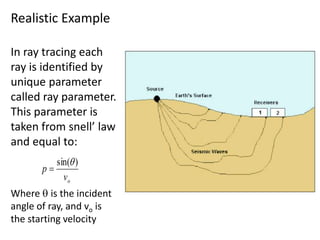
In ray tracing each
ray is identified by
unique parameter
called ray parameter.
This parameter is
taken from snell’ law
and equal to:
ov
p
)sin(

Where  is the incident
angle of ray, and vo is
the starting velocity
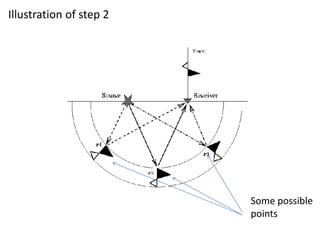
Illustration of step 2
Some possible
points
Problems With KM
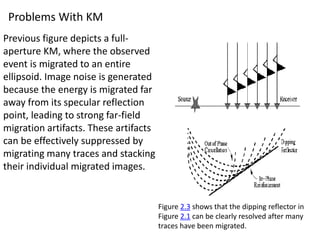
Previous figure depicts a full-
aperture KM, where the observed
event is migrated to an entire
ellipsoid. Image noise is generated
because the energy is migrated far
away from its specular reflection
point, leading to strong far-field
migration artifacts. These artifacts
can be effectively suppressed by
migrating many traces and stacking
their individual migrated images.
Figure 2.3 shows that the dipping reflector in
Figure 2.1 can be clearly resolved after many
traces have been migrated.
The problem is solved?!!!
Answer: To some extent, since some misleading
information may results in far-field artifacts!!!
This means that at far-field of the KM-ellipsoid we may
obtain false reflector, due to violation of the antiphase
criteria at certain range of the aperture.
Possible solution is to apply anti-alias filter.
More Problems
Generally, KM method is
computationally expensive,
meaning it requires large time of
computation at powerful
computers called supercomputers
or PowerStation. For post-stack
applications the method may take
days in computation. For prestack
we may need months.
3D Vs 2D
So far we were dealing with 2D seismic profile.
Again this is an approximation to the medium, in
which we assume that the physical properties
change only with spatial coordinates; namely; the
horizontal X direction and vertical Z direction.
The y direction neglected or in other words the
physical parameters is assumed constant in that
direction. Is this assumption valid for all cases?
Why 3D?!!!
Because:
1- The earth change its properties in three
dimensions.
2- In 2D we may get reflections and diffraction
from points outside the plane. Thus all our
migration will fail or become misleading.
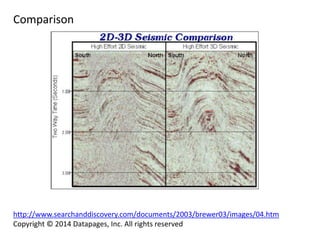
Comparison
http://www.searchanddiscovery.com/documents/2003/brewer03/images/04.htm
Copyright © 2014 Datapages, Inc. All rights reserved
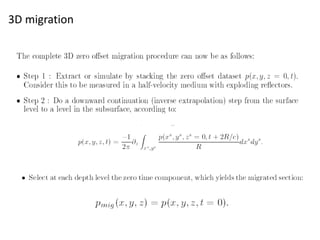
3D migration
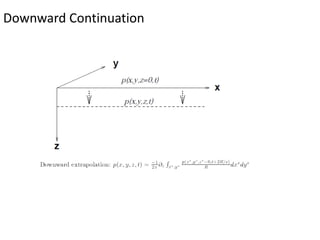
Downward Continuation
Artifact
Velocity is needed for applying 3D migration.
In the present case we need to know the
velocity change in 3D meaning with x, y and z
direction which is not feasible. In addition
using velocity which change spatially will also
complicate the problem.
Seismic data processing 15, kirchhof migration

Seismic data processing 15, kirchhof migration

  • 1.
    Seismic Data Processing Lecture15 Kirchhoff Migration Prepared by Dr. Amin Khalil School of Physics, USM 2014
  • 2.
    What is Kirchhoffmigration? Kirchhoff-type migration methods are widely used in the current oil and gas industry for both depth imaging and iterative velocity analysis. For migrating a single event on a single trace, a full-aperture KM smears the event energy to all possible subsurface points in the model space. After smearing all samples on all traces, a KM image is obtained by stacking all individual contributions. Both the obliquity factor and the geometric spreading factor are compensated in the KM algorithm.
  • 3.
    Kirchhoff Migration ofa Single Trace Given a source and a geophone on the free surface, and a single dipping reflector in a homogeneous acoustic medium, there will be only one primary reflection recorded in the seismic trace (see Figure 2.1). For convenience, multiples and direct waves will be ignored. The arrival time of this event is equal to the traveltime for energy to propagate from the source to the reflection point P and from P to the geophone. The dashed line in Figure 2.1 depicts the associated specular ray. In forward modeling, the reflectivity at point P is convolved with the source wavelet, leading to a waveform other than a unit pulse being observed. Mathematically, modeling is described as d=Lm , where d is the forward modeled seismic data, L is a linear forward modeling operator, and m is the reflectivity model.
  • 4.
    The reverse processof seismic forward modeling is seismic migration which back-projects the observed energy to its subsurface reflector. Mathematically, the migrated image is given by m = LT m . To implement migration, we need to know the medium velocity. By applying velocity analysis, we can obtain a reasonable estimate of the velocity distribution. Migration methods can not be performed without the basic knowledge of the medium's velocity distribution. Think how seismic velocity analysis is important to seismic data processing!!!! Description
  • 5.
    KM steps: 1- Applyray tracing or solve the eikonal equation to build travel time field for both source and geophone. The travel time obtained is coarse and can be fine tunned via interpolation. 2- The next step in KM is to smear the observed energy to its primary reflection point. This is, however, a blind operation because we know nothing about where the true reflection point is. As a result, we have to migrate the event to all possible reflection points. Such image points are those whose reflection traveltimes are equal to the observed traveltime of the event.
  • 6.
    What is raytracing? In physics, ray tracing is a method for calculating the path of waves or particles through a system with regions of varying propagation velocity, absorption characteristics, and reflecting surfaces. Under these circumstances, wavefronts may bend, change direction, or reflect off surfaces, complicating analysis. Ray tracing solves the problem by repeatedly advancing idealized narrow beams called rays through the medium by discrete amounts. Simple problems can be analyzed by propagating a few rays using simple mathematics. More detailed analyses can be performed by using a computer to propagate many rays. WIKIPEDIA
  • 7.
    Realistic Example In raytracing each ray is identified by unique parameter called ray parameter. This parameter is taken from snell’ law and equal to: ov p )sin(  Where  is the incident angle of ray, and vo is the starting velocity
  • 8.
    Illustration of step2 Some possible points
  • 9.
    Problems With KM Previousfigure depicts a full- aperture KM, where the observed event is migrated to an entire ellipsoid. Image noise is generated because the energy is migrated far away from its specular reflection point, leading to strong far-field migration artifacts. These artifacts can be effectively suppressed by migrating many traces and stacking their individual migrated images. Figure 2.3 shows that the dipping reflector in Figure 2.1 can be clearly resolved after many traces have been migrated.
  • 10.
    The problem issolved?!!! Answer: To some extent, since some misleading information may results in far-field artifacts!!! This means that at far-field of the KM-ellipsoid we may obtain false reflector, due to violation of the antiphase criteria at certain range of the aperture. Possible solution is to apply anti-alias filter.
  • 11.
    More Problems Generally, KMmethod is computationally expensive, meaning it requires large time of computation at powerful computers called supercomputers or PowerStation. For post-stack applications the method may take days in computation. For prestack we may need months.
  • 12.
    3D Vs 2D Sofar we were dealing with 2D seismic profile. Again this is an approximation to the medium, in which we assume that the physical properties change only with spatial coordinates; namely; the horizontal X direction and vertical Z direction. The y direction neglected or in other words the physical parameters is assumed constant in that direction. Is this assumption valid for all cases?
  • 13.
    Why 3D?!!! Because: 1- Theearth change its properties in three dimensions. 2- In 2D we may get reflections and diffraction from points outside the plane. Thus all our migration will fail or become misleading.
  • 14.
  • 15.
  • 16.
  • 17.
    Artifact Velocity is neededfor applying 3D migration. In the present case we need to know the velocity change in 3D meaning with x, y and z direction which is not feasible. In addition using velocity which change spatially will also complicate the problem.