System Approach
Dr.M.Deivam
Assistant Professor in ICT in Education
Dept. of Education
The Gandhigram Rural Institute (Deemed to be University)
Gandhigram, Dindigul district,
Tamilnadu – 624 302
Concept and Meaning of System
• The great Greek philosopher Aristotles statement,
“The whole is more than the sum of its parts”, is a
definition of the system which is still valid.
• Engineers – technological devices
• Physiologists – portions of living organisms
• Social scientists – Economic and political systems
• Philosophers – system of thought
• Educationists – Educational or instructional system
Definition
• R.L.Ackoff (1971) A system is the set of
interrelated and interdependent elements.
• A.K.Jalaluddin (1981). A system may be defined
as a dynamic, complex, integrated whole
consisting of a self-regulating pattern of
interrelated and interdependent elements that
operate in a unique way.
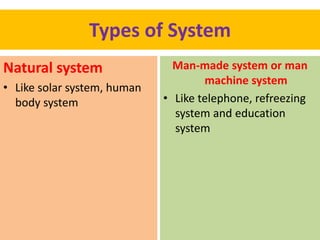
Types of System
Natural system
• Like solar system, human
body system
Man-made system or man
machine system
• Like telephone, refreezing
system and education
system
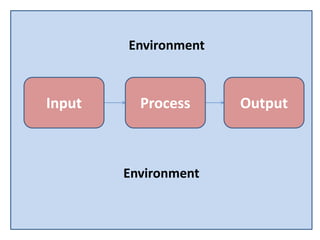
Parameters of a system
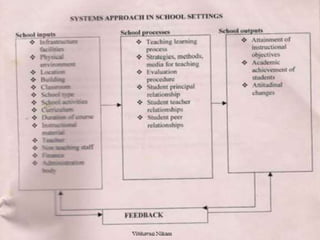
• Input refers to what is put in the system, which
comprise the human and non-human resources.
• Process refers to how a system functions, and its
various interactions and activities for attaining the
goals.
• Output is the product of the system as a
consequence of the process.
• Environmental context refers to the conditions,
factors, or constraints related with the physical
social environment in which the system operates.
Input Process Output
Environment
Environment
Contd.,
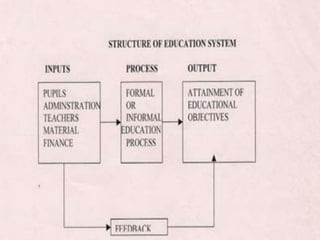
• Pupils, teachers, content, etc. are inputs
• Formal or non-formal education is the process
• Attainment of educational objectives are
output
• Social system is the environment of the
educational system
Characteristics of system
• It is applicable to various fields including education.
• It is dynamic.
• It functions as a whole and achieves better results.
• It is integrated whole comprising interrelated.
• systems have structure, defined by parts and their composition;
• Systems have behavior, which involves inputs, processing and outputs
of material;
• Systems have interconnectivity : the various parts of a system have
functional as well as structural relationships between each other.
• System(s) have by itself function(s) or group of functions .
Steps Involved in Systems Approach
System analysis
The task of analysing a system in the form of
identifying its elements, their organization, their
function or performance individually or as a whole
in order to determine the need to make
adjustments to ensure the achievement of system,
namely input, process, output and environmental
constraints. It helps to designer of the system
identify the constraints that interfere in the
attainment of system objectives.
Contd.,
System Design and Development
The systems design and development is related with
the task of synthesizing. The following activities
undertaken in this step
• Determination of the objectives of a system
• Selection of appropriate devices, methods,
strategies and approaches
• Formulating a scheme of comprehensive
programmes for the working of the system in
relation to its parameters and the stipulated
objectives.
Contd.,
System operation and Evaluation
System operation and evaluation is concerned with
the actual operation of a system and its evaluation
in terms of the stipulated objectives for providing
necessary feedback to bring desirable improvement
and modification in the structure and functioning of
the system. If the output of a system meet the
expectations or requirements of the stipulated
objectives or norms, the system can be allowed to
carry on. The need for brining necessary alternation
or improvement in the system.
Application of System approach to
classroom instruction
• It can effectively improve the instructional system
• It can bring efficiency in the school administration
and management
• It may help in seeking the maximum effective
utilization f the men and material resources
• A systematic educational planning (institutional,
regional or national) in terms of long-range goals
and specific short range objective can be done by
it.
Cont.,
• It may help in improving the examination and
evaluation system
• Improvement in the organization of co-curricular
activities and other educational aspects of bringing
behavior and affective development of the pupils can
be brought.
• It may help in maintaining, controlling and improving
the guidance services of the schools.
• It may help in improving the training and development
programmes, e.g. the training of teachers (pre-service
and in-service) may be effectively improved
Cont.,
• It may prove an invaluable means for designing,
controlling and improving the systems of non-
informal and adult education
• Over and above, it may render valuable services in
improving the quality of education in all its
aspects and dimension.
System approach

System approach

  • 1.
    System Approach Dr.M.Deivam Assistant Professorin ICT in Education Dept. of Education The Gandhigram Rural Institute (Deemed to be University) Gandhigram, Dindigul district, Tamilnadu – 624 302
  • 2.
    Concept and Meaningof System • The great Greek philosopher Aristotles statement, “The whole is more than the sum of its parts”, is a definition of the system which is still valid. • Engineers – technological devices • Physiologists – portions of living organisms • Social scientists – Economic and political systems • Philosophers – system of thought • Educationists – Educational or instructional system
  • 3.
    Definition • R.L.Ackoff (1971)A system is the set of interrelated and interdependent elements. • A.K.Jalaluddin (1981). A system may be defined as a dynamic, complex, integrated whole consisting of a self-regulating pattern of interrelated and interdependent elements that operate in a unique way.
  • 4.
    Types of System Naturalsystem • Like solar system, human body system Man-made system or man machine system • Like telephone, refreezing system and education system
  • 5.
    Parameters of asystem • Input refers to what is put in the system, which comprise the human and non-human resources. • Process refers to how a system functions, and its various interactions and activities for attaining the goals. • Output is the product of the system as a consequence of the process. • Environmental context refers to the conditions, factors, or constraints related with the physical social environment in which the system operates.
  • 6.
  • 8.
    Contd., • Pupils, teachers,content, etc. are inputs • Formal or non-formal education is the process • Attainment of educational objectives are output • Social system is the environment of the educational system
  • 10.
    Characteristics of system •It is applicable to various fields including education. • It is dynamic. • It functions as a whole and achieves better results. • It is integrated whole comprising interrelated. • systems have structure, defined by parts and their composition; • Systems have behavior, which involves inputs, processing and outputs of material; • Systems have interconnectivity : the various parts of a system have functional as well as structural relationships between each other. • System(s) have by itself function(s) or group of functions .
  • 11.
    Steps Involved inSystems Approach System analysis The task of analysing a system in the form of identifying its elements, their organization, their function or performance individually or as a whole in order to determine the need to make adjustments to ensure the achievement of system, namely input, process, output and environmental constraints. It helps to designer of the system identify the constraints that interfere in the attainment of system objectives.
  • 12.
    Contd., System Design andDevelopment The systems design and development is related with the task of synthesizing. The following activities undertaken in this step • Determination of the objectives of a system • Selection of appropriate devices, methods, strategies and approaches • Formulating a scheme of comprehensive programmes for the working of the system in relation to its parameters and the stipulated objectives.
  • 13.
    Contd., System operation andEvaluation System operation and evaluation is concerned with the actual operation of a system and its evaluation in terms of the stipulated objectives for providing necessary feedback to bring desirable improvement and modification in the structure and functioning of the system. If the output of a system meet the expectations or requirements of the stipulated objectives or norms, the system can be allowed to carry on. The need for brining necessary alternation or improvement in the system.
  • 14.
    Application of Systemapproach to classroom instruction • It can effectively improve the instructional system • It can bring efficiency in the school administration and management • It may help in seeking the maximum effective utilization f the men and material resources • A systematic educational planning (institutional, regional or national) in terms of long-range goals and specific short range objective can be done by it.
  • 15.
    Cont., • It mayhelp in improving the examination and evaluation system • Improvement in the organization of co-curricular activities and other educational aspects of bringing behavior and affective development of the pupils can be brought. • It may help in maintaining, controlling and improving the guidance services of the schools. • It may help in improving the training and development programmes, e.g. the training of teachers (pre-service and in-service) may be effectively improved
  • 16.
    Cont., • It mayprove an invaluable means for designing, controlling and improving the systems of non- informal and adult education • Over and above, it may render valuable services in improving the quality of education in all its aspects and dimension.