Local Knowledge (स्थानीय ज्ञान)
and
Universal Knowledge (सार्वभौमिक ज्ञान)
Dr. Deivam M
Assistant Professor
Department of Education
H.N.B Garhwal University
(A Central University)
S.R.T Campus, Tehri Garhwal
Uttarakhand – 249 199
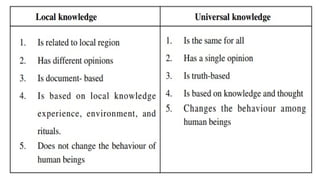
Local knowledge
It refers to information or understanding specific to a particular
state, community, or region.
It evolves over time within a given community and continues to
grow.
It is rooted in practical common sense, shaped by teachings and
experiences handed down through generations.
Known by other terms such as traditional knowledge or
indigenous knowledge.
Types of Local Knowledge
1. Common Knowledge:
o Known by most people in a community.
o Example: Cooking the local food.
2. Shared Knowledge:
o Known by many but not all members of the community.
3. Specialized Knowledge:
o Possessed by only a few individuals with special training or experience.
o Examples: Villagers trained as healers, midwives, or blacksmiths.
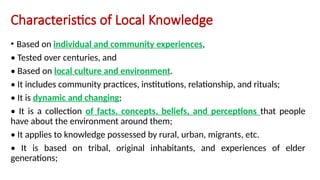
Characteristics of Local Knowledge
• Based on individual and community experiences,
• Tested over centuries, and
• Based on local culture and environment.
• It includes community practices, institutions, relationship, and rituals;
• It is dynamic and changing;
• It is a collection of facts, concepts, beliefs, and perceptions that people
have about the environment around them;
• It applies to knowledge possessed by rural, urban, migrants, etc.
• It is based on tribal, original inhabitants, and experiences of elder
generations;
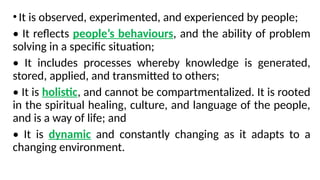
•It is observed, experimented, and experienced by people;
• It reflects people’s behaviours, and the ability of problem
solving in a specific situation;
• It includes processes whereby knowledge is generated,
stored, applied, and transmitted to others;
• It is holistic, and cannot be compartmentalized. It is rooted
in the spiritual healing, culture, and language of the people,
and is a way of life; and
• It is dynamic and constantly changing as it adapts to a
changing environment.
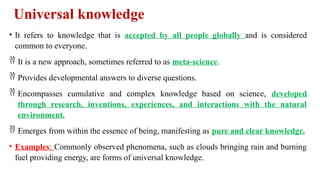
Universal knowledge
• It refers to knowledge that is accepted by all people globally and is considered
common to everyone.
 It is a new approach, sometimes referred to as meta-science.
 Provides developmental answers to diverse questions.
 Encompasses cumulative and complex knowledge based on science, developed
through research, inventions, experiences, and interactions with the natural
environment.
 Emerges from within the essence of being, manifesting as pure and clear knowledge.
• Examples: Commonly observed phenomena, such as clouds bringing rain and burning
fuel providing energy, are forms of universal knowledge.
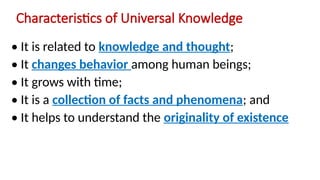
Characteristics of Universal Knowledge
• It is related to knowledge and thought;
• It changes behavior among human beings;
• It grows with time;
• It is a collection of facts and phenomena; and
• It helps to understand the originality of existence
References
•Knowledge and Curriculum.(2019). Mangalore
University. https://www.mangaloreuniversity.ac.in/site
s/default/files/2019/Course%20-%209%20Knowledge
%20%26%20Curriculum%20(English
%20Version).pdf
https://prakasheducationblog.wordpress.com/2021/02/0
3/universal-and-local-facets-of-knowledge/
Thank You

The Local Knowledge and Universal Knowledge

  • 1.
    Local Knowledge (स्थानीयज्ञान) and Universal Knowledge (सार्वभौमिक ज्ञान) Dr. Deivam M Assistant Professor Department of Education H.N.B Garhwal University (A Central University) S.R.T Campus, Tehri Garhwal Uttarakhand – 249 199
  • 2.
    Local knowledge It refersto information or understanding specific to a particular state, community, or region. It evolves over time within a given community and continues to grow. It is rooted in practical common sense, shaped by teachings and experiences handed down through generations. Known by other terms such as traditional knowledge or indigenous knowledge.
  • 3.
    Types of LocalKnowledge 1. Common Knowledge: o Known by most people in a community. o Example: Cooking the local food. 2. Shared Knowledge: o Known by many but not all members of the community. 3. Specialized Knowledge: o Possessed by only a few individuals with special training or experience. o Examples: Villagers trained as healers, midwives, or blacksmiths.
  • 4.
    Characteristics of LocalKnowledge • Based on individual and community experiences, • Tested over centuries, and • Based on local culture and environment. • It includes community practices, institutions, relationship, and rituals; • It is dynamic and changing; • It is a collection of facts, concepts, beliefs, and perceptions that people have about the environment around them; • It applies to knowledge possessed by rural, urban, migrants, etc. • It is based on tribal, original inhabitants, and experiences of elder generations;
  • 5.
    •It is observed,experimented, and experienced by people; • It reflects people’s behaviours, and the ability of problem solving in a specific situation; • It includes processes whereby knowledge is generated, stored, applied, and transmitted to others; • It is holistic, and cannot be compartmentalized. It is rooted in the spiritual healing, culture, and language of the people, and is a way of life; and • It is dynamic and constantly changing as it adapts to a changing environment.
  • 6.
    Universal knowledge • Itrefers to knowledge that is accepted by all people globally and is considered common to everyone.  It is a new approach, sometimes referred to as meta-science.  Provides developmental answers to diverse questions.  Encompasses cumulative and complex knowledge based on science, developed through research, inventions, experiences, and interactions with the natural environment.  Emerges from within the essence of being, manifesting as pure and clear knowledge. • Examples: Commonly observed phenomena, such as clouds bringing rain and burning fuel providing energy, are forms of universal knowledge.
  • 7.
    Characteristics of UniversalKnowledge • It is related to knowledge and thought; • It changes behavior among human beings; • It grows with time; • It is a collection of facts and phenomena; and • It helps to understand the originality of existence
  • 9.
    References •Knowledge and Curriculum.(2019).Mangalore University. https://www.mangaloreuniversity.ac.in/site s/default/files/2019/Course%20-%209%20Knowledge %20%26%20Curriculum%20(English %20Version).pdf https://prakasheducationblog.wordpress.com/2021/02/0 3/universal-and-local-facets-of-knowledge/
  • 10.