IMPROVISED AIDS
Prepared by
Dr. Harikrishnan M & Sajithamol K.
CPAS CTE Nedumkandam
Kerala
Improvised Aids Definition
Oxford (2000) defines improvisation as using
whatever is available because one does not have
what is really needed. Ibeneme sees it as using
alternative materials and resources to facilitate
learning whenever there is lack or shortage of some
first hand teaching aids. In common language
they are home made apparatus to aid teaching
DEFINITION
The apparatus devised and
made in the laboratory
workshop or school by the
teacher or the pupils is
usually called as improvised
aids.This increases science
learning
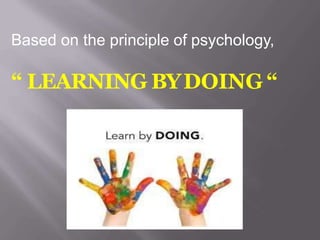
Based on the principle of psychology,
“ LEARNING BYDOING “
Improvised aids are,
Used in the absence of the
real, original or delicate objects.
Bring about some learning effect
that the real or complicated materials.
Materials can be invented or
produced from readily available
materials within the local
environment.Thus it is an
indigenous, curiosity arising
homemade apparatus.Many of
them are often developed by
teachers, students or both of them
by mutual cooperation
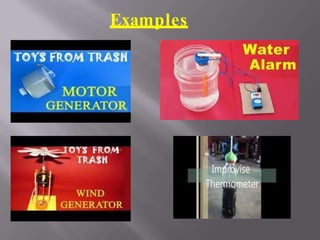
EXAMPLES
Homemade torch
Examples
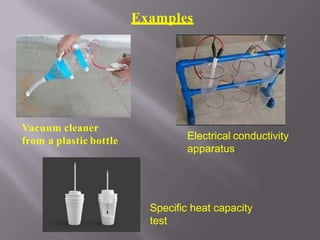
Examples
Air capacitor
Examples
Vacuum cleaner
from a plastic bottle Electrical conductivity
apparatus
Specific heat capacity
test
Enthusiastic, resourceful
science teacher with some
ingenuity and manual skill is
necessary.
Valuable and serviceable articles
from,
Tin cans
Wire from discarded
devices, motors, pumps,
bolts……
wireless sets, old
clocks, gramophones.
Some of the materials that can be easily
made in laboratory,
Test tube stands
Test tube holders
Inclined planes
Pulleys
Models of pumps
Newton's discs
Pinhole camera
Voltaic cell
Electric bell
Importance of Improvised aids
Motivation
Clarification
Attention and interest
Discouragement of cramming
Direct experience
Classroom live and active
Increase the vocabulary
Characteristics
Meaningful and purposeful
Accurate in every aspect
Simple
Cheap
Up-to-date
According to the mental level of students
Motivate the learners
Engross them in work
Avoid dullness
ADVANTAGES
Economical (Saves time, money
and effort)
Develops correlation of work
Develops skills in learning
Application of science to everyday
life
Introduce variety into nature of
experiments
Continues……
Use of senses to maxima level
Fixing and recalling the
knowledge
Meeting the individual differences
Development of scientific attitude
Appreciate the works and
difficulties of great scientists.
Improvised