sof and Har approach with easiy approacheable ideas.pptx
1.
APPROACHES TO EDUCATIONALTECHNOLOGY
SOFTWARE APPROACH
WHAT IS SOFTWARE?
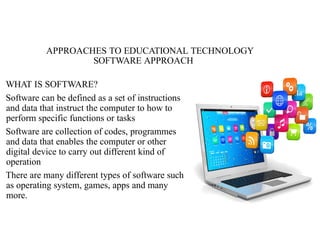
Software can be defined as a set of instructions
and data that instruct the computer to how to
perform specific functions or tasks
Software are collection of codes, programmes
and data that enables the computer or other
digital device to carry out different kind of
operation
There are many different types of software such
as operating system, games, apps and many
more.
2.
SOFTWARE APPROACH
Softwareapproach is also termed as Instructional technology or teaching
technology or behavioural technology
Software approach help to construct clear guidelines for
instruction, behaviour modification techniques and behaviour
teaching methods.
Software approach is basically uses process-oriented approach
It refers to the application of teaching and learning technique to
guide and shape students conduct in accordance with societal norms.
3.
SOFTWARE APPROACH
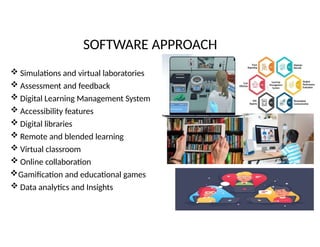
Simulationsand virtual laboratories
Assessment and feedback
Digital Learning Management System
Accessibility features
Digital libraries
Remote and blended learning
Virtual classroom
Online collaboration
Gamification and educational games
Data analytics and Insights
4.
APPROACHES TO EDUCATIONALTECHNOLOGY:
HARDWARE APPROACH
WHAT IS HARDWARE?
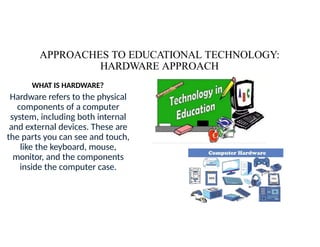
Hardware refers to the physical
components of a computer
system, including both internal
and external devices. These are
the parts you can see and touch,
like the keyboard, mouse,
monitor, and the components
inside the computer case.
5.
HARDWARE APPROACH
Characteristics ofHardware Approach
• High speed and performance.
• Involves physical devices.
• Less flexible than software.
• Power-efficient and reliable.
• Supports real-time instruction.
6.
HARDWARE APPROACH
Enhancing LearningExperience
Facilitating Effective Teaching
Promoting Digital Literacy
Access to Resources
Supporting Different
Learning Style
7.
APPROACHES TO EDUCATIONAL
TECHNOLOGY:SYSTEM APPROACH
WHAT IS SYSTEM APPROACH?
The system approach is an effective
approach of educational technology.
System approach was introduced
during Second World War. Since then it
has particularly influenced the
management decisions of industry,
government, military and business
sectors. System refers to a fixed
method. In fact, system approach is a
thorough analysis of a system or
subsystem. This term is system
analysis .
8.
There are threeimportant
things in system analysis -
1. System thinking
2. system analysis
3. system
System has three parts -
1. Goal - It give the
knowledge of what to do
and why.
2. Process - It consists of
various and activities.
3. Contents - It is related
to sub- parts of a system.
9.
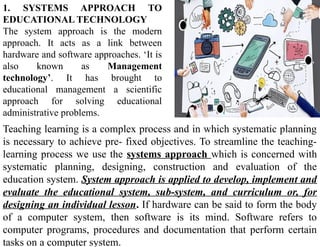
1. SYSTEMS APPROACHTO
EDUCATIONAL TECHNOLOGY
The system approach is the modern
approach. It acts as a link between
hardware and software approaches. ‘It is
also known as Management
technology’. It has brought to
educational management a scientific
approach for solving educational
administrative problems.
Teaching learning is a complex process and in which systematic planning
is necessary to achieve pre- fixed objectives. To streamline the teaching-
learning process we use the systems approach which is concerned with
systematic planning, designing, construction and evaluation of the
education system. System approach is applied to develop, implement and
evaluate the educational system, sub-system, and curriculum or, for
designing an individual lesson. If hardware can be said to form the body
of a computer system, then software is its mind. Software refers to
computer programs, procedures and documentation that perform certain
tasks on a computer system.
10.
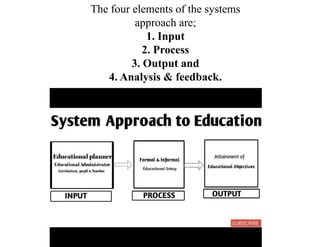
The four elementsof the systems
approach are;
1. Input
2. Process
3. Output and
4. Analysis & feedback.
11.
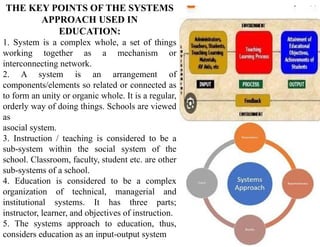
THE KEY POINTSOF THE SYSTEMS
APPROACH USED IN
EDUCATION:
1. System is a complex whole, a set of things
working together as a mechanism or
interconnecting network.
2. A system is an arrangement of
components/elements so related or connected as
to form an unity or organic whole. It is a regular,
orderly way of doing things. Schools are viewed
as
asocial system.
3. Instruction / teaching is considered to be a
sub-system within the social system of the
school. Classroom, faculty, student etc. are other
sub-systems of a school.
4. Education is considered to be a complex
organization of technical, managerial and
institutional systems. It has three parts;
instructor, learner, and objectives of instruction.
5. The systems approach to education, thus,
considers education as an input-output system
12.
Advantages of Systemapproach
A system approach helps to
identify the suitability of the resource
material to achieve the
specific goal.
Technological advances could be
used to provide integration of machines,
media, and
People for attaining the defined goal.
It helps to assess the resource
needs, their sources and facilities in
relation to quantities,
Time, and others factors.
It permits an orderly introduction
of components demonstrated to be
required for systems
success in terms of student learning.
It avoids rigidity in the plan of
action as continuous evaluation affords
desired beneficial changes to be
made.
13.
Limitations of thesystem
approach
Resistance to change.
Old ways are difficult to
erase.
Involves to hard work.
System approach requires
hard continuous work on the part
of school personnel.
Some are not prepared for
an extra load.
Lack of understanding.
Teachers and administrators are
still not familiar with the system
approach.
Though it has been successfully
implemented in industry,