Contextual and Textual Knowledge
Dr. Deivam M
Assistant Professor
Department of Education
H.N.B Garhwal University
(A Central University)
S.R.T Campus, Tehri Garhwal
Uttarakhand – 249 199
Context
• Circumstances forming the background of an event, idea,
or statement.
• Enables understanding of information.
• Gives meaning and relevance to events/happenings.
•Physical Context – The environment where an event occurs.
•Cultural Context – Shared beliefs, traditions, and values.
•Historical Context – Time period influencing an event or idea.
•Social Context – Interactions and relationships within a society.
•Political Context – Governance, laws, and power dynamics.
Contextual Knowledge
•Knowledge in context, information or skills that have
particular meaning because of the conditions that
form part of their descriptions.
•Knowledge acquired during an incident that provides
information about the development of the event is
contextual knowledge.
• Contextual knowledge is knowledge on specific and
general events, situations, or general content of an
event/text.
Contextual Knowledge is Related to School
Knowledge
• Importance of Context: It involves understanding "who, what,
and where," as well as factors like the socio-economic status and
cultural background of students. Teachers should consider these
factors to provide meaningful contextual knowledge.
• Learning by Doing: Contextual knowledge includes hands-on and
experiential learning, where students are actively engaged in the
learning process.
Contd.,
•Collaborative Learning: Teamwork, discussions,
cooperation, and self-reflection are emphasized as
effective methods for acquiring contextual knowledge.
•Link to School Knowledge: By integrating these practices,
students gain a deeper understanding and greater
willingness to learn, thereby bridging contextual
knowledge with formal school knowledge.
Characteristics of Contextual Knowledge
• It is related to the context of information;
• The context gives meaning to a situation or event;
• Connectedness within and outside society, it is a linkage
between individual and groups and organizations;
• Relationship between factors leads to knowledge;
• Relates classroom subjects to everyday life;
• Knowledge may extend beyond the boundaries of
conventional classrooms;
• High order thinking and problem-solving skills are
encouraged.
Textual Knowledge
• Text refers to written words, a primary method of storing knowledge.
• The term "textual" pertains to anything related to or derived from a
text, often used in disciplines like religion, literature, science, and law.
• Textual Knowledge: It encompasses understanding textual content,
codes, conventions, forms, and their social context.
• It emphasizes reading, teaching, and researching to preserve
knowledge in written form and supports grammatical comprehension.
Contd.,
•Role in Knowledge Storage: Textual form is a primary
medium for recording ideas and information, from personal
thoughts to vast repositories like newspapers and
textbooks.
•Application in Education: Textual knowledge is
foundational in education, aiding in the understanding of
various subjects, particularly languages, history, literature,
science, and mathematics.
Characteristics of Textual Knowledge
•It is a major source in teaching and learning;
• It provides logic and comprehensiveness to information;
• It provides more knowledge;
• It provides direct and indirect experiences;
• It provides textual evidences to support an idea or to
answer a question;
• It enhances the appropriateness of the information;
• It arouses interest in students to acquire more information;
• It involves students in higher level thinking, problem solving
activities, and extending activities, which lead to acquire more
information;
• It is a source of information to both teachers and students;
• It is used in formal and informal education;
• It is helpful to students in self-learning;
• It makes students to think deeply about the text, source, and the
authors; and
• As a source of knowledge, it is readily available to teacher and
students.
Contextual
References
•Knowledge and Curriculum.(2019). Mangalore
University. https://www.mangaloreuniversity.ac.in/site
s/default/files/2019/Course%20-%209%20Knowledge
%20%26%20Curriculum%20(English
%20Version).pdf
•https://prepwithharshita.com/difference-between-conte
xtual-and-textual-knowledge/
Thank You

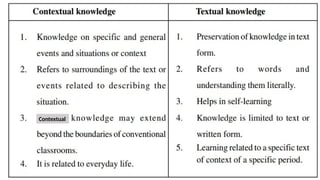
Contextual Knowledge ; Textual Knowledge

  • 1.
    Contextual and TextualKnowledge Dr. Deivam M Assistant Professor Department of Education H.N.B Garhwal University (A Central University) S.R.T Campus, Tehri Garhwal Uttarakhand – 249 199
  • 2.
    Context • Circumstances formingthe background of an event, idea, or statement. • Enables understanding of information. • Gives meaning and relevance to events/happenings. •Physical Context – The environment where an event occurs. •Cultural Context – Shared beliefs, traditions, and values. •Historical Context – Time period influencing an event or idea. •Social Context – Interactions and relationships within a society. •Political Context – Governance, laws, and power dynamics.
  • 3.
    Contextual Knowledge •Knowledge incontext, information or skills that have particular meaning because of the conditions that form part of their descriptions. •Knowledge acquired during an incident that provides information about the development of the event is contextual knowledge. • Contextual knowledge is knowledge on specific and general events, situations, or general content of an event/text.
  • 4.
    Contextual Knowledge isRelated to School Knowledge • Importance of Context: It involves understanding "who, what, and where," as well as factors like the socio-economic status and cultural background of students. Teachers should consider these factors to provide meaningful contextual knowledge. • Learning by Doing: Contextual knowledge includes hands-on and experiential learning, where students are actively engaged in the learning process.
  • 5.
    Contd., •Collaborative Learning: Teamwork,discussions, cooperation, and self-reflection are emphasized as effective methods for acquiring contextual knowledge. •Link to School Knowledge: By integrating these practices, students gain a deeper understanding and greater willingness to learn, thereby bridging contextual knowledge with formal school knowledge.
  • 6.
    Characteristics of ContextualKnowledge • It is related to the context of information; • The context gives meaning to a situation or event; • Connectedness within and outside society, it is a linkage between individual and groups and organizations; • Relationship between factors leads to knowledge; • Relates classroom subjects to everyday life; • Knowledge may extend beyond the boundaries of conventional classrooms; • High order thinking and problem-solving skills are encouraged.
  • 7.
    Textual Knowledge • Textrefers to written words, a primary method of storing knowledge. • The term "textual" pertains to anything related to or derived from a text, often used in disciplines like religion, literature, science, and law. • Textual Knowledge: It encompasses understanding textual content, codes, conventions, forms, and their social context. • It emphasizes reading, teaching, and researching to preserve knowledge in written form and supports grammatical comprehension.
  • 8.
    Contd., •Role in KnowledgeStorage: Textual form is a primary medium for recording ideas and information, from personal thoughts to vast repositories like newspapers and textbooks. •Application in Education: Textual knowledge is foundational in education, aiding in the understanding of various subjects, particularly languages, history, literature, science, and mathematics.
  • 9.
    Characteristics of TextualKnowledge •It is a major source in teaching and learning; • It provides logic and comprehensiveness to information; • It provides more knowledge; • It provides direct and indirect experiences; • It provides textual evidences to support an idea or to answer a question; • It enhances the appropriateness of the information;
  • 10.
    • It arousesinterest in students to acquire more information; • It involves students in higher level thinking, problem solving activities, and extending activities, which lead to acquire more information; • It is a source of information to both teachers and students; • It is used in formal and informal education; • It is helpful to students in self-learning; • It makes students to think deeply about the text, source, and the authors; and • As a source of knowledge, it is readily available to teacher and students.
  • 11.
  • 12.
    References •Knowledge and Curriculum.(2019).Mangalore University. https://www.mangaloreuniversity.ac.in/site s/default/files/2019/Course%20-%209%20Knowledge %20%26%20Curriculum%20(English %20Version).pdf •https://prepwithharshita.com/difference-between-conte xtual-and-textual-knowledge/
  • 13.