A SYSTEMS APPROACH TO
INSTRUCTONAL DESIGN
PROFESSOR D.K AKANBI
BY
Objectives
This session is primarily
• to build on the exposure through colloquium presentations
on systems thinking particularly as it relates to one of our
cardinal tripartite university responsibilities-Teaching. Put
simply how could we apply systems thinking to instruction?
• to sensitize on the need to re-examine our instructional plan
and delivery system based on systems thinking for more
efficiency and effectiveness using empirically-tested
pedagogical principles.
Objectives-- 2
• to discuss and share our professional experiences
with respect to viability of an application of
systems thinking to teaching and learning.
Rationale
Research studies have established the fact that
learners/trainees acquire and retain knowledge and
skills and even perform significantly better when the
delivery of content/pedagogy is diversified and enriched
with human and non-human resources than those
without them (Akanbi,1988;Agun,1988, Ajayi-Dopemu,
1989, Akinyemi,1989; Reiser & Dempsey, 2012)
INTRODUCTION
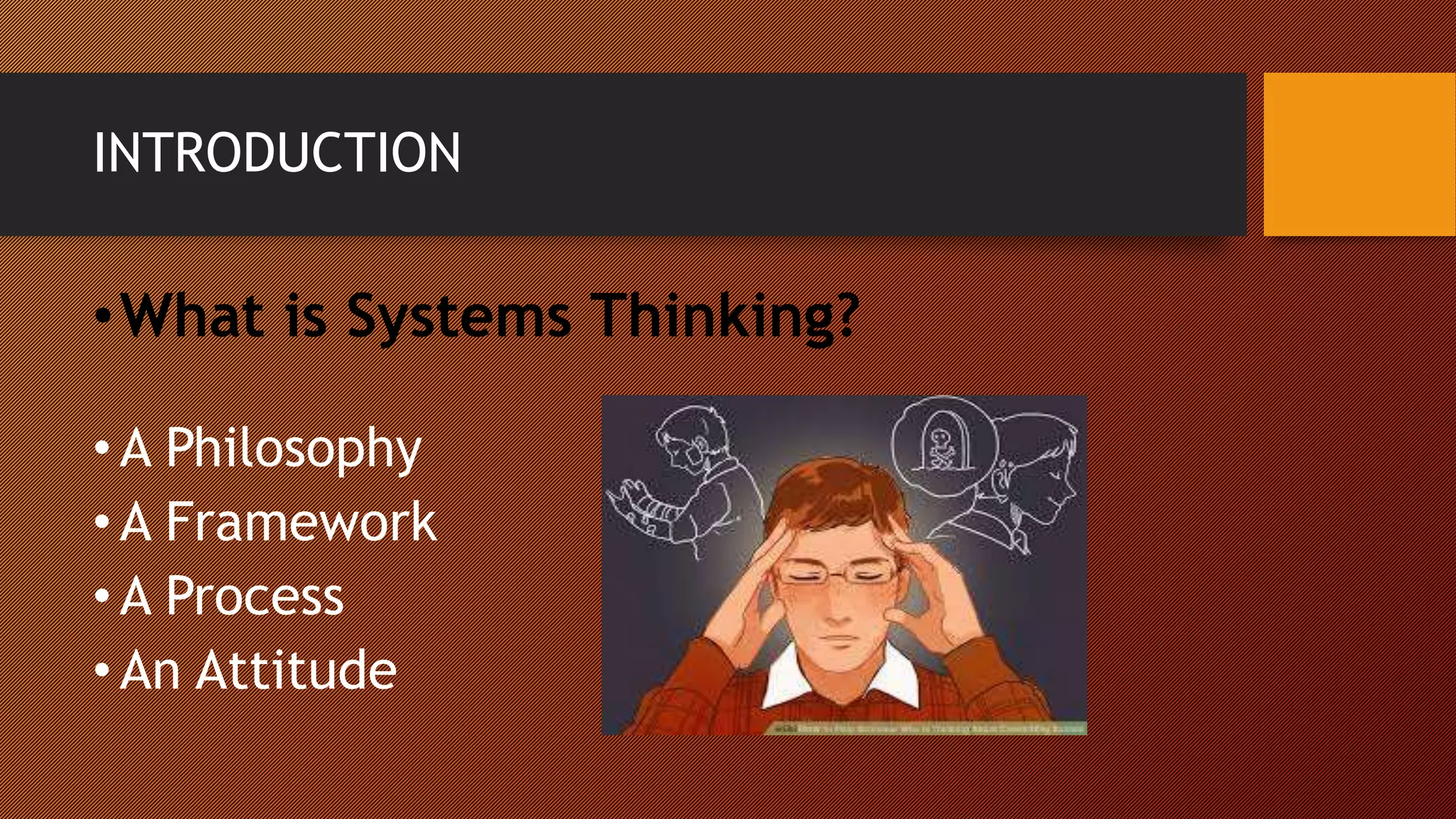
•What is Systems Thinking?
•A Philosophy
•A Framework
•A Process
•An Attitude
What is a System?
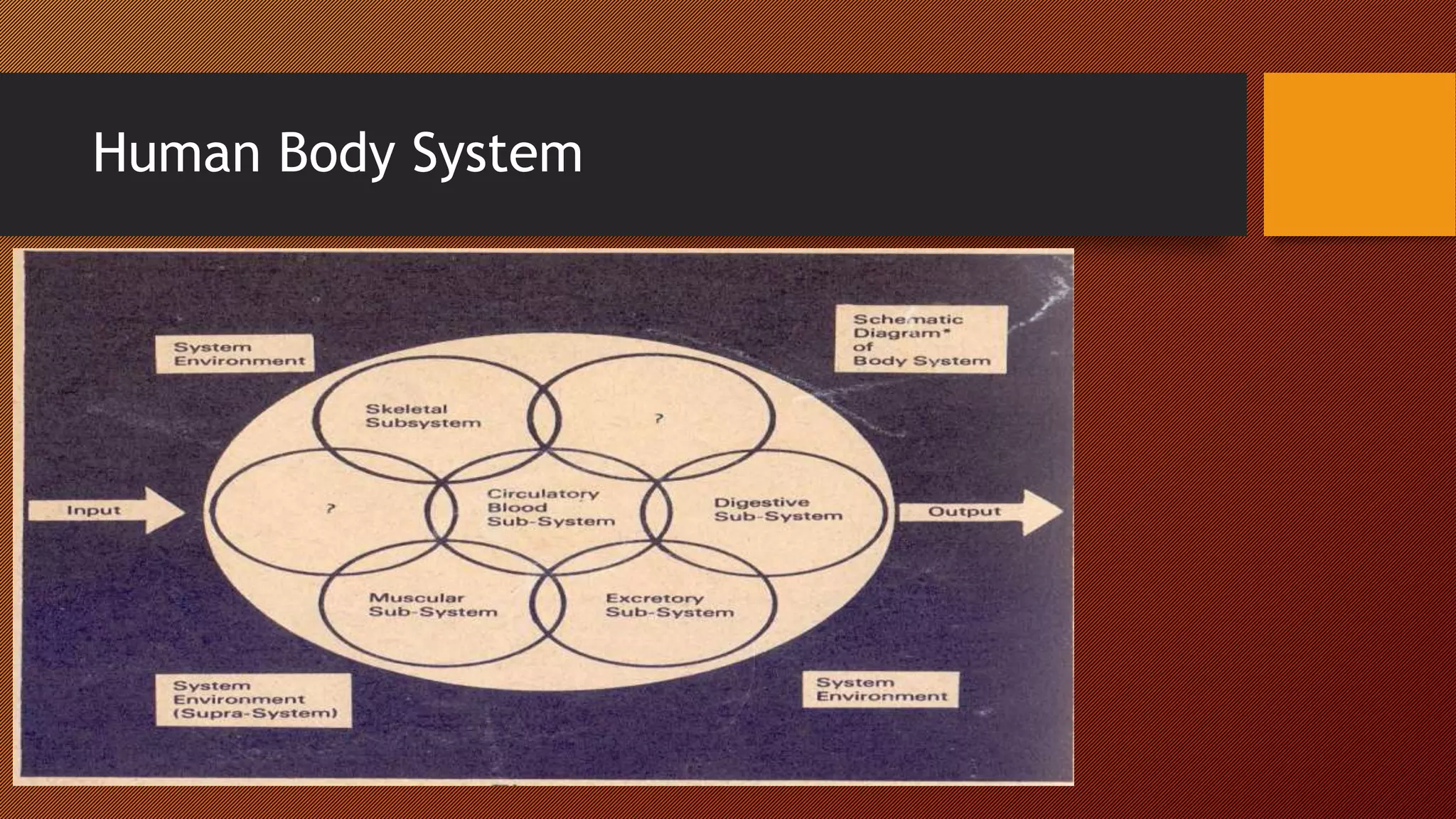
System is an event/object/process made up of parts/elements
that are co-operatively working together for a predetermined
purpose. The parts are mutually interdependent and
functionally related. While a system has an arbitrary boundary
which encloses sub-systems- the component parts. Examples
are body system, car, queuing procedure in the bank, eco-
system, a nation (Nigeria, Brazil).
Within any System are sub-systems while beyond the boundary
of a system is a supra-system i.e. its environment
What is a System? --2
• Any defect in any of the sub-system will affect
the other sub-systems and the whole system.
• Any system is greater than the sum of its
components.
Attributes of A System
• System, Sub-system, Supra-system (Organic whole or organism)
• Interdependence
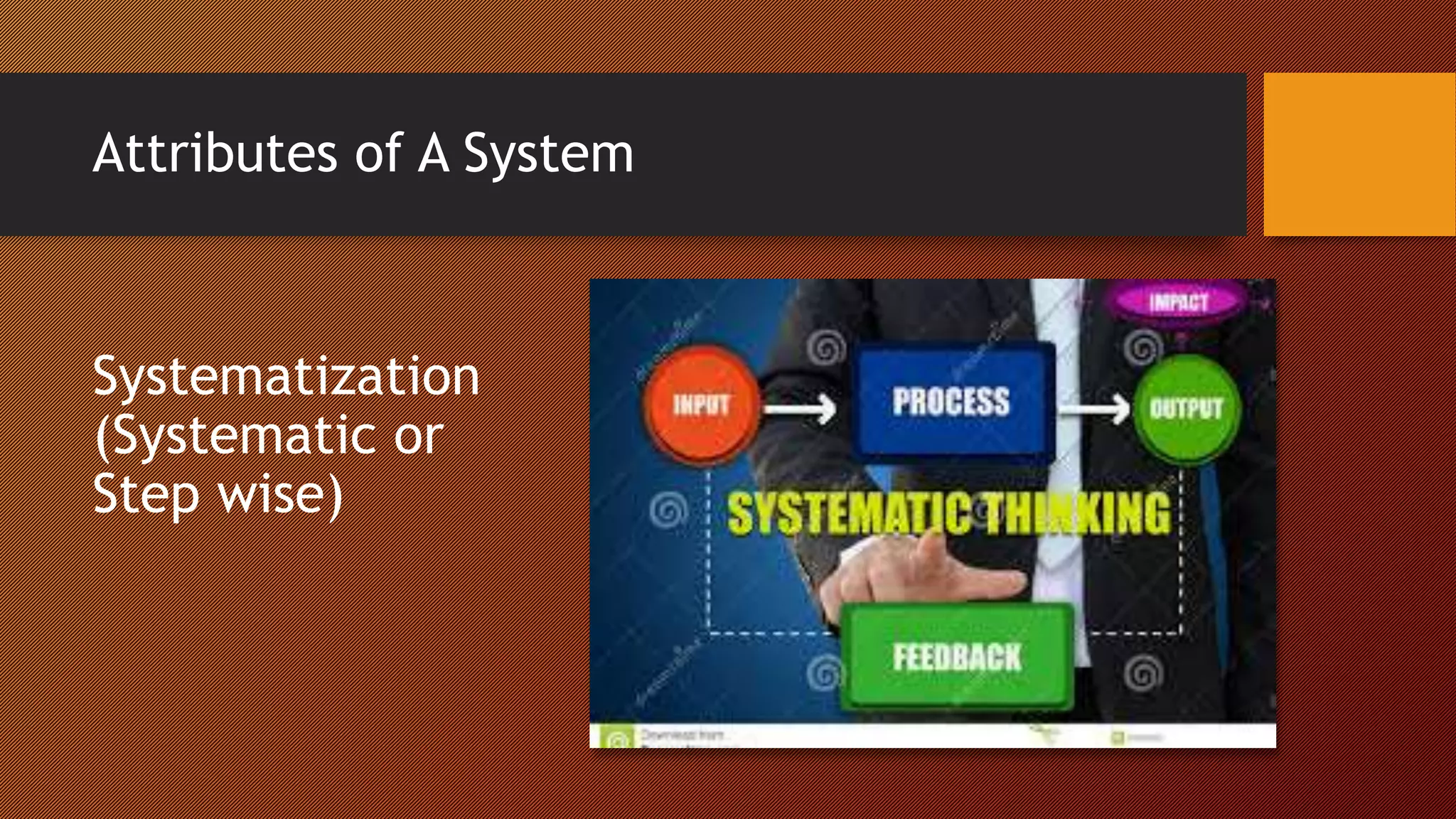
• Systematization (Systematic or Step wise)
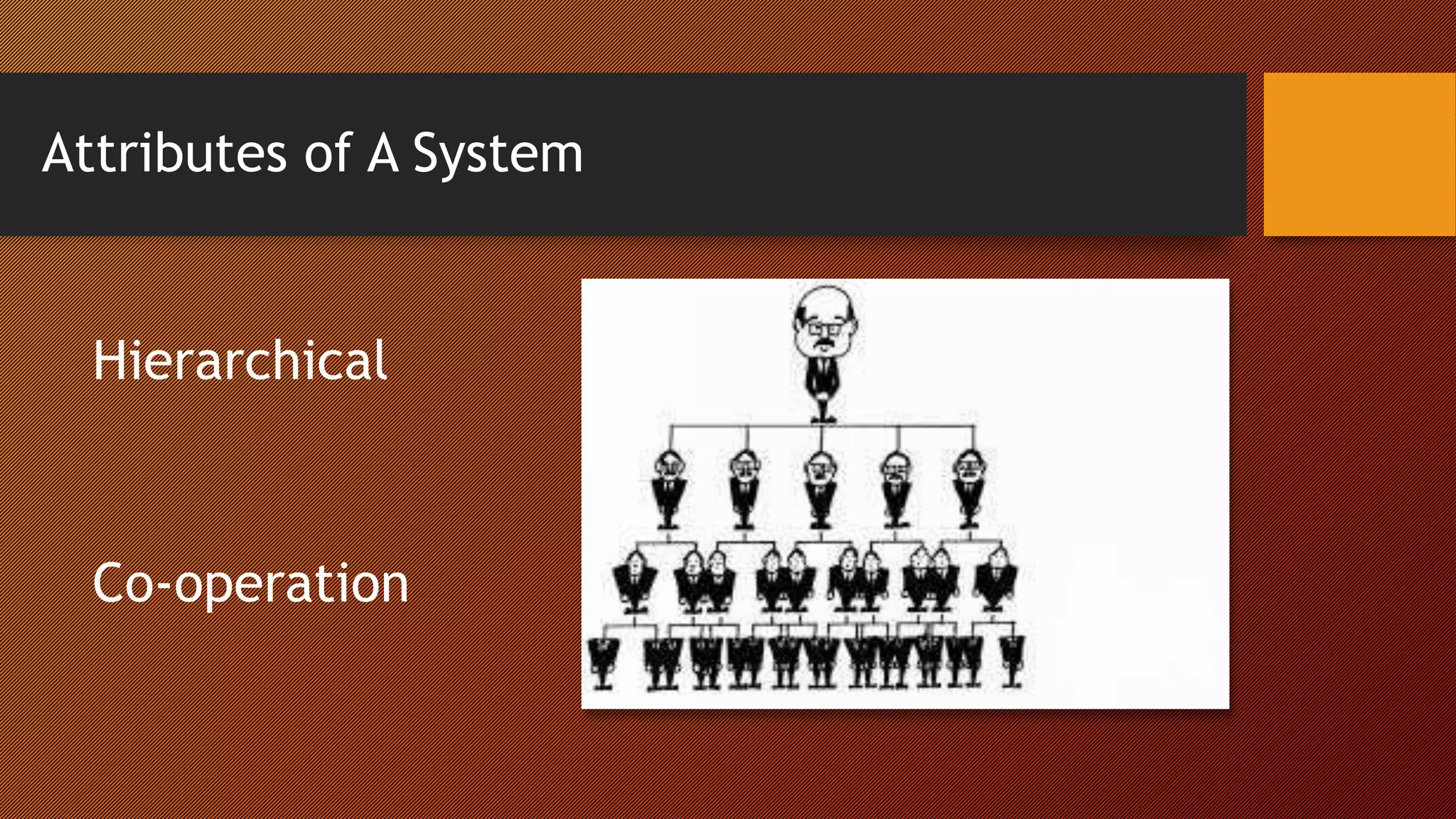
• Hierarchical
• Co-operation
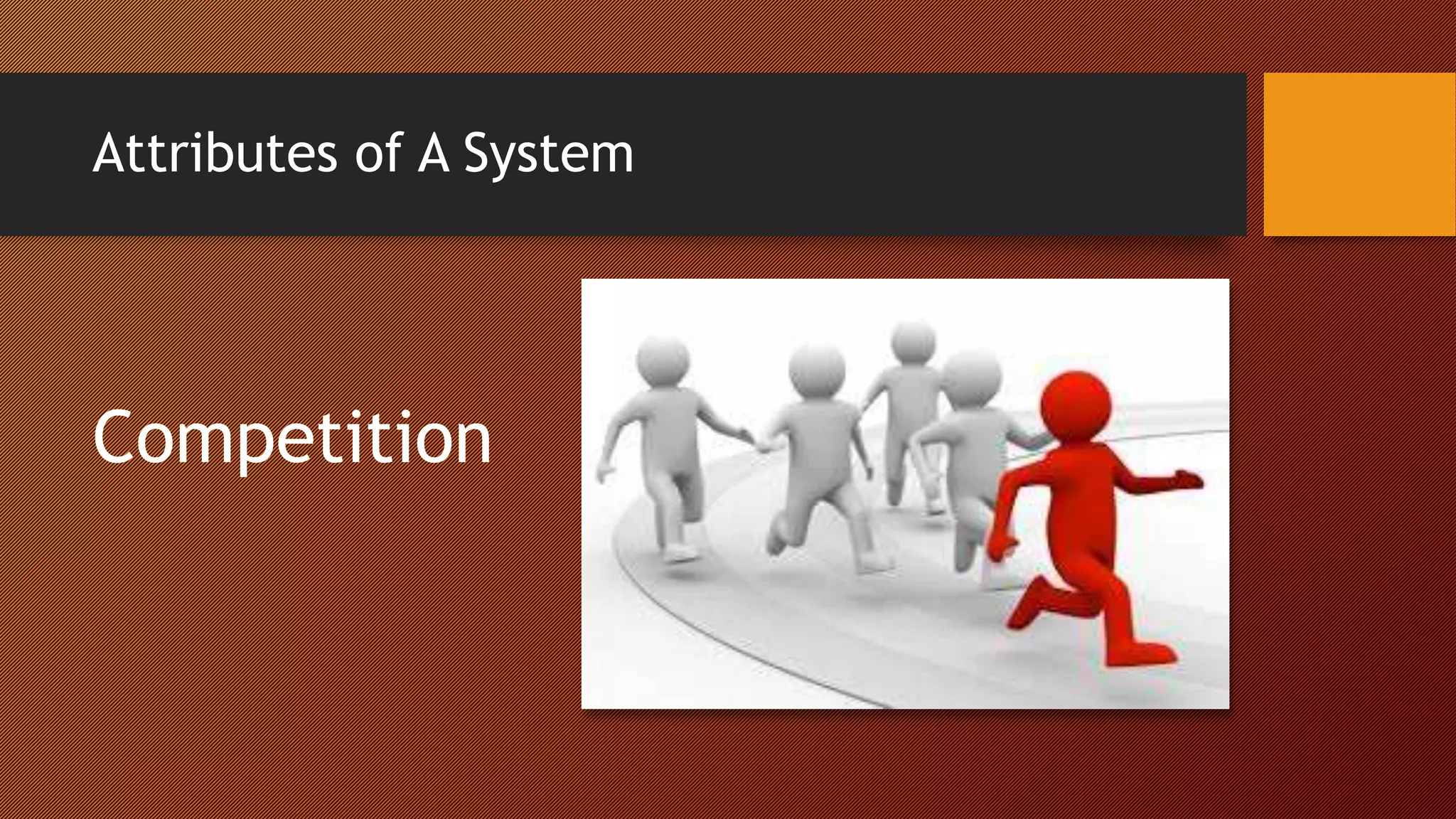
• Competition
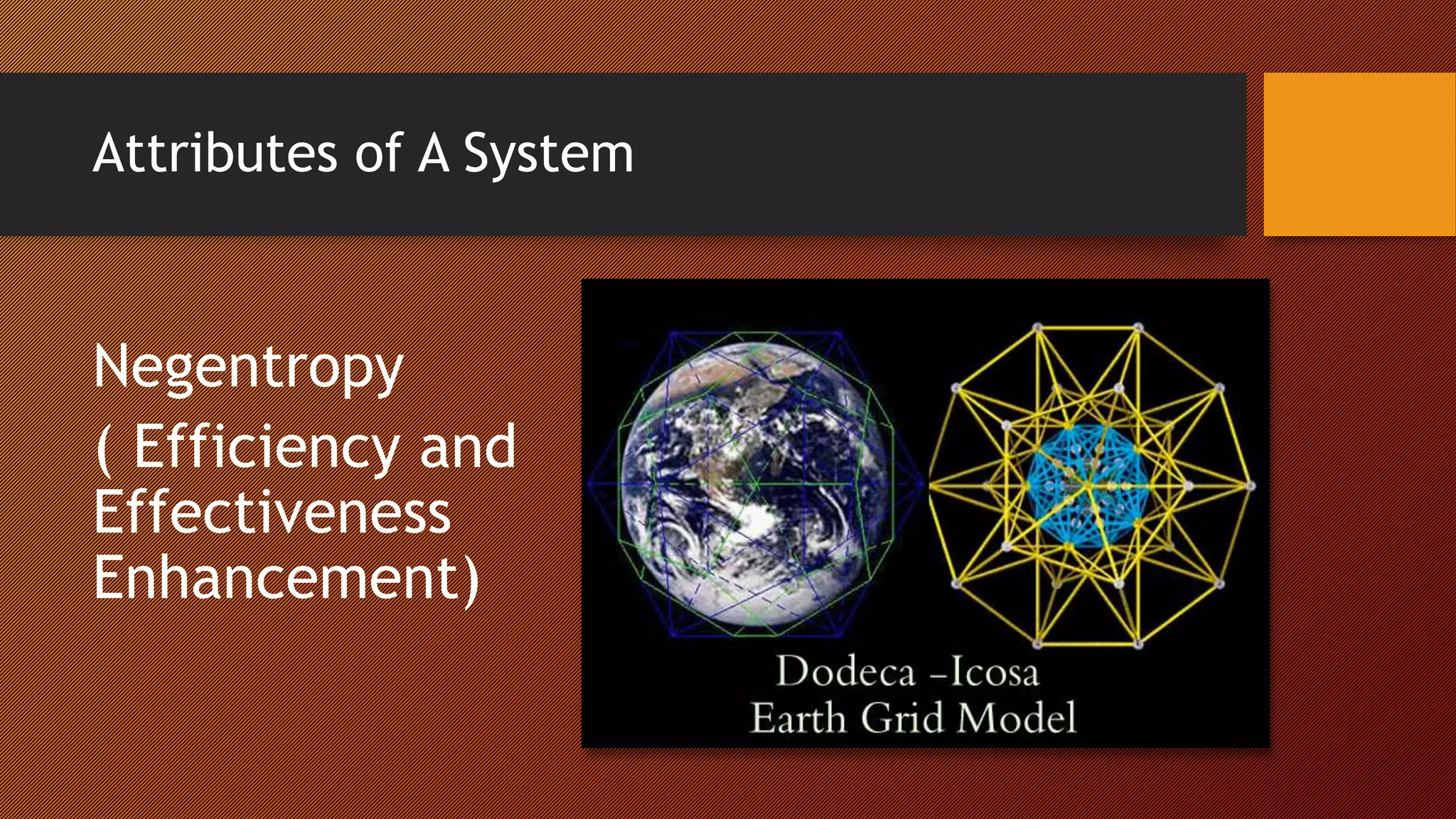
• Negentropy ( Efficiency and Effectiveness Enhancement)
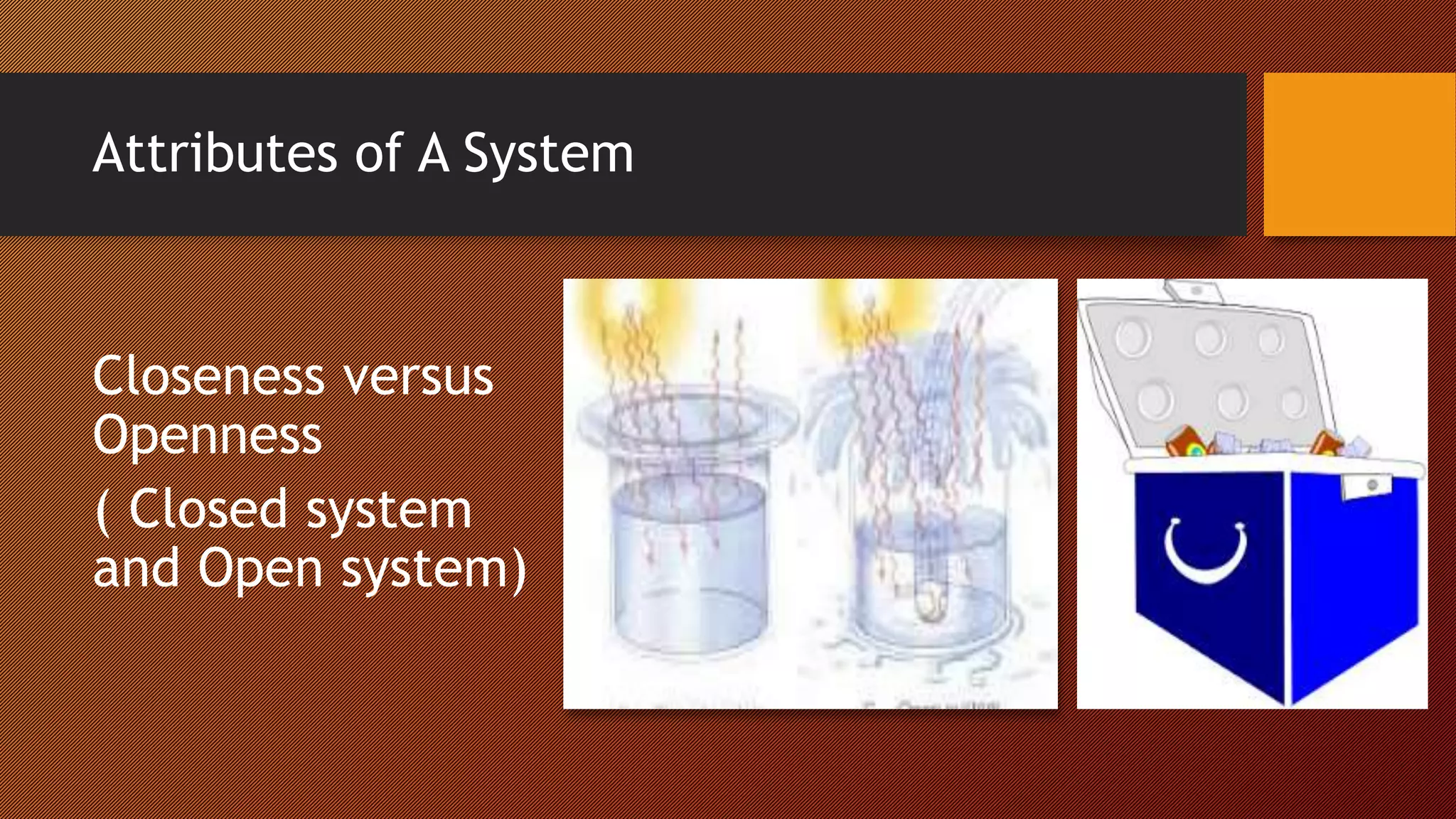
• Closeness versus Openness ( Closed system and Open system)
• Ubiquity
Attributes of A System
•System, Sub-system, Supra-system (Organic
whole or organism)
•Interdependence
Attributes of A System
Systematization
(Systematic or
Step wise)
Attributes of A System
Hierarchical
Co-operation
Attributes of A System
Competition
Attributes of A System
Negentropy
( Efficiency and
Effectiveness
Enhancement)
Attributes of A System
Closeness versus
Openness
( Closed system
and Open system)
Attributes of A System
•Ubiquity
Human Body System
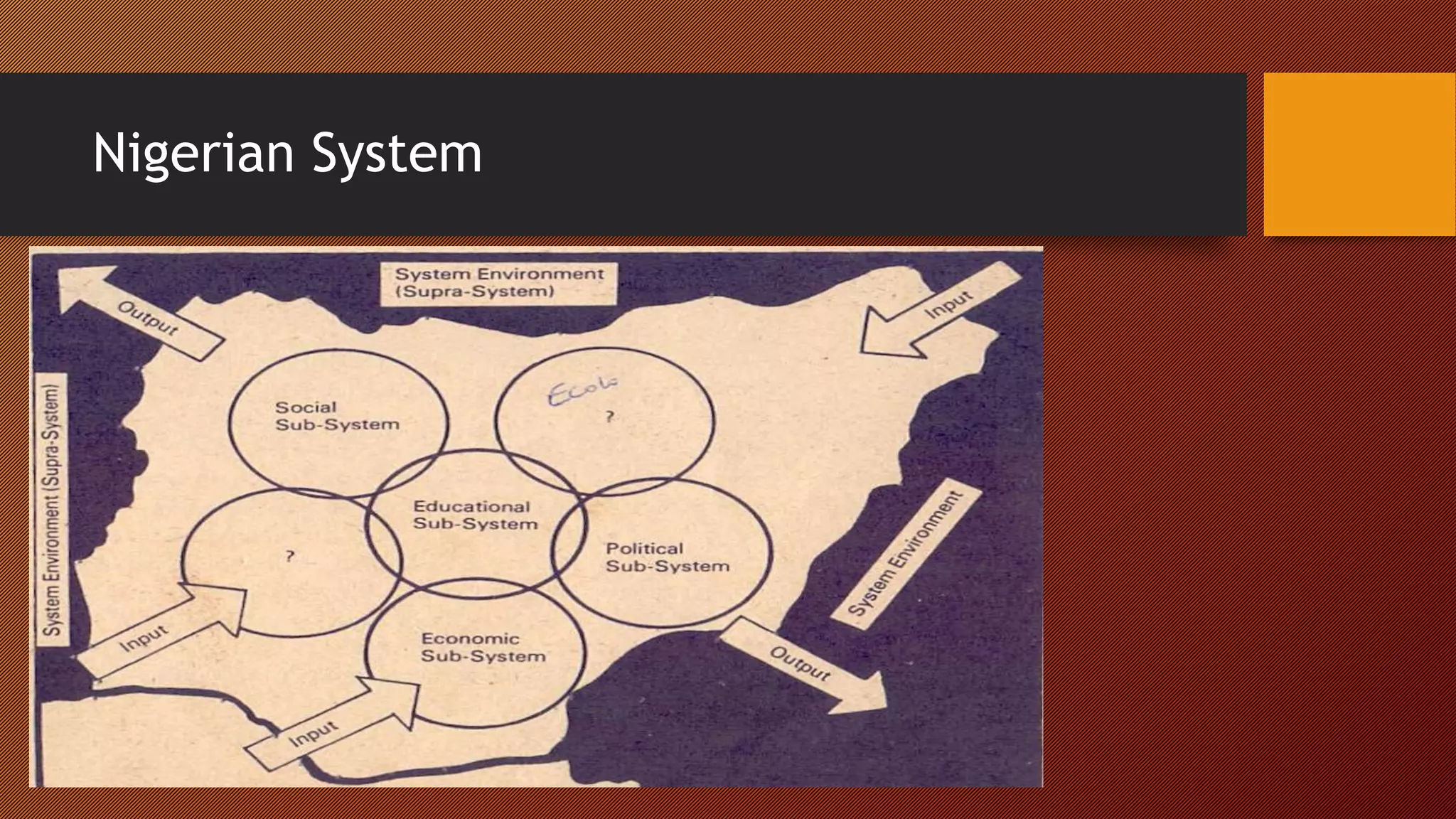
Nigerian System
A Sub-system- A Subset of A System
The purpose and focus of any area of interest in a
system could make its sub-system a system or an
entity. Logically within the new system will be sub-
systems while beyond its boundary is supra-system.
A Sub-system- A Subset of A System --2
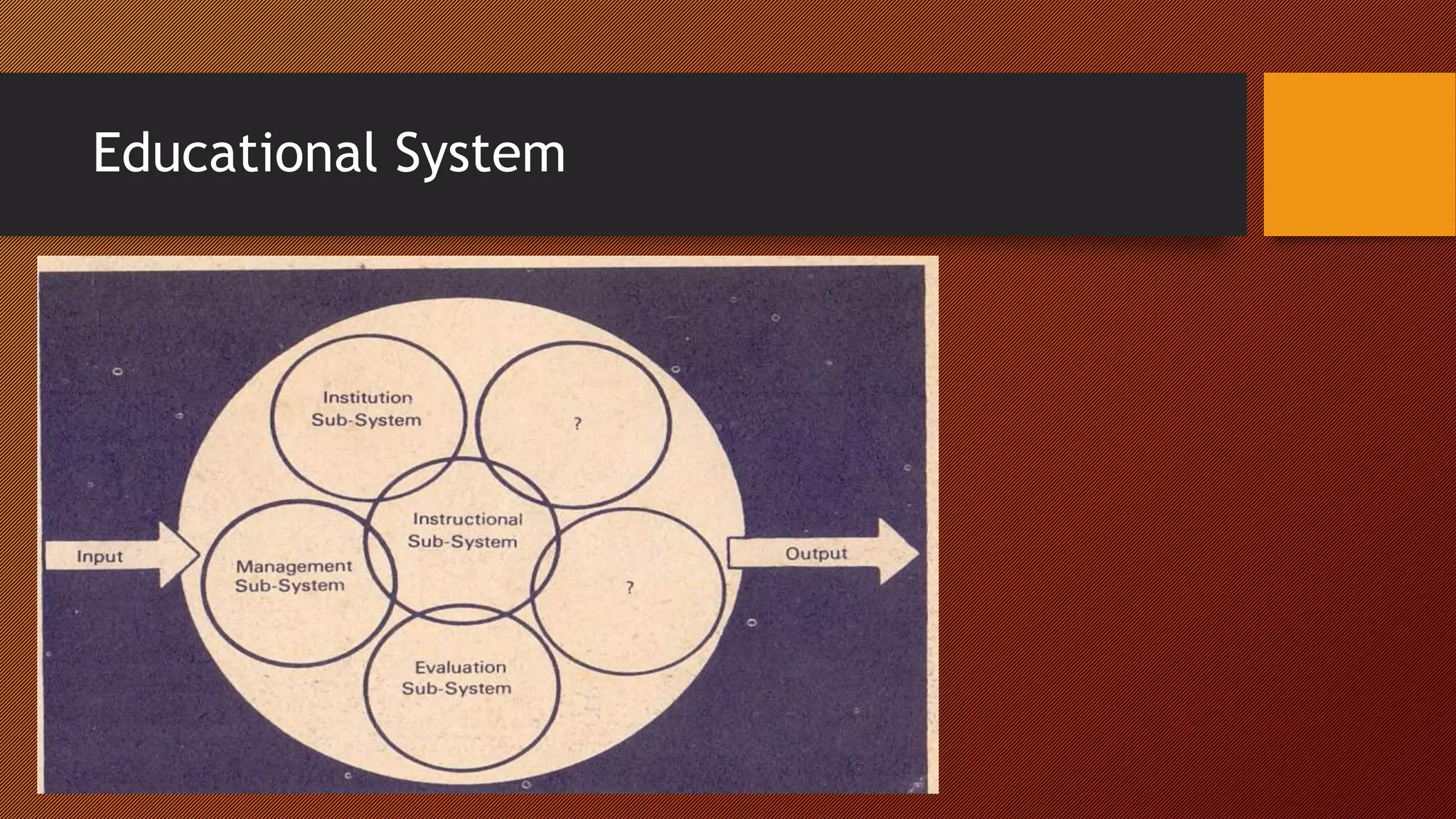
• For instance within the Nigerian system are
Educational Sub-system and others(Political,
Social, Economic etc.) and within the Educational
sub-system are Instructional sub-system and
others(Institutional, Management, Evaluation
etc.)
Educational System
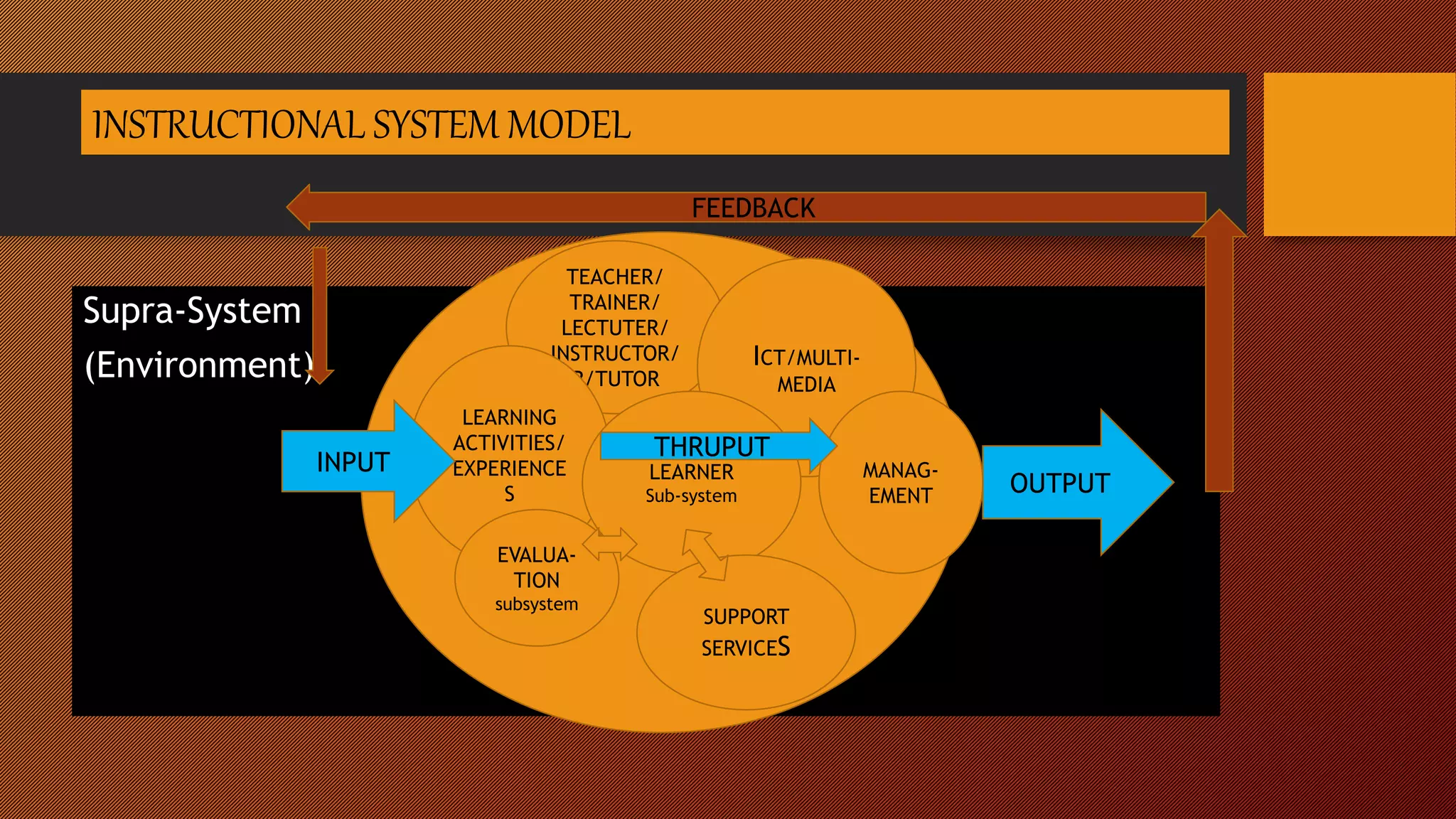
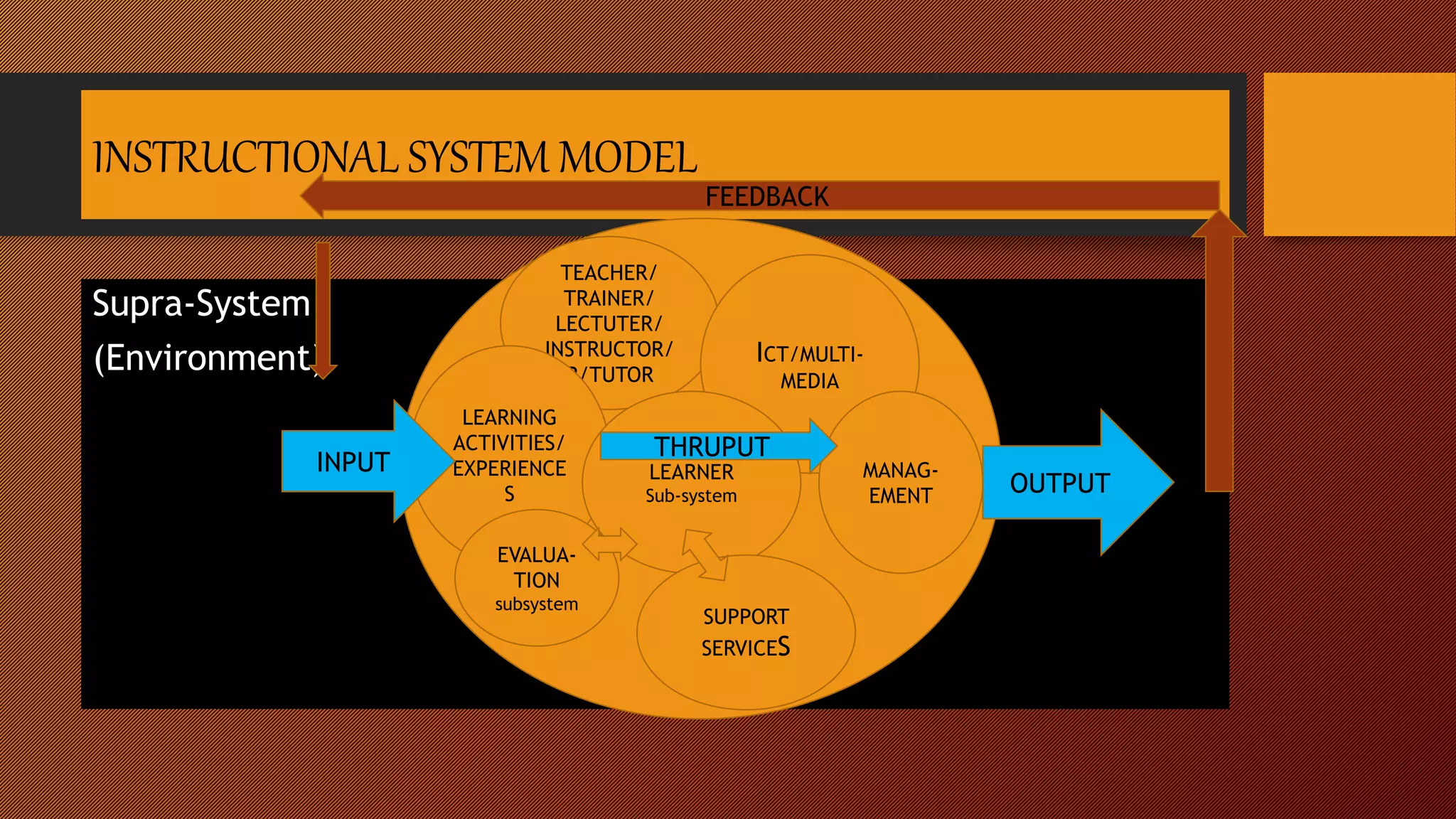
INSTRUCTIONAL SYSTEM MODEL
Supra-System
(Environment)
TEACHER/
TRAINER/
LECTUTER/
INSTRUCTOR/
R/TUTOR
LEARNING
ACTIVITIES/
EXPERIENCE
S
ICT/MULTI-
MEDIA
MANAG-
EMENT
EVALUA-
TION
subsystem
LEARNER
Sub-system
SUPPORT
SERVICES
OUTPUT
INPUT
THRUPUT
FEEDBACK
A Sub-system- A Subset of A System --3
• Instructional sub-system is a subset of an Educational system but
more specifically it is a subset of a Curriculum. Any Educational
system be it primary, secondary, tertiary, have several curricula
e.g in Babcock University System has amongst other sub-systems
several academic curricula or programs which you and I co-jointly
manage.
WHAT IS A CURRICULUM?
A curriculum refers to the knowledge
areas, skills, and attitudes that are
supposed to be taught in an institution.
It is the totality of the syllabuses on
educational programmes.
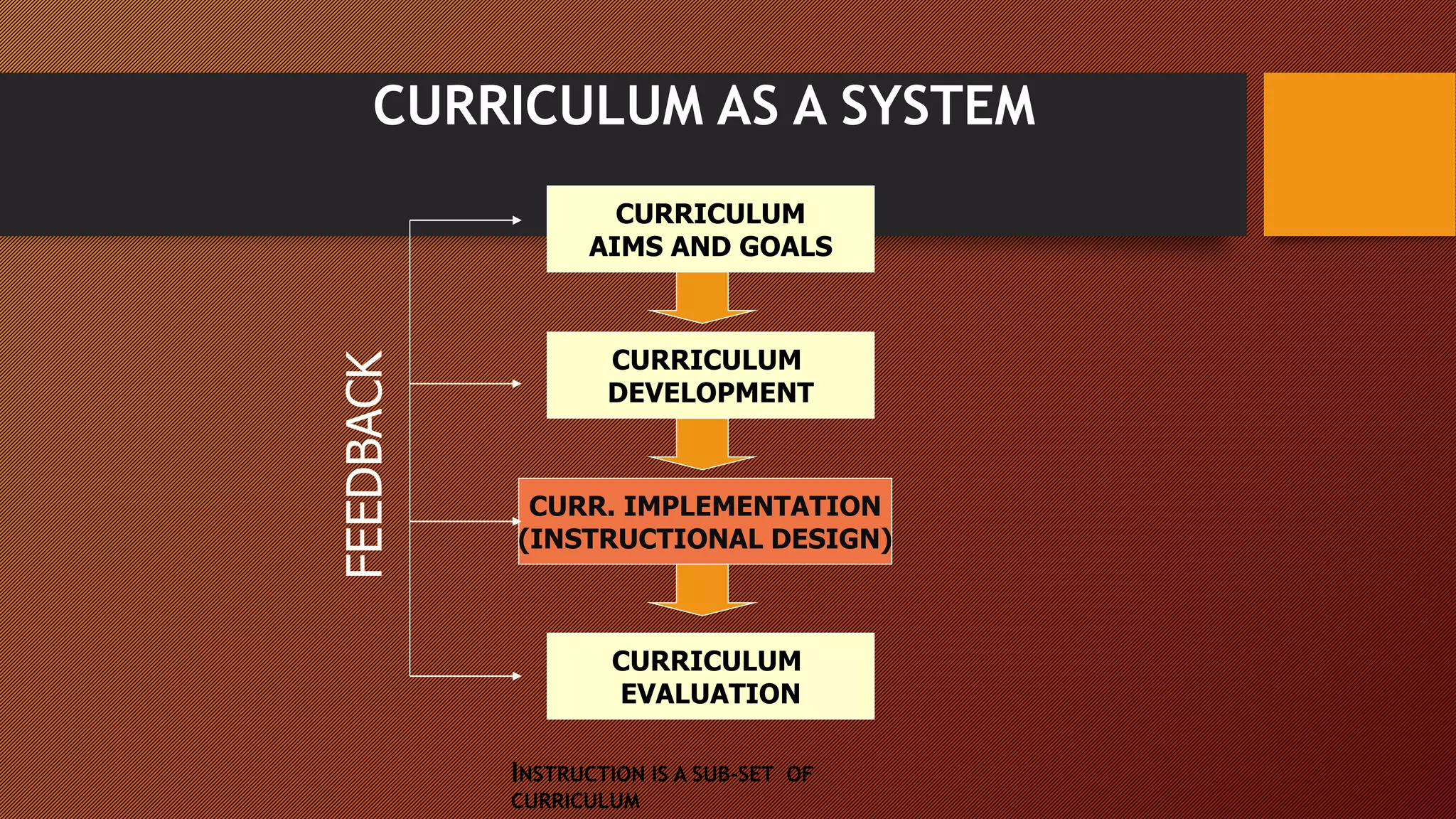
Let us conceive of a curriculum as a
system.
CURRICULUM AS A SYSTEM
CURRICULUM
AIMS AND GOALS
CURRICULUM
DEVELOPMENT
CURR. IMPLEMENTATION
(INSTRUCTIONAL DESIGN)
CURRICULUM
EVALUATION
FEEDBACK
INSTRUCTION IS A SUB-SET OF
CURRICULUM
Application of Systems Model to Instruction
Systems approach to instruction conceives of the
teaching-learning as an event/process consisting
of several elements (teacher, learner, media,
methods, evaluation) which are all co-operatively
interacting to promote efficiency and effectiveness
of the management of human and non-human
resources.
INSTRUCTIONAL SYSTEM MODEL
Supra-System
(Environment)
TEACHER/
TRAINER/
LECTUTER/
INSTRUCTOR/
R/TUTOR
LEARNING
ACTIVITIES/
EXPERIENCE
S
ICT/MULTI-
MEDIA
MANAG-
EMENT
EVALUA-
TION
subsystem
LEARNER
Sub-system
SUPPORT
SERVICES
OUTPUT
INPUT
THRUPUT
FEEDBACK
Instructional Design
Instructional design is an integral aspect of pedagogy
which explores, develops and implements varieties of
strategies based on empirically–tested principles of
teaching and learning drawn from several fields such as
management, psychology, communication technology,
teacher education amongst others.
Put simply instructional design by its very nature is a
conglomeration of several ideas which are aptly described
as ‘eclectic’.
Instructional Models are Diverse and
Systematic
Systems model to instruction has been conceived
and constructed by researchers, educators,
engineers, management experts, the military
establishment with diverse background in a variety
of models running to over hundred at different
levels of complexity.
Instructional Models are Diverse and
Systematic --2
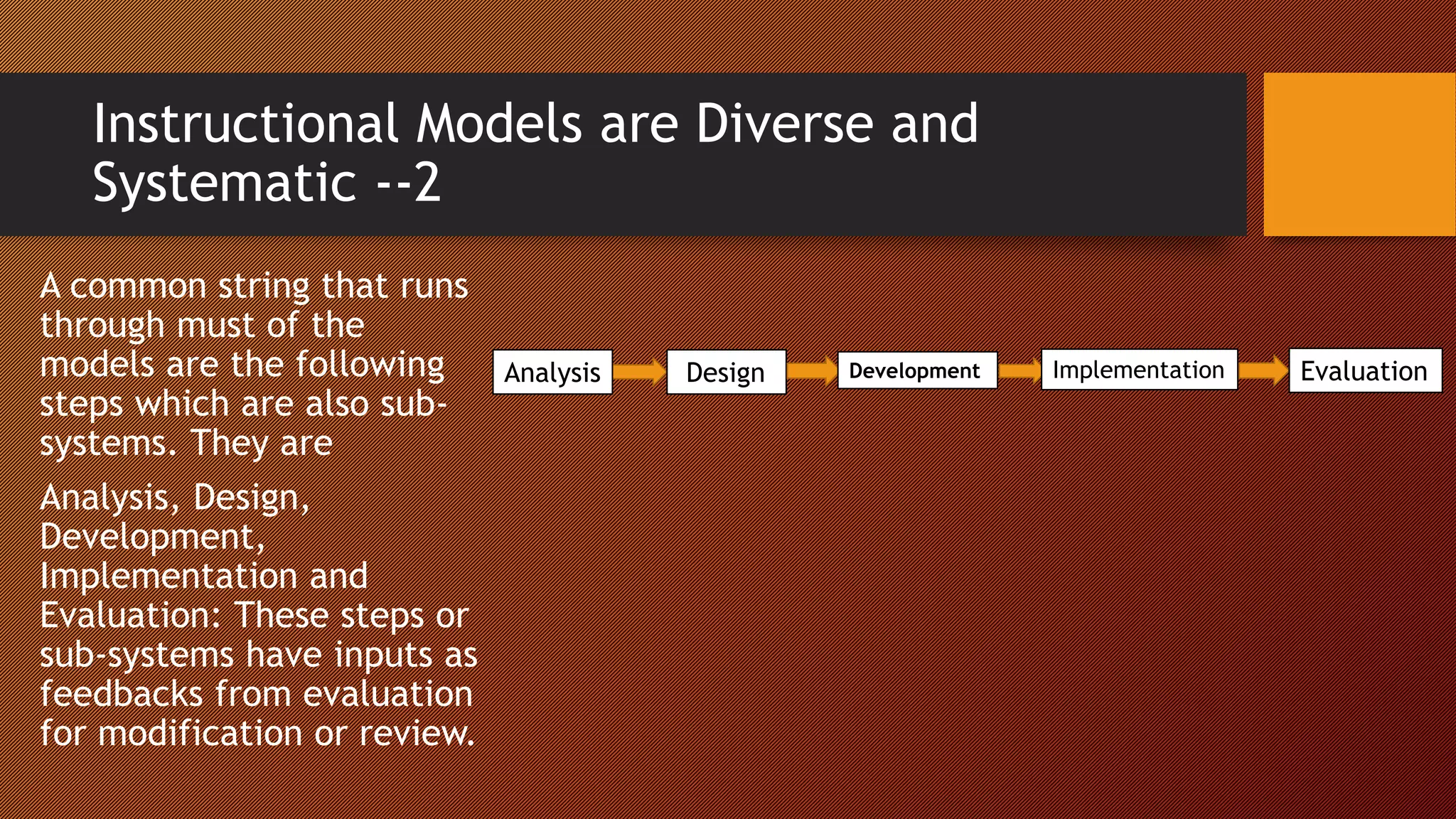
A common string that runs
through must of the
models are the following
steps which are also sub-
systems. They are
Analysis, Design,
Development,
Implementation and
Evaluation: These steps or
sub-systems have inputs as
feedbacks from evaluation
for modification or review.
Analysis Design Development Implementation Evaluation
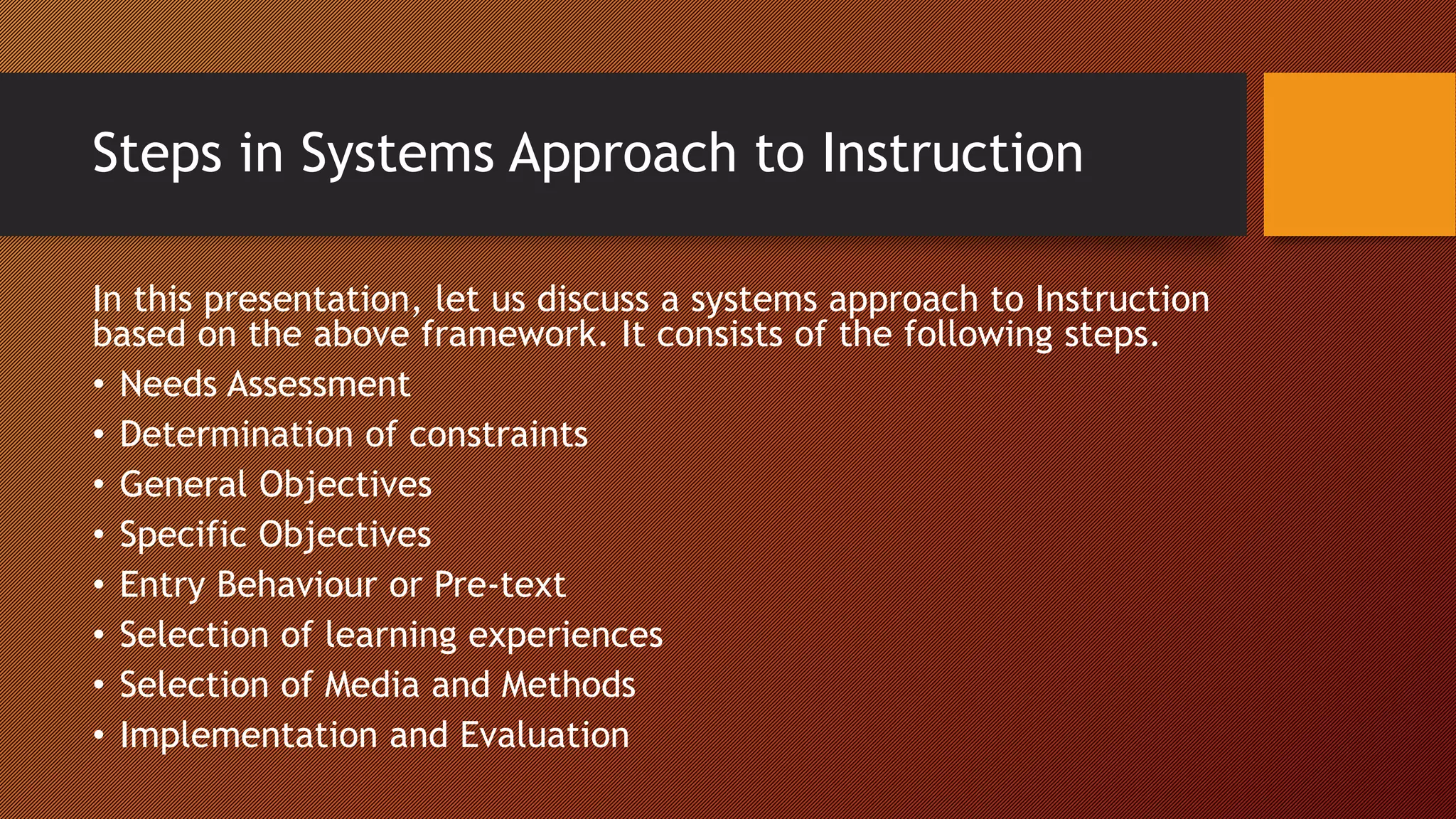
Steps in Systems Approach to Instruction
In this presentation, let us discuss a systems approach to Instruction
based on the above framework. It consists of the following steps.
• Needs Assessment
• Determination of constraints
• General Objectives
• Specific Objectives
• Entry Behaviour or Pre-text
• Selection of learning experiences
• Selection of Media and Methods
• Implementation and Evaluation
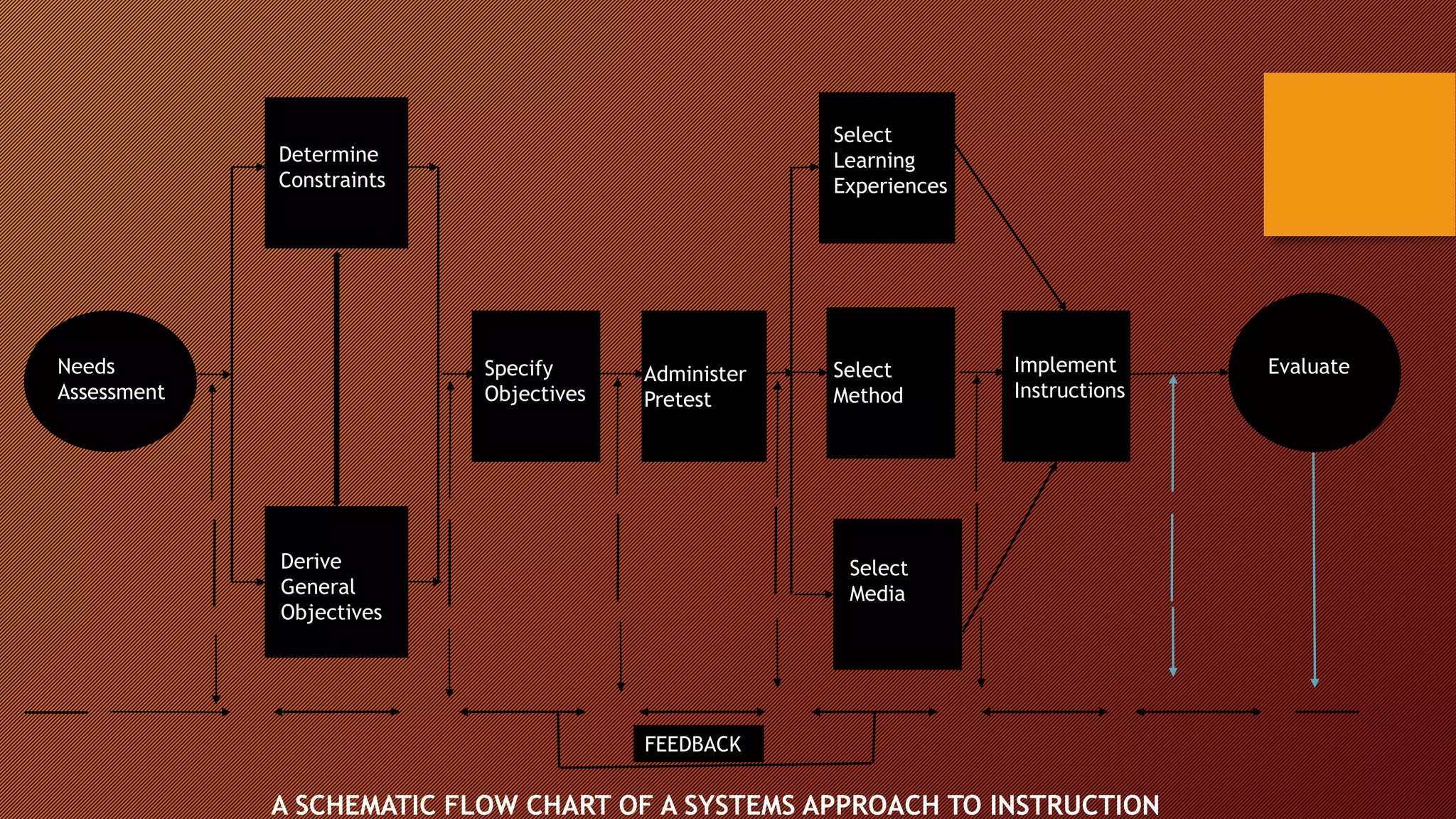
Determine
Constraints
Select
Learning
Experiences
Needs
Assessment
Derive
General
Objectives
Select
Media
Evaluate
Specify
Objectives
Administer
Pretest
Select
Method
Implement
Instructions
FEEDBACK
A SCHEMATIC FLOW CHART OF A SYSTEMS APPROACH TO INSTRUCTION
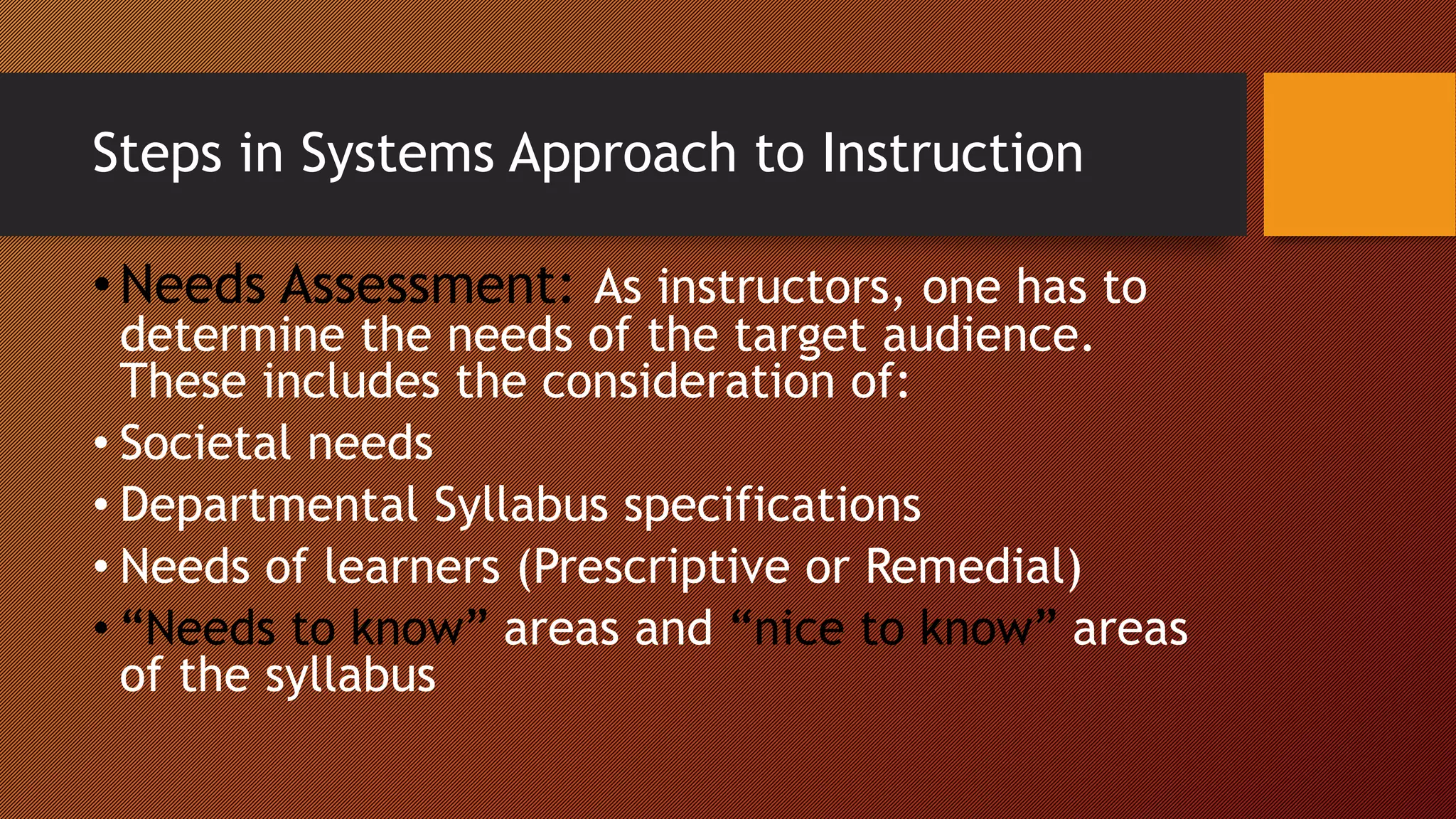
Steps in Systems Approach to Instruction
•Needs Assessment: As instructors, one has to
determine the needs of the target audience.
These includes the consideration of:
• Societal needs
• Departmental Syllabus specifications
• Needs of learners (Prescriptive or Remedial)
• “Needs to know” areas and “nice to know” areas
of the syllabus
Steps in Systems Approach to Instruction
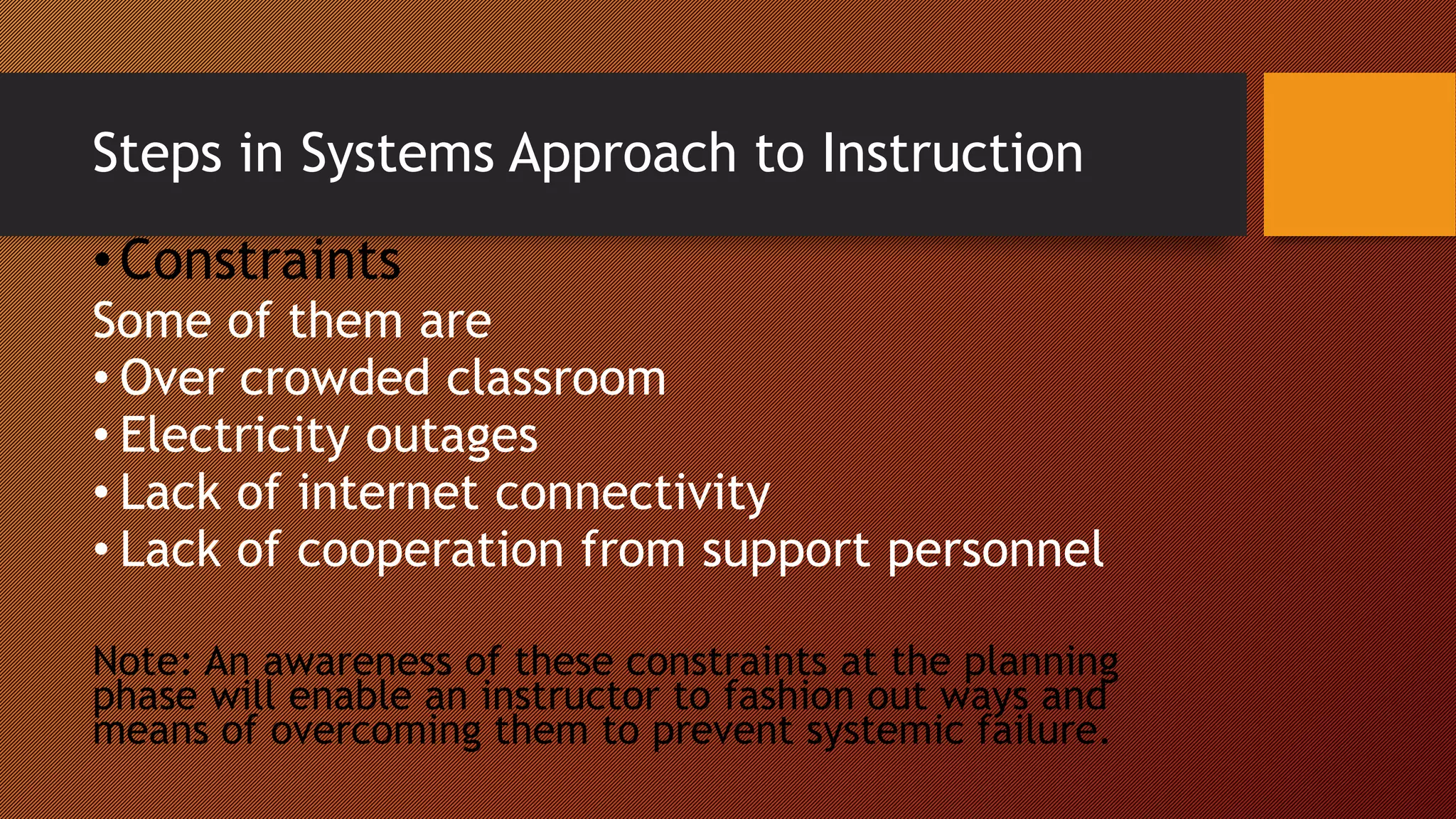
•Constraints
Some of them are
• Over crowded classroom
• Electricity outages
• Lack of internet connectivity
• Lack of cooperation from support personnel
Note: An awareness of these constraints at the planning
phase will enable an instructor to fashion out ways and
means of overcoming them to prevent systemic failure.
Steps in Systems Approach to Instruction
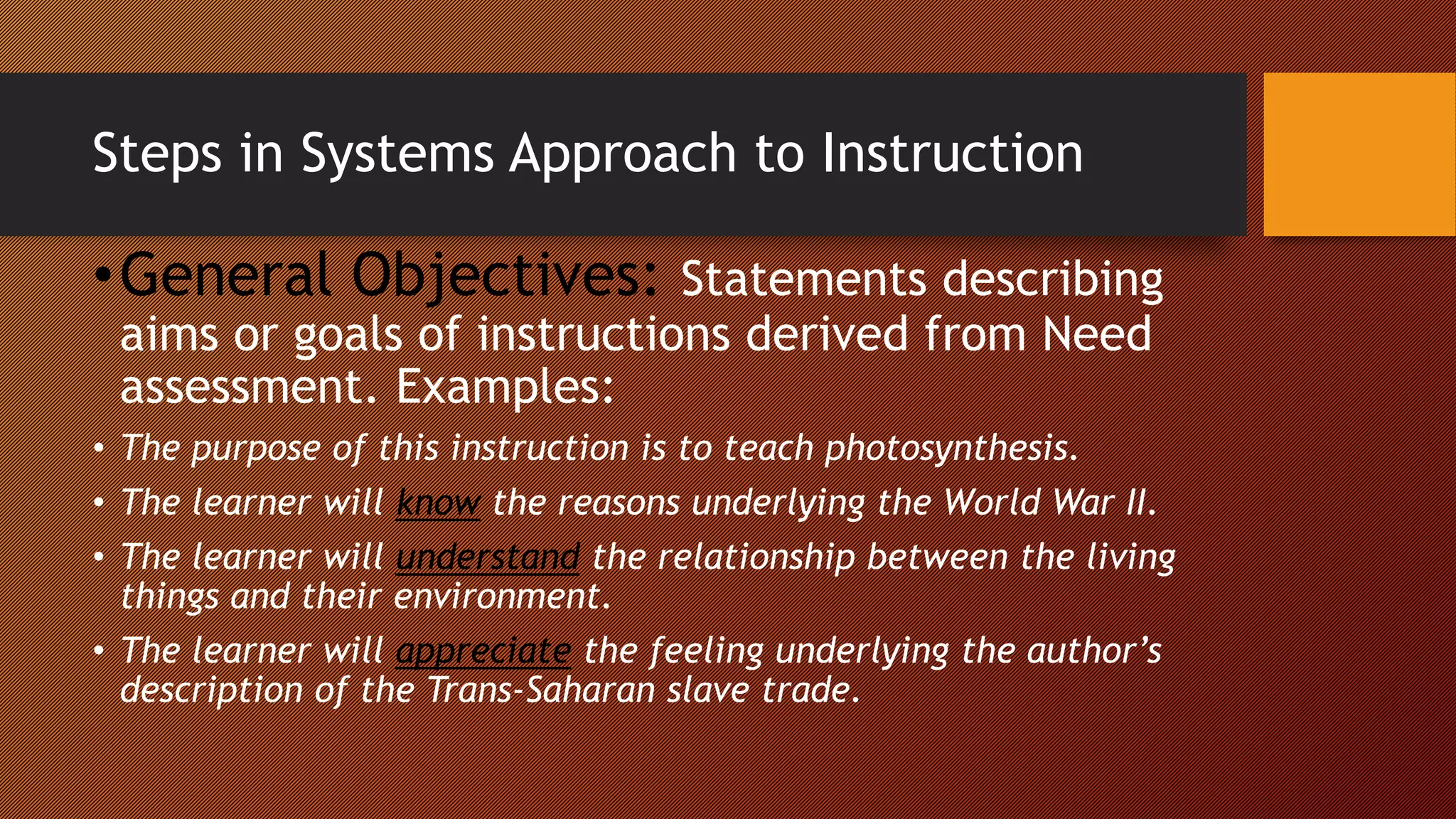
•General Objectives: Statements describing
aims or goals of instructions derived from Need
assessment. Examples:
• The purpose of this instruction is to teach photosynthesis.
• The learner will know the reasons underlying the World War II.
• The learner will understand the relationship between the living
things and their environment.
• The learner will appreciate the feeling underlying the author’s
description of the Trans-Saharan slave trade.
Steps in Systems Approach to Instruction
•SPECIFIC OBJECTIVES:
Specific objectives are statements
describing what a learner will be able to
do/accomplish at the completion of any
prescribed unit of instruction. They are
derived from General objectives.
SPECIFIC OBJECTIVES
• They map out the journey through teaching-
learning process. The journey incudes the
acquisition of knowledge, skills, beliefs and
values in the curricula content. Put simply, an
instructor breaks down a topic/concept into
learnable and teachable sub-concepts. This
concept/content analysis enables an instructor to
develop sub-objectives.
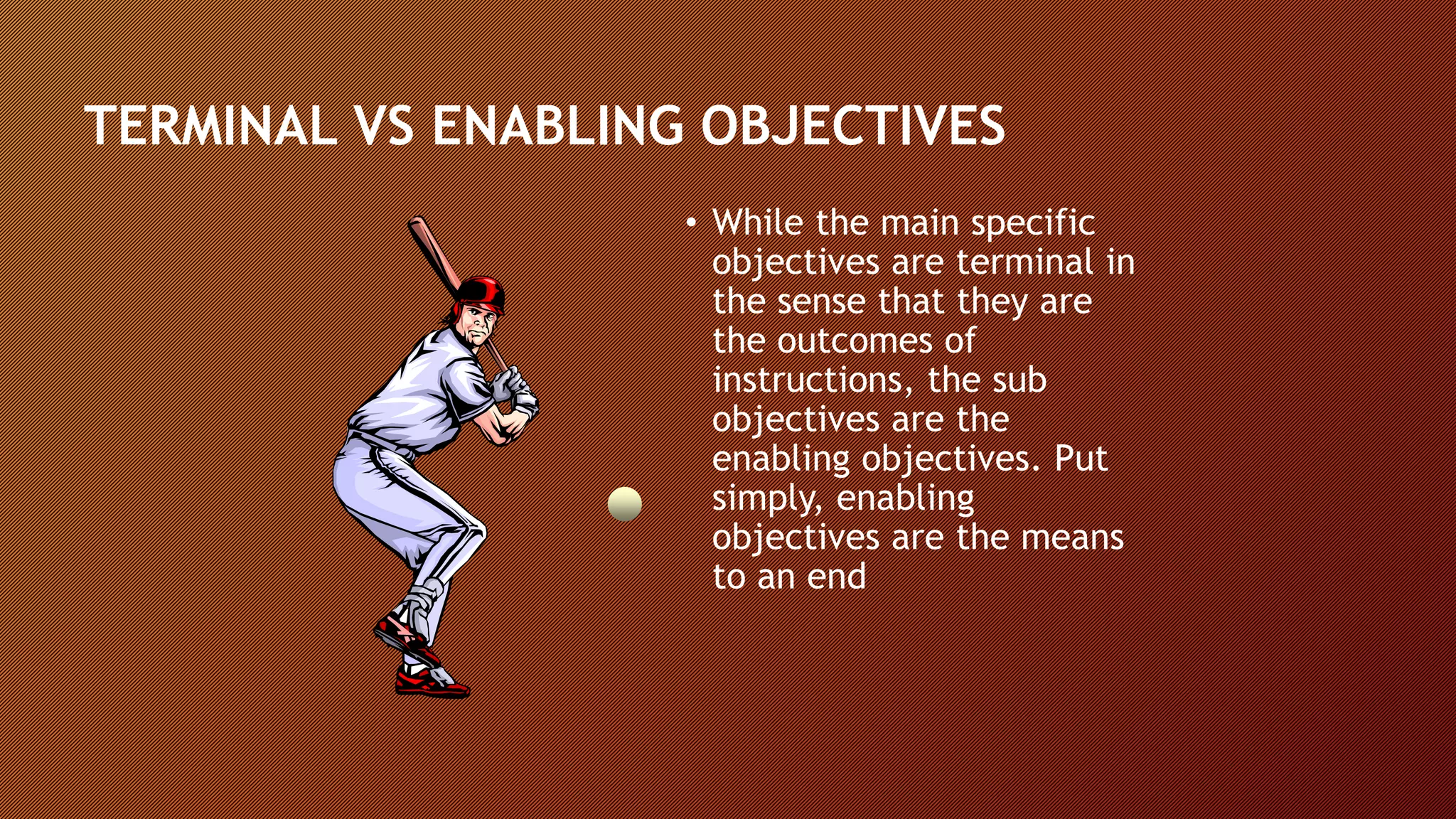
TERMINAL VS ENABLING OBJECTIVES
• While the main specific
objectives are terminal in
the sense that they are
the outcomes of
instructions, the sub
objectives are the
enabling objectives. Put
simply, enabling
objectives are the means
to an end
SPECIFIC OBJECTIVES
EXAMPLES OF SPECIFIC OBJECTIVES
At the end of the instruction,
• The learner would be able to list five causes that lead to World
War II.
• The learner will be able to distinguish between the causes and
effects of the World War II.
• The learner will be able to identify four living things commonly
found in a particular niche/environment.
• The learner will be able to discuss orally or in writing the reasons
underlying the Trans-Atlantic slave trade.
• Given a map of Africa, the learner will be able to draw two of the
routes of Atlantic slave trade.
SPECIFIC OBJECTIVES- SEQUENCING
One can sequence concepts and sub-concepts as follows:
• Simple concept to complex concept
• Known concept to unknown concept
• Subordinate to Super-ordinate concept
• Super-ordinate concept to Subordinate
• Co-ordinate concept to Co-ordinate concept
• Rules to Examples concept and Examples to Rules
concept
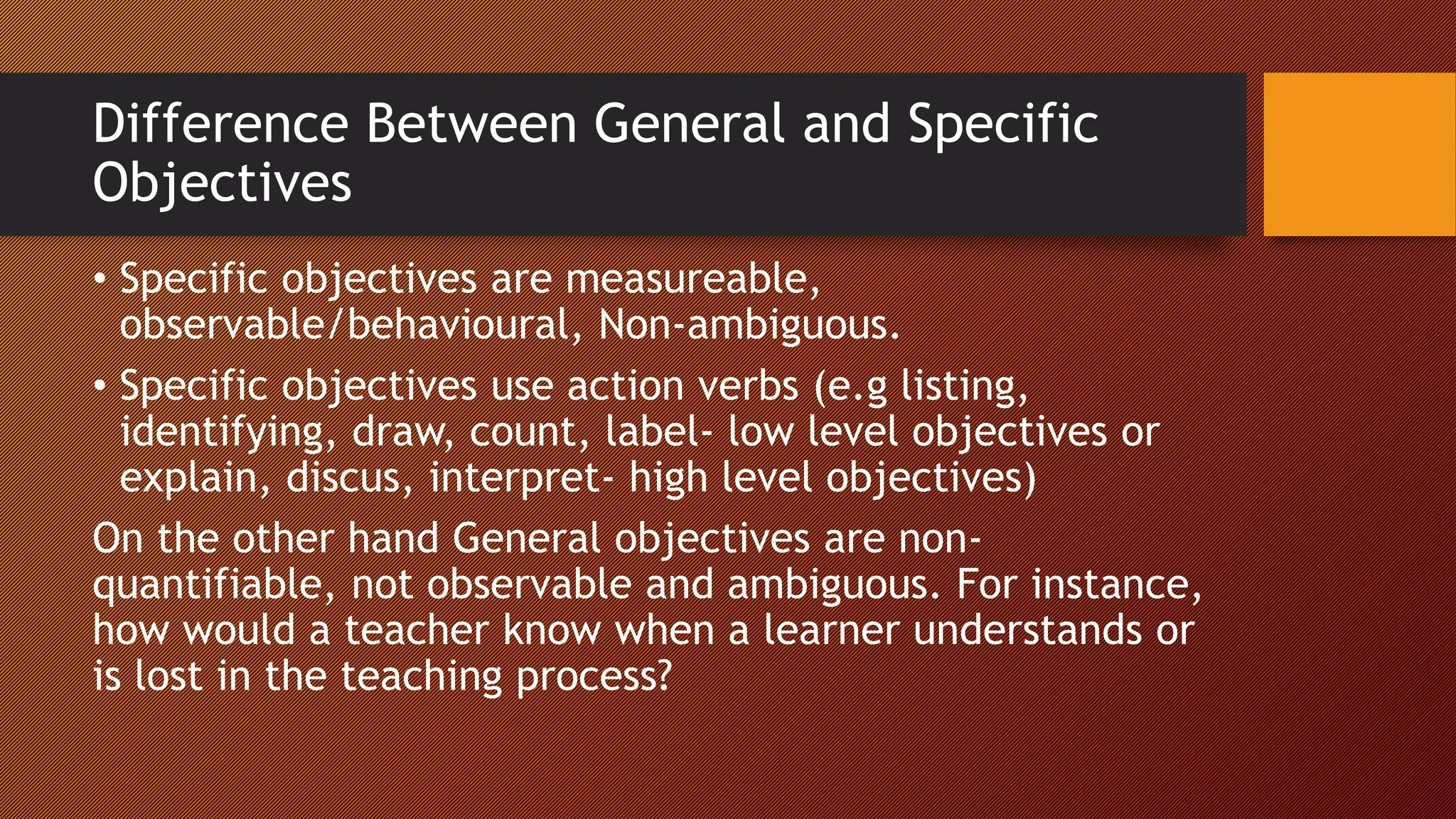
Difference Between General and Specific
Objectives
• Specific objectives are measureable,
observable/behavioural, Non-ambiguous.
• Specific objectives use action verbs (e.g listing,
identifying, draw, count, label- low level objectives or
explain, discus, interpret- high level objectives)
On the other hand General objectives are non-
quantifiable, not observable and ambiguous. For instance,
how would a teacher know when a learner understands or
is lost in the teaching process?
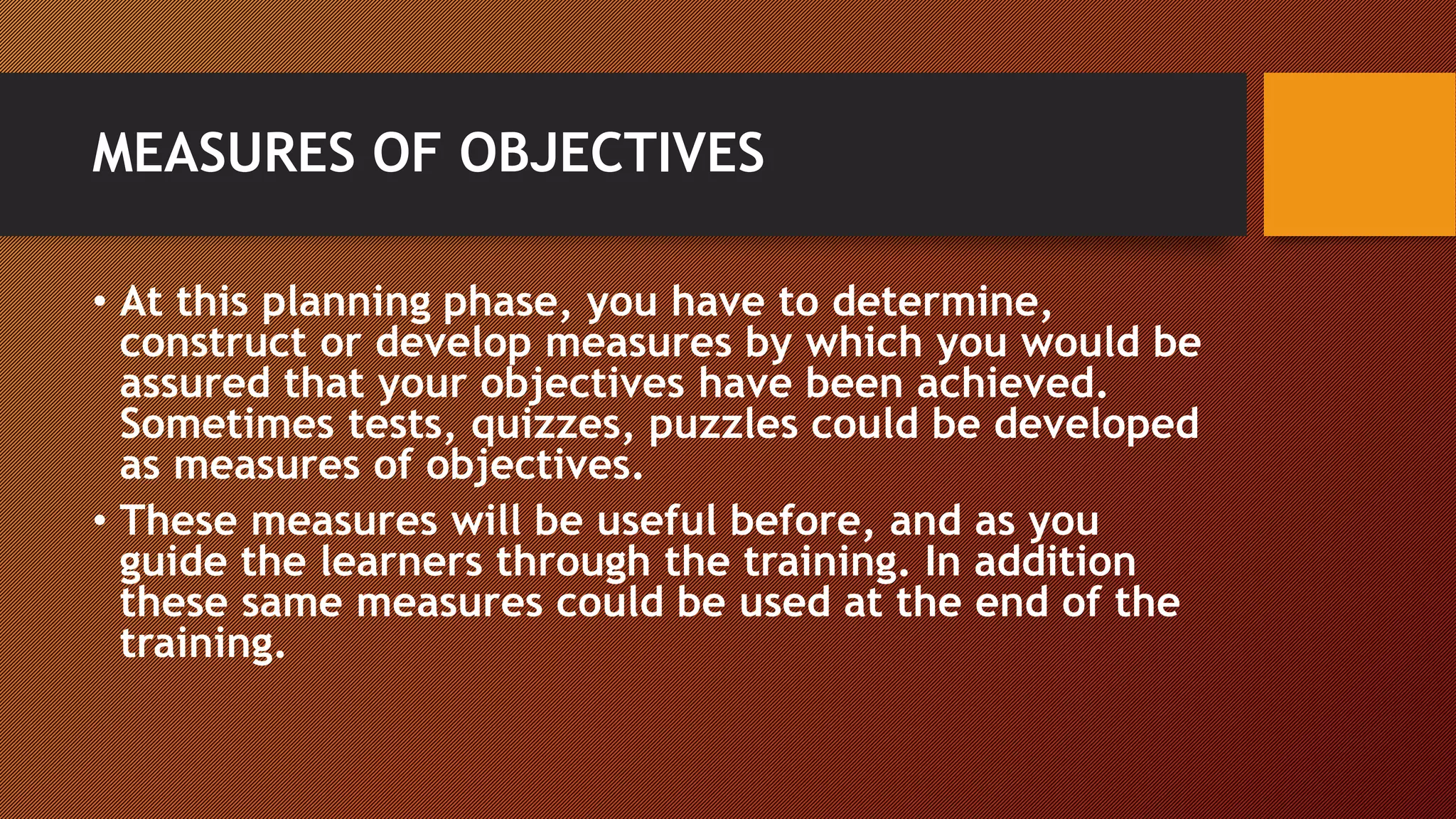
MEASURES OF OBJECTIVES
• At this planning phase, you have to determine,
construct or develop measures by which you would be
assured that your objectives have been achieved.
Sometimes tests, quizzes, puzzles could be developed
as measures of objectives.
• These measures will be useful before, and as you
guide the learners through the training. In addition
these same measures could be used at the end of the
training.
Pre-Knowledge or Entry Bahaviour of Learner
An instructor administers a pre-test to determine
the entry behaviour or pre-knowledge of the
students.
Thus far in the Systems approach to instruction an
instructor has carried out both the learner and
task/content analyses.
Design and Development
Selection of learning experiences
The stages of design and development involve copious use
of meaningful learning experiences, examples and non-
examples to clarify, explain, reinforce and facilitate the
acquisition of concept of task being taught.
These stages also employ the use appropriate use of a
multi-media resources such as text, audio CD, video clips,
DVD, visual graphics, YouTube, video conferencing amongst
others to stimulate the students.
Design and Development
• In this digital age the internet provides varieties of open
educational resources which are free for limited classroom or
usable for instruction only if permissions are sought.
• The choice of learning experiences, appropriate media and modes
of delivery will be determined by the nature of the topic being
taught.
• More detailed information on these aspects of the instructional
design could be further sought by consultation with the
directorate of the Centre for Open Distance Learning.
Design and Development
Selection of Media/Modes or Methods
The selection of appropriate media and modes or methods of
instruction is an integral aspect of instructional design.
Different types of media are now being used to enrich lectures.

Most of them are now being integrated into delivery systems
e.g Video streams, YouTube, Cartoon clips, Art clips. Some of
these are available on Google images.
Implementation
Learner is the centre of teaching and learning process in any
instructional system. The instructor is the director/manager
who orchestrates the teaching-learning process. The
instructors ability to harmonize all the elements or sub-
systems of the instruction and motivate the learner will
determine efficiency and effectiveness of the instruction. The
instructor determines what aspect of the presentation could
best be delivered face to face by the instructors to the class.
He also determines which aspect of the presentation the
learners would benefit most by direct interaction with the
instructional resources such as Video streams, CD, objects
e.t.c
Some Tips on Making Presentations Inspiring
Some of the following presentations skills are vital
tools that should be developed by an effective
instructor.
 variation skills
 questioning skills
 responding skills
 explanation skills
 reinforcement skills
Evaluation
Its an integral aspect/sub-system of
instructional systems design. In this context, its
usually based on specific objectives and this is
why it is otherwise described as criterion-
referenced.
Evaluation-- 2
In contrast, the use of norm-referenced testing and
ranking in the traditional teaching and learning
context does not facilitate any meaningful revision of
instructional process. Hence, the criterion-reference
testing provide useable relevant data that could be
fed-back to all parts of the system for revision and or
modification.
Evaluation--3
• Evaluation is a measure of objectives achieved in
a teaching-learning process.
• It uses varieties of measuring tools e.g tests,
puzzles, quizzes, inventories, check-list etc.
• Guides and monitors the performance of
instructors and learners using a feedback of data.
Evaluation--4
• Multiple measures using a variety of evaluation
tools are more reliable than one or two.
• Use of formative (continuous assessment)
facilitates development while the summative
evaluation facilitates decision making on
selection of media/modes or any resources after
a period of time.
ARISE, SHINE; FOR YOUR
LIGHT HAS COME AND
THE GLORY OF THE LORD
IS RISEN UPON YOU.
ISAIAH 60:1
THANK YOU AND BEST WISHES !

A_SYSTEMS_APPROACH_TO_INSTRUCTIONAL_DESIGN.ppt

  • 1.
    A SYSTEMS APPROACHTO INSTRUCTONAL DESIGN PROFESSOR D.K AKANBI BY
  • 2.
    Objectives This session isprimarily • to build on the exposure through colloquium presentations on systems thinking particularly as it relates to one of our cardinal tripartite university responsibilities-Teaching. Put simply how could we apply systems thinking to instruction? • to sensitize on the need to re-examine our instructional plan and delivery system based on systems thinking for more efficiency and effectiveness using empirically-tested pedagogical principles.
  • 3.
    Objectives-- 2 • todiscuss and share our professional experiences with respect to viability of an application of systems thinking to teaching and learning.
  • 4.
    Rationale Research studies haveestablished the fact that learners/trainees acquire and retain knowledge and skills and even perform significantly better when the delivery of content/pedagogy is diversified and enriched with human and non-human resources than those without them (Akanbi,1988;Agun,1988, Ajayi-Dopemu, 1989, Akinyemi,1989; Reiser & Dempsey, 2012)
  • 5.
    INTRODUCTION •What is SystemsThinking? •A Philosophy •A Framework •A Process •An Attitude
  • 6.
    What is aSystem? System is an event/object/process made up of parts/elements that are co-operatively working together for a predetermined purpose. The parts are mutually interdependent and functionally related. While a system has an arbitrary boundary which encloses sub-systems- the component parts. Examples are body system, car, queuing procedure in the bank, eco- system, a nation (Nigeria, Brazil). Within any System are sub-systems while beyond the boundary of a system is a supra-system i.e. its environment
  • 7.
    What is aSystem? --2 • Any defect in any of the sub-system will affect the other sub-systems and the whole system. • Any system is greater than the sum of its components.
  • 8.
    Attributes of ASystem • System, Sub-system, Supra-system (Organic whole or organism) • Interdependence • Systematization (Systematic or Step wise) • Hierarchical • Co-operation • Competition • Negentropy ( Efficiency and Effectiveness Enhancement) • Closeness versus Openness ( Closed system and Open system) • Ubiquity
  • 9.
    Attributes of ASystem •System, Sub-system, Supra-system (Organic whole or organism) •Interdependence
  • 10.
    Attributes of ASystem Systematization (Systematic or Step wise)
  • 11.
    Attributes of ASystem Hierarchical Co-operation
  • 12.
    Attributes of ASystem Competition
  • 13.
    Attributes of ASystem Negentropy ( Efficiency and Effectiveness Enhancement)
  • 14.
    Attributes of ASystem Closeness versus Openness ( Closed system and Open system)
  • 15.
    Attributes of ASystem •Ubiquity
  • 16.
  • 17.
  • 18.
    A Sub-system- ASubset of A System The purpose and focus of any area of interest in a system could make its sub-system a system or an entity. Logically within the new system will be sub- systems while beyond its boundary is supra-system.
  • 19.
    A Sub-system- ASubset of A System --2 • For instance within the Nigerian system are Educational Sub-system and others(Political, Social, Economic etc.) and within the Educational sub-system are Instructional sub-system and others(Institutional, Management, Evaluation etc.)
  • 20.
  • 21.
  • 22.
    A Sub-system- ASubset of A System --3 • Instructional sub-system is a subset of an Educational system but more specifically it is a subset of a Curriculum. Any Educational system be it primary, secondary, tertiary, have several curricula e.g in Babcock University System has amongst other sub-systems several academic curricula or programs which you and I co-jointly manage.
  • 23.
    WHAT IS ACURRICULUM? A curriculum refers to the knowledge areas, skills, and attitudes that are supposed to be taught in an institution. It is the totality of the syllabuses on educational programmes. Let us conceive of a curriculum as a system.
  • 24.
    CURRICULUM AS ASYSTEM CURRICULUM AIMS AND GOALS CURRICULUM DEVELOPMENT CURR. IMPLEMENTATION (INSTRUCTIONAL DESIGN) CURRICULUM EVALUATION FEEDBACK INSTRUCTION IS A SUB-SET OF CURRICULUM
  • 25.
    Application of SystemsModel to Instruction Systems approach to instruction conceives of the teaching-learning as an event/process consisting of several elements (teacher, learner, media, methods, evaluation) which are all co-operatively interacting to promote efficiency and effectiveness of the management of human and non-human resources.
  • 26.
  • 27.
    Instructional Design Instructional designis an integral aspect of pedagogy which explores, develops and implements varieties of strategies based on empirically–tested principles of teaching and learning drawn from several fields such as management, psychology, communication technology, teacher education amongst others. Put simply instructional design by its very nature is a conglomeration of several ideas which are aptly described as ‘eclectic’.
  • 28.
    Instructional Models areDiverse and Systematic Systems model to instruction has been conceived and constructed by researchers, educators, engineers, management experts, the military establishment with diverse background in a variety of models running to over hundred at different levels of complexity.
  • 29.
    Instructional Models areDiverse and Systematic --2 A common string that runs through must of the models are the following steps which are also sub- systems. They are Analysis, Design, Development, Implementation and Evaluation: These steps or sub-systems have inputs as feedbacks from evaluation for modification or review. Analysis Design Development Implementation Evaluation
  • 30.
    Steps in SystemsApproach to Instruction In this presentation, let us discuss a systems approach to Instruction based on the above framework. It consists of the following steps. • Needs Assessment • Determination of constraints • General Objectives • Specific Objectives • Entry Behaviour or Pre-text • Selection of learning experiences • Selection of Media and Methods • Implementation and Evaluation
  • 31.
  • 32.
    Steps in SystemsApproach to Instruction •Needs Assessment: As instructors, one has to determine the needs of the target audience. These includes the consideration of: • Societal needs • Departmental Syllabus specifications • Needs of learners (Prescriptive or Remedial) • “Needs to know” areas and “nice to know” areas of the syllabus
  • 33.
    Steps in SystemsApproach to Instruction •Constraints Some of them are • Over crowded classroom • Electricity outages • Lack of internet connectivity • Lack of cooperation from support personnel Note: An awareness of these constraints at the planning phase will enable an instructor to fashion out ways and means of overcoming them to prevent systemic failure.
  • 34.
    Steps in SystemsApproach to Instruction •General Objectives: Statements describing aims or goals of instructions derived from Need assessment. Examples: • The purpose of this instruction is to teach photosynthesis. • The learner will know the reasons underlying the World War II. • The learner will understand the relationship between the living things and their environment. • The learner will appreciate the feeling underlying the author’s description of the Trans-Saharan slave trade.
  • 35.
    Steps in SystemsApproach to Instruction •SPECIFIC OBJECTIVES: Specific objectives are statements describing what a learner will be able to do/accomplish at the completion of any prescribed unit of instruction. They are derived from General objectives.
  • 36.
    SPECIFIC OBJECTIVES • Theymap out the journey through teaching- learning process. The journey incudes the acquisition of knowledge, skills, beliefs and values in the curricula content. Put simply, an instructor breaks down a topic/concept into learnable and teachable sub-concepts. This concept/content analysis enables an instructor to develop sub-objectives.
  • 37.
    TERMINAL VS ENABLINGOBJECTIVES • While the main specific objectives are terminal in the sense that they are the outcomes of instructions, the sub objectives are the enabling objectives. Put simply, enabling objectives are the means to an end
  • 38.
    SPECIFIC OBJECTIVES EXAMPLES OFSPECIFIC OBJECTIVES At the end of the instruction, • The learner would be able to list five causes that lead to World War II. • The learner will be able to distinguish between the causes and effects of the World War II. • The learner will be able to identify four living things commonly found in a particular niche/environment. • The learner will be able to discuss orally or in writing the reasons underlying the Trans-Atlantic slave trade. • Given a map of Africa, the learner will be able to draw two of the routes of Atlantic slave trade.
  • 39.
    SPECIFIC OBJECTIVES- SEQUENCING Onecan sequence concepts and sub-concepts as follows: • Simple concept to complex concept • Known concept to unknown concept • Subordinate to Super-ordinate concept • Super-ordinate concept to Subordinate • Co-ordinate concept to Co-ordinate concept • Rules to Examples concept and Examples to Rules concept
  • 40.
    Difference Between Generaland Specific Objectives • Specific objectives are measureable, observable/behavioural, Non-ambiguous. • Specific objectives use action verbs (e.g listing, identifying, draw, count, label- low level objectives or explain, discus, interpret- high level objectives) On the other hand General objectives are non- quantifiable, not observable and ambiguous. For instance, how would a teacher know when a learner understands or is lost in the teaching process?
  • 41.
    MEASURES OF OBJECTIVES •At this planning phase, you have to determine, construct or develop measures by which you would be assured that your objectives have been achieved. Sometimes tests, quizzes, puzzles could be developed as measures of objectives. • These measures will be useful before, and as you guide the learners through the training. In addition these same measures could be used at the end of the training.
  • 42.
    Pre-Knowledge or EntryBahaviour of Learner An instructor administers a pre-test to determine the entry behaviour or pre-knowledge of the students. Thus far in the Systems approach to instruction an instructor has carried out both the learner and task/content analyses.
  • 43.
    Design and Development Selectionof learning experiences The stages of design and development involve copious use of meaningful learning experiences, examples and non- examples to clarify, explain, reinforce and facilitate the acquisition of concept of task being taught. These stages also employ the use appropriate use of a multi-media resources such as text, audio CD, video clips, DVD, visual graphics, YouTube, video conferencing amongst others to stimulate the students.
  • 44.
    Design and Development •In this digital age the internet provides varieties of open educational resources which are free for limited classroom or usable for instruction only if permissions are sought. • The choice of learning experiences, appropriate media and modes of delivery will be determined by the nature of the topic being taught. • More detailed information on these aspects of the instructional design could be further sought by consultation with the directorate of the Centre for Open Distance Learning.
  • 45.
    Design and Development Selectionof Media/Modes or Methods The selection of appropriate media and modes or methods of instruction is an integral aspect of instructional design. Different types of media are now being used to enrich lectures. Most of them are now being integrated into delivery systems e.g Video streams, YouTube, Cartoon clips, Art clips. Some of these are available on Google images.
  • 46.
    Implementation Learner is thecentre of teaching and learning process in any instructional system. The instructor is the director/manager who orchestrates the teaching-learning process. The instructors ability to harmonize all the elements or sub- systems of the instruction and motivate the learner will determine efficiency and effectiveness of the instruction. The instructor determines what aspect of the presentation could best be delivered face to face by the instructors to the class. He also determines which aspect of the presentation the learners would benefit most by direct interaction with the instructional resources such as Video streams, CD, objects e.t.c
  • 47.
    Some Tips onMaking Presentations Inspiring Some of the following presentations skills are vital tools that should be developed by an effective instructor.  variation skills  questioning skills  responding skills  explanation skills  reinforcement skills
  • 48.
    Evaluation Its an integralaspect/sub-system of instructional systems design. In this context, its usually based on specific objectives and this is why it is otherwise described as criterion- referenced.
  • 49.
    Evaluation-- 2 In contrast,the use of norm-referenced testing and ranking in the traditional teaching and learning context does not facilitate any meaningful revision of instructional process. Hence, the criterion-reference testing provide useable relevant data that could be fed-back to all parts of the system for revision and or modification.
  • 50.
    Evaluation--3 • Evaluation isa measure of objectives achieved in a teaching-learning process. • It uses varieties of measuring tools e.g tests, puzzles, quizzes, inventories, check-list etc. • Guides and monitors the performance of instructors and learners using a feedback of data.
  • 51.
    Evaluation--4 • Multiple measuresusing a variety of evaluation tools are more reliable than one or two. • Use of formative (continuous assessment) facilitates development while the summative evaluation facilitates decision making on selection of media/modes or any resources after a period of time.
  • 52.
    ARISE, SHINE; FORYOUR LIGHT HAS COME AND THE GLORY OF THE LORD IS RISEN UPON YOU. ISAIAH 60:1
  • 53.
    THANK YOU ANDBEST WISHES !

Editor's Notes

  • #5 World War II Military training materials, Edger Dale 1946, Skinner 1950 Science of Learning. Mager 1962 learning objectives, Gagne 1965.
  • #10 Negentropy –process of attaining equilibrium state from a chaotic ,unstable state: randomness of entropy; a measure of energy in a system but not put to work ;lack of order
  • #15 Openness (implies existence of input, throughput and output
  • #18 European Union and the effect of BRET
  • #34 What are challenges peculiar to Babcock teaching-learning environment.
  • #43 That marks the end of Analysis