SYSTEM APPROACH
&COGNITIVIST APPROACH
PREPARED BY: BHABANI SENAPATI
M.ED 2ND SEM
CYBERNETICS
CYBERNETICS
• Derived from Greek word-KUBERNETES meaning STEERSMAN/TO
STEER/NAVIGATE/GOVERN.
• The science of communication and control that can help in building as a self
regulatory automatic feedback system similar to that found in animal, men and
machines.
THEORETICAL IDEAS AND PRINCIPLES OF CYBERNETICS
Any system has three basic elements- input, process and output.
The system can be classified as an open loop system and a closed loop system.
Feedback mechanism in a cybernetic system.
APPLICATION AND ADVANTAGE IN EDUCATION
• Teaching and instructional process can be made self-regulatory and
auto instructional.
• Continuous reinforcement and motivation for self learning.
• Proper control over the system of instruction as a whole.
• Useful for remedial instructional activities.
• Automatic feedback system and a mechanism for self improvement.
• Method of good communication.
• A proper training technology.
RELATIONSHIP BETWEEN CYBERNETICS AND
SYSTEM APPROACH
• Cybernetic is a trans-disciplinary approach for exploring regulatory systems, their
structure, constraints and possibilities.
• Relevant to the study of system such as mechanical, physical, biological, cognitive
and social system.
• Applicable when a system is a closed loop system.
• Fields which are influenced by cybernetics are sociology, psychology, philosophy
etc.
• Goal is to understand and define the functions and processes of systems that
have goals.
Disciplinary: Epistemologies, assumptions,
knowledge, skills, methods within the
boundary of a discipline.
eg. Physics; History; Psychology
Multidisciplinary: Using the
knowledge/understanding of more than one
discipline.
eg Physics and History;
Biology and Architecture
Interdisciplinary: Using the
epistemologies/methods of one discipline
within another.
eg. Biochemistry; Ecophilosophy; Astrophysics
Transdisciplinary: Focus on an issue such as
pollution or hunger both within and beyond
discipline boundaries with the possibility of
new perspectives.
ORIGIN OF THE CONCEPT SYSTEM
• The term "system" comes from the Latin word systēma, "whole compounded
of several parts or members, literary "composition“.
• A system is of interrelated and interdependent parts arranged or organised in a
complex manner that produces a unified whole.
• The term system may also refer to a set of rules that governs structure and/or
behaviour. .
• A system is a Combination of parts(subsystem) which have various subparts.
Ex-organization, human body etc.
CONCEPT OF SYSTEM
• Process taken as a whole incorporating all its aspects like pupils, teachers,
curriculum content, evaluation etc.
• A self-maintaining and self-regulating device consisting of interrelated &
interacting elements or self-governing system operating as a whole to achieve the
predetermined purposes or goals with utmost efficiency, economy & productivity.
TYPES
OF
SYSTEM
MANMADE SYSTEM
NATURAL SYSTEM
BEYOND HUMAN CONTROL
CREATION OF NATURE
BEHAVIOUR CAN NOT
BE DETERMINED
DELIBEARTELY DESIGNED
EX-TELEPHONE, EDUCATION
EX-SOLAR, HUMAN BODY SYSTEM
CONTROLLED FUNCTIONING
BEHAVIOUR CAN BE PREDICATED
MEANING OF SYSTEM APPROACH
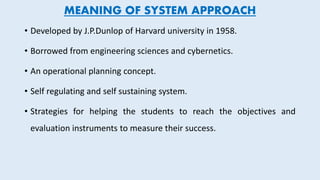
• Developed by J.P.Dunlop of Harvard university in 1958.
• Borrowed from engineering sciences and cybernetics.
• An operational planning concept.
• Self regulating and self sustaining system.
• Strategies for helping the students to reach the objectives and
evaluation instruments to measure their success.
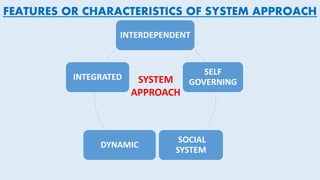
INTERDEPENDENT
SELF
GOVERNING
SOCIAL
SYSTEM
DYNAMIC
INTEGRATED SYSTEM
APPROACH
FEATURES OR CHARACTERISTICS OF SYSTEM APPROACH
SYSTEM APPROACH IS A……
Technique based on systems concept and its
parameters for understanding, predicting& controlling
the operation of a system in a given environment to
achieve the predetermined objectives in an efficient &
economic way.
COMPONENTS OF SYSTEM APPROACH
PROCESS
OUTPUT
ANALYSIS AND
FEEDBACK
INPUT
ENVIRONMENTAL
CONTEXT
STAGES OR STEPS OF SYSTEM APPROACH
 Analysis of existing situation and identification of problem.
 Setting up of goals for the desire situation and objectives.
 Analysis of the task involved in achieving the objectives.
 Analysis of input & constraints of the system in the context of the stipulated
objectives.
 System design &development-Generating alternative solutions
 Choosing the best possible solution through cost benefit analysis in given
context.
 Detailing the design of the system-operation & implementation of preferred
solution.
 Evaluation of the effectiveness of the performance in terms of specific
objectives.
 Providing feedback for modification and for improvement.
ROLE OF TEACHER IN SYSTEM APPROACH
ADVANTAGES OF SYSTEM APPROACH
Provides conceptual framework on planning and implementing the
changes in education.
Helps to identify the suitability to achieve the specific goal.
Helps to assess the resource needs, their sources and facilities in
relation to time, quantities and other factors.
Permits an orderly introduction of components demonstrated.
Rigidity in plan of action is avoided.
Technological advance could be used to provide integration of
machines, media, and people.
LIMITATIONS OF SYSTEM APPROACH
Needs more time- Results may come after a long time.
Old ways are difficult to erase-Resistance to any new method or approach.
Requires hard and continuous work which may not be expected from all
situations.
Not a remedy- Not suitable for all problems in education.
STRUCTURE OF AN INSTRUCTIONAL SYSTEM
TEACHERS
STUDENTS
CURRICULUM
CONTENT
INSTRUCTIONAL
MATERIAL
INSTRUCTIONAL
METHODS
STRATEGIES AND
APPROACHES
ATTAINMENT OF
INSTRUCTIONAL
OBJECTIVES
INPUT PROCESS OUTPUT
ENVIRONMENT
ENVIRONMENT
E
N
VI
R
O
N
M
R
N
T
E
N
VI
R
O
N
M
E
N
T
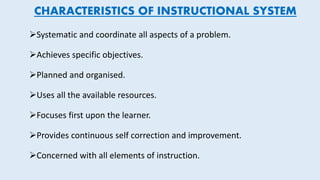
CHARACTERISTICS OF INSTRUCTIONAL SYSTEM
Systematic and coordinate all aspects of a problem.
Achieves specific objectives.
Planned and organised.
Uses all the available resources.
Focuses first upon the learner.
Provides continuous self correction and improvement.
Concerned with all elements of instruction.
EDUCATIONAL
OBJECTIVES
CHOOSE THE TOPIC AND ANALYSE
THE SUBJECT MATTER
WRITE INSTRUCTIONAL
OBJECTIVES
DO TASK ANALYSIS
CONSIDER TEST QUESTIONS
PREPARE TEACHING NOTES
TEACH
EVALUATE
MASS MEDIA METHODS
LEARNING CONDITIONS
EXAMPLE OF INSTRUCTIONAL SYSTEM
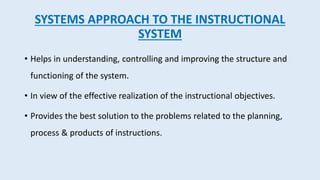
SYSTEMS APPROACH TO THE INSTRUCTIONAL
SYSTEM
• Helps in understanding, controlling and improving the structure and
functioning of the system.
• In view of the effective realization of the instructional objectives.
• Provides the best solution to the problems related to the planning,
process & products of instructions.
STAGES OF THE INSTRUCTIONAL SYSTEM
Defining or formulating instructional goals, behavioural objectives and stating
them in operational, measurable terms.
Determining functions related to the achievements of these goals by proper aids
like films, recording, video tapes etc.
Defining learner characteristics and requirement & assessing students entering
behaviour.
Choosing appropriate methods suitable for effective learning of the topic.
Selecting appropriate learning experiences from many alternatives available.
CONTINUED…..
Selecting appropriate materials, facilities, equipment, resources, environment,
tools required for students experiences
Defining and assigning appropriate personal roles- teachers- team teaching
members- supporting personnel- students
Implementing the programme- test with a few pupils in typical and appropriate
condition
Testing and evaluating the outcome in terms of original objectives measured in
student performance.
Refining and revising to improve education & student learning.
ROLE OF INSTRUCTOR IN INSTRUCTIONAL
SYSTEM
• Decides instructional method and media.
• System designer.
• Plans the utilization of selected resource material.
• Have a Good overall view of the subject.
• Continuous evaluation of learning outcomes.
• Analyses evaluation.
• Modifies the plan approach.
• Create and improve the system.
BEHAVIOURAL SCIENCE AND INSTRUCTIONAL
TECHNOLOGY
• Fundamental to instructional technology.
• Applied in support of the practical art of instruction.
• Calls for new organizational arrangements in education and the
development of high level of specialists who could assume the task of
instructional design in a research & development settings.
• Design of instructional system demands competence in the
behavioural science and in the subject matter.
COGNITIVISM & ITS APPLICATION IN EDUCATIONAL
TECHNOLOGY
• Cognitivism focuses on the mind, and more specifically, mental processes such as
thinking, knowing, memory, and problem solving.
• Cognitive theories view students as active in “an internal learning process that
involves memory, thinking, reflection, abstraction, motivation.
• Some great examples of Cognitivism in educational technology can be found in
online games and reinforcement activities, such as sorting games, puzzles, and
flashcards.
• The real focus of this approach is on changing the learner behaviour by
encouraging him/her to use appropriate learning strategies.
DIFFERENCE BETWEEN THE TWO APPROACHES
BEHAVIOURAL SCIENCE
 Fundamental principle- S-R Connection.
 Assumes human behaviour is predictable.
 Procedures to implement theories of
instructions.
 The study of behaviour for the purpose of
identifying its determinants.
 Employs mechanism as a fundamental
metaphor, which assumes that behaviour is
governed by a finite set of physical laws.
COGNITIVIST APPROACH
• Role of individual differences in
learning and their relevance to the
selection of instructional strategies
has been a prominent theme in
cognitive theory.
• Cognitivist was a reaction to
Behaviourism.
• It is the study of mental processes
through the scientific method and
abstraction from behaviour.
• Cognitivist employs mechanism and
information processing as the
principle metaphors for interpreting
findings.
CONTINUED………
BEHAVIOURAL SCIENCE
 Behaviourism, whose research subjects were
mostly animals, views behaviour as an
irreducible consequence of environmental
stimuli.
 Behaviourism focused on observable
behaviour and the response of humans to
environmental stimuli, cognitivist took into
account the human mind and complex
processes of the mind such as thinking,
problem solving, and memory.
COGNITIVIST APPROACH
• Cognitivist, whose research subjects are often
humans, sees behaviour as a point from
which to abstract the mental processes
behind the behaviour.
• Mental process and internal representation
Invalidates the assumptions of behavioural
theory.
• Theme -The role of individual differences in
learning and their relevance to the selection
of instructional strategies and metacognition.
BEHAVIOURAL SCIENCE(COGNITIVIST
APPROACH)
• change from behavioural to cognitive theories of learning
• ascendancy of cognitive theory and its replacement of behavioural
theory as the dominant paradigm in educational psychology and
technology.
• Behaviourism and Cognitivism are two movements in psychology that
have significant implications for viewing learning and education.
system approach.pptx

system approach.pptx

  • 1.
    SYSTEM APPROACH &COGNITIVIST APPROACH PREPAREDBY: BHABANI SENAPATI M.ED 2ND SEM
  • 2.
  • 3.
    CYBERNETICS • Derived fromGreek word-KUBERNETES meaning STEERSMAN/TO STEER/NAVIGATE/GOVERN. • The science of communication and control that can help in building as a self regulatory automatic feedback system similar to that found in animal, men and machines. THEORETICAL IDEAS AND PRINCIPLES OF CYBERNETICS Any system has three basic elements- input, process and output. The system can be classified as an open loop system and a closed loop system. Feedback mechanism in a cybernetic system.
  • 4.
    APPLICATION AND ADVANTAGEIN EDUCATION • Teaching and instructional process can be made self-regulatory and auto instructional. • Continuous reinforcement and motivation for self learning. • Proper control over the system of instruction as a whole. • Useful for remedial instructional activities. • Automatic feedback system and a mechanism for self improvement. • Method of good communication. • A proper training technology.
  • 5.
    RELATIONSHIP BETWEEN CYBERNETICSAND SYSTEM APPROACH • Cybernetic is a trans-disciplinary approach for exploring regulatory systems, their structure, constraints and possibilities. • Relevant to the study of system such as mechanical, physical, biological, cognitive and social system. • Applicable when a system is a closed loop system. • Fields which are influenced by cybernetics are sociology, psychology, philosophy etc. • Goal is to understand and define the functions and processes of systems that have goals.
  • 8.
    Disciplinary: Epistemologies, assumptions, knowledge,skills, methods within the boundary of a discipline. eg. Physics; History; Psychology Multidisciplinary: Using the knowledge/understanding of more than one discipline. eg Physics and History; Biology and Architecture Interdisciplinary: Using the epistemologies/methods of one discipline within another. eg. Biochemistry; Ecophilosophy; Astrophysics Transdisciplinary: Focus on an issue such as pollution or hunger both within and beyond discipline boundaries with the possibility of new perspectives.
  • 9.
    ORIGIN OF THECONCEPT SYSTEM • The term "system" comes from the Latin word systēma, "whole compounded of several parts or members, literary "composition“. • A system is of interrelated and interdependent parts arranged or organised in a complex manner that produces a unified whole. • The term system may also refer to a set of rules that governs structure and/or behaviour. . • A system is a Combination of parts(subsystem) which have various subparts. Ex-organization, human body etc.
  • 10.
    CONCEPT OF SYSTEM •Process taken as a whole incorporating all its aspects like pupils, teachers, curriculum content, evaluation etc. • A self-maintaining and self-regulating device consisting of interrelated & interacting elements or self-governing system operating as a whole to achieve the predetermined purposes or goals with utmost efficiency, economy & productivity.
  • 11.
    TYPES OF SYSTEM MANMADE SYSTEM NATURAL SYSTEM BEYONDHUMAN CONTROL CREATION OF NATURE BEHAVIOUR CAN NOT BE DETERMINED DELIBEARTELY DESIGNED EX-TELEPHONE, EDUCATION EX-SOLAR, HUMAN BODY SYSTEM CONTROLLED FUNCTIONING BEHAVIOUR CAN BE PREDICATED
  • 13.
    MEANING OF SYSTEMAPPROACH • Developed by J.P.Dunlop of Harvard university in 1958. • Borrowed from engineering sciences and cybernetics. • An operational planning concept. • Self regulating and self sustaining system. • Strategies for helping the students to reach the objectives and evaluation instruments to measure their success.
  • 14.
  • 15.
    SYSTEM APPROACH ISA…… Technique based on systems concept and its parameters for understanding, predicting& controlling the operation of a system in a given environment to achieve the predetermined objectives in an efficient & economic way.
  • 16.
    COMPONENTS OF SYSTEMAPPROACH PROCESS OUTPUT ANALYSIS AND FEEDBACK INPUT ENVIRONMENTAL CONTEXT
  • 19.
    STAGES OR STEPSOF SYSTEM APPROACH  Analysis of existing situation and identification of problem.  Setting up of goals for the desire situation and objectives.  Analysis of the task involved in achieving the objectives.  Analysis of input & constraints of the system in the context of the stipulated objectives.  System design &development-Generating alternative solutions  Choosing the best possible solution through cost benefit analysis in given context.  Detailing the design of the system-operation & implementation of preferred solution.  Evaluation of the effectiveness of the performance in terms of specific objectives.  Providing feedback for modification and for improvement.
  • 20.
    ROLE OF TEACHERIN SYSTEM APPROACH
  • 21.
    ADVANTAGES OF SYSTEMAPPROACH Provides conceptual framework on planning and implementing the changes in education. Helps to identify the suitability to achieve the specific goal. Helps to assess the resource needs, their sources and facilities in relation to time, quantities and other factors. Permits an orderly introduction of components demonstrated. Rigidity in plan of action is avoided. Technological advance could be used to provide integration of machines, media, and people.
  • 22.
    LIMITATIONS OF SYSTEMAPPROACH Needs more time- Results may come after a long time. Old ways are difficult to erase-Resistance to any new method or approach. Requires hard and continuous work which may not be expected from all situations. Not a remedy- Not suitable for all problems in education.
  • 23.
    STRUCTURE OF ANINSTRUCTIONAL SYSTEM TEACHERS STUDENTS CURRICULUM CONTENT INSTRUCTIONAL MATERIAL INSTRUCTIONAL METHODS STRATEGIES AND APPROACHES ATTAINMENT OF INSTRUCTIONAL OBJECTIVES INPUT PROCESS OUTPUT ENVIRONMENT ENVIRONMENT E N VI R O N M R N T E N VI R O N M E N T
  • 24.
    CHARACTERISTICS OF INSTRUCTIONALSYSTEM Systematic and coordinate all aspects of a problem. Achieves specific objectives. Planned and organised. Uses all the available resources. Focuses first upon the learner. Provides continuous self correction and improvement. Concerned with all elements of instruction.
  • 25.
    EDUCATIONAL OBJECTIVES CHOOSE THE TOPICAND ANALYSE THE SUBJECT MATTER WRITE INSTRUCTIONAL OBJECTIVES DO TASK ANALYSIS CONSIDER TEST QUESTIONS PREPARE TEACHING NOTES TEACH EVALUATE MASS MEDIA METHODS LEARNING CONDITIONS EXAMPLE OF INSTRUCTIONAL SYSTEM
  • 26.
    SYSTEMS APPROACH TOTHE INSTRUCTIONAL SYSTEM • Helps in understanding, controlling and improving the structure and functioning of the system. • In view of the effective realization of the instructional objectives. • Provides the best solution to the problems related to the planning, process & products of instructions.
  • 27.
    STAGES OF THEINSTRUCTIONAL SYSTEM Defining or formulating instructional goals, behavioural objectives and stating them in operational, measurable terms. Determining functions related to the achievements of these goals by proper aids like films, recording, video tapes etc. Defining learner characteristics and requirement & assessing students entering behaviour. Choosing appropriate methods suitable for effective learning of the topic. Selecting appropriate learning experiences from many alternatives available.
  • 28.
    CONTINUED….. Selecting appropriate materials,facilities, equipment, resources, environment, tools required for students experiences Defining and assigning appropriate personal roles- teachers- team teaching members- supporting personnel- students Implementing the programme- test with a few pupils in typical and appropriate condition Testing and evaluating the outcome in terms of original objectives measured in student performance. Refining and revising to improve education & student learning.
  • 29.
    ROLE OF INSTRUCTORIN INSTRUCTIONAL SYSTEM • Decides instructional method and media. • System designer. • Plans the utilization of selected resource material. • Have a Good overall view of the subject. • Continuous evaluation of learning outcomes. • Analyses evaluation. • Modifies the plan approach. • Create and improve the system.
  • 31.
    BEHAVIOURAL SCIENCE ANDINSTRUCTIONAL TECHNOLOGY • Fundamental to instructional technology. • Applied in support of the practical art of instruction. • Calls for new organizational arrangements in education and the development of high level of specialists who could assume the task of instructional design in a research & development settings. • Design of instructional system demands competence in the behavioural science and in the subject matter.
  • 32.
    COGNITIVISM & ITSAPPLICATION IN EDUCATIONAL TECHNOLOGY • Cognitivism focuses on the mind, and more specifically, mental processes such as thinking, knowing, memory, and problem solving. • Cognitive theories view students as active in “an internal learning process that involves memory, thinking, reflection, abstraction, motivation. • Some great examples of Cognitivism in educational technology can be found in online games and reinforcement activities, such as sorting games, puzzles, and flashcards. • The real focus of this approach is on changing the learner behaviour by encouraging him/her to use appropriate learning strategies.
  • 33.
    DIFFERENCE BETWEEN THETWO APPROACHES BEHAVIOURAL SCIENCE  Fundamental principle- S-R Connection.  Assumes human behaviour is predictable.  Procedures to implement theories of instructions.  The study of behaviour for the purpose of identifying its determinants.  Employs mechanism as a fundamental metaphor, which assumes that behaviour is governed by a finite set of physical laws. COGNITIVIST APPROACH • Role of individual differences in learning and their relevance to the selection of instructional strategies has been a prominent theme in cognitive theory. • Cognitivist was a reaction to Behaviourism. • It is the study of mental processes through the scientific method and abstraction from behaviour. • Cognitivist employs mechanism and information processing as the principle metaphors for interpreting findings.
  • 34.
    CONTINUED……… BEHAVIOURAL SCIENCE  Behaviourism,whose research subjects were mostly animals, views behaviour as an irreducible consequence of environmental stimuli.  Behaviourism focused on observable behaviour and the response of humans to environmental stimuli, cognitivist took into account the human mind and complex processes of the mind such as thinking, problem solving, and memory. COGNITIVIST APPROACH • Cognitivist, whose research subjects are often humans, sees behaviour as a point from which to abstract the mental processes behind the behaviour. • Mental process and internal representation Invalidates the assumptions of behavioural theory. • Theme -The role of individual differences in learning and their relevance to the selection of instructional strategies and metacognition.
  • 35.
    BEHAVIOURAL SCIENCE(COGNITIVIST APPROACH) • changefrom behavioural to cognitive theories of learning • ascendancy of cognitive theory and its replacement of behavioural theory as the dominant paradigm in educational psychology and technology. • Behaviourism and Cognitivism are two movements in psychology that have significant implications for viewing learning and education.