Presentation on

SYSTEM
APPROACH TO
EDUCATION
System approach
Neils view: “System approach
to education is defined as a
particular method of
exploration to find effective
ways of talking about,
designing and organizing
learning situation in
System approach applied to
educational situation implies

 Standards of output performance.
 Planned input and processes involving
organised learning materials and methods.
 Monitored output in which the use is to
revise, improve and evaluate the
instructional system providing feedback to
the learner and teacher.
 A degree of inbuilt flexibility to adjust to
individual situation.
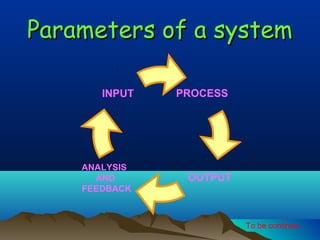
Parameters of a system
INPUT

ANALYSIS
AND
FEEDBACK

PROCESS

OUTPUT

To be continue…
 INPUT
Input refers applied to what is put into a
system
o
o
o
o
o
o
o
o

Student
Teacher
Administration
Curriculum
Instructional material
Job opportunity
Rural and urban local institute
Hostel facility
To be continue…
 Process
Process refers to what goes on in a system
o Curriculum
o Institute
o Facility
o Teachers

 Output
output is the product of a system. Monitored output
which is used to revise, improve and evaluate the
instructional system.
To be continue…
 Analysis and feedback
Monitored environment provides
feedback to the learner and
teacher. A system operates in a
physical and social
environment. A system cannot
operates beyond the limits and
boundaries of its environment
context and constraints.
PURPOSES AND USES OF SYSTEM
APPROACH IN EDUCATION

 Improvement in instructional system :
System approach can effectively improve
the instructional system. In instructional system, certain
interactive and interrelated elements are operating in a
systematic way to achieve stipulated instructional
objectives.
 Inputs: Inputs are teachers, students, curriculum, content,
instructional material.
 Process: It includes instructional methods strategies and
approaches.
 Output: Output are attainment of instructional objectives.



Improvement in co-curriculum activities: It helps

in bringing improvement in the organization of curriculum
activities and other educational aspects for maximum
development of personality.



Improvement in training: It helps in improvingcontinue…
To be

training and development programmes.
 Utilization of resources: Utilization of human and
non human material and resources can utilize more
effectively the schools personnel by controlling,
coordinating and evaluating continuously the activities of
all the personnel.



Increase control and coordination: Coordination

among different parts is exercised as a result of the
achievement of specific objectives at level of operation.



Improvement in school affairs: System approach

may help in managing and improving the school affairs by
bringing efficiency in the school management and
administration.



Improvement in planning: It helps in systematic
educational planning in terms of long range goals
and specific short range objectives.



Improvement in evaluation: It helps in bringing

To be continue…
improvement in the examination and evaluation system.
 Improvement in guidance: System approach in
education can help in organizing and improving the
guidance service of the school.

 Improvement in non-formal and adult
education: System approach in education can prove an
effective means for designing, controlling and improving
the system of non-formal and adult education.

 Improvement in quality of education: It has full
potentiality to provide quite effective control to the process
and products of education by solving the various problems
related to education.

Thus the main use of system
approach n education is to improve the
quality of education.
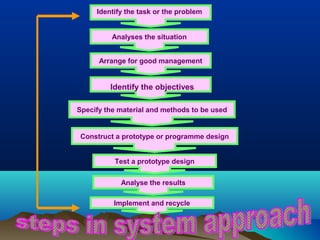
Identify the task or the problem
Analyses the situation
Arrange for good management

Identify the objectives
Specify the material and methods to be used

Construct a prototype or programme design
Test a prototype design
Analyse the results
Implement and recycle
Model instructional area
AREA: Learning to speaking ENGLISH
Step 1: Identify the task or the problem:
An English teacher finds out that there students are not able to
speak English properly. So they try to develop an Instructional
System to train the student to speak English with fluency and good
pronunciation

Step 2: Analyse the situation
The English teachers, developing the instructional system, find
out that their students, coming from lower middle class families
are not exposed to spoken English. List of available resources,
both in a school as well as in the community, which could be
utilized for speech practice, is prepared. This list may include
tape records, radios, television, lingua phone records, audio
cassettes, projectors, chats, diagrams etc. If a language
laboratory is available in the school or in the nearby
community, it will be ideal for giving speech practice. If a
To be continue….
language laboratory is not available at least a good number of
Step 3: Arrange for good management
There should be very good co-ordination among the teachers
developing Instructional system. Each one is to be assigned some
responsibilities.

Step 4: Identify the objects

The terminal objectives may be stated in general terms as well as in
specific terms.
(A)The students, at the end of the instruction, will be able to speak
in English with fluency and good pronunciation.
(B) They can distinguish between sound pattern.

Step 5 : Specify the materials and method to be
used
(1) Audio tape recorder
(2) Radio
(3) Chart of vowels, diphthongs and consonants
(4) Film-strips, slides etc. for visual presentation
(5) Television

To be continue….
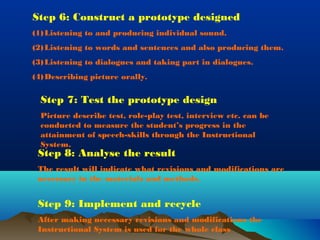
Step 6: Construct a prototype designed
(1) Listening to and producing individual sound.
(2) Listening to words and sentences and also producing them.
(3) Listening to dialogues and taking part in dialogues.
(4) Describing picture orally.

Step 7: Test the prototype design
Picture describe test, role-play test, interview etc. can be
conducted to measure the student’s progress in the
attainment of speech-skills through the Instructional
System.

Step 8: Analyse the result

The result will indicate what revisions and modifications are
necessary in the materials and methods.

Step 9: Implement and recycle
After making necessary revisions and modifications the
Instructional System is used for the whole class
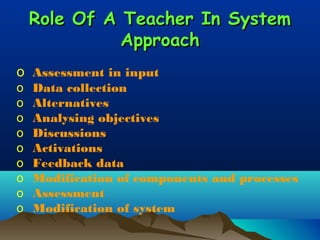
Role Of A Teacher In System
Approach
o Assessment in input
o
o
o
o
o
o
o
o
o

Data collection
Alternatives
Analysing objectives
Discussions
Activations
Feedback data
Modification of components and processes
Assessment
Modification of system
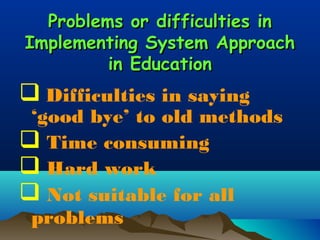
Problems or difficulties in
Implementing System Approach
in Education

 Difficulties in saying

‘good bye’ to old methods
 Time consuming
 Hard work
 Not suitable for all
problems
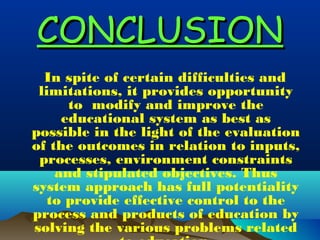
CONCLUSION
In spite of certain difficulties and
limitations, it provides opportunity
to modify and improve the
educational system as best as
possible in the light of the evaluation
of the outcomes in relation to inputs,
processes, environment constraints
and stipulated objectives. Thus
system approach has full potentiality
to provide effective control to the
process and products of education by
solving the various problems related
System approach

System approach

  • 1.
  • 2.
    System approach Neils view:“System approach to education is defined as a particular method of exploration to find effective ways of talking about, designing and organizing learning situation in
  • 3.
    System approach appliedto educational situation implies  Standards of output performance.  Planned input and processes involving organised learning materials and methods.  Monitored output in which the use is to revise, improve and evaluate the instructional system providing feedback to the learner and teacher.  A degree of inbuilt flexibility to adjust to individual situation.
  • 4.
    Parameters of asystem INPUT ANALYSIS AND FEEDBACK PROCESS OUTPUT To be continue…
  • 5.
     INPUT Input refersapplied to what is put into a system o o o o o o o o Student Teacher Administration Curriculum Instructional material Job opportunity Rural and urban local institute Hostel facility To be continue…
  • 6.
     Process Process refersto what goes on in a system o Curriculum o Institute o Facility o Teachers  Output output is the product of a system. Monitored output which is used to revise, improve and evaluate the instructional system. To be continue…
  • 7.
     Analysis andfeedback Monitored environment provides feedback to the learner and teacher. A system operates in a physical and social environment. A system cannot operates beyond the limits and boundaries of its environment context and constraints.
  • 8.
    PURPOSES AND USESOF SYSTEM APPROACH IN EDUCATION  Improvement in instructional system : System approach can effectively improve the instructional system. In instructional system, certain interactive and interrelated elements are operating in a systematic way to achieve stipulated instructional objectives.  Inputs: Inputs are teachers, students, curriculum, content, instructional material.  Process: It includes instructional methods strategies and approaches.  Output: Output are attainment of instructional objectives.  Improvement in co-curriculum activities: It helps in bringing improvement in the organization of curriculum activities and other educational aspects for maximum development of personality.  Improvement in training: It helps in improvingcontinue… To be training and development programmes.
  • 9.
     Utilization ofresources: Utilization of human and non human material and resources can utilize more effectively the schools personnel by controlling, coordinating and evaluating continuously the activities of all the personnel.  Increase control and coordination: Coordination among different parts is exercised as a result of the achievement of specific objectives at level of operation.  Improvement in school affairs: System approach may help in managing and improving the school affairs by bringing efficiency in the school management and administration.  Improvement in planning: It helps in systematic educational planning in terms of long range goals and specific short range objectives.  Improvement in evaluation: It helps in bringing To be continue… improvement in the examination and evaluation system.
  • 10.
     Improvement inguidance: System approach in education can help in organizing and improving the guidance service of the school.  Improvement in non-formal and adult education: System approach in education can prove an effective means for designing, controlling and improving the system of non-formal and adult education.  Improvement in quality of education: It has full potentiality to provide quite effective control to the process and products of education by solving the various problems related to education. Thus the main use of system approach n education is to improve the quality of education.
  • 11.
    Identify the taskor the problem Analyses the situation Arrange for good management Identify the objectives Specify the material and methods to be used Construct a prototype or programme design Test a prototype design Analyse the results Implement and recycle
  • 12.
    Model instructional area AREA:Learning to speaking ENGLISH Step 1: Identify the task or the problem: An English teacher finds out that there students are not able to speak English properly. So they try to develop an Instructional System to train the student to speak English with fluency and good pronunciation Step 2: Analyse the situation The English teachers, developing the instructional system, find out that their students, coming from lower middle class families are not exposed to spoken English. List of available resources, both in a school as well as in the community, which could be utilized for speech practice, is prepared. This list may include tape records, radios, television, lingua phone records, audio cassettes, projectors, chats, diagrams etc. If a language laboratory is available in the school or in the nearby community, it will be ideal for giving speech practice. If a To be continue…. language laboratory is not available at least a good number of
  • 13.
    Step 3: Arrangefor good management There should be very good co-ordination among the teachers developing Instructional system. Each one is to be assigned some responsibilities. Step 4: Identify the objects The terminal objectives may be stated in general terms as well as in specific terms. (A)The students, at the end of the instruction, will be able to speak in English with fluency and good pronunciation. (B) They can distinguish between sound pattern. Step 5 : Specify the materials and method to be used (1) Audio tape recorder (2) Radio (3) Chart of vowels, diphthongs and consonants (4) Film-strips, slides etc. for visual presentation (5) Television To be continue….
  • 14.
    Step 6: Constructa prototype designed (1) Listening to and producing individual sound. (2) Listening to words and sentences and also producing them. (3) Listening to dialogues and taking part in dialogues. (4) Describing picture orally. Step 7: Test the prototype design Picture describe test, role-play test, interview etc. can be conducted to measure the student’s progress in the attainment of speech-skills through the Instructional System. Step 8: Analyse the result The result will indicate what revisions and modifications are necessary in the materials and methods. Step 9: Implement and recycle After making necessary revisions and modifications the Instructional System is used for the whole class
  • 15.
    Role Of ATeacher In System Approach o Assessment in input o o o o o o o o o Data collection Alternatives Analysing objectives Discussions Activations Feedback data Modification of components and processes Assessment Modification of system
  • 16.
    Problems or difficultiesin Implementing System Approach in Education  Difficulties in saying ‘good bye’ to old methods  Time consuming  Hard work  Not suitable for all problems
  • 17.
    CONCLUSION In spite ofcertain difficulties and limitations, it provides opportunity to modify and improve the educational system as best as possible in the light of the evaluation of the outcomes in relation to inputs, processes, environment constraints and stipulated objectives. Thus system approach has full potentiality to provide effective control to the process and products of education by solving the various problems related