Presenter:
Deepti Kothari
ID- 38293
System
 Derived from Greek word Systema.
 Refers to set of parts or components
interconnected naturally or manually to form
unit and accomplish certain objectives by
means of tasks.
 Set of concepts, definitions, and propositions
that explain or predict relationships between
events/situations
e.g. A computer.
Definitions
 The sum total of separate parts working
independently and in interaction to achieve
previously specified objectives.
- Kaufman
 System is a group of components consisting
of humans and or non-human components
who organized and arranged so that the
components can act as a unity in achieving its
objectives, common goals or outcomes.
- H. Kerzner
 System is a whole that functions as a whole
by virtue of interdependence of its parts.
-Buckley
 System is essentially a set of components,
elements, which are related to each other,
interplay and interdependence, so that the
whole is an integrated unit or a totality, and
has a specific role or purpose.
-Institute of Public Administration(IPA)
SYSTEM
INPUT
• Information
• Students
• Faculty
• Resources
PROCESSOR
/ PROCESS
• Teaching-
Learning
Process
OUTPUT
• Educated
students
and
teaching
faculty
BOUNDARY
&
INTERFACE
ENVIRONMENT
CONTROL
FEEDBACK
Characteristics of System
 Hierarchy
 Synergy
 Interconnections and dependence (Inside
and outside)
 Boundaries (Closed and open)
 Structure (Inside and outside area)
 Behavior (Tasks/activities for goal seeking)
 Control mechanism
 Equilibrium
 Differentiation and elaboration
Instruction System
• Instruction system is a set of events that
affect students, leading to the learning
process.
- Gagne and Atwi
• Instruction system is an organized
combination which includes the elements
of human, material, facilities, equipment,
and procedures that interact to achieve a
purpose.
- Oemar Hamalik
Components of Instruction
System
 Student
 Objectives
 Conditions
 Learning resources
 Learning outcomes
Factors affecting Instruction System
Instruction
system
Student
Teacher
EnvironmentEquipment
Infrastructure
Systems Approach to Instruction
• A systematic process of solving problems,
analyzing and reaching to systematic
conclusions on educational/instructional
problems.
• Calculate possibilities dealing with
institutional problems and developmental
issues.
• The approach comprise of two parts-
 System analysis and
 System synthesis
• Focus on-
 Process orientation and
 Product orientation
Kaufman’s model of System approach
to Education
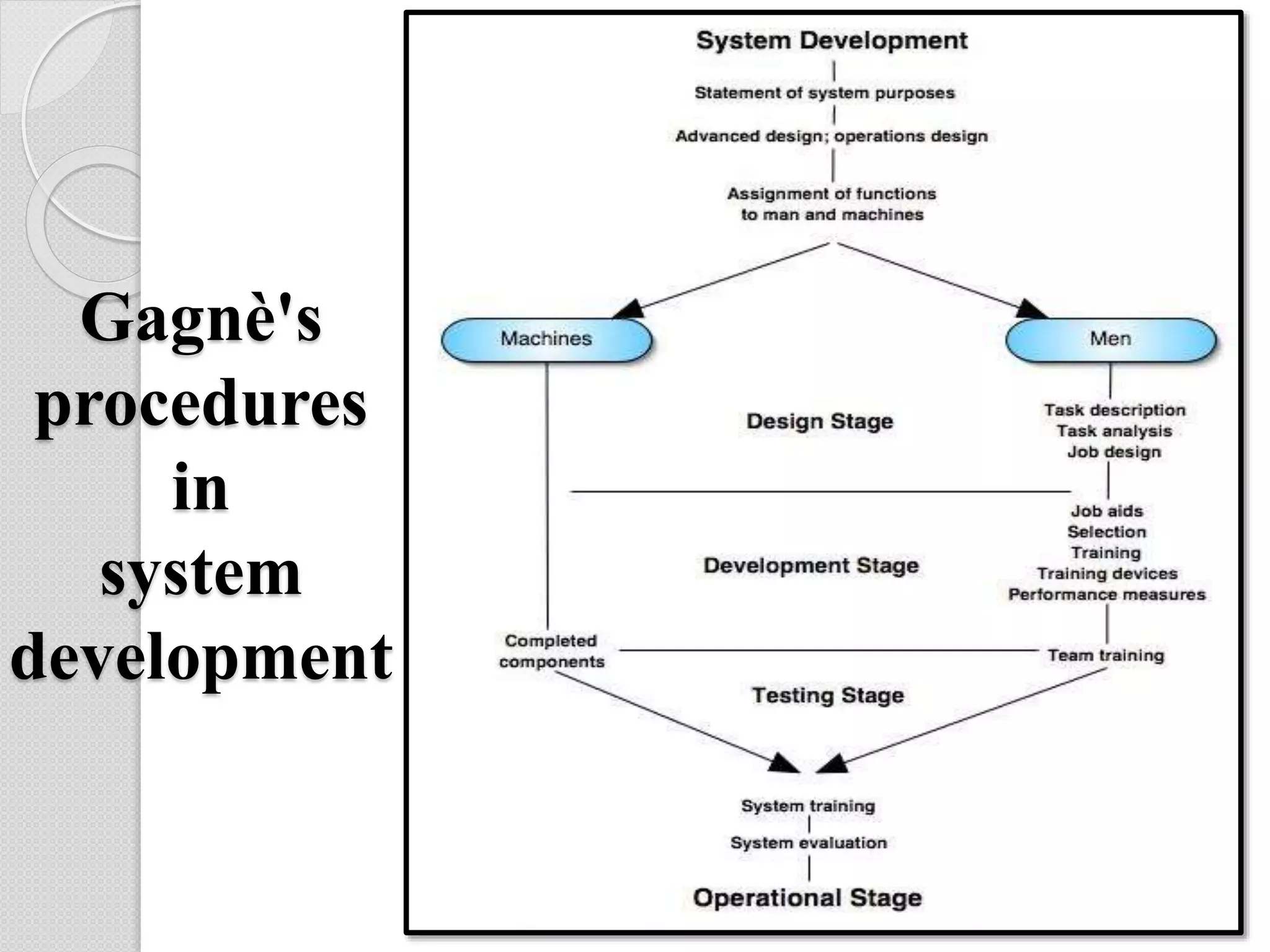
Gagnè's
procedures
in
system
development
Advantages
• Effective planning by planners and
implementers
• Optimization of available potential
resources
• Provide feedback
• Increases learning and its outcome
• Decreases frustration and increases
achievement of students
• Focus on impact of environmental changes
• Explain synergy & interdependence
References
₪ Saettler, Paul (1990). The Evolution of American
Educational Technology. Englewood, Colorado:
Libraries Unlimited, Inc.
₪ K.L Kumar- Educational Technology
₪ http://mennta.hi.is/starfsfolk/solrunb/system.htm
₪ http://victor-gp.blogspot.in/2011/07/system-approach-
to-instruction.html
₪ https://en.wikibooks.org/wiki/Systems_Theory/Systems
_Approach_to_Instruction
₪ http://edutech202.blogspot.in/2012/12/the-concept-of-
system-approach-to.html

System approach to management

  • 1.
  • 2.
    System  Derived fromGreek word Systema.  Refers to set of parts or components interconnected naturally or manually to form unit and accomplish certain objectives by means of tasks.  Set of concepts, definitions, and propositions that explain or predict relationships between events/situations e.g. A computer.
  • 3.
    Definitions  The sumtotal of separate parts working independently and in interaction to achieve previously specified objectives. - Kaufman  System is a group of components consisting of humans and or non-human components who organized and arranged so that the components can act as a unity in achieving its objectives, common goals or outcomes. - H. Kerzner
  • 4.
     System isa whole that functions as a whole by virtue of interdependence of its parts. -Buckley  System is essentially a set of components, elements, which are related to each other, interplay and interdependence, so that the whole is an integrated unit or a totality, and has a specific role or purpose. -Institute of Public Administration(IPA)
  • 5.
    SYSTEM INPUT • Information • Students •Faculty • Resources PROCESSOR / PROCESS • Teaching- Learning Process OUTPUT • Educated students and teaching faculty BOUNDARY & INTERFACE ENVIRONMENT CONTROL FEEDBACK
  • 6.
    Characteristics of System Hierarchy  Synergy  Interconnections and dependence (Inside and outside)  Boundaries (Closed and open)  Structure (Inside and outside area)  Behavior (Tasks/activities for goal seeking)  Control mechanism  Equilibrium  Differentiation and elaboration
  • 7.
    Instruction System • Instructionsystem is a set of events that affect students, leading to the learning process. - Gagne and Atwi • Instruction system is an organized combination which includes the elements of human, material, facilities, equipment, and procedures that interact to achieve a purpose. - Oemar Hamalik
  • 8.
    Components of Instruction System Student  Objectives  Conditions  Learning resources  Learning outcomes
  • 9.
    Factors affecting InstructionSystem Instruction system Student Teacher EnvironmentEquipment Infrastructure
  • 10.
    Systems Approach toInstruction • A systematic process of solving problems, analyzing and reaching to systematic conclusions on educational/instructional problems. • Calculate possibilities dealing with institutional problems and developmental issues.
  • 11.
    • The approachcomprise of two parts-  System analysis and  System synthesis • Focus on-  Process orientation and  Product orientation
  • 12.
    Kaufman’s model ofSystem approach to Education
  • 13.
  • 14.
    Advantages • Effective planningby planners and implementers • Optimization of available potential resources • Provide feedback • Increases learning and its outcome • Decreases frustration and increases achievement of students • Focus on impact of environmental changes • Explain synergy & interdependence
  • 15.
    References ₪ Saettler, Paul(1990). The Evolution of American Educational Technology. Englewood, Colorado: Libraries Unlimited, Inc. ₪ K.L Kumar- Educational Technology ₪ http://mennta.hi.is/starfsfolk/solrunb/system.htm ₪ http://victor-gp.blogspot.in/2011/07/system-approach- to-instruction.html ₪ https://en.wikibooks.org/wiki/Systems_Theory/Systems _Approach_to_Instruction ₪ http://edutech202.blogspot.in/2012/12/the-concept-of- system-approach-to.html