Curriculum as Processand Practice
Dr. Deivam M
Assistant Professor
Department of Education
H.N.B Garhwal University (A Central University)
S.R.T Campus, Tehri Garhwal
Uttarakhand – 249 199
2.
Introduction
•Curriculum as processemphasizes the dynamic
interactions between teachers, students, and
knowledge, focusing on what actually happens in
the classroom rather than just planned outcomes or
content lists.
•Curriculum as practice refers to the lived
experiences of both teachers and students as they
engage with educational content, methods, and each
other, highlighting the importance of context,
negotiation, and adaptation in real educational
settings.
3.
Curriculum as Process
•Theprocess model views curriculum as an
ongoing, interactive activity rather than a static
product or syllabus.
•Teachers enter the classroom with a proposal for
action-essential principles and features of the
educational encounter-but these are open to
interpretation and adaptation during teaching.
•Learning is seen as an active, evolving process
shaped by the interactions among students,
teachers, and the environment.
4.
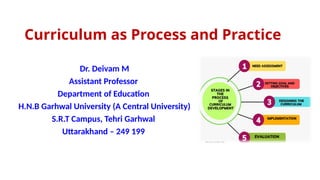
Steps in theCurricular Process
•Formulating Educational Objectives:
Set goals based on philosophy to guide curriculum direction.
•Selecting Content:
Choose and organize material that meets educational aims and
student needs.
•Organizing Content:
Arrange knowledge and skills for smooth progression and
connection.
•Selecting Learning Experiences:
Provide meaningful activities that link students with their
environment.
•Evaluating the Curriculum:
Measure student progress to check if the curriculum is effective.
•Assessing Educational Needs:
Identify real, felt, and observed needs to keep the curriculum
relevant.
•Development Tryout:
Test the curriculum using real data to check its usefulness,
reliability, and validity.
5.
Characteristics
• Curriculum asprocess is experimental, viewing
each classroom as a “laboratory” where teaching
strategies are tested and refined.
• It values critical scrutiny, adaptability, and
ongoing improvement rather than rigid
adherence to predetermined outcomes.
• The teacher’s role is as a facilitator, guiding
learning based on principles and adapting to
students’ needs and responses
6.
Curriculum as Practice
•Curriculumas practice centers on what students
and teachers actually do-how curriculum is
enacted and experienced in real settings.
•It includes not just intended learning outcomes
but also the feelings, habits, social behaviors,
and skills developed through classroom
interactions.
•Practice involves of meaning between teachers
and students cooperation, adaptation, and the
co-construction
7.
Emphasis
• Focuses onthe lived curriculum-the real
experiences and learning processes of
students, beyond what is documented in official
plans or syllabi.
• Recognizes that curriculum is constructed daily
through the actions and decisions of participants
in the educational process.
• Encourages reflective practice, where teachers
and students critically examine and adapt their
approaches to maximize learning and relevance