


TERM PAPER ON 
SYNTHETIC PYRETHROIDS 
Course Incharge: 
Dr.Sridharan sir, 
Department of Agricultural Entomology, 
CPPS ,TNAU.
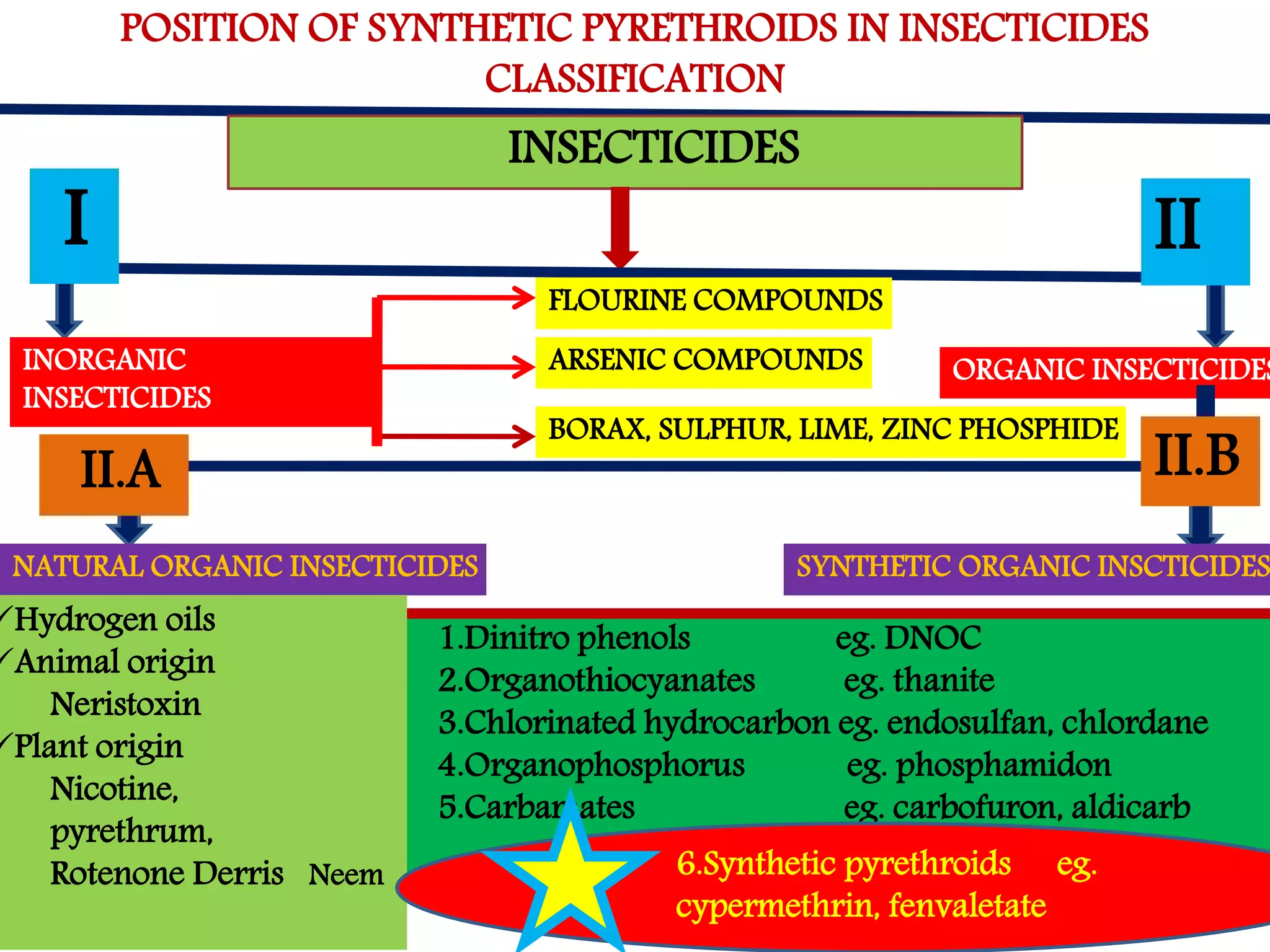
POSITION OF SYNTHETIC PYRETHROIDS IN INSECTICIDES 
CLASSIFICATION 
INSECTICIDES 
I II 
INORGANIC 
INSECTICIDES 
FLOURINE COMPOUNDS 
ARSENIC COMPOUNDS 
BORAX, SULPHUR, LIME, ZINC PHOSPHIDE 
ORGANIC INSECTICIDES 
II.A II.B 
NATURAL ORGANIC INSECTICIDES SYNTHETIC ORGANIC INSCTICIDES 
1.Dinitro phenols eg. DNOC 
2.Organothiocyanates eg. thanite 
3.Chlorinated hydrocarbon eg. endosulfan, chlordane 
4.Organophosphorus eg. phosphamidon 
5.Carbamates eg. carbofuron, aldicarb 
Hydrogen oils 
Animal origin 
Neristoxin 
Plant origin 
Nicotine, 
pyrethrum, 
Rotenone Derris Neem 6.Synthetic pyrethroids eg. 
cypermethrin, fenvaletate
?
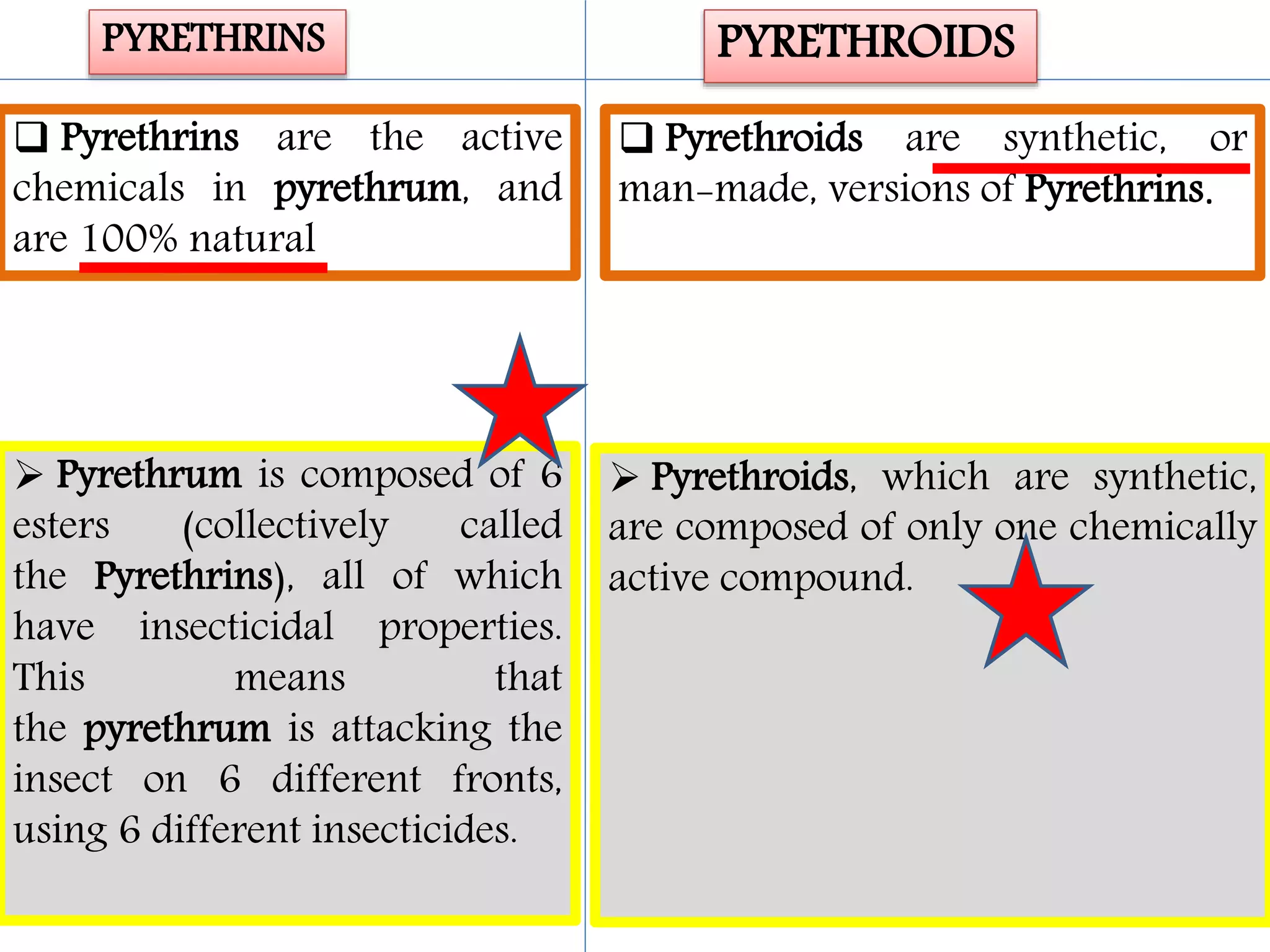
PYRETHRINS PYRETHROIDS 
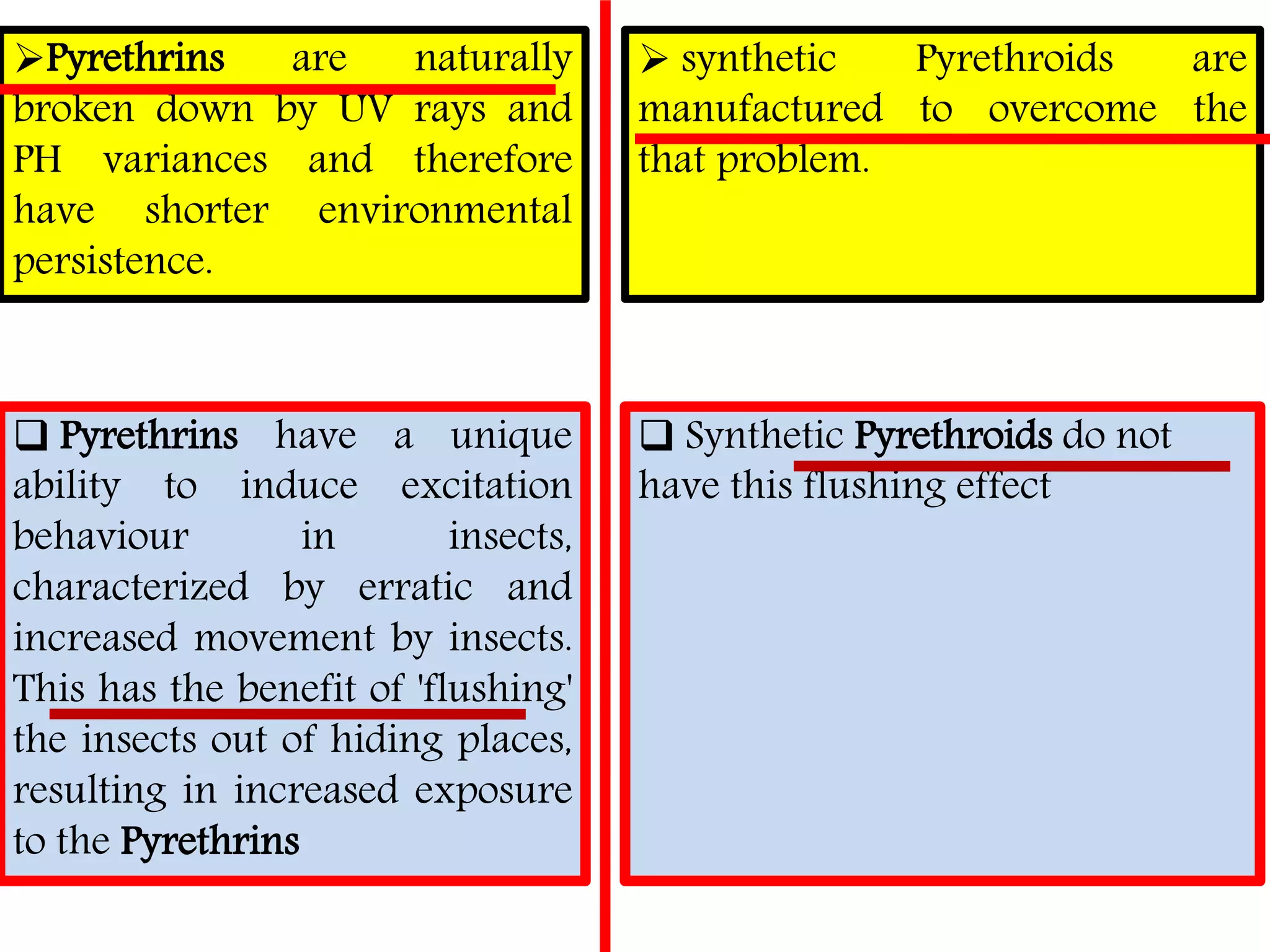
 Pyrethrins are the active 
chemicals in pyrethrum, and 
are 100% natural 
 Pyrethroids are synthetic, or 
man-made, versions of Pyrethrins. 
 Pyrethrum is composed of 6 
esters (collectively called 
the Pyrethrins), all of which 
have insecticidal properties. 
This means that 
the pyrethrum is attacking the 
insect on 6 different fronts, 
using 6 different insecticides. 
 Pyrethroids, which are synthetic, 
are composed of only one chemically 
active compound.
 Pyrethrins have a unique 
ability to induce excitation 
behaviour in insects, 
characterized by erratic and 
increased movement by insects. 
This has the benefit of 'flushing' 
the insects out of hiding places, 
resulting in increased exposure 
to the Pyrethrins 
 Synthetic Pyrethroids do not 
have this flushing effect 
Pyrethrins are naturally 
broken down by UV rays and 
PH variances and therefore 
have shorter environmental 
persistence. 
 synthetic Pyrethroids are 
manufactured to overcome the 
that problem.
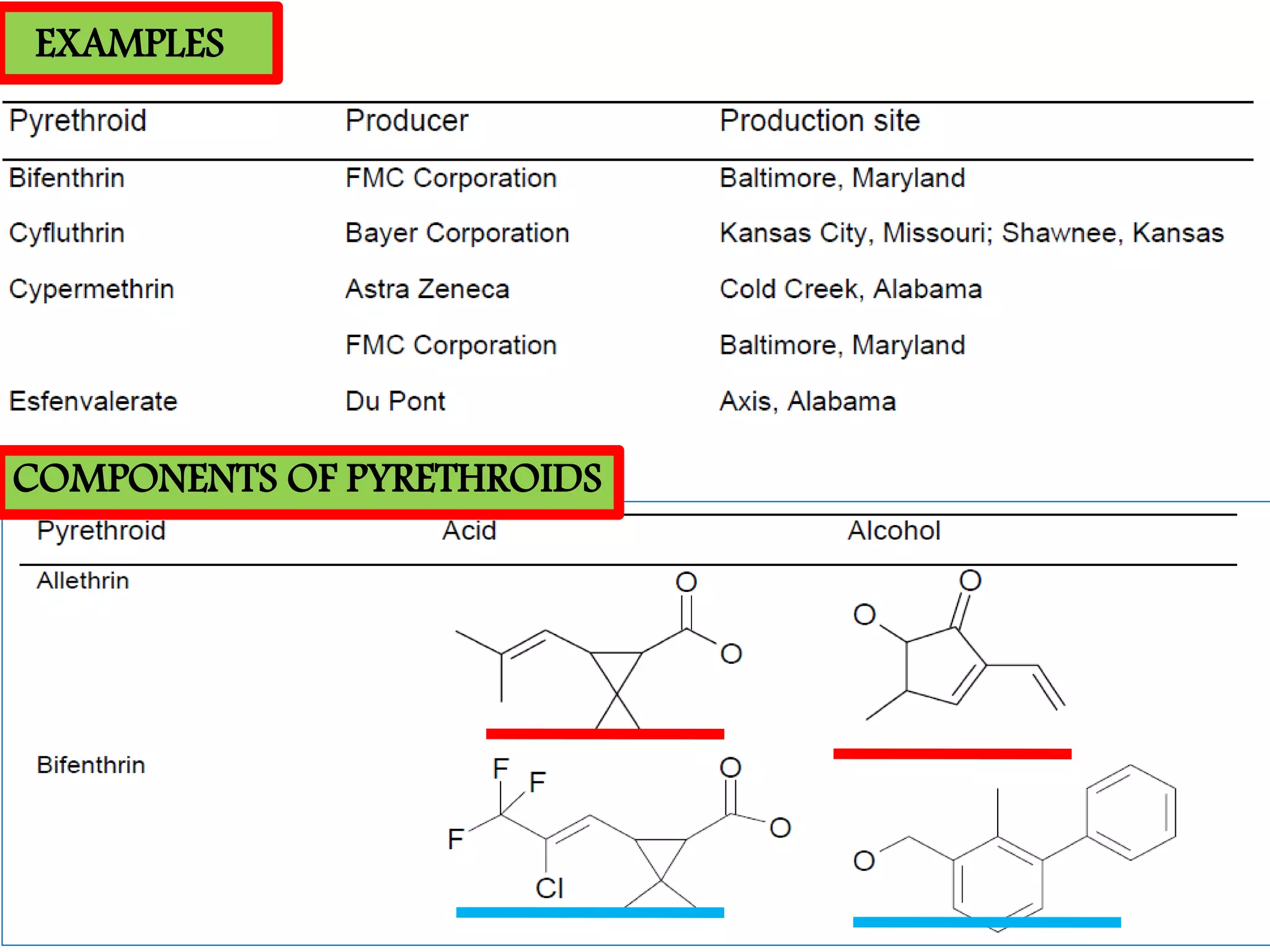
EXAMPLES 
COMPONENTS OF PYRETHROIDS
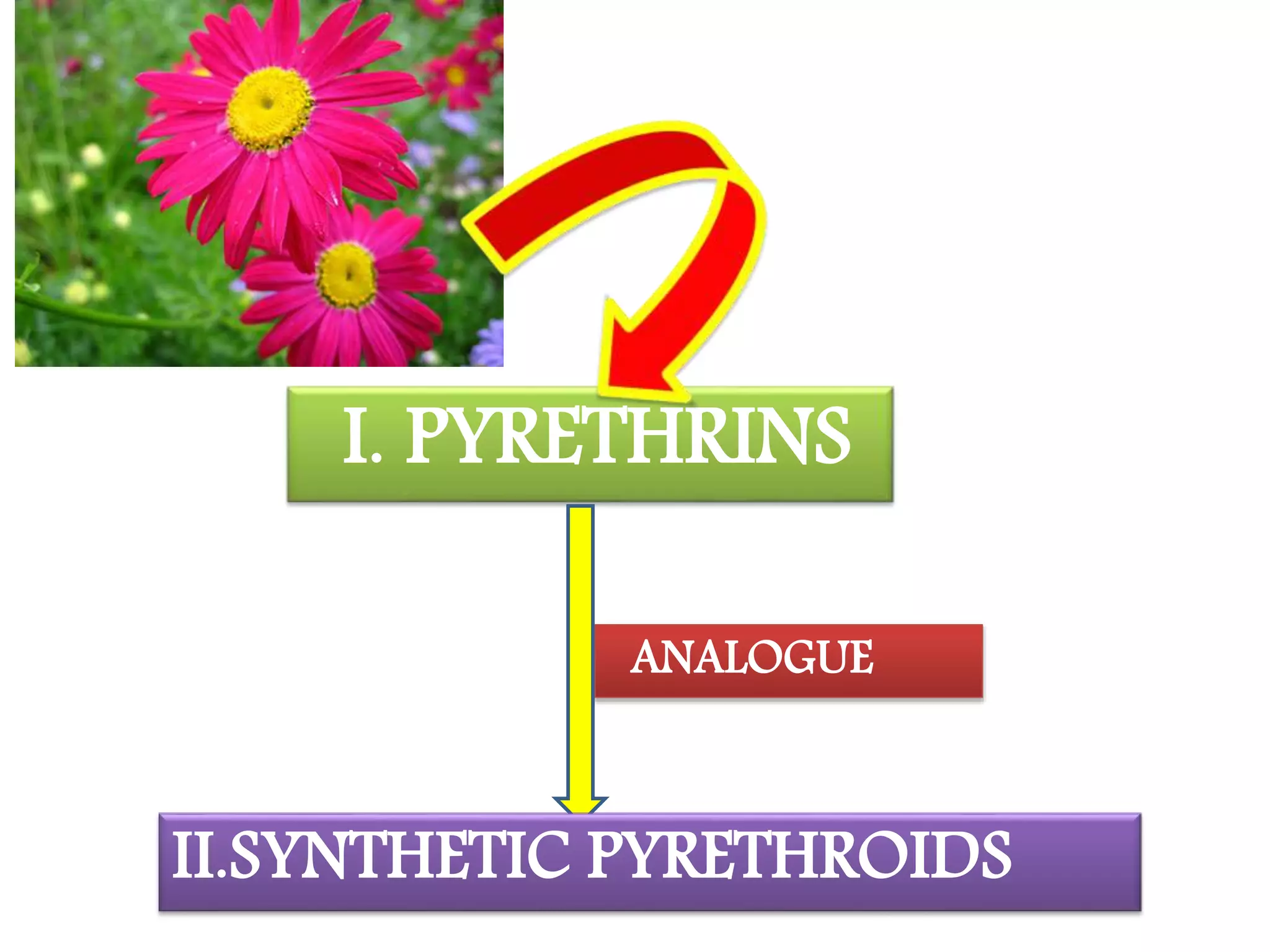
I. PYRETHRINS 
ANALOGUE 
II.SYNTHETIC PYRETHROIDS
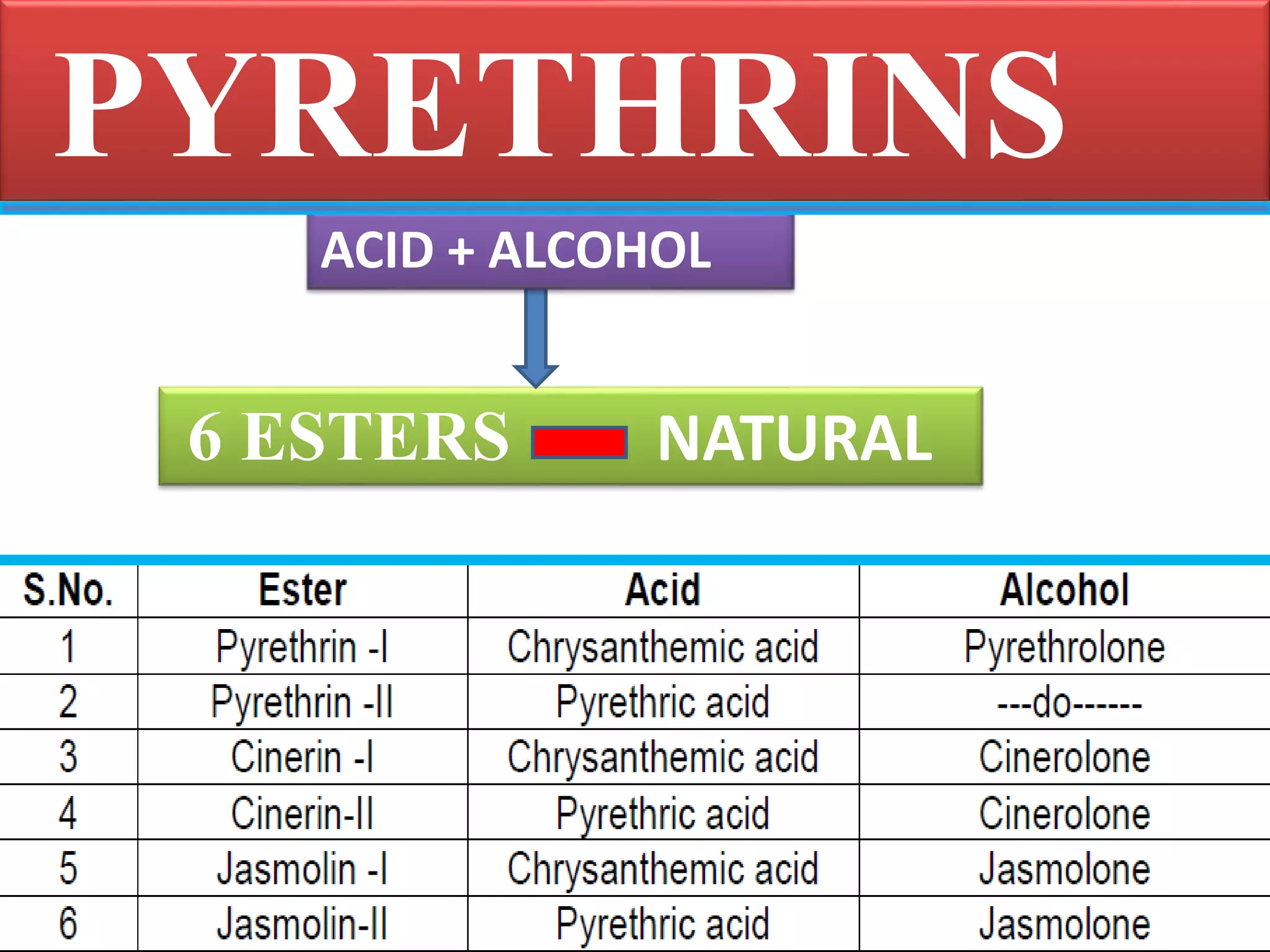
PYRETHRINS 
ACID + ALCOHOL 
6 ESTERS NATURAL
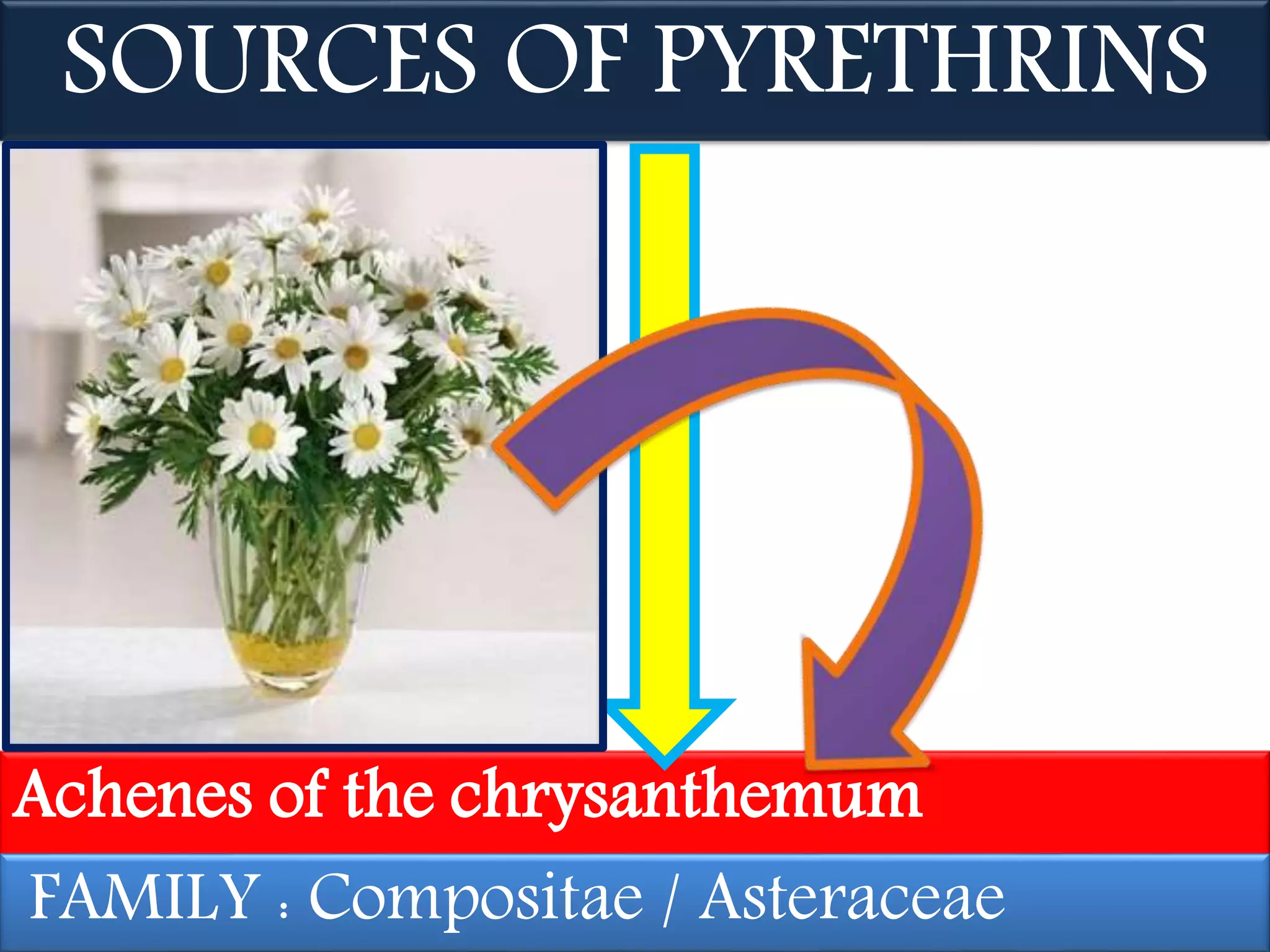
SOURCES OF PYRETHRINS 
Achenes of the chrysanthemum 
FAMILY : Compositae / Asteraceae
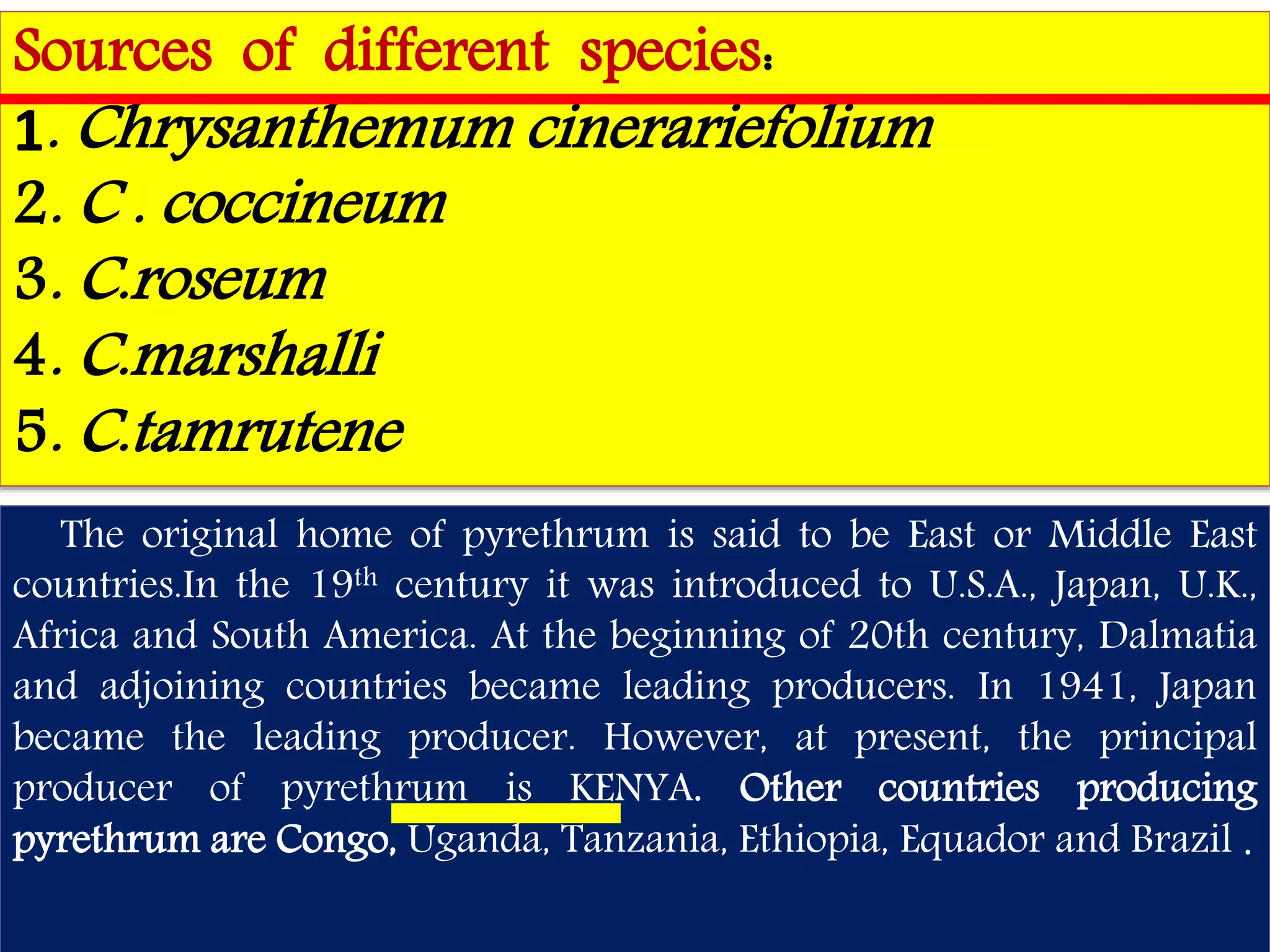
Sources of different species: 
1. Chrysanthemum cinerariefolium 
2. C . coccineum 
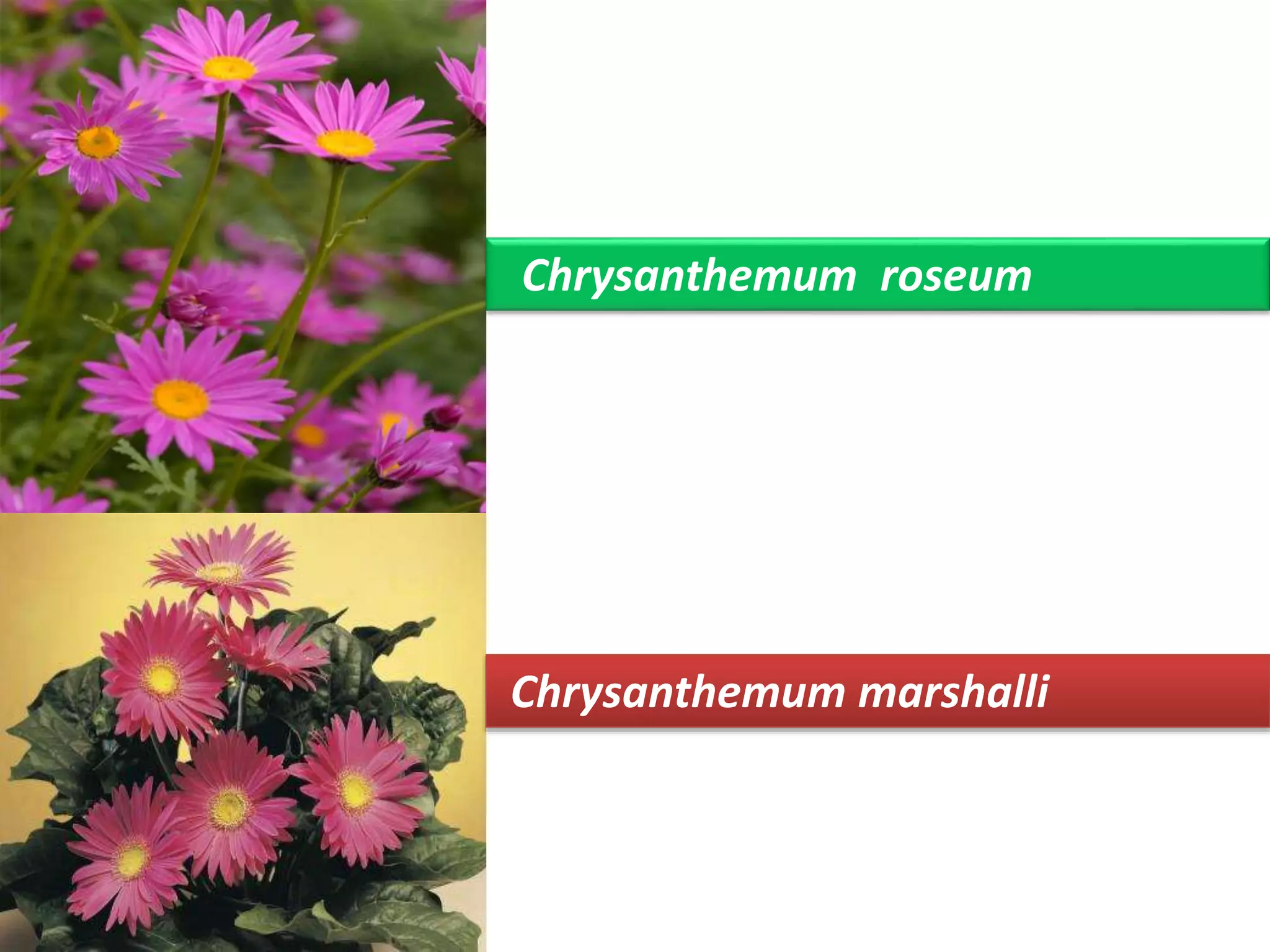
3. C.roseum 
4. C.marshalli 
5. C.tamrutene 
The original home of pyrethrum is said to be East or Middle East 
countries.In the 19th century it was introduced to U.S.A., Japan, U.K., 
Africa and South America. At the beginning of 20th century, Dalmatia 
and adjoining countries became leading producers. In 1941, Japan 
became the leading producer. However, at present, the principal 
producer of pyrethrum is KENYA. Other countries producing 
pyrethrum are Congo, Uganda, Tanzania, Ethiopia, Equador and Brazil .
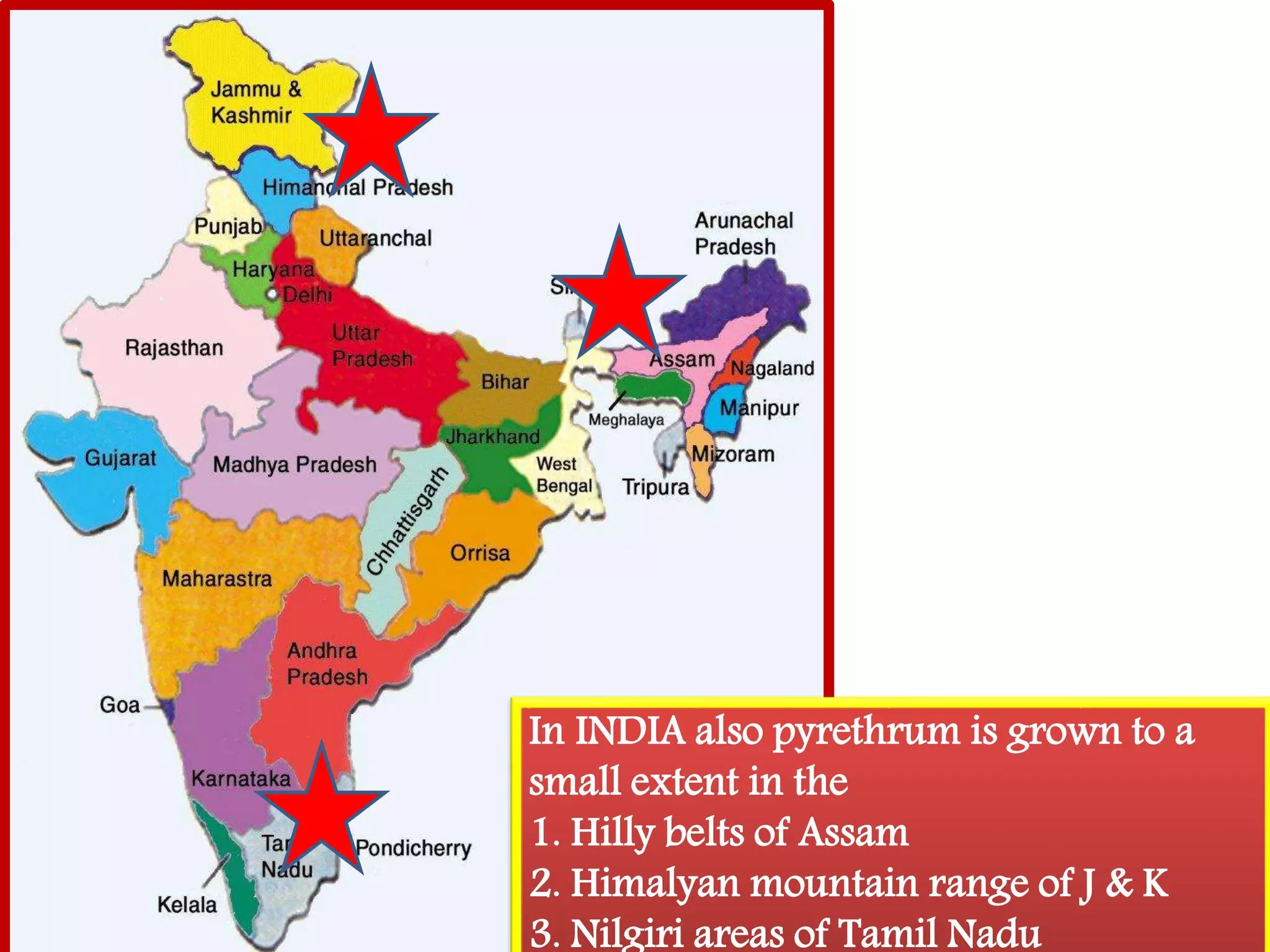
In INDIA also pyrethrum is grown to a 
small extent in the 
1. Hilly belts of Assam 
2. Himalyan mountain range of J & K 
3. Nilgiri areas of Tamil Nadu
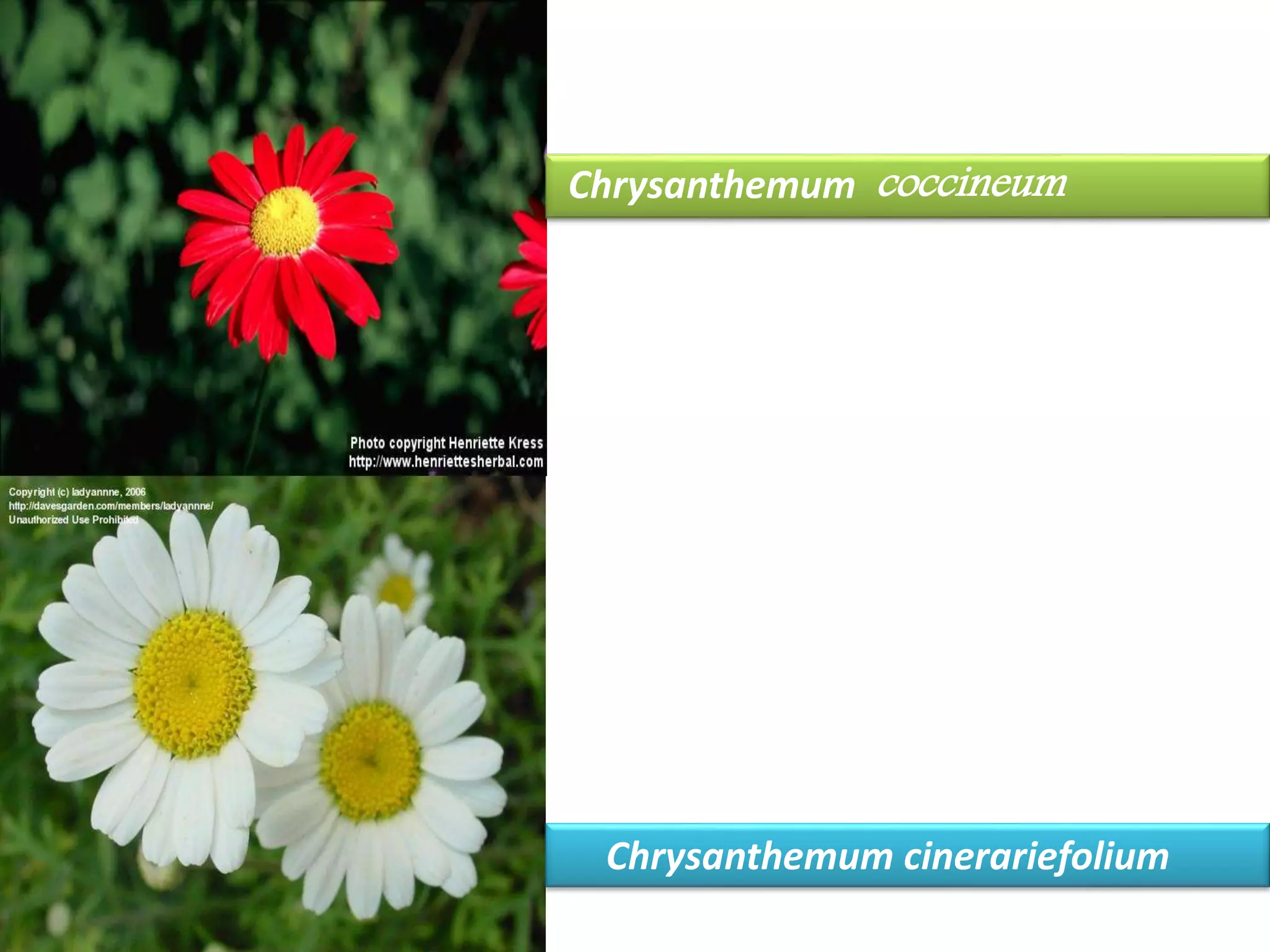
Chrysanthemum coccineum 
Chrysanthemum cinerariefolium
Chrysanthemum roseum 
Chrysanthemum marshalli
EXTRACTION OF 
PYRETHRUM 
METHOD I 
METHOD II
METHOD I
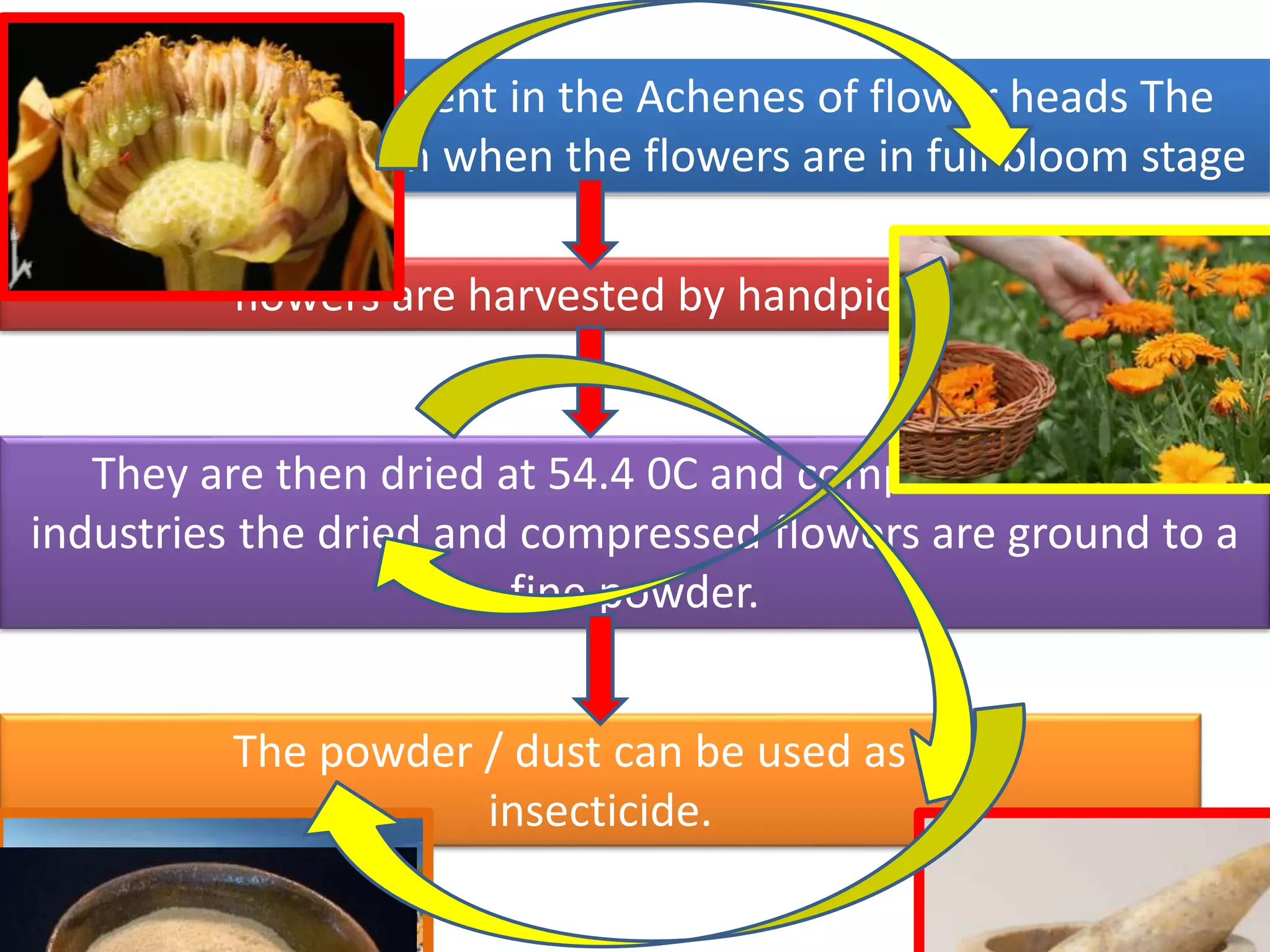
Pyrethrum is present in the Achenes of flower heads The 
content is maximum when the flowers are in full bloom stage 
flowers are harvested by handpicking 
They are then dried at 54.4 0C and compressed. In the 
industries the dried and compressed flowers are ground to a 
fine powder. 
The powder / dust can be used as an 
insecticide.
METHOD II
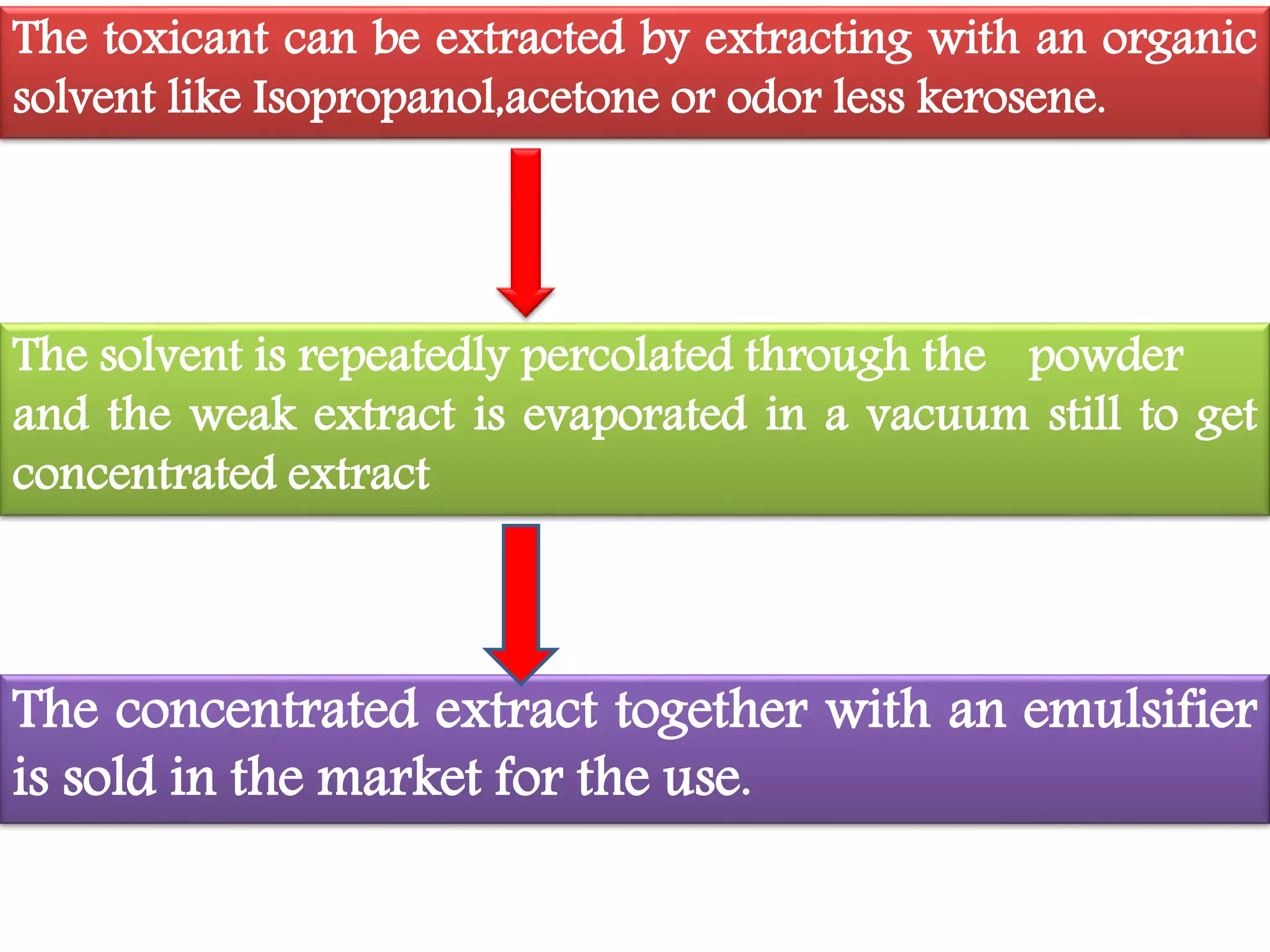
The toxicant can be extracted by extracting with an organic 
solvent like Isopropanol,acetone or odor less kerosene. 
The solvent is repeatedly percolated through the powder 
and the weak extract is evaporated in a vacuum still to get 
concentrated extract 
The concentrated extract together with an emulsifier 
is sold in the market for the use.
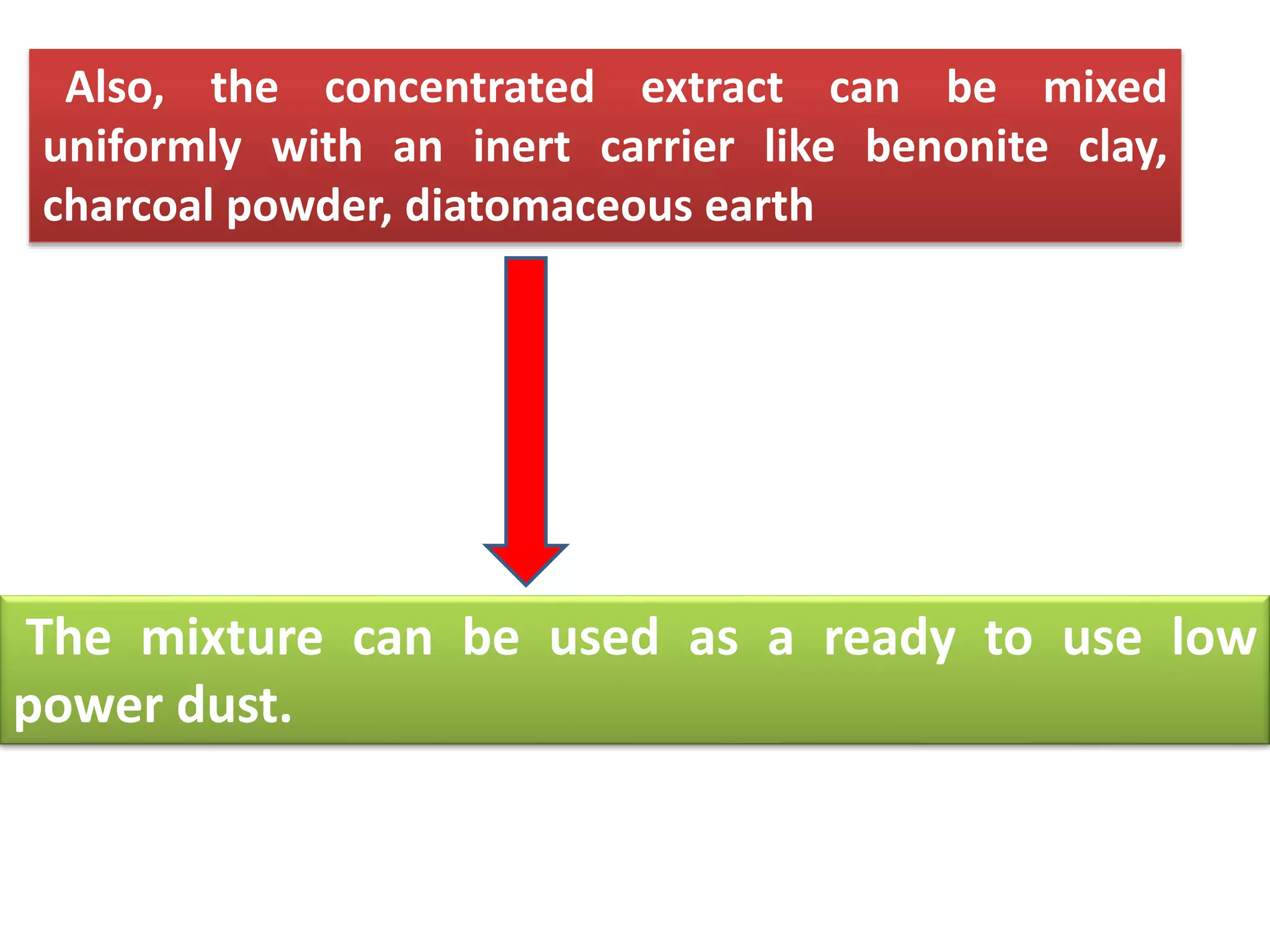
Also, the concentrated extract can be mixed 
uniformly with an inert carrier like benonite clay, 
charcoal powder, diatomaceous earth 
The mixture can be used as a ready to use low 
power dust.
PYRETHRUM 
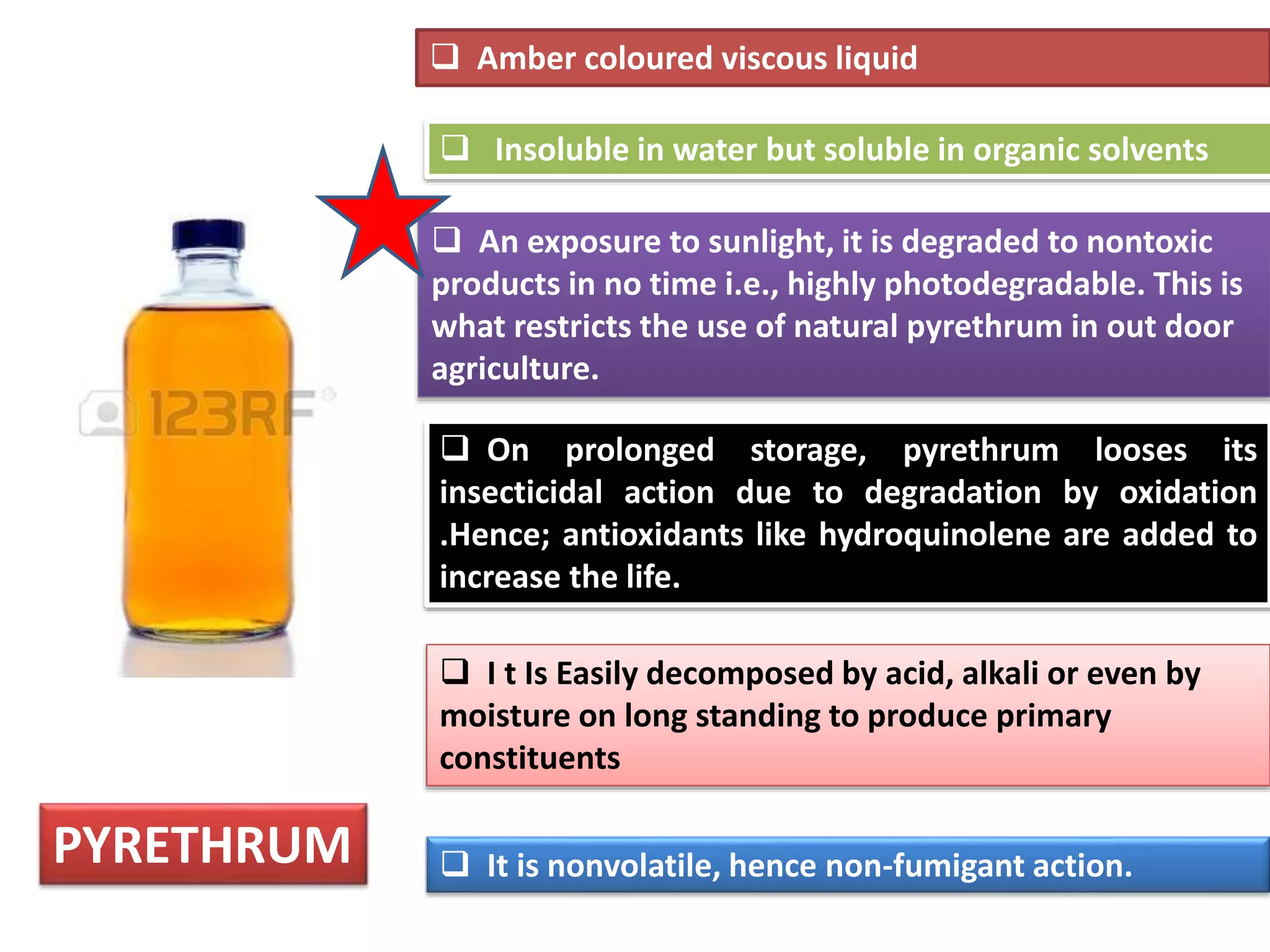
 Amber coloured viscous liquid 
 Insoluble in water but soluble in organic solvents 
 An exposure to sunlight, it is degraded to nontoxic 
products in no time i.e., highly photodegradable. This is 
what restricts the use of natural pyrethrum in out door 
agriculture. 
 On prolonged storage, pyrethrum looses its 
insecticidal action due to degradation by oxidation 
.Hence; antioxidants like hydroquinolene are added to 
increase the life. 
 I t Is Easily decomposed by acid, alkali or even by 
moisture on long standing to produce primary 
constituents 
 It is nonvolatile, hence non-fumigant action.
II.SYNTHETIC 
PYRETHROID
Mode of action
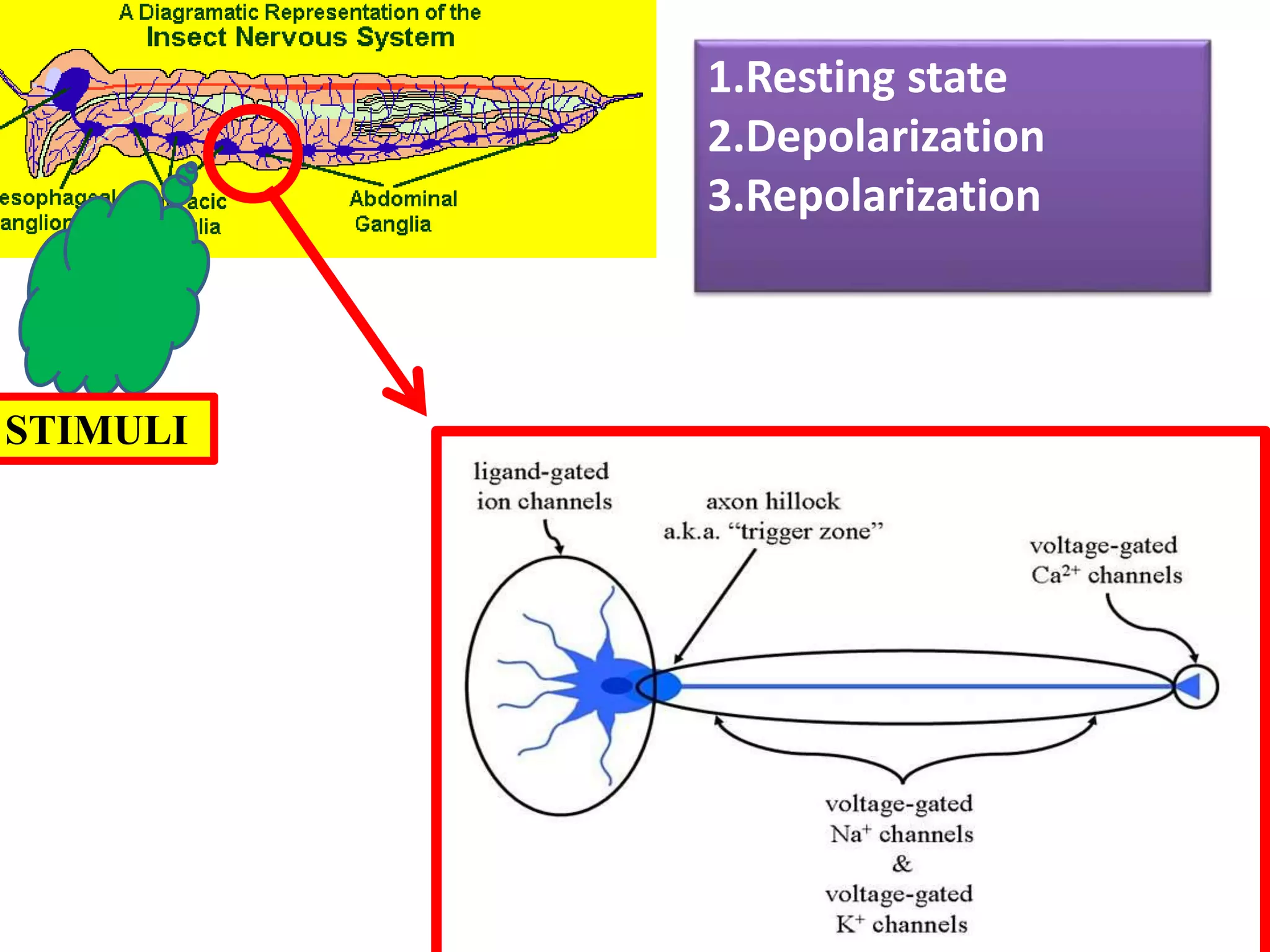
STIMULI 
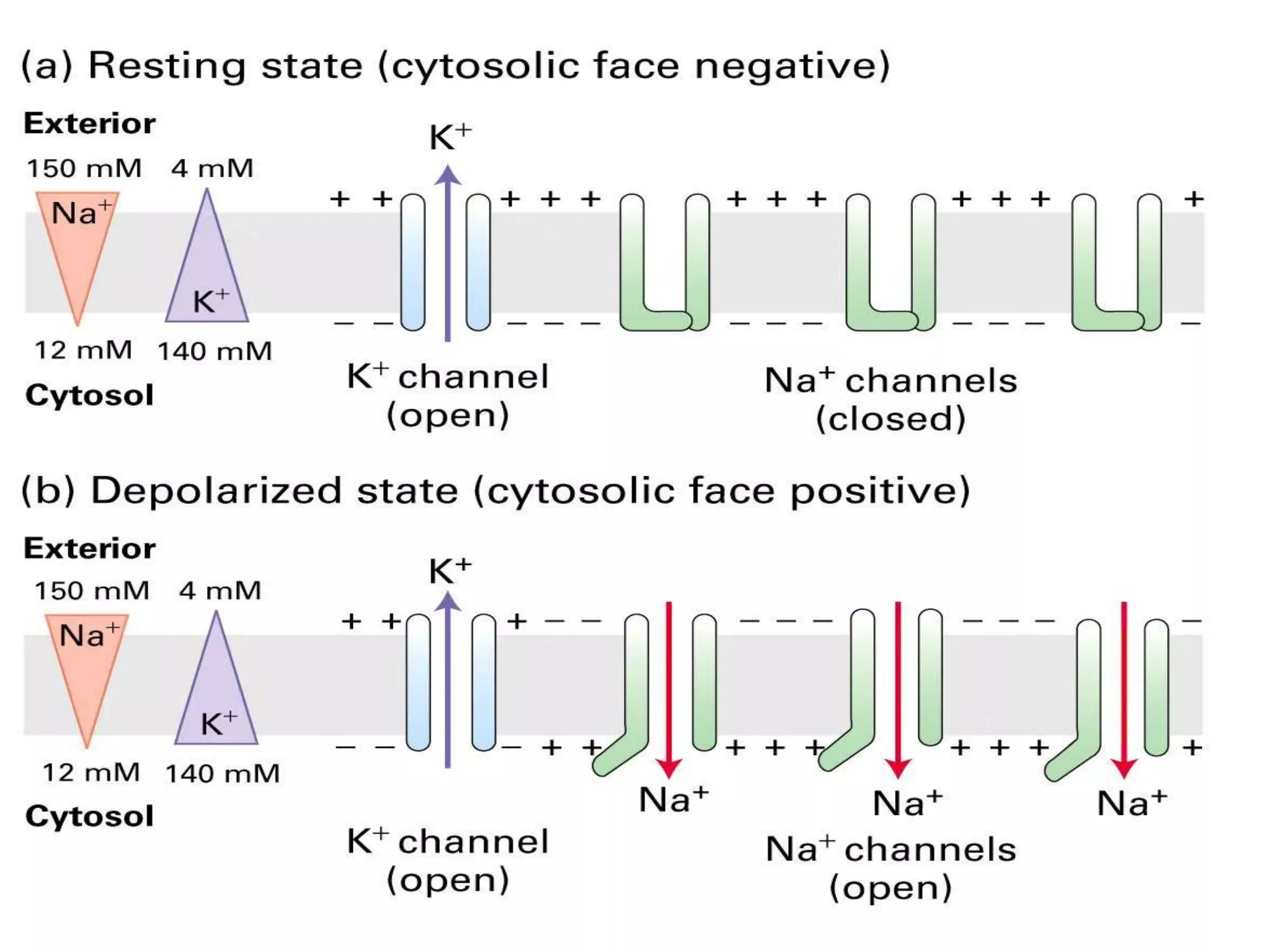
1.Resting state 
2.Depolarization 
3.Repolarization
Synthetic pyrethroids 
commercial -compounds
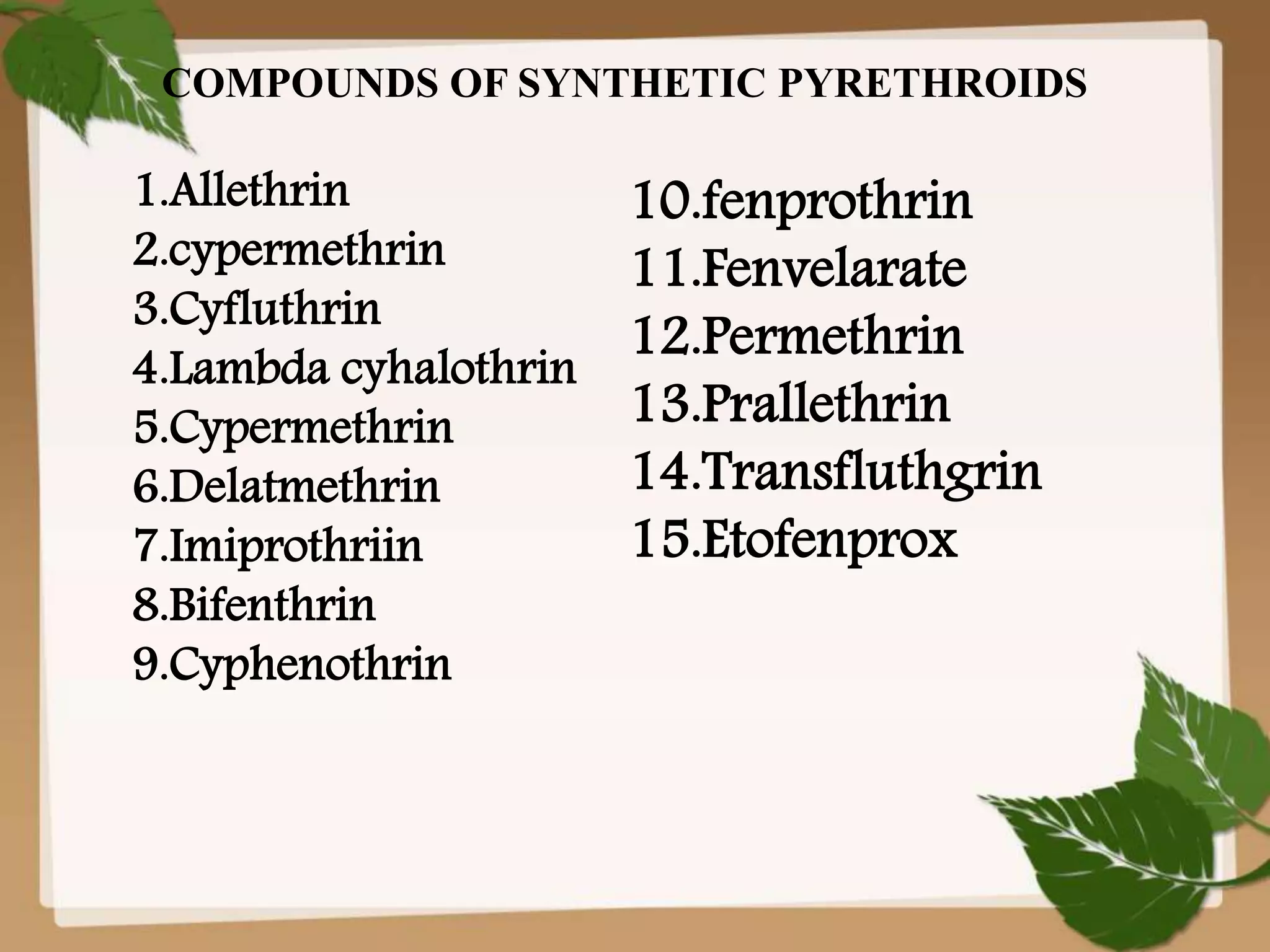
COMPOUNDS OF SYNTHETIC PYRETHROIDS 
1.Allethrin 
10.fenprothrin 
2.cypermethrin 
11.Fenvelarate 
3.Cyfluthrin 
4.Lambda cyhalothrin 
12.Permethrin 
5.Cypermethrin 
13.Prallethrin 
6.Delatmethrin 
14.Transfluthgrin 
7.Imiprothriin 
15.Etofenprox 
8.Bifenthrin 
9.Cyphenothrin
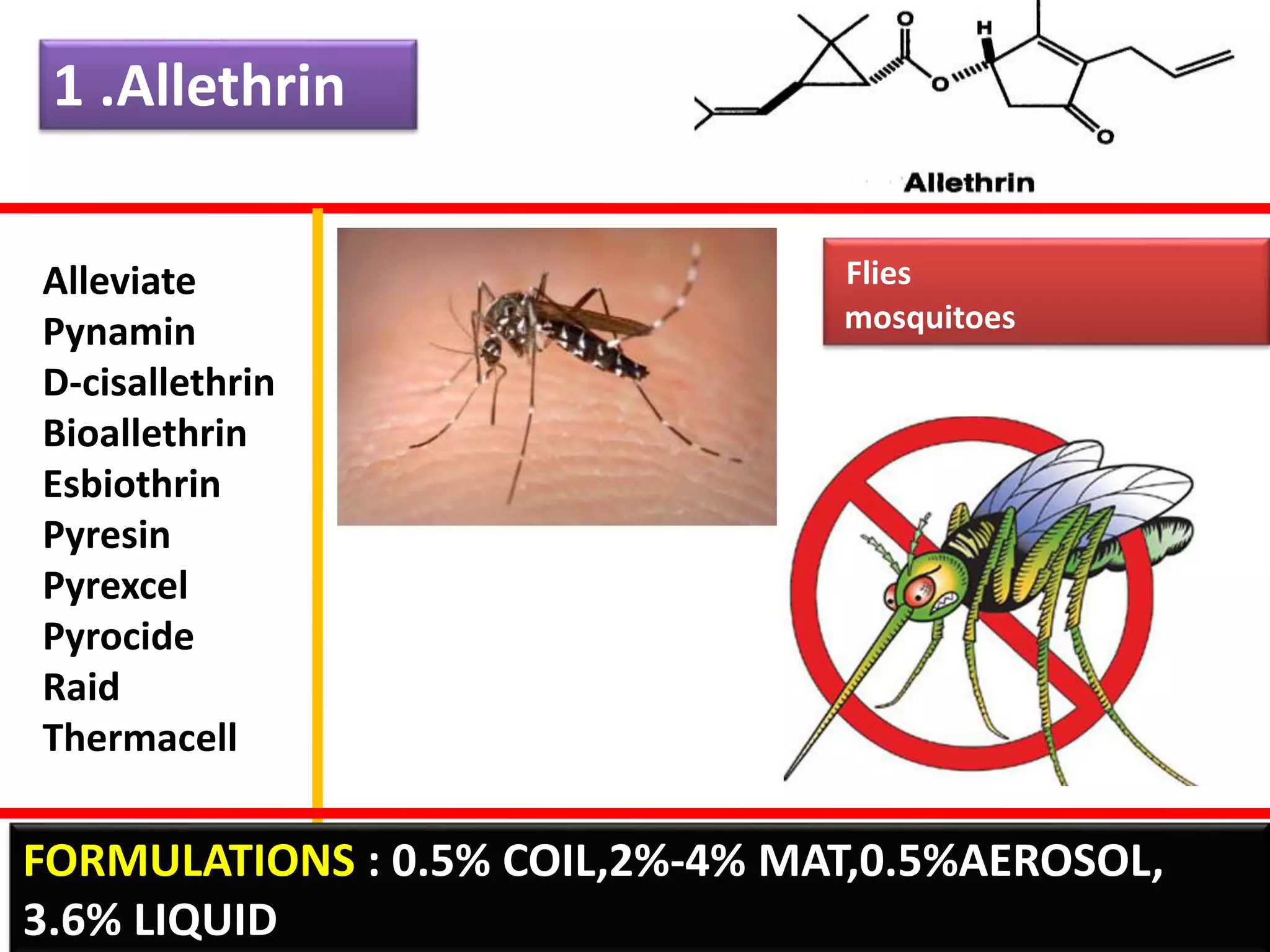
1 .Allethrin 
Alleviate 
Pynamin 
D-cisallethrin 
Bioallethrin 
Esbiothrin 
Pyresin 
Pyrexcel 
Pyrocide 
Raid 
Thermacell 
Flies 
mosquitoes 
FORMULATIONS : 0.5% COIL,2%-4% MAT,0.5%AEROSOL, 
3.6% LIQUID
RAID 
THERMACELL
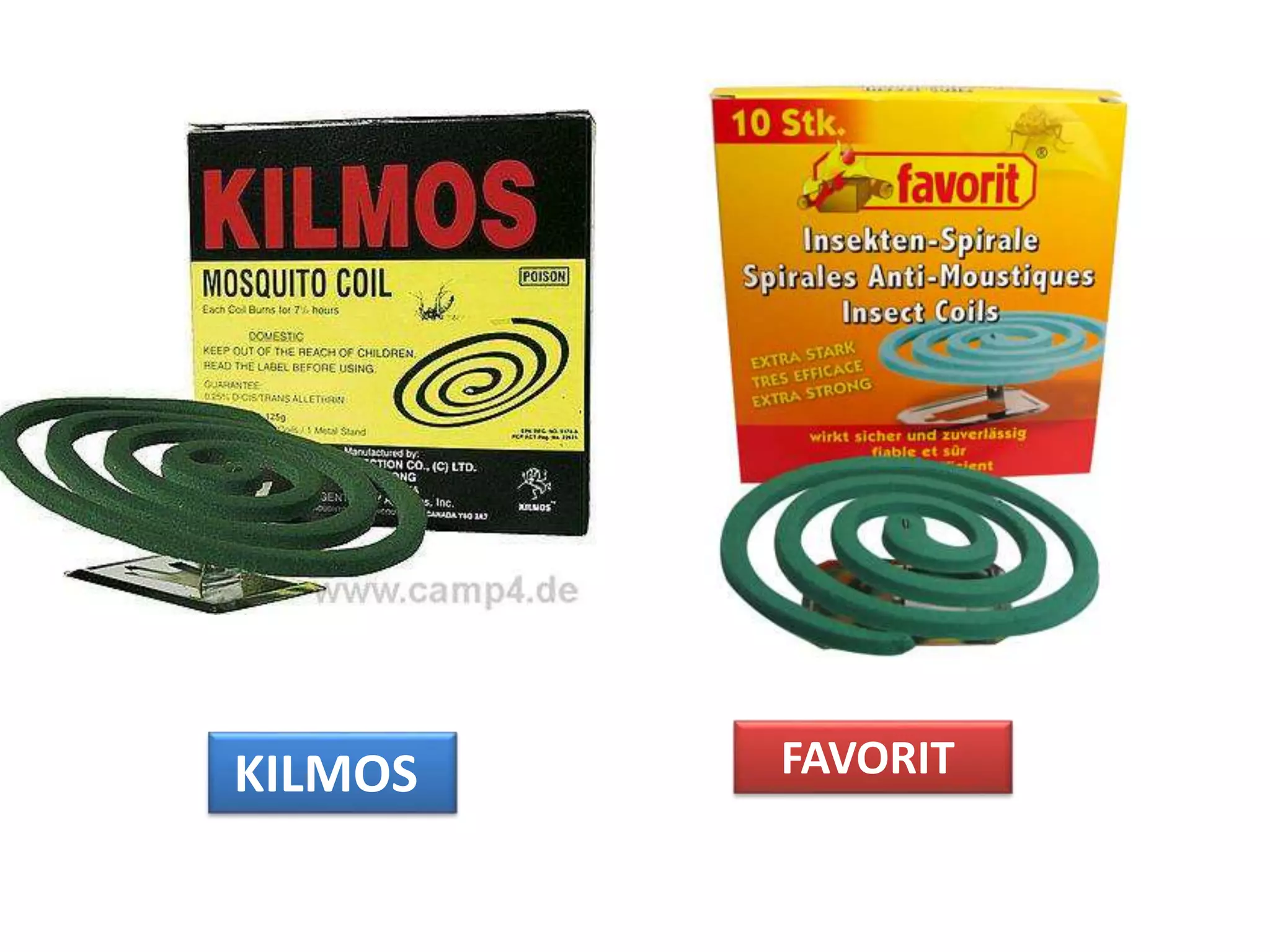
KILMOS FAVORIT
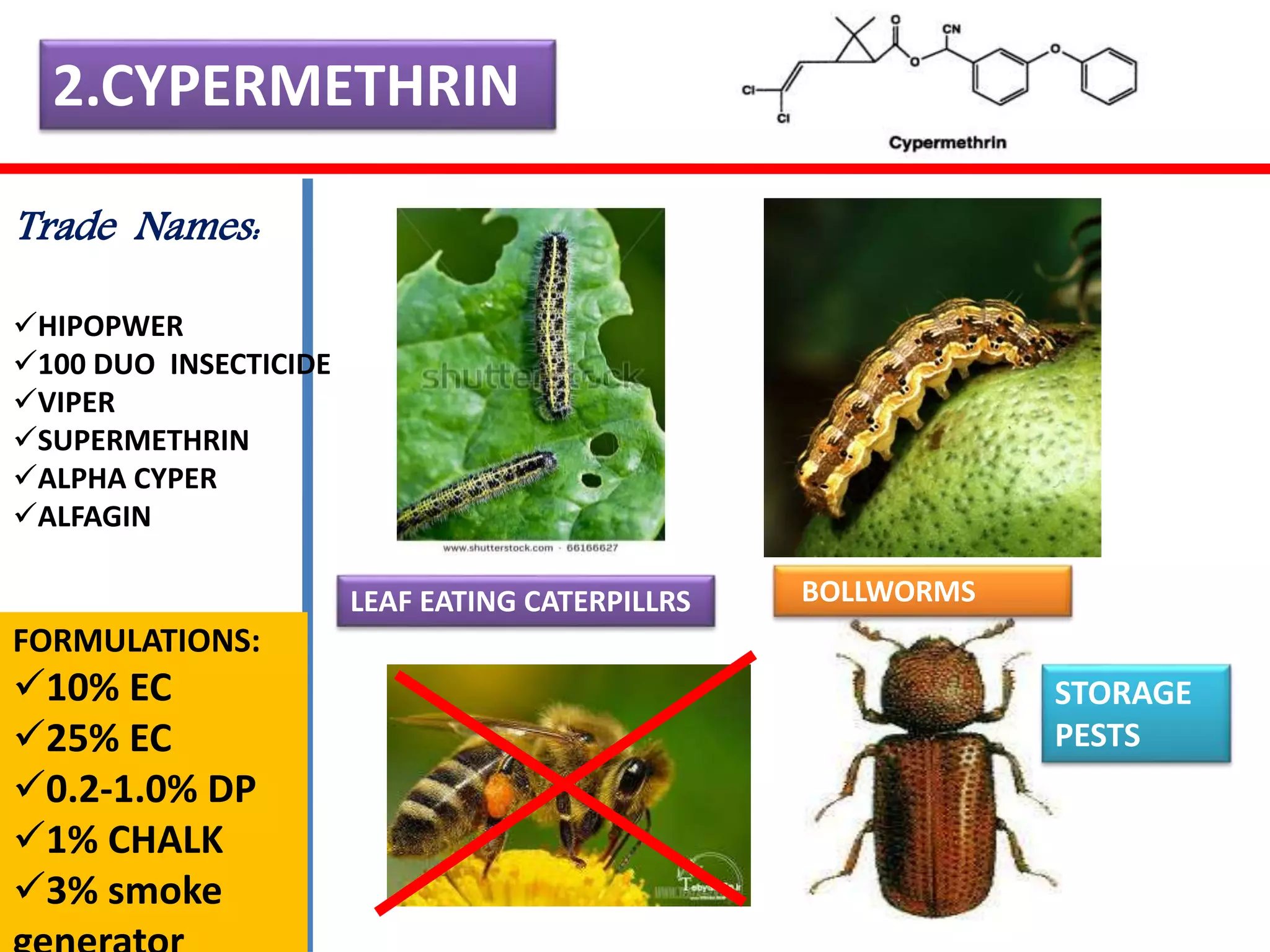
2.CYPERMETHRIN 
LEAF EATING CATERPILLRS BOLLWORMS 
STORAGE 
PESTS 
Trade Names: 
HIPOPWER 
100 DUO INSECTICIDE 
VIPER 
SUPERMETHRIN 
ALPHA CYPER 
ALFAGIN 
FORMULATIONS: 
10% EC 
+ 
25% EC 
0.2-1.0% DP 
1% CHALK 
3% smoke 
generator
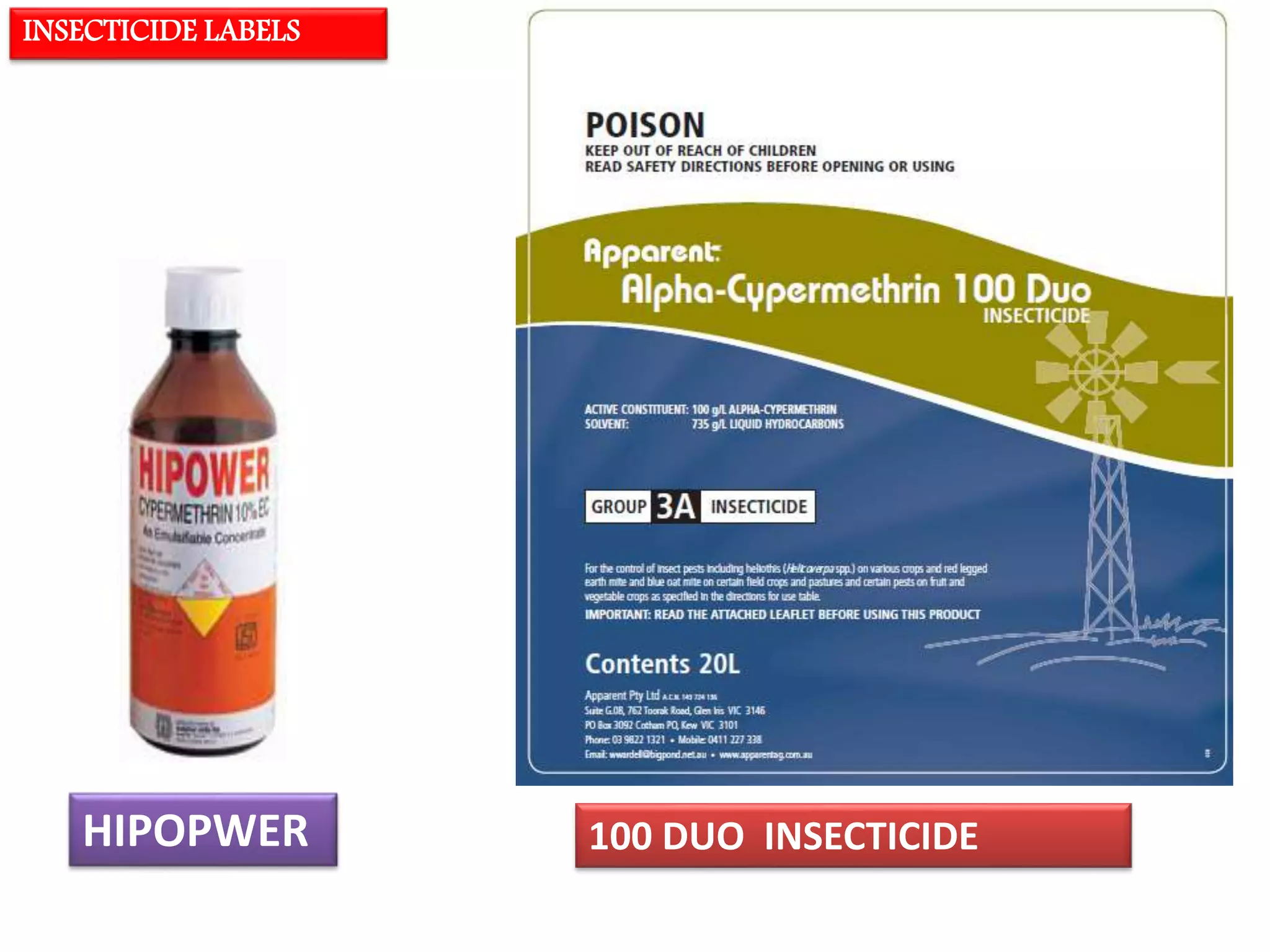
INSECTICIDE LABELS 
HIPOPWER 100 DUO INSECTICIDE
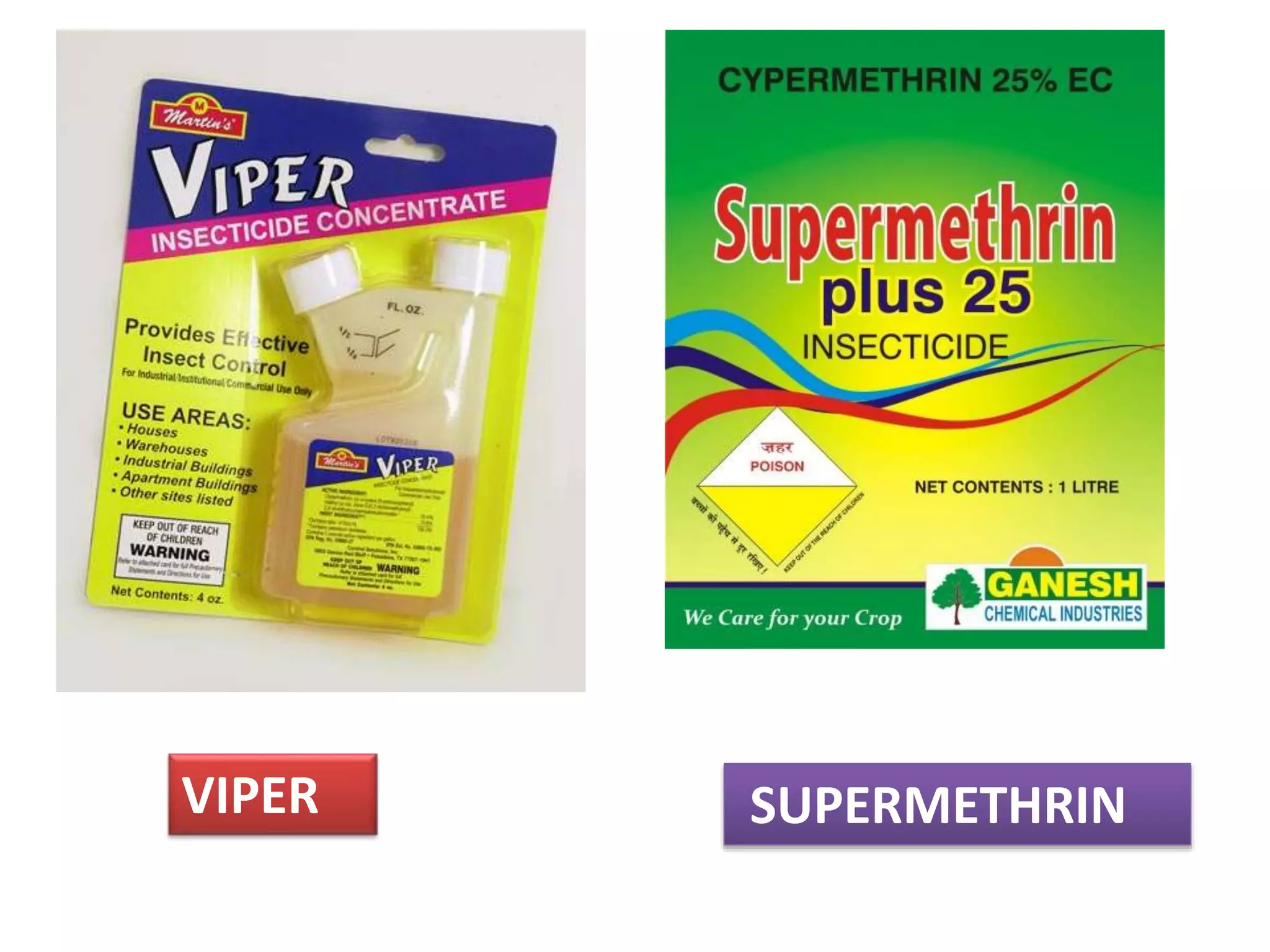
VIPER SUPERMETHRIN
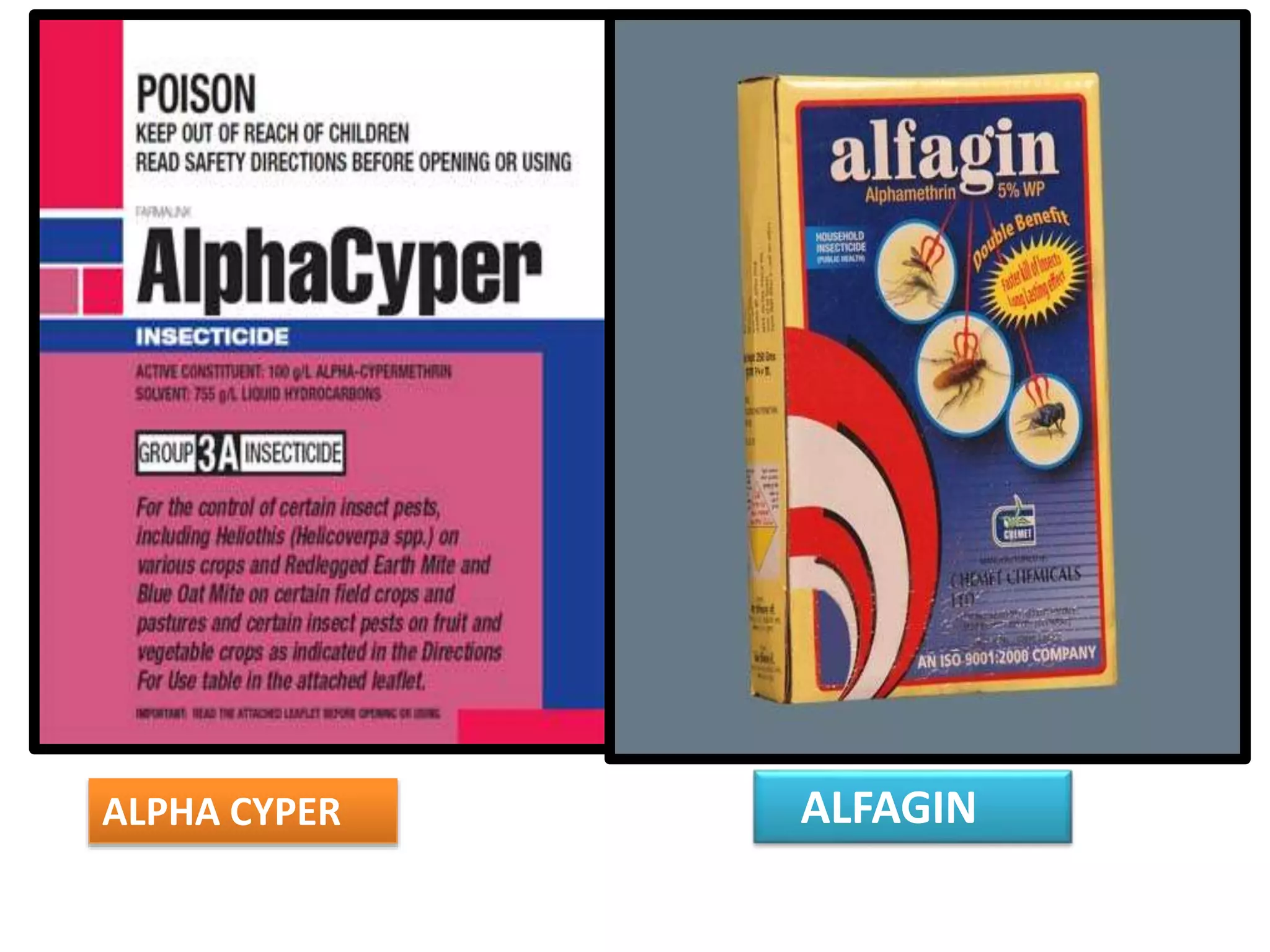
ALPHA CYPER ALFAGIN
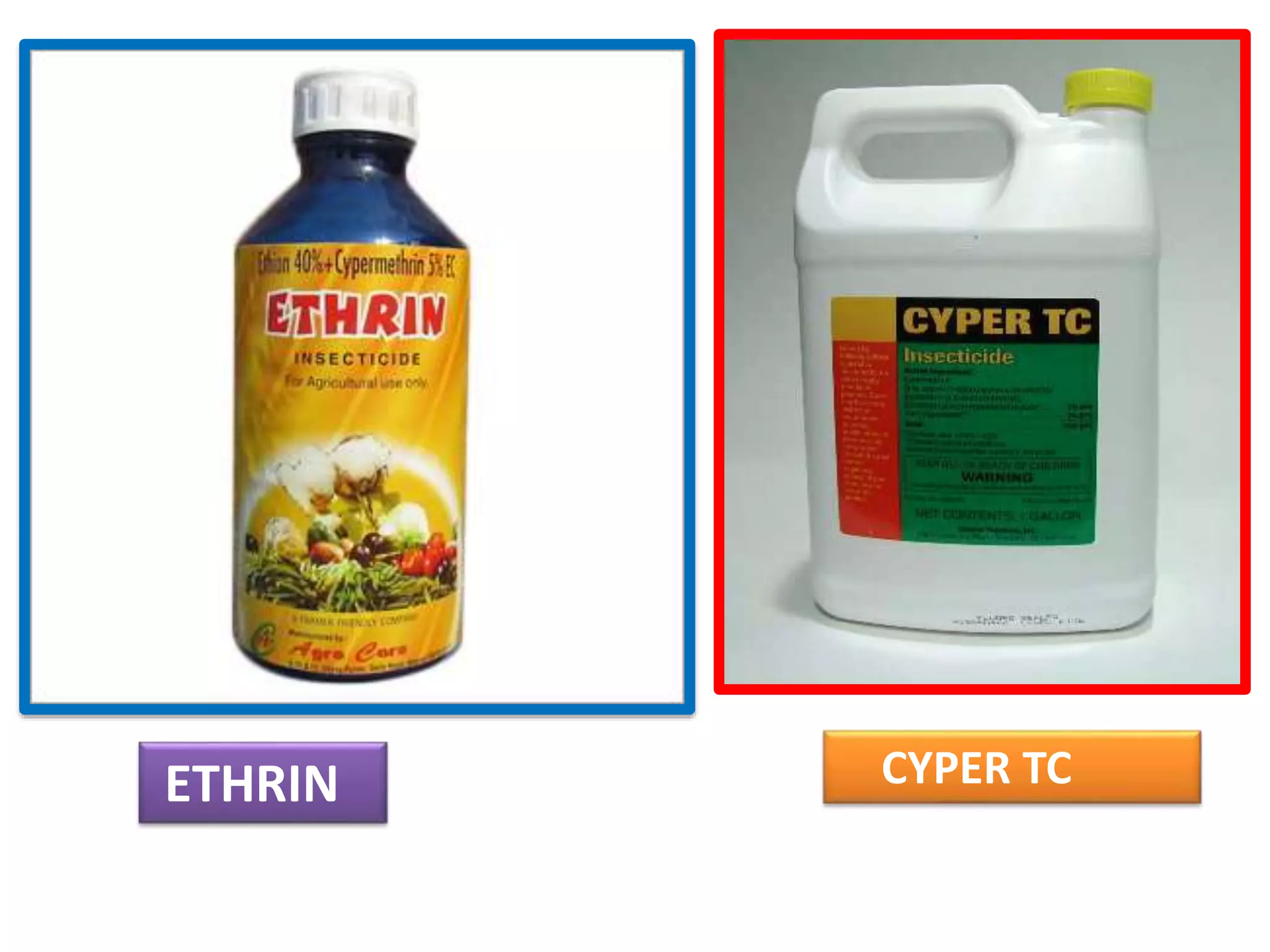
ETHRIN CYPER TC
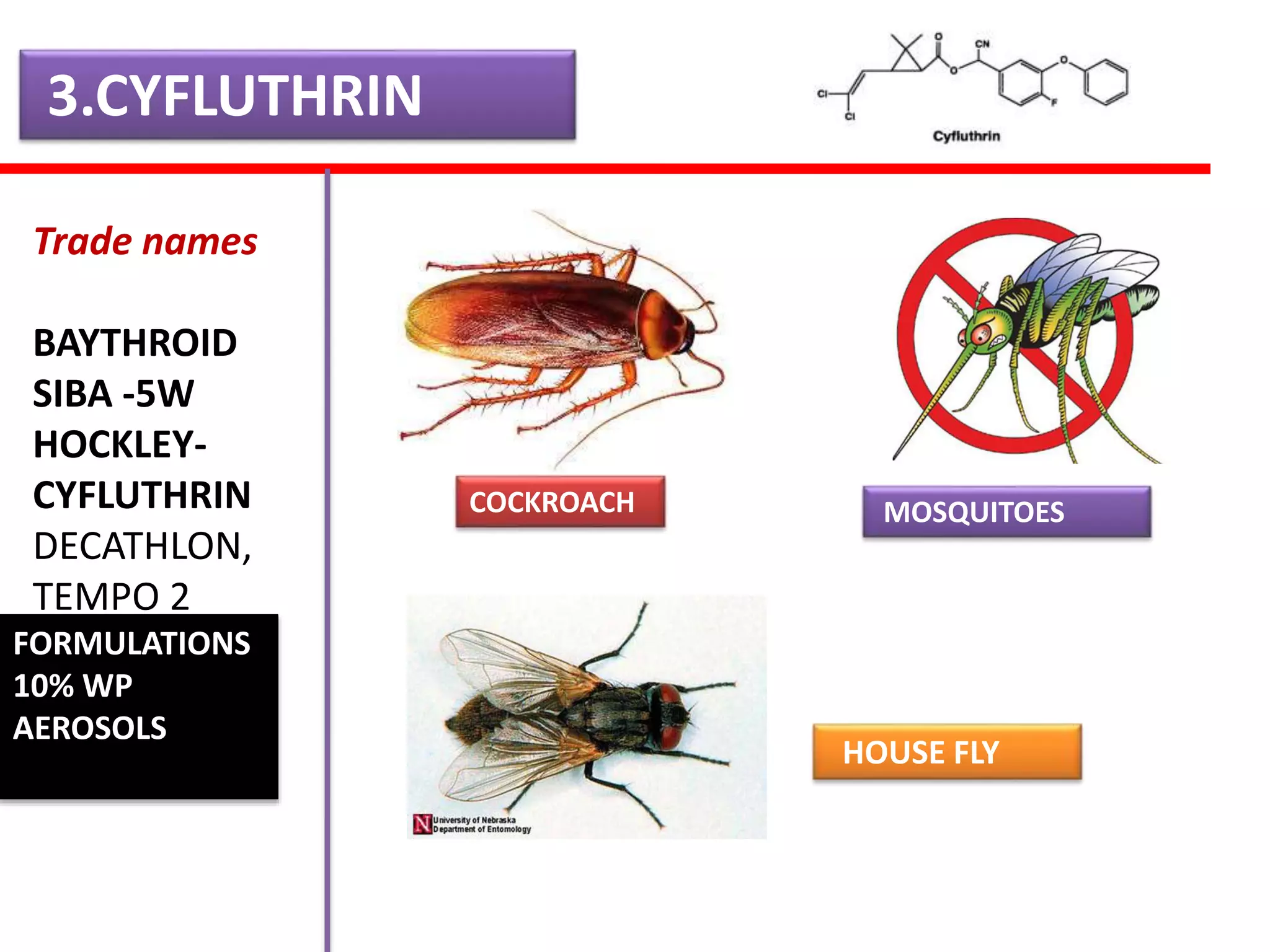
3.CYFLUTHRIN 
Trade names 
BAYTHROID 
SIBA -5W 
HOCKLEY-CYFLUTHRIN 
DECATHLON, 
TEMPO 2 
FORMULATIONS 
10% WP 
AEROSOLS 
MOSQUITOES 
HOUSE FLY 
COCKROACH
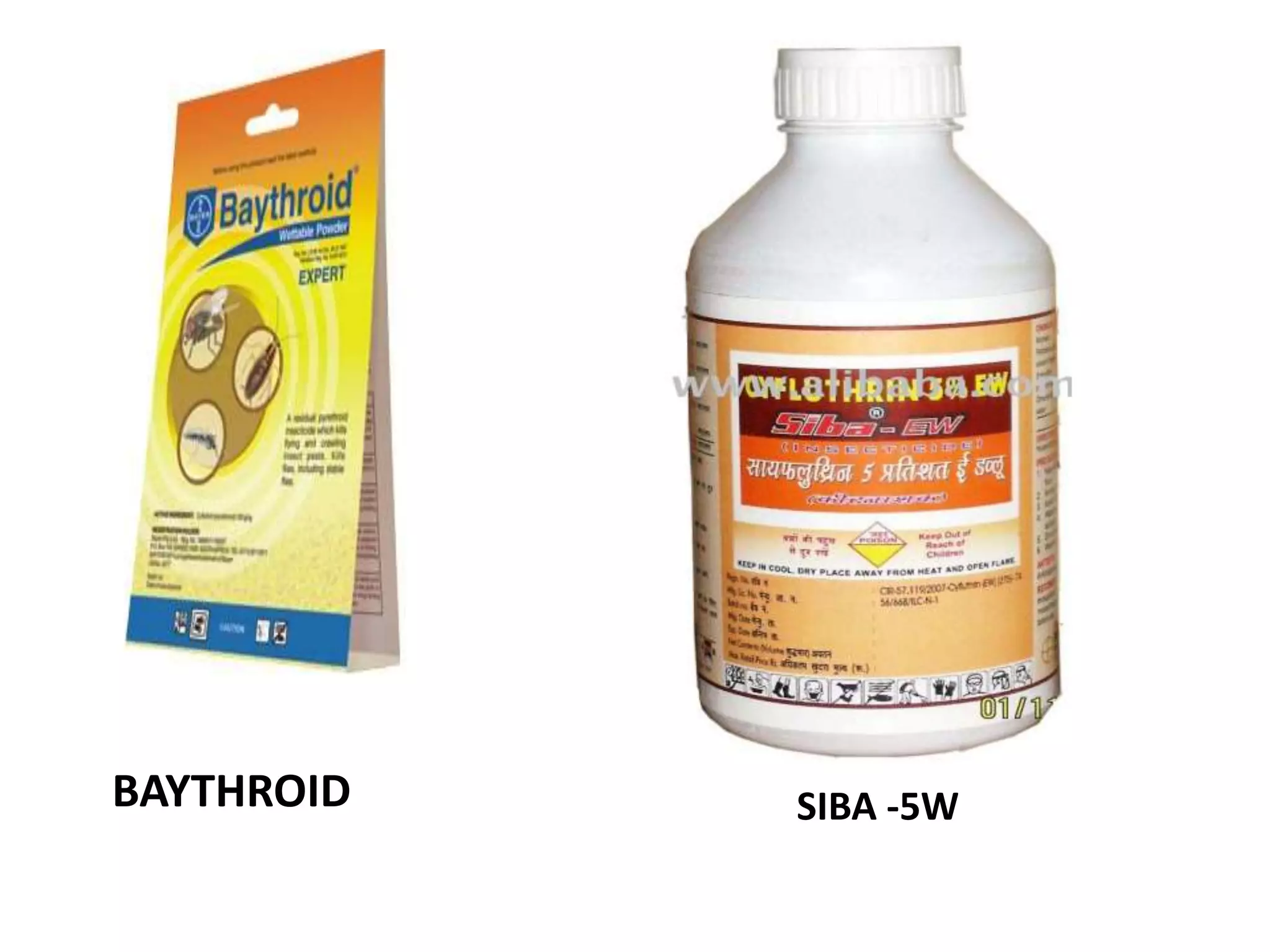
BAYTHROID SIBA -5W
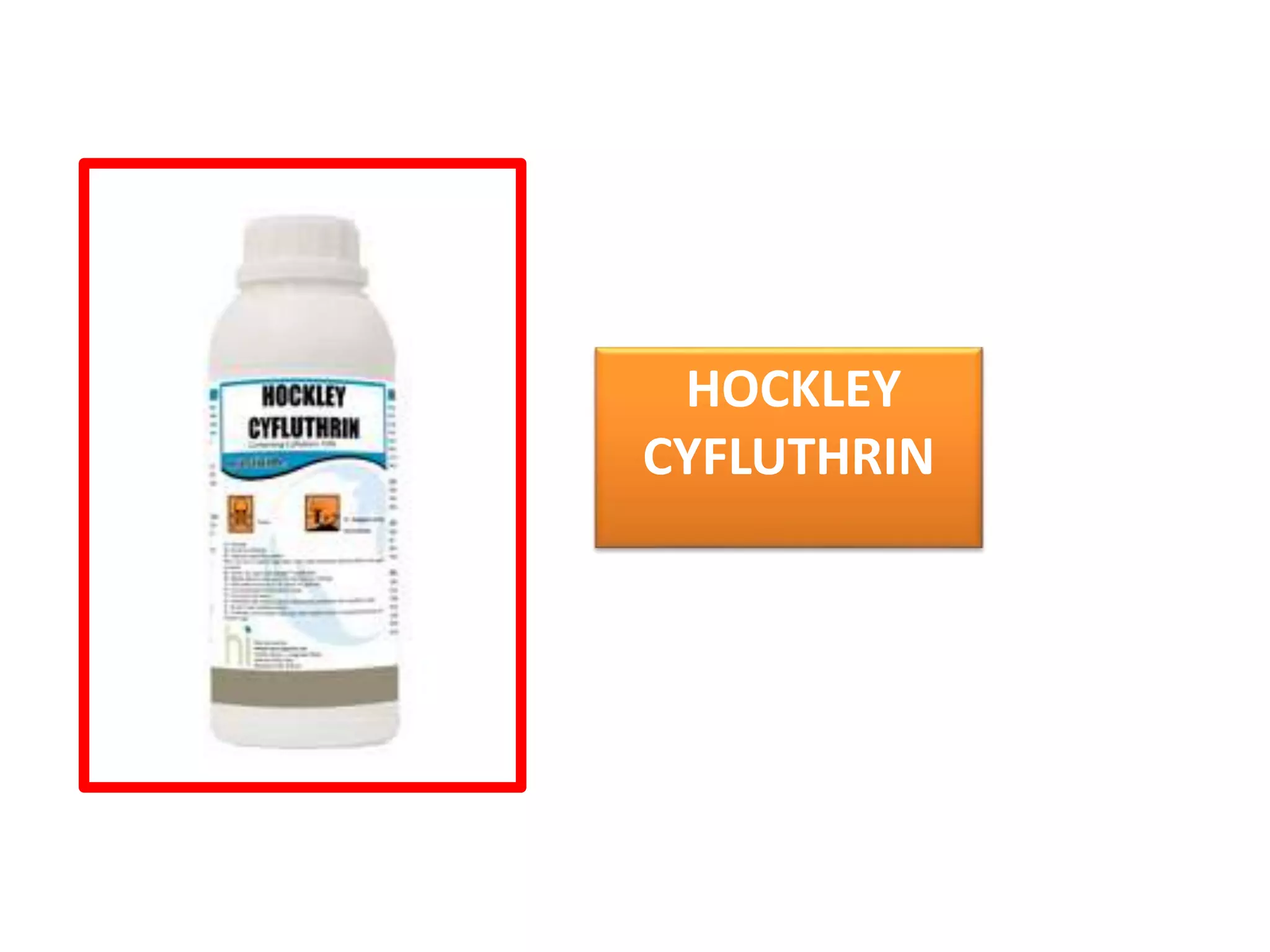
HOCKLEY 
CYFLUTHRIN
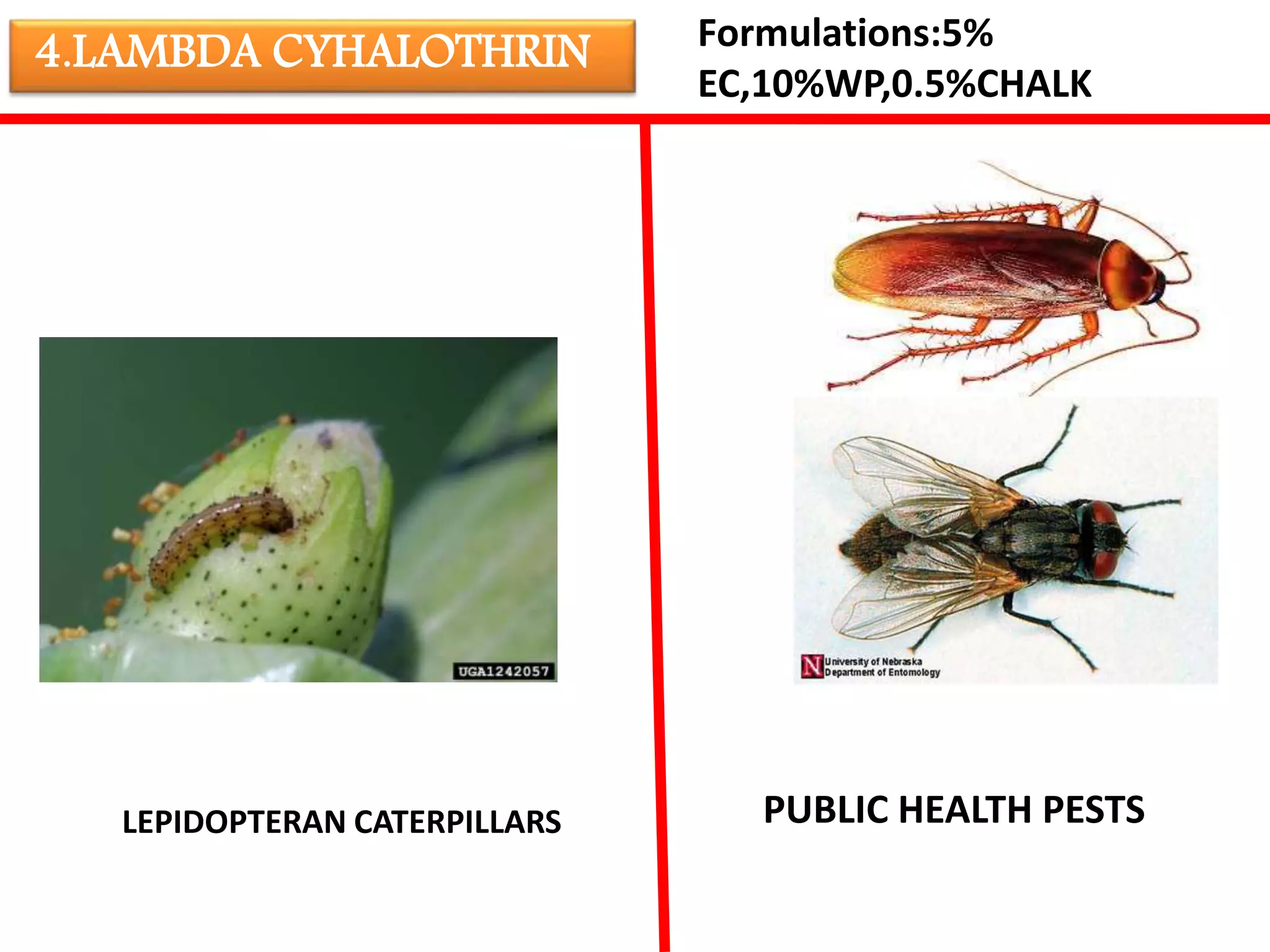
4.LAMBDA CYHALOTHRIN Formulations:5% 
EC,10%WP,0.5%CHALK 
LEPIDOPTERAN CATERPILLARS PUBLIC HEALTH PESTS
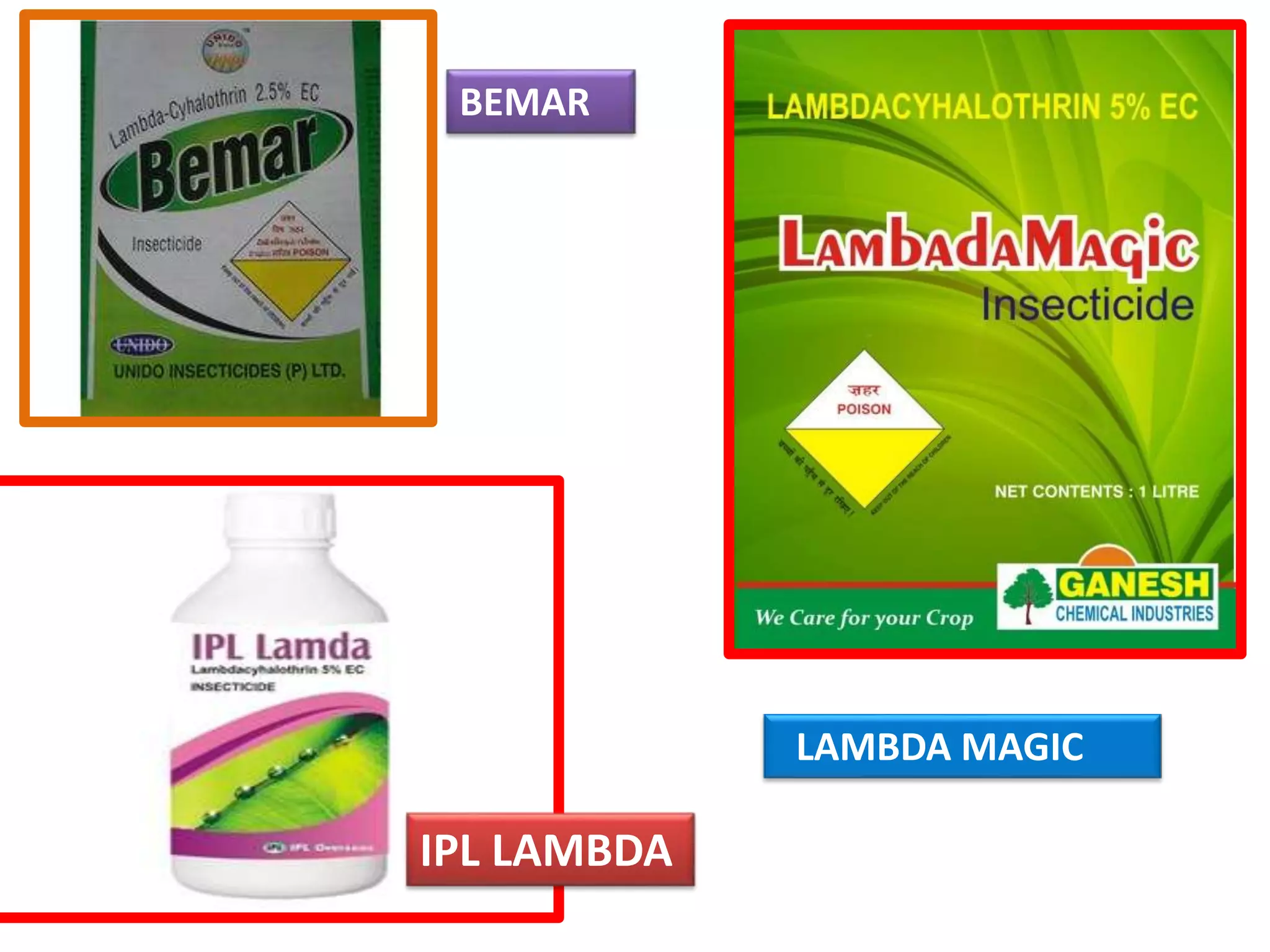
BEMAR 
IPL LAMBDA 
LAMBDA MAGIC
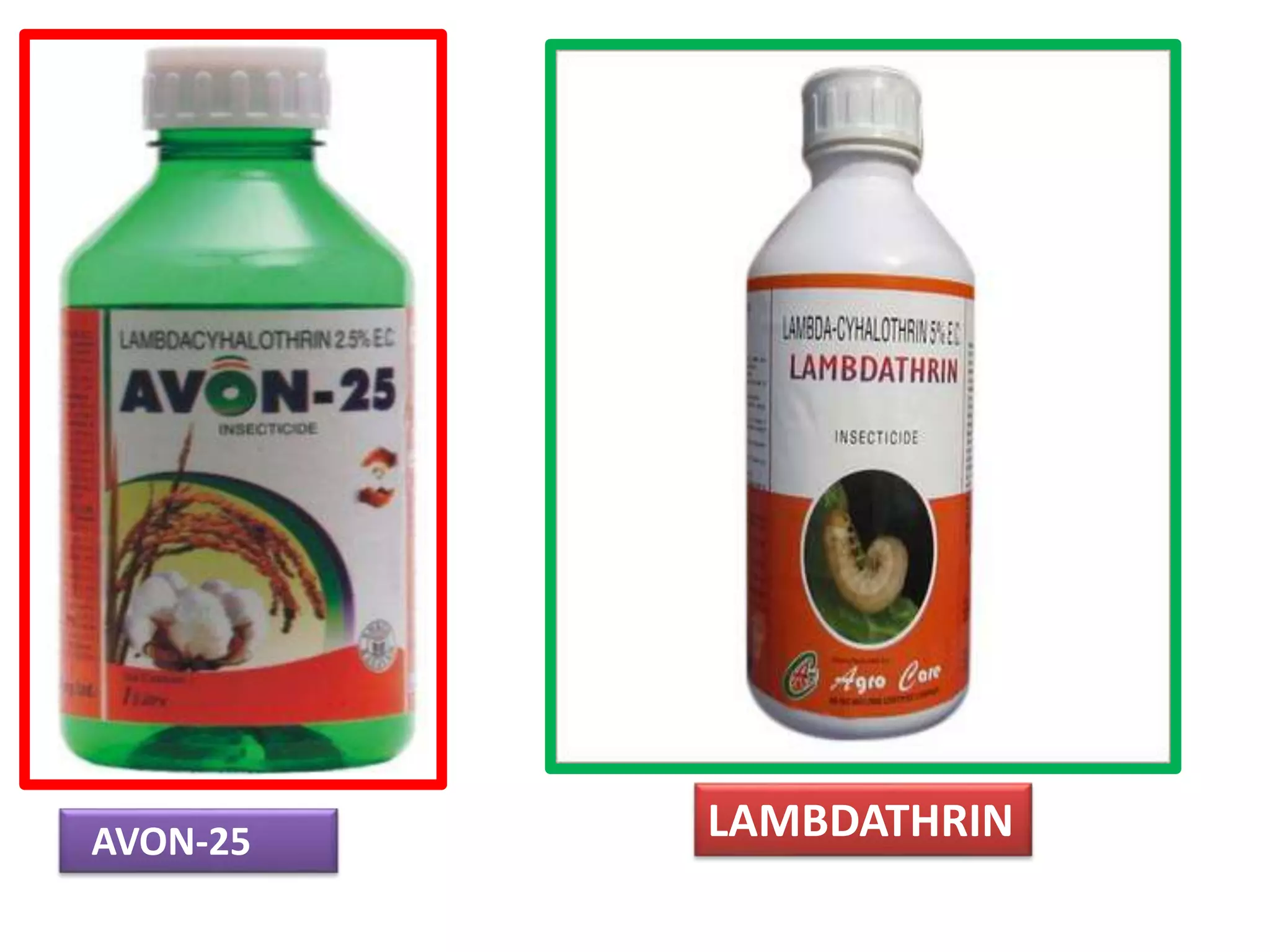
AVON-25 LAMBDATHRIN
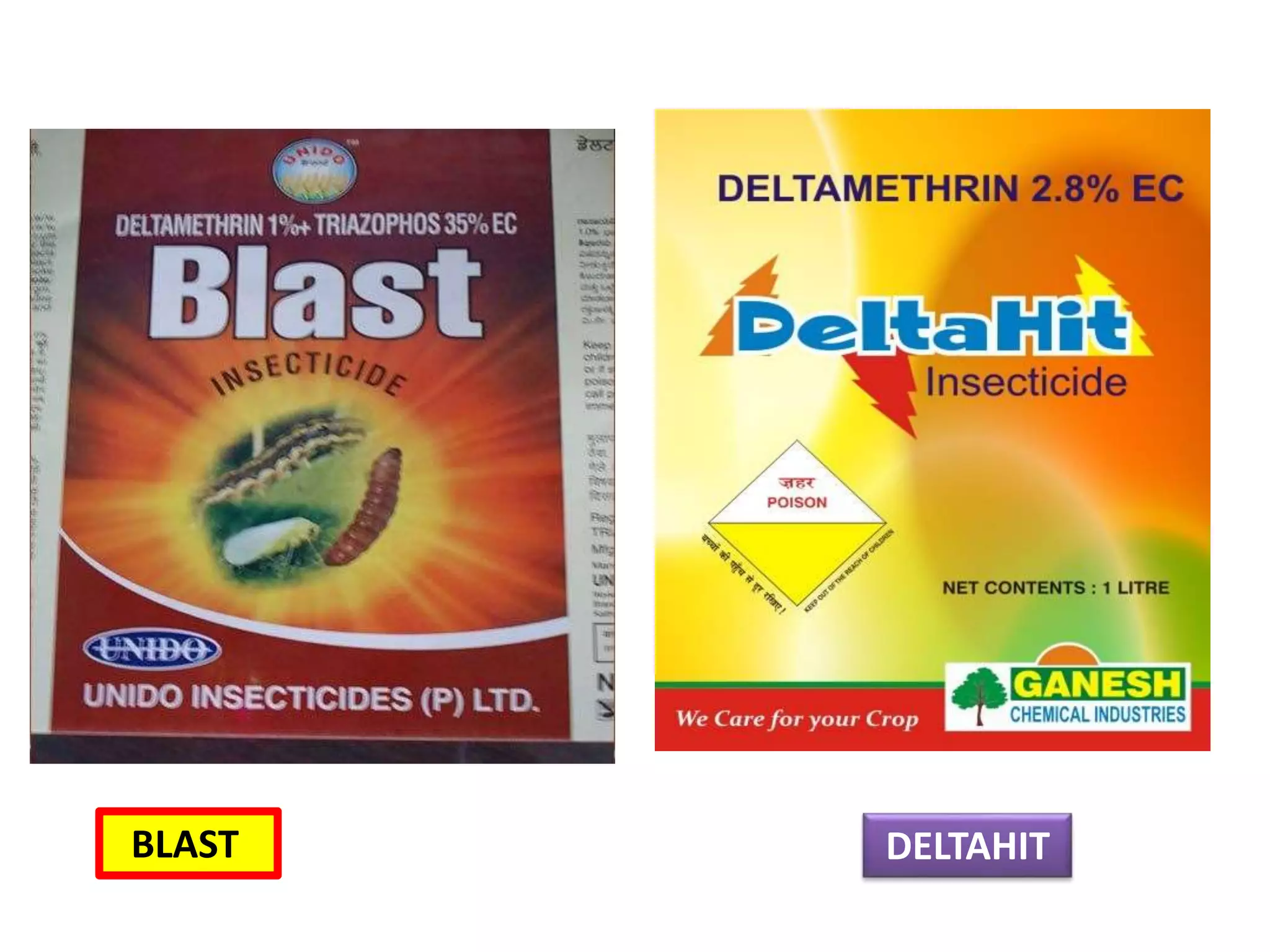
5.DELTA METHRIN 
Trade Names 
BLAST 
DELTAHIT 
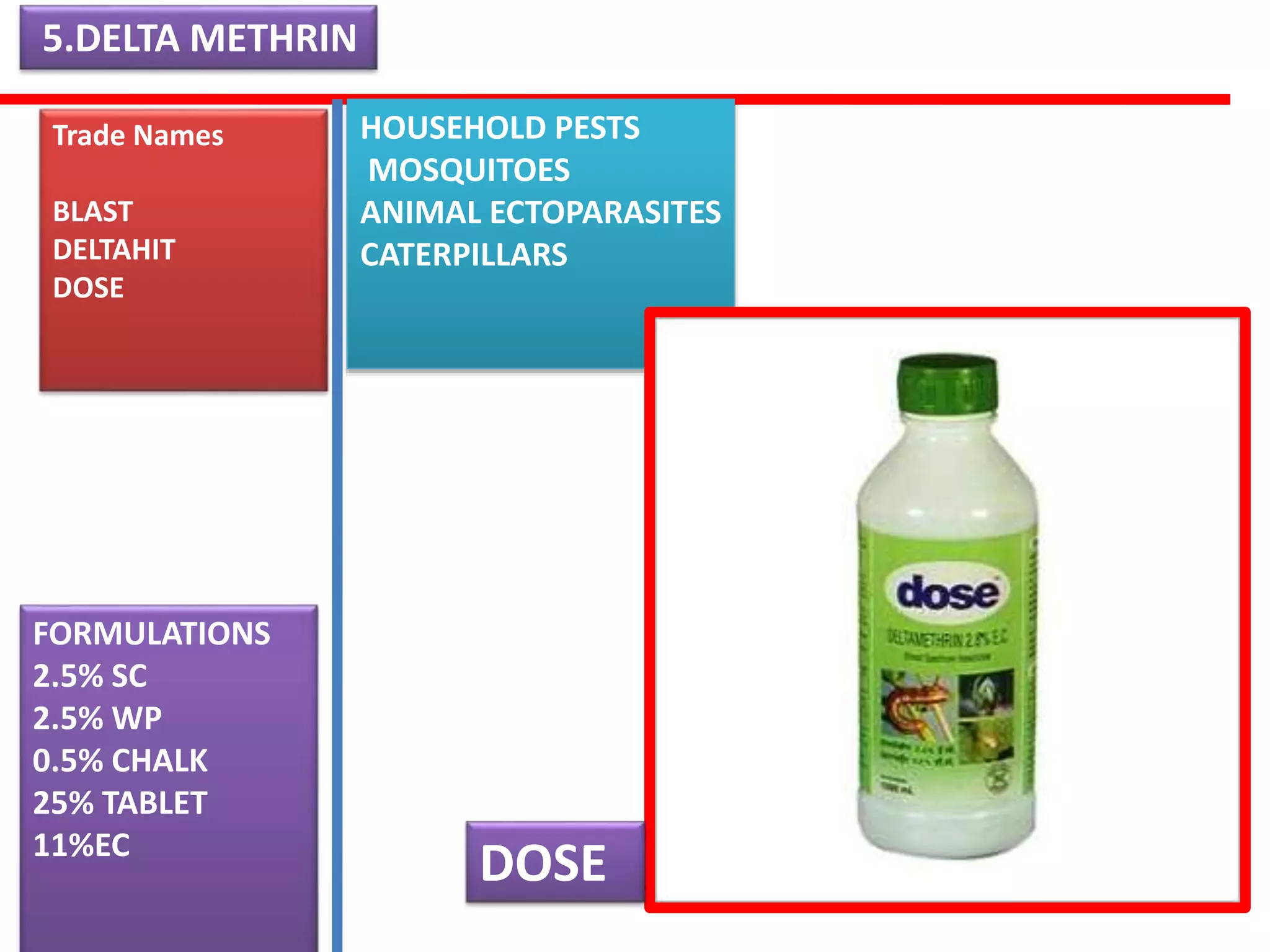
DOSE 
HOUSEHOLD PESTS 
MOSQUITOES 
ANIMAL ECTOPARASITES 
CATERPILLARS 
DOSE 
FORMULATIONS 
2.5% SC 
2.5% WP 
0.5% CHALK 
25% TABLET 
11%EC
BLAST DELTAHIT
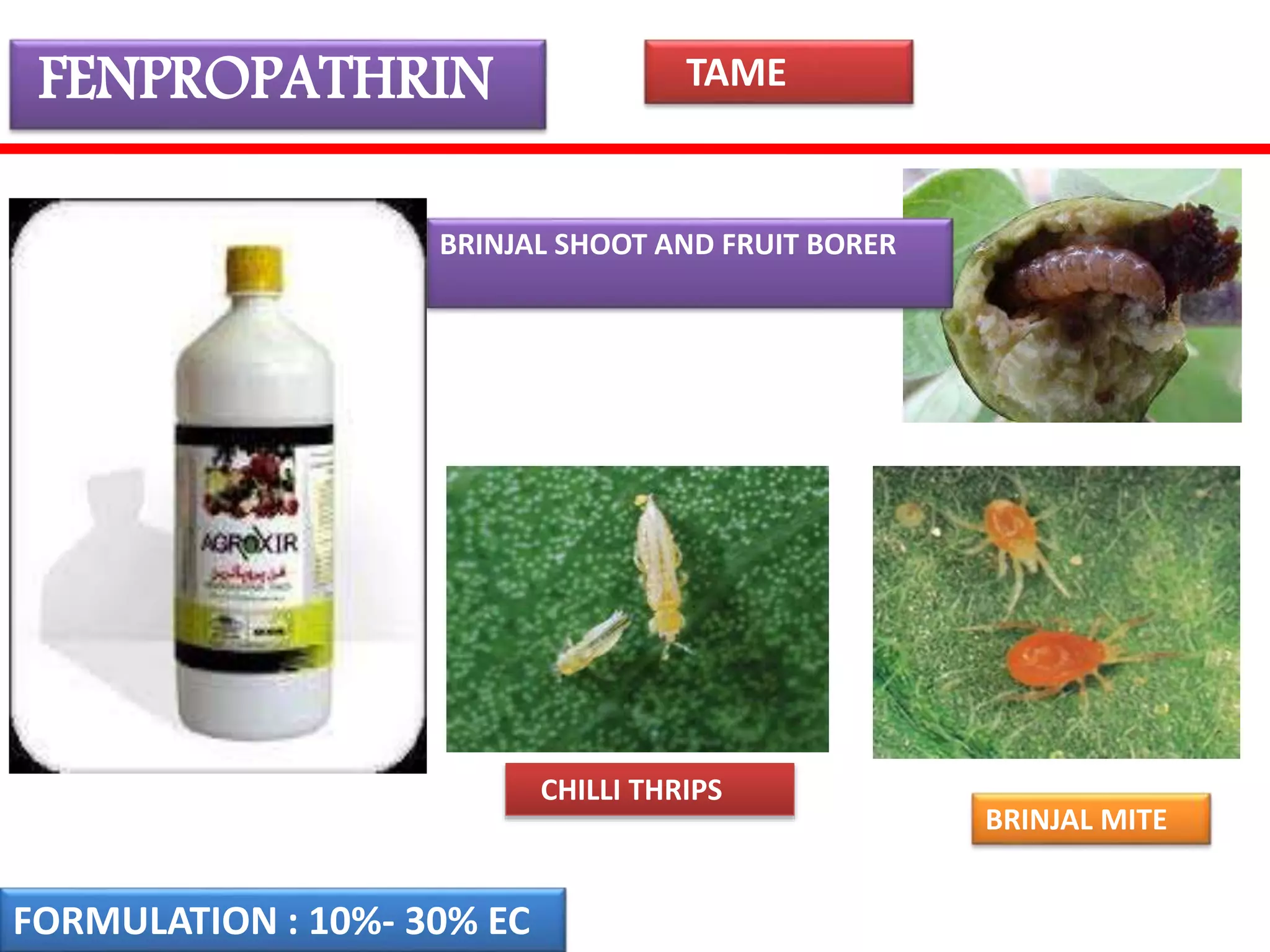
FENPROPATHRIN 
BRINJAL SHOOT AND FRUIT BORER 
BRINJAL MITE 
CHILLI THRIPS 
FORMULATION : 10%- 30% EC 
TAME
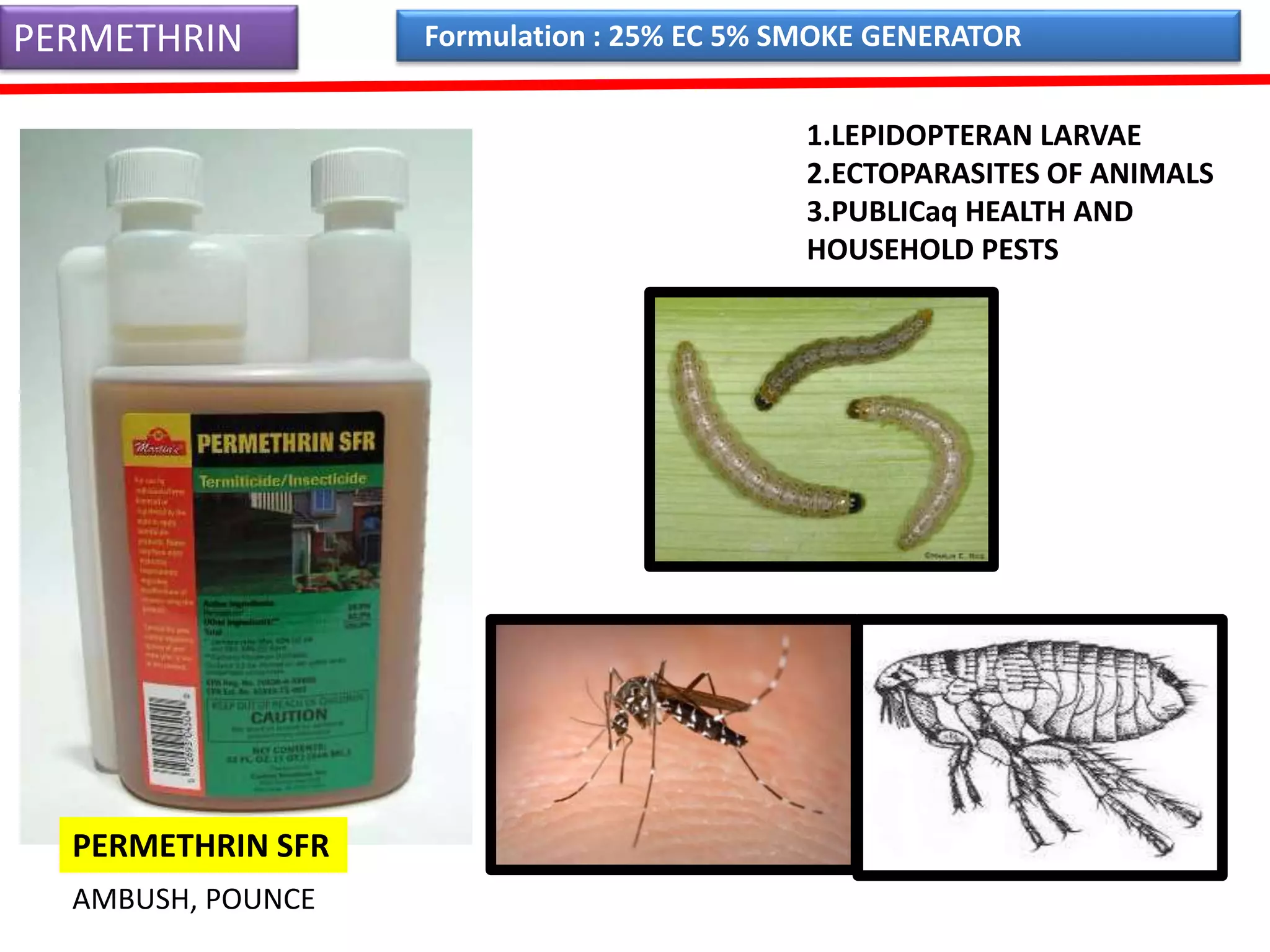
PERMETHRIN 
1.LEPIDOPTERAN LARVAE 
2.ECTOPARASITES OF ANIMALS 
3.PUBLICaq HEALTH AND 
HOUSEHOLD PESTS 
PERMETHRIN SFR 
Formulation : 25% EC 5% SMOKE GENERATOR 
AMBUSH, POUNCE
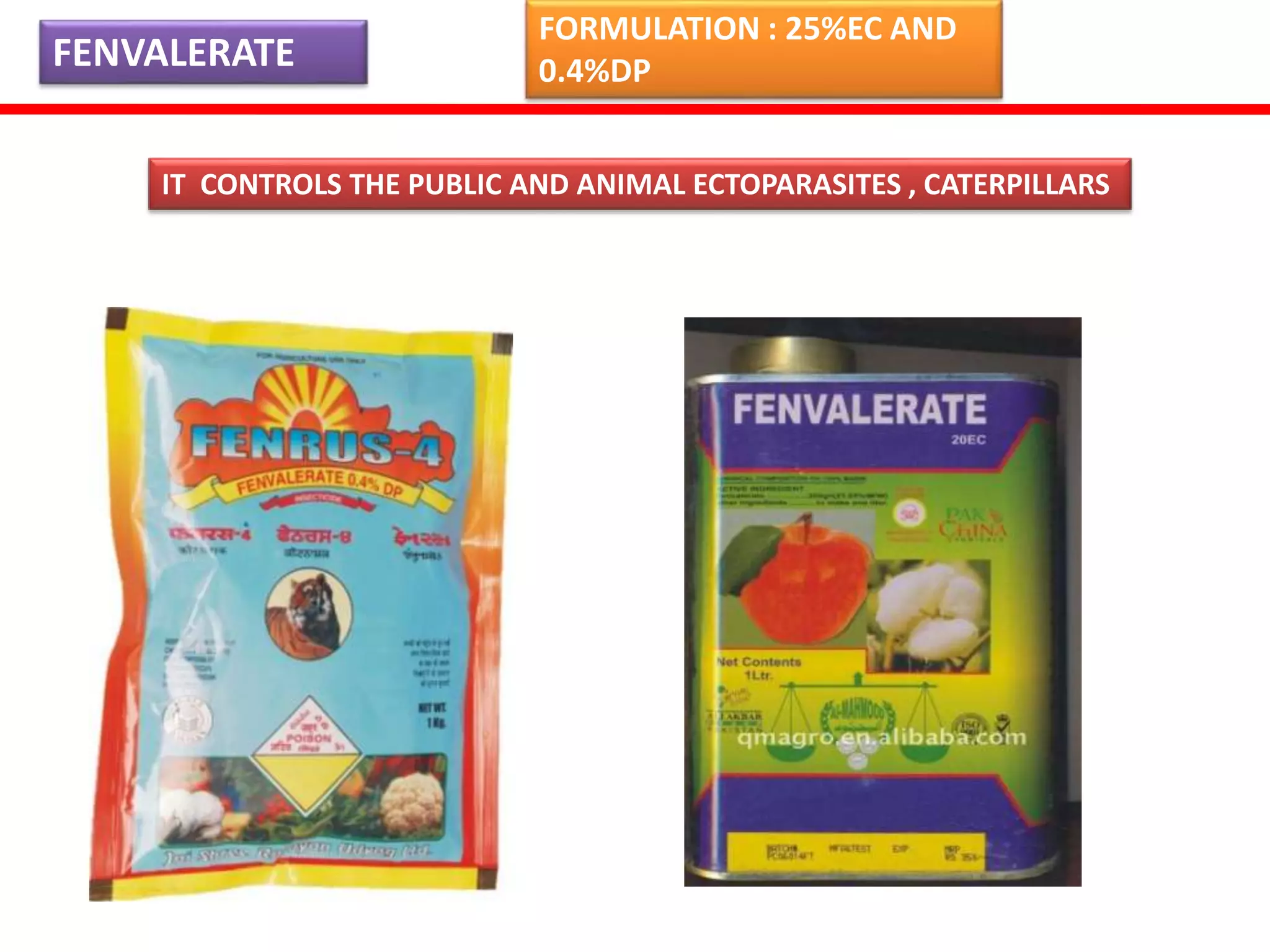
FENVALERATE 
FORMULATION : 25%EC AND 
0.4%DP 
IT CONTROLS THE PUBLIC AND ANIMAL ECTOPARASITES , CATERPILLARS
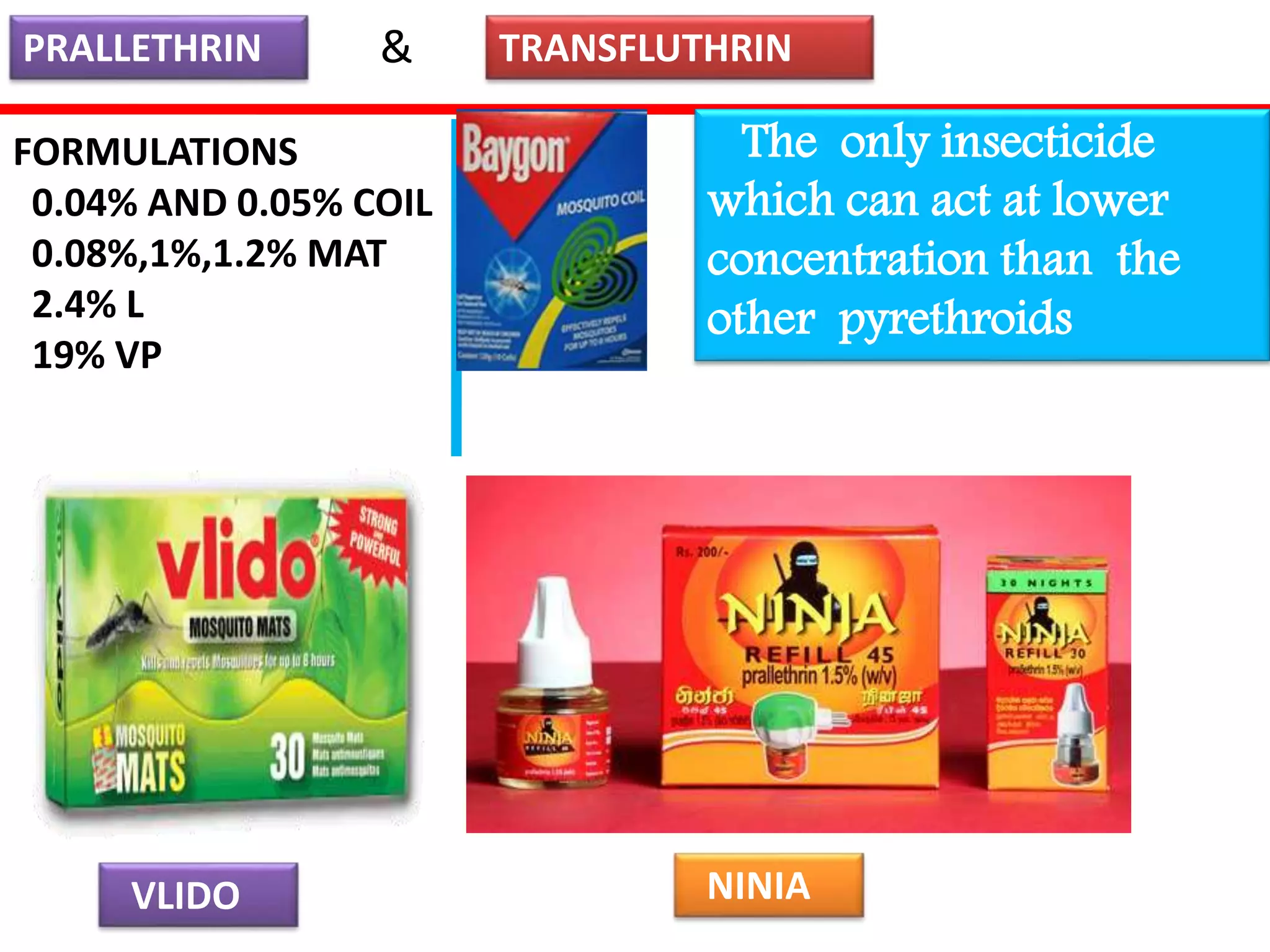
PRALLETHRIN 
& TRANSFLUTHRIN 
The only insecticide 
which can act at lower 
concentration than the 
other pyrethroids 
FORMULATIONS 
0.04% AND 0.05% COIL 
0.08%,1%,1.2% MAT 
2.4% L 
19% VP 
VLIDO NINIA
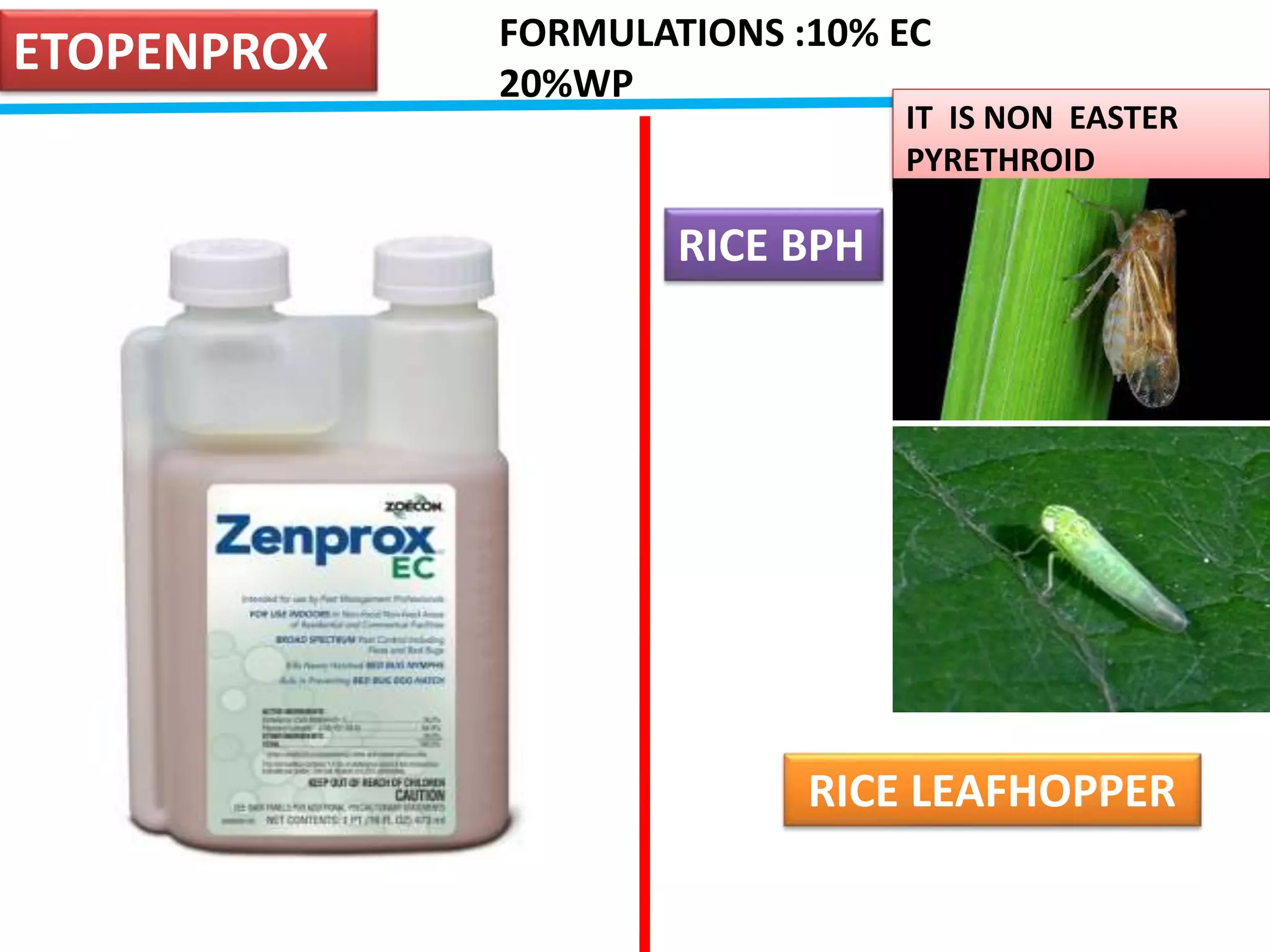
ETOPENPROX 
FORMULATIONS :10% EC 
20%WP 
IT IS NON EASTER 
PYRETHROID 
RICE BPH 
RICE LEAFHOPPER
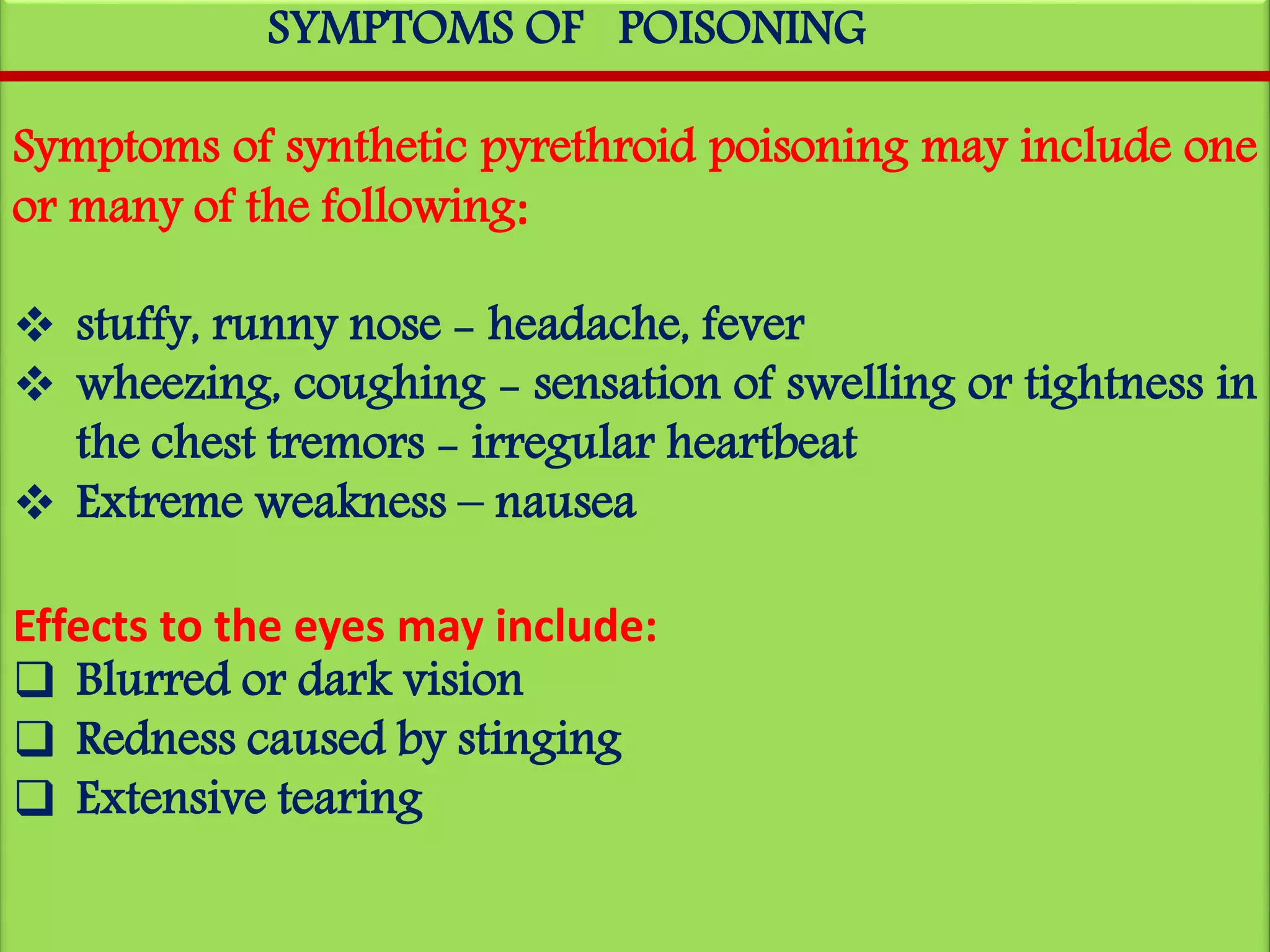
SYMPTOMS OF POISONING 
Symptoms of synthetic pyrethroid poisoning may include one 
or many of the following: 
 stuffy, runny nose - headache, fever 
 wheezing, coughing - sensation of swelling or tightness in 
the chest tremors - irregular heartbeat 
 Extreme weakness – nausea 
Effects to the eyes may include: 
 Blurred or dark vision 
 Redness caused by stinging 
 Extensive tearing
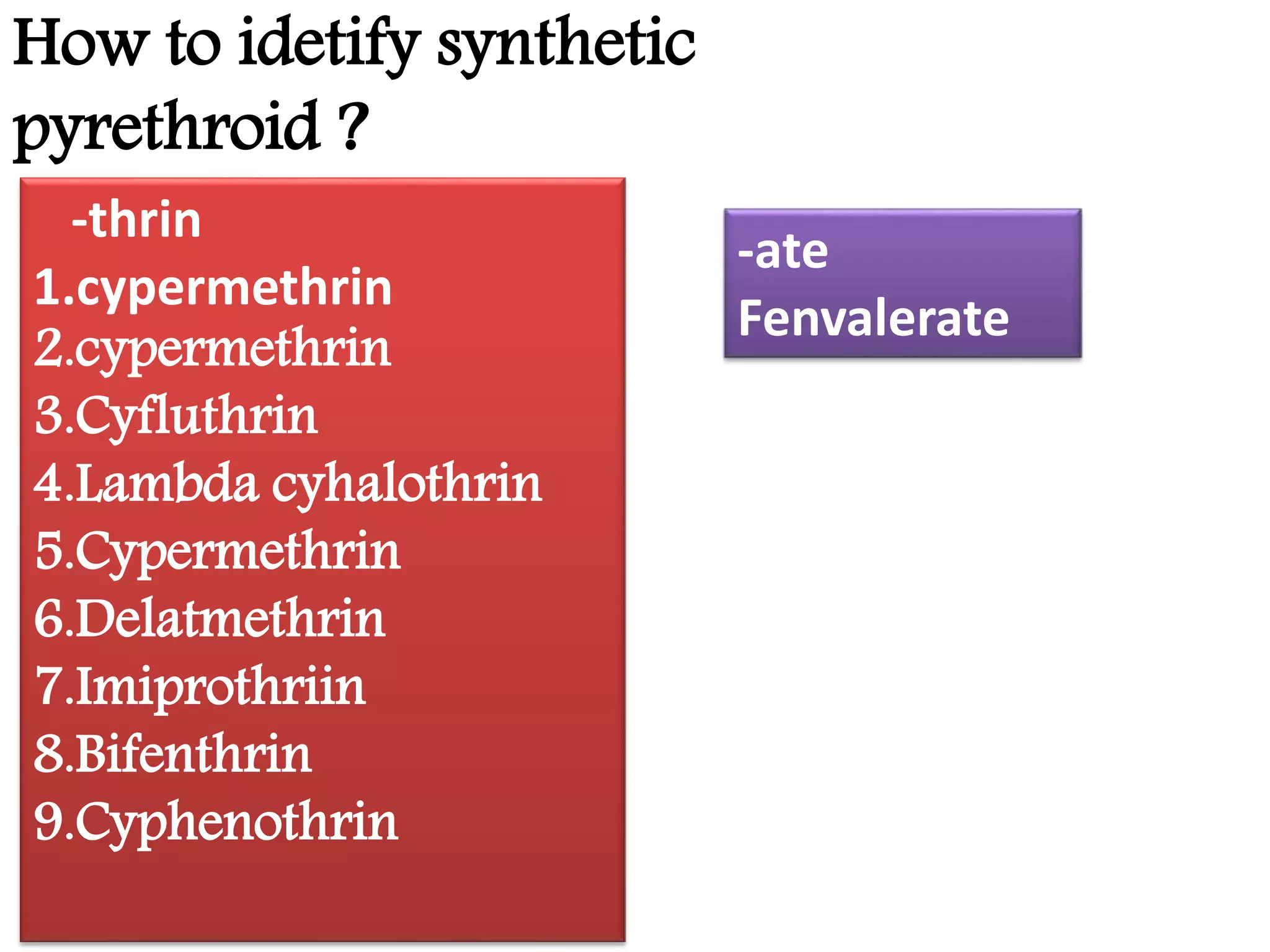
How to idetify synthetic 
pyrethroid ? 
-thrin 
1.cypermethrin 
2.cypermethrin 
3.Cyfluthrin 
4.Lambda cyhalothrin 
5.Cypermethrin 
6.Delatmethrin 
7.Imiprothriin 
8.Bifenthrin 
9.Cyphenothrin 
-ate 
Fenvalerate
Thank you 
PRESENTED BY 
S.SRINIVAS NAIK 
ID.NO:13-503-010

SYNTHETIC PYRETHROIDS SSNAIK

  • 2.
    TERM PAPER ON SYNTHETIC PYRETHROIDS Course Incharge: Dr.Sridharan sir, Department of Agricultural Entomology, CPPS ,TNAU.
  • 3.
    POSITION OF SYNTHETICPYRETHROIDS IN INSECTICIDES CLASSIFICATION INSECTICIDES I II INORGANIC INSECTICIDES FLOURINE COMPOUNDS ARSENIC COMPOUNDS BORAX, SULPHUR, LIME, ZINC PHOSPHIDE ORGANIC INSECTICIDES II.A II.B NATURAL ORGANIC INSECTICIDES SYNTHETIC ORGANIC INSCTICIDES 1.Dinitro phenols eg. DNOC 2.Organothiocyanates eg. thanite 3.Chlorinated hydrocarbon eg. endosulfan, chlordane 4.Organophosphorus eg. phosphamidon 5.Carbamates eg. carbofuron, aldicarb Hydrogen oils Animal origin Neristoxin Plant origin Nicotine, pyrethrum, Rotenone Derris Neem 6.Synthetic pyrethroids eg. cypermethrin, fenvaletate
  • 4.
  • 5.
    PYRETHRINS PYRETHROIDS Pyrethrins are the active chemicals in pyrethrum, and are 100% natural  Pyrethroids are synthetic, or man-made, versions of Pyrethrins.  Pyrethrum is composed of 6 esters (collectively called the Pyrethrins), all of which have insecticidal properties. This means that the pyrethrum is attacking the insect on 6 different fronts, using 6 different insecticides.  Pyrethroids, which are synthetic, are composed of only one chemically active compound.
  • 6.
     Pyrethrins havea unique ability to induce excitation behaviour in insects, characterized by erratic and increased movement by insects. This has the benefit of 'flushing' the insects out of hiding places, resulting in increased exposure to the Pyrethrins  Synthetic Pyrethroids do not have this flushing effect Pyrethrins are naturally broken down by UV rays and PH variances and therefore have shorter environmental persistence.  synthetic Pyrethroids are manufactured to overcome the that problem.
  • 7.
  • 8.
    I. PYRETHRINS ANALOGUE II.SYNTHETIC PYRETHROIDS
  • 9.
    PYRETHRINS ACID +ALCOHOL 6 ESTERS NATURAL
  • 10.
    SOURCES OF PYRETHRINS Achenes of the chrysanthemum FAMILY : Compositae / Asteraceae
  • 11.
    Sources of differentspecies: 1. Chrysanthemum cinerariefolium 2. C . coccineum 3. C.roseum 4. C.marshalli 5. C.tamrutene The original home of pyrethrum is said to be East or Middle East countries.In the 19th century it was introduced to U.S.A., Japan, U.K., Africa and South America. At the beginning of 20th century, Dalmatia and adjoining countries became leading producers. In 1941, Japan became the leading producer. However, at present, the principal producer of pyrethrum is KENYA. Other countries producing pyrethrum are Congo, Uganda, Tanzania, Ethiopia, Equador and Brazil .
  • 12.
    In INDIA alsopyrethrum is grown to a small extent in the 1. Hilly belts of Assam 2. Himalyan mountain range of J & K 3. Nilgiri areas of Tamil Nadu
  • 13.
  • 14.
  • 15.
    EXTRACTION OF PYRETHRUM METHOD I METHOD II
  • 16.
  • 17.
    Pyrethrum is presentin the Achenes of flower heads The content is maximum when the flowers are in full bloom stage flowers are harvested by handpicking They are then dried at 54.4 0C and compressed. In the industries the dried and compressed flowers are ground to a fine powder. The powder / dust can be used as an insecticide.
  • 18.
  • 19.
    The toxicant canbe extracted by extracting with an organic solvent like Isopropanol,acetone or odor less kerosene. The solvent is repeatedly percolated through the powder and the weak extract is evaporated in a vacuum still to get concentrated extract The concentrated extract together with an emulsifier is sold in the market for the use.
  • 20.
    Also, the concentratedextract can be mixed uniformly with an inert carrier like benonite clay, charcoal powder, diatomaceous earth The mixture can be used as a ready to use low power dust.
  • 21.
    PYRETHRUM  Ambercoloured viscous liquid  Insoluble in water but soluble in organic solvents  An exposure to sunlight, it is degraded to nontoxic products in no time i.e., highly photodegradable. This is what restricts the use of natural pyrethrum in out door agriculture.  On prolonged storage, pyrethrum looses its insecticidal action due to degradation by oxidation .Hence; antioxidants like hydroquinolene are added to increase the life.  I t Is Easily decomposed by acid, alkali or even by moisture on long standing to produce primary constituents  It is nonvolatile, hence non-fumigant action.
  • 22.
  • 23.
  • 24.
    STIMULI 1.Resting state 2.Depolarization 3.Repolarization
  • 26.
  • 27.
    COMPOUNDS OF SYNTHETICPYRETHROIDS 1.Allethrin 10.fenprothrin 2.cypermethrin 11.Fenvelarate 3.Cyfluthrin 4.Lambda cyhalothrin 12.Permethrin 5.Cypermethrin 13.Prallethrin 6.Delatmethrin 14.Transfluthgrin 7.Imiprothriin 15.Etofenprox 8.Bifenthrin 9.Cyphenothrin
  • 28.
    1 .Allethrin Alleviate Pynamin D-cisallethrin Bioallethrin Esbiothrin Pyresin Pyrexcel Pyrocide Raid Thermacell Flies mosquitoes FORMULATIONS : 0.5% COIL,2%-4% MAT,0.5%AEROSOL, 3.6% LIQUID
  • 29.
  • 30.
  • 31.
    2.CYPERMETHRIN LEAF EATINGCATERPILLRS BOLLWORMS STORAGE PESTS Trade Names: HIPOPWER 100 DUO INSECTICIDE VIPER SUPERMETHRIN ALPHA CYPER ALFAGIN FORMULATIONS: 10% EC + 25% EC 0.2-1.0% DP 1% CHALK 3% smoke generator
  • 32.
    INSECTICIDE LABELS HIPOPWER100 DUO INSECTICIDE
  • 33.
  • 34.
  • 35.
  • 36.
    3.CYFLUTHRIN Trade names BAYTHROID SIBA -5W HOCKLEY-CYFLUTHRIN DECATHLON, TEMPO 2 FORMULATIONS 10% WP AEROSOLS MOSQUITOES HOUSE FLY COCKROACH
  • 37.
  • 38.
  • 39.
    4.LAMBDA CYHALOTHRIN Formulations:5% EC,10%WP,0.5%CHALK LEPIDOPTERAN CATERPILLARS PUBLIC HEALTH PESTS
  • 40.
    BEMAR IPL LAMBDA LAMBDA MAGIC
  • 41.
  • 42.
    5.DELTA METHRIN TradeNames BLAST DELTAHIT DOSE HOUSEHOLD PESTS MOSQUITOES ANIMAL ECTOPARASITES CATERPILLARS DOSE FORMULATIONS 2.5% SC 2.5% WP 0.5% CHALK 25% TABLET 11%EC
  • 43.
  • 44.
    FENPROPATHRIN BRINJAL SHOOTAND FRUIT BORER BRINJAL MITE CHILLI THRIPS FORMULATION : 10%- 30% EC TAME
  • 45.
    PERMETHRIN 1.LEPIDOPTERAN LARVAE 2.ECTOPARASITES OF ANIMALS 3.PUBLICaq HEALTH AND HOUSEHOLD PESTS PERMETHRIN SFR Formulation : 25% EC 5% SMOKE GENERATOR AMBUSH, POUNCE
  • 46.
    FENVALERATE FORMULATION :25%EC AND 0.4%DP IT CONTROLS THE PUBLIC AND ANIMAL ECTOPARASITES , CATERPILLARS
  • 47.
    PRALLETHRIN & TRANSFLUTHRIN The only insecticide which can act at lower concentration than the other pyrethroids FORMULATIONS 0.04% AND 0.05% COIL 0.08%,1%,1.2% MAT 2.4% L 19% VP VLIDO NINIA
  • 48.
    ETOPENPROX FORMULATIONS :10%EC 20%WP IT IS NON EASTER PYRETHROID RICE BPH RICE LEAFHOPPER
  • 49.
    SYMPTOMS OF POISONING Symptoms of synthetic pyrethroid poisoning may include one or many of the following:  stuffy, runny nose - headache, fever  wheezing, coughing - sensation of swelling or tightness in the chest tremors - irregular heartbeat  Extreme weakness – nausea Effects to the eyes may include:  Blurred or dark vision  Redness caused by stinging  Extensive tearing
  • 50.
    How to idetifysynthetic pyrethroid ? -thrin 1.cypermethrin 2.cypermethrin 3.Cyfluthrin 4.Lambda cyhalothrin 5.Cypermethrin 6.Delatmethrin 7.Imiprothriin 8.Bifenthrin 9.Cyphenothrin -ate Fenvalerate
  • 52.
    Thank you PRESENTEDBY S.SRINIVAS NAIK ID.NO:13-503-010