Naturally occurring
insecticides
Prepared by
Mr. Pravin Bendle ,
Assistant Professor,
N.G. Acharya & D.K. Marathe College,
Chembur- 400071
M.Sc. Part-2
Contents
Definition
Pyrethrums
Synthesis of Pyrethrins
Rotenoids
Naturally occurring insecticides
Obtained from plants
Nontoxic to human ,
Biodegradable hence not pollute environment.
Types of insecticides:
1) Neurotoxins eg. Pyrenthrins
2) Anti-feedant eg. Azadirachtin
(Agent that causes a paste as an insect to stop eating.
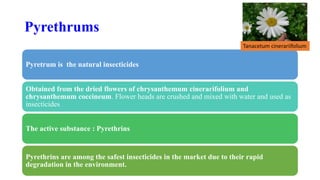
Pyrethrums
Pyretrum is the natural insecticides
Obtained from the dried flowers of chrysanthemum cinerarifolium and
chrysanthemum coccineum. Flower heads are crushed and mixed with water and used as
insecticides
The active substance : Pyrethrins
Pyrethrins are among the safest insecticides in the market due to their rapid
degradation in the environment.
Tanacetum cinerariifolium
Structure of Pyrenthrins
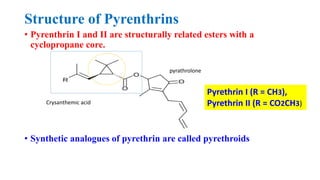
• Pyrenthrin I and II are structurally related esters with a
cyclopropane core.
• Synthetic analogues of pyrethrin are called pyrethroids
Pyrethrin I (R = CH3),
Pyrethrin II (R = CO2CH3)
Crysanthemic acid
pyrathrolone
Biological functions
Potent neurotoxic which have potent insecticidal activity by
targeting the nervous systems of insects .
They work by altering nerve function, which causes paralysis in
target insect pests, eventually resulting in death
Pyrethrins induce a toxic effect within the insect by acting on
sodium channels
en.wikipdia.org
Synthesis of Pyrethrin-I
Step(1): Synthesis of trans-chrysanthemic acid methyl ester:
• a)1-bromo-3-methyl-2-butene (1a) was condensed with
sodium -p-toluene sulphonate (1b) to obtain allyl
sulphone(1c)
C
H3 Br
C
H3
+ CH3
NaO3S
DFM
- NaBr CH3
SO3
CH3
C
H3
1-Bromo-3-methyl -2-butene sodium-p-toluene sulphonate allyl suphone
1a 1b 1c
Synthesis of Pyrethrin-I
Step(1) : Synthesis of trans-chrysanthemic acid methyl ester:
b) Base catalysed addition of sulphone(1c) to 3-methyl-2-
butenoic acid methyl ester (1d) resulted in 1,3 elimination with
formation of the cyclopropane ring of the trans-crysanthemic acid
methyl ester.(1e)
allyl suphone
+
C
H3
C
H3
COOMe
NaOCH3
1, 3 -Elimation
+
CH3
C
H3
SO3
C
H3
C
H3
C
H3
CH2
C
H3
CH3
H COOMe
CH3
C
H3
H H
COOMe
C
H3 CH3
1e
1d
1c
Step(2): Synthesis of alcohol moiety:-
The lactone (2a) was converted to bromo compound (2b)
by reduction with DIBAL-H followed by witting reaction
and dehydrobromination gave alcohol(2c)
O
OH
O
CH2
OH
DIBAL -H
PPh3 ,CBr4
O
C
OH
O
CH2
Br
PPh3
C
C
H2
H
- +
Wittig reaction
-HBr
O
H
CH2
O
H
CH
CH2
-PPh3=O
2a 2b
2c
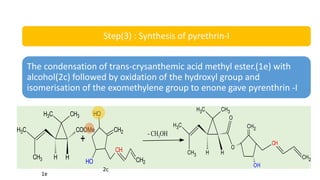
Step(3) : Synthesis of pyrethrin-I
The condensation of trans-crysanthemic acid methyl ester.(1e) with
alcohol(2c) followed by oxidation of the hydroxyl group and
isomerisation of the exomethylene group to enone gave pyrenthrin -I
O
H
CH2
O
H
CH
CH2
+
CH3
C
H3
H H
COOMe
C
H3 CH3
- CH3OH
CH3
C
H3
H H
C
H3 CH3
O
O
CH2
OH
CH
CH2
1e
2c
CH3
C
H3
H H
C
H3 CH3
O
O
CH2
OH
CH
CH2
Tautomerisation
CH3
C
H3
H H
C
H3 CH3
O
O
CH3
O
CH
CH2
Pyrethrin -I
Rotenoids
Rotenone is an odorless, colorless, crystalline isoflavone .
It occurs naturally in the seeds and stems of several plants, such as
the jicama vine plant, and the roots of several members
of Fabaceae.
It was the first described member of the family of chemical
compounds known as rotenoids .
Structure of Rotenoids
Rotenoids are naturally occurring substances containing a cis-fused
tetrahydrochromeno[3,4-b]chromene nucleus.[
Uses and Biological properties
It is used as a broad-spectrum insecticides , piscicide,
( fish killer) andpesticide .
For treatment of lice in human and pets.
Rotenone works by interfering with the electron transport
chain in mitochondria of cells of fish and insects.
Rotenone is mildly toxic to humans and other
mammals, but extremely toxic to insects and
aquatic life, including fish.
This higher toxicity in fish and insects is
because the lipophilic rotenone is easily taken
up through the gills or trachea, but not as easily
through the skin or the gastrointestinal tract.
Thanks

Natural insecticides .pptx

  • 1.
    Naturally occurring insecticides Prepared by Mr.Pravin Bendle , Assistant Professor, N.G. Acharya & D.K. Marathe College, Chembur- 400071 M.Sc. Part-2
  • 2.
  • 3.
    Naturally occurring insecticides Obtainedfrom plants Nontoxic to human , Biodegradable hence not pollute environment. Types of insecticides: 1) Neurotoxins eg. Pyrenthrins 2) Anti-feedant eg. Azadirachtin (Agent that causes a paste as an insect to stop eating.
  • 4.
    Pyrethrums Pyretrum is thenatural insecticides Obtained from the dried flowers of chrysanthemum cinerarifolium and chrysanthemum coccineum. Flower heads are crushed and mixed with water and used as insecticides The active substance : Pyrethrins Pyrethrins are among the safest insecticides in the market due to their rapid degradation in the environment. Tanacetum cinerariifolium
  • 5.
    Structure of Pyrenthrins •Pyrenthrin I and II are structurally related esters with a cyclopropane core. • Synthetic analogues of pyrethrin are called pyrethroids Pyrethrin I (R = CH3), Pyrethrin II (R = CO2CH3) Crysanthemic acid pyrathrolone
  • 6.
    Biological functions Potent neurotoxicwhich have potent insecticidal activity by targeting the nervous systems of insects . They work by altering nerve function, which causes paralysis in target insect pests, eventually resulting in death Pyrethrins induce a toxic effect within the insect by acting on sodium channels en.wikipdia.org
  • 7.
    Synthesis of Pyrethrin-I Step(1):Synthesis of trans-chrysanthemic acid methyl ester: • a)1-bromo-3-methyl-2-butene (1a) was condensed with sodium -p-toluene sulphonate (1b) to obtain allyl sulphone(1c) C H3 Br C H3 + CH3 NaO3S DFM - NaBr CH3 SO3 CH3 C H3 1-Bromo-3-methyl -2-butene sodium-p-toluene sulphonate allyl suphone 1a 1b 1c
  • 8.
    Synthesis of Pyrethrin-I Step(1): Synthesis of trans-chrysanthemic acid methyl ester: b) Base catalysed addition of sulphone(1c) to 3-methyl-2- butenoic acid methyl ester (1d) resulted in 1,3 elimination with formation of the cyclopropane ring of the trans-crysanthemic acid methyl ester.(1e) allyl suphone + C H3 C H3 COOMe NaOCH3 1, 3 -Elimation + CH3 C H3 SO3 C H3 C H3 C H3 CH2 C H3 CH3 H COOMe CH3 C H3 H H COOMe C H3 CH3 1e 1d 1c
  • 9.
    Step(2): Synthesis ofalcohol moiety:- The lactone (2a) was converted to bromo compound (2b) by reduction with DIBAL-H followed by witting reaction and dehydrobromination gave alcohol(2c) O OH O CH2 OH DIBAL -H PPh3 ,CBr4 O C OH O CH2 Br PPh3 C C H2 H - + Wittig reaction -HBr O H CH2 O H CH CH2 -PPh3=O 2a 2b 2c
  • 10.
    Step(3) : Synthesisof pyrethrin-I The condensation of trans-crysanthemic acid methyl ester.(1e) with alcohol(2c) followed by oxidation of the hydroxyl group and isomerisation of the exomethylene group to enone gave pyrenthrin -I O H CH2 O H CH CH2 + CH3 C H3 H H COOMe C H3 CH3 - CH3OH CH3 C H3 H H C H3 CH3 O O CH2 OH CH CH2 1e 2c
  • 11.
  • 12.
    Rotenoids Rotenone is anodorless, colorless, crystalline isoflavone . It occurs naturally in the seeds and stems of several plants, such as the jicama vine plant, and the roots of several members of Fabaceae. It was the first described member of the family of chemical compounds known as rotenoids .
  • 14.
    Structure of Rotenoids Rotenoidsare naturally occurring substances containing a cis-fused tetrahydrochromeno[3,4-b]chromene nucleus.[
  • 15.
    Uses and Biologicalproperties It is used as a broad-spectrum insecticides , piscicide, ( fish killer) andpesticide . For treatment of lice in human and pets. Rotenone works by interfering with the electron transport chain in mitochondria of cells of fish and insects.
  • 16.
    Rotenone is mildlytoxic to humans and other mammals, but extremely toxic to insects and aquatic life, including fish. This higher toxicity in fish and insects is because the lipophilic rotenone is easily taken up through the gills or trachea, but not as easily through the skin or the gastrointestinal tract.
  • 17.