SEMIOCHEMICALS
Pheromones & Allelochemicals
BALWANT SINGH
balwantsingh1642@gmail.com
BY
SEMIOCHEMICALS
• Chemicals that modify behavior in any way are
referred to as semiochemicals. Not only chemicals
stimulate but they might also inhibit certain
behaviors.
• Semiochemicals can be divided in two main classes:
• Pheromones: Chemicals that operate intra-
specifically. That is, among members of the same
species.
• Allelochemicals: Chemicals that operate inter-
specifically. That is among members from different
species.
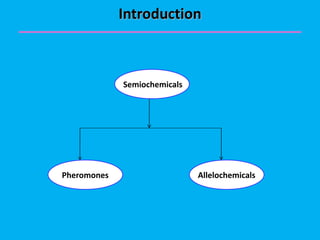
Introduction
Semiochemicals
Pheromones Allelochemicals
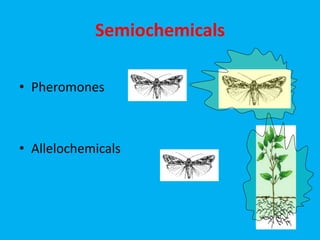
Semiochemicals
• Pheromones
• Allelochemicals
What is a Pheromone?
Defined chemical signal between
members of the same species,
eliciting a particular behavior or
physiological change...”
Pheromone
• A pheromone is a secreted or excreted chemical
factor that triggers a social response in members
of the same species.
• Pheromones are chemicals capable of acting
outside the body of the secreting individual to
impact the behavior of the receiving individual.
• Their use among insects has been particularly well
documented. In addition, some vertebrates and
plants communicate by using pheromones.
Background
• The term "pheromone" was introduced by Peter
Karlson and Martin Lüscher in 1959.
• Pheromone is the Greek word pherein (to
transport) and hormone (to stimulate).
• It is also called as ecto-hormones.
• German biochemist Adolf Butenandt had
characterized the first such chemical, bombykol, a
chemically well-characterized pheromone released
by the female silkworm to attract mates
Classification of Pheromones
• Pheromones are classified based on their function-
1) Aggregation pheromone
2) Alarm pheromone
3) Epideictic pheromone
4) Releaser pheromone
5) Signal pheromone
6) Primer pheromone
7) Territorial pheromone
8) Trail pheromone
9) Sex pheromone
10) Others pheromone
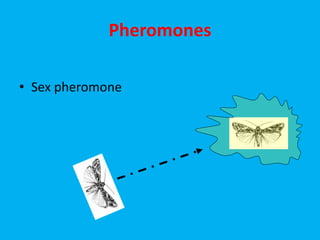
Sex pheromone
• Sex pheromones are involved in reproduction
by attracting the opposite sex.
• In some species female pheromones are used
to attract the male.
• In other species male pheromones are used to
attract the female.
Pheromones
• Sex pheromone
Alarm pheromone
• Alarm pheromones are used to warn members
of the same species about imminent danger.
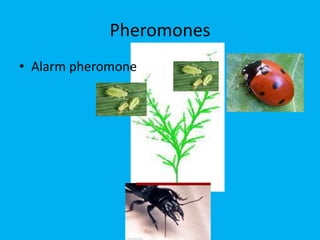
• For example the aphids were using an alarm
pheromone to inform other members of their
species that they were attacked by a lady bug!
• As soon as aphids smell this alarm pheromone
they drop from the plant. In this way, even
aphids that are not being attacked by the lady
beetle fall to the ground.
Pheromones
• Alarm pheromone
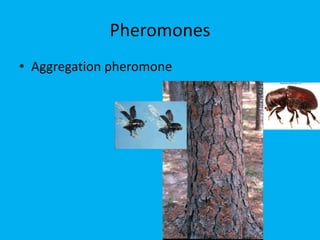
Aggregation pheromone
• Aggregation pheromones are use to congregate
members of the same species in relatively big
numbers.
• They are used by organisms that need help to
invade a new area or habitat or plant.
• These conifer beetles for example do a better
job, or have a higher fitness when feeding in
group than when feeding individually.
Pheromones
• Aggregation pheromone
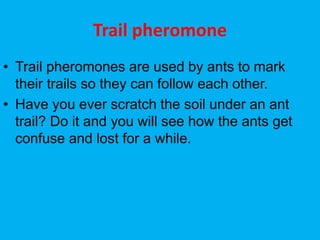
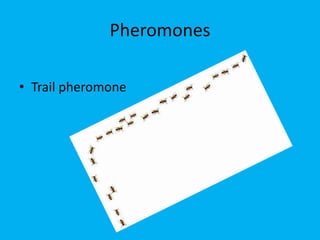
Trail pheromone
• Trail pheromones are used by ants to mark
their trails so they can follow each other.
• Have you ever scratch the soil under an ant
trail? Do it and you will see how the ants get
confuse and lost for a while.
Pheromones
• Trail pheromone
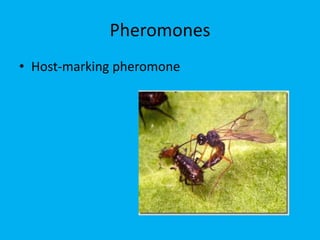
Host-marking pheromone
• Host marking pheromones are used by
parasitoids to avoid ovipositing on hosts
they or somebody else have oviposit
already.
• Hyper parasitoids may use these marking
pheromones to find their hosts.
Pheromones
• Host-marking pheromone
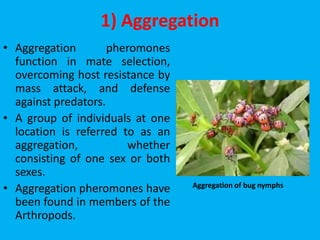
1) Aggregation
• Aggregation pheromones
function in mate selection,
overcoming host resistance by
mass attack, and defense
against predators.
• A group of individuals at one
location is referred to as an
aggregation, whether
consisting of one sex or both
sexes.
• Aggregation pheromones have
been found in members of the
Arthropods.
Aggregation of bug nymphs
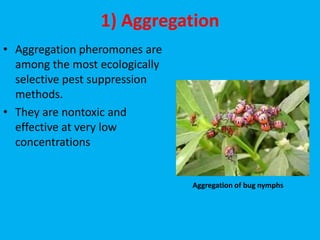
1) Aggregation
• Aggregation pheromones are
among the most ecologically
selective pest suppression
methods.
• They are nontoxic and
effective at very low
concentrations
Aggregation of bug nymphs
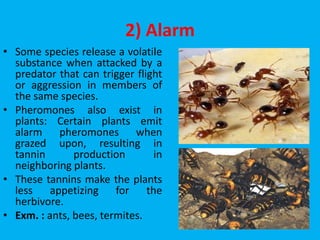
2) Alarm
• Some species release a volatile
substance when attacked by a
predator that can trigger flight
or aggression in members of
the same species.
• Pheromones also exist in
plants: Certain plants emit
alarm pheromones when
grazed upon, resulting in
tannin production in
neighboring plants.
• These tannins make the plants
less appetizing for the
herbivore.
• Exm. : ants, bees, termites.
4) Releaser
• Releaser pheromones are pheromones that cause an
alteration in the behavior of the recipient.
• In general, this type of pheromone elicits a rapid
response, but is quickly degraded.
• For example, some organisms use powerful attractant
molecules to attract mates from a distance of two
miles or more.
5) Signal
• Signal pheromones cause short-term changes,
such as the neurotransmitter release that
activates a response.
• For instance, GnRH molecule functions as a
neurotransmitter in rats to elicit lordosis
behavior.
6) Primer
• Primer pheromones trigger a change of
developmental events (in which they differ from
all the other pheromones, which trigger a change
in behavior).
7) Territorial
• Pheromones mark the boundaries and identity of
an organism's territory.
• In cats and dogs, these hormones are present in
the urine, which they deposit on landmarks
serving to mark the perimeter of the claimed
territory.
8) Trail
• Trail pheromones are common in social insects.
• As long as the food source remains, the
pheromone trail will be continuously renewed.
• The pheromone must be continuously renewed
because it evaporates quickly.
• For example, ants mark their paths with these
pheromones, which are volatile hydrocarbons.
Certain ants lay down an initial trail of
pheromones as they return to the nest with
food.
• This trail attracts other ants and serves as a
guide.
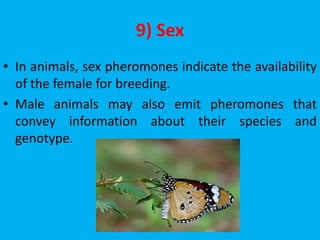
9) Sex
• In animals, sex pheromones indicate the availability
of the female for breeding.
• Male animals may also emit pheromones that
convey information about their species and
genotype.
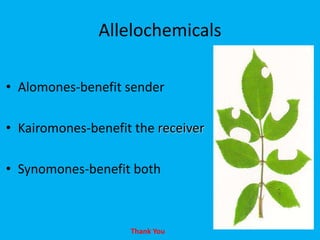
Allelochemicals
• Alomones-benefit sender
• Kairomones-benefit the receiver
• Synomones-benefit both
Thank You

Semiochemicals pheromones

  • 1.
    SEMIOCHEMICALS Pheromones & Allelochemicals BALWANTSINGH balwantsingh1642@gmail.com BY
  • 2.
    SEMIOCHEMICALS • Chemicals thatmodify behavior in any way are referred to as semiochemicals. Not only chemicals stimulate but they might also inhibit certain behaviors. • Semiochemicals can be divided in two main classes: • Pheromones: Chemicals that operate intra- specifically. That is, among members of the same species. • Allelochemicals: Chemicals that operate inter- specifically. That is among members from different species.
  • 3.
  • 4.
  • 5.
    What is aPheromone? Defined chemical signal between members of the same species, eliciting a particular behavior or physiological change...”
  • 6.
    Pheromone • A pheromoneis a secreted or excreted chemical factor that triggers a social response in members of the same species. • Pheromones are chemicals capable of acting outside the body of the secreting individual to impact the behavior of the receiving individual. • Their use among insects has been particularly well documented. In addition, some vertebrates and plants communicate by using pheromones.
  • 7.
    Background • The term"pheromone" was introduced by Peter Karlson and Martin Lüscher in 1959. • Pheromone is the Greek word pherein (to transport) and hormone (to stimulate). • It is also called as ecto-hormones. • German biochemist Adolf Butenandt had characterized the first such chemical, bombykol, a chemically well-characterized pheromone released by the female silkworm to attract mates
  • 8.
    Classification of Pheromones •Pheromones are classified based on their function- 1) Aggregation pheromone 2) Alarm pheromone 3) Epideictic pheromone 4) Releaser pheromone 5) Signal pheromone 6) Primer pheromone 7) Territorial pheromone 8) Trail pheromone 9) Sex pheromone 10) Others pheromone
  • 9.
    Sex pheromone • Sexpheromones are involved in reproduction by attracting the opposite sex. • In some species female pheromones are used to attract the male. • In other species male pheromones are used to attract the female.
  • 10.
  • 11.
    Alarm pheromone • Alarmpheromones are used to warn members of the same species about imminent danger. • For example the aphids were using an alarm pheromone to inform other members of their species that they were attacked by a lady bug! • As soon as aphids smell this alarm pheromone they drop from the plant. In this way, even aphids that are not being attacked by the lady beetle fall to the ground.
  • 12.
  • 13.
    Aggregation pheromone • Aggregationpheromones are use to congregate members of the same species in relatively big numbers. • They are used by organisms that need help to invade a new area or habitat or plant. • These conifer beetles for example do a better job, or have a higher fitness when feeding in group than when feeding individually.
  • 14.
  • 15.
    Trail pheromone • Trailpheromones are used by ants to mark their trails so they can follow each other. • Have you ever scratch the soil under an ant trail? Do it and you will see how the ants get confuse and lost for a while.
  • 16.
  • 17.
    Host-marking pheromone • Hostmarking pheromones are used by parasitoids to avoid ovipositing on hosts they or somebody else have oviposit already. • Hyper parasitoids may use these marking pheromones to find their hosts.
  • 18.
  • 19.
    1) Aggregation • Aggregationpheromones function in mate selection, overcoming host resistance by mass attack, and defense against predators. • A group of individuals at one location is referred to as an aggregation, whether consisting of one sex or both sexes. • Aggregation pheromones have been found in members of the Arthropods. Aggregation of bug nymphs
  • 20.
    1) Aggregation • Aggregationpheromones are among the most ecologically selective pest suppression methods. • They are nontoxic and effective at very low concentrations Aggregation of bug nymphs
  • 21.
    2) Alarm • Somespecies release a volatile substance when attacked by a predator that can trigger flight or aggression in members of the same species. • Pheromones also exist in plants: Certain plants emit alarm pheromones when grazed upon, resulting in tannin production in neighboring plants. • These tannins make the plants less appetizing for the herbivore. • Exm. : ants, bees, termites.
  • 22.
    4) Releaser • Releaserpheromones are pheromones that cause an alteration in the behavior of the recipient. • In general, this type of pheromone elicits a rapid response, but is quickly degraded. • For example, some organisms use powerful attractant molecules to attract mates from a distance of two miles or more.
  • 23.
    5) Signal • Signalpheromones cause short-term changes, such as the neurotransmitter release that activates a response. • For instance, GnRH molecule functions as a neurotransmitter in rats to elicit lordosis behavior.
  • 24.
    6) Primer • Primerpheromones trigger a change of developmental events (in which they differ from all the other pheromones, which trigger a change in behavior).
  • 25.
    7) Territorial • Pheromonesmark the boundaries and identity of an organism's territory. • In cats and dogs, these hormones are present in the urine, which they deposit on landmarks serving to mark the perimeter of the claimed territory.
  • 26.
    8) Trail • Trailpheromones are common in social insects. • As long as the food source remains, the pheromone trail will be continuously renewed. • The pheromone must be continuously renewed because it evaporates quickly. • For example, ants mark their paths with these pheromones, which are volatile hydrocarbons. Certain ants lay down an initial trail of pheromones as they return to the nest with food. • This trail attracts other ants and serves as a guide.
  • 27.
    9) Sex • Inanimals, sex pheromones indicate the availability of the female for breeding. • Male animals may also emit pheromones that convey information about their species and genotype.
  • 28.
    Allelochemicals • Alomones-benefit sender •Kairomones-benefit the receiver • Synomones-benefit both Thank You