IndianAgriculturalResearchInstitute,NewDelhi
Introduction
Introduction
Insects damages crops
IndianAgriculturalResearchInstitute,NewDelhi
Drawbacks of existing insecticides
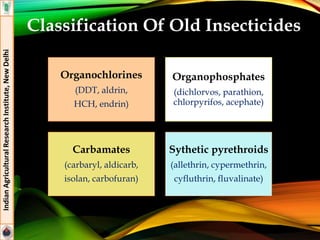
Classification Of Old Insecticides
Organochlorines
(DDT, aldrin,
HCH, endrin)
Organophosphates
(dichlorvos, parathion,
chlorpyrifos, acephate)
Carbamates
(carbaryl, aldicarb,
isolan, carbofuran)
Sythetic pyrethroids
(allethrin, cypermethrin,
cyfluthrin, fluvalinate)
IndianAgriculturalResearchInstitute,NewDelhi
Problems Of Old Insecticides
IndianAgriculturalResearchInstitute,NewDelhi
Residue
Resistance
Resurgence
IndianAgriculturalResearchInstitute,NewDelhi
New
Chemistry
Seminar (AC 691)
IndianAgriculturalResearchInstitute,NewDelhi
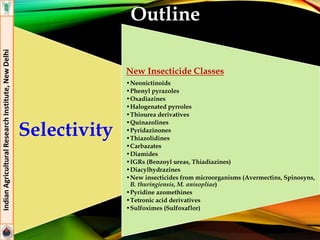
Outline
Selectivity
New Insecticide Classes
•Neonictinoids
•Phenyl pyrazoles
•Oxadiazines
•Halogenated pyrroles
•Thiourea derivatives
•Quinazolines
•Pyridazinones
•Thiazolidines
•Carbazates
•Diamides
•IGRs (Benzoyl ureas, Thiadiazines)
•Diacylhydrazines
•New insecticides from microorganisms (Avermectins, Spinosyns,
B. thuringiensis, M. anisopliae)
•Pyridine azomethines
•Tetronic acid derivatives
•Sulfoximes (Sulfoxaflor)
IndianAgriculturalResearchInstitute,NewDelhi
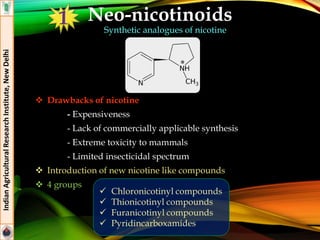
Neo-nicotinoids
Synthetic analogues of nicotine
 Drawbacks of nicotine
- Expensiveness
- Lack of commercially applicable synthesis
- Extreme toxicity to mammals
- Limited insecticidal spectrum
 Introduction of new nicotine like compounds
 4 groups
IndianAgriculturalResearchInstitute,NewDelhi
 Chloronicotinyl compounds
 Thionicotinyl compounds
 Furanicotinyl compounds
 Pyridincarboxamides
1
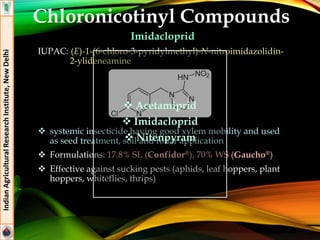
Chloronicotinyl Compounds
Imidacloprid
IUPAC: (E)-1-(6-chloro-3-pyridylmethyl)-N-nitroimidazolidin-
2-ylideneamine
 systemic insecticide having good xylem mobility and used
as seed treatment, soil and foliar application
 Formulations: 17.8% SL (Confidor®), 70% WS (Gaucho®)
 Effective against sucking pests (aphids, leaf hoppers, plant
hoppers, whiteflies, thrips)
IndianAgriculturalResearchInstitute,NewDelhi
 Acetamiprid
 Imidacloprid
 Nitenpyram
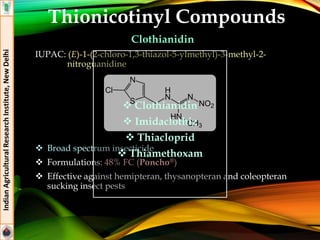
Clothianidin
IUPAC: (E)-1-(2-chloro-1,3-thiazol-5-ylmethyl)-3-methyl-2-
nitroguanidine
 Broad spectrum insecticide
 Formulations: 48% FC (Poncho®)
 Effective against hemipteran, thysanopteran and coleopteran
sucking insect pests
IndianAgriculturalResearchInstitute,NewDelhi
Thionicotinyl Compounds
 Clothianidin
 Imidaclothiz
 Thiacloprid
 Thiamethoxam
Furanicotinyl compounds
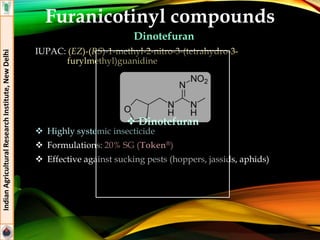
Dinotefuran
IUPAC: (EZ)-(RS)-1-methyl-2-nitro-3-(tetrahydro-3-
furylmethyl)guanidine
 Highly systemic insecticide
 Formulations: 20% SG (Token®)
 Effective against sucking pests (hoppers, jassids, aphids)
IndianAgriculturalResearchInstitute,NewDelhi
 Dinotefuran
Pyridincarboxamides
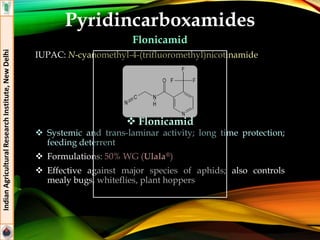
Flonicamid
IUPAC: N-cyanomethyl-4-(trifluoromethyl)nicotinamide
 Systemic and trans-laminar activity; long time protection;
feeding deterrent
 Formulations: 50% WG (Ulala®)
 Effective against major species of aphids; also controls
mealy bugs, whiteflies, plant hoppers
IndianAgriculturalResearchInstitute,NewDelhi
 Flonicamid
Mode Of Action
 They are nicotinic acetylcholine receptor agonists
 They bind strongly to nicotinic acetylcholine receptors
(nAChRs) in the central nervous system of insects, causing
nervous stimulation at low concentrations, but receptor
blockage, paralysis and death at higher concentrations
 Neonicotinoids bind more strongly to insect nAChRs than to
those of vertebrates, so they are selectively more toxic to insects
(Tomizawa & Casida, 2005)
IndianAgriculturalResearchInstitute,NewDelhi
Phenyl pyrazoles
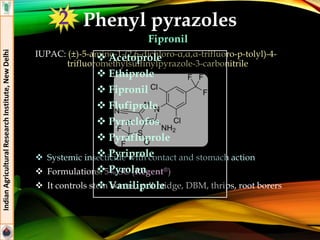
Fipronil
IUPAC: (±)-5-amino-1-(2,6-dichloro-α,α,α-trifluoro-p-tolyl)-4-
trifluoromethylsulfinylpyrazole-3-carbonitrile
 Systemic insecticide with contact and stomach action
 Formulations: 5% SC (Regent®)
 It controls stem borers, gall midge, DBM, thrips, root borers
IndianAgriculturalResearchInstitute,NewDelhi
 Acetoprole
 Ethiprole
 Fipronil
 Flufiprole
 Pyraclofos
 Pyrafluprole
 Pyriprole
 Pyrolan
 Vaniliprole
2
Mode Of Action
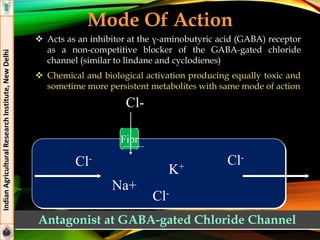
 Acts as an inhibitor at the γ-aminobutyric acid (GABA) receptor
as a non-competitive blocker of the GABA-gated chloride
channel (similar to lindane and cyclodienes)
 Chemical and biological activation producing equally toxic and
sometime more persistent metabolites with same mode of action
IndianAgriculturalResearchInstitute,NewDelhi
Cl-
Cl-
Cl-
Na+
Cl-
Fipr
K+
Antagonist at GABA-gated Chloride Channel
Oxadiazines
Indoxacarb
IUPAC: Methyl 7-chloro-2,5-dihydro-2-[[(methoxycarbonyl)[4-
(trifluoromethoxy)phenyl]amino]carbonyl]indeno[1,2-e]
[1,3,4]oxadiazine-4a(3H)-carboxylate
 Formulations: 15.8% EC (Avaunt®)
 Effective against lepidopteran pests (American boll worm,
DBM, Helicoverpa armigera, Plutella xylostella)
IndianAgriculturalResearchInstitute,NewDelhi
 Indoxacarb
3
Mode Of Action
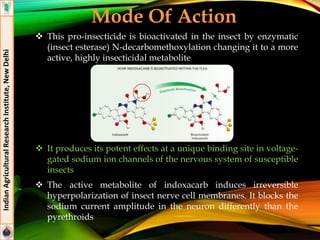
 This pro-insecticide is bioactivated in the insect by enzymatic
(insect esterase) N-decarbomethoxylation changing it to a more
active, highly insecticidal metabolite
 It produces its potent effects at a unique binding site in voltage-
gated sodium ion channels of the nervous system of susceptible
insects
 The active metabolite of indoxacarb induces irreversible
hyperpolarization of insect nerve cell membranes. It blocks the
sodium current amplitude in the neuron differently than the
pyrethroids
IndianAgriculturalResearchInstitute,NewDelhi
Halogenated pyrroles
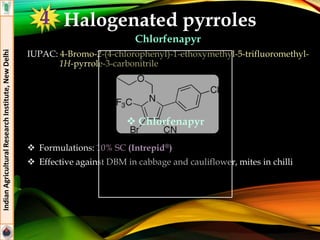
Chlorfenapyr
IUPAC: 4-Bromo-2-(4-chlorophenyl)-1-ethoxymethyl-5-trifluoromethyl-
1H-pyrrole-3-carbonitrile
 Formulations: 10% SC (Intrepid®)
 Effective against DBM in cabbage and cauliflower, mites in chilli
IndianAgriculturalResearchInstitute,NewDelhi
 Chlorfenapyr
4
Mode Of Action
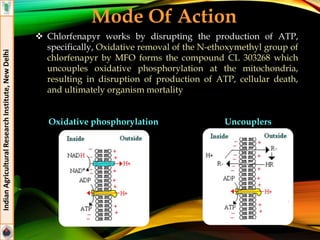
 Chlorfenapyr works by disrupting the production of ATP,
specifically, Oxidative removal of the N-ethoxymethyl group of
chlorfenapyr by MFO forms the compound CL 303268 which
uncouples oxidative phosphorylation at the mitochondria,
resulting in disruption of production of ATP, cellular death,
and ultimately organism mortality
IndianAgriculturalResearchInstitute,NewDelhi
Oxidative phosphorylation Uncouplers
Thiourea derivatives
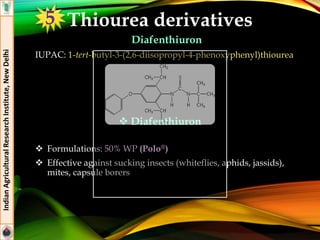
Diafenthiuron
IUPAC: 1-tert-butyl-3-(2,6-diisopropyl-4-phenoxyphenyl)thiourea
 Formulations: 50% WP (Polo®)
 Effective against sucking insects (whiteflies, aphids, jassids),
mites, capsule borers
IndianAgriculturalResearchInstitute,NewDelhi
 Diafenthiuron
5
Quinazolines
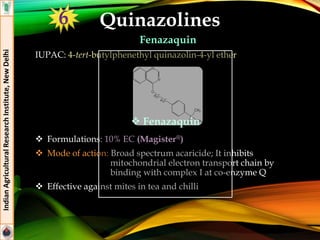
Fenazaquin
IUPAC: 4-tert-butylphenethyl quinazolin-4-yl ether
 Formulations: 10% EC (Magister®)
 Mode of action: Broad spectrum acaricide; It inhibits
mitochondrial electron transport chain by
binding with complex I at co-enzyme Q
 Effective against mites in tea and chilli
IndianAgriculturalResearchInstitute,NewDelhi
 Fenazaquin
6
Pyridazinones
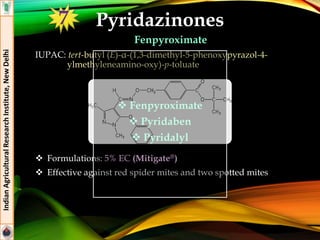
Fenpyroximate
IUPAC: tert-butyl (E)-α-(1,3-dimethyl-5-phenoxypyrazol-4-
ylmethyleneamino-oxy)-p-toluate
 Formulations: 5% EC (Mitigate®)
 Effective against red spider mites and two spotted mites
IndianAgriculturalResearchInstitute,NewDelhi
 Fenpyroximate
 Pyridaben
 Pyridalyl
7
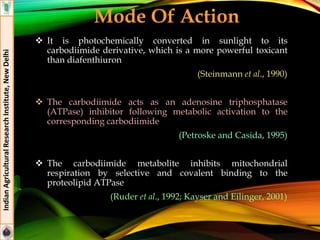
 It is photochemically converted in sunlight to its
carbodiimide derivative, which is a more powerful toxicant
than diafenthiuron
(Steinmann et al., 1990)
 The carbodiimide acts as an adenosine triphosphatase
(ATPase) inhibitor following metabolic activation to the
corresponding carbodiimide
(Petroske and Casida, 1995)
 The carbodiimide metabolite inhibits mitochondrial
respiration by selective and covalent binding to the
proteolipid ATPase
(Ruder et al., 1992; Kayser and Eilinger, 2001)
Mode Of Action
IndianAgriculturalResearchInstitute,NewDelhi
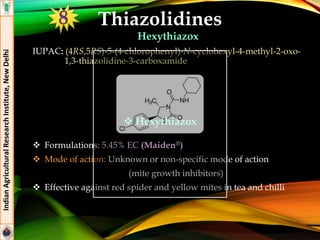
Thiazolidines
Hexythiazox
IUPAC: (4RS,5RS)-5-(4-chlorophenyl)-N-cyclohexyl-4-methyl-2-oxo-
1,3-thiazolidine-3-carboxamide
 Formulations: 5.45% EC (Maiden®)
 Mode of action: Unknown or non-specific mode of action
(mite growth inhibitors)
 Effective against red spider and yellow mites in tea and chilli
IndianAgriculturalResearchInstitute,NewDelhi
8
 Hexythiazox
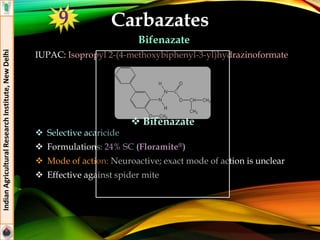
Carbazates
Bifenazate
IUPAC: Isopropyl 2-(4-methoxybiphenyl-3-yl)hydrazinoformate
 Selective acaricide
 Formulations: 24% SC (Floramite®)
 Mode of action: Neuroactive; exact mode of action is unclear
 Effective against spider mite
IndianAgriculturalResearchInstitute,NewDelhi
9
 Bifenazate
Diamides
Flubendiamide
IUPAC: 3-iodo-N’-(2-mesyl-1,1-dimethylethyl)-N-{4-[1,2,2,2-
tetrafluoro-1-trifluoromethyl)ethyl] -o-tolyl} phthalamide
 Pthalic diamide
 Formulations: 20% WG (Takumi®), 39.35% SC (Fame®)
 Effective against insect pests of rice (stem borer. Leaf folder) and
cotton (Helicoverpa armigera, spotted boll worm)
IndianAgriculturalResearchInstitute,NewDelhi
 Flubendiamide
 Chlorantraniliprole
 Cyantraniliprole
 Cyclaniliprole
 Tetraniliprole
10
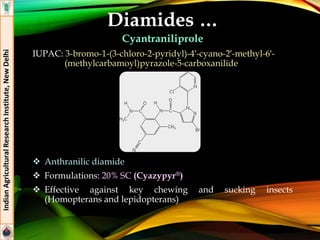
Diamides …
Cyantraniliprole
IUPAC: 3-bromo-1-(3-chloro-2-pyridyl)-4′-cyano-2′-methyl-6′-
(methylcarbamoyl)pyrazole-5-carboxanilide
 Anthranilic diamide
 Formulations: 20% SC (Cyazypyr®)
 Effective against key chewing and sucking insects
(Homopterans and lepidopterans)
IndianAgriculturalResearchInstitute,NewDelhi
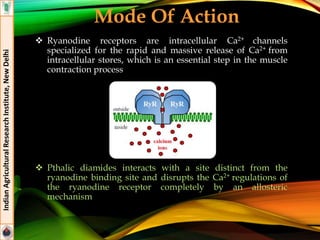
 Ryanodine receptors are intracellular Ca2+ channels
specialized for the rapid and massive release of Ca2+ from
intracellular stores, which is an essential step in the muscle
contraction process
 Pthalic diamides interacts with a site distinct from the
ryanodine binding site and disrupts the Ca2+ regulations of
the ryanodine receptor completely by an allosteric
mechanism
Mode Of Action
IndianAgriculturalResearchInstitute,NewDelhi
 Anthranilic diamides cause death of insects by disruption of
Ca2+ within muscle tissue.
 The anthranilic diamide insecticides bind to ryanodine
receptors locking them partially open. Ca2+ leaks out of
muscle tissues which results in the inability to regulate
muscle function which causes paralysis and death
(Cordova et al., 2006)
Mode Of Action …
Flufenoxuron
IUPAC: 1-[4-(2-chloro-α,α,α-trifluoro-p-tolyloxy)-2-fluorophenyl]-
3-(2,6-difluorobenzoyl)urea
 Insect growth regulator
 Formulations: 10% DC (Cascade®)
 Effective against immature stages of many phytophagous mites
and insects pests of pome fruit, vines, citrus, tea, ornamentals
IndianAgriculturalResearchInstitute,NewDelhi
Benzoyl Urea
 Bistrifluron
 Chlorbenzuron
 Chlorfluazuron
 Dichlorbenzuron
 Diflubenzuron
 Flucycloxuron
 Flufenoxuron
 Hexaflumuron
 Lufenuron
 Novaluron
 Noviflumuron
 Penfluron
 Teflubenzuron
11
Mode Of Action
 It acts as a chitin synthesis inhibitor by blocking terminal
polymerization step catalysed by chitin synthase enzyme
IndianAgriculturalResearchInstitute,NewDelhi
 These compounds alters cuticle
composition—especially that of
chitin—thereby affecting the
elasticity and firmness of the
endo-cuticle
(Grosscurt & Anderson, 1980)
 The reduced level of chitin in
the cuticle seems to result from
inhibition of biochemical
processes leading to chitin
formation
(Hajjar & Casida, 1979)
 They might affect the insect
hormonal site, thereby resulting
in physiological disturbances
such as inhibition of DNA
synthesis, alter carbohydrase
and phenoloxidase activities, or
suppress microsomal oxidase
activity
(Ishaaya & Ascher, 1977; Van Eck,
1979; Soltani et al., 1984)
 They inhibit 20E-dependent
GlcNAc incorporation into
chitin
(Oberlander & Silhacek, 1998)
Thiadiazines
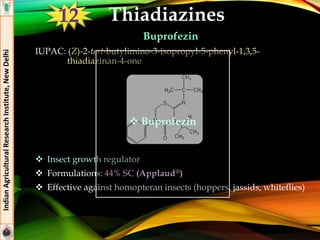
Buprofezin
IUPAC: (Z)-2-tert-butylimino-3-isopropyl-5-phenyl-1,3,5-
thiadiazinan-4-one
 Insect growth regulator
 Formulations: 44% SC (Applaud®)
 Effective against homopteran insects (hoppers, jassids, whiteflies)
IndianAgriculturalResearchInstitute,NewDelhi
 Buprofezin
12
Mode Of Action
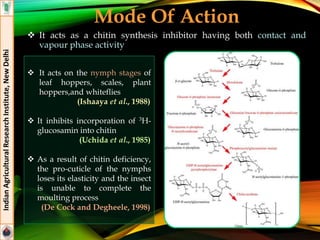
 It acts as a chitin synthesis inhibitor having both contact and
vapour phase activity
IndianAgriculturalResearchInstitute,NewDelhi
 It acts on the nymph stages of
leaf hoppers, scales, plant
hoppers,and whiteflies
(Ishaaya et al., 1988)
 It inhibits incorporation of 3H-
glucosamin into chitin
(Uchida et al., 1985)
 As a result of chitin deficiency,
the pro-cuticle of the nymphs
loses its elasticity and the insect
is unable to complete the
moulting process
(De Cock and Degheele, 1998)
Diacylhydrazines
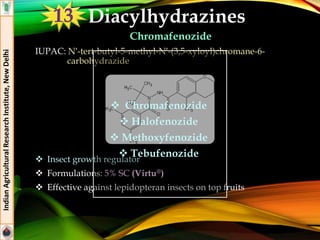
Chromafenozide
IUPAC: N′-tert-butyl-5-methyl-N′-(3,5-xyloyl)chromane-6-
carbohydrazide
 Insect growth regulator
 Formulations: 5% SC (Virtu®)
 Effective against lepidopteran insects on top fruits
IndianAgriculturalResearchInstitute,NewDelhi
 Chromafenozide
 Halofenozide
 Methoxyfenozide
 Tebufenozide
13
Mode Of Action
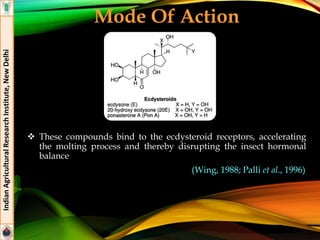
 These compounds bind to the ecdysteroid receptors, accelerating
the molting process and thereby disrupting the insect hormonal
balance
(Wing, 1988; Palli et al., 1996)
IndianAgriculturalResearchInstitute,NewDelhi
New Insecticides
From Microorganisms
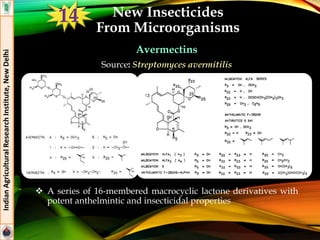
Avermectins
Source: Streptomyces avermitilis
 A series of 16-membered macrocyclic lactone derivatives with
potent anthelmintic and insecticidal properties
IndianAgriculturalResearchInstitute,NewDelhi
14
 Abamectin (Avermectin B1) Agri-Mek® 15% EC
Used against sucking pests, phytophagous mites, dipterans,
psyllidae, leaf miners
 Ivermectin (22,23-dihydroavermectin) Ivomec® 1% S
Used to control parasites of cattle
 Emamectin benzoate Proclaim® 5% WSG
Used against lepidopteran insects
Mode of action
They block the transmittance of electrical activity in nerves and
muscle cells by stimulating the release and binding of GABA at
nerve endings.
This causes an influx of chloride ions into the cells, leading
to hyperpolarisation and subsequent paralysis of the neuromuscular
systems
IndianAgriculturalResearchInstitute,NewDelhi
New Insecticides From Microorganisms …
Spinosyns
 Spinosad 1st a.i.
 Source: Saccharopolyspora spinosa
 Mixture of 2 most active metabolites, Spinosyn A and Spinosyn D
 Formulations: 45% SC (Tracer ®)
Mode of action
They primarily target binding sites on nicotinic acetylcholine
receptors (nAChRs) of the insect nervous system that are distinct
from those at which other insecticides have their activity.
Spinosoid binding leads to disruption of acetylcholine
neurotransmission. Spinosad also has secondary effects as a GABA
neurotransmitter agonist
IndianAgriculturalResearchInstitute,NewDelhi
New Insecticides From Microorganisms …
Entomopathogenic Bacteria
Bacillus thuringiensis
 Bacillus thuringiensis (Bt), a gram-positive, motile, rod shaped
bacterium produces a parasporal crystal composed of one or
more proteins
 The strains of Bt characterized so far affect members of 3 insect
orders: Lepidoptera (butterflies & moths), Diptera (mosquitoes
& biting flies) and Coleoptera (beetles)
 3 Bt products registered in India
 B.t. kurstaki is the most commonly used Bt formulation
IndianAgriculturalResearchInstitute,NewDelhi
 B.t. israelensis (diptera)—frequently used for mosquitoes
 B.t. kurstaki (lepidoptera)—frequently used for gypsy moth, spruce
budworm, and many vegetable pests
 B.t. galleriae (lepidoptera)—frequently used for leaf beetle,
Colorado potato beetle
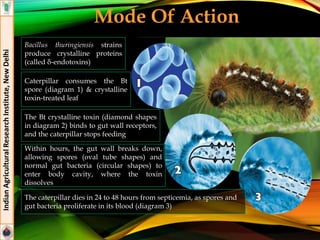
Bacillus thuringiensis strains
produce crystalline proteins
(called δ-endotoxins)
Caterpillar consumes the Bt
spore (diagram 1) & crystalline
toxin-treated leaf
The Bt crystalline toxin (diamond shapes
in diagram 2) binds to gut wall receptors,
and the caterpillar stops feeding
Within hours, the gut wall breaks down,
allowing spores (oval tube shapes) and
normal gut bacteria (circular shapes) to
enter body cavity, where the toxin
dissolves
The caterpillar dies in 24 to 48 hours from septicemia, as spores and
gut bacteria proliferate in its blood (diagram 3)
Mode Of Action
IndianAgriculturalResearchInstitute,NewDelhi
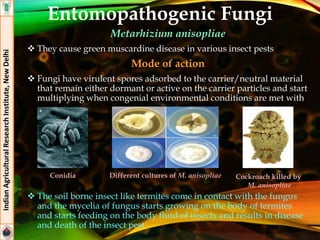
Entomopathogenic Fungi
Metarhizium anisopliae
 They cause green muscardine disease in various insect pests
Mode of action
 Fungi have virulent spores adsorbed to the carrier/neutral material
that remain either dormant or active on the carrier particles and start
multiplying when congenial environmental conditions are met with
 The soil borne insect like termites come in contact with the fungus
and the mycelia of fungus starts growing on the body of termites
and starts feeding on the body fluid of insects and results in disease
and death of the insect pest
IndianAgriculturalResearchInstitute,NewDelhi
Conidia Different cultures of M. anisopliae Cockroach killed by
M. anisopliae
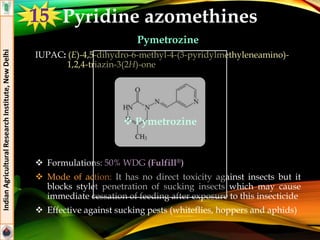
Pyridine azomethines
Pymetrozine
IUPAC: (E)-4,5-dihydro-6-methyl-4-(3-pyridylmethyleneamino)-
1,2,4-triazin-3(2H)-one
 Formulations: 50% WDG (Fulfill®)
 Mode of action: It has no direct toxicity against insects but it
blocks stylet penetration of sucking insects which may cause
immediate cessation of feeding after exposure to this insecticide
 Effective against sucking pests (whiteflies, hoppers and aphids)
IndianAgriculturalResearchInstitute,NewDelhi
15
 Pymetrozine
Tetronic Acid Derivatives
Spiromesifen
IUPAC: 3-mesityl-2-oxo-1-oxaspiro[4.4]non-3-en-4-yl 3,3-
dimethylbutyrate
 Formulations: 24% SC (Oberon®)
 Mode of action: Prevent Lipid biosynthesis by inhibiting acetyl
CoA carboxylase
 Effective against mites and moth scale insects
IndianAgriculturalResearchInstitute,NewDelhi
 Spiromesifen
16
Sulfoximines
Sulfoxaflor
IUPAC: [methyl(oxo){1-[6-(trifluoromethyl)-3-pyridyl]ethyl}-
λ6-sulfanylidene]cyanamide
 Systemic insect neuro-toxin
 Formulations: 24% SC (Transform®)
 Effective against major species of sap feeding insects
IndianAgriculturalResearchInstitute,NewDelhi
 Sulfoxaflor
17
Mode Of Action
 It causes a blockage in the nicotinergic neuronal pathway
leading to the accumulation of acetylcholine, an
important neurotransmitter, resulting in the insect's paralysis
and eventually death
 Sulfoxaflor is stable to monooxygenases that are known to
readily metabolize other insecticides such as organochlorines
and the neonicotinoids
(Zhu et al., 2011)
IndianAgriculturalResearchInstitute,NewDelhi
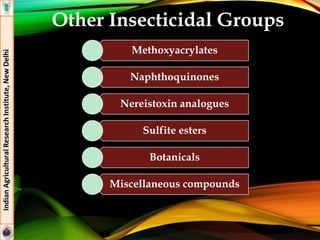
Methoxyacrylates
Naphthoquinones
Nereistoxin analogues
Sulfite esters
Botanicals
Miscellaneous compounds
Other Insecticidal Groups
IndianAgriculturalResearchInstitute,NewDelhi
Future Challenges
 To develop more and more new molecules having
 More discoveries in macromolecular pesticides
 More innovations required for new neo-nicotinoids
IndianAgriculturalResearchInstitute,NewDelhi
 Low dose compounds
 High efficacy and quick knockdown effect
 Low mammalian toxicity
 Relatively safer formulations
 Less leaching potential
 New chemistry
 Less harmful to beneficial species
Future Challenges …
 More biotechnological innovations to be directed in
transgenic plants etc.
 More innovative technology to be developed in application
of pesticides
 Minimization of residue load in ecosystem
 More emphasis shall be given in bio-control agents
 Research emphasis shall be given in innovations of more
plant derived bio-pesticides
IndianAgriculturalResearchInstitute,NewDelhi
Conclusion
 Scientific community has been involved in approaches towards the
developments of newer molecules which could be easily
biodegradable, target-specific with very low mammalian toxicity
 A distinct division in scientific opinion was made to decide whether
to go for bio-based products or for using synthetic chemicals for
protecting the crops
 A new horizon of analytical chemistry was evolved as pesticide
residue analysis to judge the residue level of these harmful chemicals
in food grains
IndianAgriculturalResearchInstitute,NewDelhi
Conclusion …
 Researches were carried out to develop safer molecules which
could undergo photo-degradation, microbial degradation as well
as chemical degradation leaving very less amount of residues in
the environment
 The prime motto for this development is to give protection to the
crops along with safety to the natural enemies of different pests as
a whole safety to environment
IndianAgriculturalResearchInstitute,NewDelhi
“If you're not part of the solution,
You're part of the precipitate …”

New Chemistries For Insect Management

  • 1.
  • 2.
  • 3.
  • 4.
    Classification Of OldInsecticides Organochlorines (DDT, aldrin, HCH, endrin) Organophosphates (dichlorvos, parathion, chlorpyrifos, acephate) Carbamates (carbaryl, aldicarb, isolan, carbofuran) Sythetic pyrethroids (allethrin, cypermethrin, cyfluthrin, fluvalinate) IndianAgriculturalResearchInstitute,NewDelhi
  • 5.
    Problems Of OldInsecticides IndianAgriculturalResearchInstitute,NewDelhi Residue Resistance Resurgence
  • 6.
  • 7.
  • 8.
    Outline Selectivity New Insecticide Classes •Neonictinoids •Phenylpyrazoles •Oxadiazines •Halogenated pyrroles •Thiourea derivatives •Quinazolines •Pyridazinones •Thiazolidines •Carbazates •Diamides •IGRs (Benzoyl ureas, Thiadiazines) •Diacylhydrazines •New insecticides from microorganisms (Avermectins, Spinosyns, B. thuringiensis, M. anisopliae) •Pyridine azomethines •Tetronic acid derivatives •Sulfoximes (Sulfoxaflor) IndianAgriculturalResearchInstitute,NewDelhi
  • 9.
    Neo-nicotinoids Synthetic analogues ofnicotine  Drawbacks of nicotine - Expensiveness - Lack of commercially applicable synthesis - Extreme toxicity to mammals - Limited insecticidal spectrum  Introduction of new nicotine like compounds  4 groups IndianAgriculturalResearchInstitute,NewDelhi  Chloronicotinyl compounds  Thionicotinyl compounds  Furanicotinyl compounds  Pyridincarboxamides 1
  • 10.
    Chloronicotinyl Compounds Imidacloprid IUPAC: (E)-1-(6-chloro-3-pyridylmethyl)-N-nitroimidazolidin- 2-ylideneamine systemic insecticide having good xylem mobility and used as seed treatment, soil and foliar application  Formulations: 17.8% SL (Confidor®), 70% WS (Gaucho®)  Effective against sucking pests (aphids, leaf hoppers, plant hoppers, whiteflies, thrips) IndianAgriculturalResearchInstitute,NewDelhi  Acetamiprid  Imidacloprid  Nitenpyram
  • 11.
    Clothianidin IUPAC: (E)-1-(2-chloro-1,3-thiazol-5-ylmethyl)-3-methyl-2- nitroguanidine  Broadspectrum insecticide  Formulations: 48% FC (Poncho®)  Effective against hemipteran, thysanopteran and coleopteran sucking insect pests IndianAgriculturalResearchInstitute,NewDelhi Thionicotinyl Compounds  Clothianidin  Imidaclothiz  Thiacloprid  Thiamethoxam
  • 12.
    Furanicotinyl compounds Dinotefuran IUPAC: (EZ)-(RS)-1-methyl-2-nitro-3-(tetrahydro-3- furylmethyl)guanidine Highly systemic insecticide  Formulations: 20% SG (Token®)  Effective against sucking pests (hoppers, jassids, aphids) IndianAgriculturalResearchInstitute,NewDelhi  Dinotefuran
  • 13.
    Pyridincarboxamides Flonicamid IUPAC: N-cyanomethyl-4-(trifluoromethyl)nicotinamide  Systemicand trans-laminar activity; long time protection; feeding deterrent  Formulations: 50% WG (Ulala®)  Effective against major species of aphids; also controls mealy bugs, whiteflies, plant hoppers IndianAgriculturalResearchInstitute,NewDelhi  Flonicamid
  • 14.
    Mode Of Action They are nicotinic acetylcholine receptor agonists  They bind strongly to nicotinic acetylcholine receptors (nAChRs) in the central nervous system of insects, causing nervous stimulation at low concentrations, but receptor blockage, paralysis and death at higher concentrations  Neonicotinoids bind more strongly to insect nAChRs than to those of vertebrates, so they are selectively more toxic to insects (Tomizawa & Casida, 2005) IndianAgriculturalResearchInstitute,NewDelhi
  • 15.
    Phenyl pyrazoles Fipronil IUPAC: (±)-5-amino-1-(2,6-dichloro-α,α,α-trifluoro-p-tolyl)-4- trifluoromethylsulfinylpyrazole-3-carbonitrile Systemic insecticide with contact and stomach action  Formulations: 5% SC (Regent®)  It controls stem borers, gall midge, DBM, thrips, root borers IndianAgriculturalResearchInstitute,NewDelhi  Acetoprole  Ethiprole  Fipronil  Flufiprole  Pyraclofos  Pyrafluprole  Pyriprole  Pyrolan  Vaniliprole 2
  • 16.
    Mode Of Action Acts as an inhibitor at the γ-aminobutyric acid (GABA) receptor as a non-competitive blocker of the GABA-gated chloride channel (similar to lindane and cyclodienes)  Chemical and biological activation producing equally toxic and sometime more persistent metabolites with same mode of action IndianAgriculturalResearchInstitute,NewDelhi Cl- Cl- Cl- Na+ Cl- Fipr K+ Antagonist at GABA-gated Chloride Channel
  • 17.
    Oxadiazines Indoxacarb IUPAC: Methyl 7-chloro-2,5-dihydro-2-[[(methoxycarbonyl)[4- (trifluoromethoxy)phenyl]amino]carbonyl]indeno[1,2-e] [1,3,4]oxadiazine-4a(3H)-carboxylate Formulations: 15.8% EC (Avaunt®)  Effective against lepidopteran pests (American boll worm, DBM, Helicoverpa armigera, Plutella xylostella) IndianAgriculturalResearchInstitute,NewDelhi  Indoxacarb 3
  • 18.
    Mode Of Action This pro-insecticide is bioactivated in the insect by enzymatic (insect esterase) N-decarbomethoxylation changing it to a more active, highly insecticidal metabolite  It produces its potent effects at a unique binding site in voltage- gated sodium ion channels of the nervous system of susceptible insects  The active metabolite of indoxacarb induces irreversible hyperpolarization of insect nerve cell membranes. It blocks the sodium current amplitude in the neuron differently than the pyrethroids IndianAgriculturalResearchInstitute,NewDelhi
  • 19.
    Halogenated pyrroles Chlorfenapyr IUPAC: 4-Bromo-2-(4-chlorophenyl)-1-ethoxymethyl-5-trifluoromethyl- 1H-pyrrole-3-carbonitrile Formulations: 10% SC (Intrepid®)  Effective against DBM in cabbage and cauliflower, mites in chilli IndianAgriculturalResearchInstitute,NewDelhi  Chlorfenapyr 4
  • 20.
    Mode Of Action Chlorfenapyr works by disrupting the production of ATP, specifically, Oxidative removal of the N-ethoxymethyl group of chlorfenapyr by MFO forms the compound CL 303268 which uncouples oxidative phosphorylation at the mitochondria, resulting in disruption of production of ATP, cellular death, and ultimately organism mortality IndianAgriculturalResearchInstitute,NewDelhi Oxidative phosphorylation Uncouplers
  • 21.
    Thiourea derivatives Diafenthiuron IUPAC: 1-tert-butyl-3-(2,6-diisopropyl-4-phenoxyphenyl)thiourea Formulations: 50% WP (Polo®)  Effective against sucking insects (whiteflies, aphids, jassids), mites, capsule borers IndianAgriculturalResearchInstitute,NewDelhi  Diafenthiuron 5
  • 22.
    Quinazolines Fenazaquin IUPAC: 4-tert-butylphenethyl quinazolin-4-ylether  Formulations: 10% EC (Magister®)  Mode of action: Broad spectrum acaricide; It inhibits mitochondrial electron transport chain by binding with complex I at co-enzyme Q  Effective against mites in tea and chilli IndianAgriculturalResearchInstitute,NewDelhi  Fenazaquin 6
  • 23.
    Pyridazinones Fenpyroximate IUPAC: tert-butyl (E)-α-(1,3-dimethyl-5-phenoxypyrazol-4- ylmethyleneamino-oxy)-p-toluate Formulations: 5% EC (Mitigate®)  Effective against red spider mites and two spotted mites IndianAgriculturalResearchInstitute,NewDelhi  Fenpyroximate  Pyridaben  Pyridalyl 7
  • 24.
     It isphotochemically converted in sunlight to its carbodiimide derivative, which is a more powerful toxicant than diafenthiuron (Steinmann et al., 1990)  The carbodiimide acts as an adenosine triphosphatase (ATPase) inhibitor following metabolic activation to the corresponding carbodiimide (Petroske and Casida, 1995)  The carbodiimide metabolite inhibits mitochondrial respiration by selective and covalent binding to the proteolipid ATPase (Ruder et al., 1992; Kayser and Eilinger, 2001) Mode Of Action IndianAgriculturalResearchInstitute,NewDelhi
  • 25.
    Thiazolidines Hexythiazox IUPAC: (4RS,5RS)-5-(4-chlorophenyl)-N-cyclohexyl-4-methyl-2-oxo- 1,3-thiazolidine-3-carboxamide  Formulations:5.45% EC (Maiden®)  Mode of action: Unknown or non-specific mode of action (mite growth inhibitors)  Effective against red spider and yellow mites in tea and chilli IndianAgriculturalResearchInstitute,NewDelhi 8  Hexythiazox
  • 26.
    Carbazates Bifenazate IUPAC: Isopropyl 2-(4-methoxybiphenyl-3-yl)hydrazinoformate Selective acaricide  Formulations: 24% SC (Floramite®)  Mode of action: Neuroactive; exact mode of action is unclear  Effective against spider mite IndianAgriculturalResearchInstitute,NewDelhi 9  Bifenazate
  • 27.
    Diamides Flubendiamide IUPAC: 3-iodo-N’-(2-mesyl-1,1-dimethylethyl)-N-{4-[1,2,2,2- tetrafluoro-1-trifluoromethyl)ethyl] -o-tolyl}phthalamide  Pthalic diamide  Formulations: 20% WG (Takumi®), 39.35% SC (Fame®)  Effective against insect pests of rice (stem borer. Leaf folder) and cotton (Helicoverpa armigera, spotted boll worm) IndianAgriculturalResearchInstitute,NewDelhi  Flubendiamide  Chlorantraniliprole  Cyantraniliprole  Cyclaniliprole  Tetraniliprole 10
  • 28.
    Diamides … Cyantraniliprole IUPAC: 3-bromo-1-(3-chloro-2-pyridyl)-4′-cyano-2′-methyl-6′- (methylcarbamoyl)pyrazole-5-carboxanilide Anthranilic diamide  Formulations: 20% SC (Cyazypyr®)  Effective against key chewing and sucking insects (Homopterans and lepidopterans) IndianAgriculturalResearchInstitute,NewDelhi
  • 29.
     Ryanodine receptorsare intracellular Ca2+ channels specialized for the rapid and massive release of Ca2+ from intracellular stores, which is an essential step in the muscle contraction process  Pthalic diamides interacts with a site distinct from the ryanodine binding site and disrupts the Ca2+ regulations of the ryanodine receptor completely by an allosteric mechanism Mode Of Action IndianAgriculturalResearchInstitute,NewDelhi
  • 30.
     Anthranilic diamidescause death of insects by disruption of Ca2+ within muscle tissue.  The anthranilic diamide insecticides bind to ryanodine receptors locking them partially open. Ca2+ leaks out of muscle tissues which results in the inability to regulate muscle function which causes paralysis and death (Cordova et al., 2006) Mode Of Action …
  • 31.
    Flufenoxuron IUPAC: 1-[4-(2-chloro-α,α,α-trifluoro-p-tolyloxy)-2-fluorophenyl]- 3-(2,6-difluorobenzoyl)urea  Insectgrowth regulator  Formulations: 10% DC (Cascade®)  Effective against immature stages of many phytophagous mites and insects pests of pome fruit, vines, citrus, tea, ornamentals IndianAgriculturalResearchInstitute,NewDelhi Benzoyl Urea  Bistrifluron  Chlorbenzuron  Chlorfluazuron  Dichlorbenzuron  Diflubenzuron  Flucycloxuron  Flufenoxuron  Hexaflumuron  Lufenuron  Novaluron  Noviflumuron  Penfluron  Teflubenzuron 11
  • 32.
    Mode Of Action It acts as a chitin synthesis inhibitor by blocking terminal polymerization step catalysed by chitin synthase enzyme IndianAgriculturalResearchInstitute,NewDelhi  These compounds alters cuticle composition—especially that of chitin—thereby affecting the elasticity and firmness of the endo-cuticle (Grosscurt & Anderson, 1980)  The reduced level of chitin in the cuticle seems to result from inhibition of biochemical processes leading to chitin formation (Hajjar & Casida, 1979)  They might affect the insect hormonal site, thereby resulting in physiological disturbances such as inhibition of DNA synthesis, alter carbohydrase and phenoloxidase activities, or suppress microsomal oxidase activity (Ishaaya & Ascher, 1977; Van Eck, 1979; Soltani et al., 1984)  They inhibit 20E-dependent GlcNAc incorporation into chitin (Oberlander & Silhacek, 1998)
  • 33.
    Thiadiazines Buprofezin IUPAC: (Z)-2-tert-butylimino-3-isopropyl-5-phenyl-1,3,5- thiadiazinan-4-one  Insectgrowth regulator  Formulations: 44% SC (Applaud®)  Effective against homopteran insects (hoppers, jassids, whiteflies) IndianAgriculturalResearchInstitute,NewDelhi  Buprofezin 12
  • 34.
    Mode Of Action It acts as a chitin synthesis inhibitor having both contact and vapour phase activity IndianAgriculturalResearchInstitute,NewDelhi  It acts on the nymph stages of leaf hoppers, scales, plant hoppers,and whiteflies (Ishaaya et al., 1988)  It inhibits incorporation of 3H- glucosamin into chitin (Uchida et al., 1985)  As a result of chitin deficiency, the pro-cuticle of the nymphs loses its elasticity and the insect is unable to complete the moulting process (De Cock and Degheele, 1998)
  • 35.
    Diacylhydrazines Chromafenozide IUPAC: N′-tert-butyl-5-methyl-N′-(3,5-xyloyl)chromane-6- carbohydrazide  Insectgrowth regulator  Formulations: 5% SC (Virtu®)  Effective against lepidopteran insects on top fruits IndianAgriculturalResearchInstitute,NewDelhi  Chromafenozide  Halofenozide  Methoxyfenozide  Tebufenozide 13
  • 36.
    Mode Of Action These compounds bind to the ecdysteroid receptors, accelerating the molting process and thereby disrupting the insect hormonal balance (Wing, 1988; Palli et al., 1996) IndianAgriculturalResearchInstitute,NewDelhi
  • 37.
    New Insecticides From Microorganisms Avermectins Source:Streptomyces avermitilis  A series of 16-membered macrocyclic lactone derivatives with potent anthelmintic and insecticidal properties IndianAgriculturalResearchInstitute,NewDelhi 14
  • 38.
     Abamectin (AvermectinB1) Agri-Mek® 15% EC Used against sucking pests, phytophagous mites, dipterans, psyllidae, leaf miners  Ivermectin (22,23-dihydroavermectin) Ivomec® 1% S Used to control parasites of cattle  Emamectin benzoate Proclaim® 5% WSG Used against lepidopteran insects Mode of action They block the transmittance of electrical activity in nerves and muscle cells by stimulating the release and binding of GABA at nerve endings. This causes an influx of chloride ions into the cells, leading to hyperpolarisation and subsequent paralysis of the neuromuscular systems IndianAgriculturalResearchInstitute,NewDelhi New Insecticides From Microorganisms …
  • 39.
    Spinosyns  Spinosad 1sta.i.  Source: Saccharopolyspora spinosa  Mixture of 2 most active metabolites, Spinosyn A and Spinosyn D  Formulations: 45% SC (Tracer ®) Mode of action They primarily target binding sites on nicotinic acetylcholine receptors (nAChRs) of the insect nervous system that are distinct from those at which other insecticides have their activity. Spinosoid binding leads to disruption of acetylcholine neurotransmission. Spinosad also has secondary effects as a GABA neurotransmitter agonist IndianAgriculturalResearchInstitute,NewDelhi New Insecticides From Microorganisms …
  • 40.
    Entomopathogenic Bacteria Bacillus thuringiensis Bacillus thuringiensis (Bt), a gram-positive, motile, rod shaped bacterium produces a parasporal crystal composed of one or more proteins  The strains of Bt characterized so far affect members of 3 insect orders: Lepidoptera (butterflies & moths), Diptera (mosquitoes & biting flies) and Coleoptera (beetles)  3 Bt products registered in India  B.t. kurstaki is the most commonly used Bt formulation IndianAgriculturalResearchInstitute,NewDelhi  B.t. israelensis (diptera)—frequently used for mosquitoes  B.t. kurstaki (lepidoptera)—frequently used for gypsy moth, spruce budworm, and many vegetable pests  B.t. galleriae (lepidoptera)—frequently used for leaf beetle, Colorado potato beetle
  • 41.
    Bacillus thuringiensis strains producecrystalline proteins (called δ-endotoxins) Caterpillar consumes the Bt spore (diagram 1) & crystalline toxin-treated leaf The Bt crystalline toxin (diamond shapes in diagram 2) binds to gut wall receptors, and the caterpillar stops feeding Within hours, the gut wall breaks down, allowing spores (oval tube shapes) and normal gut bacteria (circular shapes) to enter body cavity, where the toxin dissolves The caterpillar dies in 24 to 48 hours from septicemia, as spores and gut bacteria proliferate in its blood (diagram 3) Mode Of Action IndianAgriculturalResearchInstitute,NewDelhi
  • 42.
    Entomopathogenic Fungi Metarhizium anisopliae They cause green muscardine disease in various insect pests Mode of action  Fungi have virulent spores adsorbed to the carrier/neutral material that remain either dormant or active on the carrier particles and start multiplying when congenial environmental conditions are met with  The soil borne insect like termites come in contact with the fungus and the mycelia of fungus starts growing on the body of termites and starts feeding on the body fluid of insects and results in disease and death of the insect pest IndianAgriculturalResearchInstitute,NewDelhi Conidia Different cultures of M. anisopliae Cockroach killed by M. anisopliae
  • 43.
    Pyridine azomethines Pymetrozine IUPAC: (E)-4,5-dihydro-6-methyl-4-(3-pyridylmethyleneamino)- 1,2,4-triazin-3(2H)-one Formulations: 50% WDG (Fulfill®)  Mode of action: It has no direct toxicity against insects but it blocks stylet penetration of sucking insects which may cause immediate cessation of feeding after exposure to this insecticide  Effective against sucking pests (whiteflies, hoppers and aphids) IndianAgriculturalResearchInstitute,NewDelhi 15  Pymetrozine
  • 44.
    Tetronic Acid Derivatives Spiromesifen IUPAC:3-mesityl-2-oxo-1-oxaspiro[4.4]non-3-en-4-yl 3,3- dimethylbutyrate  Formulations: 24% SC (Oberon®)  Mode of action: Prevent Lipid biosynthesis by inhibiting acetyl CoA carboxylase  Effective against mites and moth scale insects IndianAgriculturalResearchInstitute,NewDelhi  Spiromesifen 16
  • 45.
    Sulfoximines Sulfoxaflor IUPAC: [methyl(oxo){1-[6-(trifluoromethyl)-3-pyridyl]ethyl}- λ6-sulfanylidene]cyanamide  Systemicinsect neuro-toxin  Formulations: 24% SC (Transform®)  Effective against major species of sap feeding insects IndianAgriculturalResearchInstitute,NewDelhi  Sulfoxaflor 17
  • 46.
    Mode Of Action It causes a blockage in the nicotinergic neuronal pathway leading to the accumulation of acetylcholine, an important neurotransmitter, resulting in the insect's paralysis and eventually death  Sulfoxaflor is stable to monooxygenases that are known to readily metabolize other insecticides such as organochlorines and the neonicotinoids (Zhu et al., 2011) IndianAgriculturalResearchInstitute,NewDelhi
  • 47.
    Methoxyacrylates Naphthoquinones Nereistoxin analogues Sulfite esters Botanicals Miscellaneouscompounds Other Insecticidal Groups IndianAgriculturalResearchInstitute,NewDelhi
  • 48.
    Future Challenges  Todevelop more and more new molecules having  More discoveries in macromolecular pesticides  More innovations required for new neo-nicotinoids IndianAgriculturalResearchInstitute,NewDelhi  Low dose compounds  High efficacy and quick knockdown effect  Low mammalian toxicity  Relatively safer formulations  Less leaching potential  New chemistry  Less harmful to beneficial species
  • 49.
    Future Challenges … More biotechnological innovations to be directed in transgenic plants etc.  More innovative technology to be developed in application of pesticides  Minimization of residue load in ecosystem  More emphasis shall be given in bio-control agents  Research emphasis shall be given in innovations of more plant derived bio-pesticides IndianAgriculturalResearchInstitute,NewDelhi
  • 50.
    Conclusion  Scientific communityhas been involved in approaches towards the developments of newer molecules which could be easily biodegradable, target-specific with very low mammalian toxicity  A distinct division in scientific opinion was made to decide whether to go for bio-based products or for using synthetic chemicals for protecting the crops  A new horizon of analytical chemistry was evolved as pesticide residue analysis to judge the residue level of these harmful chemicals in food grains IndianAgriculturalResearchInstitute,NewDelhi
  • 51.
    Conclusion …  Researcheswere carried out to develop safer molecules which could undergo photo-degradation, microbial degradation as well as chemical degradation leaving very less amount of residues in the environment  The prime motto for this development is to give protection to the crops along with safety to the natural enemies of different pests as a whole safety to environment IndianAgriculturalResearchInstitute,NewDelhi
  • 52.
    IndianAgriculturalResearchInstitute,NewDelhi “If you're notpart of the solution, You're part of the precipitate …”