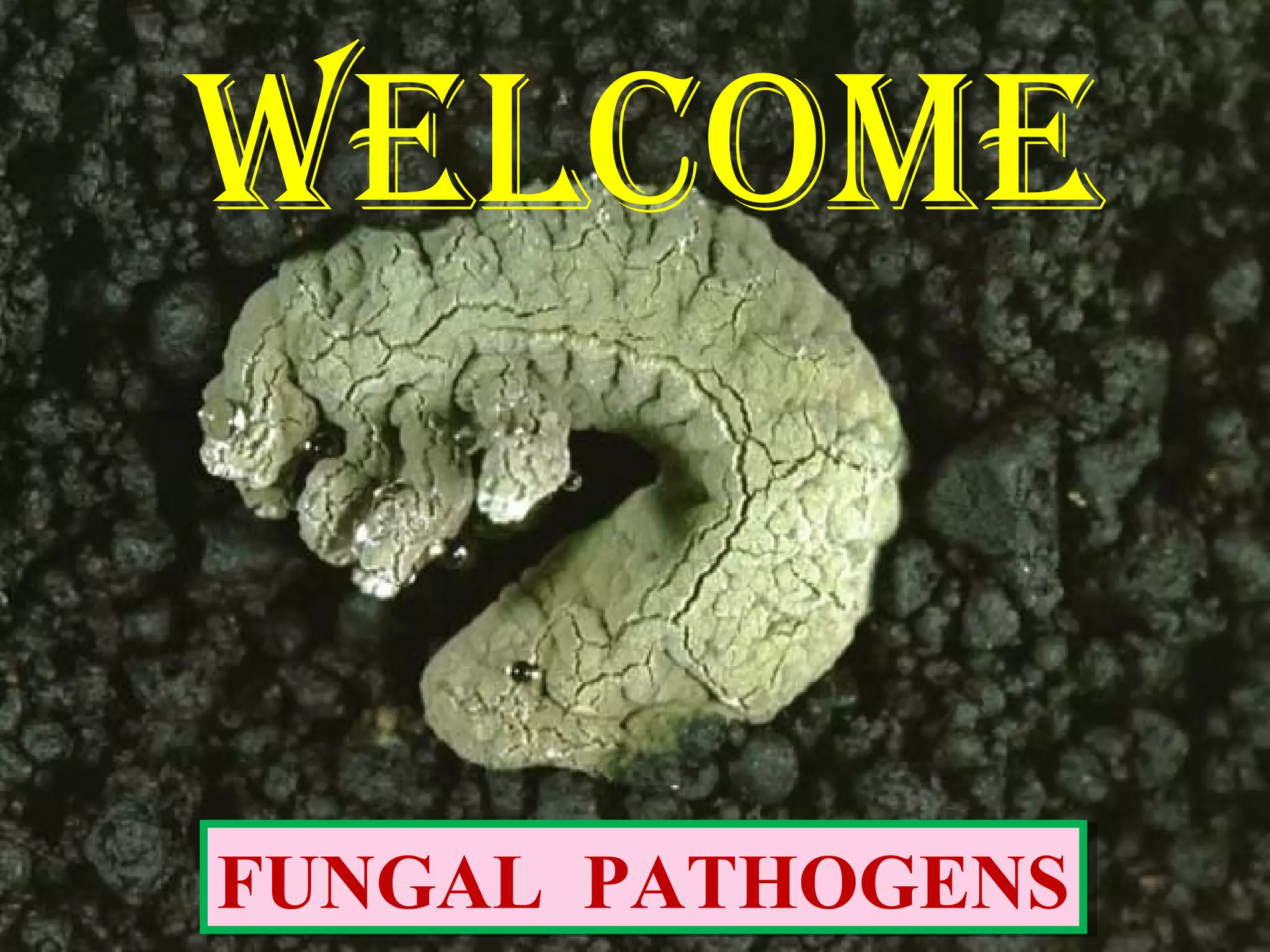

WELCOME 
FFUUNNGGAALL PPAATTHHOOGGEENNSS
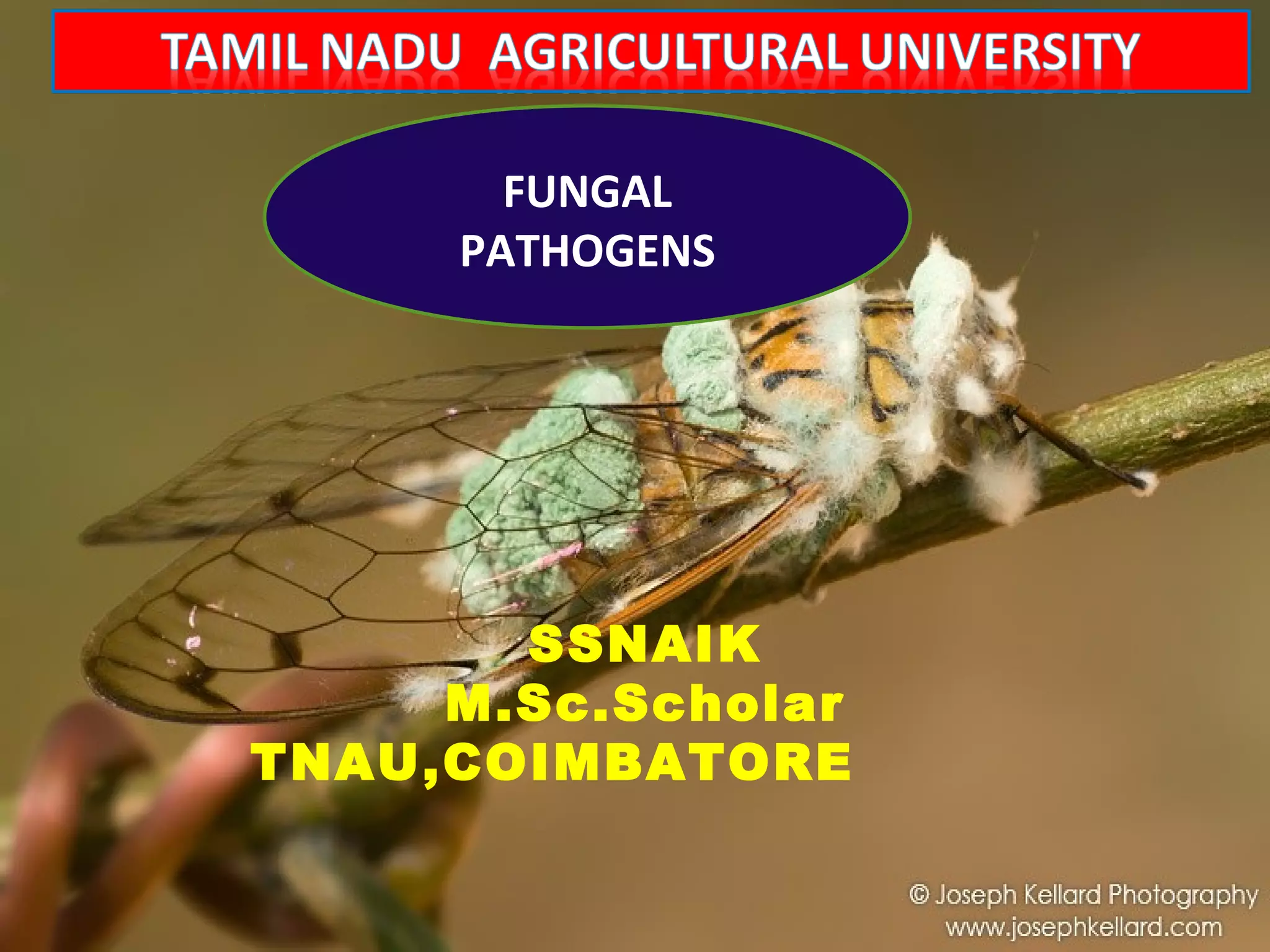
FUNGAL 
PATHOGENS 
FUNGAL PATHOGENS 
SSNAIK 
M.Sc.Scholar 
TNAU,COIMBATORE
What is microbial control ?
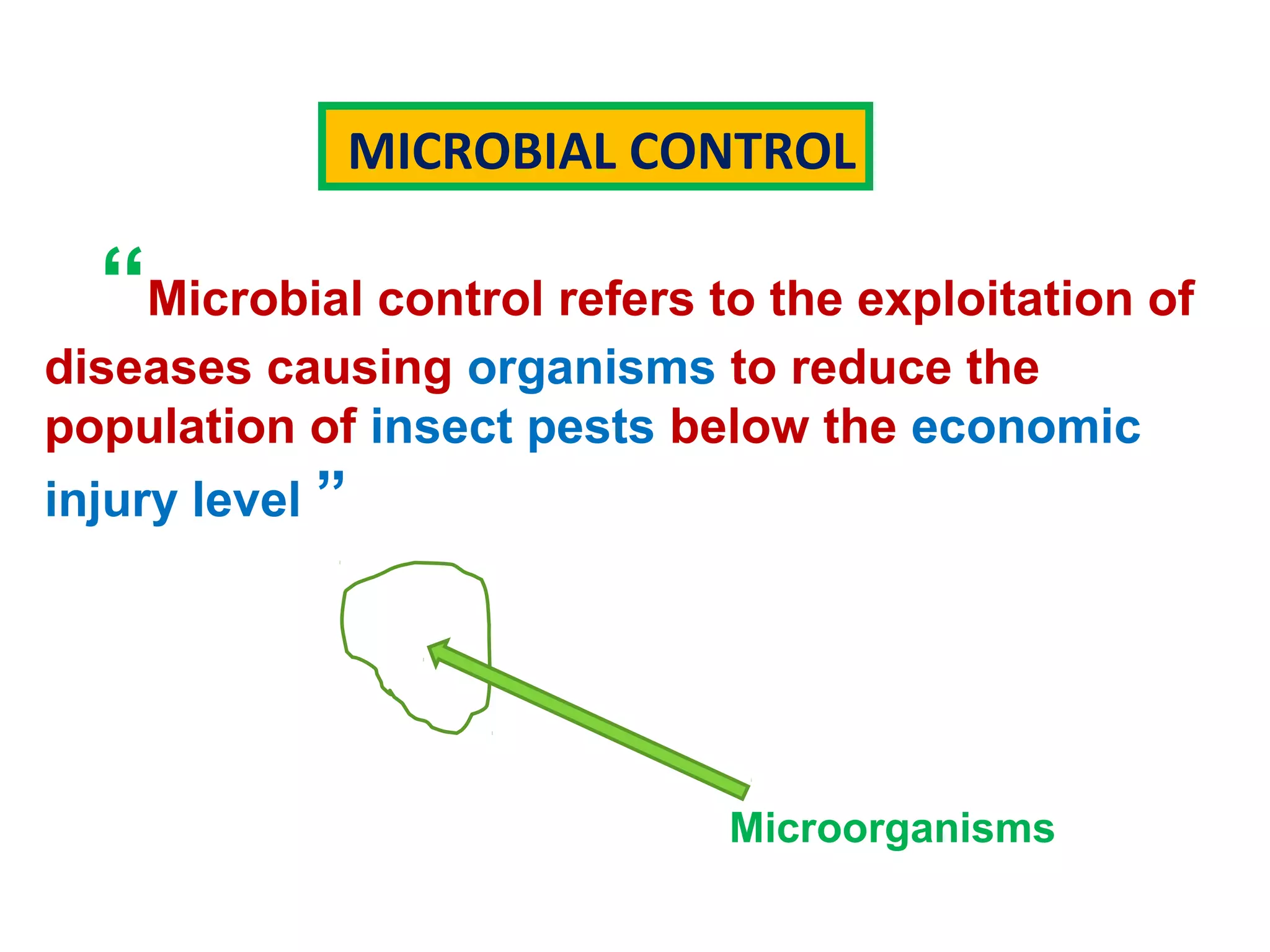
MICROBIAL CONTROL 
“Microbial control refers to the exploitation of 
diseases causing organisms to reduce the 
population of insect pests below the economic 
injury level ” 
Microorganisms
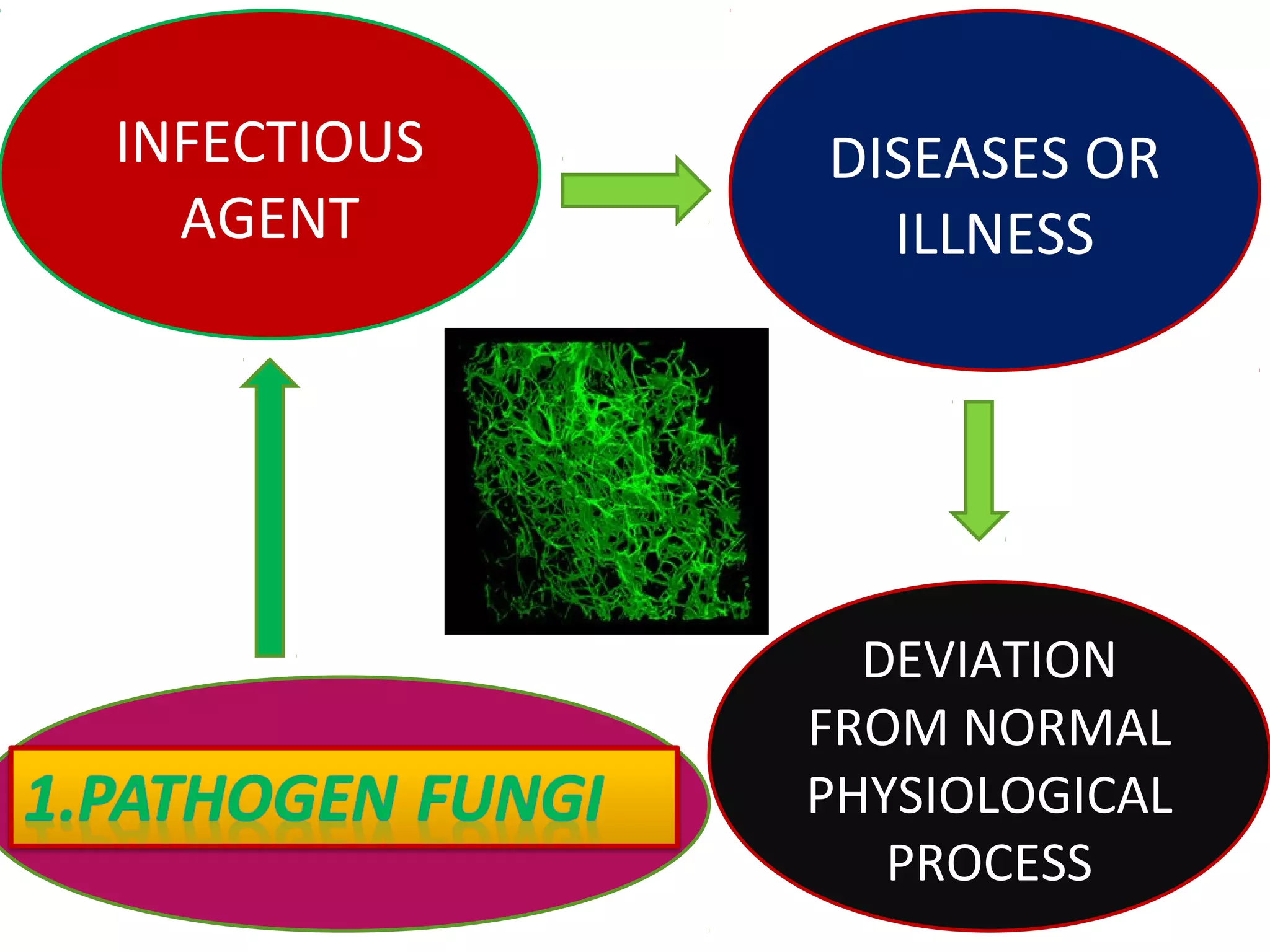
INFECTIOUS 
AGENT 
DISEASES OR 
ILLNESS 
DEVIATION 
FROM NORMAL 
PHYSIOLOGICAL 
PROCESS
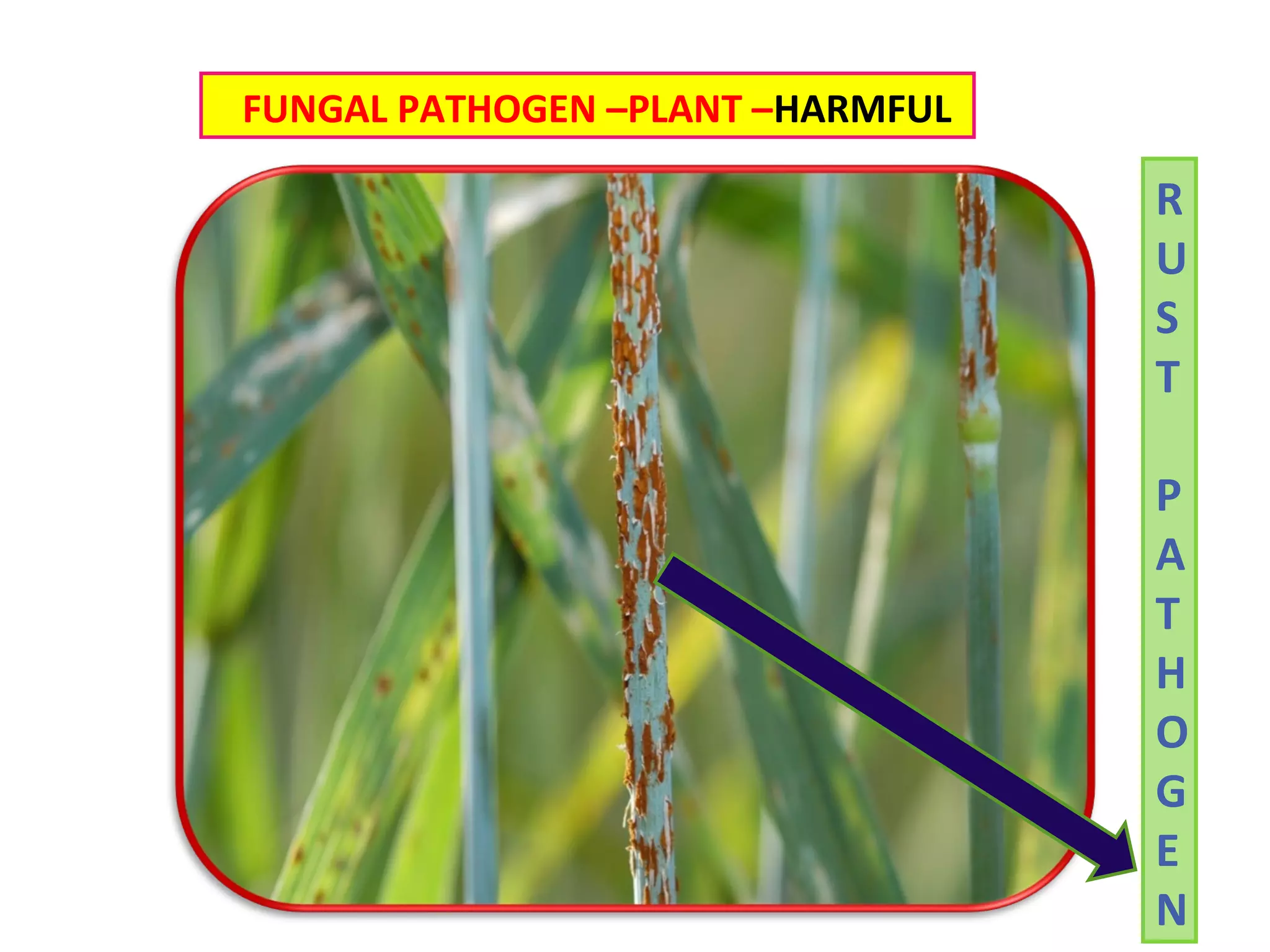
FUNGAL PATHOGEN –PLANT –HARMFUL 
R 
U 
S 
T 
P 
A 
T 
H 
O 
G 
E 
N
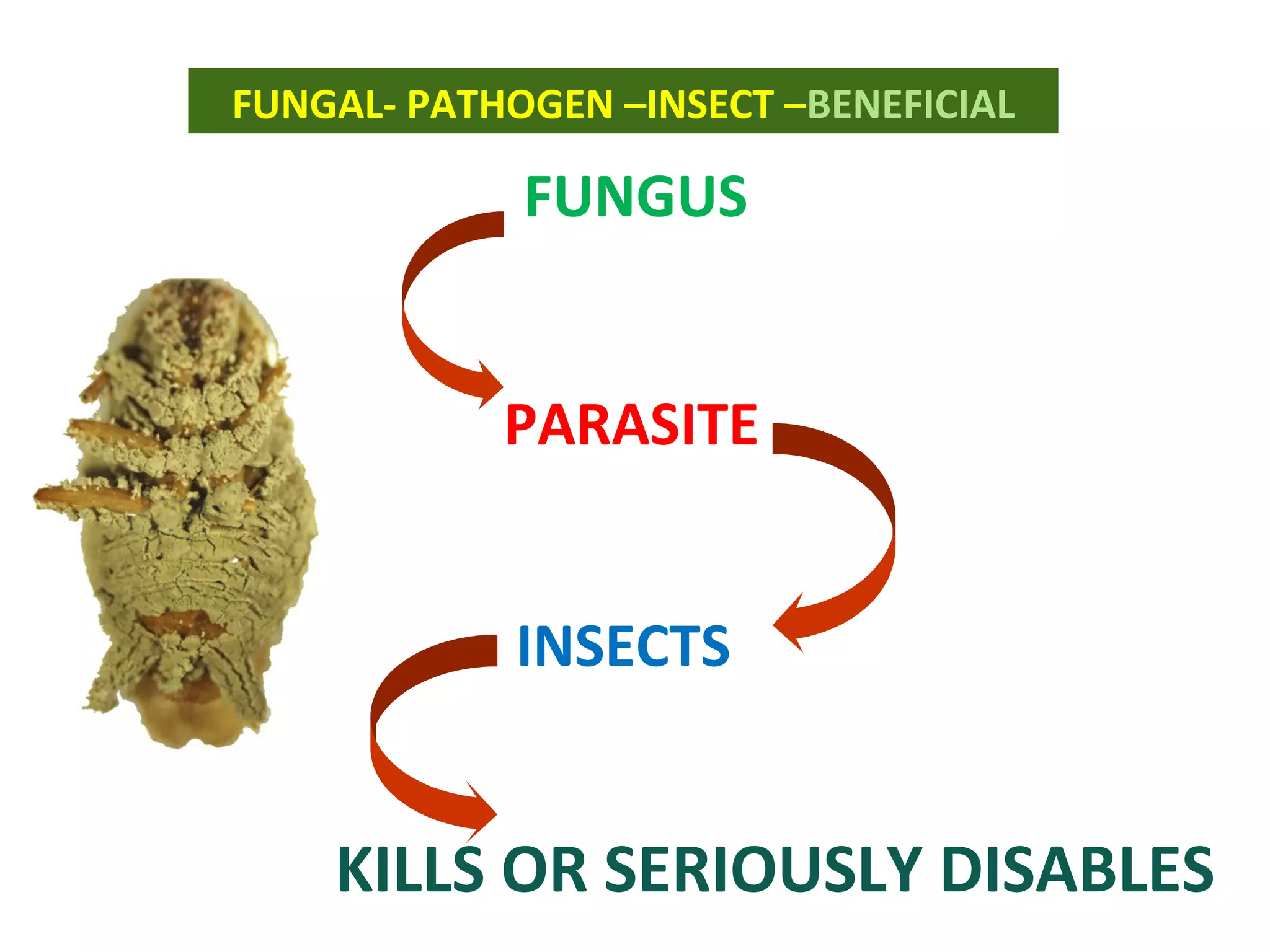
FUNGAL- PATHOGEN –INSECT –BENEFICIAL 
FUNGUS 
PARASITE 
INSECTS 
KILLS OR SERIOUSLY DISABLES
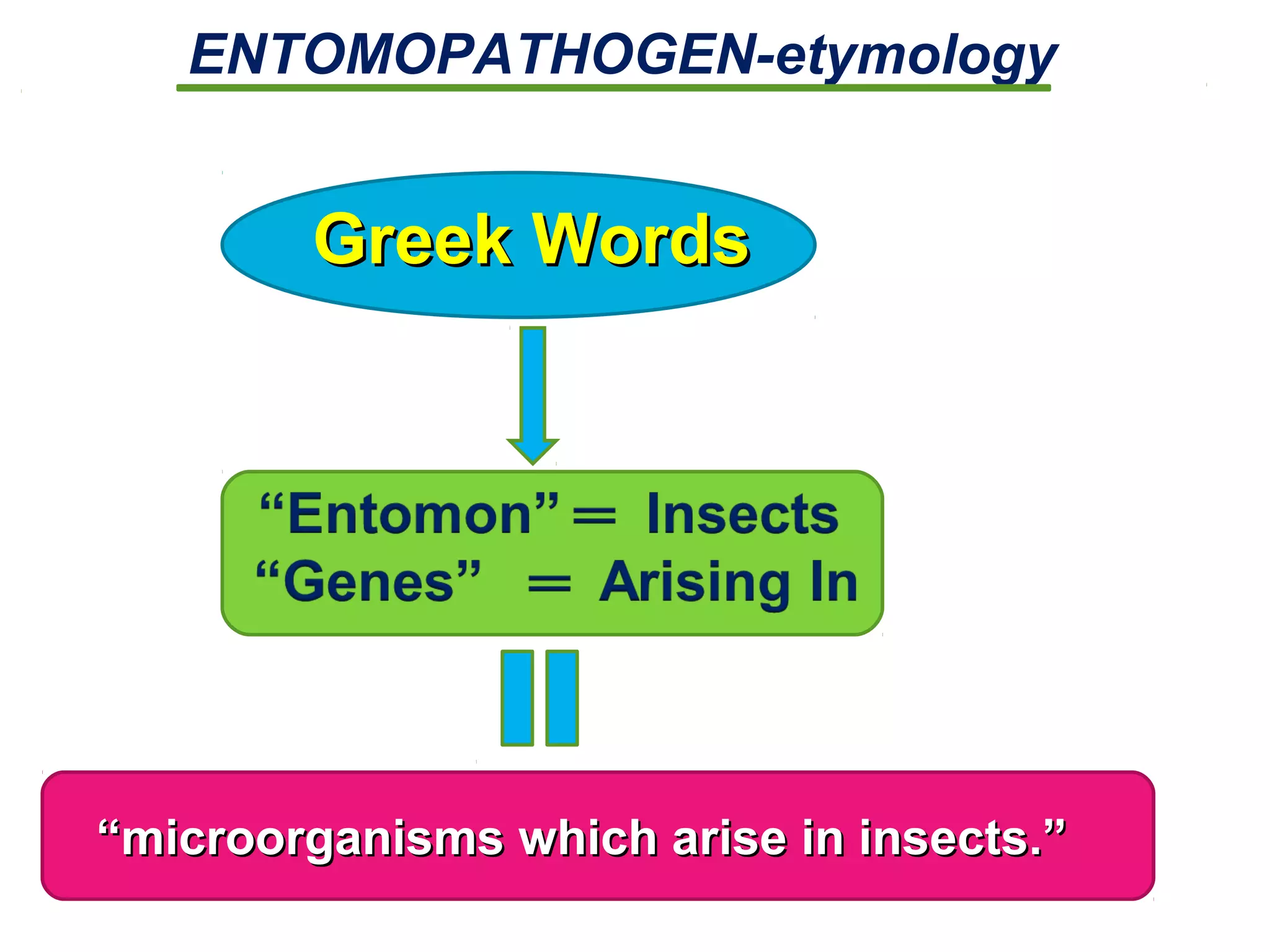
ENTOMOPATHOGEN-etymology 
GGrreeeekk WWoorrddss 
““mmiiccrroooorrggaanniissmmss wwhhiicchh aarriissee iinn iinnsseeccttss..””
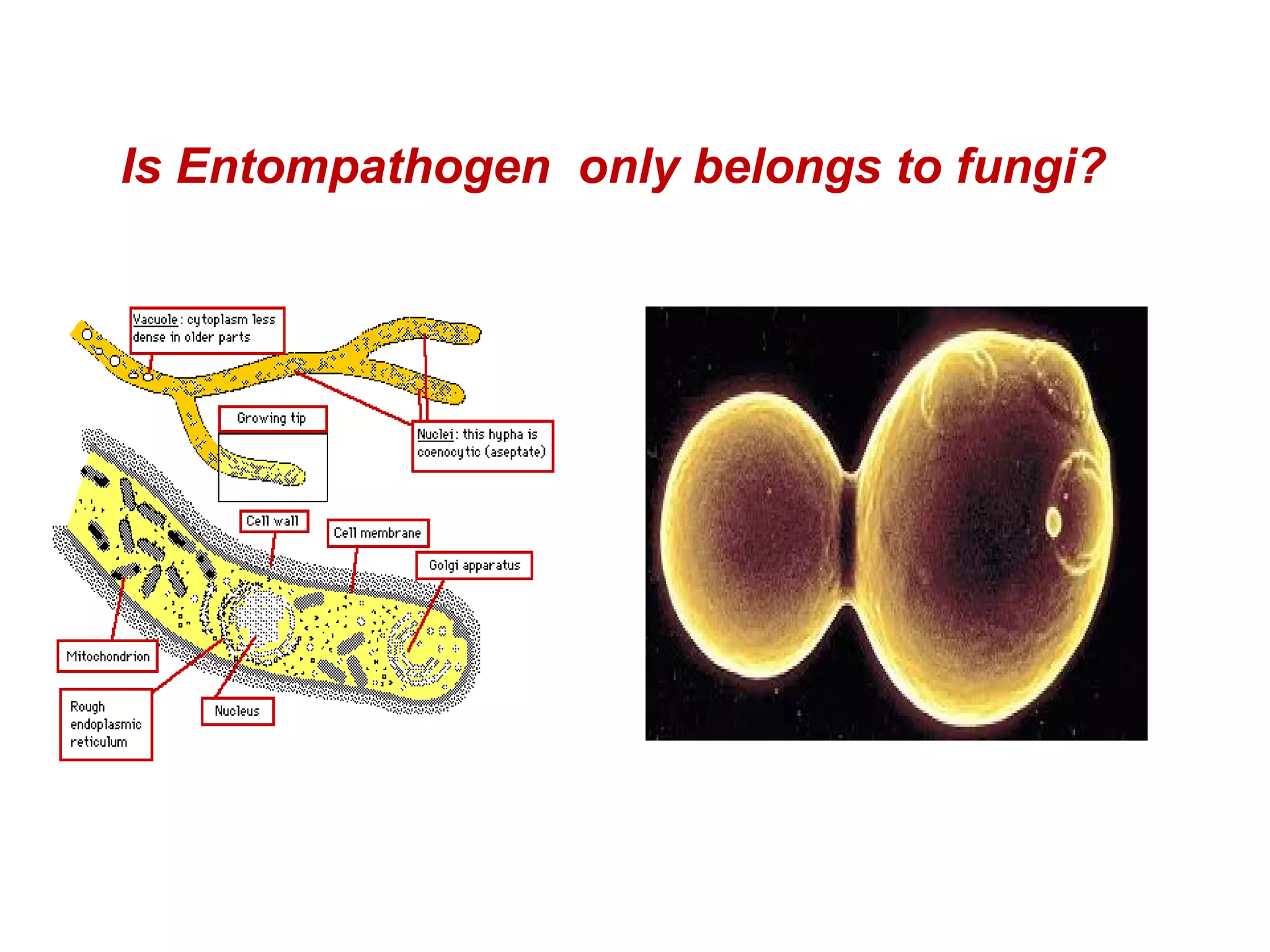
Is Entompathogen only belongs to fungi?
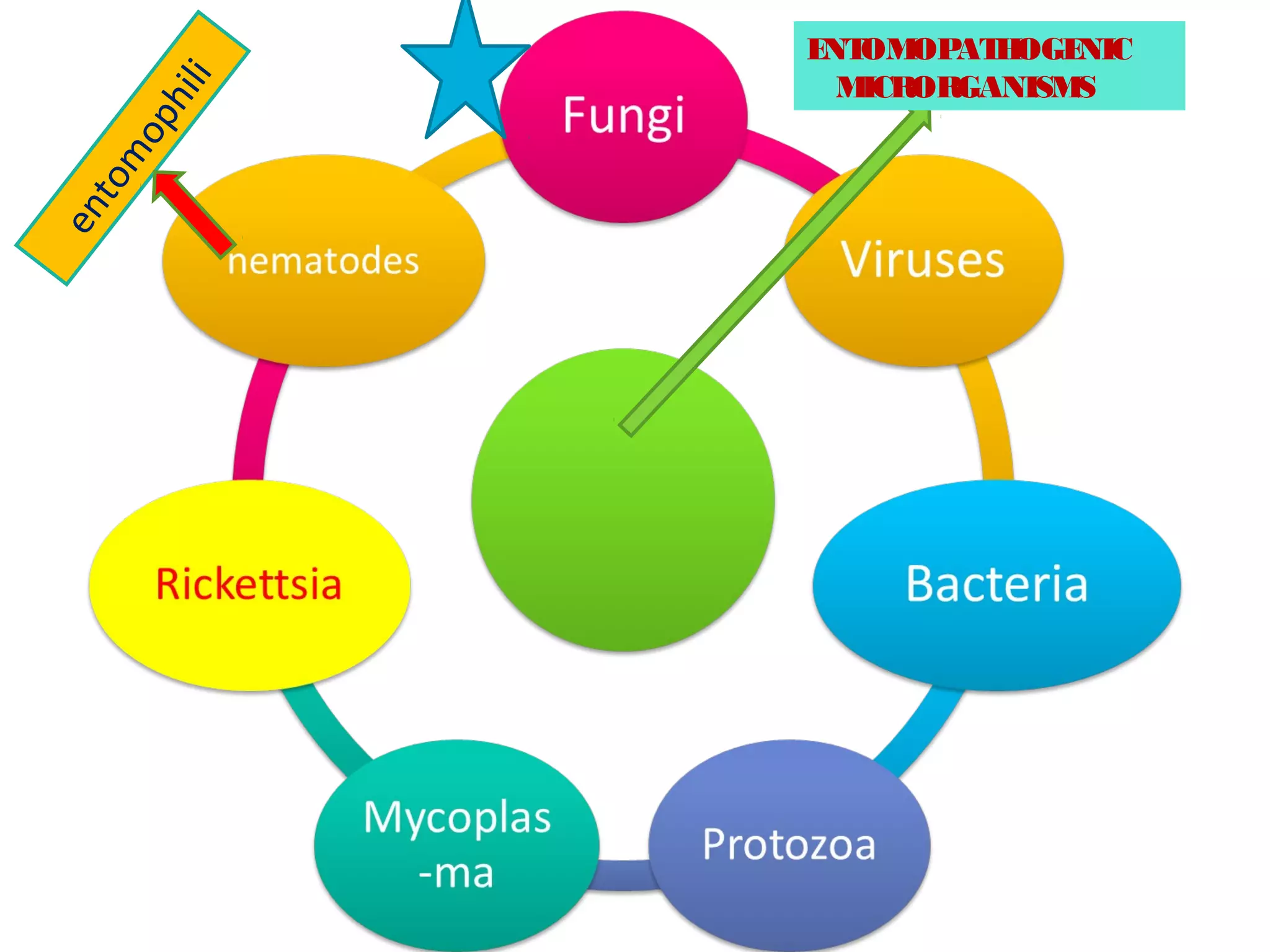
entomophili 
ENTOMOPATHOGENIC 
MICRORGANISMS
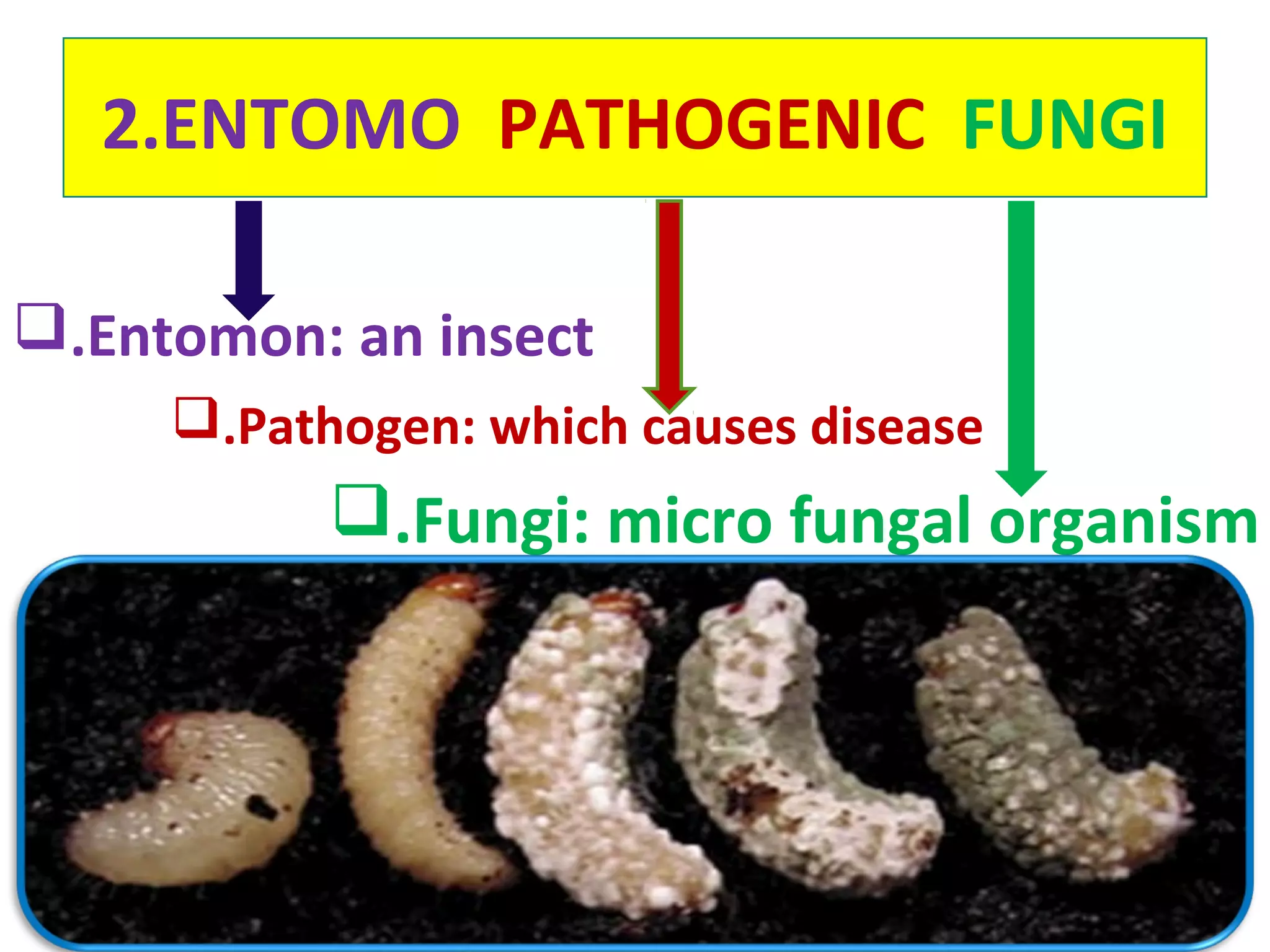
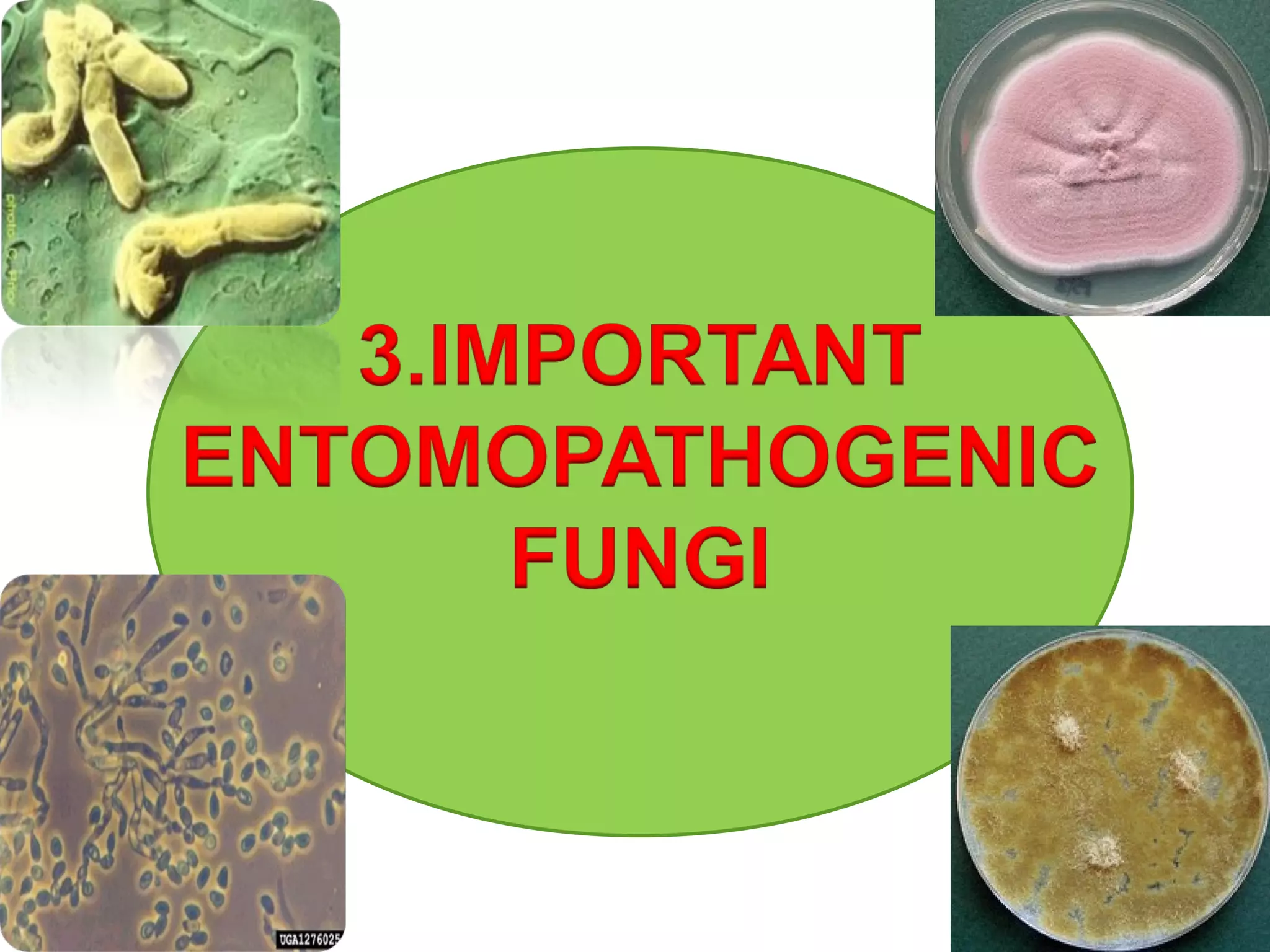
2.ENTOMO PATHOGENIC FUNGI 
.Entomon: an insect 
.Pathogen: which causes disease 
.Fungi: micro fungal organism
INTRODUCTION 
 FFIIRRSSTT ffoouunndd ppaatthhooggeennss 
 DDiisseeaassee -- MMYYCCOOSSEESS 
 775500/110000--ssppeecciieess 
 AAttttrraaccttiivvee aalltteerrnnaattiivvee--cchheemmiiccaall 
ppeessttiicciiddeess.. 
LLeessss ddaammaaggee ttoo tthhee 
eennvviirroonnmmeenntt..
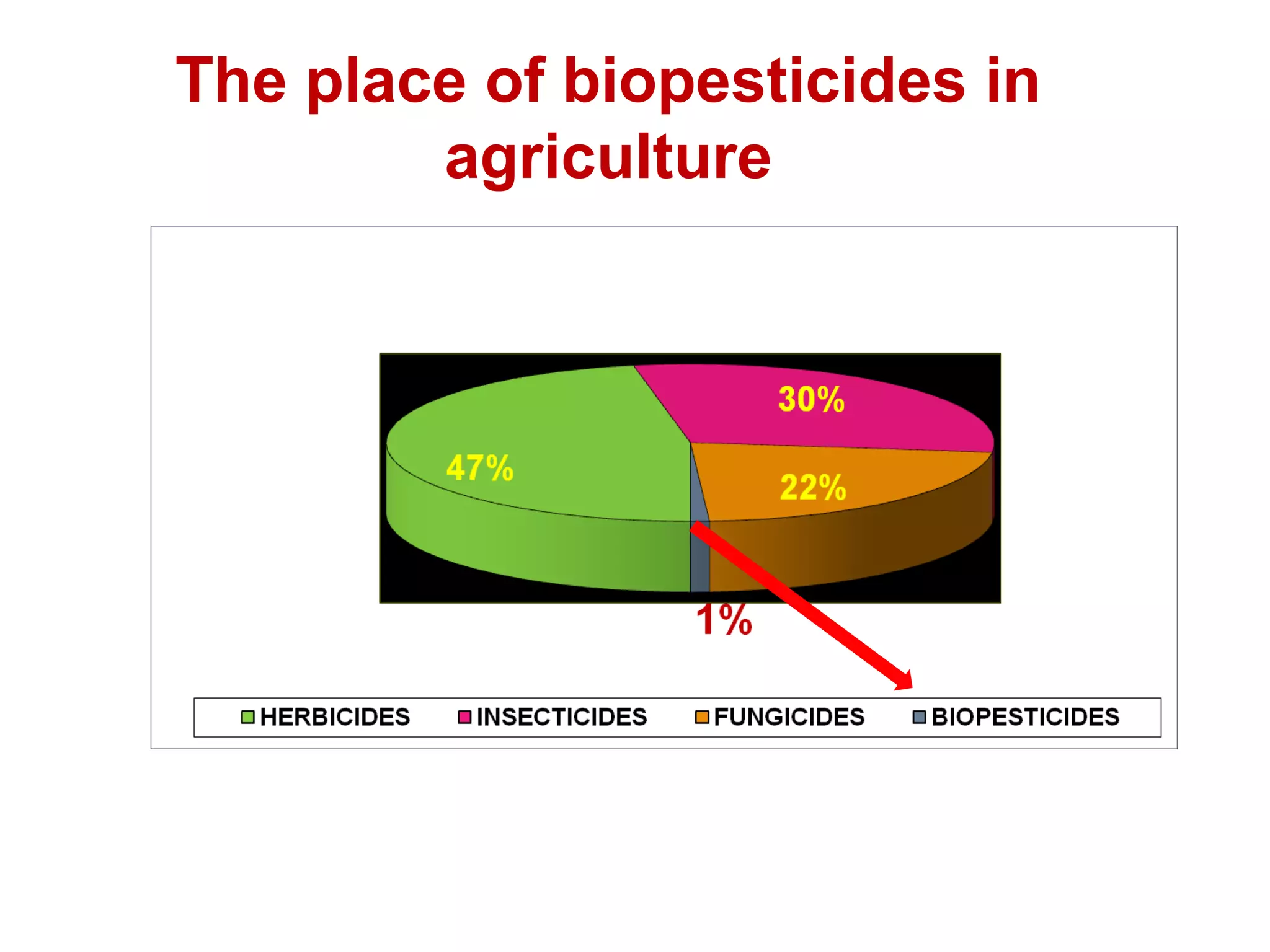
The place of biopesticides in 
agriculture
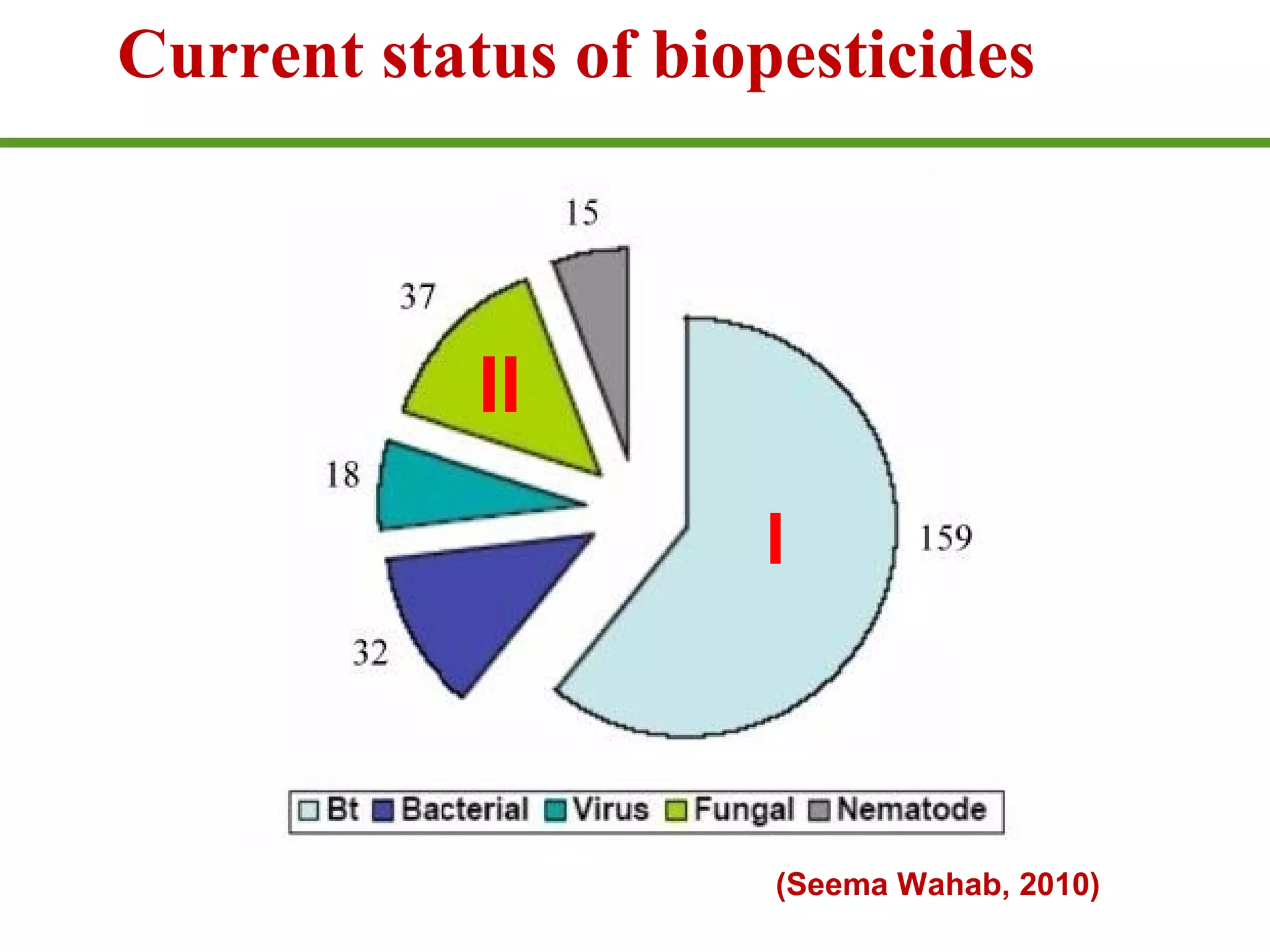
Current status of biopesticides 
I 
(Seema Wahab, 2010) 
II
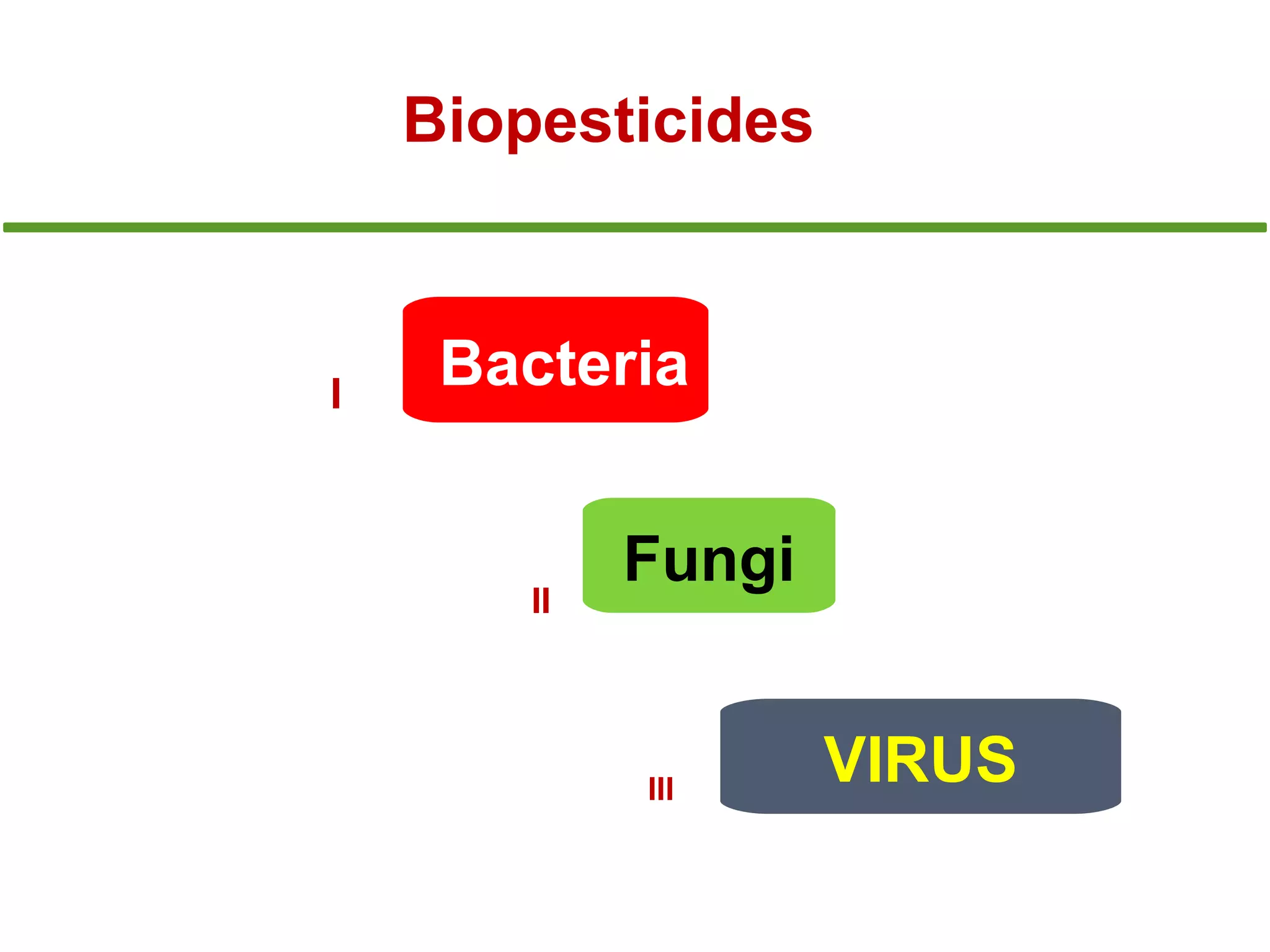
Biopesticides 
VIRUS 
Bacteria I 
Fungi 
II 
III
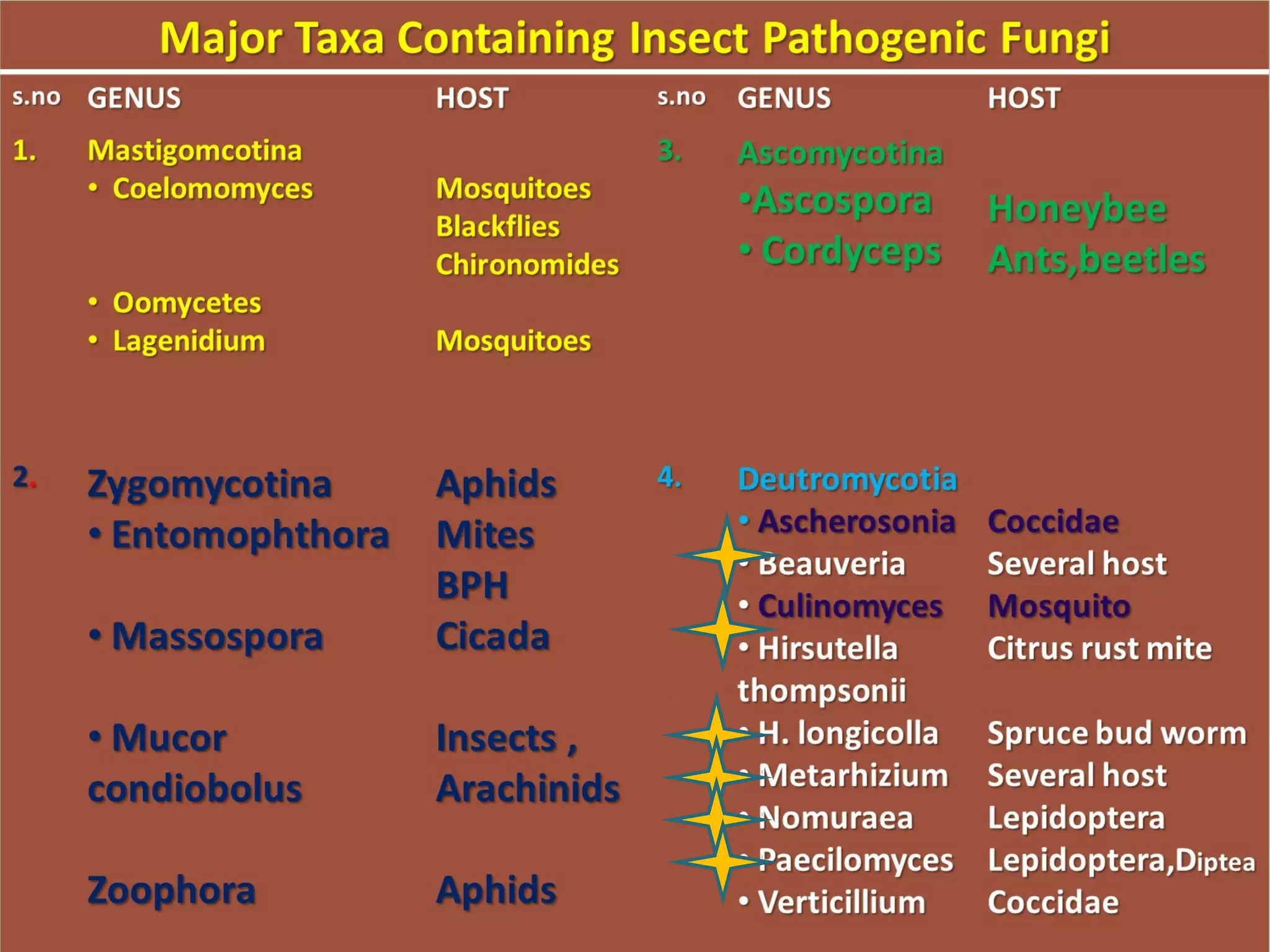
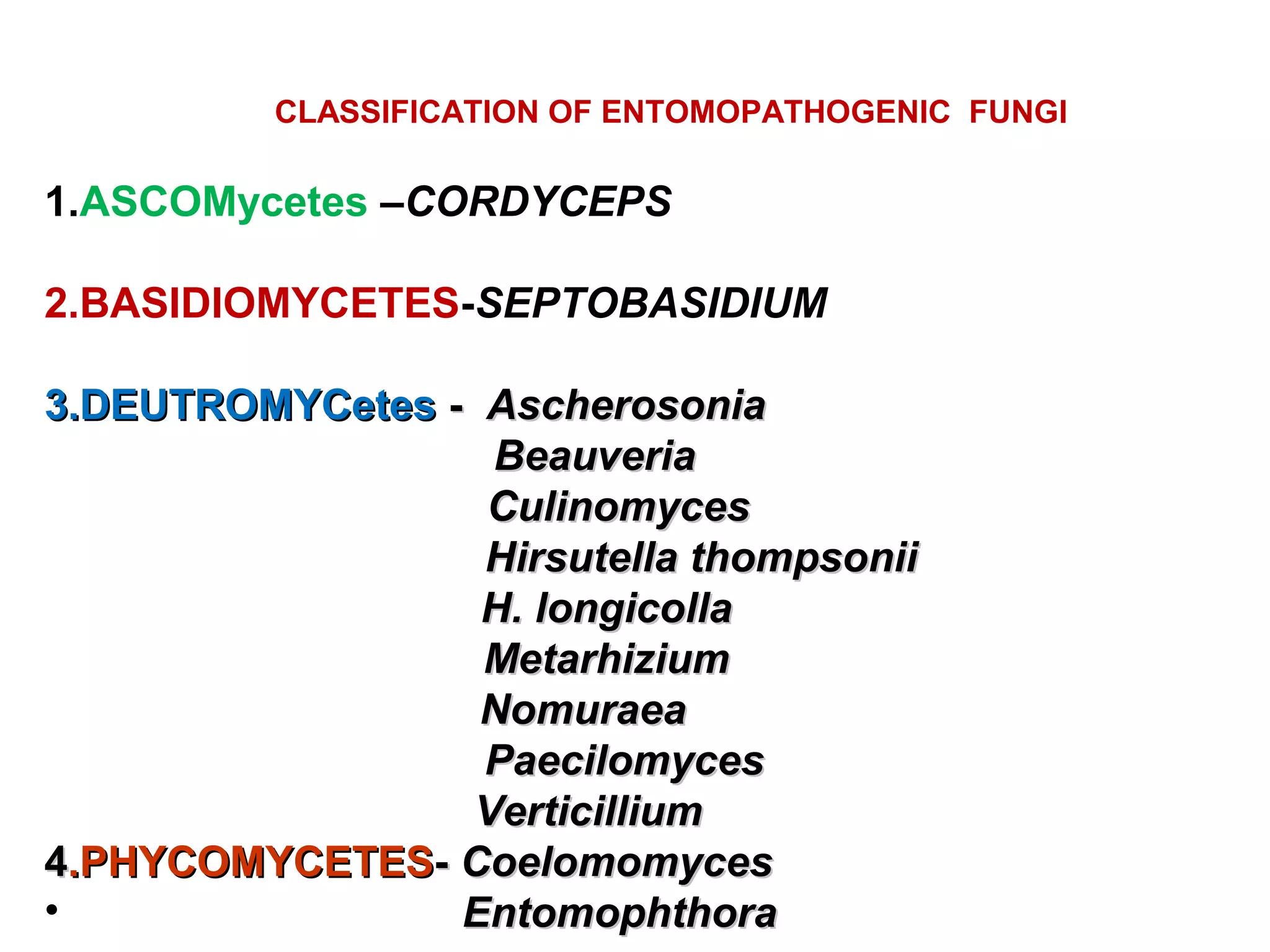
CLASSIFICATION OF ENTOMOPATHOGENIC FUNGI 
1.ASCOMycetes –CORDYCEPS 
2.BASIDIOMYCETES-SEPTOBASIDIUM 
33..DDEEUUTTRROOMMYYCCeetteess -- AAsscchheerroossoonniiaa 
BBeeaauuvveerriiaa 
CCuulliinnoommyycceess 
HHiirrssuutteellllaa tthhoommppssoonniiii 
HH.. lloonnggiiccoollllaa 
MMeettaarrhhiizziiuumm 
NNoommuurraaeeaa 
PPaaeecciilloommyycceess 
VVeerrttiicciilllliiuumm 
44..PPHHYYCCOOMMYYCCEETTEESS-- CCooeelloommoommyycceess 
• EEnnttoommoopphhtthhoorraa
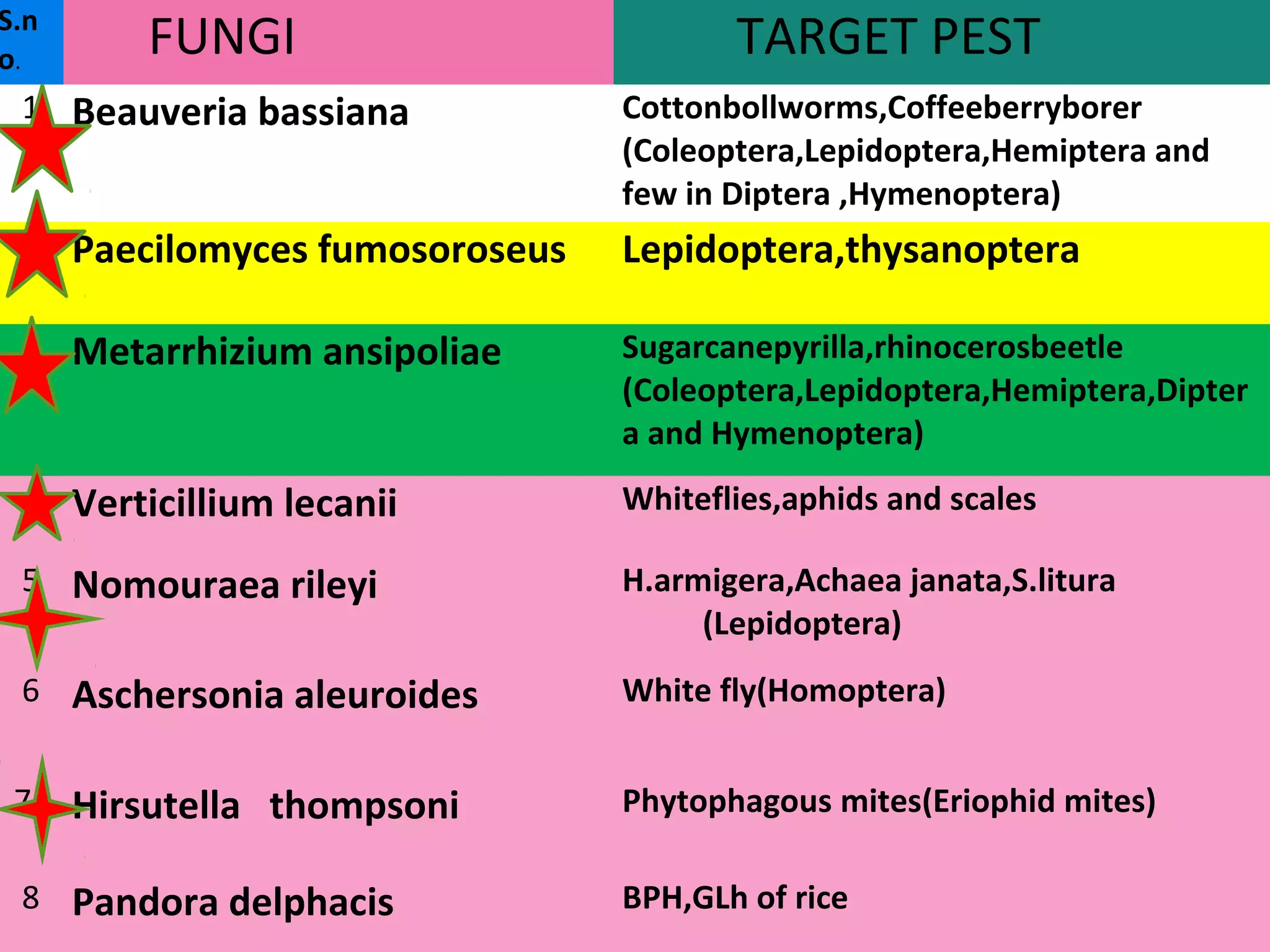
S.n 
o. FUNGI TARGET PEST 
1 Beauveria bassiana Cottonbollworms,Coffeeberryborer 
(Coleoptera,Lepidoptera,Hemiptera and 
few in Diptera ,Hymenoptera) 
2 Paecilomyces fumosoroseus Lepidoptera,thysanoptera 
3 Metarrhizium ansipoliae Sugarcanepyrilla,rhinocerosbeetle 
(Coleoptera,Lepidoptera,Hemiptera,Dipter 
a and Hymenoptera) 
4 Verticillium lecanii Whiteflies,aphids and scales 
5 Nomouraea rileyi H.armigera,Achaea janata,S.litura 
(Lepidoptera) 
6 Aschersonia aleuroides White fly(Homoptera) 
7 Hirsutella thompsoni Phytophagous mites(Eriophid mites) 
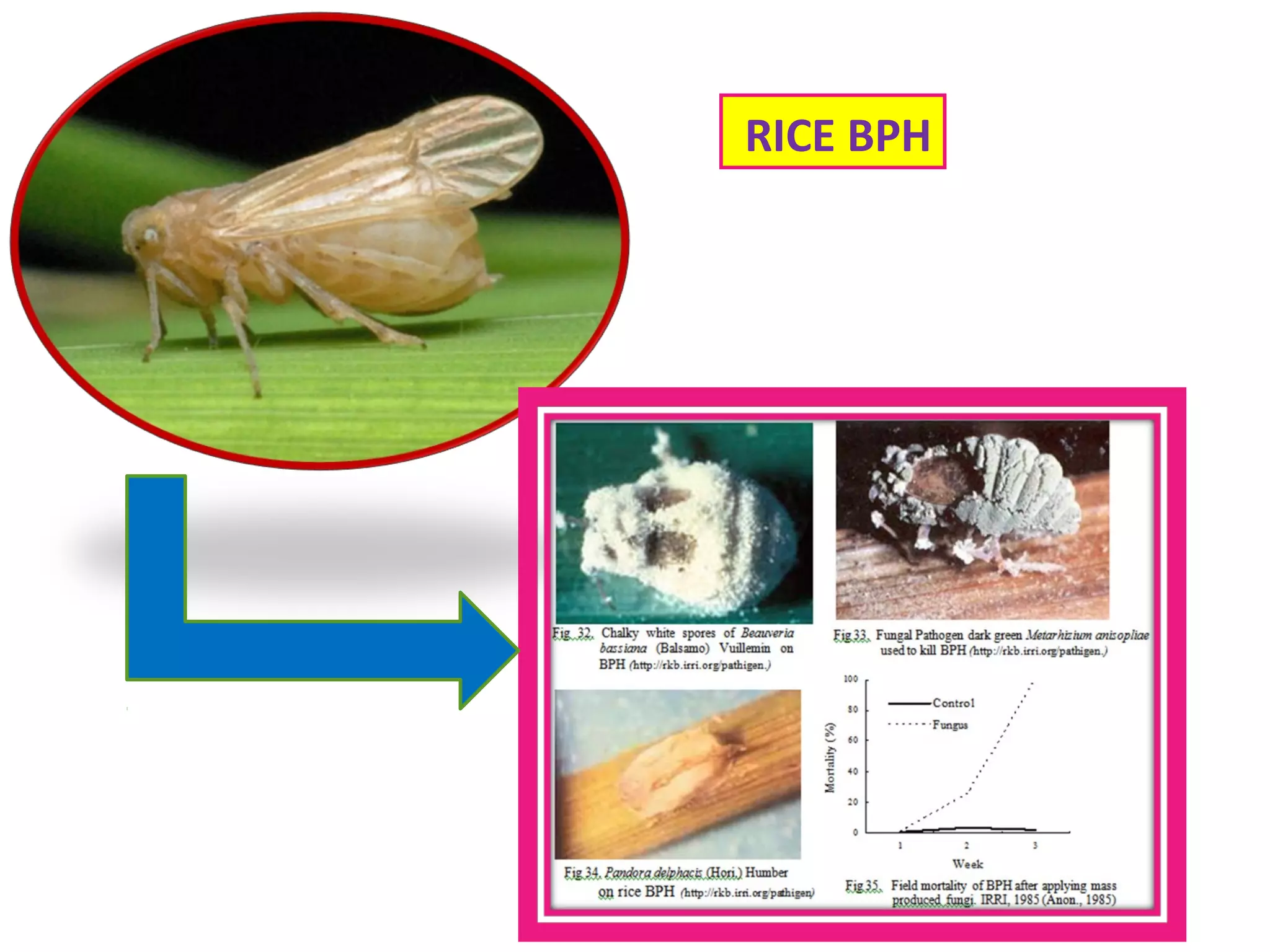
8 Pandora delphacis BPH,GLh of rice
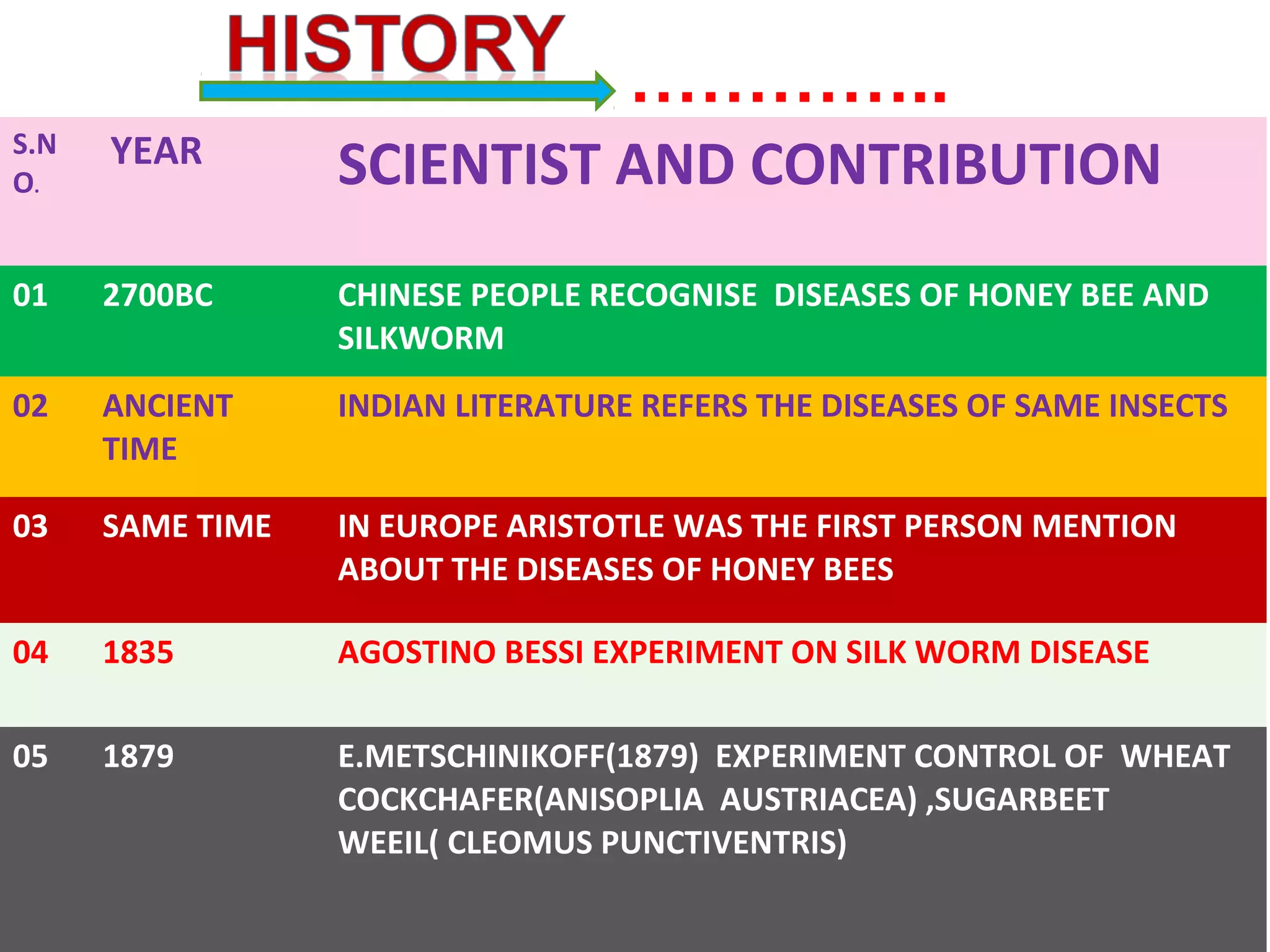
S.N 
O. 
………….. 
YEAR SCIENTIST AND CONTRIBUTION 
01 2700BC CHINESE PEOPLE RECOGNISE DISEASES OF HONEY BEE AND 
SILKWORM 
02 ANCIENT 
TIME 
INDIAN LITERATURE REFERS THE DISEASES OF SAME INSECTS 
03 SAME TIME IN EUROPE ARISTOTLE WAS THE FIRST PERSON MENTION 
ABOUT THE DISEASES OF HONEY BEES 
04 1835 AGOSTINO BESSI EXPERIMENT ON SILK WORM DISEASE 
05 1879 E.METSCHINIKOFF(1879) EXPERIMENT CONTROL OF WHEAT 
COCKCHAFER(ANISOPLIA AUSTRIACEA) ,SUGARBEET 
WEEIL( CLEOMUS PUNCTIVENTRIS)
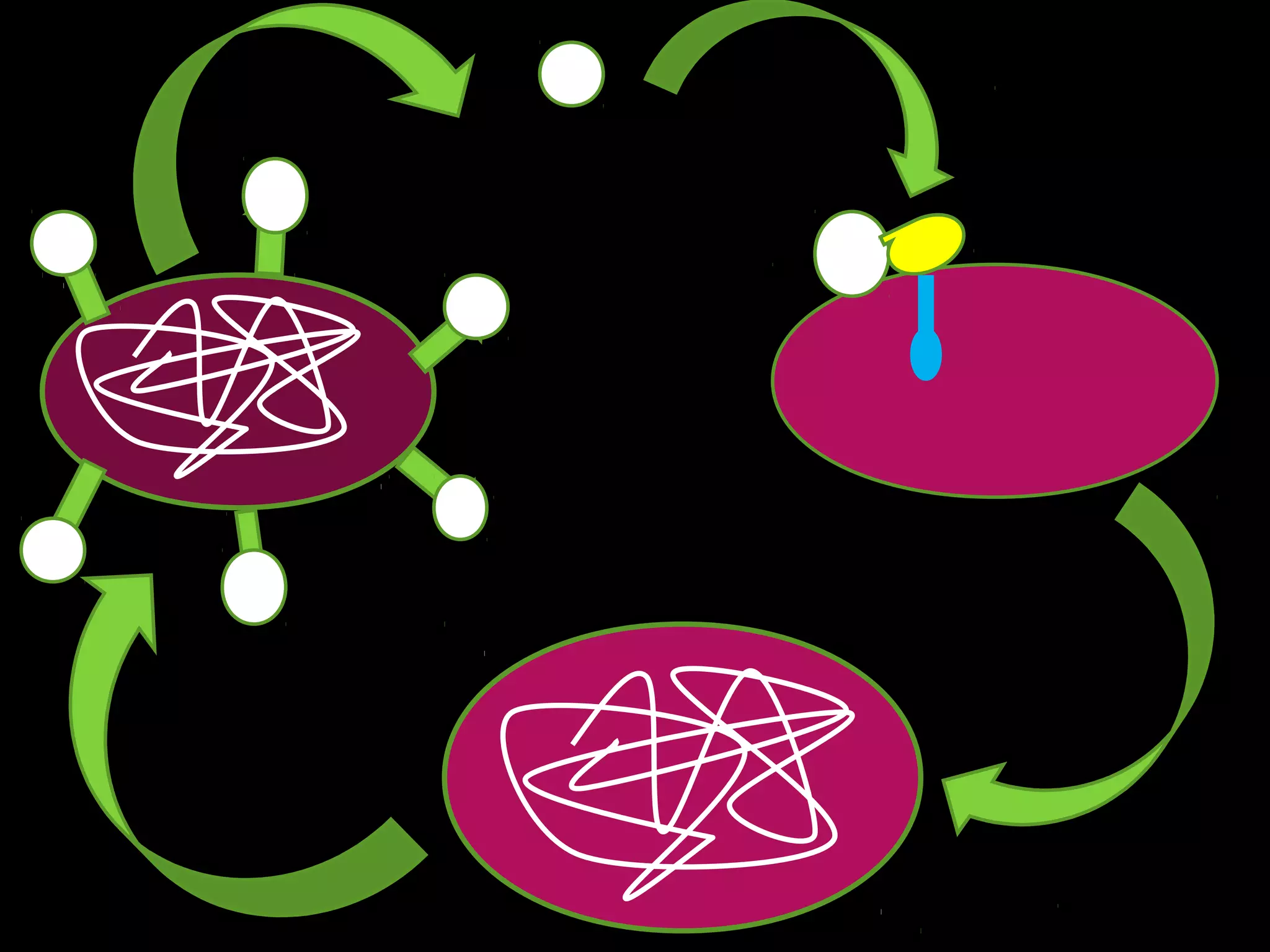
4. MODE OF ACTION
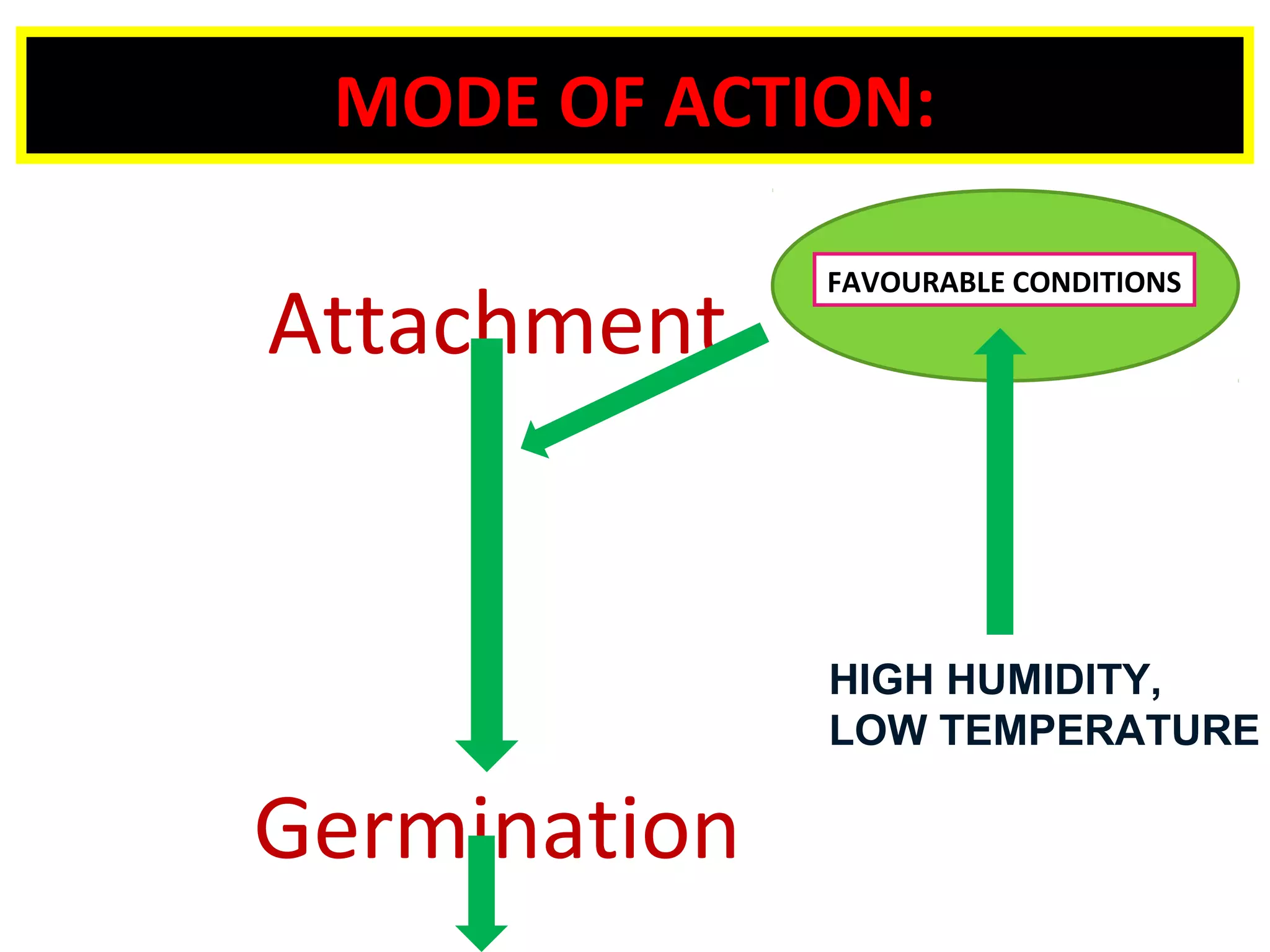
MODE OF ACTION: 
Attachment 
Germination 
FAVOURABLE CONDITIONS 
HIGH HUMIDITY, 
LOW TEMPERATURE
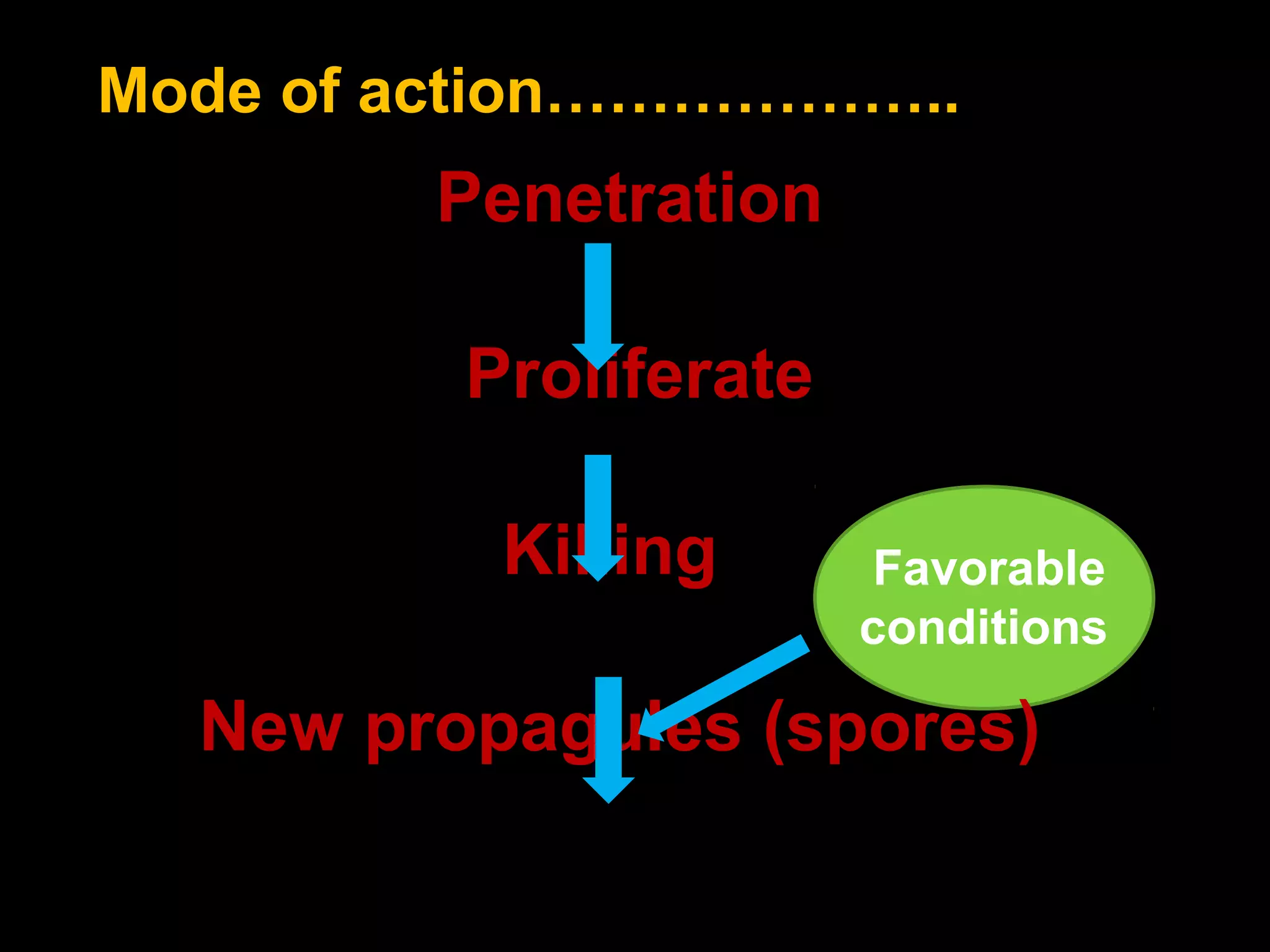
Mode of action……………….. 
Penetration 
Proliferate 
Killing 
Favorable 
conditions 
New propagules (spores)
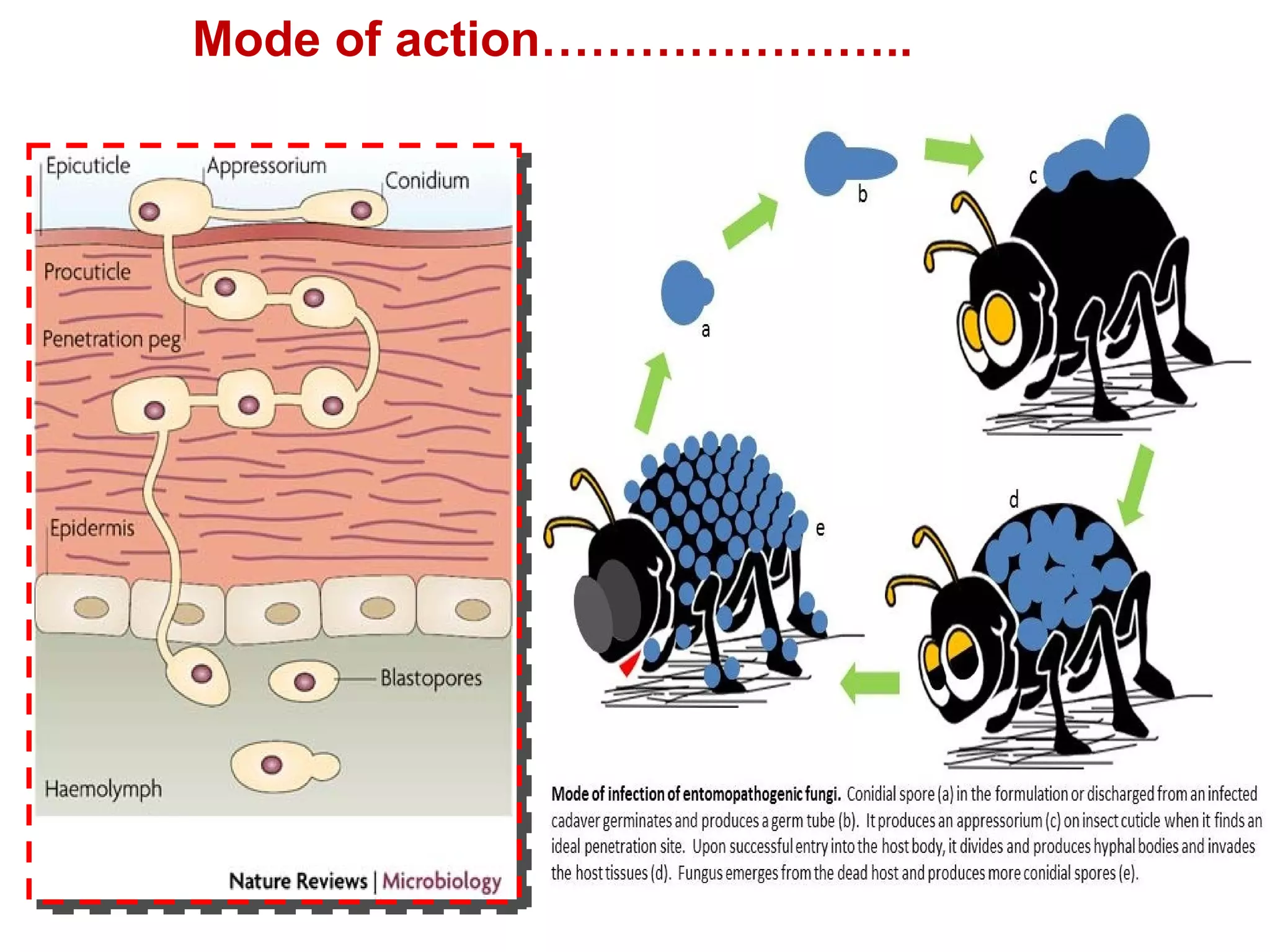
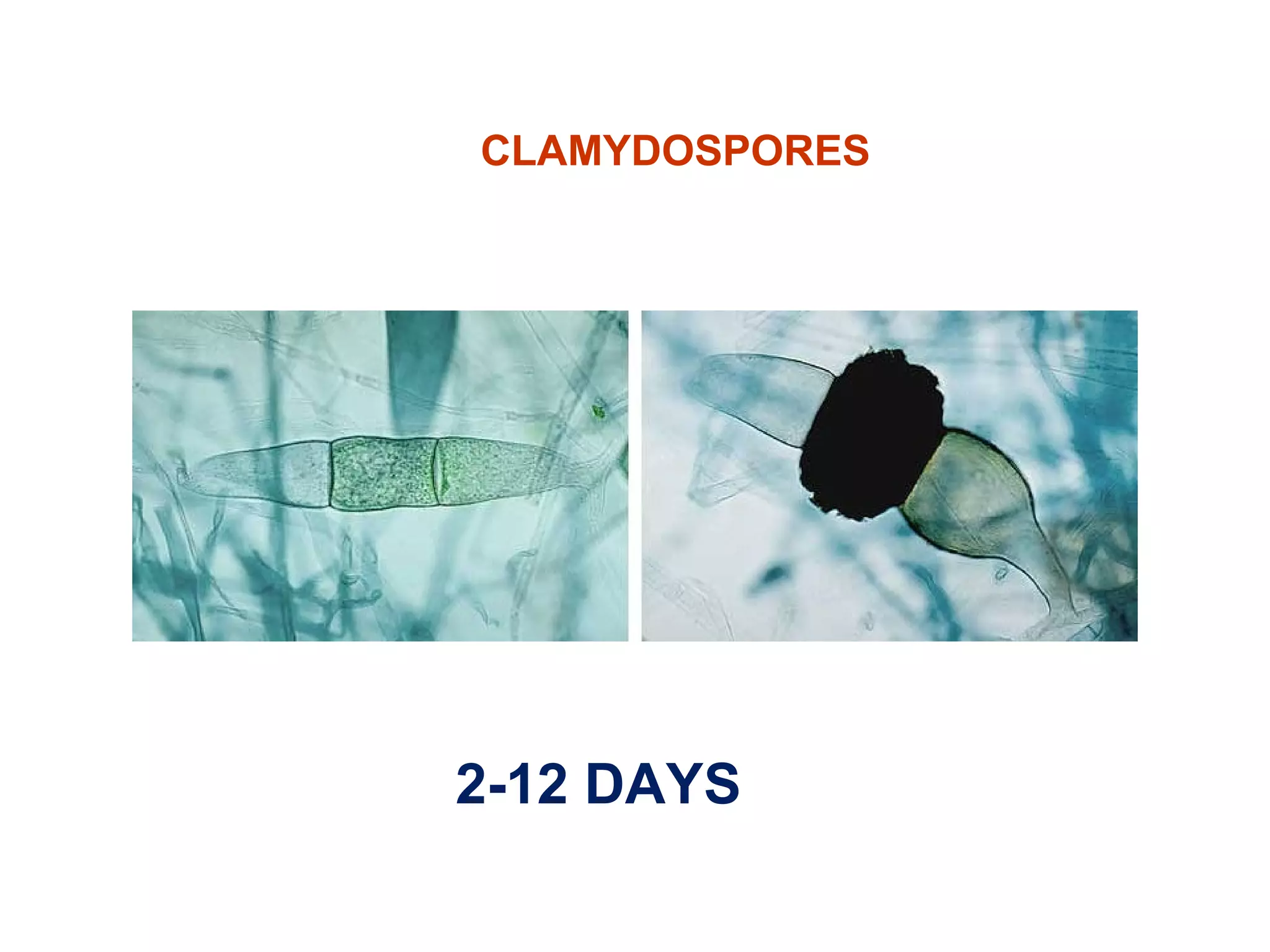
Mode of action…………………..
CLAMYDOSPORES 
2-12 DAYS
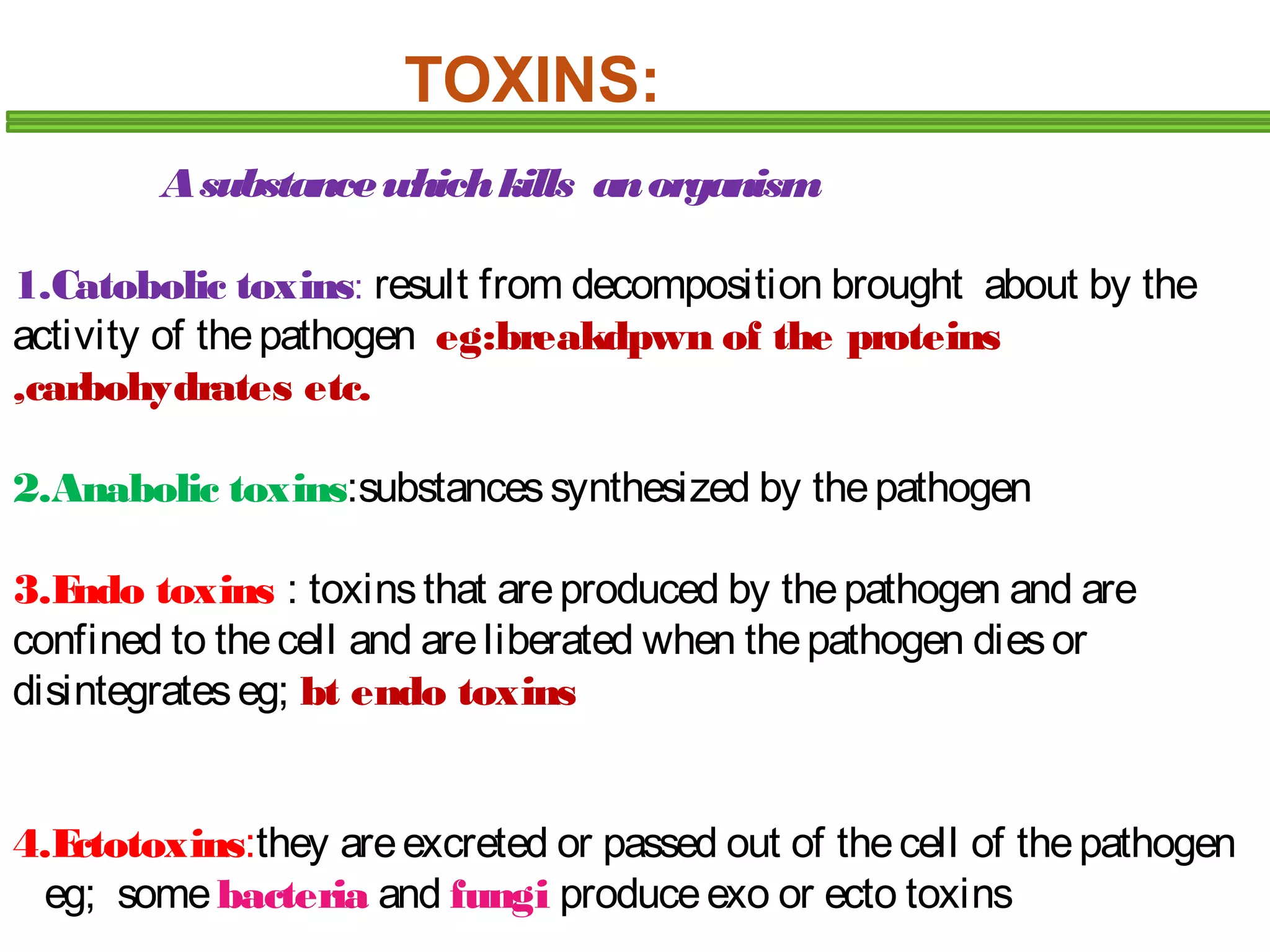
TOXINS: 
A substance which kills an organism 
1.Catobolic toxins: result from decomposition brought about by the 
activity of the pathogen eg:breakdpwn of the proteins 
,carbohydrates etc. 
2.Anabolic toxins:substances synthesized by the pathogen 
3.Endo toxins : toxins that are produced by the pathogen and are 
confined to the cell and are liberated when the pathogen dies or 
disintegrates eg; bt endo toxins 
4.Ectotoxins:they are excreted or passed out of the cell of the pathogen 
eg; some bacteria and fungi produce exo or ecto toxins
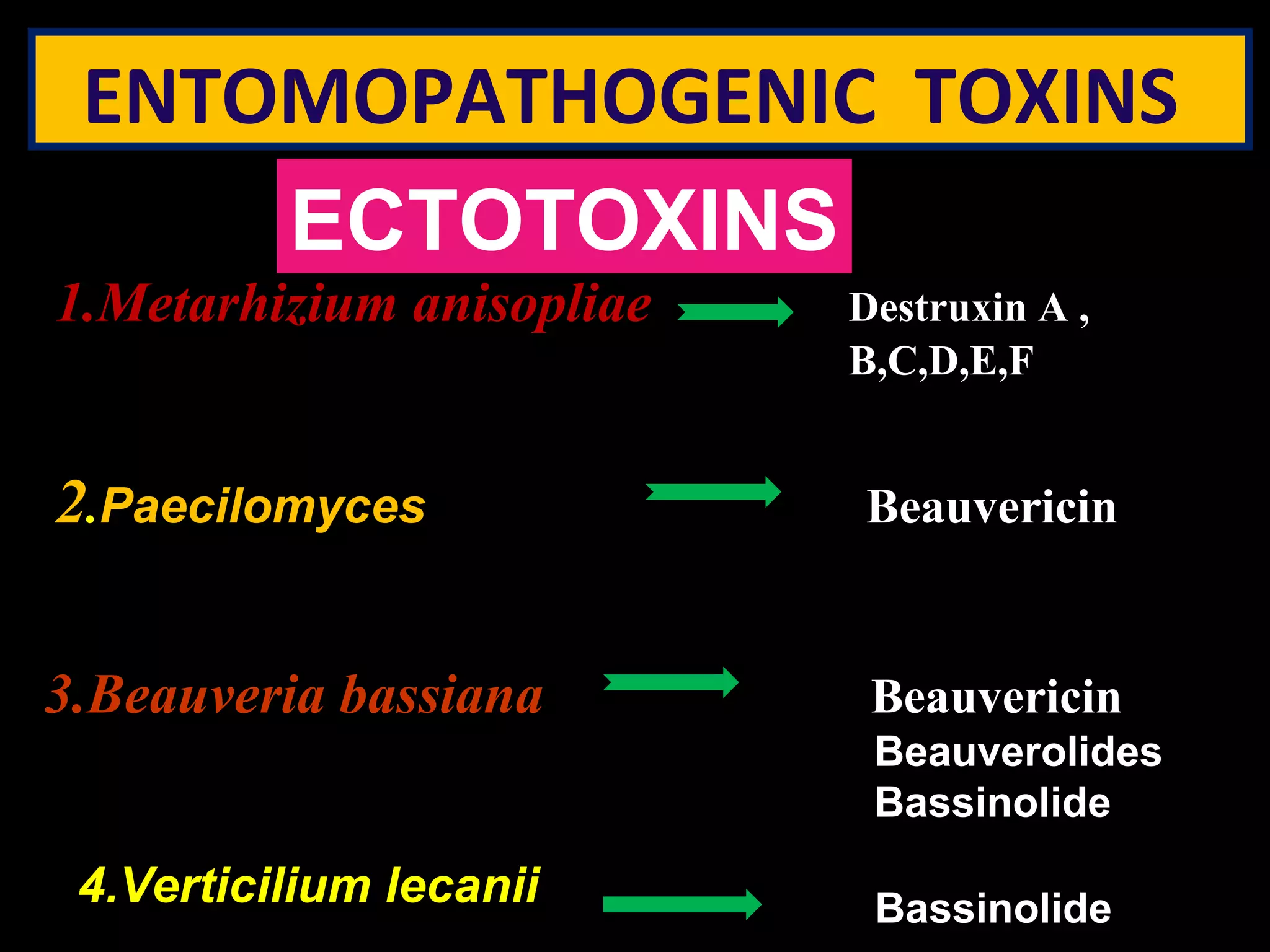
ENTOMOPATHOGENIC TOXINS 
1.Metarhizium anisopliae Destruxin A , 
B,C,D,E,F 
2.Paecilomyces Beauvericin 
3.Beauveria bassiana Beauvericin 
Beauverolides 
Bassinolide 
4.Verticilium lecanii 
Bassinolide 
ECTOTOXINS
Beauveria bassiana 
Metarhizium anisopliae 
Verticillium lecanii 
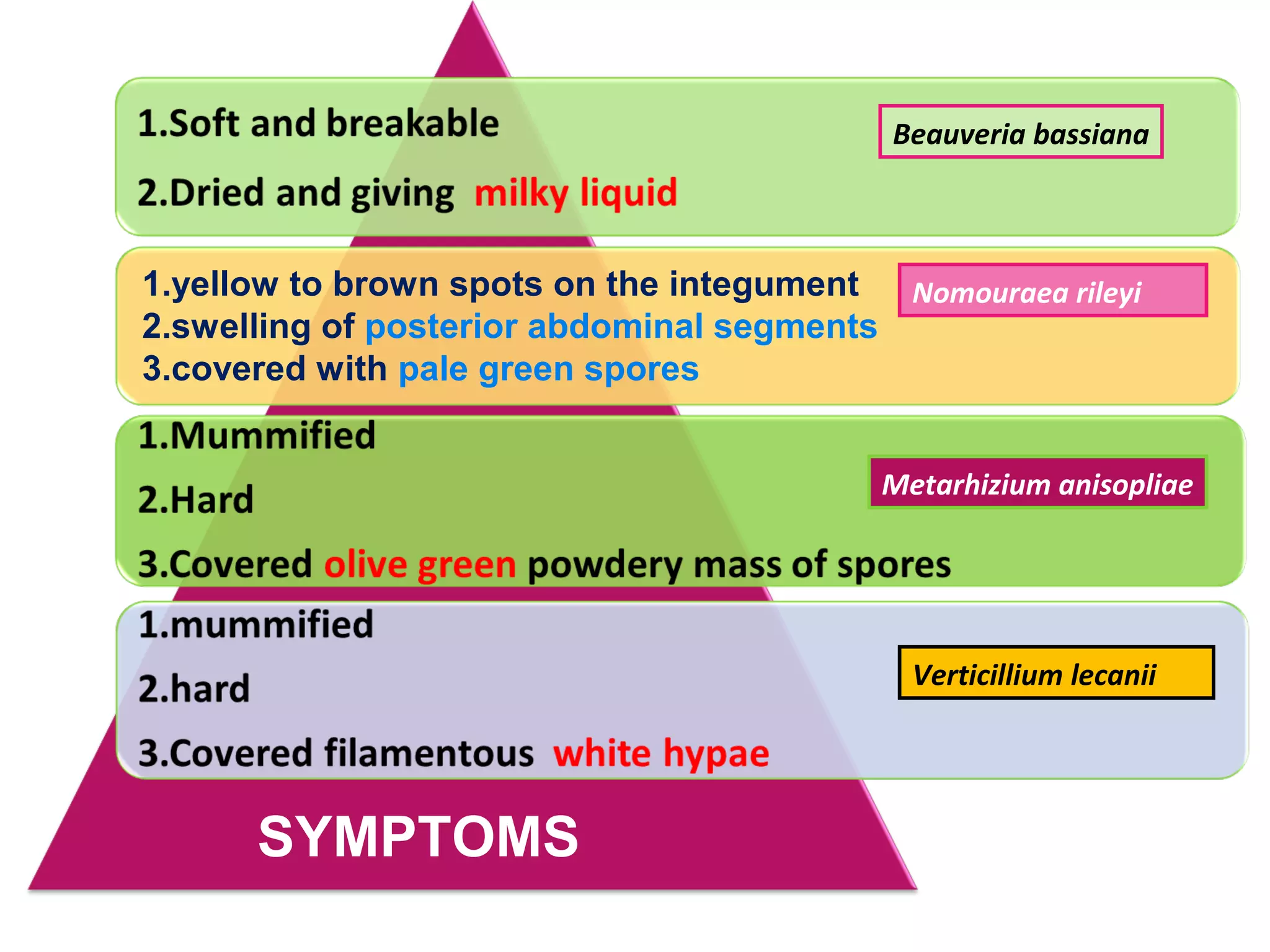
1.yellow to brown spots on the integument 
2.swelling of posterior abdominal segments 
3.covered with pale green spores 
SYMPTOMS 
Nomouraea rileyi
MASS PRODUCTION
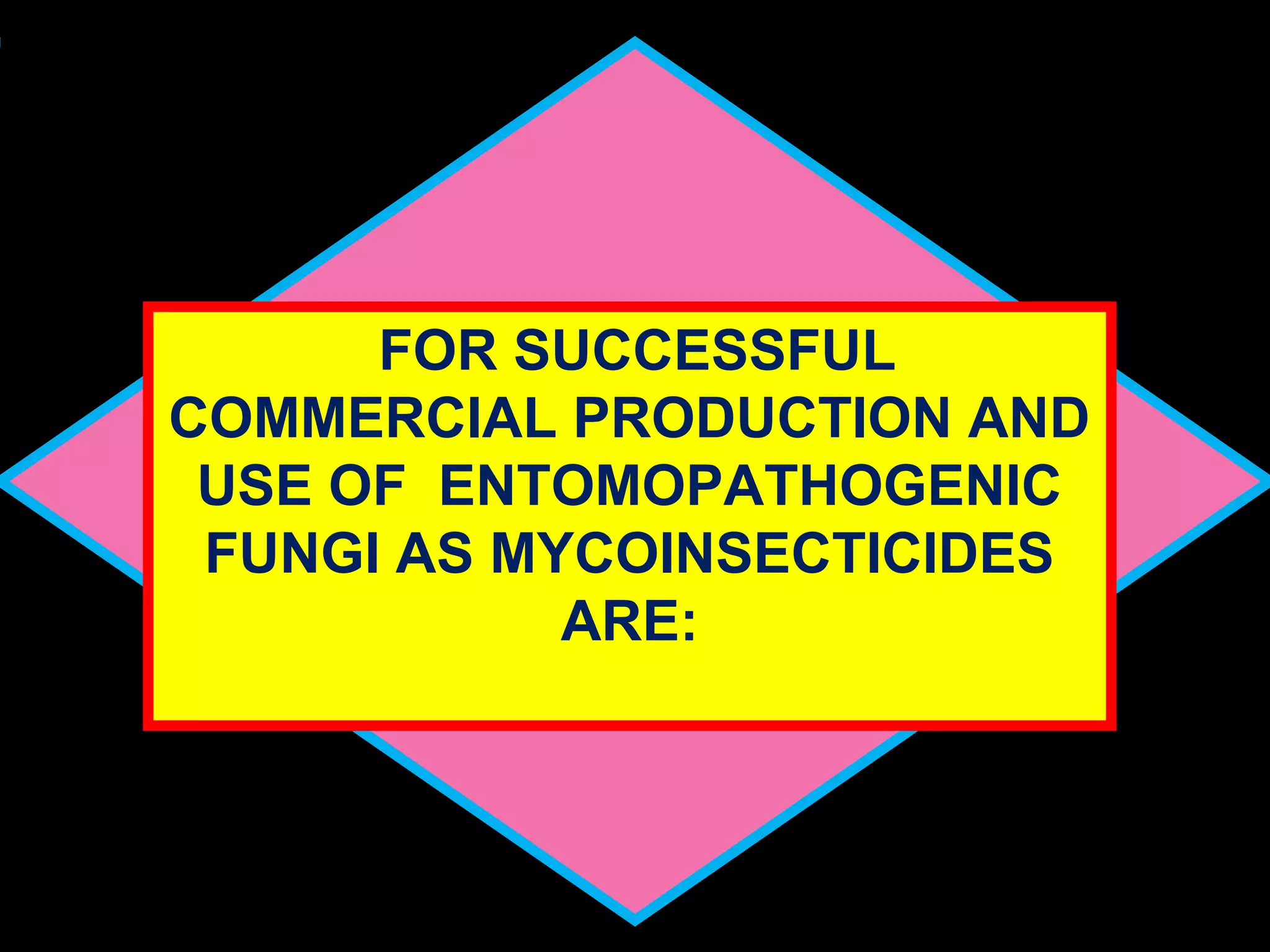
FOR SUCCESSFUL 
COMMERCIAL PRODUCTION AND 
USE OF ENTOMOPATHOGENIC 
FUNGI AS MYCOINSECTICIDES 
ARE:
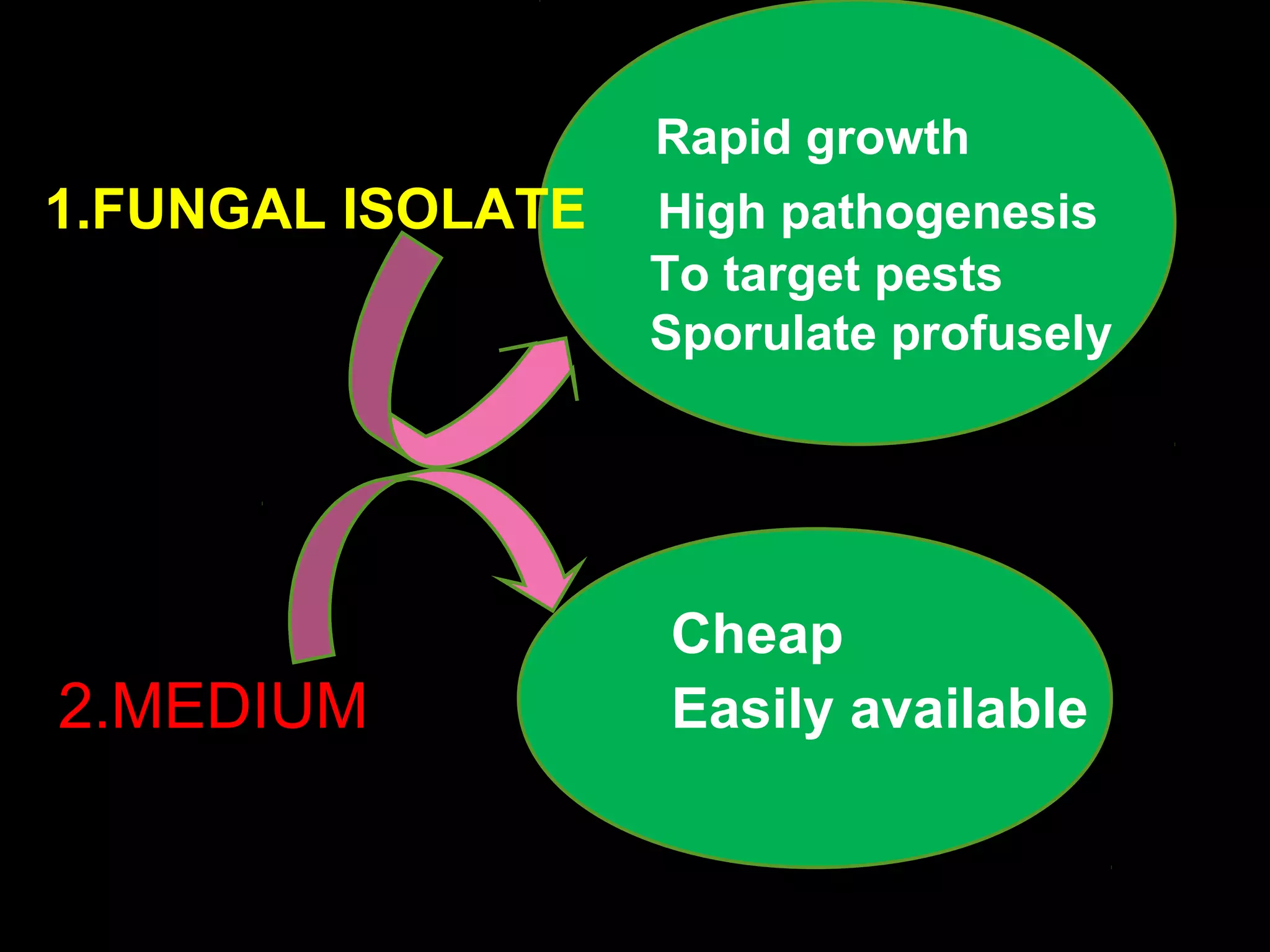
Rapid growth 
1.FUNGAL ISOLATE High pathogenesis 
To target pests 
Sporulate profusely 
Cheap 
2.MEDIUM Easily available
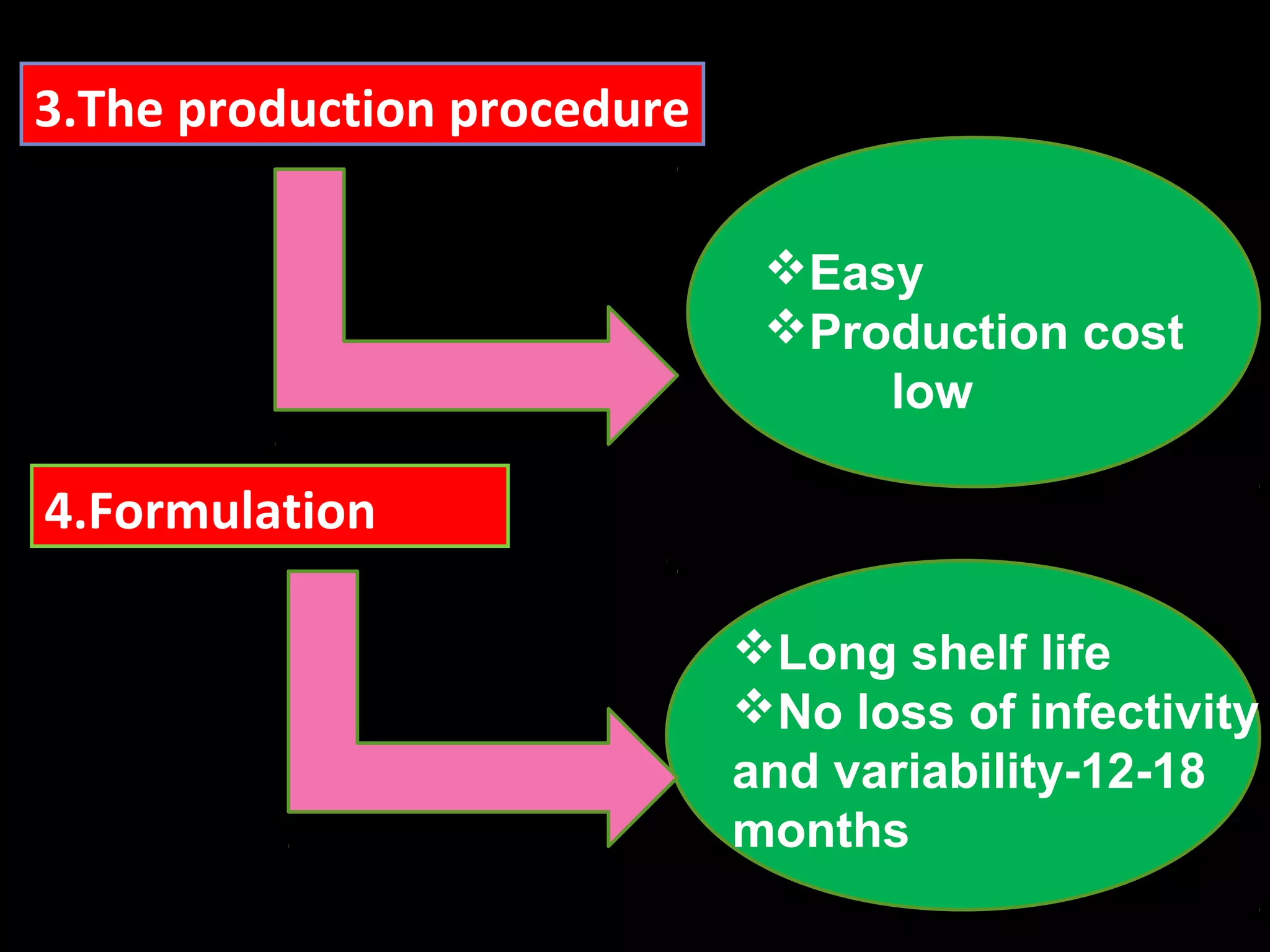
3.The production procedure 
Easy 
Production cost 
low 
4.Formulation 
Long shelf life 
No loss of infectivity 
and variability-12-18 
months
1.Beauveria bassiana
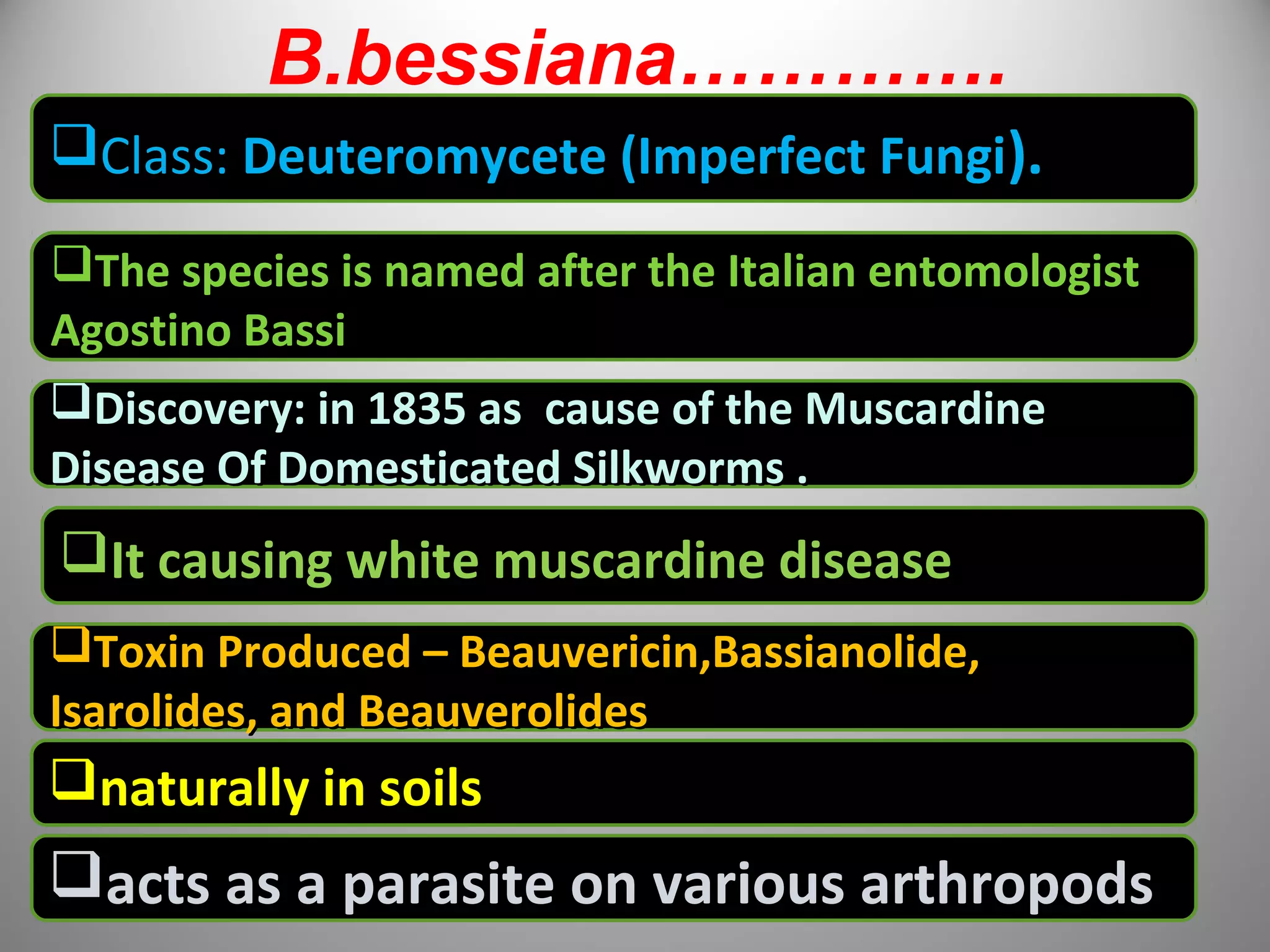
B.bessiana…………. 
CCllaassss:: DDeeuutteerroommyycceettee ((IImmppeerrffeecctt FFuunnggii)).. 
TThhee ssppeecciieess iiss nnaammeedd aafftteerr tthhee IIttaalliiaann eennttoommoollooggiisstt 
AAggoossttiinnoo BBaassssii 
DDiissccoovveerryy:: iinn 11883355 aass ccaauussee ooff tthhee MMuussccaarrddiinnee 
DDiisseeaassee OOff DDoommeessttiiccaatteedd SSiillkkwwoorrmmss .. 
IItt ccaauussiinngg wwhhiittee mmuussccaarrddiinnee ddiisseeaassee 
TTooxxiinn PPrroodduucceedd –– BBeeaauuvveerriicciinn,,BBaassssiiaannoolliiddee,, 
IIssaarroolliiddeess,, aanndd BBeeaauuvveerroolliiddeess 
nnaattuurraallllyy iinn ssooiillss 
aaccttss aass aa ppaarraassiittee oonn vvaarriioouuss aarrtthhrrooppooddss
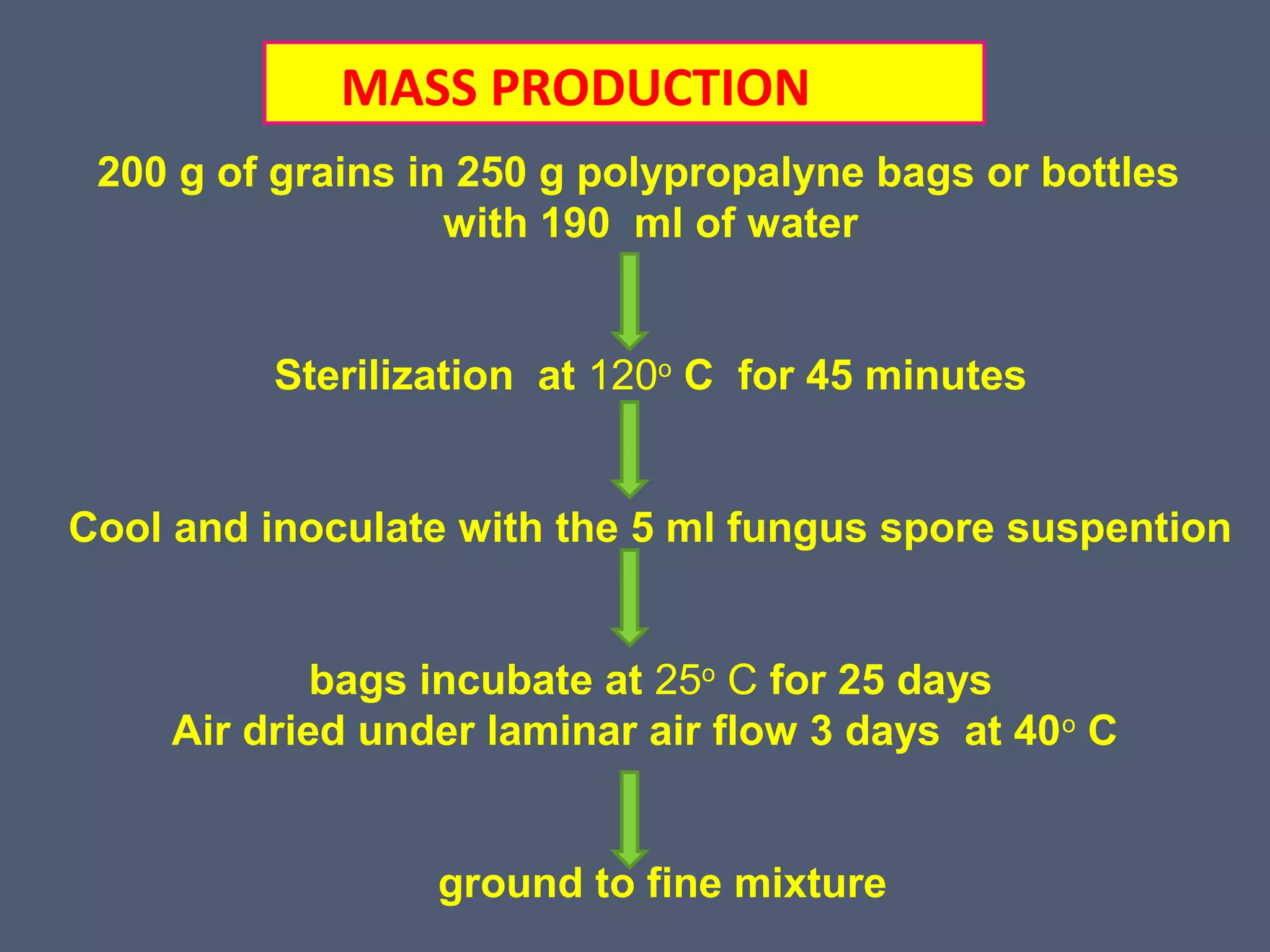
MASS PRODUCTION 
200 g of grains in 250 g polypropalyne bags or bottles 
with 190 ml of water 
Sterilization at 120o C for 45 minutes 
Cool and inoculate with the 5 ml fungus spore suspention 
bags incubate at 25o C for 25 days 
Air dried under laminar air flow 3 days at 40o C 
ground to fine mixture
FFIIEELLDD RREELLEEAASSEE 
 mmeetthhoodd:: SSpprraayyiinngg 
EEmmuullssiiffiieedd SSuussppeennssiioonn 
WWeettttaabbllee PPoowwddeerr.. 
DDoossaaggee:: 
11..SSppoorreess aatt 11..55kkgg//hhaa ((3300xx110099 ccoonniiddiiaa//gg)) 
++ 
22.. CChhlloorroopphhooss 
@@ LLooww ddoossee iiss ffoouunnddeedd ggoooodd ffoorr rreedduucciinngg 
tthhee ppeesstt 
TTrraaddee nnaammeess 
BBoottaanniiggaarrdd®EESS 
 BBoottaanniiggaarrdd®2222WWPP 
NNaattuurraalliiss 
MMyyccoottrrooll
AAGGAAIINNSSTT 
TTeerrmmiitteess 
TThhrriippss 
 WWhhiitteefflliieess 
AApphhiiddss 
GGrraasssshhooppppeerrss 
BBeeeettlleess 
CCaatteerrppiillllaarrss 
SSiillkkwwoorrmmss 
IIttss uussee iinn tthhee CCoonnttrrooll OOff MMaallaarriiaa -- TTrraannssmmiittttiinngg 
MMoossqquuiittooss iiss uunnddeerr iinnvveessttiiggaattiioonn..
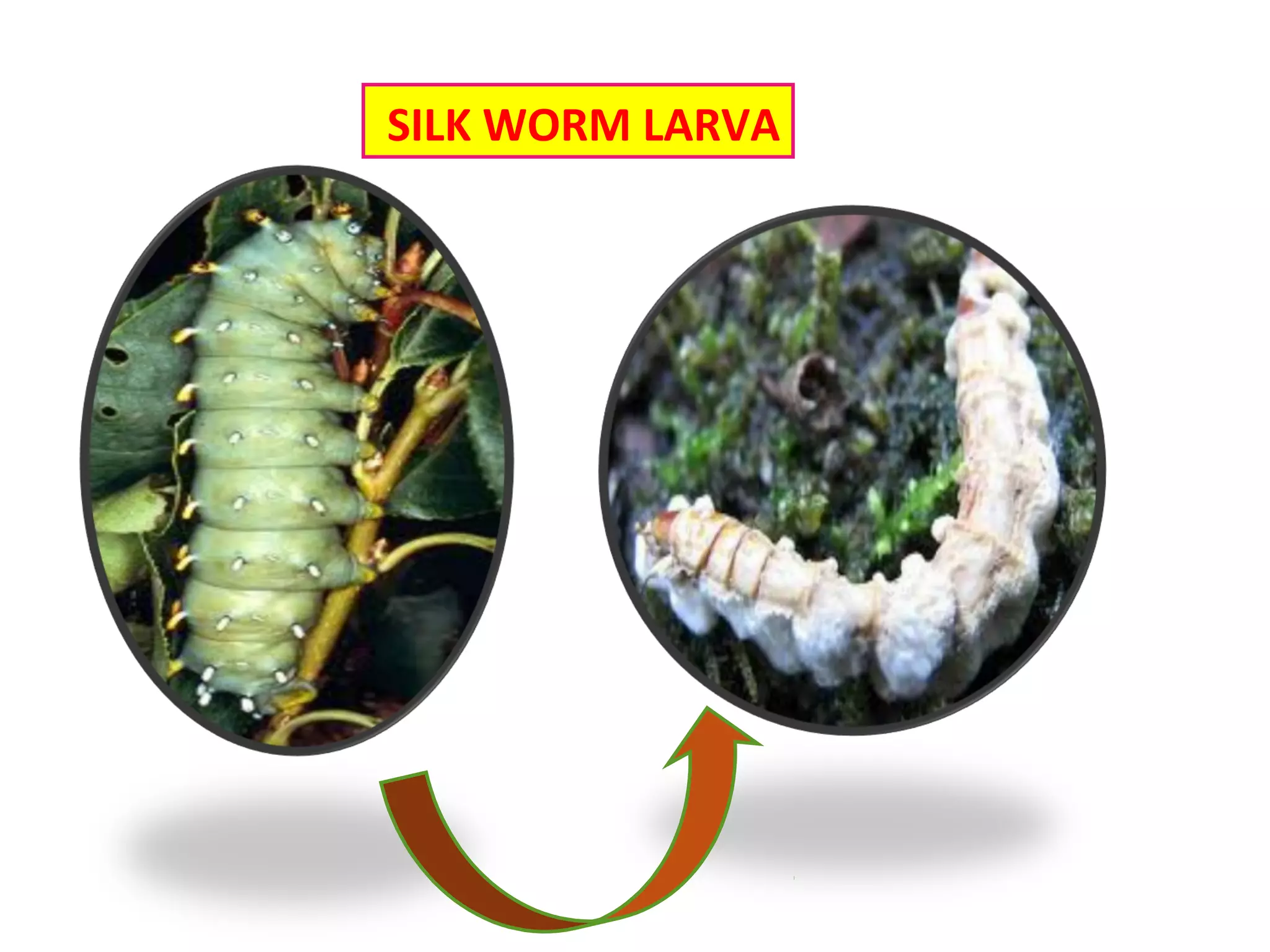
SILK WORM LARVA
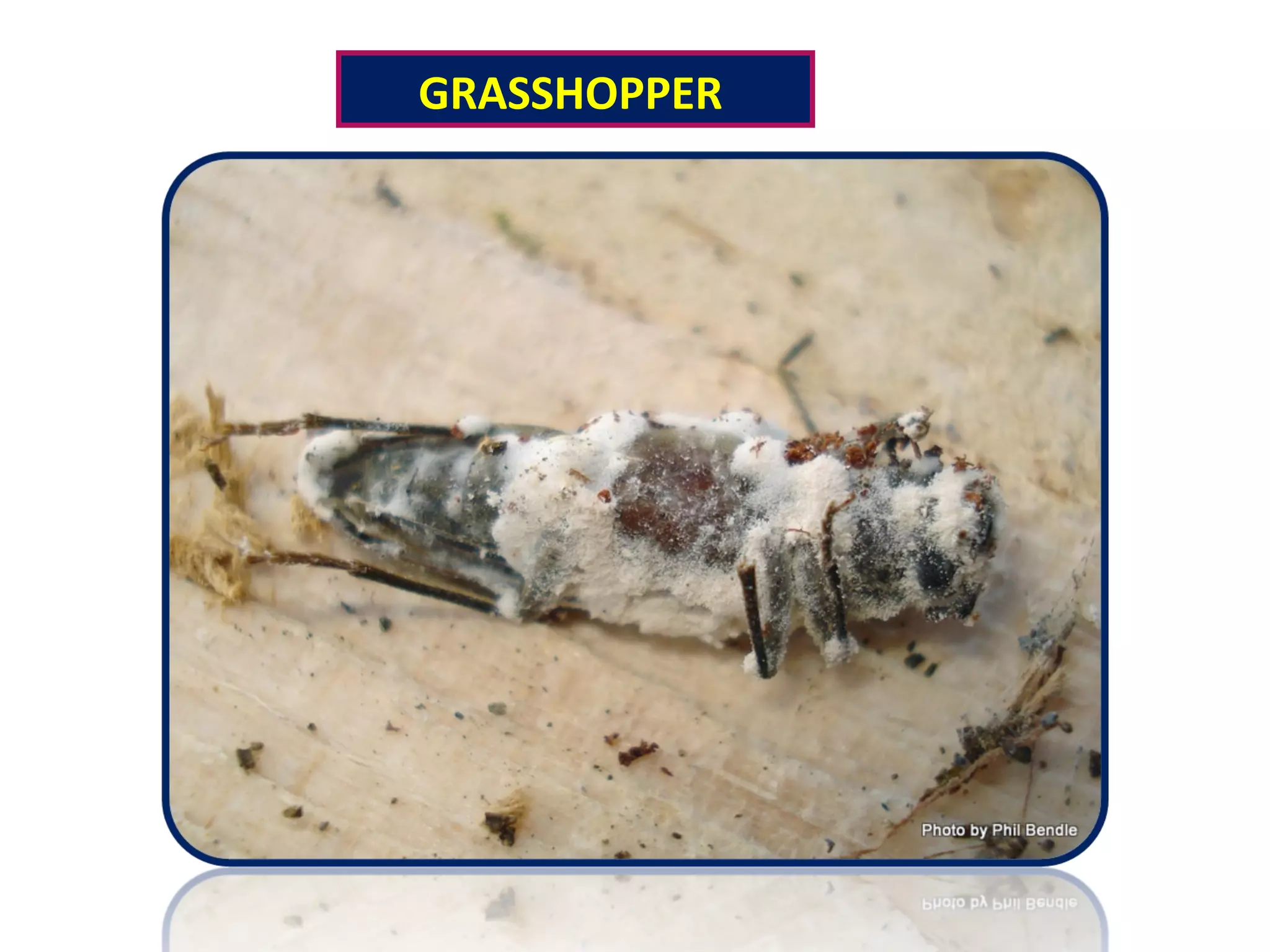
GRASSHOPPER
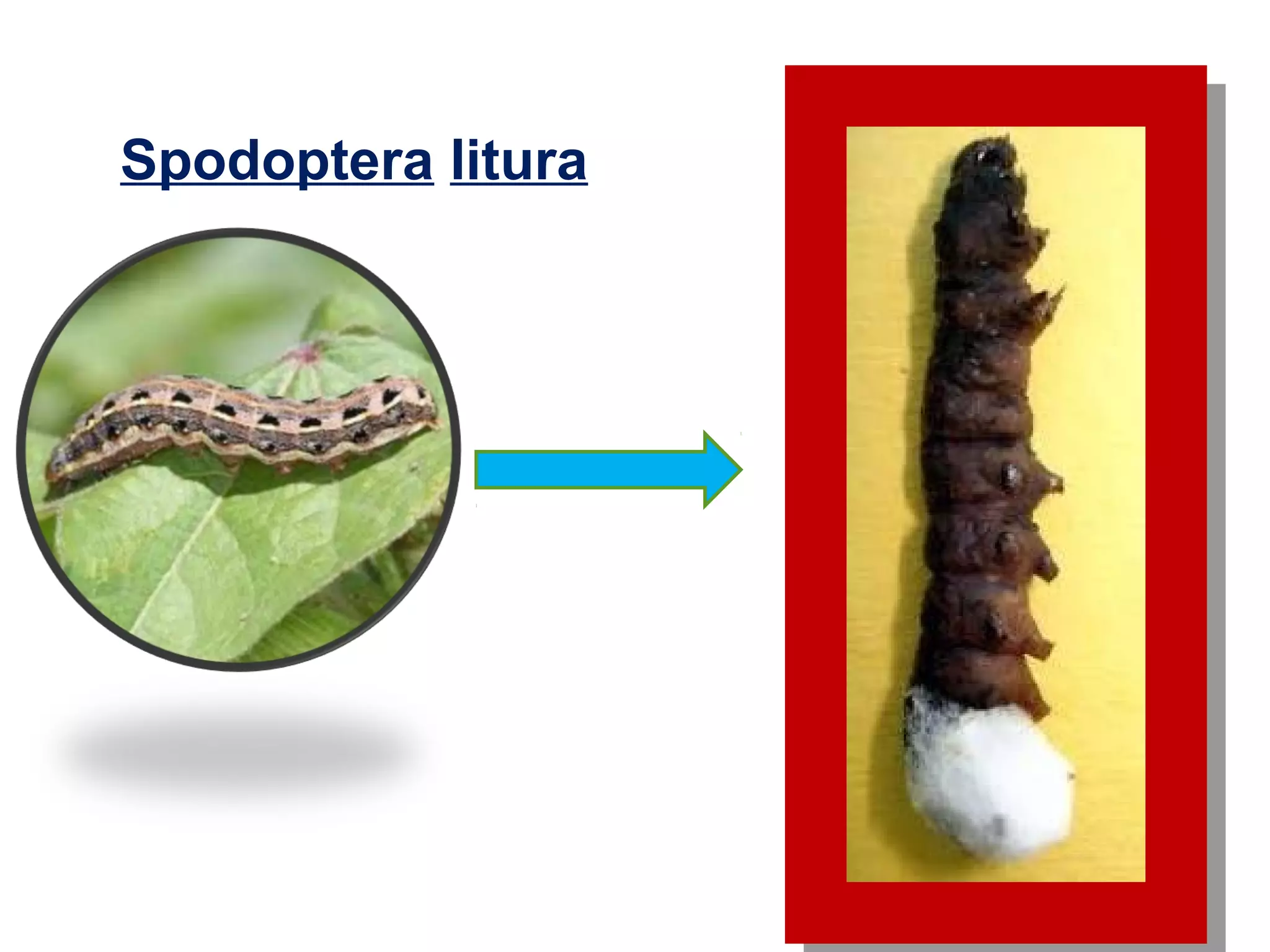
Spodoptera litura
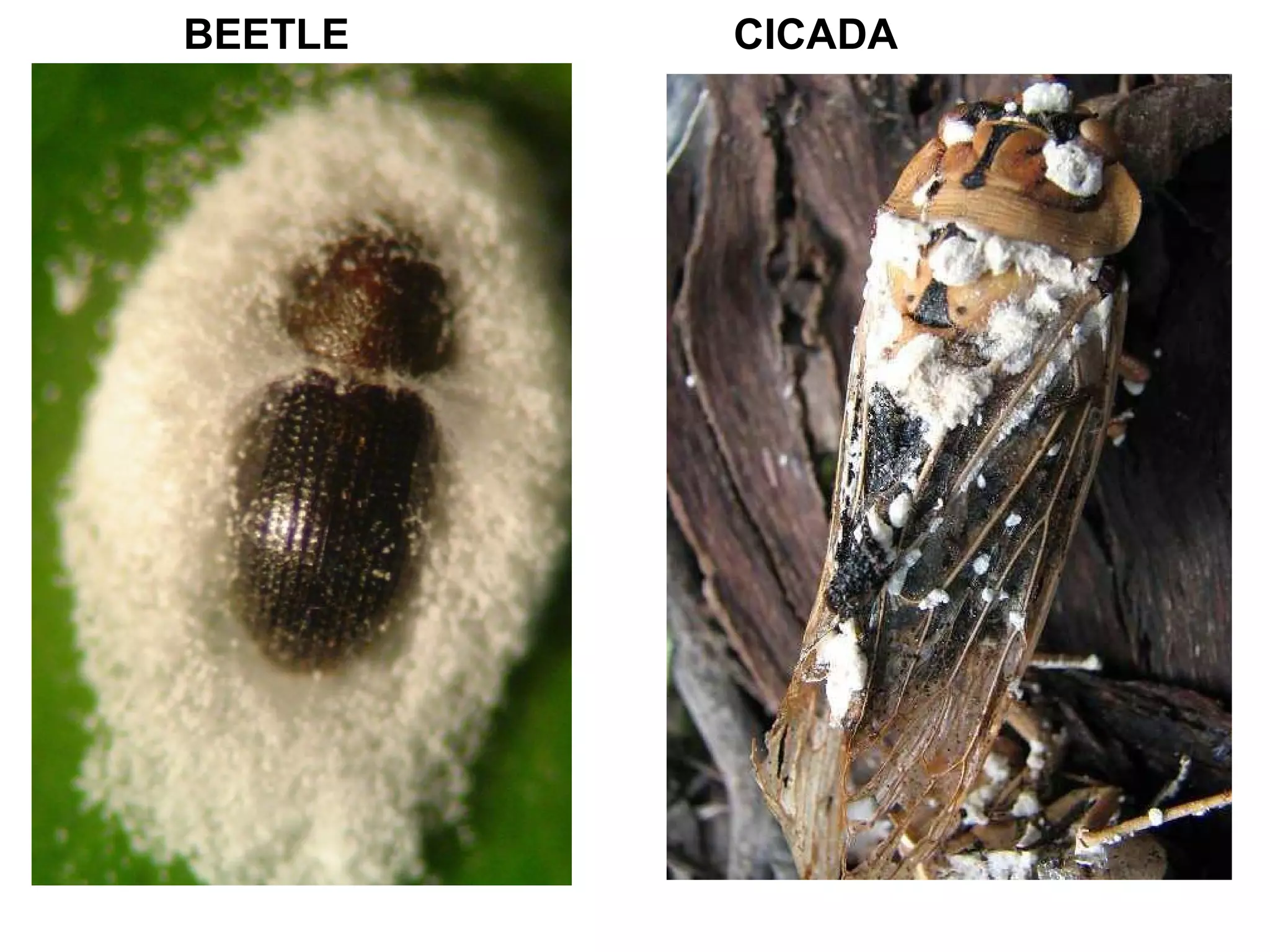
BEETLE CICADA
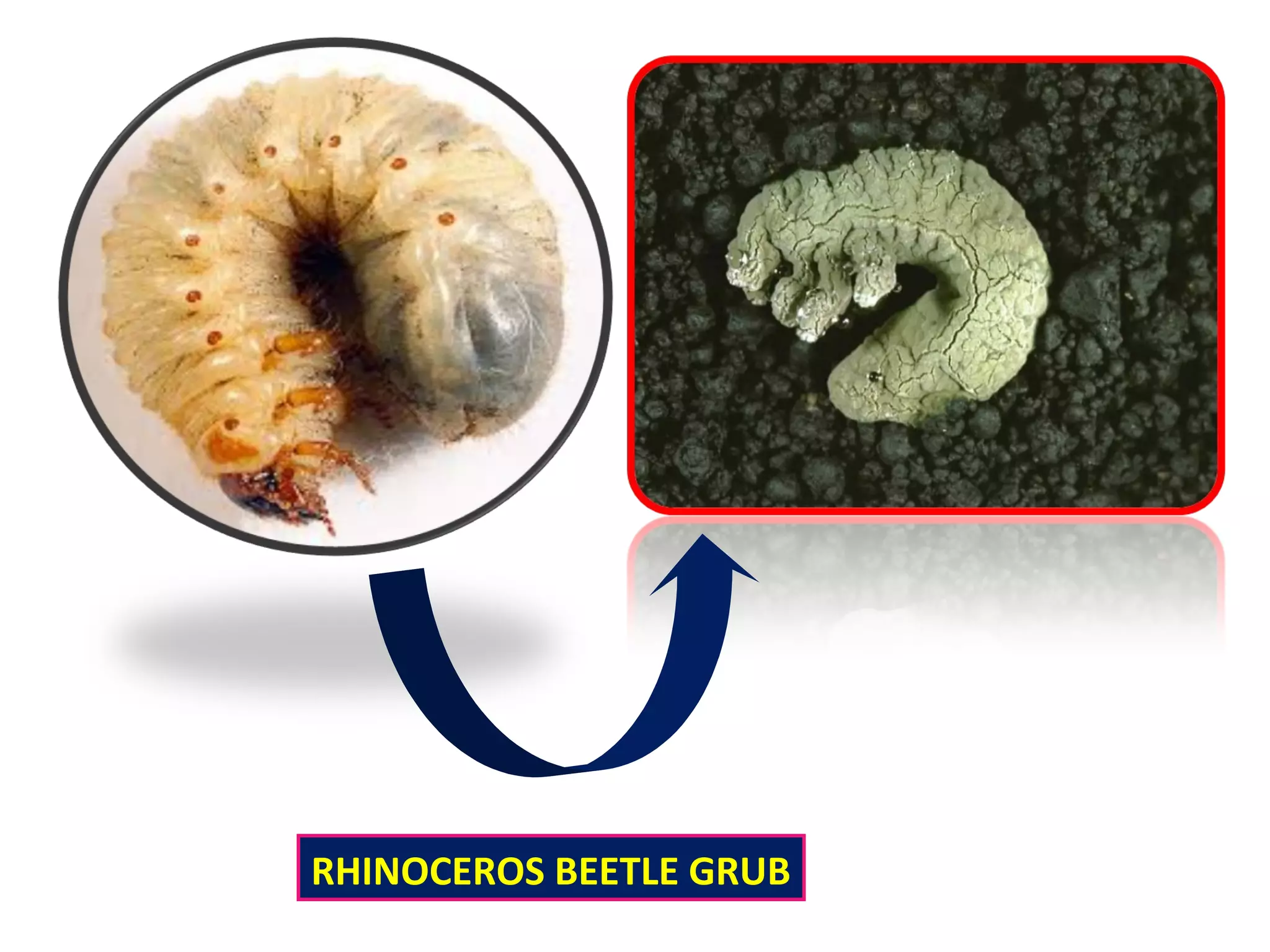
2.Metarhizium anisopliae
MASS PRODUCTION 
40 g of carrot bits in 250 ml of conical flask with 
65 ml of water 
Autoclave at 25psifor 30 minutes 
Cool and inoculate with the fungus 
Fungal can be applied to manure pit after a 
fortnight
FFIIEELLDD RREELLEEAASSEE 
55xx11001111 ssppoorreess// mm33 ooff FFYYMM hhaavvee ttoo 
bbee iinnooccuullaatteedd ttoo aacchhiieevvee 110000%% 
mmoorrttaalliittyy..
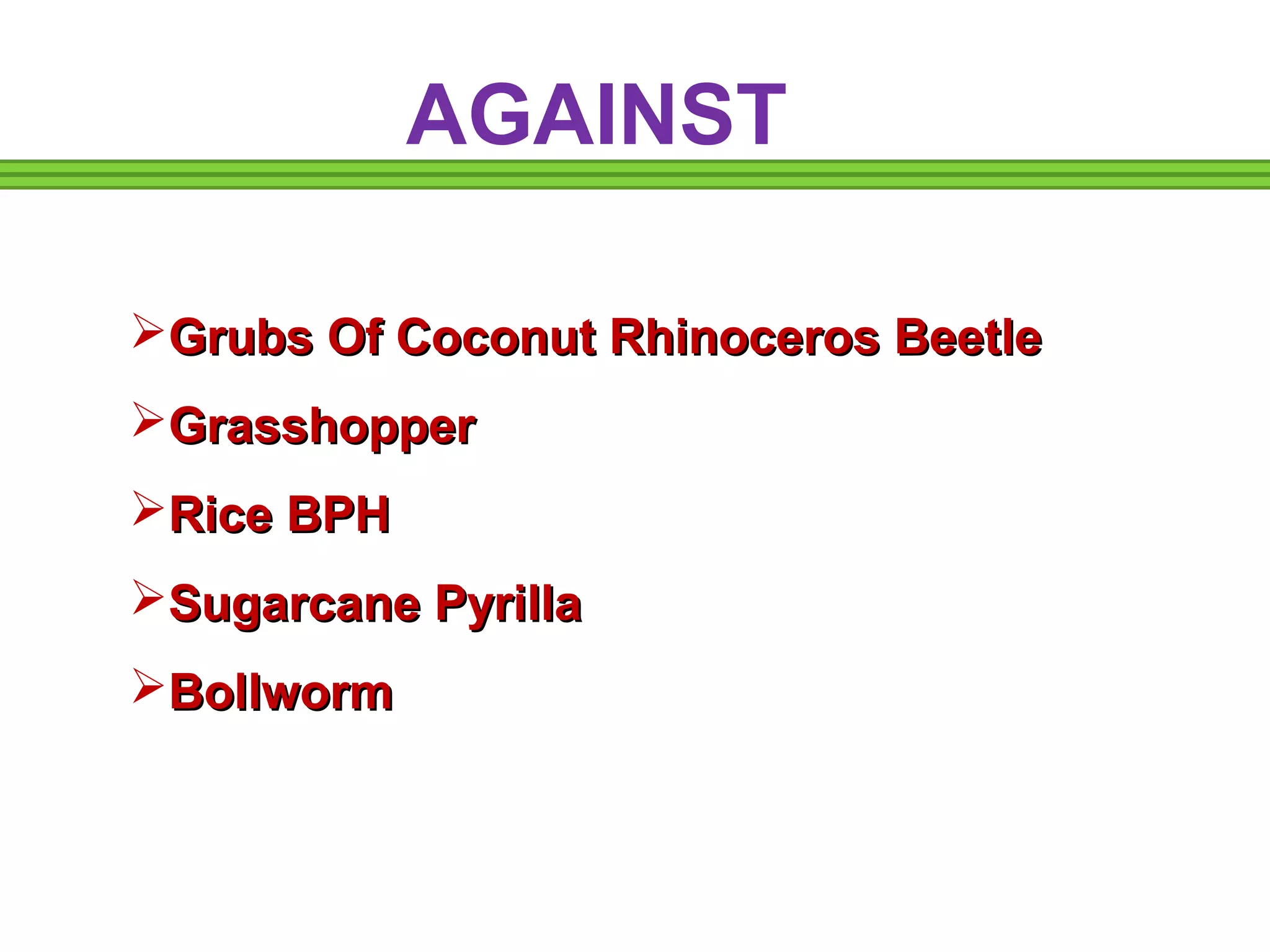
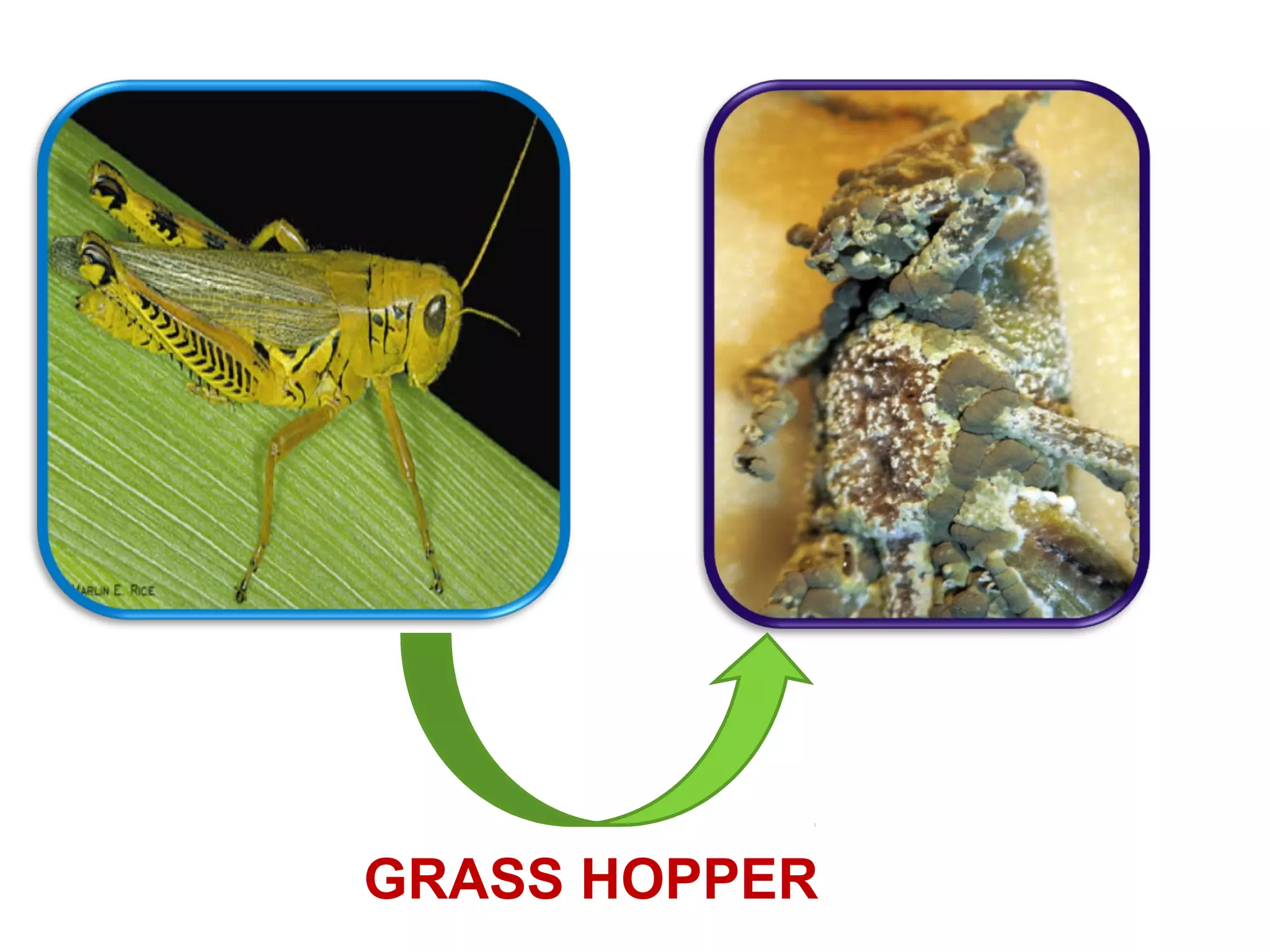
AGAINST 
GGrruubbss OOff CCooccoonnuutt RRhhiinnoocceerrooss BBeeeettllee 
GGrraasssshhooppppeerr 
RRiiccee BBPPHH 
SSuuggaarrccaannee PPyyrriillllaa 
BBoollllwwoorrmm
RHINOCEROS BEETLE GRUB
GRASS HOPPER
RICE BPH
3.Verticillium lecanii
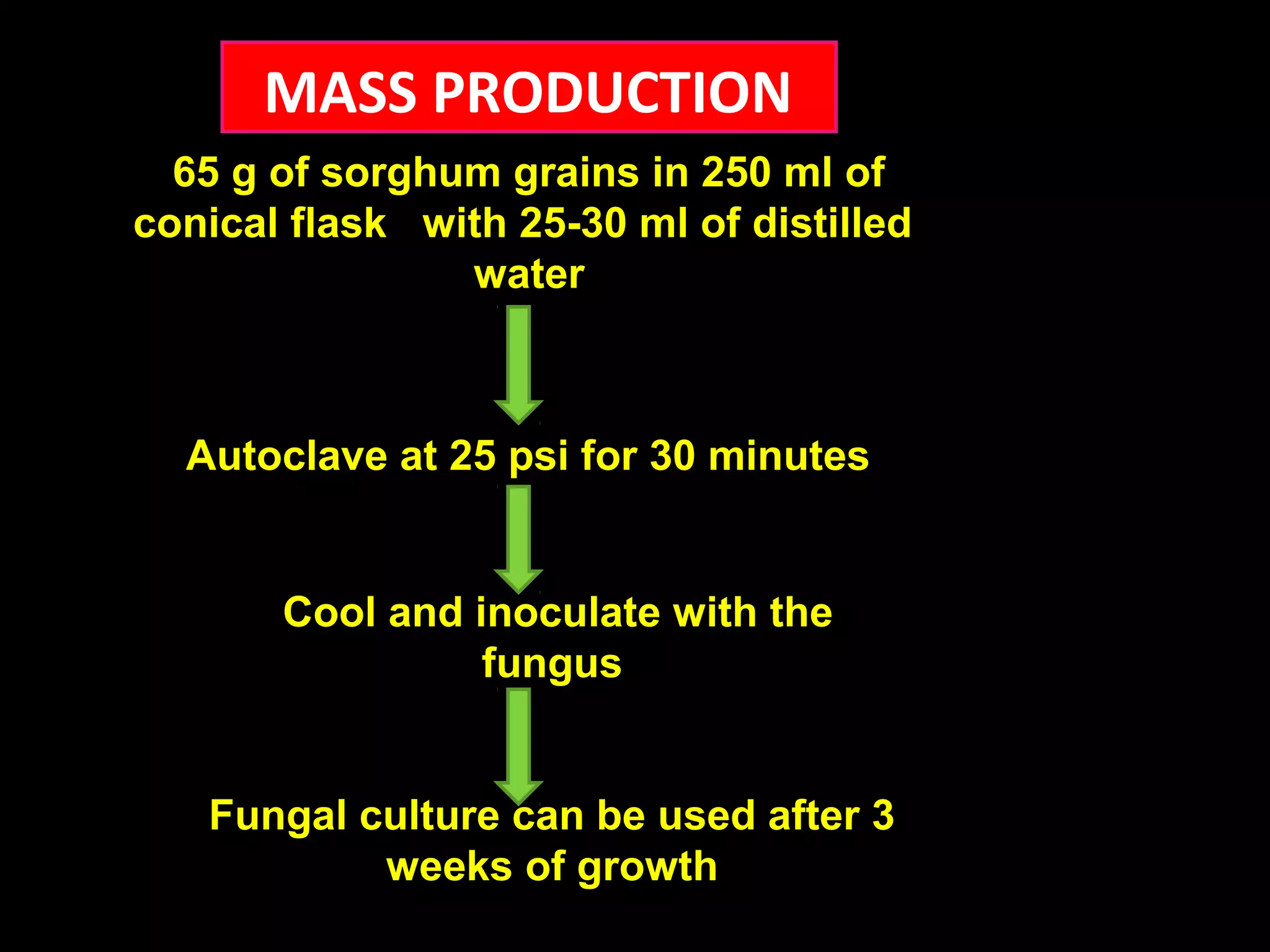
MASS PRODUCTION 
65 g of sorghum grains in 250 ml of 
conical flask with 25-30 ml of distilled 
water 
Autoclave at 25 psi for 30 minutes 
Cool and inoculate with the 
fungus 
Fungal culture can be used after 3 
weeks of growth
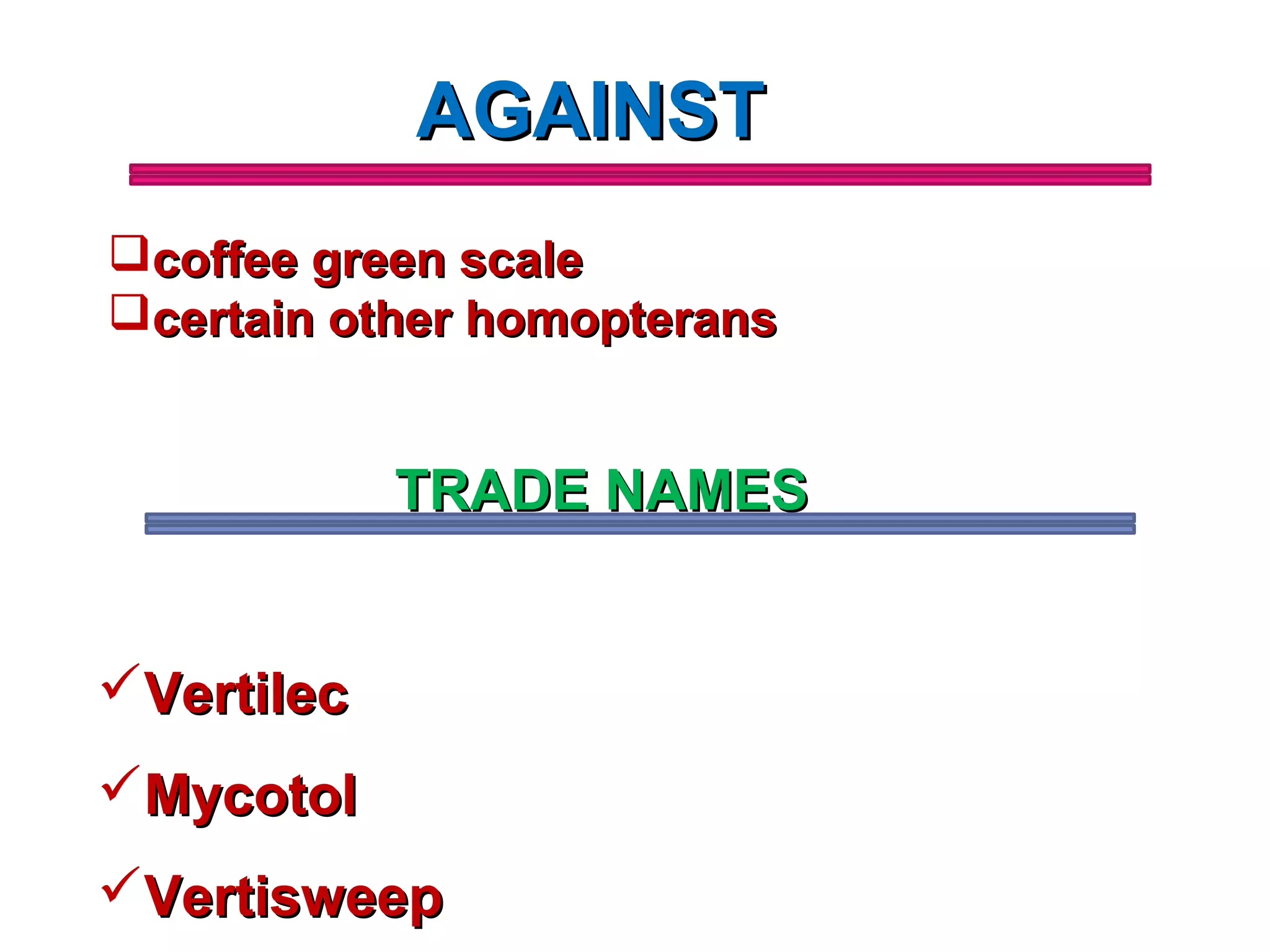
AAGGAAIINNSSTT 
ccooffffeeee ggrreeeenn ssccaallee 
cceerrttaaiinn ootthheerr hhoommoopptteerraannss 
TTRRAADDEE NNAAMMEESS 
VVeerrttiilleecc 
MMyyccoottooll 
VVeerrttiisswweeeepp
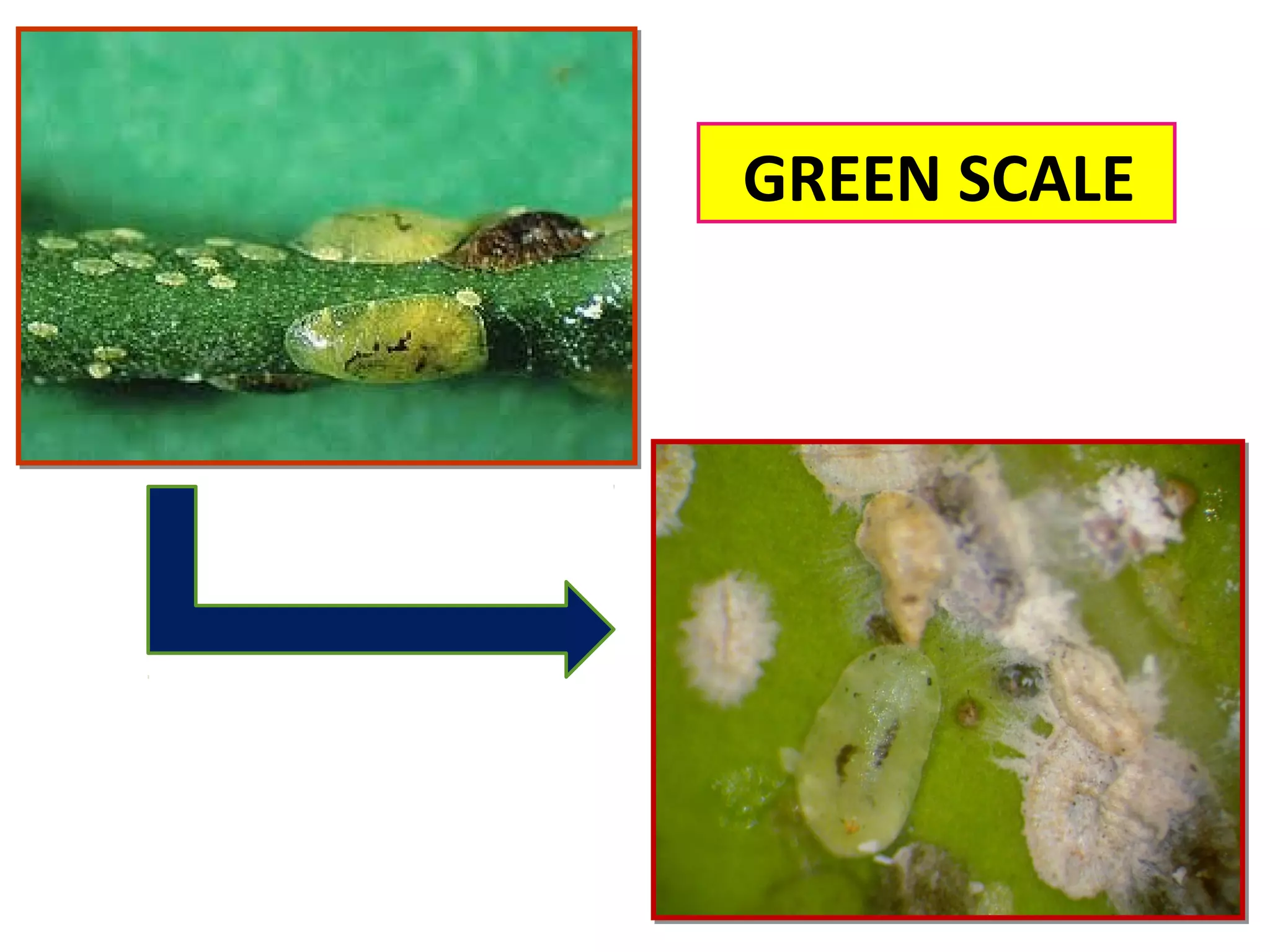
GREEN SCALE
Paecilomyces ffuummoossoorroosseeuuss
PP.. ffuummoossoorroosseeuuss……………………………….. 
Most important natural enemies of whiteflies wwoorrllddwwiiddee,, 
ssiicckknneessss :: ““YYeellllooww MMuussccaarrddiinnee”” .. 
SSttrroonngg eeppiizzoooottiicc ppootteennttiiaall aaggaaiinnsstt BBeemmiissiiaa aanndd TTrriiaalleeuurrooddeess 
sspppp.. iinn bbootthh ggrreeeennhhoouussee aanndd ooppeenn ffiieelldd eennvviirroonnmmeennttss hhaass bbeeeenn 
rreeppoorrtteedd.. 
SSyymmppttoomm:: rroossyy--ttaann ttoo ssmmookkyy--ppiinnkk ((oorr ggrraayy)) ffuunnggaall mmaassss 
PPaaeecciilloommyycceess lliillaacciinnuuss pprriinncciippaallllyy iinnffeeccttss aanndd aassssiimmiillaatteess eeggggss 
ooff rroooott--kknnoott aanndd ccyysstt nneemmaattooddeess
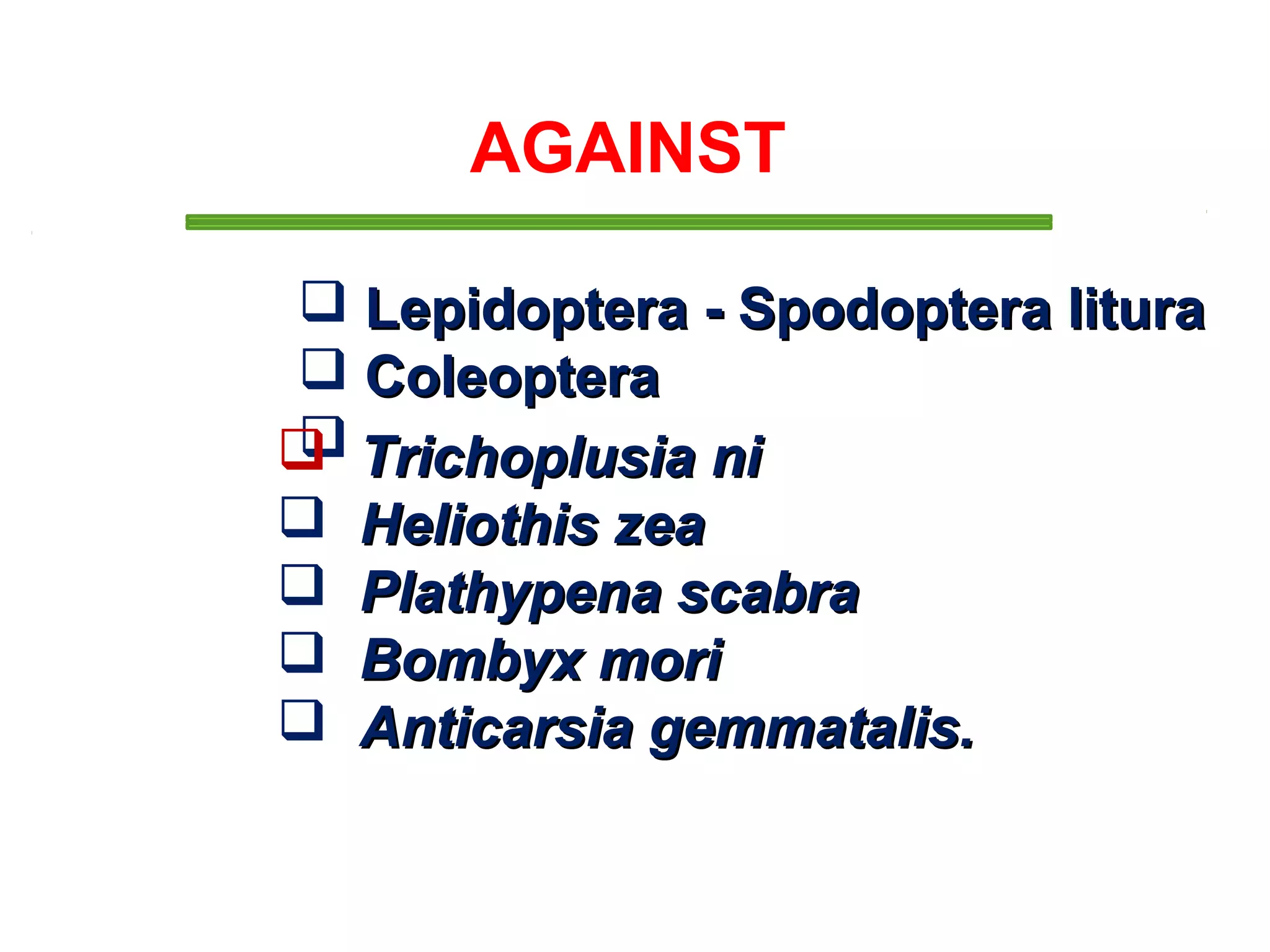
AGAINST 
 Lepidoptera -- SSppooddoopptteerraa lliittuurraa 
 CCoolleeoopptteerraa 
 TTrriicchhoopplluussiiaa nnii 
 HHeelliiootthhiiss zzeeaa 
 PPllaatthhyyppeennaa ssccaabbrraa 
 BBoommbbyyxx mmoorrii 
 AAnnttiiccaarrssiiaa ggeemmmmaattaalliiss..
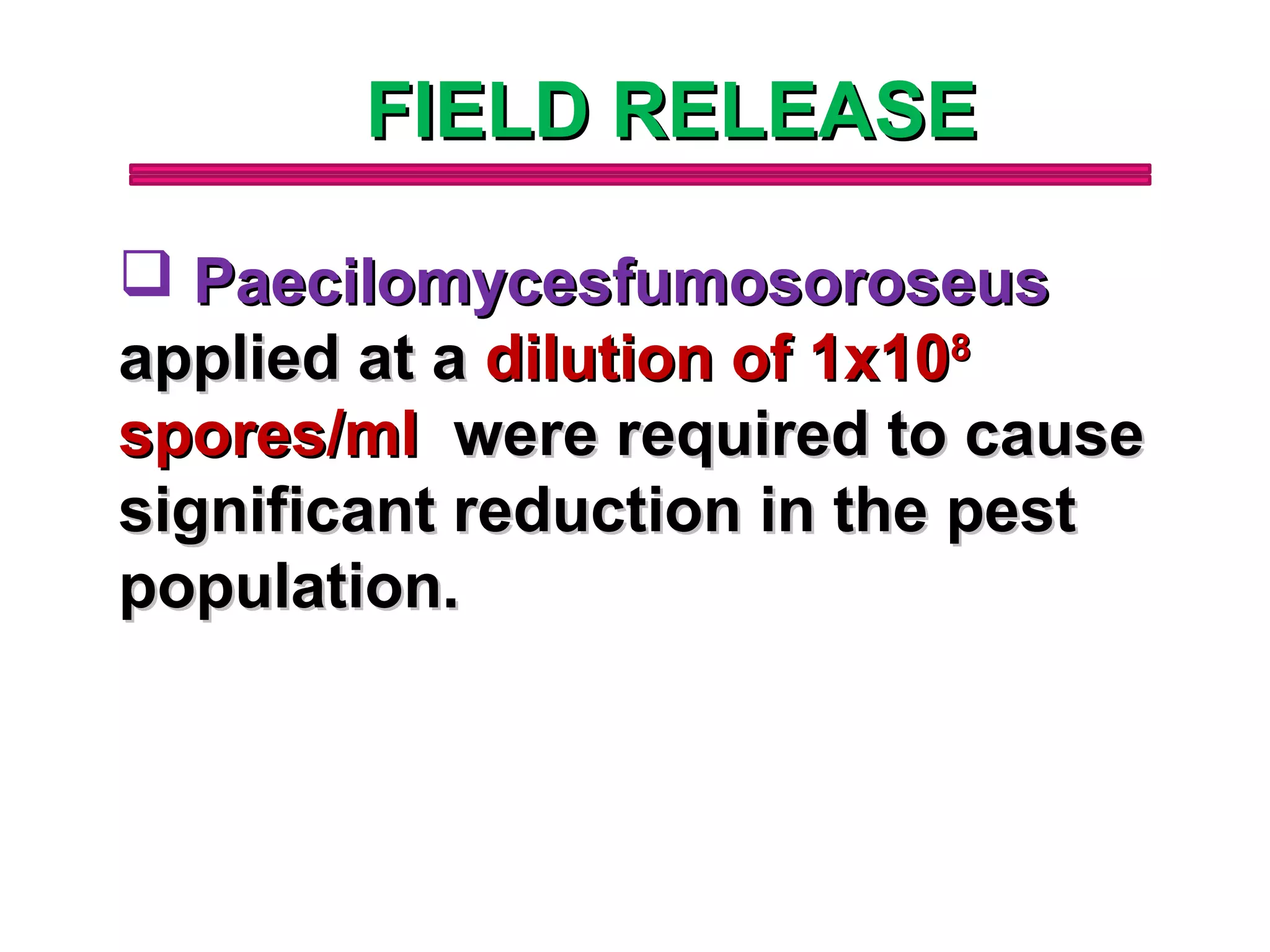
FFIIEELLDD RREELLEEAASSEE 
 PPaaeecciilloommyycceessffuummoossoorroosseeuuss 
aapppplliieedd aatt aa ddiilluuttiioonn ooff 11xx110088 
ssppoorreess//mmll wweerree rreeqquuiirreedd ttoo ccaauussee 
ssiiggnniiffiiccaanntt rreedduuccttiioonn iinn tthhee ppeesstt 
ppooppuullaattiioonn..
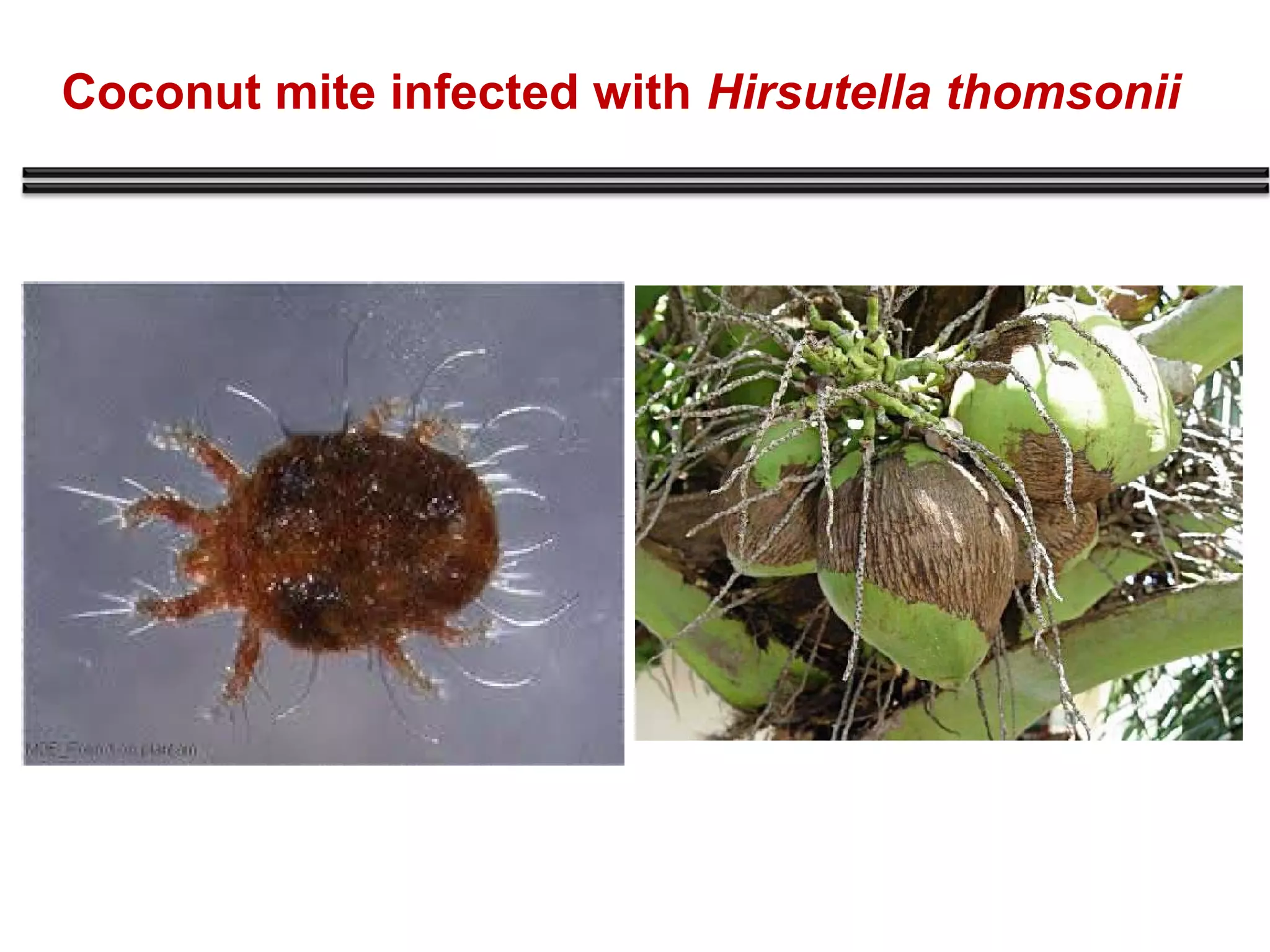
Hirsutella thomsoni 
NOMENCLATURE: Approved name: Hirsutella thompsonii 
SOURCE: Originally isolated from an eriophyid mite in 
TamilNadu. 
TARGET :PESTS: Eriophyid mites, particularly the coconut 
mite (Aceria guerreronis Keifer). 
TARGET :CROPS: Major crop use is in coconut plantations, 
but can be used in palmyrah palm and in arecanut.
AGAINST 
It is specific to the eriophid mites 
1.coconut mite 
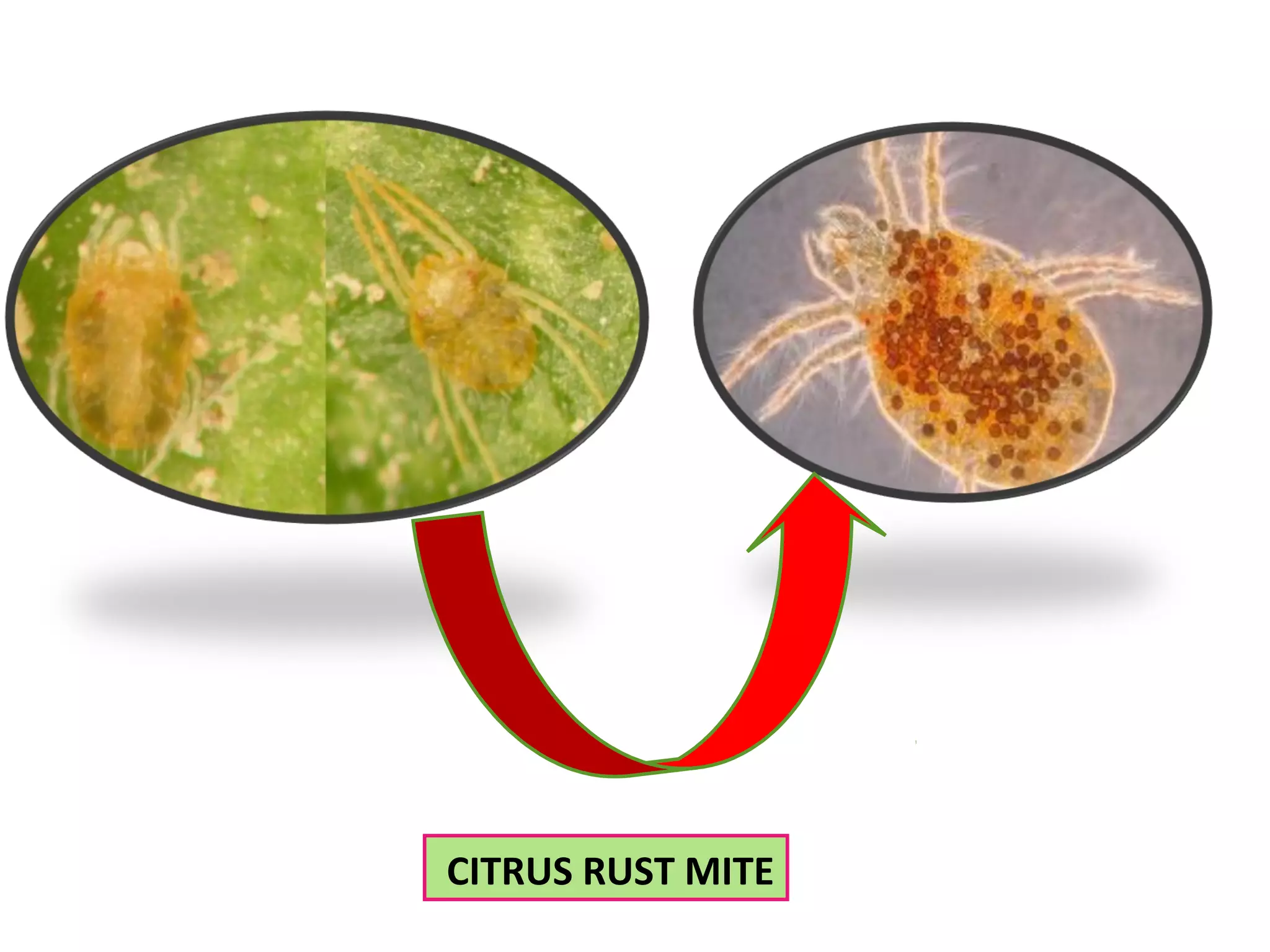
2.Citrus rust mite 
EFFICACY: 
Field investigations conducted in more than 15 
locations to evaluate the performance of ' Mycohit' 
showed that by the 70th day of the experiment 
greater than 90% mortality of the mites was observed 
in coconuts sprayed twice (at 2-week intervals).
ENVIRONMENTAL IMPACT AND NON-TARGET 
TOXICITY: 
Hirsutella thompsonii is widespread in Nature 
It is not pathogenic to non-target species. 
 It not shown adverse effects on the 
environment 
Sold as a talc-based formulation coded 
Formulation-moisture content of about 
12%. 
Tradenames: ' Mycohit' .
CITRUS RUST MITE
Coconut mite infected with Hirsutella thomsonii
ADVANTAGES 
 Nontoxic 
 Nonpathogenic 
 Specific 
 No residual toxicity 
Can also applied at harvest stage
 No imDmeIdSiaAteD aVctiAonN TAGES 
 Only effective to a specific group of 
insects 
 Each application may control part of the 
insect pests 
 If the other species may present they 
may continue to cause damage
CONTRIBUTION TO FARMING SOCIETY 
TNAU a biopesticide formulation based on 
fusarium sp isolated from the dead mite has 
been released by TNAU under the brand name 
TNAU-AGROBIOCIDE to control mite 
Menace in coconut
DIAGNOSIS OF FUNGI 
Need of diagnosis of fungi: 
Sometimes we may indistinguish between the two 
fungal pathogens there by we canot diagnosis the 
correct entomopathogenic fungi for the responsible 
disease in insect 
The actual cause of many diseases is difficult to 
determine. Although many organisms can be isolated 
from a diseased organisms tissue, their presence does 
not prove that any or all of them caused the disease due 
to the fact that the isolated microbe may be part of the 
normal flora or transient flora of that area or a secondary
DIAGNOSIS OF FUNG………………………………. 
The pioneering GERMAN microbiologist, 
ROBERT KOCH, identified a set of four 
conditions which has to be satisfied to 
establish that a particular organism is the 
causative agent of a particular disease. 
These conditions known as Koch's 
postulates are:
1. The suspected pathogen must be found 
associated with the disease in all the diseased 
insects examined. 
2. The organism must be isolated from the 
diseased insect tissue and grown in pure 
culture on nutrient media and its characteristics 
described obligate or non obligate , and its 
appearance and effects recorded. 
. 
Koch's postulates
Koch's 
postulates……………. 
3. When a healthy insect of the same species is 
inoculated with this culture, it must produce the 
disease and show the characteristic symptoms 
4.The organism must be re-isolated from the 
inoculated plants and must be known to be the same 
pathogen as the original. If all the above steps have 
been followed and proved true, then the isolated 
pathogen is identified as the organism responsible for 
the disease 3. When a healthy insect of the same 
species is inoculated with this culture, it must 
produce the disease and show the characteristic 
symptoms.
Who is father of insect pathology ?
REFERENCES 
BOOKS: 
*PRINCIPLES OF INSECT PATHOLOGY 
Dr. STEINHAUS 
1.APPLED ENTOMOLOGY –D.S.REDDY 
2.INTEGRATED PEST MANAGEMENT –G.S.DHALIWAL ,R.ARORA 
3.PRINCIPLES OF APPLIED ENTOMOLOGY-K.N.RAGUMOORTHI, 
M.R.SRINIVASAN, 
V. BALASUBRAMANI, 
N. NATARAJAN 
4.ELEMENTS OF ECONOMIC ENTOMOLGY-B. 
VASANTHARAJ DAVID 
V.V.RAMANAMURTHY 
INTERNET: 
WWW.WIKIPEDIA.IN 
WWW.Dr.REDDYS LABORATORIES.com 
WWW.NBAII.IN.
Thanks a lot my course incharge 
Dr . DHANDAPANI and my 
friends 
Presented by 
S. Srinivas 
naik 
13-503

ENTOMOPATHOGENIC FUNGI

  • 1.
  • 2.
    FUNGAL PATHOGENS FUNGALPATHOGENS SSNAIK M.Sc.Scholar TNAU,COIMBATORE
  • 3.
  • 4.
    MICROBIAL CONTROL “Microbialcontrol refers to the exploitation of diseases causing organisms to reduce the population of insect pests below the economic injury level ” Microorganisms
  • 5.
    INFECTIOUS AGENT DISEASESOR ILLNESS DEVIATION FROM NORMAL PHYSIOLOGICAL PROCESS
  • 6.
    FUNGAL PATHOGEN –PLANT–HARMFUL R U S T P A T H O G E N
  • 7.
    FUNGAL- PATHOGEN –INSECT–BENEFICIAL FUNGUS PARASITE INSECTS KILLS OR SERIOUSLY DISABLES
  • 8.
    ENTOMOPATHOGEN-etymology GGrreeeekk WWoorrddss ““mmiiccrroooorrggaanniissmmss wwhhiicchh aarriissee iinn iinnsseeccttss..””
  • 9.
    Is Entompathogen onlybelongs to fungi?
  • 10.
  • 11.
    2.ENTOMO PATHOGENIC FUNGI .Entomon: an insect .Pathogen: which causes disease .Fungi: micro fungal organism
  • 12.
    INTRODUCTION  FFIIRRSSTTffoouunndd ppaatthhooggeennss  DDiisseeaassee -- MMYYCCOOSSEESS  775500/110000--ssppeecciieess  AAttttrraaccttiivvee aalltteerrnnaattiivvee--cchheemmiiccaall ppeessttiicciiddeess.. LLeessss ddaammaaggee ttoo tthhee eennvviirroonnmmeenntt..
  • 13.
    The place ofbiopesticides in agriculture
  • 14.
    Current status ofbiopesticides I (Seema Wahab, 2010) II
  • 15.
  • 17.
    CLASSIFICATION OF ENTOMOPATHOGENICFUNGI 1.ASCOMycetes –CORDYCEPS 2.BASIDIOMYCETES-SEPTOBASIDIUM 33..DDEEUUTTRROOMMYYCCeetteess -- AAsscchheerroossoonniiaa BBeeaauuvveerriiaa CCuulliinnoommyycceess HHiirrssuutteellllaa tthhoommppssoonniiii HH.. lloonnggiiccoollllaa MMeettaarrhhiizziiuumm NNoommuurraaeeaa PPaaeecciilloommyycceess VVeerrttiicciilllliiuumm 44..PPHHYYCCOOMMYYCCEETTEESS-- CCooeelloommoommyycceess • EEnnttoommoopphhtthhoorraa
  • 19.
    S.n o. FUNGITARGET PEST 1 Beauveria bassiana Cottonbollworms,Coffeeberryborer (Coleoptera,Lepidoptera,Hemiptera and few in Diptera ,Hymenoptera) 2 Paecilomyces fumosoroseus Lepidoptera,thysanoptera 3 Metarrhizium ansipoliae Sugarcanepyrilla,rhinocerosbeetle (Coleoptera,Lepidoptera,Hemiptera,Dipter a and Hymenoptera) 4 Verticillium lecanii Whiteflies,aphids and scales 5 Nomouraea rileyi H.armigera,Achaea janata,S.litura (Lepidoptera) 6 Aschersonia aleuroides White fly(Homoptera) 7 Hirsutella thompsoni Phytophagous mites(Eriophid mites) 8 Pandora delphacis BPH,GLh of rice
  • 20.
    S.N O. ………….. YEAR SCIENTIST AND CONTRIBUTION 01 2700BC CHINESE PEOPLE RECOGNISE DISEASES OF HONEY BEE AND SILKWORM 02 ANCIENT TIME INDIAN LITERATURE REFERS THE DISEASES OF SAME INSECTS 03 SAME TIME IN EUROPE ARISTOTLE WAS THE FIRST PERSON MENTION ABOUT THE DISEASES OF HONEY BEES 04 1835 AGOSTINO BESSI EXPERIMENT ON SILK WORM DISEASE 05 1879 E.METSCHINIKOFF(1879) EXPERIMENT CONTROL OF WHEAT COCKCHAFER(ANISOPLIA AUSTRIACEA) ,SUGARBEET WEEIL( CLEOMUS PUNCTIVENTRIS)
  • 21.
    4. MODE OFACTION
  • 22.
    MODE OF ACTION: Attachment Germination FAVOURABLE CONDITIONS HIGH HUMIDITY, LOW TEMPERATURE
  • 23.
    Mode of action……………….. Penetration Proliferate Killing Favorable conditions New propagules (spores)
  • 24.
  • 26.
  • 27.
    TOXINS: A substancewhich kills an organism 1.Catobolic toxins: result from decomposition brought about by the activity of the pathogen eg:breakdpwn of the proteins ,carbohydrates etc. 2.Anabolic toxins:substances synthesized by the pathogen 3.Endo toxins : toxins that are produced by the pathogen and are confined to the cell and are liberated when the pathogen dies or disintegrates eg; bt endo toxins 4.Ectotoxins:they are excreted or passed out of the cell of the pathogen eg; some bacteria and fungi produce exo or ecto toxins
  • 28.
    ENTOMOPATHOGENIC TOXINS 1.Metarhiziumanisopliae Destruxin A , B,C,D,E,F 2.Paecilomyces Beauvericin 3.Beauveria bassiana Beauvericin Beauverolides Bassinolide 4.Verticilium lecanii Bassinolide ECTOTOXINS
  • 29.
    Beauveria bassiana Metarhiziumanisopliae Verticillium lecanii 1.yellow to brown spots on the integument 2.swelling of posterior abdominal segments 3.covered with pale green spores SYMPTOMS Nomouraea rileyi
  • 30.
  • 31.
    FOR SUCCESSFUL COMMERCIALPRODUCTION AND USE OF ENTOMOPATHOGENIC FUNGI AS MYCOINSECTICIDES ARE:
  • 32.
    Rapid growth 1.FUNGALISOLATE High pathogenesis To target pests Sporulate profusely Cheap 2.MEDIUM Easily available
  • 33.
    3.The production procedure Easy Production cost low 4.Formulation Long shelf life No loss of infectivity and variability-12-18 months
  • 34.
  • 35.
    B.bessiana…………. CCllaassss:: DDeeuutteerroommyycceettee((IImmppeerrffeecctt FFuunnggii)).. TThhee ssppeecciieess iiss nnaammeedd aafftteerr tthhee IIttaalliiaann eennttoommoollooggiisstt AAggoossttiinnoo BBaassssii DDiissccoovveerryy:: iinn 11883355 aass ccaauussee ooff tthhee MMuussccaarrddiinnee DDiisseeaassee OOff DDoommeessttiiccaatteedd SSiillkkwwoorrmmss .. IItt ccaauussiinngg wwhhiittee mmuussccaarrddiinnee ddiisseeaassee TTooxxiinn PPrroodduucceedd –– BBeeaauuvveerriicciinn,,BBaassssiiaannoolliiddee,, IIssaarroolliiddeess,, aanndd BBeeaauuvveerroolliiddeess nnaattuurraallllyy iinn ssooiillss aaccttss aass aa ppaarraassiittee oonn vvaarriioouuss aarrtthhrrooppooddss
  • 36.
    MASS PRODUCTION 200g of grains in 250 g polypropalyne bags or bottles with 190 ml of water Sterilization at 120o C for 45 minutes Cool and inoculate with the 5 ml fungus spore suspention bags incubate at 25o C for 25 days Air dried under laminar air flow 3 days at 40o C ground to fine mixture
  • 37.
    FFIIEELLDD RREELLEEAASSEE mmeetthhoodd:: SSpprraayyiinngg EEmmuullssiiffiieedd SSuussppeennssiioonn WWeettttaabbllee PPoowwddeerr.. DDoossaaggee:: 11..SSppoorreess aatt 11..55kkgg//hhaa ((3300xx110099 ccoonniiddiiaa//gg)) ++ 22.. CChhlloorroopphhooss @@ LLooww ddoossee iiss ffoouunnddeedd ggoooodd ffoorr rreedduucciinngg tthhee ppeesstt TTrraaddee nnaammeess BBoottaanniiggaarrdd®EESS  BBoottaanniiggaarrdd®2222WWPP NNaattuurraalliiss MMyyccoottrrooll
  • 38.
    AAGGAAIINNSSTT TTeerrmmiitteess TThhrriippss  WWhhiitteefflliieess AApphhiiddss GGrraasssshhooppppeerrss BBeeeettlleess CCaatteerrppiillllaarrss SSiillkkwwoorrmmss IIttss uussee iinn tthhee CCoonnttrrooll OOff MMaallaarriiaa -- TTrraannssmmiittttiinngg MMoossqquuiittooss iiss uunnddeerr iinnvveessttiiggaattiioonn..
  • 39.
  • 40.
  • 41.
  • 42.
  • 43.
  • 44.
    MASS PRODUCTION 40g of carrot bits in 250 ml of conical flask with 65 ml of water Autoclave at 25psifor 30 minutes Cool and inoculate with the fungus Fungal can be applied to manure pit after a fortnight
  • 45.
    FFIIEELLDD RREELLEEAASSEE 55xx11001111ssppoorreess// mm33 ooff FFYYMM hhaavvee ttoo bbee iinnooccuullaatteedd ttoo aacchhiieevvee 110000%% mmoorrttaalliittyy..
  • 46.
    AGAINST GGrruubbss OOffCCooccoonnuutt RRhhiinnoocceerrooss BBeeeettllee GGrraasssshhooppppeerr RRiiccee BBPPHH SSuuggaarrccaannee PPyyrriillllaa BBoollllwwoorrmm
  • 47.
  • 48.
  • 49.
  • 50.
  • 51.
    MASS PRODUCTION 65g of sorghum grains in 250 ml of conical flask with 25-30 ml of distilled water Autoclave at 25 psi for 30 minutes Cool and inoculate with the fungus Fungal culture can be used after 3 weeks of growth
  • 52.
    AAGGAAIINNSSTT ccooffffeeee ggrreeeennssccaallee cceerrttaaiinn ootthheerr hhoommoopptteerraannss TTRRAADDEE NNAAMMEESS VVeerrttiilleecc MMyyccoottooll VVeerrttiisswweeeepp
  • 53.
  • 54.
  • 55.
    PP.. ffuummoossoorroosseeuuss……………………………….. Mostimportant natural enemies of whiteflies wwoorrllddwwiiddee,, ssiicckknneessss :: ““YYeellllooww MMuussccaarrddiinnee”” .. SSttrroonngg eeppiizzoooottiicc ppootteennttiiaall aaggaaiinnsstt BBeemmiissiiaa aanndd TTrriiaalleeuurrooddeess sspppp.. iinn bbootthh ggrreeeennhhoouussee aanndd ooppeenn ffiieelldd eennvviirroonnmmeennttss hhaass bbeeeenn rreeppoorrtteedd.. SSyymmppttoomm:: rroossyy--ttaann ttoo ssmmookkyy--ppiinnkk ((oorr ggrraayy)) ffuunnggaall mmaassss PPaaeecciilloommyycceess lliillaacciinnuuss pprriinncciippaallllyy iinnffeeccttss aanndd aassssiimmiillaatteess eeggggss ooff rroooott--kknnoott aanndd ccyysstt nneemmaattooddeess
  • 56.
    AGAINST  Lepidoptera-- SSppooddoopptteerraa lliittuurraa  CCoolleeoopptteerraa  TTrriicchhoopplluussiiaa nnii  HHeelliiootthhiiss zzeeaa  PPllaatthhyyppeennaa ssccaabbrraa  BBoommbbyyxx mmoorrii  AAnnttiiccaarrssiiaa ggeemmmmaattaalliiss..
  • 57.
    FFIIEELLDD RREELLEEAASSEE PPaaeecciilloommyycceessffuummoossoorroosseeuuss aapppplliieedd aatt aa ddiilluuttiioonn ooff 11xx110088 ssppoorreess//mmll wweerree rreeqquuiirreedd ttoo ccaauussee ssiiggnniiffiiccaanntt rreedduuccttiioonn iinn tthhee ppeesstt ppooppuullaattiioonn..
  • 58.
    Hirsutella thomsoni NOMENCLATURE:Approved name: Hirsutella thompsonii SOURCE: Originally isolated from an eriophyid mite in TamilNadu. TARGET :PESTS: Eriophyid mites, particularly the coconut mite (Aceria guerreronis Keifer). TARGET :CROPS: Major crop use is in coconut plantations, but can be used in palmyrah palm and in arecanut.
  • 59.
    AGAINST It isspecific to the eriophid mites 1.coconut mite 2.Citrus rust mite EFFICACY: Field investigations conducted in more than 15 locations to evaluate the performance of ' Mycohit' showed that by the 70th day of the experiment greater than 90% mortality of the mites was observed in coconuts sprayed twice (at 2-week intervals).
  • 60.
    ENVIRONMENTAL IMPACT ANDNON-TARGET TOXICITY: Hirsutella thompsonii is widespread in Nature It is not pathogenic to non-target species.  It not shown adverse effects on the environment Sold as a talc-based formulation coded Formulation-moisture content of about 12%. Tradenames: ' Mycohit' .
  • 61.
  • 62.
    Coconut mite infectedwith Hirsutella thomsonii
  • 63.
    ADVANTAGES  Nontoxic  Nonpathogenic  Specific  No residual toxicity Can also applied at harvest stage
  • 64.
     No imDmeIdSiaAteDaVctiAonN TAGES  Only effective to a specific group of insects  Each application may control part of the insect pests  If the other species may present they may continue to cause damage
  • 65.
    CONTRIBUTION TO FARMINGSOCIETY TNAU a biopesticide formulation based on fusarium sp isolated from the dead mite has been released by TNAU under the brand name TNAU-AGROBIOCIDE to control mite Menace in coconut
  • 66.
    DIAGNOSIS OF FUNGI Need of diagnosis of fungi: Sometimes we may indistinguish between the two fungal pathogens there by we canot diagnosis the correct entomopathogenic fungi for the responsible disease in insect The actual cause of many diseases is difficult to determine. Although many organisms can be isolated from a diseased organisms tissue, their presence does not prove that any or all of them caused the disease due to the fact that the isolated microbe may be part of the normal flora or transient flora of that area or a secondary
  • 67.
    DIAGNOSIS OF FUNG………………………………. The pioneering GERMAN microbiologist, ROBERT KOCH, identified a set of four conditions which has to be satisfied to establish that a particular organism is the causative agent of a particular disease. These conditions known as Koch's postulates are:
  • 68.
    1. The suspectedpathogen must be found associated with the disease in all the diseased insects examined. 2. The organism must be isolated from the diseased insect tissue and grown in pure culture on nutrient media and its characteristics described obligate or non obligate , and its appearance and effects recorded. . Koch's postulates
  • 69.
    Koch's postulates……………. 3.When a healthy insect of the same species is inoculated with this culture, it must produce the disease and show the characteristic symptoms 4.The organism must be re-isolated from the inoculated plants and must be known to be the same pathogen as the original. If all the above steps have been followed and proved true, then the isolated pathogen is identified as the organism responsible for the disease 3. When a healthy insect of the same species is inoculated with this culture, it must produce the disease and show the characteristic symptoms.
  • 70.
    Who is fatherof insect pathology ?
  • 71.
    REFERENCES BOOKS: *PRINCIPLESOF INSECT PATHOLOGY Dr. STEINHAUS 1.APPLED ENTOMOLOGY –D.S.REDDY 2.INTEGRATED PEST MANAGEMENT –G.S.DHALIWAL ,R.ARORA 3.PRINCIPLES OF APPLIED ENTOMOLOGY-K.N.RAGUMOORTHI, M.R.SRINIVASAN, V. BALASUBRAMANI, N. NATARAJAN 4.ELEMENTS OF ECONOMIC ENTOMOLGY-B. VASANTHARAJ DAVID V.V.RAMANAMURTHY INTERNET: WWW.WIKIPEDIA.IN WWW.Dr.REDDYS LABORATORIES.com WWW.NBAII.IN.
  • 72.
    Thanks a lotmy course incharge Dr . DHANDAPANI and my friends Presented by S. Srinivas naik 13-503