STUDY MATERIAL
ELEC 230 (2+1) – BIOPESTICIDES AND BIOFERTLIZERS
COURSE TEACHER
Mr. S. SRINIVASNAIK, M.Sc.Ag. (Ento.)
Assistant Professor
COURSE ASSOCIATE
Mr. A. UMARAJASHEKAR, M.Sc.Ag. (Micro.)
Assistant Professor
COMPILED BY
Mr. S. Srinivasnaik, Assistant Professor (Ento.)
Mr. A. Umarajashekar, Assistant Professor (Micro.)
Dr.P.Swarna Sree, Professor & Head (Ento.)
Dr. S. J. Rahaman, Professor & University Head (Ento.)
DEPARTMENT OF ENTOMOLOGY
AGRICULTURAL COLLEGE, POLASA, JAGTIAL-505 529
PROFESSOR JAYASHANKAR TELANAGANA STATE
AGRICULTURAL UNIVERSITY
LECTURE NO: 01
HISTORY AND CONCEPT OF INSECT PATHOGENS AND BIOPESTICIDES
================================================================
Biological agents are used to control pests, pathogens, and weeds by a
variety of means. Microbial biocontrol agents may include a pathogen or parasite that infects
the target. Alternatively, they might act as competitors or inducers of plant host resistance.
Bio Control agents can also act through a variety of mechanisms. Some act by inhibiting
the growth, feeding, development or reproduction of a pest or pathogen. Still other Bio
Control agents may be used to form a barrier on the host, so as to act as a feeding or
infection inhibitor.
1. Plant extracts were likely the earliest agricultural Bio Control agents, as history
records that nicotine was used to control plum beetles as early as the 17th
century.
2. Experiments involving Bio Control agents for insect pests in agriculture date back as
far as 1835, when Agostino Bassi demonstrated that white-muscadine fungus
(Beauveria bassiana) could be used to cause an infectious disease in silkworm.
3. Pebrine disease caused by a microsporidian, Nosema bombycis in silk worm
was reported during the same time
4. Experiments with mineral oils as plant protectants were also reported in the 19th
century.
5. During the rapid institutional expansion of agricultural research during the early 20th
century, an ever-growing number of studies and proposal for Bio Control agents
were developed.
6. The first, and still most, widely used Bio Control agents included spores of the
bacteria Bacillus thuringiensis (Bt).
7. In 1901, Bt was isolated from a diseased silkworm by Japanese biologist
Shigetane Ishiwata.
8. Ernst Berliner in Thuringen, Germany, then rediscovered it ten years later in a
diseased caterpillar of flour moth.
9. The Bt pathogen was classified in 1911 as type species Bacillus thuringiensis and
remains the most widely used Bio Control agents to this day.
10. In the early 1920 s, the French began to use Bt as a biological insecticide.
11. The first commercially available Bt product, Sporeine, appeared in France in
1938.
12. In the US in the 1950s, widespread use of Bio Control agents began to take hold as a
host of research on Bt efficacy was published.
13. In the latter half of the 20th century, research and development continued at a low
level because of the widespread adoption of cheaper but more toxic synthetic
chemical insecticides.
14. During this time, new products were developed and applied; especially in niche
markets where petroleum based chemicals were not registered, not effective, or not
economical. For example, in 1956, the Pacific Yeast Product Company developed
an industrial process known as submerged fermentation, which allowed production of
Bt on a large scale.
15. In 1973, Heliothis NPV was granted exemption from tolerance and the first viral
insecticide, Elcar received a label in 1975.
16. In 1977, Bacillus thuringiensis var. israelensis (toxic to flies) was discovered, and
in 1983 the strain tenebrion (toxic to beetles) was found.
17. In 1979, the U.S. EPA registered the first insect pheromone for use in mass
trapping of Japanese beetles.
18. In the 1990s, researchers began testing kaolin clay as an insect repellent in
organic fruit orchards. It was made commercially available, particularly for use in
organic systems, in 1999.
19. Biological development for the control of plant diseases has undergone a similar
transformation. During the early 20th century, studies of soil microbiology and
ecology had led to the identification of many different microorganisms that act as
antagonists or hyperparasites of pathogens and insect pests. A number of these
were shown to be useful in field-scale inoculations, but few were developed
commercially because of the rapid adoption of chemical pesticides during that time
period.
20. Commercial success stories from the 1980s and 1990s include products containing
Agrobacterium radiobacter for the prevention of crown gall on woody crops
and Pseudomonas fluorescens for the prevention of fire blight in orchards where
the streptomycin had been overused and resistant pathogen populations were
abundant.
21. In the greenhouse and potting mix industry, products containing a variety of
microbes that suppressed soil borne pathogens were introduced into the market.
22. As the costs of overusing such synthetic chemicals became apparent, there was
resurgence in academic and industrial research related to Bio Control agents
development. And with the rapid expansion of organic agriculture during the past
decade, adoption rates have rapidly increased. Because of this, development of new
and useful Bio Control agents has continued to increase rapidly since the mid-
1990s.
23. In fact, more than 100 Bio Control Agents active ingredients have been registered
with the U.S. EPA Biologicals division since 1995. Many of these have been
introduced Biologicals division since 1995. Many of these have been introduced
commercially in a variety of products. Many of the active ingredients currently
approved for use in the U.S.A. can be found in publicly available databases.
**********
LECTURE NO: 02
INTRODUCTION, DEFINITIONS, TERMINOLOGY, IMPORTANCE, SCOPE AND
POTENTIAL OF BIOPESTICIDES
================================================================
Definitions
1. According to USEPA(United States Environmental Protection Agents :
Biopesticides may be defined as naturally occurring substances that control
pests (Biochemical pesticides), Microorganisms that control the
pests(Microbial pests) and Pesticidal substances produced by plants
containing added genetic material (Plant Incorporated protectants)
2. According to European Union: Biopesticides have been defined as form of
pesticide based on microorganisms/natural products
Terminology
 Entomopathogen/ Insect pathogen: Entomopathogens are infectious
agents, microorganisms that invade and reproduce in an insect and spread to
infect other insects. Eg: Fungi, bacteria, actinomycetes and nematodes etc.
 Insect pathology: Insect pathology is the study of anything that goes wrong
[i.e., disease (“lack of ease”)] with an insect.
 Infectivity: Ability of microorganism to enter the body of a susceptible insect
and produce an infection
 Pathogenicity: The quality or state or being pathogenic, the potential or
ability to produce disease
 Virulence: The disease producing power of an organism, the degree of
pathogenicity within a group or species
 Dosage: A minimal number of infective propagules is needed to pass through
the portal of entry for infection to occur in an insect
 Sign: Physical or structural abnormality in an insect as a result of infection.
Eg: abnormalities in the morphology or structure such as colour, malformed
appendages or body segments, fragility of the integument, etc.
 Symptom: Functional and behavioural abnormality in an insect as a result of
infection. Eg: Abnormal movement, abnormal response to stimuli, digestive
disturbances (vomiting or diarrhoea), inability to mate, etc.
 Syndrome: It refers to a system complex or a particular combination or
sequence of signs and symptoms (Group of characteristic signs and
symptoms)
 Course of infection: It is the time from when the entomopathogen
infects/enters the host until its death
 Incubation period: It is the time from when the entomopathogen
infects/enters the host until the development of signs and/or symptoms
 Acute infection: Acute infections are of short duration and usually result in
the death of the host (i.e., the period of lethal infection is short).
 Chronic infection: Chronic infections are of long duration and the hosts may
or may not die
 Latent infection: Latent infections in insects have been detected primarily
with viruses. In such cases, the term latent or occult viral infection is used,
and the virus is referred to as an occult virus and not as a latent virus
 Epizootiology: It deals with epizootic and enzootic levels of animal disease.
Epizootic is defined as an outbreak of disease in which there is an unusually
large number of cases, whereas an enzootic refers to a low level of disease
that is constantly present in a population
Concepts
Robert Koch’s postulates
One of the basic tenets in pathology for establishing the etiological or causal
agent of a disease involving microorganisms is the application of Koch’s postulates.
Robert Koch (1843-1910), a German physician who is considered one of the
founders of microbiology, made brilliant discoveries on the causal agents of anthrax,
tuberculosis, and cholera through the application of postulates that bear his name:
1. The suspected pathogen must be found associated with the disease in all the
diseased insects examined.
2. The organism must be isolated from the diseased insect and grown in pure
culture on nutrient media and its characteristics described (non-obligate
parasites) or in a susceptible host (obligate parasites), and its appearance
and effects recorded.
3. When a healthy insect, of the same species or variety, is inoculated with this
culture, it must produce the disease and show the characteristic symptoms.
4. The organism must be re-isolated from the inoculated insect and must be
shown to be the same pathogen as the original. If all the above steps have
been followed and proved true, then the isolated pathogen is identified as the
organism responsible for the disease.
Diagnosis
Diagnosis is a fundamental branch of insect pathology which involves the
process by which one disease is distinguished from another. The identification of the
etiological or causal agent alone is not diagnosis, but only one of a series of steps in
the operation to determine the cause of the disease. To conduct a proper diagnosis,
a study has to be made of the etiology, symptomatology, pathogenesis, pathologies,
and epizootiology of the disease. The importance of diagnosis in insect pathology
lies in the fact that one must know the nature of the disease and what ails or has
killed an insect before the disease can be properly studied, controlled, or
suppressed, used as a microbial control measure, its potential for natural spread
determined, or its role in the ecological life of an insect species ascertained.
*************
LECTURE NO: 03
CLASSIFICATION OF BIOPESTICIDES
================================================================
In the present WTO regime, quality of the agricultural produce has gained
importance apart from quantity produced. The globalization of agriculture necessitated Indian
farmer to follow Good Agricultural Practices (GAP) in crop protection through Integrated Pest
Management (IPM). The globalized competition led the farmer to adopt Sustainable
agriculture approaches to improve the quality of the produce without chemical residues. In
agriculture, plant protection is vital area, which considerably influence the yield attributes. An
enormous amount of crop losses are caused due to insect pests, diseases and weeds in
several of the commonly grown commodities in India ranging from grain crops like cereals,
pulses & oilseeds to cash crops like cotton, jute and several of the vegetables and fruits. Till
the last decade, pesticidal applications were used to be the prime measures for insect pest
and disease control in many of the crops. However, due to several of the disadvantages
associated with pesticidal use such as residues in commodities, resistance development to
pesticides in insect and also most importantly the enormous amount of environmental
hazards caused by pesticides, the farmer never got the real benefit out of the chemicals what
he was using in the name of pesticides. On the other hand, due to indiscriminate use of
pesticides several of the non-target beneficial organisms like natural enemies, honeybees
and other such useful fauna are adversely affected causing ecological imbalance resulting
into unaccountable amounts of deleterious effects on “Mother Nature”.
Bio Intensive Pest Management (BIPM) – A Suitable Need in Sustainable
agriculture
By keeping in view the above facts, in mind, it becomes imperative to
concentrate on alternate methods of pest control without the negative impact of plant
protection measures on the ecosystem. Among various approaches adopted in pest control,
Biological control based Bio Intensive Pest Management (BIPM) of crop pests is found to be
the most important and practically feasible one by considering the present scenario of Indian
agriculture. These tested eco friendly measures of pest management are of certain
importance in the era of sustainable agriculture.
Applicability of Biological Control and non-chemical methods to fit into
Sustainable agriculture situations:
Several non-insecticidal methods of pest control such as Biological Control,
use of Pheromones, Cultural Control and use of botanical insecticides started gaining
importance in IPM programmes in different important crops. Validation of these IPM
programmes with biological control as an integral component was done in important crops to
work out the economic feasibility of these ecofriendly inputs. Application of these biological
pest management inputs in Sustainable agriculture is well justified as the basic concept of
sustainable agriculture highlights the fact that it envisages the alternate production system
which avoids or largely exclude the use of synthetic fertilizers, pesticides and growth
regulating hormones. In case of BIPM it proved to be two way process wherein, BIPM acts
as a potential tool in Sustainable agriculture while Sustainable agriculture enhance the
potentiality of BIPM.
Biological Control agents as Bio Pesticides and their categories
The efforts aimed at increasing the naturally occurring biotic agents against
the pest, both qualitatively and quantitatively can be termed as Biological Control and the
pest management programmes where these inputs form the core component is designated
as Bio Intensive Pest Management (BIPM). Use of microorganisms as Bio Pesticides is one
of the most effective, economical & sustainable method of pest management in the recent
years.
` The microorganisms exploited in biological control of insect pests are (a)
Insect viruses (b) Bacteria (c) Entomo Pathogenic Fungi (d) Entomo Pathogenic Nematodes
and other organisms like Protozoans and rickettsia etc. while several antagonistic fungi and
bacteria are being successfully used in minimizing the plant disease incidence. Nematode
pest management by using biotic agents is also one of the most promising areas and gaining
much deserved importance in the current scenario of sustainable agriculture. The most
commonly used bio agents as Bio Pesticides are:
(a) Insect Viruses:
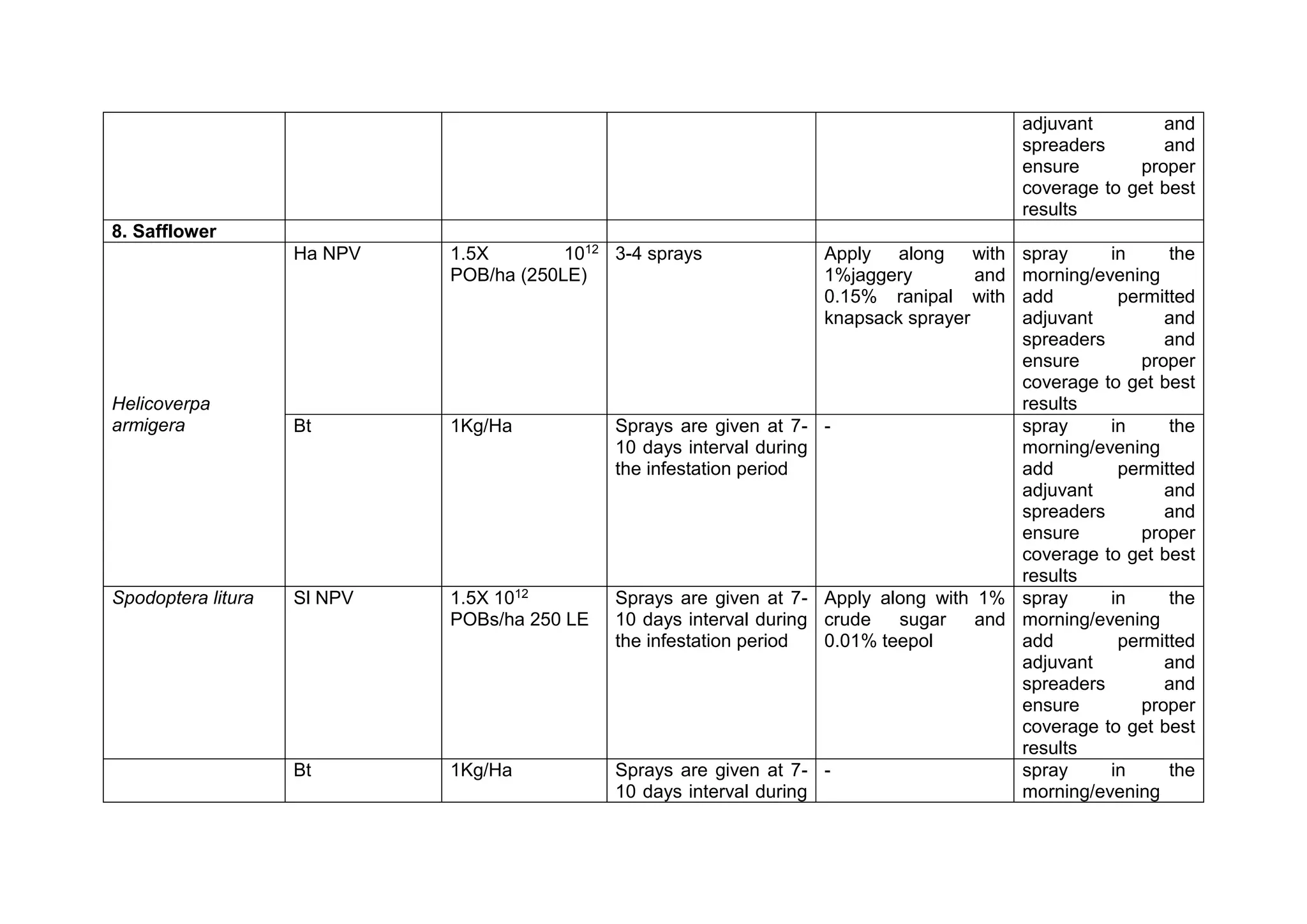
Nucleo Polyhedrosis Virus (NPV): Effective against only lepidopteran insects
individually in different crops. Ha NPV is used for the management of Helicoverpa armigera
while Sl NPV is meant for Spodoptera litura. Similarly, castor semi looper is managed by Ach
NPV and red hairy caterpillar by Am NPV.
Granulosis Virus (GV) and Cyto Plasmic Viruses (CPV): are being extensively
used against insect pests of sugarcane.
(b) Bacteria: Most commonly and widely used bio pesticide in insect control
operations is Bacillus thuringiensis. This bacterium is highly effective against several insect
pests of Lepidoptera. They cause disease due to which insect turns black and die. The
bacteria come in several commercial formulations such as Dipel, Delfin, Halt, Spicturin,
Biolep, BioAsp etc.
(c) Fungi: Several fungi such as, Beauveria bassiana, Metarhizium anisopliae and
Lecanicillium (Verticillium) lecanii are used against important pests like gram pod borer,
tobacco cater pillar and sucking pests like thrips, aphids and mealy bugs. The fungi develop
hyphae inside insect system as a result insect dies due to mechanical congestions. This
mode of action makes these organisms to perfectly suit to the needs of sustainable
agriculture. In certain cases they produce toxins to kill the insect.
(d) Entomopathogenic nematodes: These nematodes harbour certain bacteria
which act as toxins to insect systems. Mainly exploited entomopathogenic nematodes in
insect control operations are Heterorhabditis sp., Steinernema sp.
Other than these microorganisms protozoans such as Variomorpha sp and
others were also found to be effective against insect pests and can be effectively be
incorporated as tools in sustainable agriculture.
Antagonistic organisms for plant disease management
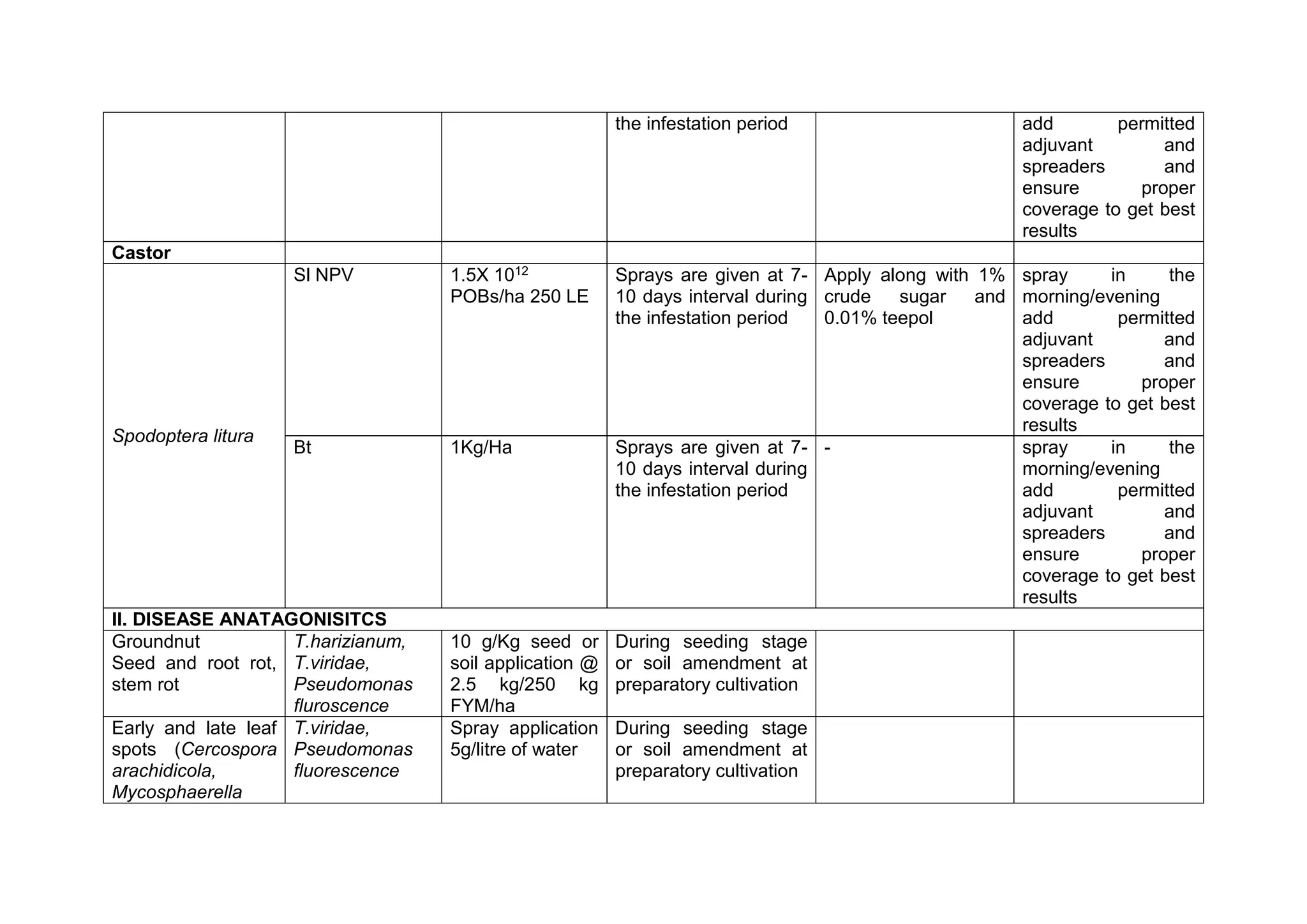
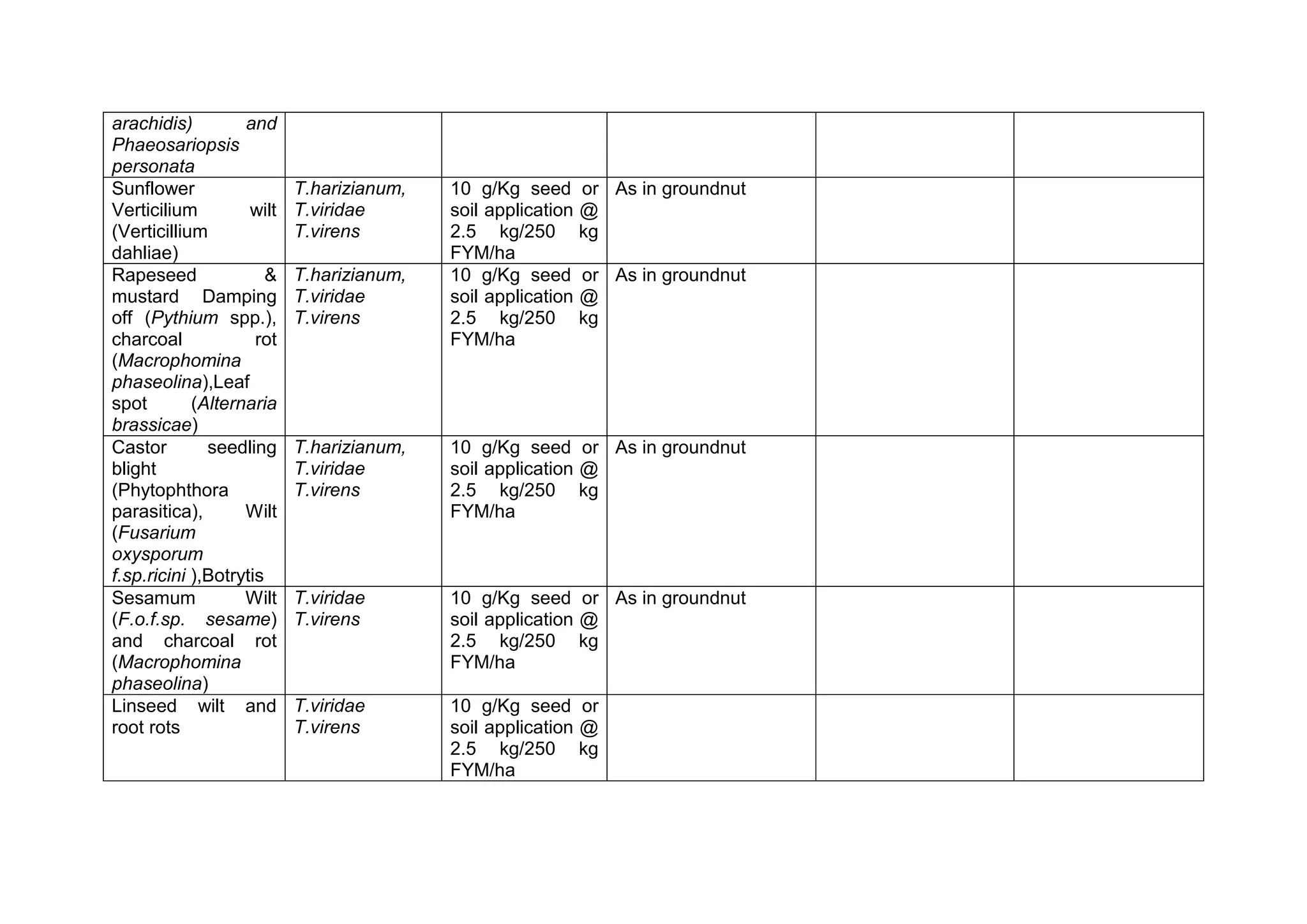
Biological control of plant diseases is also very important in the ecofriendly
management of the biotic stresses. The most commonly and widely used organisms for
these purposes are Trichoderma viride, Pseudomonas fluorescens and Bacillus subtilis
which are used for controlling the diseases caused by different pathogens viz., Pythium,
Phytophthora, Rhizoctonia, Fusarium etc., These antagonistic organisms certainly give
efficient, practical and cost effective plant disease control without causing any abnormal and
adverse effect in the ecosystem. In addition to control of plant diseases, several of the
disease antagonistic bio control agents play several other important roles such as plant
growth promoting (Pseudomonas fluorescens), decomposition of crop residues in to organic
matter (Trichoderma viride) and for extracting certain enzymes and other commercially viable
metabolites.
Weed management through Biological Control
Biological control of the weeds through biotic agents is gaining momentum in
the recent years as the weed menace in cultivated lands as well as in waste lands posing
serious health problems to the mankind besides reducing the yield levels considerably in
agriculture. Mexican beetle, Zygogramma bicolorata is being used for reducing the menace
of Congress grass, Parthenium hysterophorus. Water hyacinth is reported to be attacked by
Neochitina bruchi (weevil) and Orthogalumna trerbrantis (mite). Rust fungus, Puccinia
spegazzinii is exploited for suppression of Mikania micrantha
*******************
LECTURE NO: 04
MICROBIAL BIO PESTICIDES: VIRUSES, BACTERIA, FUNGI, NEMATODES,
PROTOZOA & RICKETTSIAE
================================================================
Microbial control
“Microbial control refers to the exploitation of diseases causing organisms to
reduce the population of insect pests below the economic injury level
Entomopathogens
Word derived from two Greek words
“Entomon” - Insects
“Genes” - Arising In
Therefore, the etymological meaning of entomogenous microorganism is
“microorganisms which arise in insects.”
1. ENTOMOPATHOGENIC BACTERIA
Bacillus thuringiensis is considered as a type species for the entomopathogenic
bacteria
Introduction
Bacteria are unicellular organisms, small in size and lack defined nucleus.
Two categories of bacteria have been noted. Those with rigid cell wall are spherical
(coocal), rod (bacilli) or spiral (spirilla) shaped. The other category lacks rigid cell
wall and is called pleomorphic (mollicutes). Bacteria occur in regular and irregular
aggregations, may develop chains or packets of individual cells and may be motile.
Bacteria reproduce by binary fission (asexual mode) and conjugation (sexual mode).
They develop aerobically in the presence of oxygen or in its absence anaerobically.
History
The Bacillus thuringiensis Berliner story began in the first decade of the
20th Century when the Japanese bacteriologist S. Ishiwata isolated the bacillus
from diseased Bombyx mori (L.) larvae. He named it Sottokin, which means
"sudden death bacillus." He described the pathology it causes in silkworm larvae
and its cultural characteristics.
He also noted that many of the larvae that did not die when exposed to the
bacillus were very weak and stunted. In a subsequent report (Ishiwata 1905b) he
stated that "From these experiments the intoxication seems to be caused by some
toxine, not only because of the alimentation of bacillus, the death occurs before the
multiplication of the bacillus..." This showed that from the very beginning it was
realized that a toxin was involved in the pathogenicity of B. thuringiensis.
Ernst Berliner isolated a similar organism from diseased granary populations
of Ephestia kuehniella (Zeller) larvae from Thuringia, Germany, which he named
Bacillus thuringiensis, and because Ishiwata did not formally describe the
organism he found, Berliner is credited with naming it.
Aoki & Chigasaki (1916) reported on their studies of Ishiwata's isolate, noting
that its activity was due to a toxin present in sporulated cultures, but not in young
cultures of vegetative cells. The toxin was not an exotoxin because it was not found
in culture filtrates. It is obvious from their data on inactivation of the toxin by acids,
phenol, mercuric chloride, and heat that they had a protein. Nothing further was
accomplished with B. thuringiensis for over a decade, which was due perhaps to the
fact that in Japan the Sotto disease was not a serious problem in silkworm culture
and in Europe World War I was in progress.
Berliner's isolate was lost, but in 1927 Mattes reisolated the same organism
from the same host as did Berliner (Heimpel & Angus 1960a). Mattes' isolate was
widely distributed to laboratories in various parts of the world, and most of the early
commercial B. thuringiensis-based products and most of the early microbial control
attempts used this isolate (Norris 1970). Both Berliner and Mattes observed in
addition to the spore, a second body, which they called a Restkörper in the
developing sporangia.
Cutter Laboratories then produced B. thuringiensis preparations for Steinhaus
which he used successfully against C. eurytheme larvae (Briggs 1986).
In 1956 Steinhaus and R. A. Fisher met with the president of Pacific Yeast
Products, J. M. Sudarsky, to explore the practicality of producing a B. thuringiensis-
based product. Pacific Yeast Products was a yeast and vitamin B-12 producer in
Wasco, CA. The decision was made to produce B. thuringiensis and by 1957 a
product called Thuricide was available for testing. Thuricide was formulated as
liquid concentrates, dusts, and wettable powders.
Several other U.S. Companies (Merck, Agritrol; Rohm & Haas, Bakthane;
and Grain Producers, Parasporine) produced B. thuringiensis for short periods
(van der Geest & van der Laan 1971).
Besides the production of Sporeine in France in the late 1930s, there was the
development of B. thuringiensis production and usage in European socialist
countries in the 1950s.
Angus, Hannay and Fitz James alkalinity of soluble proteins determined the
toxicity of the crystals in 1955
Goldberg and margalit found B. thuringiensis israelensis in mosquito
breeding pond and negev desert which highly toxic to the mosquitoes and black flies
during 1970s
Schenepf and whitely first time identified the insecticidal activity of crystal
proteins and first cloning of the Bt sub sp, kurstaki in E.cloi in 1981
Kreig found Bacillus thuringiensis tenebrionis effective against meal worm:
Tenebrio molitor in 1983
Crickmore given the classification of the crystal proteins based on the amino
acid homology
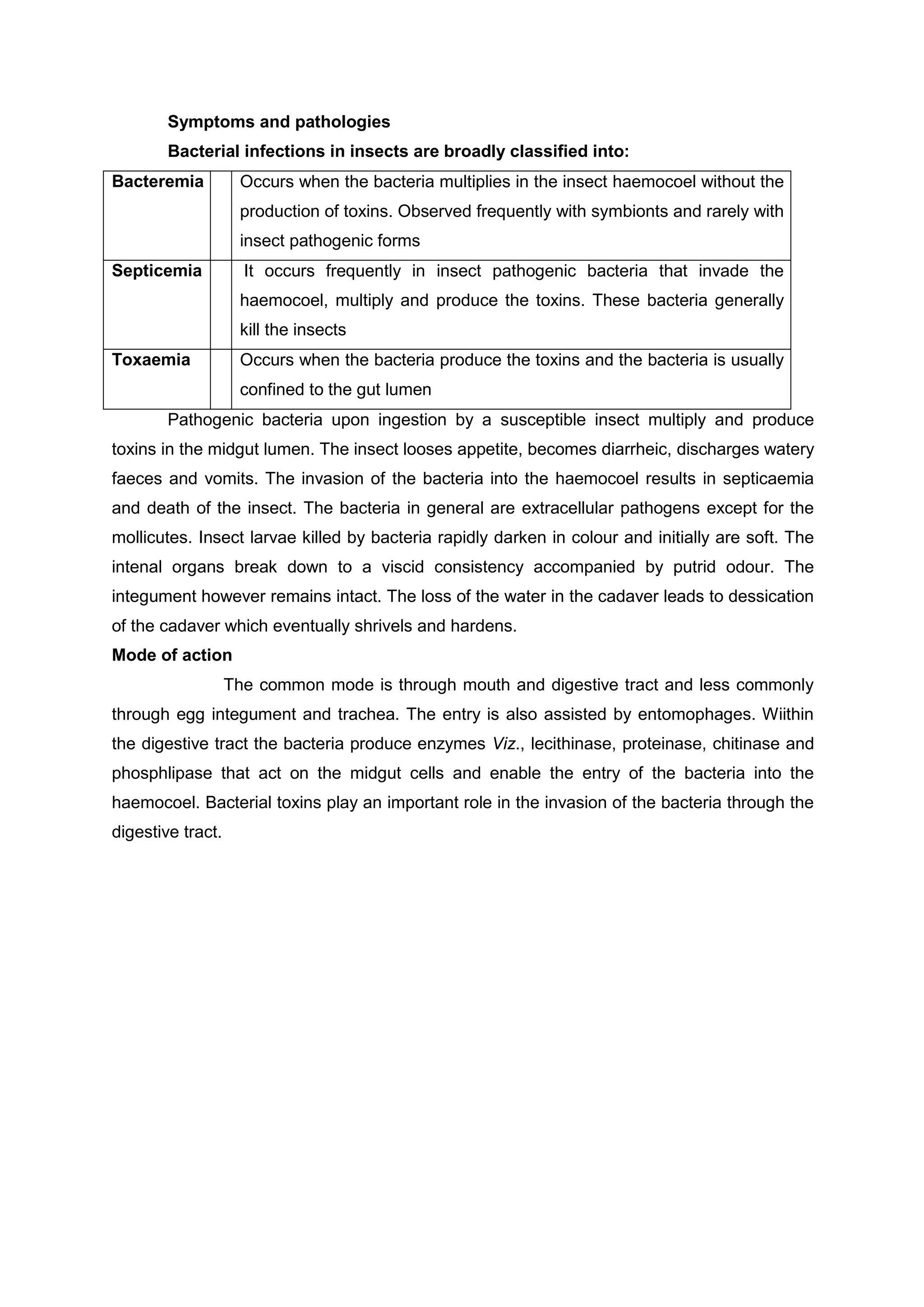
Symptoms and pathologies
Bacterial infections in insects are broadly classified into:
Bacteremia :
Occurs when the bacteria multiplies in the insect haemocoel without the
production of toxins. Observed frequently with symbionts and rarely with
insect pathogenic forms
Septicemia :
It occurs frequently in insect pathogenic bacteria that invade the
haemocoel, multiply and produce the toxins. These bacteria generally
kill the insects
Toxaemia :
Occurs when the bacteria produce the toxins and the bacteria is usually
confined to the gut lumen
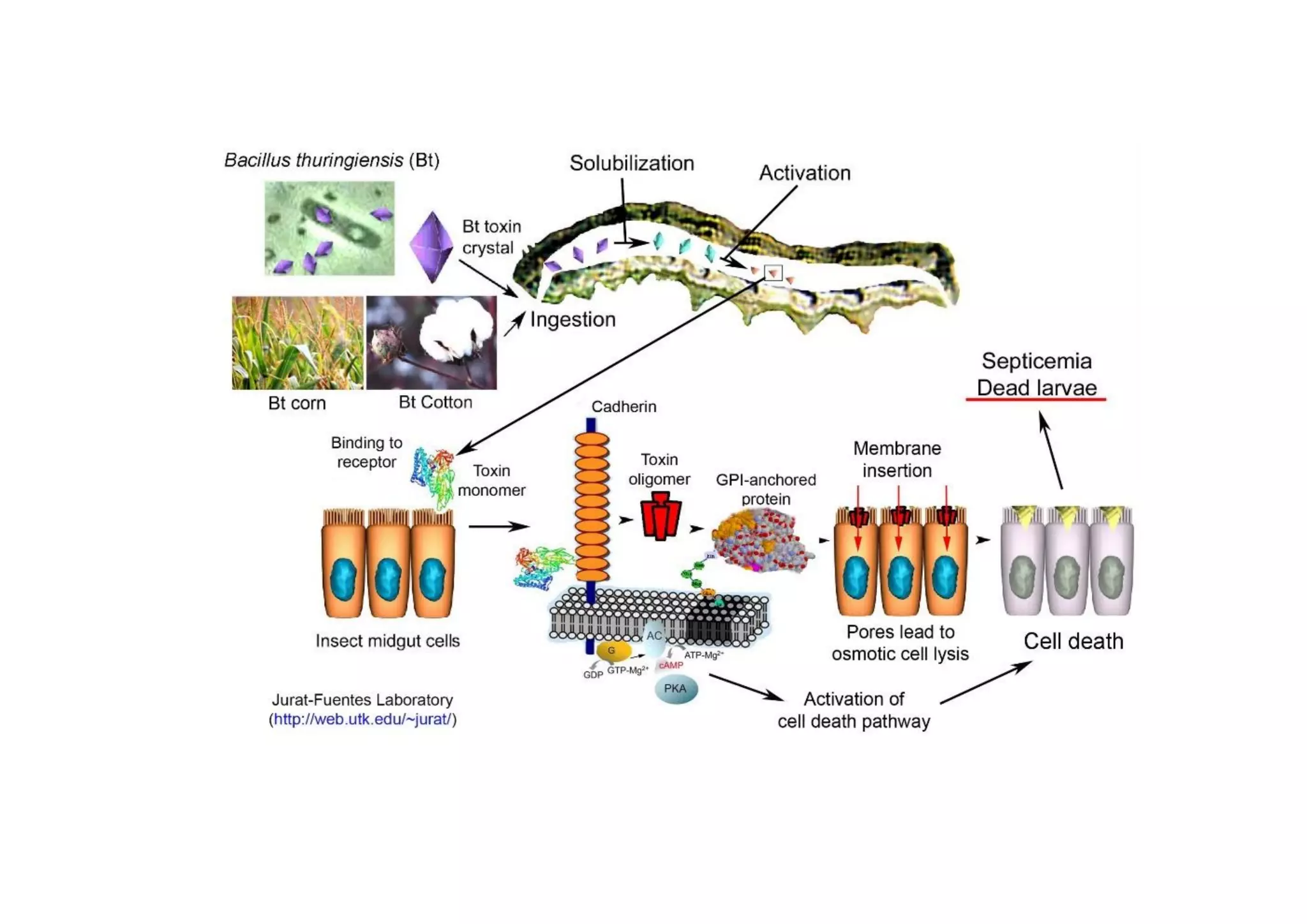
Pathogenic bacteria upon ingestion by a susceptible insect multiply and produce
toxins in the midgut lumen. The insect looses appetite, becomes diarrheic, discharges watery
faeces and vomits. The invasion of the bacteria into the haemocoel results in septicaemia
and death of the insect. The bacteria in general are extracellular pathogens except for the
mollicutes. Insect larvae killed by bacteria rapidly darken in colour and initially are soft. The
intenal organs break down to a viscid consistency accompanied by putrid odour. The
integument however remains intact. The loss of the water in the cadaver leads to dessication
of the cadaver which eventually shrivels and hardens.
Mode of action
The common mode is through mouth and digestive tract and less commonly
through egg integument and trachea. The entry is also assisted by entomophages. Wiithin
the digestive tract the bacteria produce enzymes Viz., lecithinase, proteinase, chitinase and
phosphlipase that act on the midgut cells and enable the entry of the bacteria into the
haemocoel. Bacterial toxins play an important role in the invasion of the bacteria through the
digestive tract.
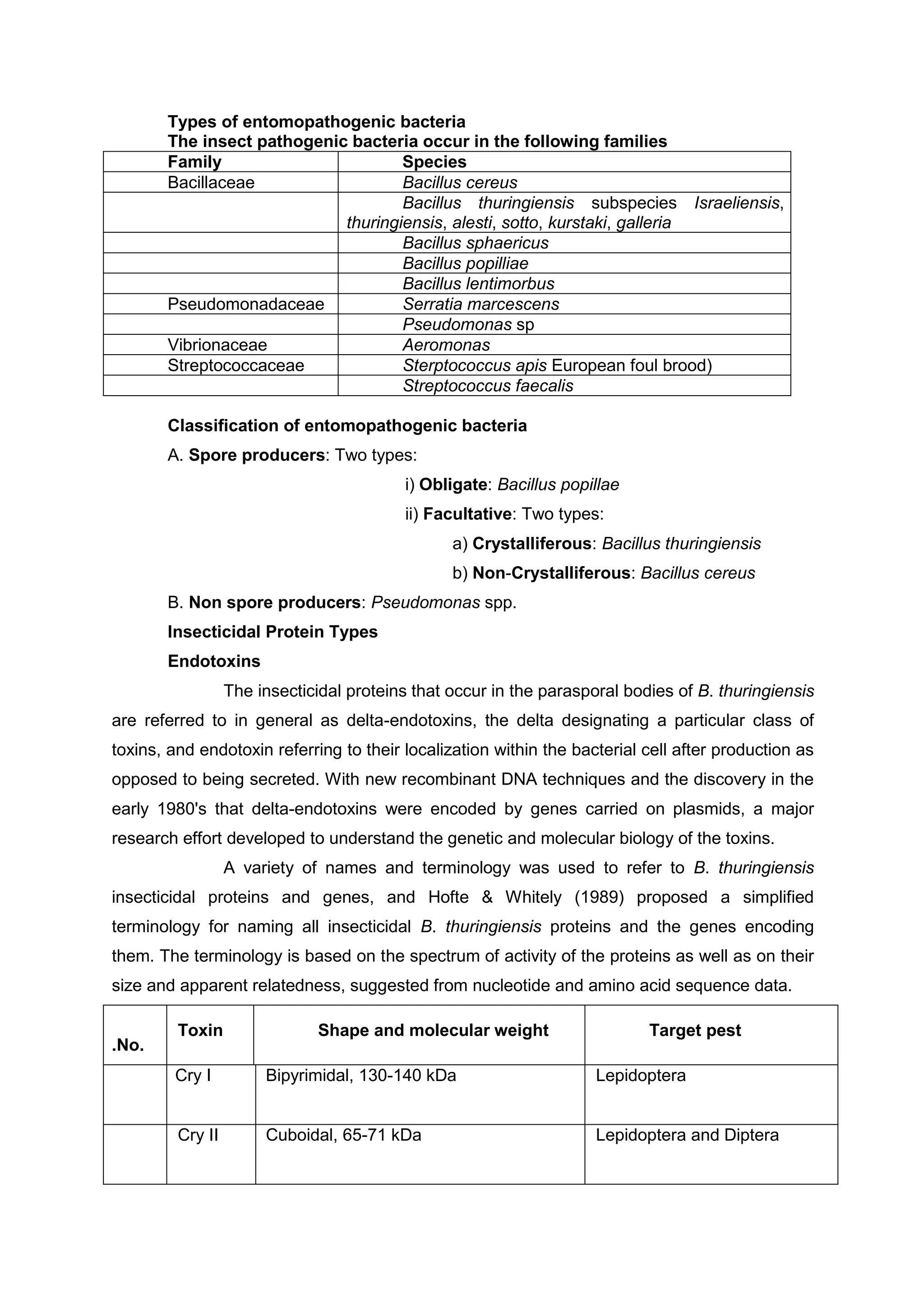
Types of entomopathogenic bacteria
The insect pathogenic bacteria occur in the following families
Family Species
Bacillaceae Bacillus cereus
Bacillus thuringiensis subspecies Israeliensis,
thuringiensis, alesti, sotto, kurstaki, galleria
Bacillus sphaericus
Bacillus popilliae
Bacillus lentimorbus
Pseudomonadaceae Serratia marcescens
Pseudomonas sp
Vibrionaceae Aeromonas
Streptococcaceae Sterptococcus apis European foul brood)
Streptococcus faecalis
Classification of entomopathogenic bacteria
A. Spore producers: Two types:
i) Obligate: Bacillus popillae
ii) Facultative: Two types:
a) Crystalliferous: Bacillus thuringiensis
b) Non-Crystalliferous: Bacillus cereus
B. Non spore producers: Pseudomonas spp.
Insecticidal Protein Types
Endotoxins
The insecticidal proteins that occur in the parasporal bodies of B. thuringiensis
are referred to in general as delta-endotoxins, the delta designating a particular class of
toxins, and endotoxin referring to their localization within the bacterial cell after production as
opposed to being secreted. With new recombinant DNA techniques and the discovery in the
early 1980's that delta-endotoxins were encoded by genes carried on plasmids, a major
research effort developed to understand the genetic and molecular biology of the toxins.
A variety of names and terminology was used to refer to B. thuringiensis
insecticidal proteins and genes, and Hofte & Whitely (1989) proposed a simplified
terminology for naming all insecticidal B. thuringiensis proteins and the genes encoding
them. The terminology is based on the spectrum of activity of the proteins as well as on their
size and apparent relatedness, suggested from nucleotide and amino acid sequence data.
S
.No.
Toxin Shape and molecular weight Target pest
1
.
Cry I Bipyrimidal, 130-140 kDa Lepidoptera
2
.
Cry II Cuboidal, 65-71 kDa Lepidoptera and Diptera
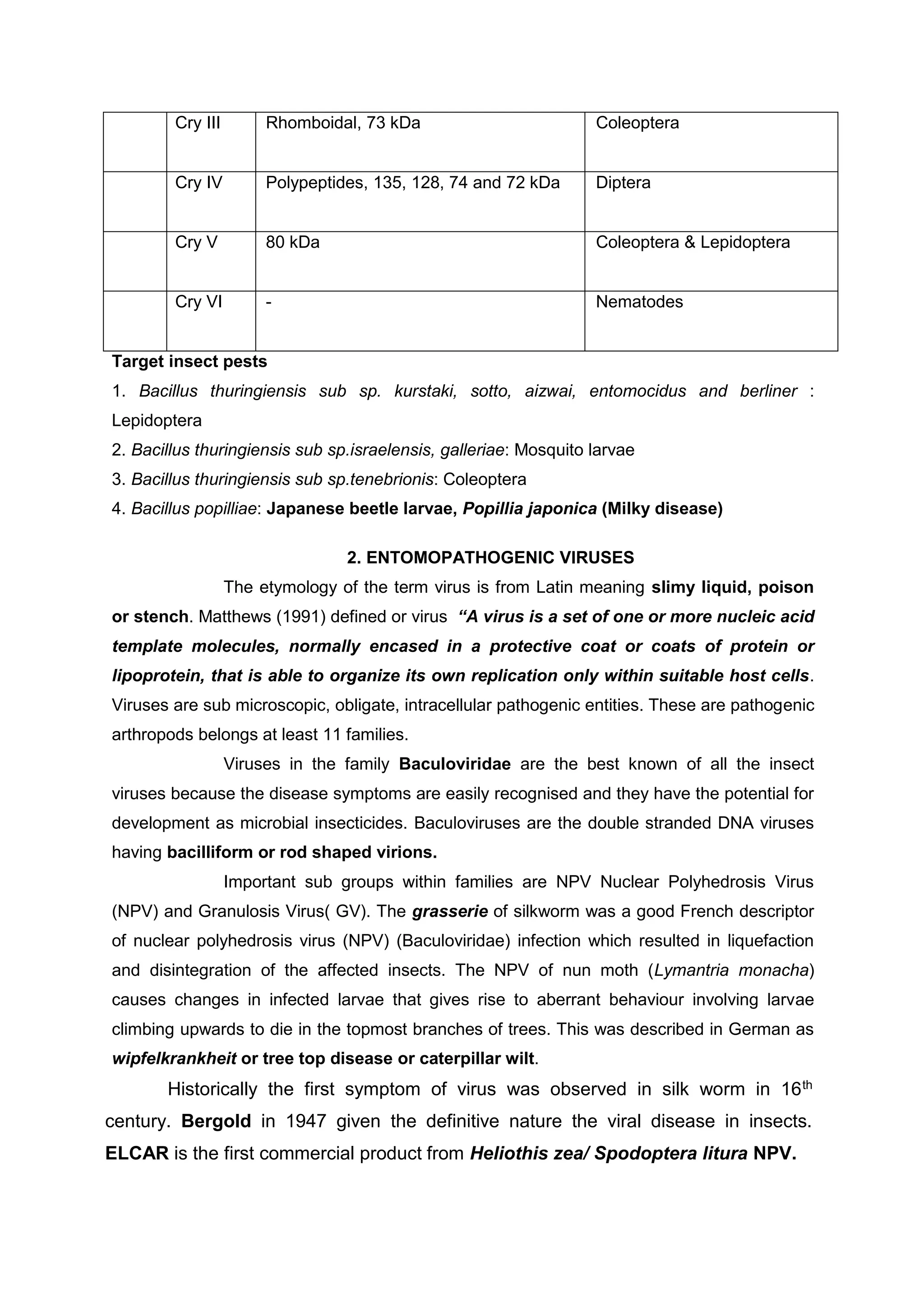
3
.
Cry III Rhomboidal, 73 kDa Coleoptera
4
.
Cry IV Polypeptides, 135, 128, 74 and 72 kDa Diptera
5
.
Cry V 80 kDa Coleoptera & Lepidoptera
6
.
Cry VI - Nematodes
Target insect pests
1. Bacillus thuringiensis sub sp. kurstaki, sotto, aizwai, entomocidus and berliner :
Lepidoptera
2. Bacillus thuringiensis sub sp.israelensis, galleriae: Mosquito larvae
3. Bacillus thuringiensis sub sp.tenebrionis: Coleoptera
4. Bacillus popilliae: Japanese beetle larvae, Popillia japonica (Milky disease)
2. ENTOMOPATHOGENIC VIRUSES
The etymology of the term virus is from Latin meaning slimy liquid, poison
or stench. Matthews (1991) defined or virus “A virus is a set of one or more nucleic acid
template molecules, normally encased in a protective coat or coats of protein or
lipoprotein, that is able to organize its own replication only within suitable host cells.
Viruses are sub microscopic, obligate, intracellular pathogenic entities. These are pathogenic
arthropods belongs at least 11 families.
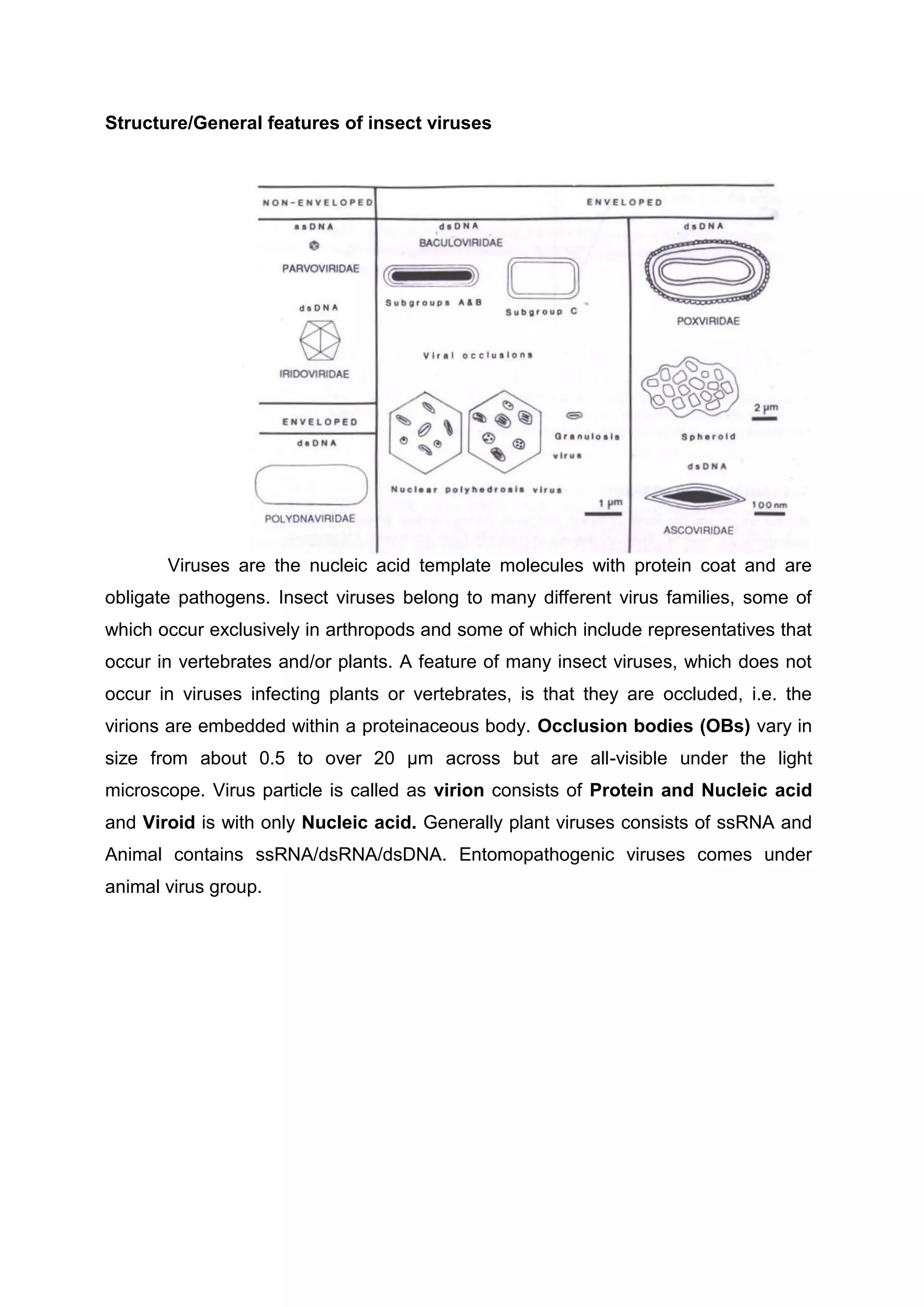
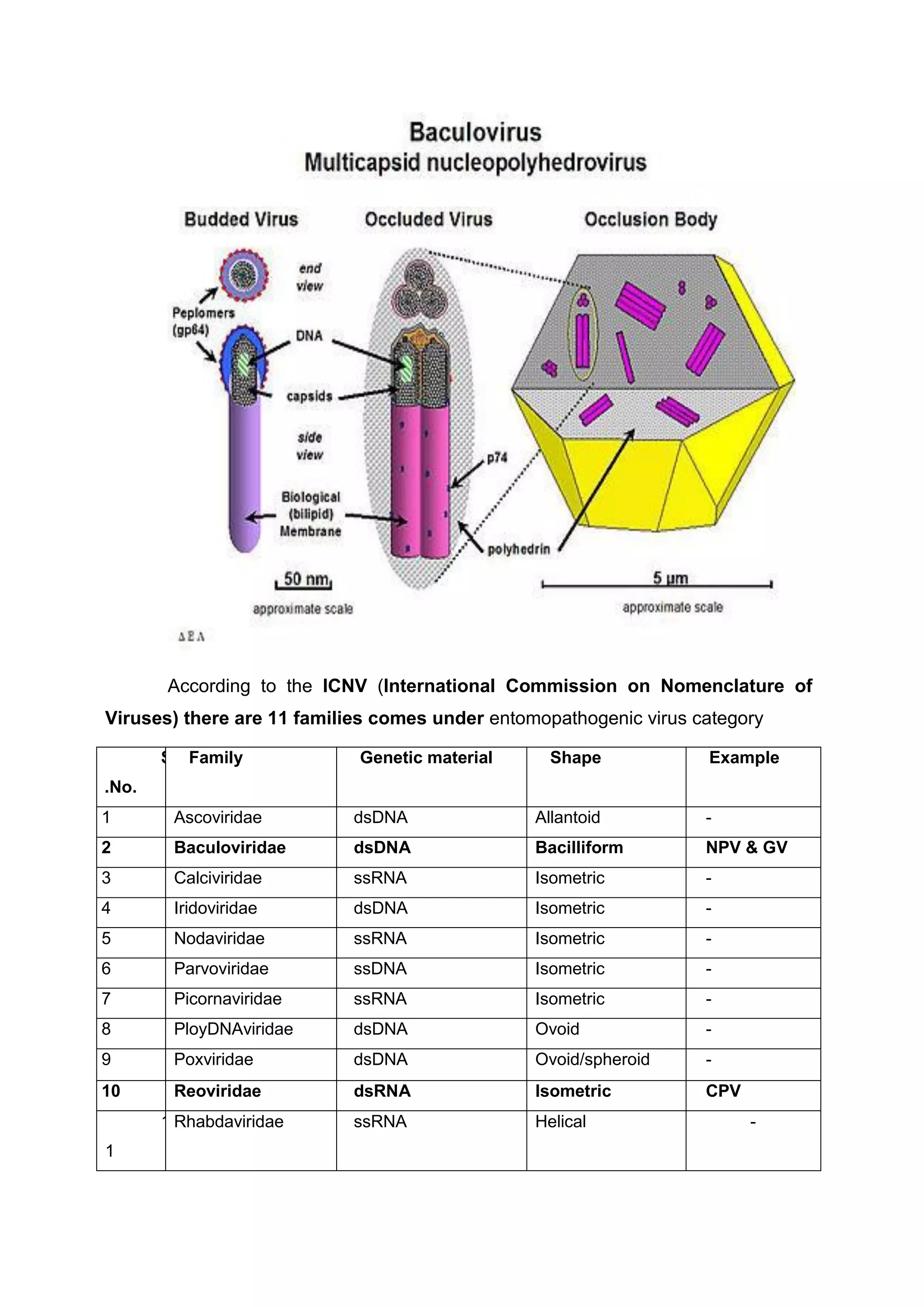
Viruses in the family Baculoviridae are the best known of all the insect
viruses because the disease symptoms are easily recognised and they have the potential for
development as microbial insecticides. Baculoviruses are the double stranded DNA viruses
having bacilliform or rod shaped virions.
Important sub groups within families are NPV Nuclear Polyhedrosis Virus
(NPV) and Granulosis Virus( GV). The grasserie of silkworm was a good French descriptor
of nuclear polyhedrosis virus (NPV) (Baculoviridae) infection which resulted in liquefaction
and disintegration of the affected insects. The NPV of nun moth (Lymantria monacha)
causes changes in infected larvae that gives rise to aberrant behaviour involving larvae
climbing upwards to die in the topmost branches of trees. This was described in German as
wipfelkrankheit or tree top disease or caterpillar wilt.
Historically the first symptom of virus was observed in silk worm in 16th
century. Bergold in 1947 given the definitive nature the viral disease in insects.
ELCAR is the first commercial product from Heliothis zea/ Spodoptera litura NPV.
Structure/General features of insect viruses
Viruses are the nucleic acid template molecules with protein coat and are
obligate pathogens. Insect viruses belong to many different virus families, some of
which occur exclusively in arthropods and some of which include representatives that
occur in vertebrates and/or plants. A feature of many insect viruses, which does not
occur in viruses infecting plants or vertebrates, is that they are occluded, i.e. the
virions are embedded within a proteinaceous body. Occlusion bodies (OBs) vary in
size from about 0.5 to over 20 µm across but are all-visible under the light
microscope. Virus particle is called as virion consists of Protein and Nucleic acid
and Viroid is with only Nucleic acid. Generally plant viruses consists of ssRNA and
Animal contains ssRNA/dsRNA/dsDNA. Entomopathogenic viruses comes under
animal virus group.
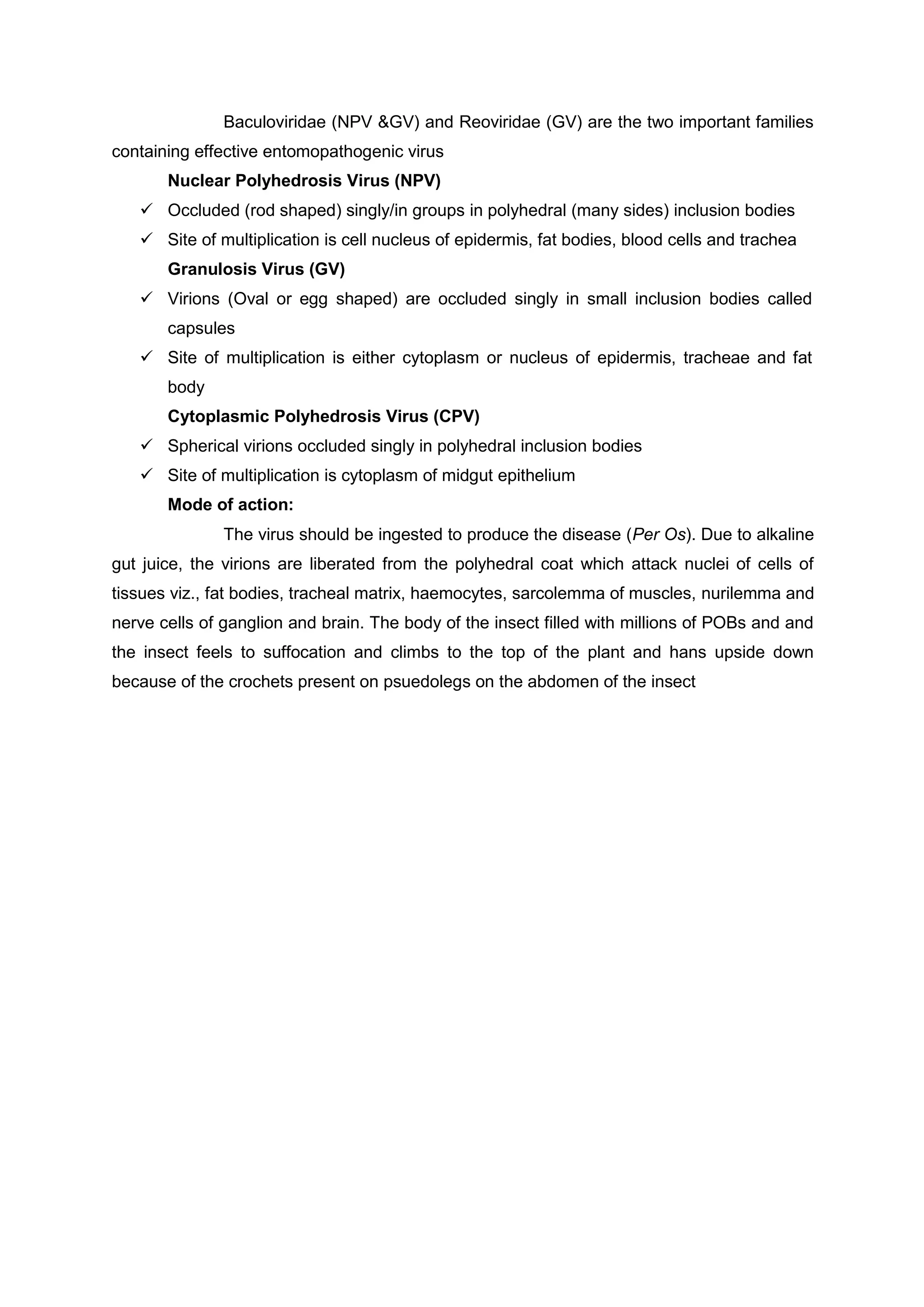
According to the ICNV (International Commission on Nomenclature of
Viruses) there are 11 families comes under entomopathogenic virus category
S
.No.
Family Genetic material Shape Example
1 Ascoviridae dsDNA Allantoid -
2 Baculoviridae dsDNA Bacilliform NPV & GV
3 Calciviridae ssRNA Isometric -
4 Iridoviridae dsDNA Isometric -
5 Nodaviridae ssRNA Isometric -
6 Parvoviridae ssDNA Isometric -
7 Picornaviridae ssRNA Isometric -
8 PloyDNAviridae dsDNA Ovoid -
9 Poxviridae dsDNA Ovoid/spheroid -
10 Reoviridae dsRNA Isometric CPV
1
1
Rhabdaviridae ssRNA Helical -
Baculoviridae (NPV &GV) and Reoviridae (GV) are the two important families
containing effective entomopathogenic virus
Nuclear Polyhedrosis Virus (NPV)
 Occluded (rod shaped) singly/in groups in polyhedral (many sides) inclusion bodies
 Site of multiplication is cell nucleus of epidermis, fat bodies, blood cells and trachea
Granulosis Virus (GV)
 Virions (Oval or egg shaped) are occluded singly in small inclusion bodies called
capsules
 Site of multiplication is either cytoplasm or nucleus of epidermis, tracheae and fat
body
Cytoplasmic Polyhedrosis Virus (CPV)
 Spherical virions occluded singly in polyhedral inclusion bodies
 Site of multiplication is cytoplasm of midgut epithelium
Mode of action:
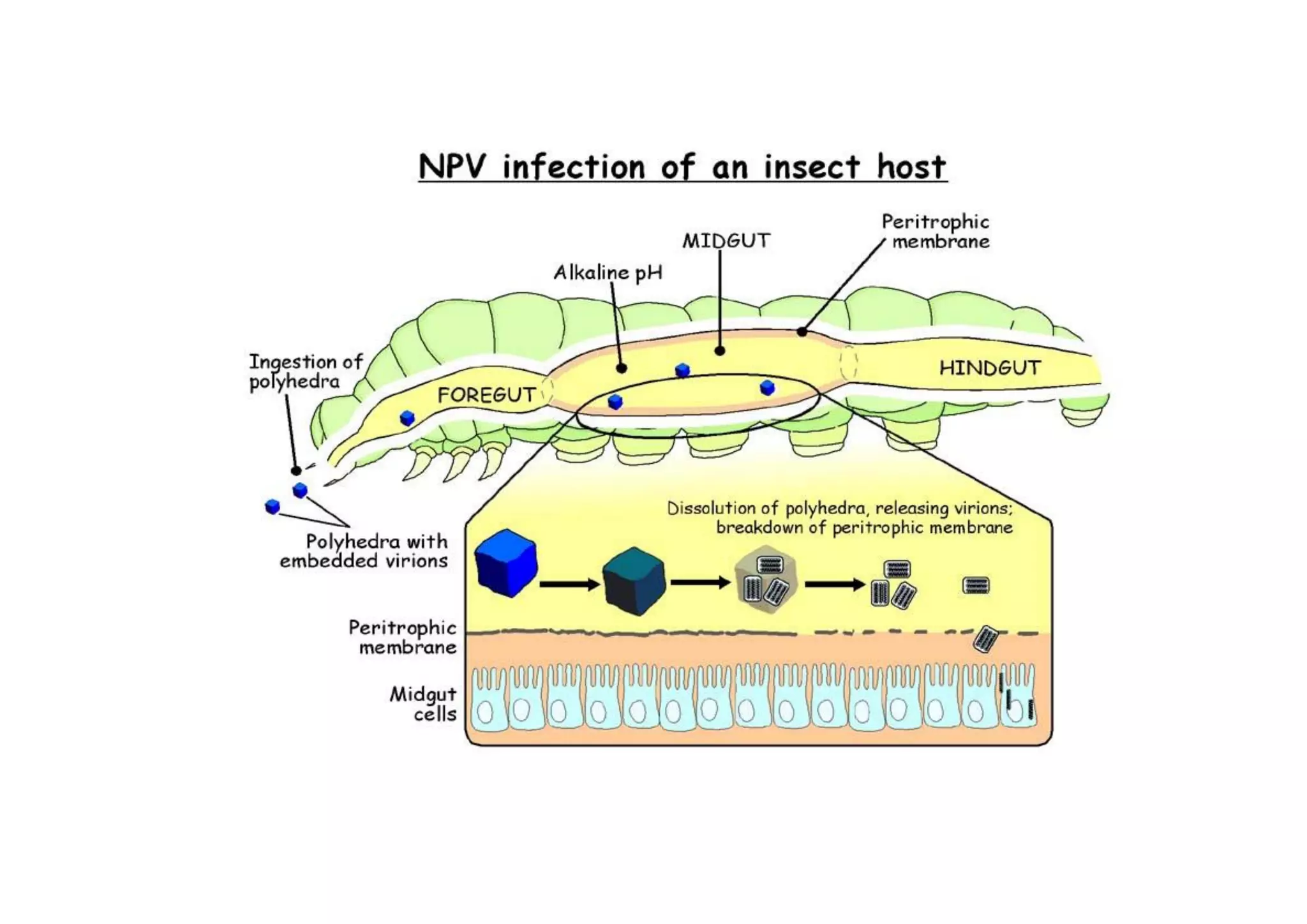
The virus should be ingested to produce the disease (Per Os). Due to alkaline
gut juice, the virions are liberated from the polyhedral coat which attack nuclei of cells of
tissues viz., fat bodies, tracheal matrix, haemocytes, sarcolemma of muscles, nurilemma and
nerve cells of ganglion and brain. The body of the insect filled with millions of POBs and and
the insect feels to suffocation and climbs to the top of the plant and hans upside down
because of the crochets present on psuedolegs on the abdomen of the insect
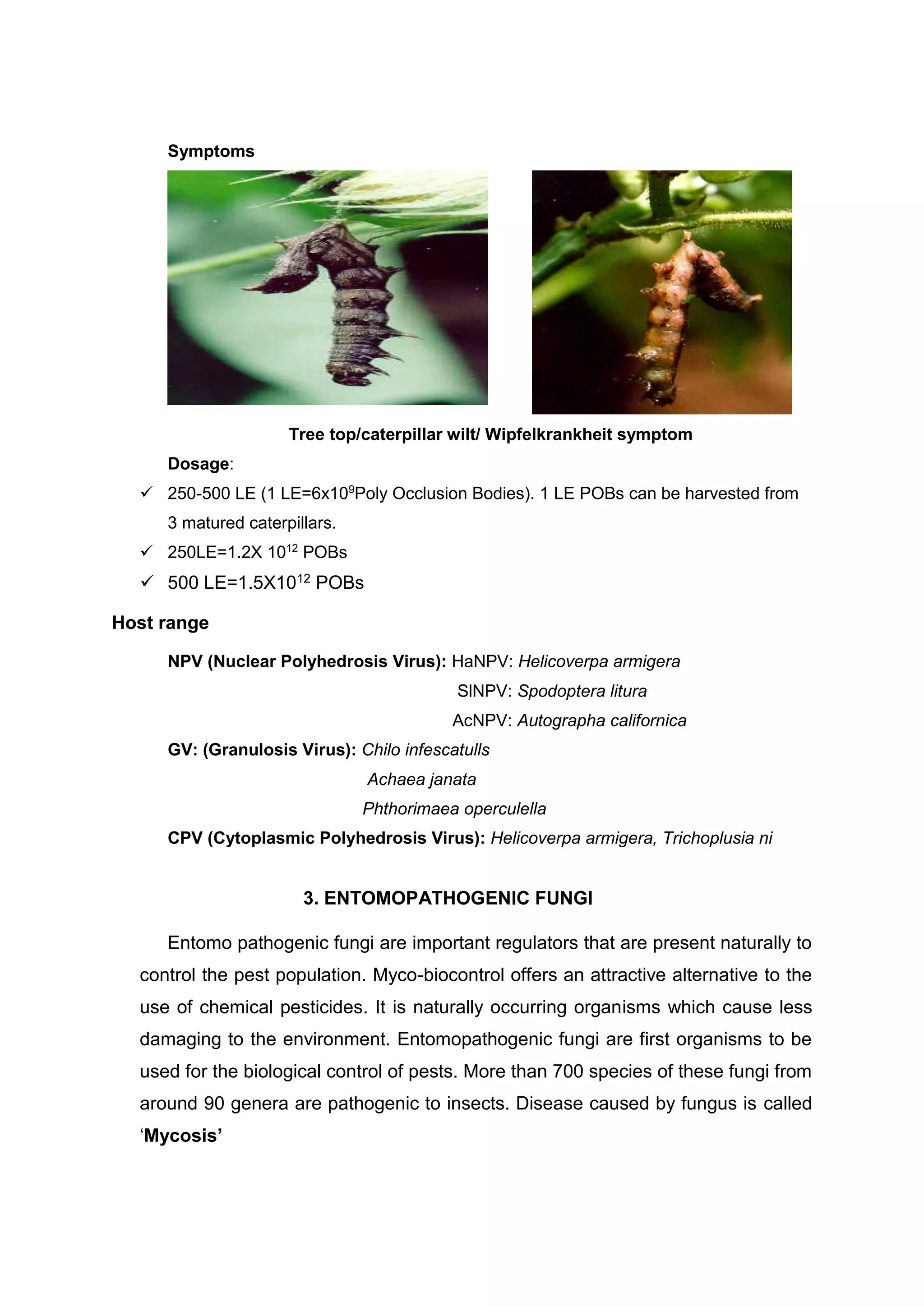
Symptoms
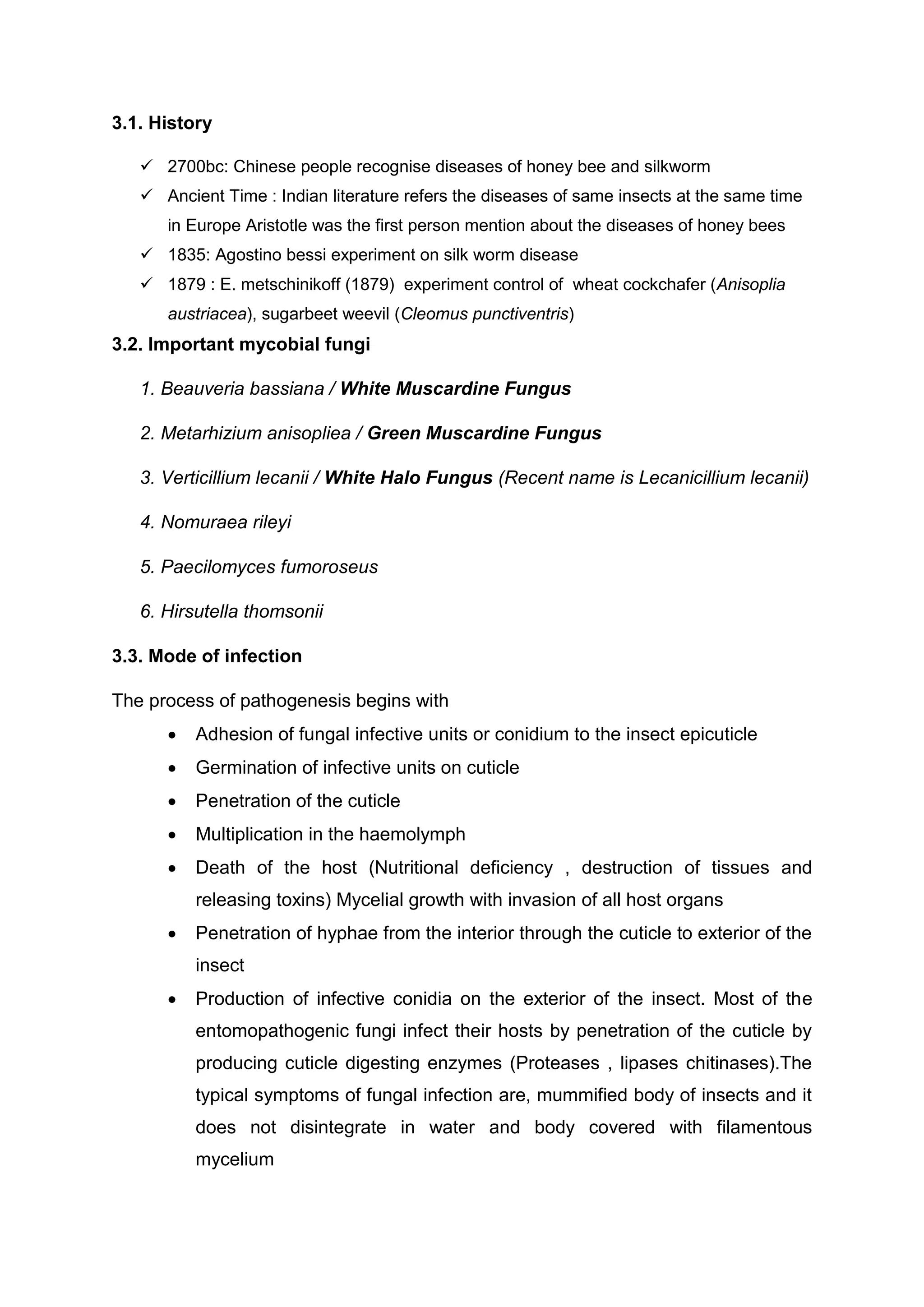
Tree top/caterpillar wilt/ Wipfelkrankheit symptom
Dosage:
 250-500 LE (1 LE=6x10⁹
Poly Occlusion Bodies). 1 LE POBs can be harvested from
3 matured caterpillars.
 250LE=1.2X 10¹²
POBs
 500 LE=1.5X10¹² POBs
Host range
NPV (Nuclear Polyhedrosis Virus): HaNPV: Helicoverpa armigera
SlNPV: Spodoptera litura
AcNPV: Autographa californica
GV: (Granulosis Virus): Chilo infescatulls
Achaea janata
Phthorimaea operculella
CPV (Cytoplasmic Polyhedrosis Virus): Helicoverpa armigera, Trichoplusia ni
3. ENTOMOPATHOGENIC FUNGI
Entomo pathogenic fungi are important regulators that are present naturally to
control the pest population. Myco-biocontrol offers an attractive alternative to the
use of chemical pesticides. It is naturally occurring organisms which cause less
damaging to the environment. Entomopathogenic fungi are first organisms to be
used for the biological control of pests. More than 700 species of these fungi from
around 90 genera are pathogenic to insects. Disease caused by fungus is called
‘Mycosis’
3.1. History
 2700bc: Chinese people recognise diseases of honey bee and silkworm
 Ancient Time : Indian literature refers the diseases of same insects at the same time
in Europe Aristotle was the first person mention about the diseases of honey bees
 1835: Agostino bessi experiment on silk worm disease
 1879 : E. metschinikoff (1879) experiment control of wheat cockchafer (Anisoplia
austriacea), sugarbeet weevil (Cleomus punctiventris)
3.2. Important mycobial fungi
1. Beauveria bassiana / White Muscardine Fungus
2. Metarhizium anisopliea / Green Muscardine Fungus
3. Verticillium lecanii / White Halo Fungus (Recent name is Lecanicillium lecanii)
4. Nomuraea rileyi
5. Paecilomyces fumoroseus
6. Hirsutella thomsonii
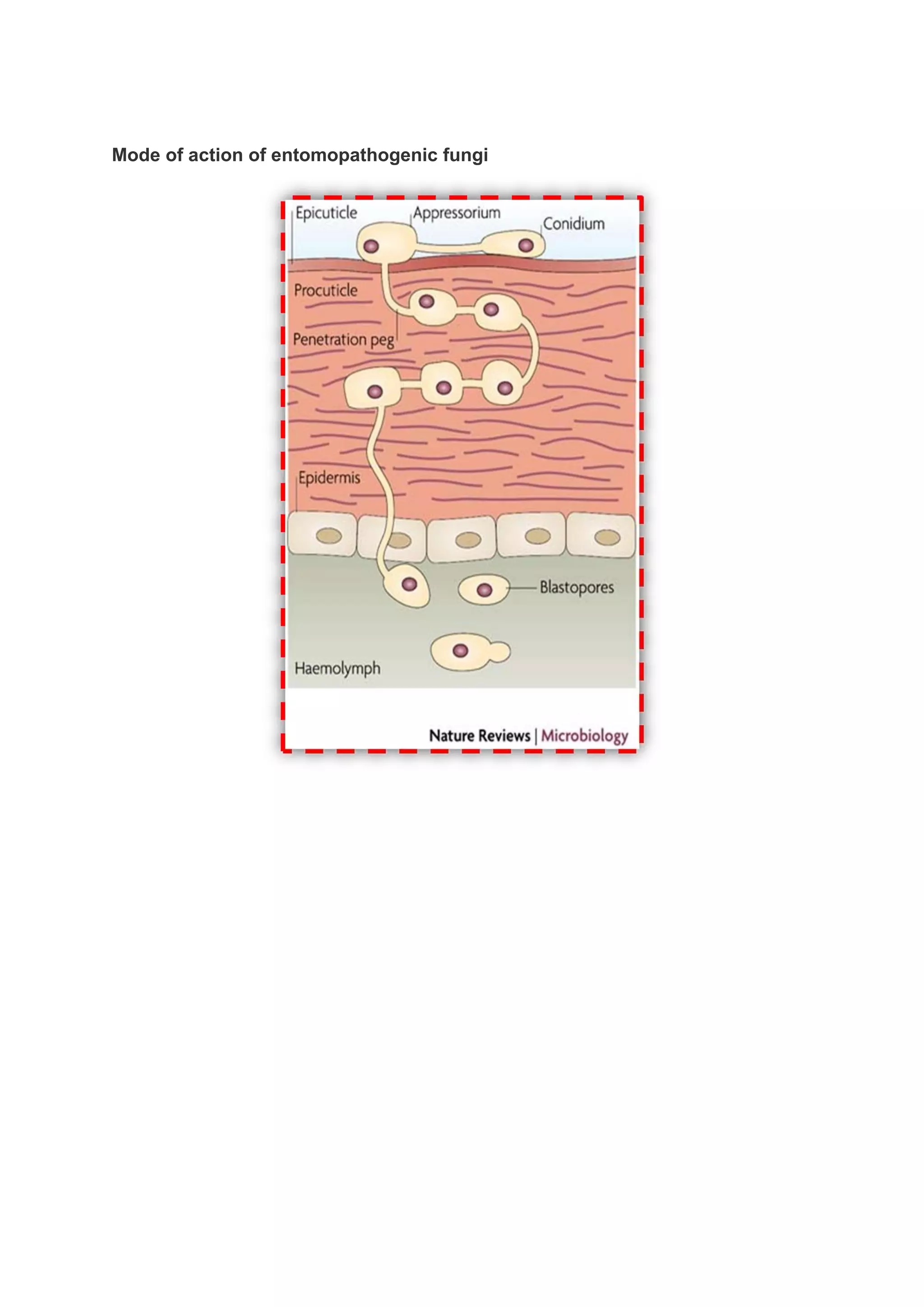
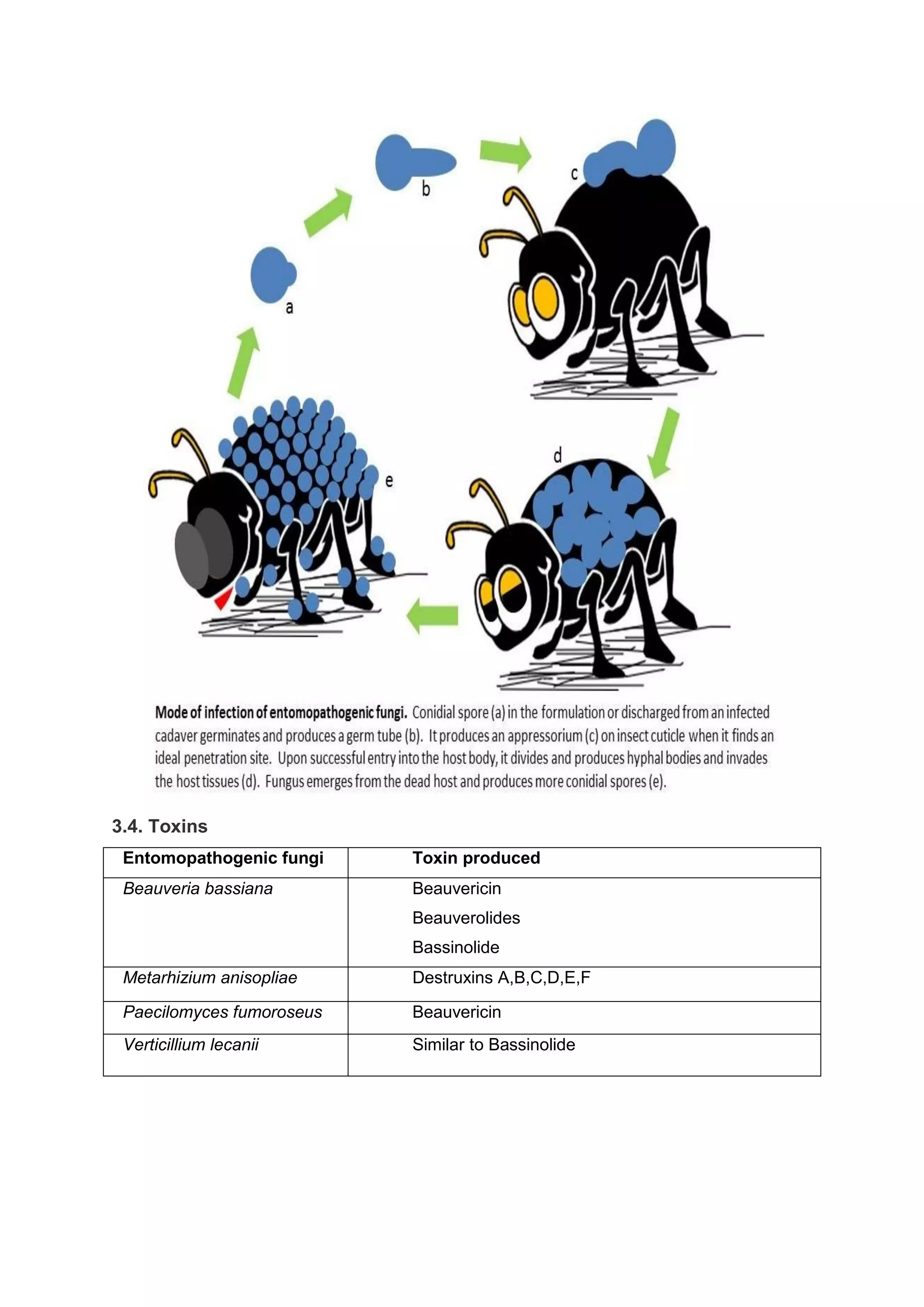
3.3. Mode of infection
The process of pathogenesis begins with
 Adhesion of fungal infective units or conidium to the insect epicuticle
 Germination of infective units on cuticle
 Penetration of the cuticle
 Multiplication in the haemolymph
 Death of the host (Nutritional deficiency , destruction of tissues and
releasing toxins) Mycelial growth with invasion of all host organs
 Penetration of hyphae from the interior through the cuticle to exterior of the
insect
 Production of infective conidia on the exterior of the insect. Most of the
entomopathogenic fungi infect their hosts by penetration of the cuticle by
producing cuticle digesting enzymes (Proteases , lipases chitinases).The
typical symptoms of fungal infection are, mummified body of insects and it
does not disintegrate in water and body covered with filamentous
mycelium
Mode of action of entomopathogenic fungi
3.4. Toxins
Entomopathogenic fungi Toxin produced
Beauveria bassiana Beauvericin
Beauverolides
Bassinolide
Metarhizium anisopliae Destruxins A,B,C,D,E,F
Paecilomyces fumoroseus Beauvericin
Verticillium lecanii Similar to Bassinolide
1. Beauveria bassiana
 Grows naturally in soils and acts as a parasite on various arthropods.
 It causing white muscardine disease
 Toxin Produced – Beauvericin, Bassianolide, Isarolides, and
Beauverolides
 It is being used as a biological insecticide against Termites, Thrips,
Whiteflies, Aphids, Grasshoppers, Beetles Caterpillars, Silkworms.
 Its use in the control of malaria transmitting mosquitos is under
investigation.
 Field release of Beauveria bassiana as an insecticide, the spores are
sprayed as an emulsified suspension or wettable powder. Spores at
1.5kg/ha (30x109 conidia/g) is found to be good for reducing the pest. It is
available in market in the trade name of Botanigard®ES ,
Botanigard®22WP, Naturalis, Mycotrol
2. Metarhizium anisopliae
 It is formerly known as Entomophthora anisopliae grows naturally in soils –
 It has long been recognised that many isolates are specific, and they were
assigned variety status But they have now been assigned as new
Metarhizium species, such as M. anisopliae, M. majus and M. acridum M.
anisopliae var. acridum and included the isolates used for locust control.
 The disease caused by the fungus is called Green Muscardine Disease
Toxins: Destruxins (DTXs) and Cytochalasins have been isolated from M.
anisopliae hosts.
 Field Release: 5x10¹¹ spores/ m3 of FYM have to be inoculated to achieve
100% mortality. The fungus is now a candidate for mass production of the
enzyme. White Grubs Of Coconut Rhinoceros Beetle, Sugarcane Root Grubs,
Sugarcane Pyrilla ,Termites ,Hoppers and Bollworms
Additional information
In August 2007, a team of scientists at the Indian Institute of Chemical
Technology discovered a more efficient way of producing biodiesel which uses
lipase, an enzyme produced in significant quantities by Metarhizium anisopliae.
As opposed to other reactions which use enzymes that require heat in order to
become active, the reaction that uses lipase runs at room temperature.
3. Verticillium lecanii
 Verticillium lecanii was considered as a major parasite which is effective
against coffee green bug and certain other homopterans.
 Verticillium chlamydosporium has a wide host range amongst cyst and root-
knot nematodes but it is very variable and only some isolates may have
potential as commercial biological control agents.
 Available In Market As Vertilec, Mycotol and Vertisweep
4. Nomuraea rileyi
 Nomuraea rileyi is another potential entomopathogenic fungi is a dimorphic
hyphomycete that can cause epizootic death in various insects
 It has been shown that many insect species belonging to Lepidoptera
including Spodoptera litura and some belonging to Coleoptera
 The host specificity of N. rileyi and its ecofriendly nature encourage its use in
insect pest management.
 Nomuraea rileyi, Although, its mode of infection and development have been
reported for several insect hosts such as Trichoplusia ni, Heliothis zea,
Plathypena scabra, Bombyx mori and Anticarsia gemmatalis.
5. Paecilomyces fumoroseus
 Paecilomyces fumosoroseus is one of the most important natural enemies of
whiteflies worldwide, and causes the sickness called “Yellow Muscardine”.
 Strong epizootic potential against Bemisia and Trialeurodes spp. in both
greenhouse and open field environments has been reported.
 Infected insects will be covered with a rosy-tan to smoky-pink (or gray) fungal
mass.
 Paecilomyces is a genus of nematophagous fungus which kills harmful
nematodes by pathogenesis.
 Thus, the fungus can be used as a bionematicide to control nematodes by
applying to soil. Paecilomyces lilacinus principally infects and assimilates
eggs of root-knot and cyst nematodes.
 The fungus has been the subject of considerable biological control research
following its discovery as a biological control agent in 1979.
 Field release: Paecilomyces fumosoroseus applied at a dilution of 1x10⁸
spores/ml
6. Hirsutella thomsonii
 Source: Originally isolated from an eriophyid mite in Tamil Nadu.
 Target pests: Eriophyid mites, particularly the coconut mite (Aceria
guerreronis Keifer).
 Target crops: Major crop use is in coconut plantations, but can be used in
palmyrah palm and in arecanut.
 It is specific to the eriophid mites viz., coconut mite and Citrus rust mite
Efficacy:
Field investigations conducted in more than 15 locations to evaluate the
performance of ' Mycohit' showed that by the 70th day of the experiment greater than
90% mortality of the mites was observed in coconuts sprayed twice (at 2-week
intervals).
Environmental Impact and Non-Target Toxicity:
 Hirsutella thompsonii is widespread in nature. It is not pathogenic to non-
target species. It not shown adverse effects on the environment
 Sold as a talc-based formulation coded Formulation-moisture content of about
12%.
 Tradenames: Mycohit .
Symptoms expressed by entomopathogenic fungi
1. Beauveria bassiana
 Soft and breakable
 Dried and giving milky liquid
2. Nomouraea rileyi
 Yellow to brown spots on the integument
 Swelling of posterior abdominal segments
 Covered with pale green spores
3. Metarhizium anisopliae
 Mummified
 Hard
 Covered olive green powdery mass of spores
4. Verticillium lecanii
 Mummified
 Hard
 Covered filamentous white hyphae
For successful commercial production and use of entomopathogenic fungi as
mycoinsecticides are:
1. Fungal Isolate
 Rapid growth
 High pathogenesis
 To target pests
 Sporulate profuse
2. Medium should be cheap and easily available
3. The production procedure should be easy and production cost low
4. Formulation should have long shelf life and no loss of infectivity up to 12-18
months
Advantages
 Nontoxic
 Nonpathogenic
 Specific
 No residual toxicity
 Can also applied at harvest stage
Disadvantages
 No immediate action
 Only effective to a specific group of insects
 Each application may control part of the insect pests
 If the other species may present they may continue to cause damage
Virulence: The degree of pathogenisity/Virulence would be 5-7 days for complete
death of the insect
4. ENTOMOPATHOGENIC NEMATODES
Nematodes, commonly referred to as roundworms, eelworms, or
threadworms, are translucent, usually elongate, and more or less cylindrical
throughout their body length. The body is covered by a noncellular elastic cuticle that
differs chemically from the chitinous cuticle of arthropods. Nematodes have
excretory, nervous, digestive, reproductive, and muscular systems but lack
circulatory and respiratory systems. The alimentary canal consists of a mouth
situated terminally, followed by the stoma or buccal cavity, an esophagus, intestine,
and return with the anus opening ventrally.
History
One of the earliest reports of an insect-parasitic nematode was made by
Reamur in 1742 when he described a nematode that was later named
Sphaerularia bombi. Shortly thereafter, in 1747, Gould described the detrimental
effects of mermithids on ants. In 1826, Kirby, who wrote the first comprehensive
work on insect disease ended his chapter with an interesting account of the infection
of insects with worms. In addition, Shephard (1974) has prepared an extensive
literature on arthropods as final hosts for nematodes and nematomorphs from 1900
to 1972, and Gaugler and Kaya (1990) have edited a book on steinernematid and
heterorhabditid nematodes.
In 1929, R.W. Glaser found the nematode Steinernema glaseri infecting
the Japanese beetle, Popillia japonica, and was the first to culture this parasitic
nematode on artificial media and use it in field tests against the beetle. Later, Dutky
and Hough (1955) found another steinernematid known an the DD – 136 strain of
Steinernema carpocapsae and tested it on the codling moth. Others also applied
this nematode against a number of insect pests in laboratory and field trails with
encouraging results. The use of S. glaseri and S. carpocapsae in biological control
was accelerated because of the imagination of their discoverers and the ease in
producing great numbers of nematodes on an artificial medium or a suitable insect
host. In addition, Heterorhabditis spp., similar in action to steinernematids, have
been isolated and described. These nematodes are currently being applied against
agricultural and turf pests. In 1976, Romanomermis culicivorax became
commercially available as a biological control agent against mosquitoes.
Unfortunately, this commercial venture failed in part because of the difficulty in the
production, storage, and transport of the nematode and the more effective control
with Bacillus thuringensis subspecies israelensis. This mermithid is still used on a
small scale for mosquito larval control in many parts of the world.
Types of insect – nematode associations
Relationships between nematodes and insects vary fortuitous association to
obligatory parasitism. Entomogenous nematodes have been classified into various
groups. Van Zwaluwenburg (1928) grouped nematodes into five classifications :
primary parasitism, secondary parasitism, mechanical association (internal),
mechanical association (external), and commensalisms.
Mode of infection
 Insect-parasitic nematodes parasitize their hosts by directly penetrating
through the cuticle into the haemocoel or by entering through natural
openings (spiracles, mouth, and anus). Some insect-parasitic nematodes
possess a spear or stylet that is used to pierce the cuticle.
 Nematodes infect their insect hosts passively or actively.
 Passive infection occurs when a mermithid deposits its eggs on the host's
food. The eggs are ingested by an insect, and the nematodes hatch, bore
through the midgut, and enter the haemocoel. About 2 h after ingestion, the
egg hatches at the posterior end of the midgut near the region where the
Malpighian tubules are attached. The infective juvenile uses its spear to
penetrate through the midgut into the haemocoel within 20 to 30 min.
 Active infection occurs when the nematodes seek their hosts and penetrate
directly through the integument into the haemocoel. The infective adult
female, unsheathed in the fourth-stage cuticle, produces an adhesive mass
about its head. This secretion digests the anterior portion of the unsheathed
cuticle and adheres the nematode to the host. The attached nematode uses
its stylet and possibly some enzymes to penetrate into the host. The
penetration process may take from 10 min to 2 h, and the wound is sealed by
the adhesive substance after the nematode has entered the insect.
 Host finding by infective juveniles of steinernematid and heterorhabditid
nematodes can be an active process in response to physical and chemical
cues. For example, Steinernema carpocapsae forms aggregations in
response to chemical and bacterial gradients, host fecal components, plant
roots and carbon dioxide.
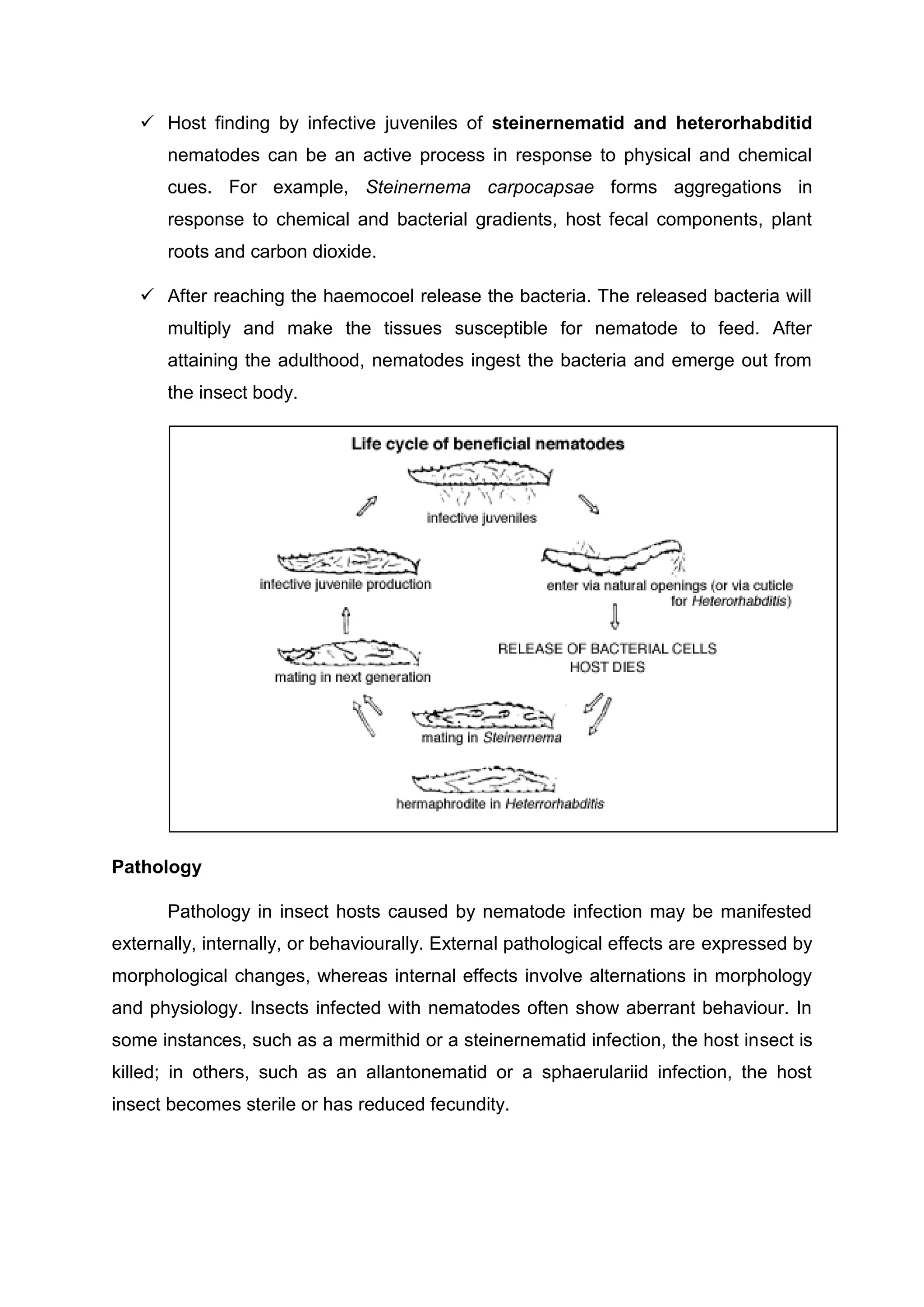
 After reaching the haemocoel release the bacteria. The released bacteria will
multiply and make the tissues susceptible for nematode to feed. After
attaining the adulthood, nematodes ingest the bacteria and emerge out from
the insect body.
Pathology
Pathology in insect hosts caused by nematode infection may be manifested
externally, internally, or behaviourally. External pathological effects are expressed by
morphological changes, whereas internal effects involve alternations in morphology
and physiology. Insects infected with nematodes often show aberrant behaviour. In
some instances, such as a mermithid or a steinernematid infection, the host insect is
killed; in others, such as an allantonematid or a sphaerulariid infection, the host
insect becomes sterile or has reduced fecundity.
Steinernematidae group
Representatives of this family offer much promist as biological control agents
because of their high virulence and broad host range. Steinernema carpocapsae,
for example, kills its hosts within 48 h and will infect many insect species in the
laboratory and field. A number of Steinernema species have been described from
natural infections of insects, and all have a mutualistic association with bacteria. The
bacteria, in the genus Xenorhabdus have been studied in great detail.
Heterorhabditidae group
Heterorhabditids have a similar life cycle to the steinernematids, but major
differences also exist. Infective juveniles, which invade the haemocoel, release the
bacterium Photorhabdus luminescens, killing the host within 48 h, and reach
adulthood rapidly.
5. ENTOMOPATHOGENIC PROTOZOA
The protozoa ("first animals") are a heterogeneous group of microorganisms
of very diverse characters, behaviour and life cycles. The protozoa, because of their
minute size, remained unobserved until the development of the microscope. Anton
van Leeuwenhoek (1632-1723), who produced lenses and built microscopes,
discovered free-living, fresh-water protozoa (Dobell, 1932). From the descriptions of
the animalcules provided by van Leeuwenhoek, Dobell (1932) believes that he
also observed coccidians in cats and flagellates in the digestive tract of the
horse fly (tabanid). Van Leeuwenhoek is generally recognized as the father of
protozoology for this observations on numerous protozoa.
Classification
Taxab Representative genera
Phylum Apicomplexa
Class Gregarinia
Order Eugregarinida
Gregarina, Ascogregarina
Order Microsporida
Mattesia, Farinocystis, Ophryocystis
Relation of protozoa to insects
There are about 1200 species of protozoa, out of about 15,000 described
species, that are associated with insects. The entomogenous protozoa are commonly
found in the digestive tracts of insects as commensals or they are in a mutualistic
association with insects. Some insects serve as vectors of protozoan diseases or
vertebrates and plants. In many of these cases the protozoa multiply in the insect
vectors and may even cause harm to some vectors. A great number of protozoa are
pathogenic to insects. The majority of the highly pathogenic forms occur in
Apicomplexa and Microsopora particularly those that invade the haemocoel and
develop intracellularly.
Portals of entry
 The majority of protozoa enter the insects by way of the mouth and digestive
tract. Penetration through the integument occurs in the ciliates.
 Those protozoa that remain in the lumen of the digestive tract are attached to
the epithelium, or enter appendages associated with the digestive tract and
generally cause no obvious pathology. These forms are mainly ciliates,
flagellates, and gregarines. Others penetrate into the haemocoel and exist
extracellular in the hemolymph or intracellularly within the cells of various
tissues and organs, and cause pathologies.
 They are mainly the apicomplexans and microsporidia.
Transmission
 Vertical transmission from parent to offspring occurs in many protozoa,
especially the microporidia.
 The transmission is transovum by way of the ovary (transovarial) or by
surface-contaminated eggs.
 The egg surfaces are contaminated from spore-containing faces of females
with protozoan – infected digestive tracts.
 These types of transovum transmissions are in addition to the common per os
route, and their significance, as a means of vertical transmission, varies
greatly with the protozoa and their hosts. Transmission through surface-
contaminated eggs is probably not important in regulating insect populations,
but transovarial transmission is often highly significant in the transmission of
microsporidia
Pathogenesis, signs, and symptoms
 Most entomopathogenic protozoa have low virulence and cause a chronic
infection that often does not kill an insect. Such a chronically infected insect
frequently does not exhibit marked external signs and symptoms (e.g., color
changes and abnormal movement or behaviour).
 Some protozoa, however, are highly virulent, and depending on the type of
tissues attacked, the infection may be acute and fatal. In some cases, the
infected insects become chlorotic or whitish, are reduced in size, and remain
in the immature stages much longer than the uninfected individuals.
 The enormous numbers of protozoan spores in the fat, midgut, or hemolymph
may cause these structures to turn milky white. The integument of dead
insects (mainly larvae) generally remains firm and does not readily
disintegrate.
 The intercellular forms usually occur in the cytoplasm. No toxins have been
detected in protozoan infections in insects, but Weiser (1961) has suggested
that toxins may be produced by microsporidia that cause tumorlike growths
and inflammatory responses in insects.
 Some protozoa exhibit tissue tropism and infect only certain tissues or organs
(e.g., certain microsporidia and neogregarines infect only midgut epithelium or
fat tissues). Others invade nearly all major tissues and organs to cause a
systemic infection.
 The members of class Microsporea are commonly called microsporidia. The
disease they cause is called microsporidiosis.
Hosts
About 700 species have been recorded from these hosts. Insects in nearly all
taxonomic orders are susceptible to microsporidia and over half of the hosts occur in
two orders, Lepidoptera and Diptera.
1. Nosema locustae (trade name: Nolo bait): Grasshoppers and desert locusts
2. Varimorpha necatrix-Noctuid pests
3. Nosema bombycis:Bombyx mori
4. Malpighamoeba locusate :Grasshoppers
5. Farinocystis triboli:Tribolium casataneum
Virulence: debilitative pathogen: it kills the insect in 30 days indirectly
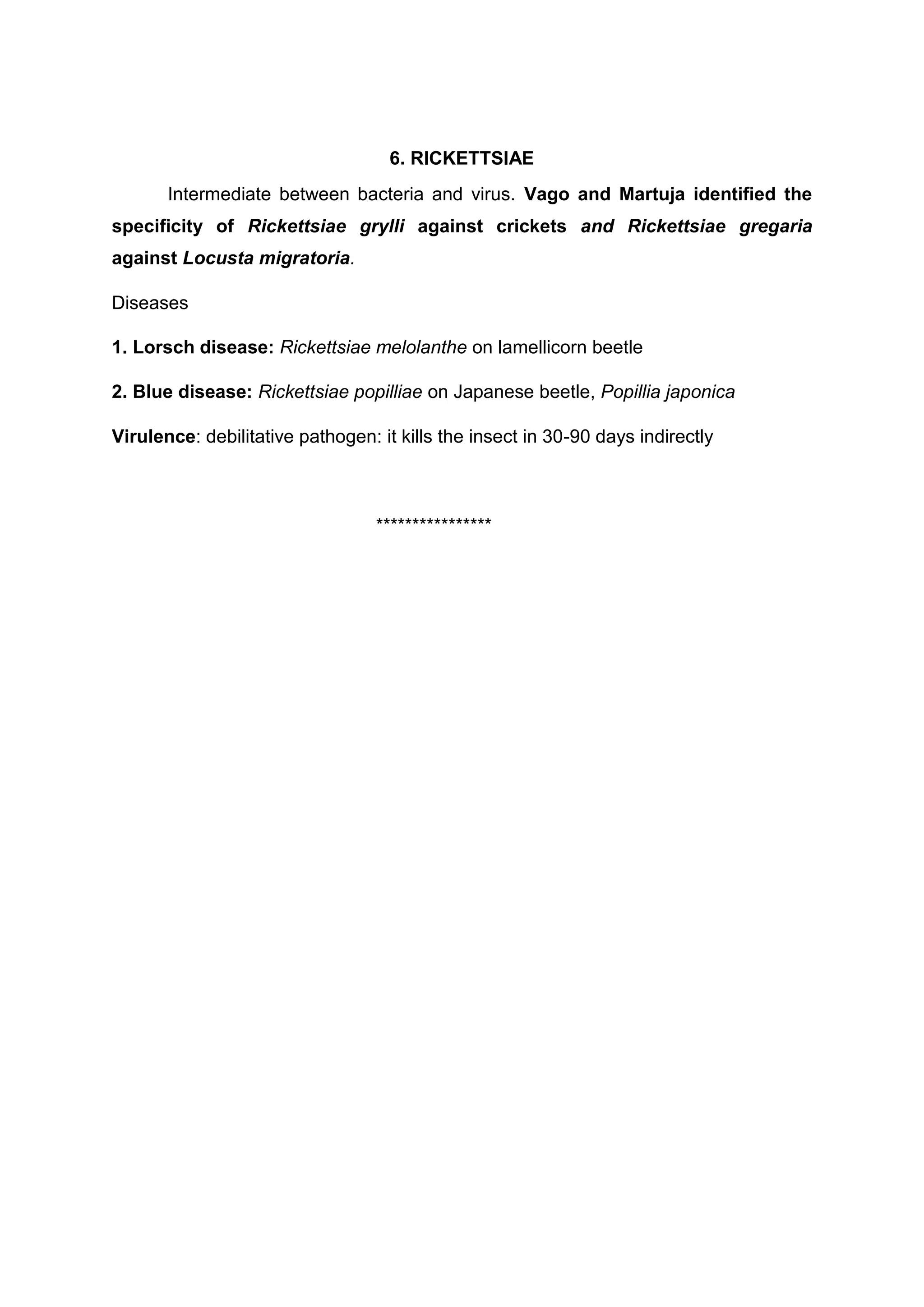
6. RICKETTSIAE
Intermediate between bacteria and virus. Vago and Martuja identified the
specificity of Rickettsiae grylli against crickets and Rickettsiae gregaria
against Locusta migratoria.
Diseases
1. Lorsch disease: Rickettsiae melolanthe on lamellicorn beetle
2. Blue disease: Rickettsiae popilliae on Japanese beetle, Popillia japonica
Virulence: debilitative pathogen: it kills the insect in 30-90 days indirectly
****************
LECTURE NO: 05&06
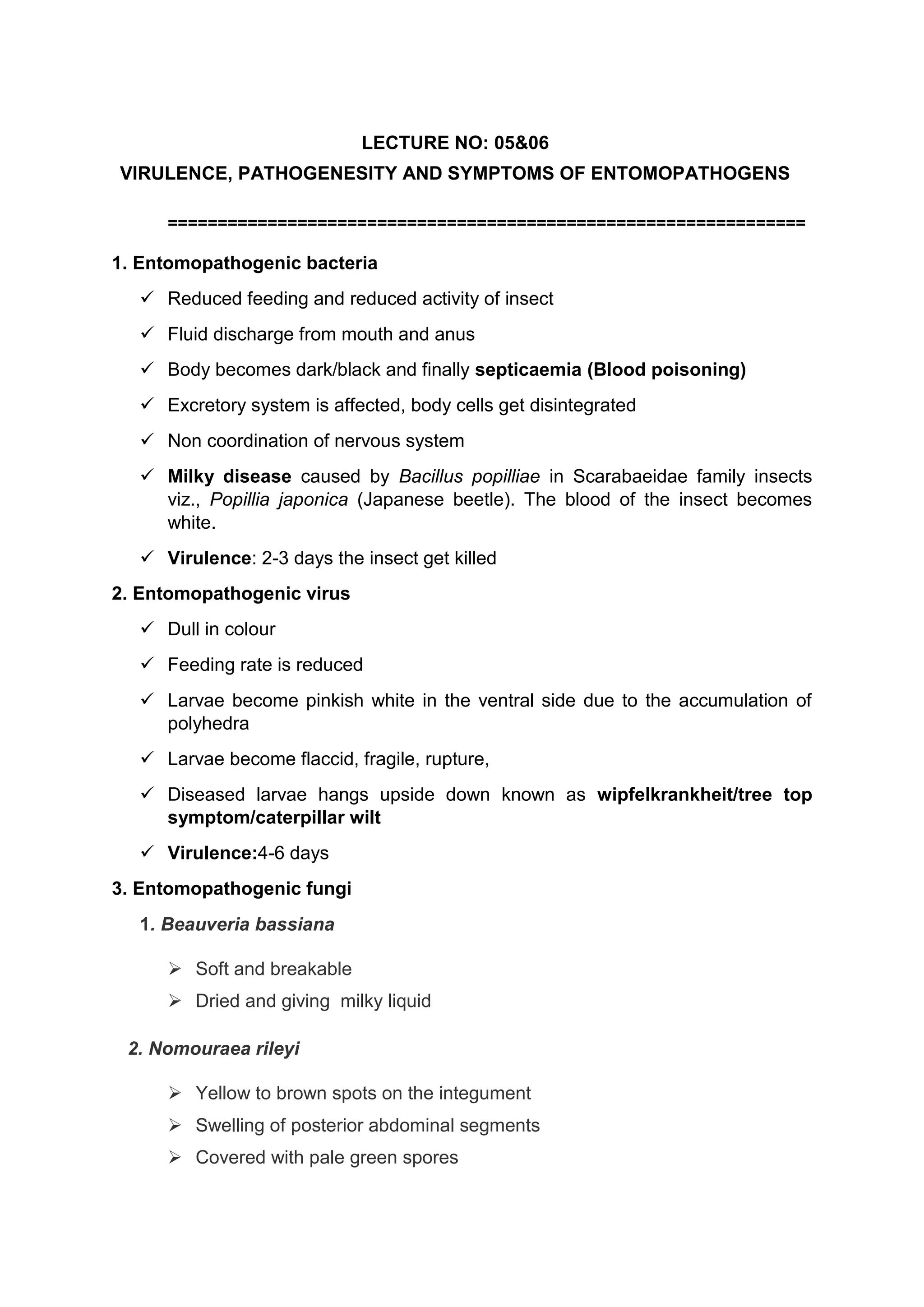
VIRULENCE, PATHOGENESITY AND SYMPTOMS OF ENTOMOPATHOGENS
================================================================
1. Entomopathogenic bacteria
 Reduced feeding and reduced activity of insect
 Fluid discharge from mouth and anus
 Body becomes dark/black and finally septicaemia (Blood poisoning)
 Excretory system is affected, body cells get disintegrated
 Non coordination of nervous system
 Milky disease caused by Bacillus popilliae in Scarabaeidae family insects
viz., Popillia japonica (Japanese beetle). The blood of the insect becomes
white.
 Virulence: 2-3 days the insect get killed
2. Entomopathogenic virus
 Dull in colour
 Feeding rate is reduced
 Larvae become pinkish white in the ventral side due to the accumulation of
polyhedra
 Larvae become flaccid, fragile, rupture,
 Diseased larvae hangs upside down known as wipfelkrankheit/tree top
symptom/caterpillar wilt
 Virulence:4-6 days
3. Entomopathogenic fungi
1. Beauveria bassiana
 Soft and breakable
 Dried and giving milky liquid
2. Nomouraea rileyi
 Yellow to brown spots on the integument
 Swelling of posterior abdominal segments
 Covered with pale green spores
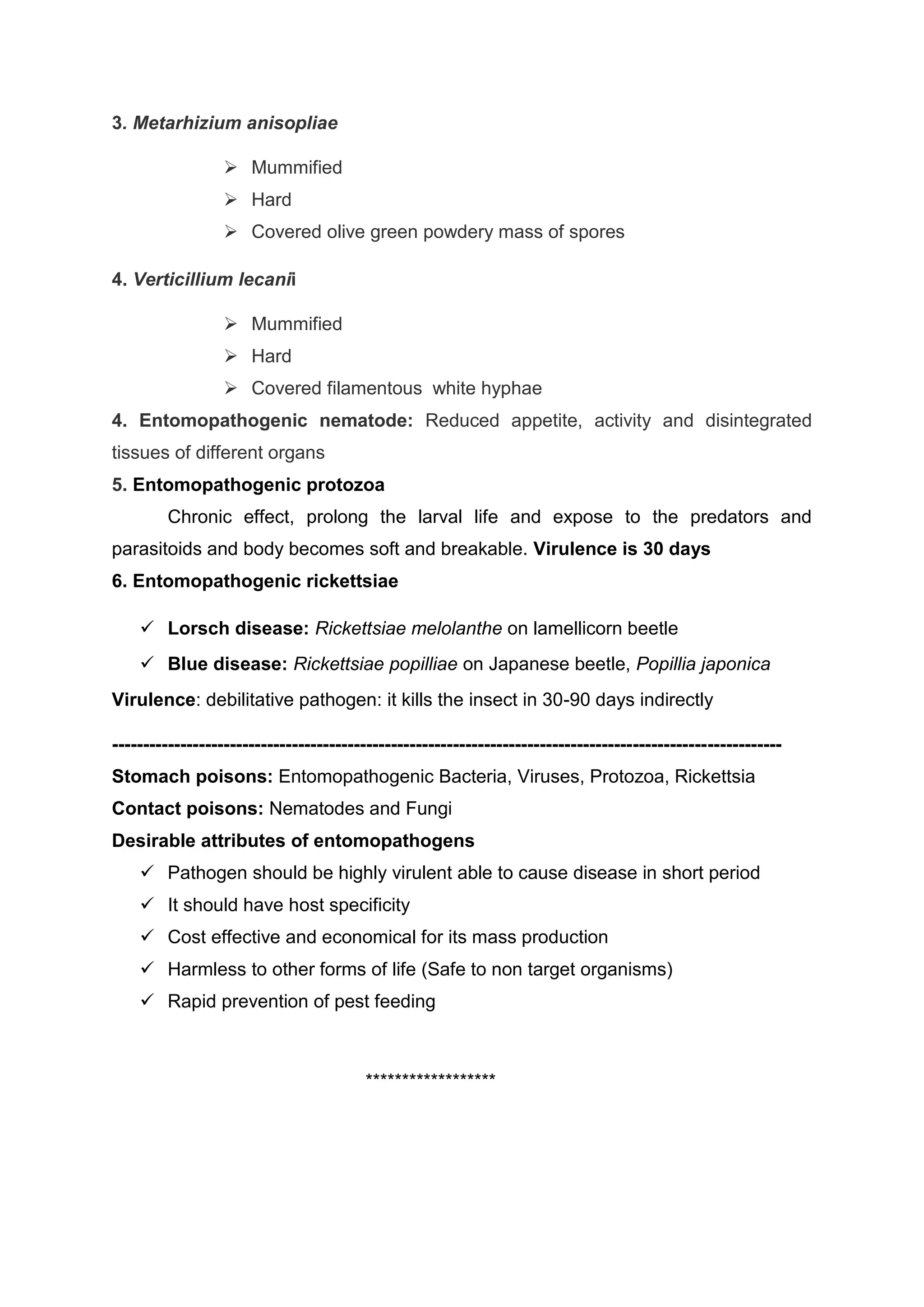
3. Metarhizium anisopliae
 Mummified
 Hard
 Covered olive green powdery mass of spores
4. Verticillium lecanii
 Mummified
 Hard
 Covered filamentous white hyphae
4. Entomopathogenic nematode: Reduced appetite, activity and disintegrated
tissues of different organs
5. Entomopathogenic protozoa
Chronic effect, prolong the larval life and expose to the predators and
parasitoids and body becomes soft and breakable. Virulence is 30 days
6. Entomopathogenic rickettsiae
 Lorsch disease: Rickettsiae melolanthe on lamellicorn beetle
 Blue disease: Rickettsiae popilliae on Japanese beetle, Popillia japonica
Virulence: debilitative pathogen: it kills the insect in 30-90 days indirectly
------------------------------------------------------------------------------------------------------------
Stomach poisons: Entomopathogenic Bacteria, Viruses, Protozoa, Rickettsia
Contact poisons: Nematodes and Fungi
Desirable attributes of entomopathogens
 Pathogen should be highly virulent able to cause disease in short period
 It should have host specificity
 Cost effective and economical for its mass production
 Harmless to other forms of life (Safe to non target organisms)
 Rapid prevention of pest feeding
******************
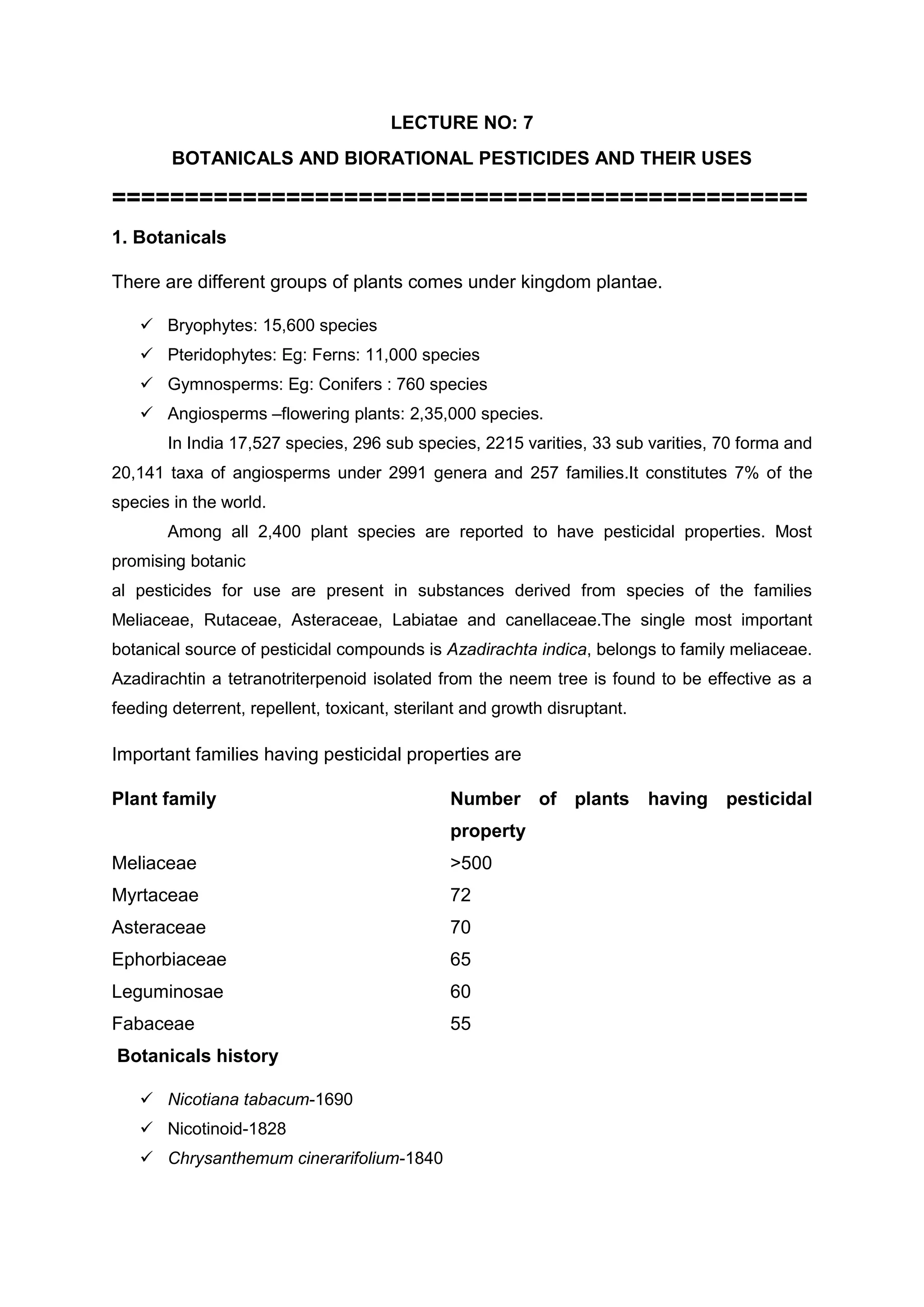
LECTURE NO: 7
BOTANICALS AND BIORATIONAL PESTICIDES AND THEIR USES
================================================
1. Botanicals
There are different groups of plants comes under kingdom plantae.
 Bryophytes: 15,600 species
 Pteridophytes: Eg: Ferns: 11,000 species
 Gymnosperms: Eg: Conifers : 760 species
 Angiosperms –flowering plants: 2,35,000 species.
In India 17,527 species, 296 sub species, 2215 varities, 33 sub varities, 70 forma and
20,141 taxa of angiosperms under 2991 genera and 257 families.It constitutes 7% of the
species in the world.
Among all 2,400 plant species are reported to have pesticidal properties. Most
promising botanic
al pesticides for use are present in substances derived from species of the families
Meliaceae, Rutaceae, Asteraceae, Labiatae and canellaceae.The single most important
botanical source of pesticidal compounds is Azadirachta indica, belongs to family meliaceae.
Azadirachtin a tetranotriterpenoid isolated from the neem tree is found to be effective as a
feeding deterrent, repellent, toxicant, sterilant and growth disruptant.
Important families having pesticidal properties are
Plant family Number of plants having pesticidal
property
Meliaceae >500
Myrtaceae 72
Asteraceae 70
Ephorbiaceae 65
Leguminosae 60
Fabaceae 55
Botanicals history
 Nicotiana tabacum-1690
 Nicotinoid-1828
 Chrysanthemum cinerarifolium-1840
 Derris, Lonchocorpus-1848
 Rotenone-1895
 Acorus calamus-1942
 Azadirachta indica-1962
 Synthetic pyrethroid-1977
Major botanical products:
 Pyrethrum
 Rotenone
 Neem
 Essential oils
Others in limited use
 Ryania
 Nicotine
 Sabadilla
Additional plant extracts and oils
 Garlic oils
 Capsicum oleoresin
1. Indian neem tree
 Neem is native to India and Burma
 The active ingradients is a mixture of Azadirachtin, melantriol, salannin, nimbin and
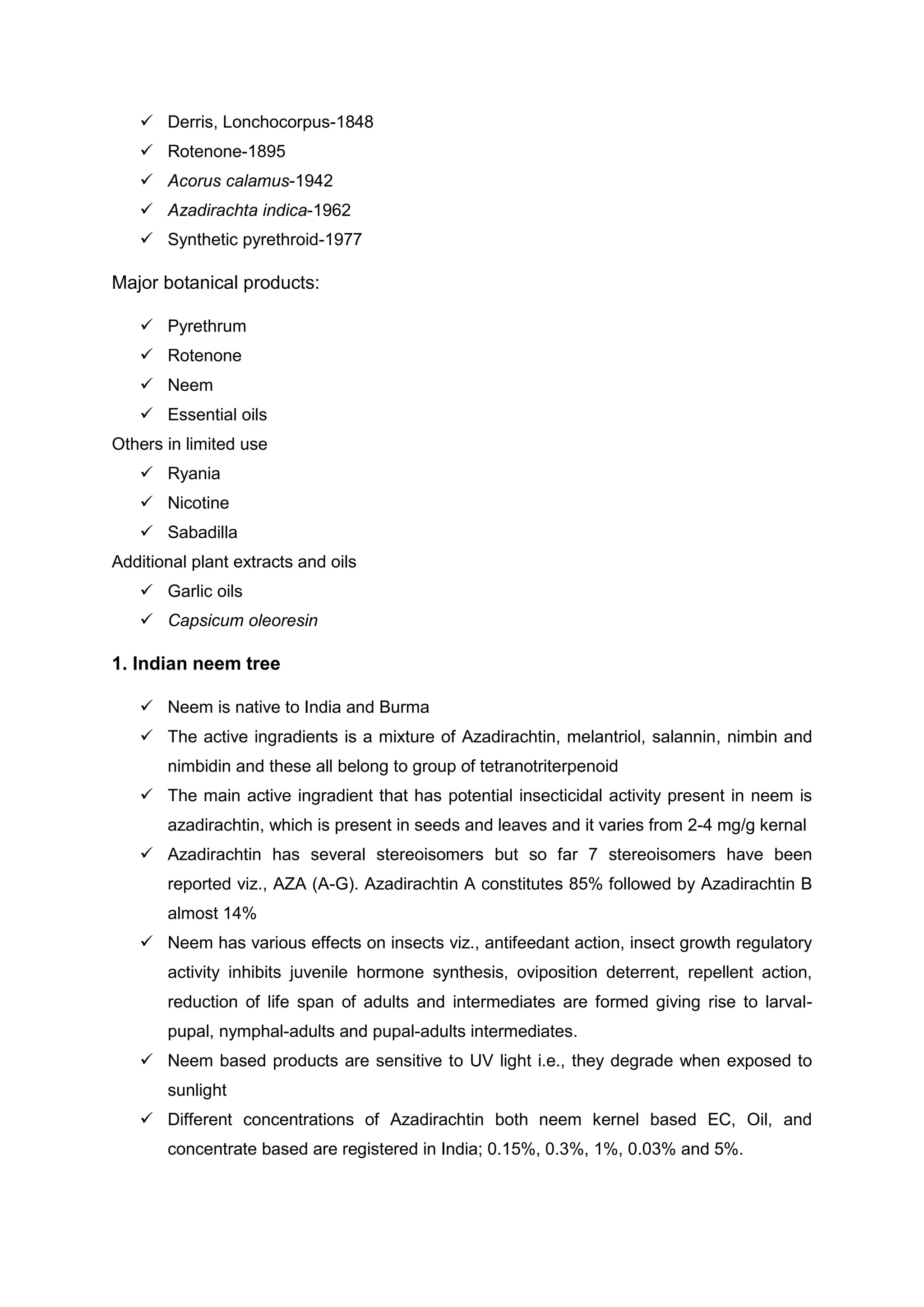
nimbidin and these all belong to group of tetranotriterpenoid
 The main active ingradient that has potential insecticidal activity present in neem is
azadirachtin, which is present in seeds and leaves and it varies from 2-4 mg/g kernal
 Azadirachtin has several stereoisomers but so far 7 stereoisomers have been
reported viz., AZA (A-G). Azadirachtin A constitutes 85% followed by Azadirachtin B
almost 14%
 Neem has various effects on insects viz., antifeedant action, insect growth regulatory
activity inhibits juvenile hormone synthesis, oviposition deterrent, repellent action,
reduction of life span of adults and intermediates are formed giving rise to larval-
pupal, nymphal-adults and pupal-adults intermediates.
 Neem based products are sensitive to UV light i.e., they degrade when exposed to
sunlight
 Different concentrations of Azadirachtin both neem kernel based EC, Oil, and
concentrate based are registered in India; 0.15%, 0.3%, 1%, 0.03% and 5%.
 The commercial insecticides of neem available in market are based on neem seed
kernel extract (NSKE) some of products are commonly used are Gronim, Neemazal,
Achook, Nimbecedine.
2. Rotenone
 It is resin derived from roots of leguminous plants Lonchocarpus spp.
(South American plant) and Derris eliptica (Malaysia)
 It is a broad spectrum and stomach poison
 It effects nerve and muscle cells in insects ab sometimes causes insects to stop
feeding
 It inhibits respiratory metabolism
 It is used as dusts containing 0.75-1.5% rotenone and effective against beetle and
caterpillars
 It is extremely toxic to fish
3. Sabadilla
 It is an alkaloid found in seeds of tropical lily, Schoenocaulon officinale
(Family:Liliaceae)
 The alkaloids mainly ceyadine and veratridine act as nerve poisons
 It is a primarily contact poison
 Sabadilla is harmful to pollinators and honey bees
5. Ryanodine
 It is an alkaloid derived from woody stems of South American shrub, Ryania speciosa
(Family: Flacourtaceae)
 It acts as muscular poison by blocking the conversion of ADP to ATP in striated
muscles
 It acts as slow acting stomach poison and causes insects to stop feeding after they
eat it
 It is reportedly effective against thrips and worms
 It is used as dust (20-40%)
6. Nicotine
 Nicotine is obtained from tobacco plants, Nicotiana tobaccum, N. rustica (Family:
Solanaceae)
 Activity: Mimics acetylcholine in the nerve synapse causing tremors, loss of
coordination and eventually death.
 It is extremely fast acting, causing sever disruption and failure of nervous system
 Sold commercially as a fumigant Nicotine or as a dust (Nicotine Suphate)
 It is commercially avaible as nicotine sulphate 40 % (Black Leaf 40) and
manufactured in India only for export purpose
 It acts as contact poison
 It is effective against soft bodied sucking insects like thrips, leafhoppers, mealybugs
and leaf miners
Mode of action
The nicotine resembles the mode of action of Neonicotinoids. The molecules would
go and bind the acytylcholine receptors. The Ach (Acetyl choline) released from the vesicles
of the presynaptic neuron and accumulate in the synoptic junction and unable to degrade by
the Ach esterase enzyme leads to accumulate in the synoptic junction. The continuous flow
of the Na+ into the post synoptic neuron leads continuous depolarisation, repetitive impulse
conduction and loss of energy that leads to the death of the insect.
For clear understanding follow the given link
https://youtu.be/yZTax0Z6uR4
7. Pyrethrum
 Pyrethrum refers to powdered dried flowers of Chrysanthemum cinerarifolium and
pyrethrins are all toxic constituents of the pyrethrum flowers and pyrethroids are the
synthetic analogues of pyrethrins
 Pyrethrum is occupied 80% global botanical insecticide market
 Chrysanthemum cinerarifolium is native of Dalmatian mountains, Croatia
 Kenya is a largest producer of pyrethrum
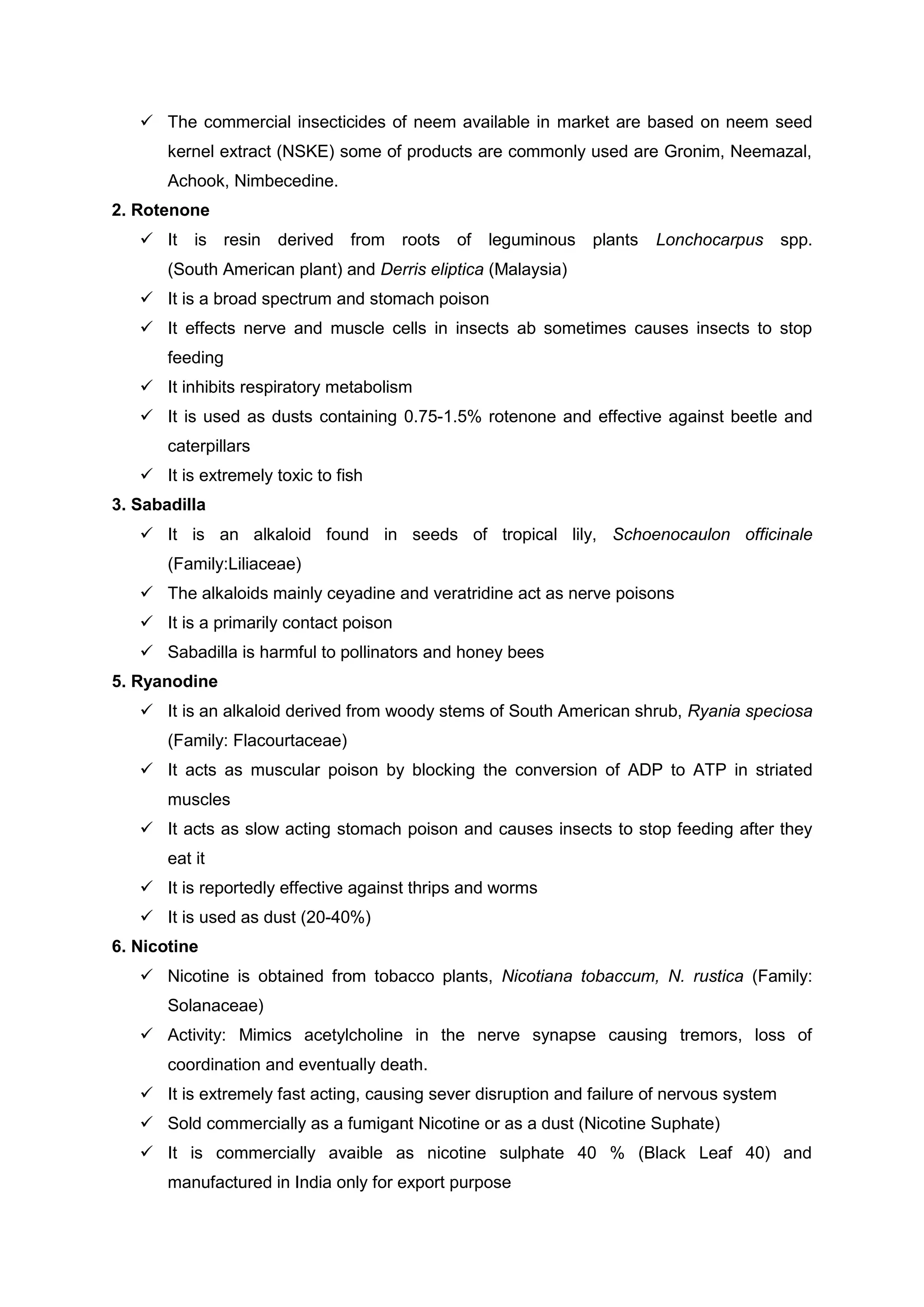
 Pyrethrins are esters formed by combination of two acids i.e., chrysanthemic acid
and pyrethric acid with three alcohols namely pyrethrolone, cinerolone and
jasmolone. The esters of chrysanthemic acid are pyrethrin I, Cinerin I and Jasmolin I
and are combined together known as pyrethrins I. The esters of pyrethric acid are
pyrethrin II, Cinerin II and jasmolin II and are together known as pyrethrins II. These
six active principles together are responsible for toxicity and knockdown action.
Pyrethrins Acid Alcohol
Pyrethrin I Chrysanthemic acid Pyrethrolone
Pyrethrin II Pyrethric acid Pyrethrolone
Cinerin I Chrysanthemic acid Cinerolone
Cinerin II Pyrethric acid Cinerolone
Jasmolin I Chrysanthemic acid Jasmolone
Jasmolin II Pyrethric acid Jasmolone
 Pyrethrins mode of action is similar to DDT and has fast acting knock down effect
 It breaks down quickly from sunlight
 The commonly used synergist to synergies pyrethrins is piperonyl butoxide (PBO)
The major pyrethrins producing species are:
 Chrysanthemum cinerarifolium
 Chrysanthemum cocineum
 Chrysanthemum roseum
 Chrysanthemum marshal
 Chrysanthemum tamrentene
The pyrethrins extracted are photodegradable. In order to keep stability in the
structure of the pyrethrins the molecular formula observed and substituted with different
molecules
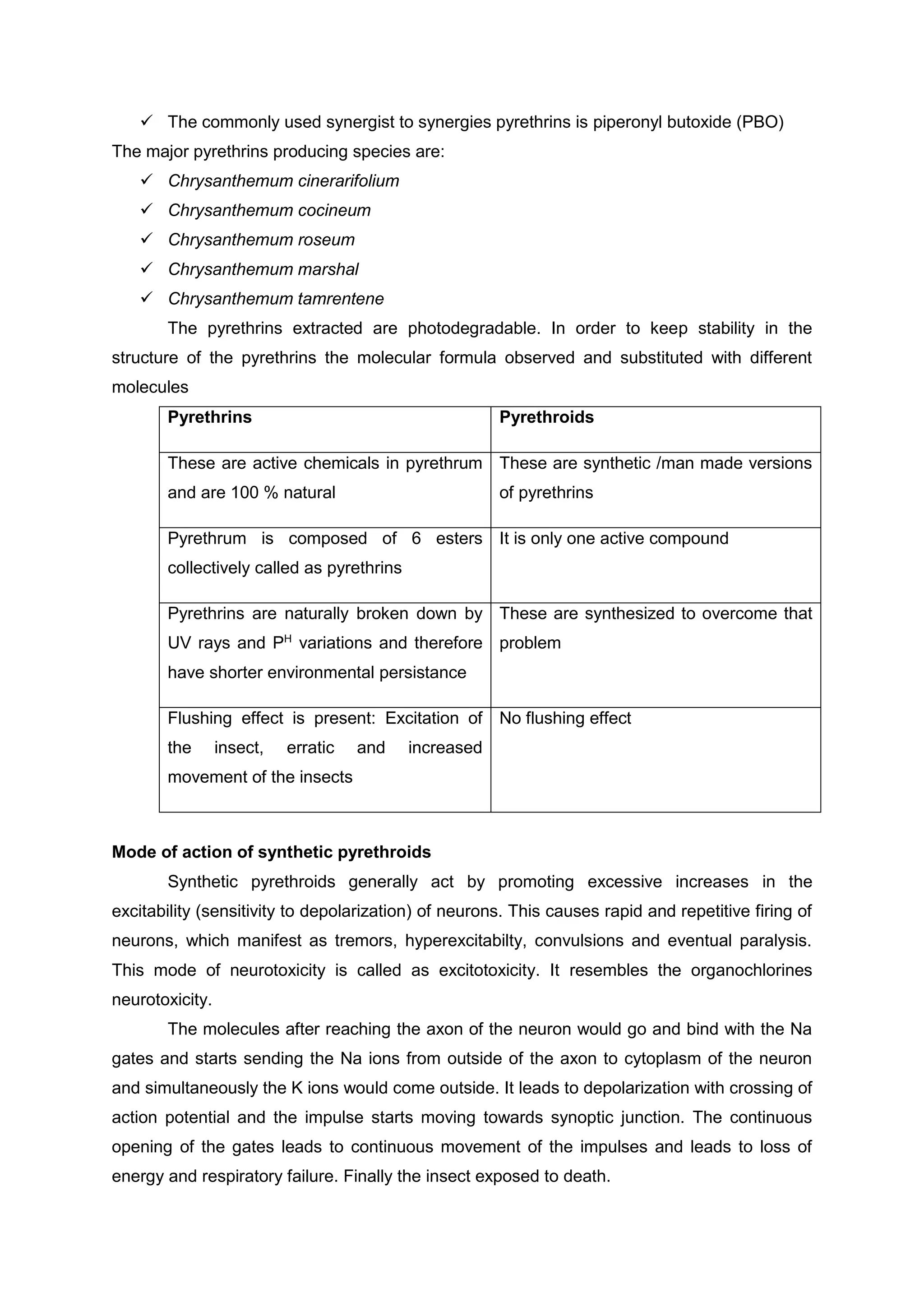
Pyrethrins Pyrethroids
These are active chemicals in pyrethrum
and are 100 % natural
These are synthetic /man made versions
of pyrethrins
Pyrethrum is composed of 6 esters
collectively called as pyrethrins
It is only one active compound
Pyrethrins are naturally broken down by
UV rays and PH
variations and therefore
have shorter environmental persistance
These are synthesized to overcome that
problem
Flushing effect is present: Excitation of
the insect, erratic and increased
movement of the insects
No flushing effect
Mode of action of synthetic pyrethroids
Synthetic pyrethroids generally act by promoting excessive increases in the
excitability (sensitivity to depolarization) of neurons. This causes rapid and repetitive firing of
neurons, which manifest as tremors, hyperexcitabilty, convulsions and eventual paralysis.
This mode of neurotoxicity is called as excitotoxicity. It resembles the organochlorines
neurotoxicity.
The molecules after reaching the axon of the neuron would go and bind with the Na
gates and starts sending the Na ions from outside of the axon to cytoplasm of the neuron
and simultaneously the K ions would come outside. It leads to depolarization with crossing of
action potential and the impulse starts moving towards synoptic junction. The continuous
opening of the gates leads to continuous movement of the impulses and leads to loss of
energy and respiratory failure. Finally the insect exposed to death.
For clear understanding follow the given link
https://youtu.be/8X31U9xyqDw
8. Limonene and linanool
 These are citrus peel extracts which cause insect paralysis.
 They evaporate quickly in environment and are used to control aphids, mites and
fleas
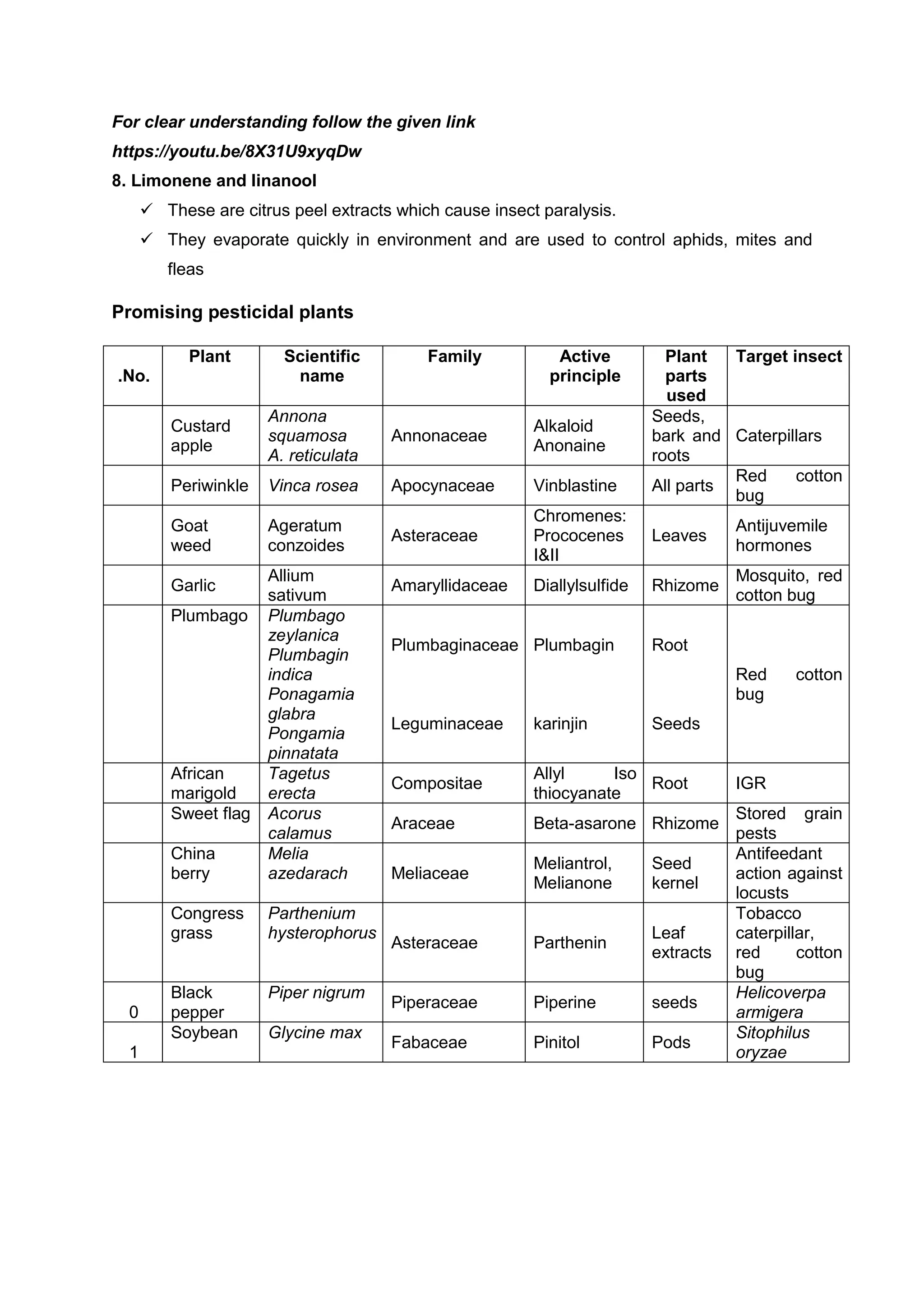
Promising pesticidal plants
S
.No.
Plant Scientific
name
Family Active
principle
Plant
parts
used
Target insect
1
Custard
apple
Annona
squamosa
A. reticulata
Annonaceae
Alkaloid
Anonaine
Seeds,
bark and
roots
Caterpillars
2
Periwinkle Vinca rosea Apocynaceae Vinblastine All parts
Red cotton
bug
3
Goat
weed
Ageratum
conzoides
Asteraceae
Chromenes:
Prococenes
I&II
Leaves
Antijuvemile
hormones
4
Garlic
Allium
sativum
Amaryllidaceae Diallylsulfide Rhizome
Mosquito, red
cotton bug
5
Plumbago Plumbago
zeylanica
Plumbagin
indica
Ponagamia
glabra
Pongamia
pinnatata
Plumbaginaceae
Leguminaceae
Plumbagin
karinjin
Root
Seeds
Red cotton
bug
6
African
marigold
Tagetus
erecta
Compositae
Allyl Iso
thiocyanate
Root IGR
7
Sweet flag Acorus
calamus
Araceae Beta-asarone Rhizome
Stored grain
pests
8
China
berry
Melia
azedarach Meliaceae
Meliantrol,
Melianone
Seed
kernel
Antifeedant
action against
locusts
9
Congress
grass
Parthenium
hysterophorus
Asteraceae Parthenin
Leaf
extracts
Tobacco
caterpillar,
red cotton
bug
1
0
Black
pepper
Piper nigrum
Piperaceae Piperine seeds
Helicoverpa
armigera
1
1
Soybean Glycine max
Fabaceae Pinitol Pods
Sitophilus
oryzae
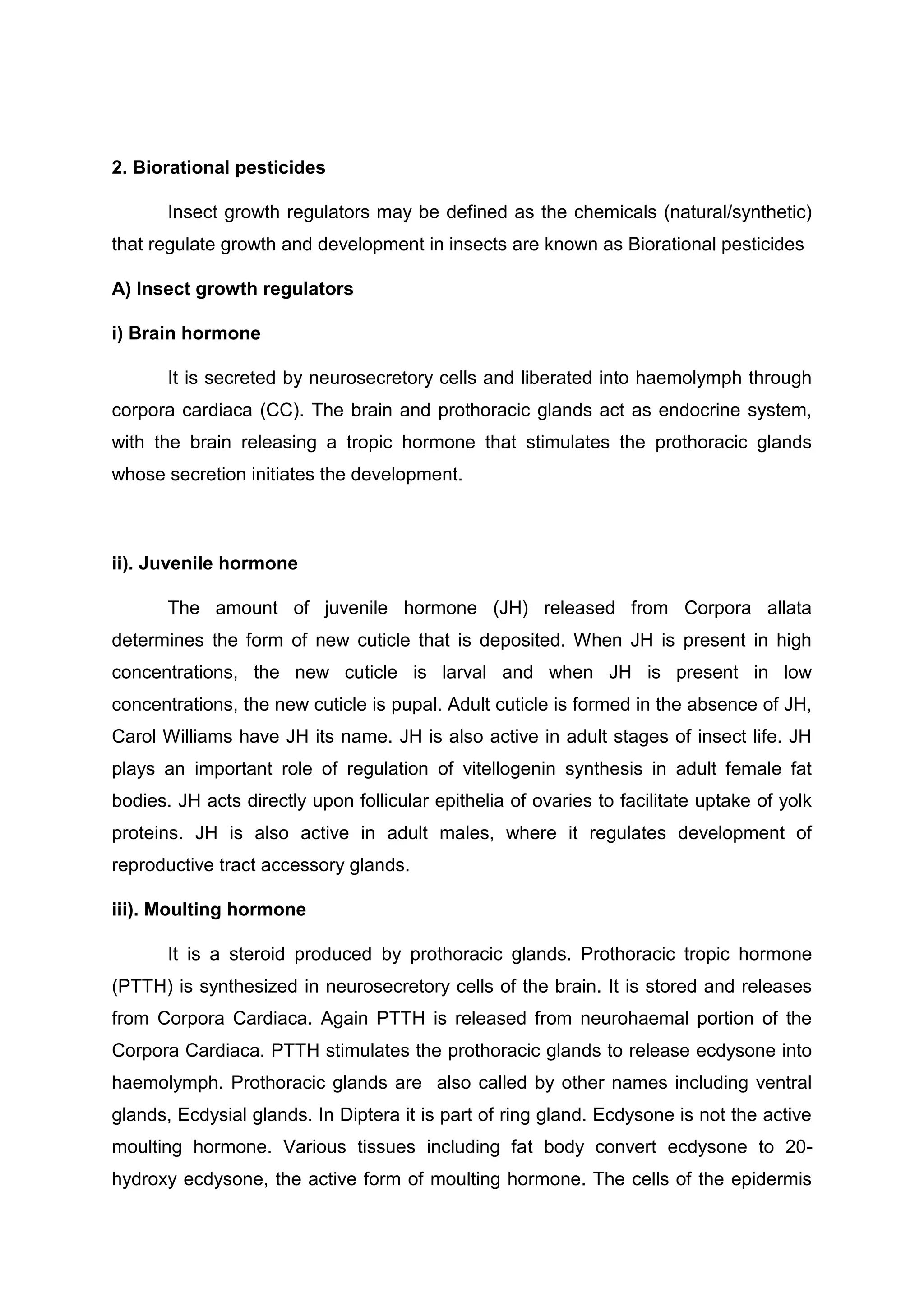
2. Biorational pesticides
Insect growth regulators may be defined as the chemicals (natural/synthetic)
that regulate growth and development in insects are known as Biorational pesticides
A) Insect growth regulators
i) Brain hormone
It is secreted by neurosecretory cells and liberated into haemolymph through
corpora cardiaca (CC). The brain and prothoracic glands act as endocrine system,
with the brain releasing a tropic hormone that stimulates the prothoracic glands
whose secretion initiates the development.
ii). Juvenile hormone
The amount of juvenile hormone (JH) released from Corpora allata
determines the form of new cuticle that is deposited. When JH is present in high
concentrations, the new cuticle is larval and when JH is present in low
concentrations, the new cuticle is pupal. Adult cuticle is formed in the absence of JH,
Carol Williams have JH its name. JH is also active in adult stages of insect life. JH
plays an important role of regulation of vitellogenin synthesis in adult female fat
bodies. JH acts directly upon follicular epithelia of ovaries to facilitate uptake of yolk
proteins. JH is also active in adult males, where it regulates development of
reproductive tract accessory glands.
iii). Moulting hormone
It is a steroid produced by prothoracic glands. Prothoracic tropic hormone
(PTTH) is synthesized in neurosecretory cells of the brain. It is stored and releases
from Corpora Cardiaca. Again PTTH is released from neurohaemal portion of the
Corpora Cardiaca. PTTH stimulates the prothoracic glands to release ecdysone into
haemolymph. Prothoracic glands are also called by other names including ventral
glands, Ecdysial glands. In Diptera it is part of ring gland. Ecdysone is not the active
moulting hormone. Various tissues including fat body convert ecdysone to 20-
hydroxy ecdysone, the active form of moulting hormone. The cells of the epidermis
respond to 20-hydroxy ecdysone with initiation of the process of moulting.
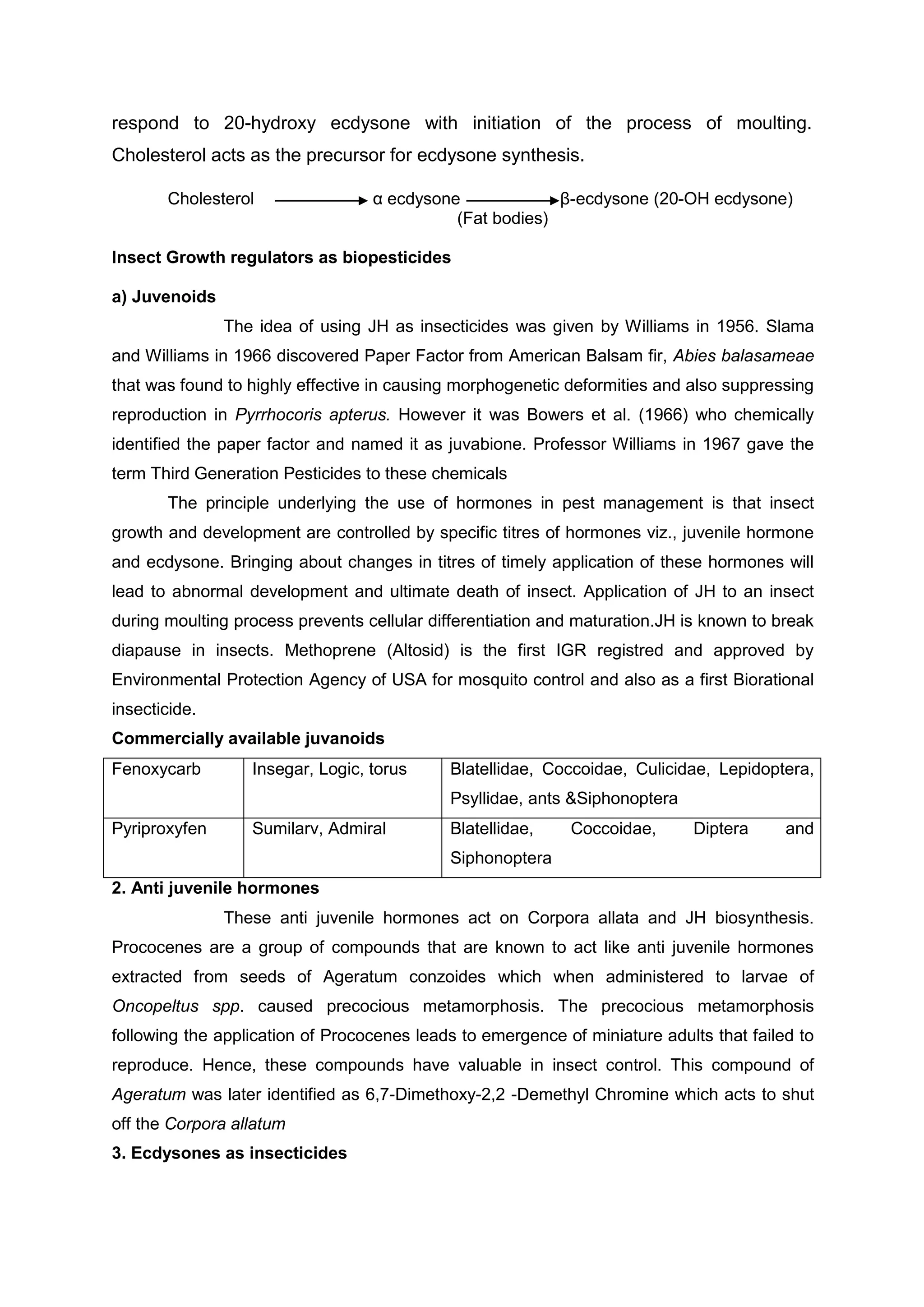
Cholesterol acts as the precursor for ecdysone synthesis.
Cholesterol α ecdysone β-ecdysone (20-OH ecdysone)
(Fat bodies)
Insect Growth regulators as biopesticides
a) Juvenoids
The idea of using JH as insecticides was given by Williams in 1956. Slama
and Williams in 1966 discovered Paper Factor from American Balsam fir, Abies balasameae
that was found to highly effective in causing morphogenetic deformities and also suppressing
reproduction in Pyrrhocoris apterus. However it was Bowers et al. (1966) who chemically
identified the paper factor and named it as juvabione. Professor Williams in 1967 gave the
term Third Generation Pesticides to these chemicals
The principle underlying the use of hormones in pest management is that insect
growth and development are controlled by specific titres of hormones viz., juvenile hormone
and ecdysone. Bringing about changes in titres of timely application of these hormones will
lead to abnormal development and ultimate death of insect. Application of JH to an insect
during moulting process prevents cellular differentiation and maturation.JH is known to break
diapause in insects. Methoprene (Altosid) is the first IGR registred and approved by
Environmental Protection Agency of USA for mosquito control and also as a first Biorational
insecticide.
Commercially available juvanoids
Fenoxycarb Insegar, Logic, torus Blatellidae, Coccoidae, Culicidae, Lepidoptera,
Psyllidae, ants &Siphonoptera
Pyriproxyfen Sumilarv, Admiral Blatellidae, Coccoidae, Diptera and
Siphonoptera
2. Anti juvenile hormones
These anti juvenile hormones act on Corpora allata and JH biosynthesis.
Prococenes are a group of compounds that are known to act like anti juvenile hormones
extracted from seeds of Ageratum conzoides which when administered to larvae of
Oncopeltus spp. caused precocious metamorphosis. The precocious metamorphosis
following the application of Prococenes leads to emergence of miniature adults that failed to
reproduce. Hence, these compounds have valuable in insect control. This compound of
Ageratum was later identified as 6,7-Dimethoxy-2,2 -Demethyl Chromine which acts to shut
off the Corpora allatum
3. Ecdysones as insecticides
Karlson and Butenandt (1954) isolated pure crystalline moulting hormone,
ecdysone from silk worm pupae. After a decade Naka Nishi et al., isolated a steroid
Ponasterone–A from Podocarpus nakaii
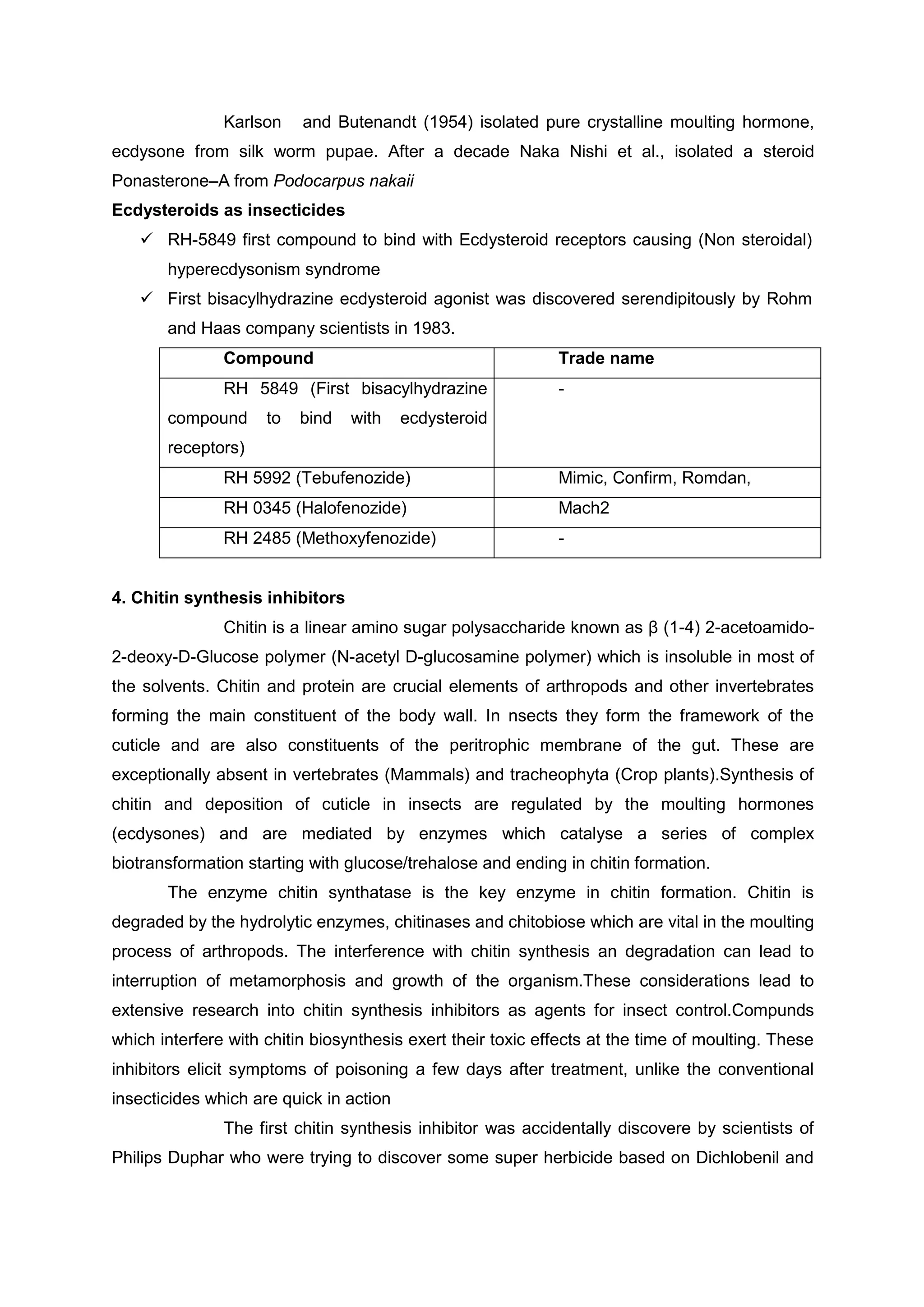
Ecdysteroids as insecticides
 RH-5849 first compound to bind with Ecdysteroid receptors causing (Non steroidal)
hyperecdysonism syndrome
 First bisacylhydrazine ecdysteroid agonist was discovered serendipitously by Rohm
and Haas company scientists in 1983.
Compound Trade name
RH 5849 (First bisacylhydrazine
compound to bind with ecdysteroid
receptors)
-
RH 5992 (Tebufenozide) Mimic, Confirm, Romdan,
RH 0345 (Halofenozide) Mach2
RH 2485 (Methoxyfenozide) -
4. Chitin synthesis inhibitors
Chitin is a linear amino sugar polysaccharide known as β (1-4) 2-acetoamido-
2-deoxy-D-Glucose polymer (N-acetyl D-glucosamine polymer) which is insoluble in most of
the solvents. Chitin and protein are crucial elements of arthropods and other invertebrates
forming the main constituent of the body wall. In nsects they form the framework of the
cuticle and are also constituents of the peritrophic membrane of the gut. These are
exceptionally absent in vertebrates (Mammals) and tracheophyta (Crop plants).Synthesis of
chitin and deposition of cuticle in insects are regulated by the moulting hormones
(ecdysones) and are mediated by enzymes which catalyse a series of complex
biotransformation starting with glucose/trehalose and ending in chitin formation.
The enzyme chitin synthatase is the key enzyme in chitin formation. Chitin is
degraded by the hydrolytic enzymes, chitinases and chitobiose which are vital in the moulting
process of arthropods. The interference with chitin synthesis an degradation can lead to
interruption of metamorphosis and growth of the organism.These considerations lead to
extensive research into chitin synthesis inhibitors as agents for insect control.Compunds
which interfere with chitin biosynthesis exert their toxic effects at the time of moulting. These
inhibitors elicit symptoms of poisoning a few days after treatment, unlike the conventional
insecticides which are quick in action
The first chitin synthesis inhibitor was accidentally discovere by scientists of
Philips Duphar who were trying to discover some super herbicide based on Dichlobenil and
Diuron. It was found that 1-(2,6-dichlobenzoyl)-3-(3,4-dichlorophenyl) (DU19111) possessed
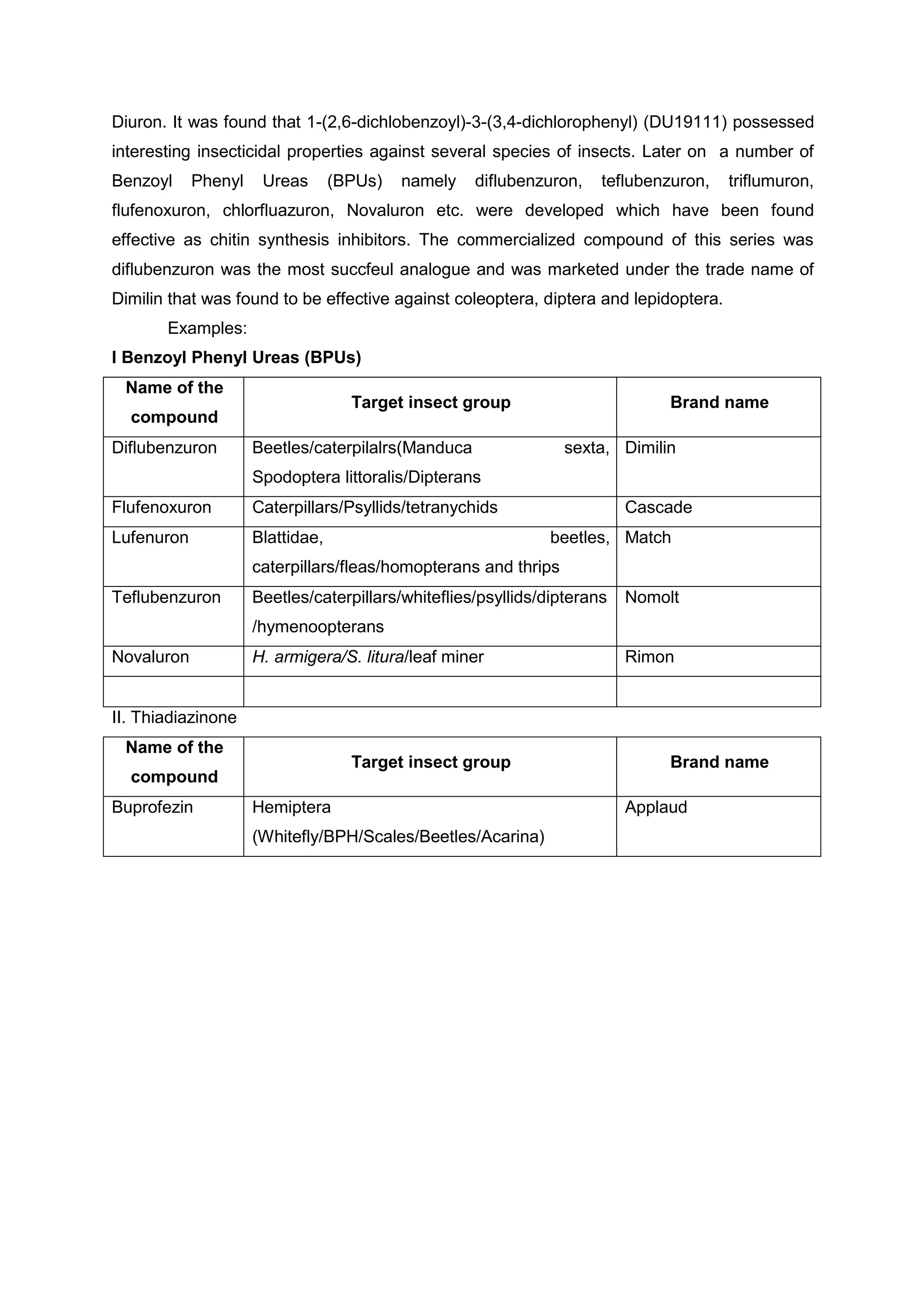
interesting insecticidal properties against several species of insects. Later on a number of
Benzoyl Phenyl Ureas (BPUs) namely diflubenzuron, teflubenzuron, triflumuron,
flufenoxuron, chlorfluazuron, Novaluron etc. were developed which have been found
effective as chitin synthesis inhibitors. The commercialized compound of this series was
diflubenzuron was the most succfeul analogue and was marketed under the trade name of
Dimilin that was found to be effective against coleoptera, diptera and lepidoptera.
Examples:
I Benzoyl Phenyl Ureas (BPUs)
Name of the
compound
Target insect group Brand name
Diflubenzuron Beetles/caterpilalrs(Manduca sexta,
Spodoptera littoralis/Dipterans
Dimilin
Flufenoxuron Caterpillars/Psyllids/tetranychids Cascade
Lufenuron Blattidae, beetles,
caterpillars/fleas/homopterans and thrips
Match
Teflubenzuron Beetles/caterpillars/whiteflies/psyllids/dipterans
/hymenoopterans
Nomolt
Novaluron H. armigera/S. litura/leaf miner Rimon
II. Thiadiazinone
Name of the
compound
Target insect group Brand name
Buprofezin Hemiptera
(Whitefly/BPH/Scales/Beetles/Acarina)
Applaud
LECTURE NO: 7
ROLE OF BIOPESTICIDES IN ORGANIC FARMING
===================================================================================================
Biopesticides are competent enough to control the insect pests of different crops. The following are the different
entomopathogens used in different crop ecosystems
Crop Bioagents Dosage/ha Frequency of
application
Application method Remarks
ENTOMOPATHOGENS
1. Sugarcane
Shoot borer,
Chilo infuscatellus
Granulovirus 250LE or 750
virosed larvae
(106-107)
First spray on day 30
of crop growth
subsequent sprays at
15 days intervals
250LE or 750 virosed
larvae (106-107)
+0.05%sandovit are
mixed in 200l water
and sprayed
Spraying is done in
the evening hours,
number of sprays
are decided based
on pest population
White grub,
Holotrichia
consanguinea
Paenibacillus
popilliae
0.5 kg Once at the time of
planting
For proper
distribution of spores,
2g spore dust
(containing 200
million spores) is
deposited with a
spacing of 3.05 m
(10feet)
In endemic areas a
higher dosage of
1kg/ha could be
applied
White grub,
Holotrichia
consanguinea
Metarhizium
anisopliae
42.5X10¹⁰
spores/m3
Once at the time of
planting
Required quantity of
spores is directly
applied or mixed with
0.05%sandovit and a
water suspension is
prepared for applying
in furrows.
Entomofungus is
more effective in
irrigated fields
2.Cotton
American bollworm,
Helicoverpa
armigera
Ha NPV 1.5-3.0X 10¹²
POBs/ha (250-
500LE)
2-4 sprays Apply along with 1%
jaggery and
0.1%ranipal at ETL 7
II instar larvae/20
plants
Spray in the
morning/evening,
add permitted
adjuvant and
spreaders and
ensure proper
coverage.
Leaf eating
caterpillars,
Spodoptera litura
Sl NPV 1.5-3.0X 10¹²
POBs/ha (250-
500LE)
2-4 sprays Apply along with
0.025 %boric/tannic
acid (or along with
0.5%jaggery and
0.1% ranipal (at ETL
of 20 II instar
larvae/20 plants
Spray in the
morning/evening,
add permitted
adjuvant and
spreaders and
ensure proper
coverage.
3. Tobacco
Spodoptera litura Sl NPV 1.5-3.0X 10¹²
POBs/ha (250-
500LE)
3-5 sprays Generally 250 LE
mixed in 125 litres
water, 1% jaggery
and 0.1% teepol/ha
and sprayed with
knapsack sprayer for
nursery 3 times at
fornightly
intervals.Subsequent
sprays could be
altered with 2% neem
seed kernel sprays
One planted crop
sprays of 500 LE/Ha
in 200-400 litres of
water, 1% crude
sugar and 0.01%
teepol are given at
7-10 days intervals
spray in the
afternoon add
permitted adjuvant
and spreaders and
ensure proper
coverage to get best
results.
American bollworm,
Helicoverpa
Ha NPV 1.5-3.0X 10¹²
POBs/ha (250-
1 or 2 well timed
applications directed
Apply along with
1%jaggery and
spray in the
morning/evening
armigera 500LE) on the inflorescence to
protect the seed crop.
0.1%ranipal with
knapsack sprayer
add permitted
adjuvant and
spreaders and
ensure proper
coverage to get best
results.Using
Nicotiana rustica,
Tagetus erecta or
chickpea as border
trap crop and
spraying the same
with Ha NPV or Bt
also gives good
results.In endemic
areas 4 sprays may
be required at
capsule formation
stage.
4. Pigeon Pea/Chickpea/Field Bean
American bollworm,
Helicoverpa
armigera
Ha NPV 1.5X10¹²
POBs/ha on
chickpea and
filed beans and
3.0X 10¹²
POBs/Ha
(500LE) on
pigeon pea
3-4 sprays Apply along with
1%jaggery and
0.1%ranipal with
knapsack sprayer
add permitted
adjuvant and
spreaders and
ensure proper
coverage to get best
results
5. Pigeon pea and lab lab
Adisura atkinsoni AaNPV 1.5X10¹²
POBs/ha (250
LE) on lab lab
and 3.0X 10¹²
First spray at the peak
of egg hatching at the
tender stage followed
by 2 more need based
Spraying with
knapsack sprayer
spray in the
morning/evening
add permitted
adjuvant and
POBs/Ha
(500LE) on
pigeon pea
sprays at weekly
intervals
spreaders and
ensure proper
coverage to get best
results
6.Mustard
Mustard aphid ,
Lipaphis erysimi
Verticillium
lecanii
10X106 2-3 well timed sprays Spores at 10X106/ml
+0.05% teepol in
water suspension are
sprayed
spray in the
morning/evening
add permitted
adjuvant and
spreaders and
ensure proper
coverage to get best
results
7.Groundnut
Helicoverpa
armigera
Ha NPV 1.5X10¹² POB/Ha
(250 LE)
3-4 sprays Apply along with
1%jaggery and
0.15% ranipal with
knapsack sprayer
spray in the
morning/evening
add permitted
adjuvant and
spreaders and
ensure proper
coverage to get best
results
Bt 1Kg/Ha Sprays are given at 7-
10 days interval during
the infestation period
- spray in the
morning/evening
add permitted
adjuvant and
spreaders and
ensure proper
coverage to get best
results
Spodoptera litura Sl NPV 1.5X 10¹²
POBs/ha 250 LE
Sprays are given at 7-
10 days interval during
Apply along with
1%jaggery and
spray in the
morning/evening
the infestation period 0.15% ranipal with
knapsack sprayer
add permitted
adjuvant and
spreaders and
ensure proper
coverage to get best
results
Bt 1Kg/Ha Sprays are given at 7-
10 days interval during
the infestation period
- spray in the
morning/evening
add permitted
adjuvant and
spreaders and
ensure proper
coverage to get best
results
White grub
Holotrichia
consanguinea
Paenibacillus
popilliae
0.5 -1.0 kg At the time of planting For proper
distribution of spores
2g spore dust
(containing 200
million spores) is
deposited with a
spacing of 3.05m (10
feet)
In endemic areas a
higher dosage of 1
kg/ha could be
applied.
White grub
Holotrichia
consanguinea
Metarhizium
anisopliae
42.5X10¹²
spores/m3
Once at the time of
planting
Required quantity of
spores is directly
applied or mixed with
0.05% sandovit and
water suspension is
prepared for
application in furrows.
The entomofungus
is more effective in
irrigated fileds
Red hairy
caterpillar
Am NPV 4.3X 10¹²
POBs/ml
Immediately after the
moth emergence after
first rains
Apply along with
1%crude sugar and
0.01% teepol
spray in the
morning/evening
add permitted
adjuvant and
spreaders and
ensure proper
coverage to get best
results
8. Safflower
Helicoverpa
armigera
Ha NPV 1.5X 10¹²
POB/ha (250LE)
3-4 sprays Apply along with
1%jaggery and
0.15% ranipal with
knapsack sprayer
spray in the
morning/evening
add permitted
adjuvant and
spreaders and
ensure proper
coverage to get best
results
Bt 1Kg/Ha Sprays are given at 7-
10 days interval during
the infestation period
- spray in the
morning/evening
add permitted
adjuvant and
spreaders and
ensure proper
coverage to get best
results
Spodoptera litura Sl NPV 1.5X 10¹²
POBs/ha 250 LE
Sprays are given at 7-
10 days interval during
the infestation period
Apply along with 1%
crude sugar and
0.01% teepol
spray in the
morning/evening
add permitted
adjuvant and
spreaders and
ensure proper
coverage to get best
results
Bt 1Kg/Ha Sprays are given at 7-
10 days interval during
- spray in the
morning/evening
the infestation period add permitted
adjuvant and
spreaders and
ensure proper
coverage to get best
results
Castor
Spodoptera litura
Sl NPV 1.5X 10¹²
POBs/ha 250 LE
Sprays are given at 7-
10 days interval during
the infestation period
Apply along with 1%
crude sugar and
0.01% teepol
spray in the
morning/evening
add permitted
adjuvant and
spreaders and
ensure proper
coverage to get best
results
Bt 1Kg/Ha Sprays are given at 7-
10 days interval during
the infestation period
- spray in the
morning/evening
add permitted
adjuvant and
spreaders and
ensure proper
coverage to get best
results
II. DISEASE ANATAGONISITCS
Groundnut
Seed and root rot,
stem rot
T.harizianum,
T.viridae,
Pseudomonas
fluroscence
10 g/Kg seed or
soil application @
2.5 kg/250 kg
FYM/ha
During seeding stage
or soil amendment at
preparatory cultivation
Early and late leaf
spots (Cercospora
arachidicola,
Mycosphaerella
T.viridae,
Pseudomonas
fluorescence
Spray application
5g/litre of water
During seeding stage
or soil amendment at
preparatory cultivation
arachidis) and
Phaeosariopsis
personata
Sunflower
Verticilium wilt
(Verticillium
dahliae)
T.harizianum,
T.viridae
T.virens
10 g/Kg seed or
soil application @
2.5 kg/250 kg
FYM/ha
As in groundnut
Rapeseed &
mustard Damping
off (Pythium spp.),
charcoal rot
(Macrophomina
phaseolina),Leaf
spot (Alternaria
brassicae)
T.harizianum,
T.viridae
T.virens
10 g/Kg seed or
soil application @
2.5 kg/250 kg
FYM/ha
As in groundnut
Castor seedling
blight
(Phytophthora
parasitica), Wilt
(Fusarium
oxysporum
f.sp.ricini ),Botrytis
T.harizianum,
T.viridae
T.virens
10 g/Kg seed or
soil application @
2.5 kg/250 kg
FYM/ha
As in groundnut
Sesamum Wilt
(F.o.f.sp. sesame)
and charcoal rot
(Macrophomina
phaseolina)
T.viridae
T.virens
10 g/Kg seed or
soil application @
2.5 kg/250 kg
FYM/ha
As in groundnut
Linseed wilt and
root rots
T.viridae
T.virens
10 g/Kg seed or
soil application @
2.5 kg/250 kg
FYM/ha
LECTURE NO: 9&10
MASS PRODUCTION AND SCALING UP OF BIOPESTICIDES
======================================================
1. Entomopathogenic bacteria
Isolation technique
Isolation from soil
 Each sample is divided into 2 to 4g lots and each lot is added to screw-
capped tubes containing 10 ml sterile water.
 Each tube is vortexed and proceeded with heat treatment and plating
Isolation from insect cadavers
 Insect cadavers are placed into tubes containing 1 ml of sterile water per 0.2
to 0.4 g of insect.
 Sample is homogenized (addition of Tween 80 to 0.5% may aid the
homogenization), then proceeded with heat treatment and plating
Heat treatment and plating
 The samples are heated in a water bath at 80 ºC for 10 min, and then allowed
to chill rapidly on ice. This step kills most vegetative cells of Bacilli and non
spore forming bacteria, thereby enriching for spores of Bacillus species (due
to their heat-resistant nature).
 After allowing the solid content of the tubes to settle, 100 µl of each of the
heated sample and dilutions of the heated sample (usually 10-1and 10-2,
exclusive for Bacillus) is plated onto a Petri dish containing a growth medium
(MBS medium and Nutrient Agar ) and incubated for 24 h at 30ºC to allow for
bacterial growth.
 Plates are examined for bacterial growth. Using a fine sterile loop, each
colony is transferred to 10 ml growth media in sterile tubes and shake at 250
rpm. on an orbital shaker for 48 h at 30º C.
Mass culturing techniques
The growth of most commonly used entomopathogenic bacteria, B.
thuringiensis and B. sphaericus. Is typically done at 30 ºC and UG medium has
provided reliable and reproducible growth, sporulation, and production of parasporal
bodies in both cases.
Preparation of a 10-ml preculture
 From a stock or a colony from a fresh plate, is inoculated into the tube
containing 10 ml UG medium to serve as a preculture.
 After inoculation, culture is incubated on a shaker for 48 h at 30ºC. and then
observed for sporulation. After sporulation occurs, the preculture is heat-
treated at 80 ºC. for 10 minutes to kill vegetative cells. Heat treatment allows
for a more consistent growth of the new culture. This preculture will be used to
inoculate the cultures for large scale production.
Harvesting of spores/crystals
 Erlenmeyer flask (1 litre) containing 100 ml UG medium is subjected to
sterilization at 121ºC for 15 minutes. After sterilization, glucose is added to
give 1%final concentration. [Glucose stock solution of 10% that has been filter
sterilized should be used]
 Flask is inoculated with ~ 0.5 ml of a preculture and incubated at 30º C with
orbital agitation for 48 to 72 h until cell lysis is complete. Culture should be
checked under a phase-contrast microscope to monitor cell lysis, the
sporulation rate and presence of parasporal crystal proteins.
 Then culture is subjected to centrifugation at 5000 rpm for 15 to 20 minutes.
supernatant is decanted and pellet of spores and crystals is collected
 The pellet of spores and crystals is resuspended with 0.5 M NaCl for 15 min
to avoid exoprotease activity.
 The resuspended spore crystal mix is centrifuged at 5000 rpm for 15 to 20
min. Again the pellet is resuspended in distilled or deionized water and
centrifugation is repeated.
 Finally, the pellet is resuspended in a water volume identical to the initial
culture (i.e. 200 ml). This material can be used in bioassays to determine
target insects or pellet of spores/ crystals is freeze dried for long term
storage
2. Entomopathogenic Virus
The mass production of Ha NPV and Sl NPV involves 3 steps
1. Rearing of adult gram pod borer and tobacco caterpillar for mass production
of eggs.
2. Rearing of larvae of the above species either on the host plants like chickpea
and castor under semi natural condition or on the synthetic diet in the
laboratory conditions. (Between these two, only the later is considered for
large scale commercial production of NPV).
3. Inoculation of Ha NPV and Sl NPV into the larvae of gram pod borer and
tobacco caterpillar respectively for mass multiplication of viruses and
extraction of polyhedral occlusion bodies (POBs) from the diseased larvae,
which is used as bio pesticide on the crop plants.
Diet preparation
The larvae of gram pod borer and tobacco caterpillar can be multiplied by
using chick pea based semi-synthetic diet. The composition of the diet for rearing
larvae is as follows:-
Item Quantity
'A' fraction: Chickpea (Kabuli chenna) flour 105.00 gm
Methyl para-hydroxt benzoate 2.00 gm
Sorbic acid 1.00 gm
Streptomycin sulphate 0.25 gm
10% formaldehyde solution 2.00 ml
'B' fraction: Agar-agar 12.75 gm
'C' fraction: Ascorbic acid 3.25 gm
Yeast tablets 25 tablets
Multivitaplex 2 capsules
Vitamin E 2 capsules
Distilled water 780.00 ml
A quantity of 390 ml of water is mixed with fraction 'A' of the diet in the blender
which is run for two minutes. Fraction 'A' and 'C' are mixed and the blender is run
again for 1 minute. Fraction 'B' is boiled in the remaining 390 ml water, added to the
mixture of A and B and the blender is run for a minute. Formaldehyde solution is
added at the end and the blender is again run for a minute.
Mass production of eggs
Tobacco caterpillar (Spodoptera litura)
The culture of Tobacco caterpillar is initiated by collecting eggs from the fields
of castor, cauliflower, lucerne, tobacco etc. These field collected eggs are reared in
isolation to eliminate the emerging parasitoids and diseases, if any. The culture can
also be established by collecting the gravid females with the help of light traps. Once
the pure culture is established the mass production is commenced under laboratory
conditions after the first generation established.
Pairs of newly emerged moths of tobacco caterpillar are placed in well
ventilated plastic containers. The inner wall of the containers is lined with paper to
enable the adults to lay eggs. The bottom of the container is lined with sponge
covered over by blotting paper. The moths are provided with 50 per cent honey
solution and water on two cottons swabs placed in small plastic cups. The eggs
which are generally laid in batches on the paper are cut out. Freshly laid egg masses
are sterilized by dipping in 10per cent formalin for 30 minutes, washed in running
water for 30 minutes, dried on blotting paper and kept for hatching in sterilized glass
vials.
The freshly laid eggs can also be surface sterilized in 0.05 percent solution of
sodium hypo chlorite for 5 minutes. These eggs are washed several times in running
tap water to remove the traces of sodium hypo chlorite. The traces of sodium hypo
chlorite could be neutralized by dipping the eggs in 10% sodium thiosulphase
solution and again the eggs are washed thoroughly under running tap water. The
surface sterilized eggs are kept in plastic tubes (7.5 x 25 cm) on moist tissue paper
for continuing the stock culture. After 3 days, the newly hatched larvae are
transferred to bouquets of castor leaves and kept in a plastic container with stand for
pupation. The pupae are collected 3 days after all the larvae enter the sand. The
pupae are sexed and kept on a lid over a wet sponge in adult emergence cage. After
10 days, freshly emerged males and females are collected from their respective
emergence cages
Gram pod borer (Helicoverpa armigera)
The culture of gram borer is initiated either collecting the adults with the help
of light traps. It could be by collection of larvae on a large scale from its host crops in
endemic areas. Nucleus culture can also be obtained from the established
laboratories. The material thus obtained is reared in the laboratory in aseptic
conditions and the healthy progeny is selected and established. The production
starts with the availability of 250 pairs of adults every day, which will yield 10,500
eggs daily. The adults are kept @ 100 pairs in each oviposition cage with a cloth
enclosing the frame. A circular plastic mesh (on which cotton swabs soaked in water
and honey solution are placed in small containers) rests on a support above the
base of the frame. The cloth cover is open at both ends with a 20 cm vertical slit in
the centre which can be closed with a zip or cloth clips. The cloth cover enclosing the
frame is tied with rubber bands at both ends. It is placed on tray with a sponge at the
bottom soaked in water. The temperature inside the cage is maintained at 260 C and
humidity at 60 – 90 per cent.
The eggs are laid all over the inner surface of the cloth cover. The egg cloth is
removed daily. This cloth is surface sterilized in 10% formalin for 10 minutes, the
eggs could also be surface sterilized using 0.2per cent sodium hypchlorite solution
for 5-7 minutes and treated with 10% sodium thiosulphate solution to neutralize the
effect of sodium hypo chlorite, rinsed in distilled water. The eggs are later placed on
paper towel under laminar flow for drying. The dried cloth pieces containing eggs are
kept in 2 litre flasks containing moist cotton. Flasks are plugged with cotton wrapped
in muslin cloth and the bottom of the flask is wrapped with aluminum foil.
Rearing of larvae on semi-synthetic diet
Tobacco caterpillar
Stage - I (rearing of early instar larvae): The rearing unit is prepared by
placing a sponge piece on a glass sheet. The sponge is covered with a single layer
of soft tissue paper. A small plastic container containing 200 surface sterilised eggs
of Tobacco caterpillar is placed in the centre over the tissue paper. A petri dish
containing about 200 ml of diet is placed inverted over the tissue paper. The eggs
hatch within 25 hr and neonate larvae crawl and spread out on the diet.
Stage - II (rearing of late instar larvae): Late instar larvae are reared in
modified plastic boxes. One window each on the four sides of the box is cut and
covered with a fine plastic mesh to provide sufficient ventilation and to prevent
moisture accumulation inside the box. A thick layer of sterilized sand is spread at the
bottom of the box. A small piece of tissue paper is kept at the centre over the sand.
The diet in the petridish (containing 200 larvae) is divided into five equal
pieces. One piece of diet bearing 40 larvae is kept in plastic box over the tissue
paper so that the sand does not soil the diet. In this way, 5 boxes are charged with
larvae from 1 petri dish. A plastic grill is fitted into the box in such a manner so that it
forms a crest higher than the brim of the box. Thick cake of diet (about 500 gm) in a
petridish is divided into two equal pieces. One such piece is kept on the top of the
crest and the lid of the box is then fixed so that the diet and grill crest are opposed to
each other just beneath the lid. After consuming the small quantity of diet on tissue
paper the larvae crawl and perch on the grill and feed from the ceiling of the box.
The boxes are stacked and left intact for 3 days. During this time the diet is almost
completely consumed. Now another piece of fresh diet (about 250 gm) is kept on the
crest in each box and the boxes are closed and stacked again. During the last 3/4
days of larval stage the food consumption is maximum and so is the fecal matter
accumulation on the sand layer. After 20 days from hatching the larvae move into the
sand and start pupating. In a period of 25 days, all the larvae, pupate and the
chitinisation of pupae is also completed. The boxes are now ready for the pupal
harvest. The pupae are collected, cleaned, sterilized and placed in adult emergence
cages. The freshly emerged moths are then placed in oviposition cages.
Gram borer
The larvae of gram borer can also be reared on a chickpea based
semisynthetic diet as detailed above. The diet is poured as per the requirement
either on the nylon mesh for rearing 5-7 day old larvae or in tray cells for rearing the
older larvae or poured into sterilized petriplates and allowed to solidify. The diet
could be stored in the refrigerators for up to 2 weeks. For preparing large quantities
of diet, the quantity of diet ingredients to be used should be calculated accordingly
and industrial type blenders could be used.
The larvae are removed from the top of the aluminum foil wrapped flasks with
a brush and then transferred to the diet. 220 larvae are transferred to diet
impregnated on nylon mesh and placed in plastic containers or sterilized glass vials.
100 such containers are maintained daily for 5-7 days. Multi-cellular trays with semi-
synthetic diet are advantageous for rearing a large number of larvae. Starting with
10,500 eggs, the total number of larvae available is 10,000 considering an estimated
5% mortality in initial 5 days of emerging and 10% mortality upto first 5 - 7 days. The
total number of larvae available for virus production is 8000 (80%). The rest of 20%
will be utilized for maintenance of host culture continuously.
The diet requirements at various stages of production of larva are:
1. for the young larvae upto 5-7 days will be 2 gms / larva.
2. for 5-7 day old larvae for Ha NPV production will be 4gms/larva
3. for five to seven day old larvae for continuation of host culture will be 6
gms/larvae.
4. for rearing the field collected larvae for augmenting the nucleus stock will be
about 1 kg
In host culture units, larvae start pupating when they are 18-19 days old and
the pupation will be over within 2-3 days. The harvested pupae are surface sterilized
using 0.2% sodium hypo chlorite solution followed by washing with 10% sodium
thiosulphate solution to neutralize sodium hypo chloride and then washed thoroughly
with distilled, sterilized water. After washing, the eggs are dried by rolling over
blotting paper. The male and female pupae are separated out and placed over moist
sponge in adult emergence cages. The egg, larval, pupal and adult stages of gram
borer last 3-4, 18-29, 7-8 and 7-9 days respectively. The oviposition period of the
females is about 5 days.
Production of Helicoverpa armigera NPV (Ha NPV) and Spodoptera litura NPV
(SI NPV).
For Ha NPV and SINPV production, the synthetic diet prepared is poured at
4gm/cell in the multi-cavity trays and the diet surface is uniformly sprayed with virus
prepared in distilled sterilised water at 18 x 106 POBs / ml. Eighty percent of the total
5-7 day old larvae are utilised for Ha NPV and SINPV production. The trays are
incubated at 260 C for 7 days. In case of virus infected larval trays, the diseased
larvae dies after attaining its maximum size of 6th instar, where the dead caterpillar
will have 2-6 billion poly occlusion bodies (POB) which is in terms of larval equivalent
(LE). 1 LE of H.armiegera NPV = 6 x 10⁹ POBs; 1 LE of S. litura = 2 x 10⁹ POBs.
The dead larvae have to be harvested, macerated in distilled/sterilised water and
filtered through muslin cloth to get the crude suspension of the virus. The extraction
is centrifuged to further clarify the solution.
3. Entomopathogenic fungi
Isolation from insect cadavers
 The cadavers of the insect that appeared to be infected by fungi were
collected and brought to the laboratory and the pathogens can be isolated on
specific media.
 To isolate the fungi, mycosed samples collected from the fields is surface
sterilized with four per cent sodium hypochlorite for few seconds and then
thoroughly washed with sterilized double distilled water several times.
 The excess water can be removed by keeping the cadaver in Whatman filter
paper no. 1. The cadavers are then cut into small pieces with the help of
sterile blade and the bits are aseptically transferred with sterilized inoculation
needle on to sterilized petridishes containing selective media and incubated at
25±2ºC
 However, if the identity of the fungus is unknown, virtually any medium used
for propagation of entomopathogenic hypocreales can be used. Routinely
Sabouraud’s Maltose Agar enriched with one per cent yeast extract (SMAY)
media or Sabouraud Dextrose Agar with yeast extract (SDAY) supplemented
with streptomycin sulphate (0.08%) is used.
Isolation from soil
Collection of soil samples
 Entomopathogenic fungi are usually heterogeneously distributed in soil,
putatively in or near insect cadavers.
 Hence, during the collection, the depth is usually limited to the top 10 to 15 cm
of the organic and/or a horizon soil zone and the collection tool should be
surface-sanitized between samples to avoid cross contamination.
 Upon collection, the soil samples are usually placed in a cool environment (~5
ºC) and
 Samples should be processed as quickly as possible, usually within 5 days of
collection
Dilution spread plating
 Place 10 g of soil into 90 ml of sterile water.
 The sample is then homogenized (stirring the slurry with a magnetic stir bar or
on a mechanical shaker for 20 to 60 min) to release propagules from the soil
matrix.
 Following homogenation, the aliquots of 1 ml are spread on to an appropriate
medium using an inclined rotary motion of the petri dish and incubated at an
appropriate temperature (20 to 25 ºC for most taxa) for 3 to7 days
 Individual colonies can then be transferred to a suitable nutrient medium.
Insect baiting
 The extraction technique facilitates collection of entomopathogens without
ever needing to find a diseased host.
 Entomopathogenic hypocreales are considered to be weak saprotrophs but
since they possess the ability to infect living insects, they can gain access to a
living insect relatively free of competitors. Larvae of the greater wax moth
(Galleria mellonella) are most commonly used insect bait
 Soil samples are placed in containers, the soil is moistened, and larvae (15
nos / container) are added to the soil and incubated for ~ 14 days
 Larvae are placed on the soil surface, and the soil is agitated or the
containers are gently inverted or shaken periodically to ensure that the larvae
remain exposed to the soil.
 Cadavers are collected at intervals and processed for isolation
Purification and storage of propagules
 Following isolation, it is necessary to ensure that the isolated fungus is free
from contaminant microorganisms and, that it represents a single genotype.
The two most common methods used to achieve genotype purity are the
isolation of individual conidia or the isolation of hyphal tips.
 Hence, after 48 h of isolation, the hyphal tip of fungi is transferred to SMAY
and further purification is achieved by subculturing
 The isolated cultures can be maintained at 25±2ᵒC in an incubator on SMAY
media. The pure stock cultures need to be sub cultured at 15 days interval in
petridishes (9 cm diameter). Pure stocks in SMAY slants is held under
refrigerated condition (4ºC) until further use
 The spores from well sporulated cultures can be scraped with sterile blade
and preserved in sterilized 60 per cent glycerol at -40ᵒC for long term storage.
Mass culturing technique
Most entomopathogenic fungi are easily propagated on defined or semi-
defined media containing suitable nitrogen and carbon sources. In general, as for
isolation, SMY broth is used for mass multiplication purpose but this may vary
depending on the biological requirements of particular fungal isolate.
 250 ml of SMY broth should be poured in round bottom flask (five hundred ml
capacity) and autoclaved at 121ᵒC for 20 minutes.
 After cooling, 1 ml of spore suspension of fungal isolates inoculated into each
flask separately and kept in orbitrary shaker for three days and incubated at
room temperature for 10 days. After sporulation, the fungal isolates can be
ground in a mixer and filtered through double layered muslin cloth. The
suspension then shaken thoroughly with a drop of Tween 80® in order to
disperse the spores in solution. The conidial suspension then vortexed for 5
min to produce a homogenous conidial suspension which can be utilized for
field experiments.
4. Entomopathogenic nematode
Entomopathogenic nematodes (EPN) represent a group of soil-inhabiting
nematodes that parasitize a wide range of insects. These nematodes belong to two
families: Steinernematidae and heterorhabditidae. Until now, more than 70 species have
been described in the steinernematidae and there are about 20 species in the
heterorhabditidae. The nematodes have a mutualistic partnership with
enterobacteriaceae bacteria and together they act as a potent insecticidal complex
that kills a wide range of insect species.
1. Use the hand shovel to collect a sample of soil
2. Fill the small plastic sealable container to about halfway with the soil sample
you collected.
3. Next, drop about 5 or 6 wax worm larvae or rice moth and layer of soil,
alternatively into the plastic container and allow it to incubate at temperature
for one week.
4. After the incubation period remove the wax worms from the soil container and
place them in the small petri dish lined with a sheet of filter paper.
5. Moisten the filter paper with a few drops of distilled water
6. Half-fill the larger petri dish with distilled water and place the smaller petri dish
into it. (This should resemble a moat-like design). Incubate the dishes for one
week.
7. After a week the nematodes will have emerged and will be visible in the water
of the larger petri dish. Remove the small petri dish.
8. Pour the nematode solution from the large petri dish into the large sealable
bottle.
9. Fill the large sealable bottle with distilled water and refrigerate for one week.
This allows the nematodes to reproduce
LECTURE NO:11
REGULATORY REQUIREMENTS OF GOI IN MASS PRODUCTION OF
BIOPESTICIDES
(Antagonistic Fungi, Entomopathogenic Fungi, Antagonistic Bacteria,
Entomopathogenic Bacteria)
================================================================
A. Manpower requirement
1. Quality control biologist
2. Sufficient personnel to supervise production, maintenance, stores etc.,
B. General requirement of space and materials
1. Production mixing and drying room and formulation unit for antagonistic
fungi/entomopathogenic fungi
2. Inoculation, fermenter and sterilization room and formulation unit for
antagonistic bacteria/entomopathogenic bacteria
3. Packaging and storage room
4. Quality control laboratory
5. Protective clothing
6. Respiratory devices
7. First aid measures
8. Waste disposal arrangement in compliance with pollution control norms
9. Plant equipment requirement
10.Plant fermenter with all accessories/bioreactor/shaker
11.Steam boiler
12.Chilling plant
13.Air compressor
14.RO/Softener (Water treatment plant)
15.Distillation unit
16.Microcentrifuge unit
17.Magnetic stirrer
18.300 µ and 160 µ sieves
19.Electric weighing balances
20.Blender/homogenizer
21.Vortex
22.Vibro screen
23.Autoclave bag
24.Large air tight container
25.Pouch sealing machine
26.Box stapling machine
27.Racks and cabinets
Laboratory equipments/instruments requirement
1. Autoclave
2. Water bath
3. Shaking incubator
4. Refrigerator
5. Thermo hygrometer
6. UV light
7. BOD Incubator
8. Hot air oven
9. Laminar air flow chamber
10.PH meter
11.Balance
12.Vacuum pump
13.Hot plate
14.Deep freezer
15.Spirit
16.Microscope and all accessories
17.Glassware: conical flasks, test tubes and beaker etc.,
18.Petri dishes
19.Titanium inoculating needles
20.Pipette fillers
21.Pipettes
22.Haemocytometer
23.Colony counter
These are the general requirements of minimum infrastructure to be created
by the manufacturers. However for specific biopesticide formulations and their
quantum of production additional requirement of manpower, space,
equipment/instrument may be needed.
.
LECTURE NO:11
REGULATORY REQUIREMENTS OF GOI IN MASS PRODUCTION OF
BIOPESTICIDES
(Entomopathogenic Virus )
================================================================
A. Manpower requirement
1. Quality control biologist
2. Sufficient personnel to supervise production, maintenance, stores etc.,
B. General requirement
1. Host culture production room with temperature and humidity control
2. Moth oviposition room with temperature and humidity control
3. Production room with temperature and humidity control
4. Diet preparation room
5. Virus processing laboratory
6. Quality control laboratory
7. Formulation unit
8. Cold storage
9. Washing and sterilization facility
10.Stores room
11.Protective clothing
12.Respiratory devices
13.First aid measures
14.Waste disposal arrangement in compliance pollution control norms
C. Equipments/instrument requirement
1. Diet preparation machine
2. Diet dispenser
3. Multichannel pipette
4. Vacuum pump with an aspirator
5. Blenders
6. Multipurpose centrifuges
7. BOD incubator or an incubator room or environmental chamber
8. Scale balance
9. Digital balance
10.Haemocytometer shallow depth counting chamber
11.Hot air oven
12.Compound research microscope
13.Zoom microscope
14.Vortex mixers
15.Tally counters
16.Electric stoves
17.Autoclave
18.Shaker
19.Water distillation unit
20.Air conditioners
21.Humidifiers
22.Oviposition iron cage
23.Washing machine
24.Racks and cabinets
25.Refrigerators
These are the general requirements of minimum infrastructure to be created
by the manufacturers. However for specific Baculovirus formulations and their
quantum of production additional requirement of manpower, space,
equipment/instrument may be needed
*************
LECTURE NO: 12
METHODS OF APPLICATION OF BIOPESTICIDES
===================================================================================================
Methods of application of biopesticides is very important in order to reach the target insect with high bioefficacy. Spraying,
dusting, drenching are the major methods. Based in the type of formulation the method application would change. The following are
the some of the application methods
S.No. Bio agent/Biopesticide Method of application Dosage
Crop/target insect
pest/disease
1 Bacillus thuringiensis var.kurstaki Foliar spraying 1Kg/ha with
2000-40000 IU/µl
16000-32000 IU/ µl
Cotton bollworms,
Castor semi lopper,
Red hairy caterpillar
Red gram pod borer
spotted pod borer brinjal
shoot and fruit borer and
bhendi fruit borer,
tobacco caterpillar
2 Granulovirus Foliar spraying first
spray on 30th day of the
planting
250 LE/700 virosed
larvae (106-107)
Sugarcane early shoot
borer, Chilo
infuscatellus
3 Ha NPV Foliar spray
+1%Jaggery and 0.1%
ranipal @ II instar
larvae/20plants
1.5-3.0X10¹² POBs/Ha
(250-500LE)
American boll worm,
Helicoverpa armigera
4 Sl NPV Foliar spraying 1.5-3.0X10¹² POBs/Ha Spodoptera litura
5 AaNPV Foliar spraying 1.5-3.0X10¹² POBs/Ha Adisura atkinsoni
6 Verticillium lecanii Foliar spraying 10X106 spores/ml
+0.05% teepol in water
suspension
Mustard aphid and
scales
7 Metarhizium anisopliae Soil application 42.5X10¹² spores/m3 White grub, Holotrichia
consanguinea
8 Pseudomonas fluorescence Seed treatment 10g/Kg of seed Paddy sheath blight
Foliar spraying 5g/l of spray fluid
Seedling root dip 5g/l of spray fluid Leaf blast
Soil application 2.5 kg/250kg of FYM/ha Ground nut seed and
root rot
9 Trichoderma viride Seed treatment 10g/Kg of seed Seed and soil borne
disease caused by
Rhizoctonia, Sclerotium
and Pythium
Soil application 4g/Kg of seed
Soil drenching 5g/l of spray fluid
10 NSKE Foliar spraying 10 Kg of seed kernel
powder soaked in 200
litre of water for 12-16
hrs. filter and spray by
adding 100 ml teepol
per acre
Defoliators
LECTURE NO: 13
PRECAUTIONARY APPROACHES IN APPLICATION AND USAGE OF
BIOPESTICIDES
================================================================
Biopesticides are intendent to control different categories of pests viz.,
borers, defoliators and sucking pests. For effective control the active ingradient has
to reach the target insect pest without losing its efficacy. The biopesticides are
formulated products of living agents. Hence they have to be protected from the
environmental conditions in order to reach the target.
Precautions
1. The NPV and Bt formulations are photodegradable and may loose their
efficacy under exposure to UV rays. Hence protection of the infective
propagules is important. Jaggery at a concentration of 1% and
sandovit/ranipal/teepol at 0.1%should be tank mixed
2. The spraying operations should be carried out during the morning/afternoon
hours in order to protect the infective propagules from environmental
conditions and early germination of the entomopathogenic fungus.
3. The formulation should be within the expiry date and monitor the quality using
the haemocytometer and it should meet the standards given by the
Government of India
4. Respiratory devices should be provided in the biopesticide laboratory and
masks should be used while spraying in the field to avoid the allergic reaction
of the entomopathogenic fungus.
5. The biopesticides should not mix with the synthetic insecticides and proper
IPM module should be prepared in order to protect the efficacy of the
respective biopesticide against the target insect pest.
6. The NPV Poly Occlusion Bodies/Bt/Entomopathogenic fungus infective
propagules should not keep outside in the laboratory, should be protected
keeping in the refrigerator
7. The farmer should clean the sprayer lance and nozzles in order to avoid the
clogging.
8. The farmer should use the protective cloths while spraying in order to avoid
the allergic reaction of entomopathogenic fungi.
LECTURE NO: 14
STANDARS AND SPECIFICATIONS OF BIOPESTICIDES
================================================================
Biopesticides are receiving increased exposure in scientific annals as
alternatives to chemical pesticides and as key components of integrated pest
management (IPM) systems. The successful adoption of biopesticides and growth
of biopesticide industry largely depends upon the quality of product available in the
market. The promise shown by biopesticide has encouraged small scale and large-
scale production units to emerge. Production units could sustain their market only
when quality products are delivered to the farmers. Maintaining high quality is
necessary as they are living agents.
A survey of suppliers in 1996-1997 in India showed that all samples tested
had low level of polyhedra to be effective and two samples had no virus at all. If
standardization and quality control of biopesticide currently marketed are not
improved, the failure of such product in control will undoubtedly discredit the use of
biopesticide. There are several reasons for the poor quality but main drawback
relates to deficiency in production techniques and quality control procedures.
1. Quality control in insect viruses
Insect viruses could be mass produced both by in vivo and in vitro techniques.
However the latter, though seriously researched upon, has not emerged in a big way
due to high cost factor involved. Important factors that contribute to the poor quality
of viral biopesticides are
A) Contamination of host culture with unwanted pathogens like microsporidia and
saprophytic fungi. To prevent such contamination in NPV production, good
hygiene and sterile production facility is one key factor. The colony of host insect
used should be periodically inspected for contamination with microsporidia and
extraneous NPV. All in vivo production should have the assistance of staff or
consultants trained to recognize pathogens and be experienced in implementing
clean-up procedures.
B) Genetic drift in host and virus during production:
Both the host stock and the virus stock will have to be selected for optimal
production. Deviation from these ideals could occur by inbreeding of stock, or
mixture of field population or due to the recycle of virus from production without
purification and monitoring. DNA restriction profiling of the virus inoculum stock
could be of great help in maintaining the purity of NPV strains.
C) Presence of bacterial contaminants in the end product:
A total bacterial count and the absence of known human pathogenic bacteria
including specific tests for Salmonella, Shigella spp should be carried out to
ensure the quality of the product.
D) Amount of polyhedral occlusion bodies (POB)/ Occlusion bodies (OB) in the end
product:
Age of larva, dose of inoculum and temperature of incubation play an
important role in maximizing the productivity per larva. Shieh (1989) found that a
deviation of just over 1.0C could result in as much as 50% deviation in larval
size. Shapiro et al.(1981) found that over the range of 23-29C, productivity of OB
per larva was constant at ca. 1.1x10⁹ but at 32C it fell to 3.5 x 10⁸ (a three fold
reduction). Similarly the stage of the insect also plays a major role in deciding the
ultimate yield. Fourth or fifth instar larvae are optimum for the mass production of
NPV. Temperature also plays a major role in deciding the bacterial load of the
final product. At higher temperatures the bacterial load is more than at lower
temperature (Subramanian, 1998). Hence proper selection of the stage of the
insect used, the dose of inoculum and the incubation temperature should be
maintained to achieve maximum productivity.
Another important factor contributing to the problem of poor POB load in the
product is the widespread use of the term, larval equivalents (LE) and the measure
of activity and field use.
In most cases, where LE are quoted, they are not based upon actual counts
of NPV but are merely a statement of how many infected insects were used to make
up the product. Hence the use of larval equivalent as a standard measure of NPV
activity is very suspect and should be replaced by actual counts of NPV.
Suggested Indian Standards:
I) Viral units/unit of formulated product:
NPV – 1x10⁹ POB/ml or gm
GV – 5x10⁹ OB/ml or gm
II) Contamination: Salmonella, Shigella or Vibrio should be absent. Other
microbial contaminants should not exceed 1x10⁴ counts/ml or gm.
III) Identification of baculoviruses by restriction enzyme analysis and southern
blot.
IV) The strain should be indigenous, naturally occurring and not exotic and
genetically modified.
V) Expected standards for NPV against II instar larvae.
Species LC50 POB/mm2
Helicoverpa armigera 0.5
Spodoptera litura 20.0
VI) Shelf life – 18 months
2.Quality control in bacterial biopesticides
Large-scale production of Bacillus thuringiensis (Bt) has not taken wings in a
big way in developing countries and still Bt production and formulation is dominated
by corporate giants like, Abbot’s laboratories, Mycogen etc.
In Bt production phage contamination is a big problem and this has to be
eliminated or else quality of the product will go down. Based on Bt metabolism
studies fermentation media composition has to be optimized.
Quality control plays a key role in Bt production. Spore counts have been
totally replaced by bioassay and expression of potency in terms of International Units
(IU). The international unit is defined as a quantity of a biological toxin or its
equivalent based on a bioassay that produces a particular biological effect agreed
upon internationally. The original reference standard was prepared by Pasteur
Institute in France using Bt sub sp. thuringiensis. The standard Bt.k strain, HD-1-S-
1971 was arbitrarily given a potency of 18000 IU/mg. Calculation of potencies of -
endotoxin of Bt is as follows:
LC50 standard
-------------------- x Potency of standard, IU/mg = Potency of test sample, IU/mg.
LC50 test sample
Test insects used are newly hatched cotton bollworm (Heliothis armigera),
Diamondback moth (Plutella xylostella), or Spodoptera exigua.
Suggested standards for Bacillus thuringiensis:
i) Immunological assay:
 ELISA/Dot Blot assay test for estimation of the  - endotoxin protein available.
ii) Routine test:
 Level of  - exotoxin to be identified by housefly bioassay method
 Potency of product by bioassay method
 Viable spore count
iii). Human pathogen like Salmonella, Shigella and Vibrio should be absent
iv). Other non-pathogenic microorganisms (not more than 104/gm)
The product quality standards are as follows:
 Liquid formulation: 2000-4000 IU/l, 1 year stability period
 Powder formulation: 16000-32000 IU/l, 2 years stability period.
In India however there are only few indigenous Bt products registered for use
such as Spicthurin, Spic Bio, Dipel, Halt etc.
Apart from the potency, maintenance of the strain of bacteria is also essential
and the field used bacterium should not be able to spread from the site of application
as a safety to beneficial organisms such as silkworm. Individual components of the
fermentation media supporting the production of -endotoxin in Bt also influence the
potency of the product.
3.Quality control in mycoinsecticides
Entomogenous fungi are a versatile group of biological control agents, as they
have a wide host range, infective to different stages of the host and are capable of
causing natural epizootics under favourable environment conditions.
Mass production of mycoinsecticide on a large scale such as in pilot test
studies and by industry, require that the candidate mycoinsecticide be produced as
cost efficiently as possible while the quality and quantity of the final product is
maintained. Agriculture products, which are available in large quantities at low cost,
have been tried for this purpose. Protein source such as soybean flour, cotton flour,
corn protein, soybean chunk are some materials that can be used. The carbon
source that are commonly tested include cornflour, corn starchs rice hull, glycerol
and sucrose. To optimize growth and sporulation, the carbon, nitrogen, mineral, pH
levels require precise balancing.
Type of formulation adopted greatly influences the shelf life of the
entomogenous fungi and this has to be taken into account in quality control.
Another important quality control aspect that has to be considered is the
danger of allergenic reaction in the labour force working with fungi. Austwick (1980)
reports two examples of allergenic reaction, both due to inhalation of conidia. Hence
stringent precautionary measures should be adopted in the production facility.
Suggested Indian standards for entomopathogenic fungi:
1) Colony forming units (CFU) count: 1x10⁸ CFU /ml or gm
2) Contaminants: Salmonella, Shigella, Vibrio should be absent. Other contaminants
should not exceed 1x10⁴/ml or gm
3) Method of analysis:
 CFU count by serial dilution and plating on specific media
 Plating for contaminants on specific media
 Entomopathogenic capability on target insect by bioassay
4) The strain should be indigenous, naturally occurring not exotic or genetically
modified
5) Maximum moisture content should not be more than 8% for dry formulation.
4.Quality control in entomophilic nematodes
Entomophilic nematodes (EPN) belonging to the genus Steinernema and
Heterodera have been used mostly in inundative biological control. They are most
efficacious for insects residing in soil or cryptic habitat, mushroom pests, berries,
citrus, turf grass etc. In India, commercial production of EPN has not taken shoot so
far. Efficacy depends on many factors, but preservation of high nematode viability
and virulence during large-scale production and formulation are essential
components of a quality control strategy. The most important production factors
affecting nematode quality are the type of medium, amount and type of antifoam,
bacterial phase, delivery of oxygen, sheer stress, production and storage
temperature, and contamination. The quality of the nematodes that survive the rigors
of the manufacturing process is analyzed by determining their shelf life and
virulence. Nematode shelf life is predicted from storage energy reserves (eg. dry wt
of total lipid content) of Infective juvenile (IJ) nematodes; virulence potential is
measured using insect bioassay.
*****************
LECTURE NO: 15
METHODS OF QUALITY CONTROL AND TECHNIQUES OF BIOPESTICIDES
================================================================
Monitoring of the quality is important for the successful production of the
biopesticides. There are different ways to analyse the quality of the biopesticides.
Among all three ways/methods of quality control is important.
1. Counting the infective propagules
2. Conducting the Bioefficacy tests
3. Analyzing the shelf life
1. Counting the infective propagules
The counting of the infective propagules taken up using the haemocytometer.
The standard procedure to be followed for counting the infective propagules.
The concentration of the polyhedra can be estimated with the help of a
hemocytometer under light microscopy. The suspension has to be made to a standard
volume. A rapid observation at low power in the microscope will indicate the level to which
the stock suspension is to be diluted. If clumps are still present during examination
sonication has to be done.
Transfer 10 µl of the suspension to a sterile microfuge tube and make up the volume
to 100 µl with distilled water. Label the solution as A. From A transfer 10 µl to another
microfuge and make up the volume to 100 µl with distilled water. Label this working standard
as B, which will be used for further enumeration. Use a digital micropipette for preparation of
dilutions.
Enumeration
 Clean the cover slip and the haemocytometer by rinsing in ethanol (70%) and
wiping with clean tissue
 Place the haemocytometer over a clean and flat surface.
 Place the cover slip on top of the slide exactly over the depression in the counting
chamber and press down firmly to ensure that the chamber is of the correct depth.
 Withdraw 10 µl of the isolate suspension and expel into the chamber directly so that
the chamber is filled completely. Avoid over flooding of the suspension.
 Leave the haemocytometer undisturbed for 2 min. So that the polyhedra in the
suspension settle down and Brownian movement is reduced. If the work area is
warm the suspension in the chamber will evaporate rapidly and the counting will
become erroneous. Therefore, the enumerations have to be done under ambient
conditions or preferably in an air-conditioned room. If such facilities are not available
the haemocytometer can be kept under saturated atmosphere before measurements
are made.
 Place the haemocytometer over the stage of a phase contrast microscope and fix the
counting area at low power with appropriate settings. Focus the objective to the
polyhedra dispersed in the centrally located squares; increase the magnification and
make finer adjustments.
 The central squares are divided into 5x5 squares equally. Each of these 1/25
squares is further subdivided into 16 smaller squares. Totally there are 400 smaller
squares which occupy a surface area of 1 mm2
. The polyhedra have to be counted
systematically in sequence across the grid. By doing so one will be able to count the
polyhedra in 80 smaller squares. The polyhedra within each smaller square and
those touching the top and left-hand sides alone are counted. If there are more than
5 polyhedra per smaller square counting will be difficult and interpretation becomes
flawed. Under such conditions dilute the working standard B by another 10 fold and
enumerate.
 During enumeration, count the polyhedra present on a single place only. Don't
attempt to use the fine adjustment of the objective, as the inadvertent inclusion of
polyhedra present in deeper layers will yield incorrect strength.
 The counts have to be taken in three replicates and average has to be worked out.
Calculation
I) The number of polyhedra/ml is calculated by the formula
X x 400x10x1000XD
=
Y
Where,
X = Number of polyhedra counted totally
Y = Number of smaller (1/400) squares checked
10 = Depth factor
1000 = Conversion factor for mm to cm to ml
D = Dilution factor
Note:
 Usually, this procedure is repeated 3 times and an average taken to get a
more accurate estimate.
 Same procedure will be used for GV also for counting the number of capsule
per unit volume of the product.
2. Conducting the Bioefficacy tests
 Biological assays are handy tools in microbial research
 Potency - measured in terms of activity / infectivity with control over variability
factors
 Used as a quality control measure
 Meaningful comparisons made with bioassays
Principle in bioassays
Administering directly or indirectly a dose of microbial to test insect & to count
the mortality inflicted or symptoms developed at a particular point of time.
 Choice of bioassay method - depends on the preparation, laboratory facilities
& insect rearing procedures, purpose.
 Number of insects/dose - determine repeatability of results
 Atleast 30 larvae/dose & 2 replicates/assay - used
 Left over /overgrown/less vigorous insects - as control won’t give true picture
 Insects equal to the size of the treatment group – as control
 Care should be given for latent infection
Methods in Bioassay
 Assays using plant parts
 Assays using diets
 Droplet feeding method
Procedure
 Make discs / take shoots of host plants
 Treat with known volume & strength of pathogens -shade dried
 Allow the larvae to feed for 24 hrs
 Change to diet and observe for mortality
3. Assessment of shelf life
The infective propagules should be effective to control the insect pests for a
minimum period of 6 months as per the GOI. The shelf life can be assessed using
the Bioefficacy tests and counting the infective propagules using the standard
haemocytometer.
LECTURE NO: 16
CONSTRAINTS AND POSSIBLE SOLUTIONS IN PRODUCTION AND USE OF
BIOPESTICIDES
================================================================
S.No. Constrain solution
1 Hygiene
Strict hygiene should be maintained in different facilities.
The equipments used should be either heat sterilized or
sterilized using steam or chemicals. The work place should
be thoroughly disinfected with sodium hypo chlorite
solution
2 Skill
The staff should be technically skilled and able identify the
cross contamination and should be known possible ways to
get rid off
3 Identification
The identification of the entomopathogen is important in
order to maintain its purity and further development of
formulation. The identification should be carried out
morphologically and molecularly.
4 Host culture
In production units, keep the host culture in a separate room
and the entomopathogen (virus, fungi, bacteria, nematode
etc.) production and storage facility should be located in a
different facility.
In the NPV production units, inspite of best care, 100%
larvae are not infected, the larvae which do not turn inactive
after 4 - 5 days and keep consuming the normal diet should
be culled out regularly from the NPV production unit.
The host culture should be initiated from a batch of healthy
adults
5
Sustained
production
Utmost care should be taken to prevent the break in the
chain of the production system. This could be achieved only
if highly dedicated and disciplined workers are engaged for
such production units.
6
Microbial
infection
Microbial infection could be avoided if good insect
husbandry practices are followed. If infection is detected,
the culture or infected part should be destroyed immediately.
Besides hygienic conditions, optimum temperature (24o
C-
26o
C) and humidity (65 - 70%) should also be maintained
7
Monitoring of
the quality
Quality of the entomopathogen should be monitored
periodically in terms of infective propagule count, bioassay,
shelf life, pathogenic/non-pathogenic microbial count in the
formulated product. In order to keep the sustainability of the
biopesticide production.
8
Spraying
operations
The spraying of the entomopathogens should be carried out
in congenial time (Morning/Evening) adding spreaders and
UV protectants to enhance efficacy of the entomopathogen.
9 Contamination
The vertical transmission is the unique feature of the
entomopathogenic protozoa which causes diseases in the
host culture. Regular monitoring and disinfection of the host
culture in important to maintain the purity of the respective
entomopathogen.
10 Awareness
Most of the farmers are not aware of biopesticides and their
utility. Make the farmers to know about the biopesticides
through trainings, workshops and method demonstrations
11 Promotion
Till date the pesticide dealers are only suggesting the
synthetic insecticides. In order avoid the ill effects of the
synthetics promote the biopesticides with prior identification
of the pest
12 Availability
Lack of availability is one of the main reason for not
recommending the biopesticides. Encouraging the
entrepreneurs or private industries with technical know how
to take up the biopesticide production may lessen the gap
between demand and supply.
***************WISH YOU ALL THE BEST *****************

Final Study Material ELEC 230.pdf

  • 1.
    STUDY MATERIAL ELEC 230(2+1) – BIOPESTICIDES AND BIOFERTLIZERS COURSE TEACHER Mr. S. SRINIVASNAIK, M.Sc.Ag. (Ento.) Assistant Professor COURSE ASSOCIATE Mr. A. UMARAJASHEKAR, M.Sc.Ag. (Micro.) Assistant Professor COMPILED BY Mr. S. Srinivasnaik, Assistant Professor (Ento.) Mr. A. Umarajashekar, Assistant Professor (Micro.) Dr.P.Swarna Sree, Professor & Head (Ento.) Dr. S. J. Rahaman, Professor & University Head (Ento.) DEPARTMENT OF ENTOMOLOGY AGRICULTURAL COLLEGE, POLASA, JAGTIAL-505 529 PROFESSOR JAYASHANKAR TELANAGANA STATE AGRICULTURAL UNIVERSITY
  • 2.
    LECTURE NO: 01 HISTORYAND CONCEPT OF INSECT PATHOGENS AND BIOPESTICIDES ================================================================ Biological agents are used to control pests, pathogens, and weeds by a variety of means. Microbial biocontrol agents may include a pathogen or parasite that infects the target. Alternatively, they might act as competitors or inducers of plant host resistance. Bio Control agents can also act through a variety of mechanisms. Some act by inhibiting the growth, feeding, development or reproduction of a pest or pathogen. Still other Bio Control agents may be used to form a barrier on the host, so as to act as a feeding or infection inhibitor. 1. Plant extracts were likely the earliest agricultural Bio Control agents, as history records that nicotine was used to control plum beetles as early as the 17th century. 2. Experiments involving Bio Control agents for insect pests in agriculture date back as far as 1835, when Agostino Bassi demonstrated that white-muscadine fungus (Beauveria bassiana) could be used to cause an infectious disease in silkworm. 3. Pebrine disease caused by a microsporidian, Nosema bombycis in silk worm was reported during the same time 4. Experiments with mineral oils as plant protectants were also reported in the 19th century. 5. During the rapid institutional expansion of agricultural research during the early 20th century, an ever-growing number of studies and proposal for Bio Control agents were developed. 6. The first, and still most, widely used Bio Control agents included spores of the bacteria Bacillus thuringiensis (Bt). 7. In 1901, Bt was isolated from a diseased silkworm by Japanese biologist Shigetane Ishiwata. 8. Ernst Berliner in Thuringen, Germany, then rediscovered it ten years later in a diseased caterpillar of flour moth. 9. The Bt pathogen was classified in 1911 as type species Bacillus thuringiensis and remains the most widely used Bio Control agents to this day. 10. In the early 1920 s, the French began to use Bt as a biological insecticide. 11. The first commercially available Bt product, Sporeine, appeared in France in 1938.
  • 3.
    12. In theUS in the 1950s, widespread use of Bio Control agents began to take hold as a host of research on Bt efficacy was published. 13. In the latter half of the 20th century, research and development continued at a low level because of the widespread adoption of cheaper but more toxic synthetic chemical insecticides. 14. During this time, new products were developed and applied; especially in niche markets where petroleum based chemicals were not registered, not effective, or not economical. For example, in 1956, the Pacific Yeast Product Company developed an industrial process known as submerged fermentation, which allowed production of Bt on a large scale. 15. In 1973, Heliothis NPV was granted exemption from tolerance and the first viral insecticide, Elcar received a label in 1975. 16. In 1977, Bacillus thuringiensis var. israelensis (toxic to flies) was discovered, and in 1983 the strain tenebrion (toxic to beetles) was found. 17. In 1979, the U.S. EPA registered the first insect pheromone for use in mass trapping of Japanese beetles. 18. In the 1990s, researchers began testing kaolin clay as an insect repellent in organic fruit orchards. It was made commercially available, particularly for use in organic systems, in 1999. 19. Biological development for the control of plant diseases has undergone a similar transformation. During the early 20th century, studies of soil microbiology and ecology had led to the identification of many different microorganisms that act as antagonists or hyperparasites of pathogens and insect pests. A number of these were shown to be useful in field-scale inoculations, but few were developed commercially because of the rapid adoption of chemical pesticides during that time period. 20. Commercial success stories from the 1980s and 1990s include products containing Agrobacterium radiobacter for the prevention of crown gall on woody crops and Pseudomonas fluorescens for the prevention of fire blight in orchards where the streptomycin had been overused and resistant pathogen populations were abundant. 21. In the greenhouse and potting mix industry, products containing a variety of microbes that suppressed soil borne pathogens were introduced into the market. 22. As the costs of overusing such synthetic chemicals became apparent, there was resurgence in academic and industrial research related to Bio Control agents development. And with the rapid expansion of organic agriculture during the past decade, adoption rates have rapidly increased. Because of this, development of new
  • 4.
    and useful BioControl agents has continued to increase rapidly since the mid- 1990s. 23. In fact, more than 100 Bio Control Agents active ingredients have been registered with the U.S. EPA Biologicals division since 1995. Many of these have been introduced Biologicals division since 1995. Many of these have been introduced commercially in a variety of products. Many of the active ingredients currently approved for use in the U.S.A. can be found in publicly available databases. **********
  • 5.
    LECTURE NO: 02 INTRODUCTION,DEFINITIONS, TERMINOLOGY, IMPORTANCE, SCOPE AND POTENTIAL OF BIOPESTICIDES ================================================================ Definitions 1. According to USEPA(United States Environmental Protection Agents : Biopesticides may be defined as naturally occurring substances that control pests (Biochemical pesticides), Microorganisms that control the pests(Microbial pests) and Pesticidal substances produced by plants containing added genetic material (Plant Incorporated protectants) 2. According to European Union: Biopesticides have been defined as form of pesticide based on microorganisms/natural products Terminology  Entomopathogen/ Insect pathogen: Entomopathogens are infectious agents, microorganisms that invade and reproduce in an insect and spread to infect other insects. Eg: Fungi, bacteria, actinomycetes and nematodes etc.  Insect pathology: Insect pathology is the study of anything that goes wrong [i.e., disease (“lack of ease”)] with an insect.  Infectivity: Ability of microorganism to enter the body of a susceptible insect and produce an infection  Pathogenicity: The quality or state or being pathogenic, the potential or ability to produce disease  Virulence: The disease producing power of an organism, the degree of pathogenicity within a group or species  Dosage: A minimal number of infective propagules is needed to pass through the portal of entry for infection to occur in an insect  Sign: Physical or structural abnormality in an insect as a result of infection. Eg: abnormalities in the morphology or structure such as colour, malformed appendages or body segments, fragility of the integument, etc.
  • 6.
     Symptom: Functionaland behavioural abnormality in an insect as a result of infection. Eg: Abnormal movement, abnormal response to stimuli, digestive disturbances (vomiting or diarrhoea), inability to mate, etc.  Syndrome: It refers to a system complex or a particular combination or sequence of signs and symptoms (Group of characteristic signs and symptoms)  Course of infection: It is the time from when the entomopathogen infects/enters the host until its death  Incubation period: It is the time from when the entomopathogen infects/enters the host until the development of signs and/or symptoms  Acute infection: Acute infections are of short duration and usually result in the death of the host (i.e., the period of lethal infection is short).  Chronic infection: Chronic infections are of long duration and the hosts may or may not die  Latent infection: Latent infections in insects have been detected primarily with viruses. In such cases, the term latent or occult viral infection is used, and the virus is referred to as an occult virus and not as a latent virus  Epizootiology: It deals with epizootic and enzootic levels of animal disease. Epizootic is defined as an outbreak of disease in which there is an unusually large number of cases, whereas an enzootic refers to a low level of disease that is constantly present in a population Concepts Robert Koch’s postulates One of the basic tenets in pathology for establishing the etiological or causal agent of a disease involving microorganisms is the application of Koch’s postulates. Robert Koch (1843-1910), a German physician who is considered one of the founders of microbiology, made brilliant discoveries on the causal agents of anthrax, tuberculosis, and cholera through the application of postulates that bear his name: 1. The suspected pathogen must be found associated with the disease in all the diseased insects examined.
  • 7.
    2. The organismmust be isolated from the diseased insect and grown in pure culture on nutrient media and its characteristics described (non-obligate parasites) or in a susceptible host (obligate parasites), and its appearance and effects recorded. 3. When a healthy insect, of the same species or variety, is inoculated with this culture, it must produce the disease and show the characteristic symptoms. 4. The organism must be re-isolated from the inoculated insect and must be shown to be the same pathogen as the original. If all the above steps have been followed and proved true, then the isolated pathogen is identified as the organism responsible for the disease. Diagnosis Diagnosis is a fundamental branch of insect pathology which involves the process by which one disease is distinguished from another. The identification of the etiological or causal agent alone is not diagnosis, but only one of a series of steps in the operation to determine the cause of the disease. To conduct a proper diagnosis, a study has to be made of the etiology, symptomatology, pathogenesis, pathologies, and epizootiology of the disease. The importance of diagnosis in insect pathology lies in the fact that one must know the nature of the disease and what ails or has killed an insect before the disease can be properly studied, controlled, or suppressed, used as a microbial control measure, its potential for natural spread determined, or its role in the ecological life of an insect species ascertained. *************
  • 8.
    LECTURE NO: 03 CLASSIFICATIONOF BIOPESTICIDES ================================================================ In the present WTO regime, quality of the agricultural produce has gained importance apart from quantity produced. The globalization of agriculture necessitated Indian farmer to follow Good Agricultural Practices (GAP) in crop protection through Integrated Pest Management (IPM). The globalized competition led the farmer to adopt Sustainable agriculture approaches to improve the quality of the produce without chemical residues. In agriculture, plant protection is vital area, which considerably influence the yield attributes. An enormous amount of crop losses are caused due to insect pests, diseases and weeds in several of the commonly grown commodities in India ranging from grain crops like cereals, pulses & oilseeds to cash crops like cotton, jute and several of the vegetables and fruits. Till the last decade, pesticidal applications were used to be the prime measures for insect pest and disease control in many of the crops. However, due to several of the disadvantages associated with pesticidal use such as residues in commodities, resistance development to pesticides in insect and also most importantly the enormous amount of environmental hazards caused by pesticides, the farmer never got the real benefit out of the chemicals what he was using in the name of pesticides. On the other hand, due to indiscriminate use of pesticides several of the non-target beneficial organisms like natural enemies, honeybees and other such useful fauna are adversely affected causing ecological imbalance resulting into unaccountable amounts of deleterious effects on “Mother Nature”. Bio Intensive Pest Management (BIPM) – A Suitable Need in Sustainable agriculture By keeping in view the above facts, in mind, it becomes imperative to concentrate on alternate methods of pest control without the negative impact of plant protection measures on the ecosystem. Among various approaches adopted in pest control, Biological control based Bio Intensive Pest Management (BIPM) of crop pests is found to be the most important and practically feasible one by considering the present scenario of Indian agriculture. These tested eco friendly measures of pest management are of certain importance in the era of sustainable agriculture. Applicability of Biological Control and non-chemical methods to fit into Sustainable agriculture situations: Several non-insecticidal methods of pest control such as Biological Control, use of Pheromones, Cultural Control and use of botanical insecticides started gaining importance in IPM programmes in different important crops. Validation of these IPM
  • 9.
    programmes with biologicalcontrol as an integral component was done in important crops to work out the economic feasibility of these ecofriendly inputs. Application of these biological pest management inputs in Sustainable agriculture is well justified as the basic concept of sustainable agriculture highlights the fact that it envisages the alternate production system which avoids or largely exclude the use of synthetic fertilizers, pesticides and growth regulating hormones. In case of BIPM it proved to be two way process wherein, BIPM acts as a potential tool in Sustainable agriculture while Sustainable agriculture enhance the potentiality of BIPM. Biological Control agents as Bio Pesticides and their categories The efforts aimed at increasing the naturally occurring biotic agents against the pest, both qualitatively and quantitatively can be termed as Biological Control and the pest management programmes where these inputs form the core component is designated as Bio Intensive Pest Management (BIPM). Use of microorganisms as Bio Pesticides is one of the most effective, economical & sustainable method of pest management in the recent years. ` The microorganisms exploited in biological control of insect pests are (a) Insect viruses (b) Bacteria (c) Entomo Pathogenic Fungi (d) Entomo Pathogenic Nematodes and other organisms like Protozoans and rickettsia etc. while several antagonistic fungi and bacteria are being successfully used in minimizing the plant disease incidence. Nematode pest management by using biotic agents is also one of the most promising areas and gaining much deserved importance in the current scenario of sustainable agriculture. The most commonly used bio agents as Bio Pesticides are: (a) Insect Viruses: Nucleo Polyhedrosis Virus (NPV): Effective against only lepidopteran insects individually in different crops. Ha NPV is used for the management of Helicoverpa armigera while Sl NPV is meant for Spodoptera litura. Similarly, castor semi looper is managed by Ach NPV and red hairy caterpillar by Am NPV. Granulosis Virus (GV) and Cyto Plasmic Viruses (CPV): are being extensively used against insect pests of sugarcane. (b) Bacteria: Most commonly and widely used bio pesticide in insect control operations is Bacillus thuringiensis. This bacterium is highly effective against several insect pests of Lepidoptera. They cause disease due to which insect turns black and die. The bacteria come in several commercial formulations such as Dipel, Delfin, Halt, Spicturin, Biolep, BioAsp etc. (c) Fungi: Several fungi such as, Beauveria bassiana, Metarhizium anisopliae and Lecanicillium (Verticillium) lecanii are used against important pests like gram pod borer,
  • 10.
    tobacco cater pillarand sucking pests like thrips, aphids and mealy bugs. The fungi develop hyphae inside insect system as a result insect dies due to mechanical congestions. This mode of action makes these organisms to perfectly suit to the needs of sustainable agriculture. In certain cases they produce toxins to kill the insect. (d) Entomopathogenic nematodes: These nematodes harbour certain bacteria which act as toxins to insect systems. Mainly exploited entomopathogenic nematodes in insect control operations are Heterorhabditis sp., Steinernema sp. Other than these microorganisms protozoans such as Variomorpha sp and others were also found to be effective against insect pests and can be effectively be incorporated as tools in sustainable agriculture. Antagonistic organisms for plant disease management Biological control of plant diseases is also very important in the ecofriendly management of the biotic stresses. The most commonly and widely used organisms for these purposes are Trichoderma viride, Pseudomonas fluorescens and Bacillus subtilis which are used for controlling the diseases caused by different pathogens viz., Pythium, Phytophthora, Rhizoctonia, Fusarium etc., These antagonistic organisms certainly give efficient, practical and cost effective plant disease control without causing any abnormal and adverse effect in the ecosystem. In addition to control of plant diseases, several of the disease antagonistic bio control agents play several other important roles such as plant growth promoting (Pseudomonas fluorescens), decomposition of crop residues in to organic matter (Trichoderma viride) and for extracting certain enzymes and other commercially viable metabolites. Weed management through Biological Control Biological control of the weeds through biotic agents is gaining momentum in the recent years as the weed menace in cultivated lands as well as in waste lands posing serious health problems to the mankind besides reducing the yield levels considerably in agriculture. Mexican beetle, Zygogramma bicolorata is being used for reducing the menace of Congress grass, Parthenium hysterophorus. Water hyacinth is reported to be attacked by Neochitina bruchi (weevil) and Orthogalumna trerbrantis (mite). Rust fungus, Puccinia spegazzinii is exploited for suppression of Mikania micrantha *******************
  • 11.
    LECTURE NO: 04 MICROBIALBIO PESTICIDES: VIRUSES, BACTERIA, FUNGI, NEMATODES, PROTOZOA & RICKETTSIAE ================================================================ Microbial control “Microbial control refers to the exploitation of diseases causing organisms to reduce the population of insect pests below the economic injury level Entomopathogens Word derived from two Greek words “Entomon” - Insects “Genes” - Arising In Therefore, the etymological meaning of entomogenous microorganism is “microorganisms which arise in insects.” 1. ENTOMOPATHOGENIC BACTERIA Bacillus thuringiensis is considered as a type species for the entomopathogenic bacteria Introduction Bacteria are unicellular organisms, small in size and lack defined nucleus. Two categories of bacteria have been noted. Those with rigid cell wall are spherical (coocal), rod (bacilli) or spiral (spirilla) shaped. The other category lacks rigid cell wall and is called pleomorphic (mollicutes). Bacteria occur in regular and irregular aggregations, may develop chains or packets of individual cells and may be motile. Bacteria reproduce by binary fission (asexual mode) and conjugation (sexual mode). They develop aerobically in the presence of oxygen or in its absence anaerobically. History The Bacillus thuringiensis Berliner story began in the first decade of the 20th Century when the Japanese bacteriologist S. Ishiwata isolated the bacillus from diseased Bombyx mori (L.) larvae. He named it Sottokin, which means "sudden death bacillus." He described the pathology it causes in silkworm larvae and its cultural characteristics.
  • 12.
    He also notedthat many of the larvae that did not die when exposed to the bacillus were very weak and stunted. In a subsequent report (Ishiwata 1905b) he stated that "From these experiments the intoxication seems to be caused by some toxine, not only because of the alimentation of bacillus, the death occurs before the multiplication of the bacillus..." This showed that from the very beginning it was realized that a toxin was involved in the pathogenicity of B. thuringiensis. Ernst Berliner isolated a similar organism from diseased granary populations of Ephestia kuehniella (Zeller) larvae from Thuringia, Germany, which he named Bacillus thuringiensis, and because Ishiwata did not formally describe the organism he found, Berliner is credited with naming it. Aoki & Chigasaki (1916) reported on their studies of Ishiwata's isolate, noting that its activity was due to a toxin present in sporulated cultures, but not in young cultures of vegetative cells. The toxin was not an exotoxin because it was not found in culture filtrates. It is obvious from their data on inactivation of the toxin by acids, phenol, mercuric chloride, and heat that they had a protein. Nothing further was accomplished with B. thuringiensis for over a decade, which was due perhaps to the fact that in Japan the Sotto disease was not a serious problem in silkworm culture and in Europe World War I was in progress. Berliner's isolate was lost, but in 1927 Mattes reisolated the same organism from the same host as did Berliner (Heimpel & Angus 1960a). Mattes' isolate was widely distributed to laboratories in various parts of the world, and most of the early commercial B. thuringiensis-based products and most of the early microbial control attempts used this isolate (Norris 1970). Both Berliner and Mattes observed in addition to the spore, a second body, which they called a Restkörper in the developing sporangia. Cutter Laboratories then produced B. thuringiensis preparations for Steinhaus which he used successfully against C. eurytheme larvae (Briggs 1986). In 1956 Steinhaus and R. A. Fisher met with the president of Pacific Yeast Products, J. M. Sudarsky, to explore the practicality of producing a B. thuringiensis-
  • 13.
    based product. PacificYeast Products was a yeast and vitamin B-12 producer in Wasco, CA. The decision was made to produce B. thuringiensis and by 1957 a product called Thuricide was available for testing. Thuricide was formulated as liquid concentrates, dusts, and wettable powders. Several other U.S. Companies (Merck, Agritrol; Rohm & Haas, Bakthane; and Grain Producers, Parasporine) produced B. thuringiensis for short periods (van der Geest & van der Laan 1971). Besides the production of Sporeine in France in the late 1930s, there was the development of B. thuringiensis production and usage in European socialist countries in the 1950s. Angus, Hannay and Fitz James alkalinity of soluble proteins determined the toxicity of the crystals in 1955 Goldberg and margalit found B. thuringiensis israelensis in mosquito breeding pond and negev desert which highly toxic to the mosquitoes and black flies during 1970s Schenepf and whitely first time identified the insecticidal activity of crystal proteins and first cloning of the Bt sub sp, kurstaki in E.cloi in 1981 Kreig found Bacillus thuringiensis tenebrionis effective against meal worm: Tenebrio molitor in 1983 Crickmore given the classification of the crystal proteins based on the amino acid homology
  • 14.
    Symptoms and pathologies Bacterialinfections in insects are broadly classified into: Bacteremia : Occurs when the bacteria multiplies in the insect haemocoel without the production of toxins. Observed frequently with symbionts and rarely with insect pathogenic forms Septicemia : It occurs frequently in insect pathogenic bacteria that invade the haemocoel, multiply and produce the toxins. These bacteria generally kill the insects Toxaemia : Occurs when the bacteria produce the toxins and the bacteria is usually confined to the gut lumen Pathogenic bacteria upon ingestion by a susceptible insect multiply and produce toxins in the midgut lumen. The insect looses appetite, becomes diarrheic, discharges watery faeces and vomits. The invasion of the bacteria into the haemocoel results in septicaemia and death of the insect. The bacteria in general are extracellular pathogens except for the mollicutes. Insect larvae killed by bacteria rapidly darken in colour and initially are soft. The intenal organs break down to a viscid consistency accompanied by putrid odour. The integument however remains intact. The loss of the water in the cadaver leads to dessication of the cadaver which eventually shrivels and hardens. Mode of action The common mode is through mouth and digestive tract and less commonly through egg integument and trachea. The entry is also assisted by entomophages. Wiithin the digestive tract the bacteria produce enzymes Viz., lecithinase, proteinase, chitinase and phosphlipase that act on the midgut cells and enable the entry of the bacteria into the haemocoel. Bacterial toxins play an important role in the invasion of the bacteria through the digestive tract.
  • 16.
    Types of entomopathogenicbacteria The insect pathogenic bacteria occur in the following families Family Species Bacillaceae Bacillus cereus Bacillus thuringiensis subspecies Israeliensis, thuringiensis, alesti, sotto, kurstaki, galleria Bacillus sphaericus Bacillus popilliae Bacillus lentimorbus Pseudomonadaceae Serratia marcescens Pseudomonas sp Vibrionaceae Aeromonas Streptococcaceae Sterptococcus apis European foul brood) Streptococcus faecalis Classification of entomopathogenic bacteria A. Spore producers: Two types: i) Obligate: Bacillus popillae ii) Facultative: Two types: a) Crystalliferous: Bacillus thuringiensis b) Non-Crystalliferous: Bacillus cereus B. Non spore producers: Pseudomonas spp. Insecticidal Protein Types Endotoxins The insecticidal proteins that occur in the parasporal bodies of B. thuringiensis are referred to in general as delta-endotoxins, the delta designating a particular class of toxins, and endotoxin referring to their localization within the bacterial cell after production as opposed to being secreted. With new recombinant DNA techniques and the discovery in the early 1980's that delta-endotoxins were encoded by genes carried on plasmids, a major research effort developed to understand the genetic and molecular biology of the toxins. A variety of names and terminology was used to refer to B. thuringiensis insecticidal proteins and genes, and Hofte & Whitely (1989) proposed a simplified terminology for naming all insecticidal B. thuringiensis proteins and the genes encoding them. The terminology is based on the spectrum of activity of the proteins as well as on their size and apparent relatedness, suggested from nucleotide and amino acid sequence data. S .No. Toxin Shape and molecular weight Target pest 1 . Cry I Bipyrimidal, 130-140 kDa Lepidoptera 2 . Cry II Cuboidal, 65-71 kDa Lepidoptera and Diptera
  • 17.
    3 . Cry III Rhomboidal,73 kDa Coleoptera 4 . Cry IV Polypeptides, 135, 128, 74 and 72 kDa Diptera 5 . Cry V 80 kDa Coleoptera & Lepidoptera 6 . Cry VI - Nematodes Target insect pests 1. Bacillus thuringiensis sub sp. kurstaki, sotto, aizwai, entomocidus and berliner : Lepidoptera 2. Bacillus thuringiensis sub sp.israelensis, galleriae: Mosquito larvae 3. Bacillus thuringiensis sub sp.tenebrionis: Coleoptera 4. Bacillus popilliae: Japanese beetle larvae, Popillia japonica (Milky disease) 2. ENTOMOPATHOGENIC VIRUSES The etymology of the term virus is from Latin meaning slimy liquid, poison or stench. Matthews (1991) defined or virus “A virus is a set of one or more nucleic acid template molecules, normally encased in a protective coat or coats of protein or lipoprotein, that is able to organize its own replication only within suitable host cells. Viruses are sub microscopic, obligate, intracellular pathogenic entities. These are pathogenic arthropods belongs at least 11 families. Viruses in the family Baculoviridae are the best known of all the insect viruses because the disease symptoms are easily recognised and they have the potential for development as microbial insecticides. Baculoviruses are the double stranded DNA viruses having bacilliform or rod shaped virions. Important sub groups within families are NPV Nuclear Polyhedrosis Virus (NPV) and Granulosis Virus( GV). The grasserie of silkworm was a good French descriptor of nuclear polyhedrosis virus (NPV) (Baculoviridae) infection which resulted in liquefaction and disintegration of the affected insects. The NPV of nun moth (Lymantria monacha) causes changes in infected larvae that gives rise to aberrant behaviour involving larvae climbing upwards to die in the topmost branches of trees. This was described in German as wipfelkrankheit or tree top disease or caterpillar wilt. Historically the first symptom of virus was observed in silk worm in 16th century. Bergold in 1947 given the definitive nature the viral disease in insects. ELCAR is the first commercial product from Heliothis zea/ Spodoptera litura NPV.
  • 18.
    Structure/General features ofinsect viruses Viruses are the nucleic acid template molecules with protein coat and are obligate pathogens. Insect viruses belong to many different virus families, some of which occur exclusively in arthropods and some of which include representatives that occur in vertebrates and/or plants. A feature of many insect viruses, which does not occur in viruses infecting plants or vertebrates, is that they are occluded, i.e. the virions are embedded within a proteinaceous body. Occlusion bodies (OBs) vary in size from about 0.5 to over 20 µm across but are all-visible under the light microscope. Virus particle is called as virion consists of Protein and Nucleic acid and Viroid is with only Nucleic acid. Generally plant viruses consists of ssRNA and Animal contains ssRNA/dsRNA/dsDNA. Entomopathogenic viruses comes under animal virus group.
  • 19.
    According to theICNV (International Commission on Nomenclature of Viruses) there are 11 families comes under entomopathogenic virus category S .No. Family Genetic material Shape Example 1 Ascoviridae dsDNA Allantoid - 2 Baculoviridae dsDNA Bacilliform NPV & GV 3 Calciviridae ssRNA Isometric - 4 Iridoviridae dsDNA Isometric - 5 Nodaviridae ssRNA Isometric - 6 Parvoviridae ssDNA Isometric - 7 Picornaviridae ssRNA Isometric - 8 PloyDNAviridae dsDNA Ovoid - 9 Poxviridae dsDNA Ovoid/spheroid - 10 Reoviridae dsRNA Isometric CPV 1 1 Rhabdaviridae ssRNA Helical -
  • 20.
    Baculoviridae (NPV &GV)and Reoviridae (GV) are the two important families containing effective entomopathogenic virus Nuclear Polyhedrosis Virus (NPV)  Occluded (rod shaped) singly/in groups in polyhedral (many sides) inclusion bodies  Site of multiplication is cell nucleus of epidermis, fat bodies, blood cells and trachea Granulosis Virus (GV)  Virions (Oval or egg shaped) are occluded singly in small inclusion bodies called capsules  Site of multiplication is either cytoplasm or nucleus of epidermis, tracheae and fat body Cytoplasmic Polyhedrosis Virus (CPV)  Spherical virions occluded singly in polyhedral inclusion bodies  Site of multiplication is cytoplasm of midgut epithelium Mode of action: The virus should be ingested to produce the disease (Per Os). Due to alkaline gut juice, the virions are liberated from the polyhedral coat which attack nuclei of cells of tissues viz., fat bodies, tracheal matrix, haemocytes, sarcolemma of muscles, nurilemma and nerve cells of ganglion and brain. The body of the insect filled with millions of POBs and and the insect feels to suffocation and climbs to the top of the plant and hans upside down because of the crochets present on psuedolegs on the abdomen of the insect
  • 22.
    Symptoms Tree top/caterpillar wilt/Wipfelkrankheit symptom Dosage:  250-500 LE (1 LE=6x10⁹ Poly Occlusion Bodies). 1 LE POBs can be harvested from 3 matured caterpillars.  250LE=1.2X 10¹² POBs  500 LE=1.5X10¹² POBs Host range NPV (Nuclear Polyhedrosis Virus): HaNPV: Helicoverpa armigera SlNPV: Spodoptera litura AcNPV: Autographa californica GV: (Granulosis Virus): Chilo infescatulls Achaea janata Phthorimaea operculella CPV (Cytoplasmic Polyhedrosis Virus): Helicoverpa armigera, Trichoplusia ni 3. ENTOMOPATHOGENIC FUNGI Entomo pathogenic fungi are important regulators that are present naturally to control the pest population. Myco-biocontrol offers an attractive alternative to the use of chemical pesticides. It is naturally occurring organisms which cause less damaging to the environment. Entomopathogenic fungi are first organisms to be used for the biological control of pests. More than 700 species of these fungi from around 90 genera are pathogenic to insects. Disease caused by fungus is called ‘Mycosis’
  • 23.
    3.1. History  2700bc:Chinese people recognise diseases of honey bee and silkworm  Ancient Time : Indian literature refers the diseases of same insects at the same time in Europe Aristotle was the first person mention about the diseases of honey bees  1835: Agostino bessi experiment on silk worm disease  1879 : E. metschinikoff (1879) experiment control of wheat cockchafer (Anisoplia austriacea), sugarbeet weevil (Cleomus punctiventris) 3.2. Important mycobial fungi 1. Beauveria bassiana / White Muscardine Fungus 2. Metarhizium anisopliea / Green Muscardine Fungus 3. Verticillium lecanii / White Halo Fungus (Recent name is Lecanicillium lecanii) 4. Nomuraea rileyi 5. Paecilomyces fumoroseus 6. Hirsutella thomsonii 3.3. Mode of infection The process of pathogenesis begins with  Adhesion of fungal infective units or conidium to the insect epicuticle  Germination of infective units on cuticle  Penetration of the cuticle  Multiplication in the haemolymph  Death of the host (Nutritional deficiency , destruction of tissues and releasing toxins) Mycelial growth with invasion of all host organs  Penetration of hyphae from the interior through the cuticle to exterior of the insect  Production of infective conidia on the exterior of the insect. Most of the entomopathogenic fungi infect their hosts by penetration of the cuticle by producing cuticle digesting enzymes (Proteases , lipases chitinases).The typical symptoms of fungal infection are, mummified body of insects and it does not disintegrate in water and body covered with filamentous mycelium
  • 24.
    Mode of actionof entomopathogenic fungi
  • 25.
    3.4. Toxins Entomopathogenic fungiToxin produced Beauveria bassiana Beauvericin Beauverolides Bassinolide Metarhizium anisopliae Destruxins A,B,C,D,E,F Paecilomyces fumoroseus Beauvericin Verticillium lecanii Similar to Bassinolide
  • 26.
    1. Beauveria bassiana Grows naturally in soils and acts as a parasite on various arthropods.  It causing white muscardine disease  Toxin Produced – Beauvericin, Bassianolide, Isarolides, and Beauverolides  It is being used as a biological insecticide against Termites, Thrips, Whiteflies, Aphids, Grasshoppers, Beetles Caterpillars, Silkworms.  Its use in the control of malaria transmitting mosquitos is under investigation.  Field release of Beauveria bassiana as an insecticide, the spores are sprayed as an emulsified suspension or wettable powder. Spores at 1.5kg/ha (30x109 conidia/g) is found to be good for reducing the pest. It is available in market in the trade name of Botanigard®ES , Botanigard®22WP, Naturalis, Mycotrol 2. Metarhizium anisopliae  It is formerly known as Entomophthora anisopliae grows naturally in soils –  It has long been recognised that many isolates are specific, and they were assigned variety status But they have now been assigned as new Metarhizium species, such as M. anisopliae, M. majus and M. acridum M. anisopliae var. acridum and included the isolates used for locust control.  The disease caused by the fungus is called Green Muscardine Disease Toxins: Destruxins (DTXs) and Cytochalasins have been isolated from M. anisopliae hosts.  Field Release: 5x10¹¹ spores/ m3 of FYM have to be inoculated to achieve 100% mortality. The fungus is now a candidate for mass production of the enzyme. White Grubs Of Coconut Rhinoceros Beetle, Sugarcane Root Grubs, Sugarcane Pyrilla ,Termites ,Hoppers and Bollworms
  • 27.
    Additional information In August2007, a team of scientists at the Indian Institute of Chemical Technology discovered a more efficient way of producing biodiesel which uses lipase, an enzyme produced in significant quantities by Metarhizium anisopliae. As opposed to other reactions which use enzymes that require heat in order to become active, the reaction that uses lipase runs at room temperature. 3. Verticillium lecanii  Verticillium lecanii was considered as a major parasite which is effective against coffee green bug and certain other homopterans.  Verticillium chlamydosporium has a wide host range amongst cyst and root- knot nematodes but it is very variable and only some isolates may have potential as commercial biological control agents.  Available In Market As Vertilec, Mycotol and Vertisweep 4. Nomuraea rileyi  Nomuraea rileyi is another potential entomopathogenic fungi is a dimorphic hyphomycete that can cause epizootic death in various insects  It has been shown that many insect species belonging to Lepidoptera including Spodoptera litura and some belonging to Coleoptera  The host specificity of N. rileyi and its ecofriendly nature encourage its use in insect pest management.  Nomuraea rileyi, Although, its mode of infection and development have been reported for several insect hosts such as Trichoplusia ni, Heliothis zea, Plathypena scabra, Bombyx mori and Anticarsia gemmatalis. 5. Paecilomyces fumoroseus  Paecilomyces fumosoroseus is one of the most important natural enemies of whiteflies worldwide, and causes the sickness called “Yellow Muscardine”.  Strong epizootic potential against Bemisia and Trialeurodes spp. in both greenhouse and open field environments has been reported.
  • 28.
     Infected insectswill be covered with a rosy-tan to smoky-pink (or gray) fungal mass.  Paecilomyces is a genus of nematophagous fungus which kills harmful nematodes by pathogenesis.  Thus, the fungus can be used as a bionematicide to control nematodes by applying to soil. Paecilomyces lilacinus principally infects and assimilates eggs of root-knot and cyst nematodes.  The fungus has been the subject of considerable biological control research following its discovery as a biological control agent in 1979.  Field release: Paecilomyces fumosoroseus applied at a dilution of 1x10⁸ spores/ml 6. Hirsutella thomsonii  Source: Originally isolated from an eriophyid mite in Tamil Nadu.  Target pests: Eriophyid mites, particularly the coconut mite (Aceria guerreronis Keifer).  Target crops: Major crop use is in coconut plantations, but can be used in palmyrah palm and in arecanut.  It is specific to the eriophid mites viz., coconut mite and Citrus rust mite Efficacy: Field investigations conducted in more than 15 locations to evaluate the performance of ' Mycohit' showed that by the 70th day of the experiment greater than 90% mortality of the mites was observed in coconuts sprayed twice (at 2-week intervals). Environmental Impact and Non-Target Toxicity:  Hirsutella thompsonii is widespread in nature. It is not pathogenic to non- target species. It not shown adverse effects on the environment  Sold as a talc-based formulation coded Formulation-moisture content of about 12%.
  • 29.
     Tradenames: Mycohit. Symptoms expressed by entomopathogenic fungi 1. Beauveria bassiana  Soft and breakable  Dried and giving milky liquid 2. Nomouraea rileyi  Yellow to brown spots on the integument  Swelling of posterior abdominal segments  Covered with pale green spores 3. Metarhizium anisopliae  Mummified  Hard  Covered olive green powdery mass of spores 4. Verticillium lecanii  Mummified  Hard  Covered filamentous white hyphae For successful commercial production and use of entomopathogenic fungi as mycoinsecticides are: 1. Fungal Isolate  Rapid growth  High pathogenesis  To target pests  Sporulate profuse 2. Medium should be cheap and easily available 3. The production procedure should be easy and production cost low
  • 30.
    4. Formulation shouldhave long shelf life and no loss of infectivity up to 12-18 months Advantages  Nontoxic  Nonpathogenic  Specific  No residual toxicity  Can also applied at harvest stage Disadvantages  No immediate action  Only effective to a specific group of insects  Each application may control part of the insect pests  If the other species may present they may continue to cause damage Virulence: The degree of pathogenisity/Virulence would be 5-7 days for complete death of the insect
  • 31.
    4. ENTOMOPATHOGENIC NEMATODES Nematodes,commonly referred to as roundworms, eelworms, or threadworms, are translucent, usually elongate, and more or less cylindrical throughout their body length. The body is covered by a noncellular elastic cuticle that differs chemically from the chitinous cuticle of arthropods. Nematodes have excretory, nervous, digestive, reproductive, and muscular systems but lack circulatory and respiratory systems. The alimentary canal consists of a mouth situated terminally, followed by the stoma or buccal cavity, an esophagus, intestine, and return with the anus opening ventrally. History One of the earliest reports of an insect-parasitic nematode was made by Reamur in 1742 when he described a nematode that was later named Sphaerularia bombi. Shortly thereafter, in 1747, Gould described the detrimental effects of mermithids on ants. In 1826, Kirby, who wrote the first comprehensive work on insect disease ended his chapter with an interesting account of the infection of insects with worms. In addition, Shephard (1974) has prepared an extensive literature on arthropods as final hosts for nematodes and nematomorphs from 1900 to 1972, and Gaugler and Kaya (1990) have edited a book on steinernematid and heterorhabditid nematodes. In 1929, R.W. Glaser found the nematode Steinernema glaseri infecting the Japanese beetle, Popillia japonica, and was the first to culture this parasitic nematode on artificial media and use it in field tests against the beetle. Later, Dutky and Hough (1955) found another steinernematid known an the DD – 136 strain of Steinernema carpocapsae and tested it on the codling moth. Others also applied this nematode against a number of insect pests in laboratory and field trails with encouraging results. The use of S. glaseri and S. carpocapsae in biological control was accelerated because of the imagination of their discoverers and the ease in producing great numbers of nematodes on an artificial medium or a suitable insect host. In addition, Heterorhabditis spp., similar in action to steinernematids, have been isolated and described. These nematodes are currently being applied against agricultural and turf pests. In 1976, Romanomermis culicivorax became commercially available as a biological control agent against mosquitoes.
  • 32.
    Unfortunately, this commercialventure failed in part because of the difficulty in the production, storage, and transport of the nematode and the more effective control with Bacillus thuringensis subspecies israelensis. This mermithid is still used on a small scale for mosquito larval control in many parts of the world. Types of insect – nematode associations Relationships between nematodes and insects vary fortuitous association to obligatory parasitism. Entomogenous nematodes have been classified into various groups. Van Zwaluwenburg (1928) grouped nematodes into five classifications : primary parasitism, secondary parasitism, mechanical association (internal), mechanical association (external), and commensalisms. Mode of infection  Insect-parasitic nematodes parasitize their hosts by directly penetrating through the cuticle into the haemocoel or by entering through natural openings (spiracles, mouth, and anus). Some insect-parasitic nematodes possess a spear or stylet that is used to pierce the cuticle.  Nematodes infect their insect hosts passively or actively.  Passive infection occurs when a mermithid deposits its eggs on the host's food. The eggs are ingested by an insect, and the nematodes hatch, bore through the midgut, and enter the haemocoel. About 2 h after ingestion, the egg hatches at the posterior end of the midgut near the region where the Malpighian tubules are attached. The infective juvenile uses its spear to penetrate through the midgut into the haemocoel within 20 to 30 min.  Active infection occurs when the nematodes seek their hosts and penetrate directly through the integument into the haemocoel. The infective adult female, unsheathed in the fourth-stage cuticle, produces an adhesive mass about its head. This secretion digests the anterior portion of the unsheathed cuticle and adheres the nematode to the host. The attached nematode uses its stylet and possibly some enzymes to penetrate into the host. The penetration process may take from 10 min to 2 h, and the wound is sealed by the adhesive substance after the nematode has entered the insect.
  • 33.
     Host findingby infective juveniles of steinernematid and heterorhabditid nematodes can be an active process in response to physical and chemical cues. For example, Steinernema carpocapsae forms aggregations in response to chemical and bacterial gradients, host fecal components, plant roots and carbon dioxide.  After reaching the haemocoel release the bacteria. The released bacteria will multiply and make the tissues susceptible for nematode to feed. After attaining the adulthood, nematodes ingest the bacteria and emerge out from the insect body. Pathology Pathology in insect hosts caused by nematode infection may be manifested externally, internally, or behaviourally. External pathological effects are expressed by morphological changes, whereas internal effects involve alternations in morphology and physiology. Insects infected with nematodes often show aberrant behaviour. In some instances, such as a mermithid or a steinernematid infection, the host insect is killed; in others, such as an allantonematid or a sphaerulariid infection, the host insect becomes sterile or has reduced fecundity.
  • 34.
    Steinernematidae group Representatives ofthis family offer much promist as biological control agents because of their high virulence and broad host range. Steinernema carpocapsae, for example, kills its hosts within 48 h and will infect many insect species in the laboratory and field. A number of Steinernema species have been described from natural infections of insects, and all have a mutualistic association with bacteria. The bacteria, in the genus Xenorhabdus have been studied in great detail. Heterorhabditidae group Heterorhabditids have a similar life cycle to the steinernematids, but major differences also exist. Infective juveniles, which invade the haemocoel, release the bacterium Photorhabdus luminescens, killing the host within 48 h, and reach adulthood rapidly.
  • 35.
    5. ENTOMOPATHOGENIC PROTOZOA Theprotozoa ("first animals") are a heterogeneous group of microorganisms of very diverse characters, behaviour and life cycles. The protozoa, because of their minute size, remained unobserved until the development of the microscope. Anton van Leeuwenhoek (1632-1723), who produced lenses and built microscopes, discovered free-living, fresh-water protozoa (Dobell, 1932). From the descriptions of the animalcules provided by van Leeuwenhoek, Dobell (1932) believes that he also observed coccidians in cats and flagellates in the digestive tract of the horse fly (tabanid). Van Leeuwenhoek is generally recognized as the father of protozoology for this observations on numerous protozoa. Classification Taxab Representative genera Phylum Apicomplexa Class Gregarinia Order Eugregarinida Gregarina, Ascogregarina Order Microsporida Mattesia, Farinocystis, Ophryocystis Relation of protozoa to insects There are about 1200 species of protozoa, out of about 15,000 described species, that are associated with insects. The entomogenous protozoa are commonly found in the digestive tracts of insects as commensals or they are in a mutualistic association with insects. Some insects serve as vectors of protozoan diseases or vertebrates and plants. In many of these cases the protozoa multiply in the insect vectors and may even cause harm to some vectors. A great number of protozoa are pathogenic to insects. The majority of the highly pathogenic forms occur in Apicomplexa and Microsopora particularly those that invade the haemocoel and develop intracellularly.
  • 36.
    Portals of entry The majority of protozoa enter the insects by way of the mouth and digestive tract. Penetration through the integument occurs in the ciliates.  Those protozoa that remain in the lumen of the digestive tract are attached to the epithelium, or enter appendages associated with the digestive tract and generally cause no obvious pathology. These forms are mainly ciliates, flagellates, and gregarines. Others penetrate into the haemocoel and exist extracellular in the hemolymph or intracellularly within the cells of various tissues and organs, and cause pathologies.  They are mainly the apicomplexans and microsporidia. Transmission  Vertical transmission from parent to offspring occurs in many protozoa, especially the microporidia.  The transmission is transovum by way of the ovary (transovarial) or by surface-contaminated eggs.  The egg surfaces are contaminated from spore-containing faces of females with protozoan – infected digestive tracts.  These types of transovum transmissions are in addition to the common per os route, and their significance, as a means of vertical transmission, varies greatly with the protozoa and their hosts. Transmission through surface- contaminated eggs is probably not important in regulating insect populations, but transovarial transmission is often highly significant in the transmission of microsporidia Pathogenesis, signs, and symptoms  Most entomopathogenic protozoa have low virulence and cause a chronic infection that often does not kill an insect. Such a chronically infected insect frequently does not exhibit marked external signs and symptoms (e.g., color changes and abnormal movement or behaviour).  Some protozoa, however, are highly virulent, and depending on the type of tissues attacked, the infection may be acute and fatal. In some cases, the
  • 37.
    infected insects becomechlorotic or whitish, are reduced in size, and remain in the immature stages much longer than the uninfected individuals.  The enormous numbers of protozoan spores in the fat, midgut, or hemolymph may cause these structures to turn milky white. The integument of dead insects (mainly larvae) generally remains firm and does not readily disintegrate.  The intercellular forms usually occur in the cytoplasm. No toxins have been detected in protozoan infections in insects, but Weiser (1961) has suggested that toxins may be produced by microsporidia that cause tumorlike growths and inflammatory responses in insects.  Some protozoa exhibit tissue tropism and infect only certain tissues or organs (e.g., certain microsporidia and neogregarines infect only midgut epithelium or fat tissues). Others invade nearly all major tissues and organs to cause a systemic infection.  The members of class Microsporea are commonly called microsporidia. The disease they cause is called microsporidiosis. Hosts About 700 species have been recorded from these hosts. Insects in nearly all taxonomic orders are susceptible to microsporidia and over half of the hosts occur in two orders, Lepidoptera and Diptera. 1. Nosema locustae (trade name: Nolo bait): Grasshoppers and desert locusts 2. Varimorpha necatrix-Noctuid pests 3. Nosema bombycis:Bombyx mori 4. Malpighamoeba locusate :Grasshoppers 5. Farinocystis triboli:Tribolium casataneum Virulence: debilitative pathogen: it kills the insect in 30 days indirectly
  • 38.
    6. RICKETTSIAE Intermediate betweenbacteria and virus. Vago and Martuja identified the specificity of Rickettsiae grylli against crickets and Rickettsiae gregaria against Locusta migratoria. Diseases 1. Lorsch disease: Rickettsiae melolanthe on lamellicorn beetle 2. Blue disease: Rickettsiae popilliae on Japanese beetle, Popillia japonica Virulence: debilitative pathogen: it kills the insect in 30-90 days indirectly ****************
  • 39.
    LECTURE NO: 05&06 VIRULENCE,PATHOGENESITY AND SYMPTOMS OF ENTOMOPATHOGENS ================================================================ 1. Entomopathogenic bacteria  Reduced feeding and reduced activity of insect  Fluid discharge from mouth and anus  Body becomes dark/black and finally septicaemia (Blood poisoning)  Excretory system is affected, body cells get disintegrated  Non coordination of nervous system  Milky disease caused by Bacillus popilliae in Scarabaeidae family insects viz., Popillia japonica (Japanese beetle). The blood of the insect becomes white.  Virulence: 2-3 days the insect get killed 2. Entomopathogenic virus  Dull in colour  Feeding rate is reduced  Larvae become pinkish white in the ventral side due to the accumulation of polyhedra  Larvae become flaccid, fragile, rupture,  Diseased larvae hangs upside down known as wipfelkrankheit/tree top symptom/caterpillar wilt  Virulence:4-6 days 3. Entomopathogenic fungi 1. Beauveria bassiana  Soft and breakable  Dried and giving milky liquid 2. Nomouraea rileyi  Yellow to brown spots on the integument  Swelling of posterior abdominal segments  Covered with pale green spores
  • 40.
    3. Metarhizium anisopliae Mummified  Hard  Covered olive green powdery mass of spores 4. Verticillium lecanii  Mummified  Hard  Covered filamentous white hyphae 4. Entomopathogenic nematode: Reduced appetite, activity and disintegrated tissues of different organs 5. Entomopathogenic protozoa Chronic effect, prolong the larval life and expose to the predators and parasitoids and body becomes soft and breakable. Virulence is 30 days 6. Entomopathogenic rickettsiae  Lorsch disease: Rickettsiae melolanthe on lamellicorn beetle  Blue disease: Rickettsiae popilliae on Japanese beetle, Popillia japonica Virulence: debilitative pathogen: it kills the insect in 30-90 days indirectly ------------------------------------------------------------------------------------------------------------ Stomach poisons: Entomopathogenic Bacteria, Viruses, Protozoa, Rickettsia Contact poisons: Nematodes and Fungi Desirable attributes of entomopathogens  Pathogen should be highly virulent able to cause disease in short period  It should have host specificity  Cost effective and economical for its mass production  Harmless to other forms of life (Safe to non target organisms)  Rapid prevention of pest feeding ******************
  • 41.
    LECTURE NO: 7 BOTANICALSAND BIORATIONAL PESTICIDES AND THEIR USES ================================================ 1. Botanicals There are different groups of plants comes under kingdom plantae.  Bryophytes: 15,600 species  Pteridophytes: Eg: Ferns: 11,000 species  Gymnosperms: Eg: Conifers : 760 species  Angiosperms –flowering plants: 2,35,000 species. In India 17,527 species, 296 sub species, 2215 varities, 33 sub varities, 70 forma and 20,141 taxa of angiosperms under 2991 genera and 257 families.It constitutes 7% of the species in the world. Among all 2,400 plant species are reported to have pesticidal properties. Most promising botanic al pesticides for use are present in substances derived from species of the families Meliaceae, Rutaceae, Asteraceae, Labiatae and canellaceae.The single most important botanical source of pesticidal compounds is Azadirachta indica, belongs to family meliaceae. Azadirachtin a tetranotriterpenoid isolated from the neem tree is found to be effective as a feeding deterrent, repellent, toxicant, sterilant and growth disruptant. Important families having pesticidal properties are Plant family Number of plants having pesticidal property Meliaceae >500 Myrtaceae 72 Asteraceae 70 Ephorbiaceae 65 Leguminosae 60 Fabaceae 55 Botanicals history  Nicotiana tabacum-1690  Nicotinoid-1828  Chrysanthemum cinerarifolium-1840
  • 42.
     Derris, Lonchocorpus-1848 Rotenone-1895  Acorus calamus-1942  Azadirachta indica-1962  Synthetic pyrethroid-1977 Major botanical products:  Pyrethrum  Rotenone  Neem  Essential oils Others in limited use  Ryania  Nicotine  Sabadilla Additional plant extracts and oils  Garlic oils  Capsicum oleoresin 1. Indian neem tree  Neem is native to India and Burma  The active ingradients is a mixture of Azadirachtin, melantriol, salannin, nimbin and nimbidin and these all belong to group of tetranotriterpenoid  The main active ingradient that has potential insecticidal activity present in neem is azadirachtin, which is present in seeds and leaves and it varies from 2-4 mg/g kernal  Azadirachtin has several stereoisomers but so far 7 stereoisomers have been reported viz., AZA (A-G). Azadirachtin A constitutes 85% followed by Azadirachtin B almost 14%  Neem has various effects on insects viz., antifeedant action, insect growth regulatory activity inhibits juvenile hormone synthesis, oviposition deterrent, repellent action, reduction of life span of adults and intermediates are formed giving rise to larval- pupal, nymphal-adults and pupal-adults intermediates.  Neem based products are sensitive to UV light i.e., they degrade when exposed to sunlight  Different concentrations of Azadirachtin both neem kernel based EC, Oil, and concentrate based are registered in India; 0.15%, 0.3%, 1%, 0.03% and 5%.
  • 43.
     The commercialinsecticides of neem available in market are based on neem seed kernel extract (NSKE) some of products are commonly used are Gronim, Neemazal, Achook, Nimbecedine. 2. Rotenone  It is resin derived from roots of leguminous plants Lonchocarpus spp. (South American plant) and Derris eliptica (Malaysia)  It is a broad spectrum and stomach poison  It effects nerve and muscle cells in insects ab sometimes causes insects to stop feeding  It inhibits respiratory metabolism  It is used as dusts containing 0.75-1.5% rotenone and effective against beetle and caterpillars  It is extremely toxic to fish 3. Sabadilla  It is an alkaloid found in seeds of tropical lily, Schoenocaulon officinale (Family:Liliaceae)  The alkaloids mainly ceyadine and veratridine act as nerve poisons  It is a primarily contact poison  Sabadilla is harmful to pollinators and honey bees 5. Ryanodine  It is an alkaloid derived from woody stems of South American shrub, Ryania speciosa (Family: Flacourtaceae)  It acts as muscular poison by blocking the conversion of ADP to ATP in striated muscles  It acts as slow acting stomach poison and causes insects to stop feeding after they eat it  It is reportedly effective against thrips and worms  It is used as dust (20-40%) 6. Nicotine  Nicotine is obtained from tobacco plants, Nicotiana tobaccum, N. rustica (Family: Solanaceae)  Activity: Mimics acetylcholine in the nerve synapse causing tremors, loss of coordination and eventually death.  It is extremely fast acting, causing sever disruption and failure of nervous system  Sold commercially as a fumigant Nicotine or as a dust (Nicotine Suphate)  It is commercially avaible as nicotine sulphate 40 % (Black Leaf 40) and manufactured in India only for export purpose
  • 44.
     It actsas contact poison  It is effective against soft bodied sucking insects like thrips, leafhoppers, mealybugs and leaf miners Mode of action The nicotine resembles the mode of action of Neonicotinoids. The molecules would go and bind the acytylcholine receptors. The Ach (Acetyl choline) released from the vesicles of the presynaptic neuron and accumulate in the synoptic junction and unable to degrade by the Ach esterase enzyme leads to accumulate in the synoptic junction. The continuous flow of the Na+ into the post synoptic neuron leads continuous depolarisation, repetitive impulse conduction and loss of energy that leads to the death of the insect. For clear understanding follow the given link https://youtu.be/yZTax0Z6uR4 7. Pyrethrum  Pyrethrum refers to powdered dried flowers of Chrysanthemum cinerarifolium and pyrethrins are all toxic constituents of the pyrethrum flowers and pyrethroids are the synthetic analogues of pyrethrins  Pyrethrum is occupied 80% global botanical insecticide market  Chrysanthemum cinerarifolium is native of Dalmatian mountains, Croatia  Kenya is a largest producer of pyrethrum  Pyrethrins are esters formed by combination of two acids i.e., chrysanthemic acid and pyrethric acid with three alcohols namely pyrethrolone, cinerolone and jasmolone. The esters of chrysanthemic acid are pyrethrin I, Cinerin I and Jasmolin I and are combined together known as pyrethrins I. The esters of pyrethric acid are pyrethrin II, Cinerin II and jasmolin II and are together known as pyrethrins II. These six active principles together are responsible for toxicity and knockdown action. Pyrethrins Acid Alcohol Pyrethrin I Chrysanthemic acid Pyrethrolone Pyrethrin II Pyrethric acid Pyrethrolone Cinerin I Chrysanthemic acid Cinerolone Cinerin II Pyrethric acid Cinerolone Jasmolin I Chrysanthemic acid Jasmolone Jasmolin II Pyrethric acid Jasmolone  Pyrethrins mode of action is similar to DDT and has fast acting knock down effect  It breaks down quickly from sunlight
  • 45.
     The commonlyused synergist to synergies pyrethrins is piperonyl butoxide (PBO) The major pyrethrins producing species are:  Chrysanthemum cinerarifolium  Chrysanthemum cocineum  Chrysanthemum roseum  Chrysanthemum marshal  Chrysanthemum tamrentene The pyrethrins extracted are photodegradable. In order to keep stability in the structure of the pyrethrins the molecular formula observed and substituted with different molecules Pyrethrins Pyrethroids These are active chemicals in pyrethrum and are 100 % natural These are synthetic /man made versions of pyrethrins Pyrethrum is composed of 6 esters collectively called as pyrethrins It is only one active compound Pyrethrins are naturally broken down by UV rays and PH variations and therefore have shorter environmental persistance These are synthesized to overcome that problem Flushing effect is present: Excitation of the insect, erratic and increased movement of the insects No flushing effect Mode of action of synthetic pyrethroids Synthetic pyrethroids generally act by promoting excessive increases in the excitability (sensitivity to depolarization) of neurons. This causes rapid and repetitive firing of neurons, which manifest as tremors, hyperexcitabilty, convulsions and eventual paralysis. This mode of neurotoxicity is called as excitotoxicity. It resembles the organochlorines neurotoxicity. The molecules after reaching the axon of the neuron would go and bind with the Na gates and starts sending the Na ions from outside of the axon to cytoplasm of the neuron and simultaneously the K ions would come outside. It leads to depolarization with crossing of action potential and the impulse starts moving towards synoptic junction. The continuous opening of the gates leads to continuous movement of the impulses and leads to loss of energy and respiratory failure. Finally the insect exposed to death.
  • 46.
    For clear understandingfollow the given link https://youtu.be/8X31U9xyqDw 8. Limonene and linanool  These are citrus peel extracts which cause insect paralysis.  They evaporate quickly in environment and are used to control aphids, mites and fleas Promising pesticidal plants S .No. Plant Scientific name Family Active principle Plant parts used Target insect 1 Custard apple Annona squamosa A. reticulata Annonaceae Alkaloid Anonaine Seeds, bark and roots Caterpillars 2 Periwinkle Vinca rosea Apocynaceae Vinblastine All parts Red cotton bug 3 Goat weed Ageratum conzoides Asteraceae Chromenes: Prococenes I&II Leaves Antijuvemile hormones 4 Garlic Allium sativum Amaryllidaceae Diallylsulfide Rhizome Mosquito, red cotton bug 5 Plumbago Plumbago zeylanica Plumbagin indica Ponagamia glabra Pongamia pinnatata Plumbaginaceae Leguminaceae Plumbagin karinjin Root Seeds Red cotton bug 6 African marigold Tagetus erecta Compositae Allyl Iso thiocyanate Root IGR 7 Sweet flag Acorus calamus Araceae Beta-asarone Rhizome Stored grain pests 8 China berry Melia azedarach Meliaceae Meliantrol, Melianone Seed kernel Antifeedant action against locusts 9 Congress grass Parthenium hysterophorus Asteraceae Parthenin Leaf extracts Tobacco caterpillar, red cotton bug 1 0 Black pepper Piper nigrum Piperaceae Piperine seeds Helicoverpa armigera 1 1 Soybean Glycine max Fabaceae Pinitol Pods Sitophilus oryzae
  • 47.
    2. Biorational pesticides Insectgrowth regulators may be defined as the chemicals (natural/synthetic) that regulate growth and development in insects are known as Biorational pesticides A) Insect growth regulators i) Brain hormone It is secreted by neurosecretory cells and liberated into haemolymph through corpora cardiaca (CC). The brain and prothoracic glands act as endocrine system, with the brain releasing a tropic hormone that stimulates the prothoracic glands whose secretion initiates the development. ii). Juvenile hormone The amount of juvenile hormone (JH) released from Corpora allata determines the form of new cuticle that is deposited. When JH is present in high concentrations, the new cuticle is larval and when JH is present in low concentrations, the new cuticle is pupal. Adult cuticle is formed in the absence of JH, Carol Williams have JH its name. JH is also active in adult stages of insect life. JH plays an important role of regulation of vitellogenin synthesis in adult female fat bodies. JH acts directly upon follicular epithelia of ovaries to facilitate uptake of yolk proteins. JH is also active in adult males, where it regulates development of reproductive tract accessory glands. iii). Moulting hormone It is a steroid produced by prothoracic glands. Prothoracic tropic hormone (PTTH) is synthesized in neurosecretory cells of the brain. It is stored and releases from Corpora Cardiaca. Again PTTH is released from neurohaemal portion of the Corpora Cardiaca. PTTH stimulates the prothoracic glands to release ecdysone into haemolymph. Prothoracic glands are also called by other names including ventral glands, Ecdysial glands. In Diptera it is part of ring gland. Ecdysone is not the active moulting hormone. Various tissues including fat body convert ecdysone to 20- hydroxy ecdysone, the active form of moulting hormone. The cells of the epidermis
  • 48.
    respond to 20-hydroxyecdysone with initiation of the process of moulting. Cholesterol acts as the precursor for ecdysone synthesis. Cholesterol α ecdysone β-ecdysone (20-OH ecdysone) (Fat bodies) Insect Growth regulators as biopesticides a) Juvenoids The idea of using JH as insecticides was given by Williams in 1956. Slama and Williams in 1966 discovered Paper Factor from American Balsam fir, Abies balasameae that was found to highly effective in causing morphogenetic deformities and also suppressing reproduction in Pyrrhocoris apterus. However it was Bowers et al. (1966) who chemically identified the paper factor and named it as juvabione. Professor Williams in 1967 gave the term Third Generation Pesticides to these chemicals The principle underlying the use of hormones in pest management is that insect growth and development are controlled by specific titres of hormones viz., juvenile hormone and ecdysone. Bringing about changes in titres of timely application of these hormones will lead to abnormal development and ultimate death of insect. Application of JH to an insect during moulting process prevents cellular differentiation and maturation.JH is known to break diapause in insects. Methoprene (Altosid) is the first IGR registred and approved by Environmental Protection Agency of USA for mosquito control and also as a first Biorational insecticide. Commercially available juvanoids Fenoxycarb Insegar, Logic, torus Blatellidae, Coccoidae, Culicidae, Lepidoptera, Psyllidae, ants &Siphonoptera Pyriproxyfen Sumilarv, Admiral Blatellidae, Coccoidae, Diptera and Siphonoptera 2. Anti juvenile hormones These anti juvenile hormones act on Corpora allata and JH biosynthesis. Prococenes are a group of compounds that are known to act like anti juvenile hormones extracted from seeds of Ageratum conzoides which when administered to larvae of Oncopeltus spp. caused precocious metamorphosis. The precocious metamorphosis following the application of Prococenes leads to emergence of miniature adults that failed to reproduce. Hence, these compounds have valuable in insect control. This compound of Ageratum was later identified as 6,7-Dimethoxy-2,2 -Demethyl Chromine which acts to shut off the Corpora allatum 3. Ecdysones as insecticides
  • 49.
    Karlson and Butenandt(1954) isolated pure crystalline moulting hormone, ecdysone from silk worm pupae. After a decade Naka Nishi et al., isolated a steroid Ponasterone–A from Podocarpus nakaii Ecdysteroids as insecticides  RH-5849 first compound to bind with Ecdysteroid receptors causing (Non steroidal) hyperecdysonism syndrome  First bisacylhydrazine ecdysteroid agonist was discovered serendipitously by Rohm and Haas company scientists in 1983. Compound Trade name RH 5849 (First bisacylhydrazine compound to bind with ecdysteroid receptors) - RH 5992 (Tebufenozide) Mimic, Confirm, Romdan, RH 0345 (Halofenozide) Mach2 RH 2485 (Methoxyfenozide) - 4. Chitin synthesis inhibitors Chitin is a linear amino sugar polysaccharide known as β (1-4) 2-acetoamido- 2-deoxy-D-Glucose polymer (N-acetyl D-glucosamine polymer) which is insoluble in most of the solvents. Chitin and protein are crucial elements of arthropods and other invertebrates forming the main constituent of the body wall. In nsects they form the framework of the cuticle and are also constituents of the peritrophic membrane of the gut. These are exceptionally absent in vertebrates (Mammals) and tracheophyta (Crop plants).Synthesis of chitin and deposition of cuticle in insects are regulated by the moulting hormones (ecdysones) and are mediated by enzymes which catalyse a series of complex biotransformation starting with glucose/trehalose and ending in chitin formation. The enzyme chitin synthatase is the key enzyme in chitin formation. Chitin is degraded by the hydrolytic enzymes, chitinases and chitobiose which are vital in the moulting process of arthropods. The interference with chitin synthesis an degradation can lead to interruption of metamorphosis and growth of the organism.These considerations lead to extensive research into chitin synthesis inhibitors as agents for insect control.Compunds which interfere with chitin biosynthesis exert their toxic effects at the time of moulting. These inhibitors elicit symptoms of poisoning a few days after treatment, unlike the conventional insecticides which are quick in action The first chitin synthesis inhibitor was accidentally discovere by scientists of Philips Duphar who were trying to discover some super herbicide based on Dichlobenil and
  • 50.
    Diuron. It wasfound that 1-(2,6-dichlobenzoyl)-3-(3,4-dichlorophenyl) (DU19111) possessed interesting insecticidal properties against several species of insects. Later on a number of Benzoyl Phenyl Ureas (BPUs) namely diflubenzuron, teflubenzuron, triflumuron, flufenoxuron, chlorfluazuron, Novaluron etc. were developed which have been found effective as chitin synthesis inhibitors. The commercialized compound of this series was diflubenzuron was the most succfeul analogue and was marketed under the trade name of Dimilin that was found to be effective against coleoptera, diptera and lepidoptera. Examples: I Benzoyl Phenyl Ureas (BPUs) Name of the compound Target insect group Brand name Diflubenzuron Beetles/caterpilalrs(Manduca sexta, Spodoptera littoralis/Dipterans Dimilin Flufenoxuron Caterpillars/Psyllids/tetranychids Cascade Lufenuron Blattidae, beetles, caterpillars/fleas/homopterans and thrips Match Teflubenzuron Beetles/caterpillars/whiteflies/psyllids/dipterans /hymenoopterans Nomolt Novaluron H. armigera/S. litura/leaf miner Rimon II. Thiadiazinone Name of the compound Target insect group Brand name Buprofezin Hemiptera (Whitefly/BPH/Scales/Beetles/Acarina) Applaud
  • 51.
    LECTURE NO: 7 ROLEOF BIOPESTICIDES IN ORGANIC FARMING =================================================================================================== Biopesticides are competent enough to control the insect pests of different crops. The following are the different entomopathogens used in different crop ecosystems Crop Bioagents Dosage/ha Frequency of application Application method Remarks ENTOMOPATHOGENS 1. Sugarcane Shoot borer, Chilo infuscatellus Granulovirus 250LE or 750 virosed larvae (106-107) First spray on day 30 of crop growth subsequent sprays at 15 days intervals 250LE or 750 virosed larvae (106-107) +0.05%sandovit are mixed in 200l water and sprayed Spraying is done in the evening hours, number of sprays are decided based on pest population White grub, Holotrichia consanguinea Paenibacillus popilliae 0.5 kg Once at the time of planting For proper distribution of spores, 2g spore dust (containing 200 million spores) is deposited with a spacing of 3.05 m (10feet) In endemic areas a higher dosage of 1kg/ha could be applied White grub, Holotrichia consanguinea Metarhizium anisopliae 42.5X10¹⁰ spores/m3 Once at the time of planting Required quantity of spores is directly applied or mixed with 0.05%sandovit and a water suspension is prepared for applying in furrows. Entomofungus is more effective in irrigated fields
  • 52.
    2.Cotton American bollworm, Helicoverpa armigera Ha NPV1.5-3.0X 10¹² POBs/ha (250- 500LE) 2-4 sprays Apply along with 1% jaggery and 0.1%ranipal at ETL 7 II instar larvae/20 plants Spray in the morning/evening, add permitted adjuvant and spreaders and ensure proper coverage. Leaf eating caterpillars, Spodoptera litura Sl NPV 1.5-3.0X 10¹² POBs/ha (250- 500LE) 2-4 sprays Apply along with 0.025 %boric/tannic acid (or along with 0.5%jaggery and 0.1% ranipal (at ETL of 20 II instar larvae/20 plants Spray in the morning/evening, add permitted adjuvant and spreaders and ensure proper coverage. 3. Tobacco Spodoptera litura Sl NPV 1.5-3.0X 10¹² POBs/ha (250- 500LE) 3-5 sprays Generally 250 LE mixed in 125 litres water, 1% jaggery and 0.1% teepol/ha and sprayed with knapsack sprayer for nursery 3 times at fornightly intervals.Subsequent sprays could be altered with 2% neem seed kernel sprays One planted crop sprays of 500 LE/Ha in 200-400 litres of water, 1% crude sugar and 0.01% teepol are given at 7-10 days intervals spray in the afternoon add permitted adjuvant and spreaders and ensure proper coverage to get best results. American bollworm, Helicoverpa Ha NPV 1.5-3.0X 10¹² POBs/ha (250- 1 or 2 well timed applications directed Apply along with 1%jaggery and spray in the morning/evening
  • 53.
    armigera 500LE) onthe inflorescence to protect the seed crop. 0.1%ranipal with knapsack sprayer add permitted adjuvant and spreaders and ensure proper coverage to get best results.Using Nicotiana rustica, Tagetus erecta or chickpea as border trap crop and spraying the same with Ha NPV or Bt also gives good results.In endemic areas 4 sprays may be required at capsule formation stage. 4. Pigeon Pea/Chickpea/Field Bean American bollworm, Helicoverpa armigera Ha NPV 1.5X10¹² POBs/ha on chickpea and filed beans and 3.0X 10¹² POBs/Ha (500LE) on pigeon pea 3-4 sprays Apply along with 1%jaggery and 0.1%ranipal with knapsack sprayer add permitted adjuvant and spreaders and ensure proper coverage to get best results 5. Pigeon pea and lab lab Adisura atkinsoni AaNPV 1.5X10¹² POBs/ha (250 LE) on lab lab and 3.0X 10¹² First spray at the peak of egg hatching at the tender stage followed by 2 more need based Spraying with knapsack sprayer spray in the morning/evening add permitted adjuvant and
  • 54.
    POBs/Ha (500LE) on pigeon pea spraysat weekly intervals spreaders and ensure proper coverage to get best results 6.Mustard Mustard aphid , Lipaphis erysimi Verticillium lecanii 10X106 2-3 well timed sprays Spores at 10X106/ml +0.05% teepol in water suspension are sprayed spray in the morning/evening add permitted adjuvant and spreaders and ensure proper coverage to get best results 7.Groundnut Helicoverpa armigera Ha NPV 1.5X10¹² POB/Ha (250 LE) 3-4 sprays Apply along with 1%jaggery and 0.15% ranipal with knapsack sprayer spray in the morning/evening add permitted adjuvant and spreaders and ensure proper coverage to get best results Bt 1Kg/Ha Sprays are given at 7- 10 days interval during the infestation period - spray in the morning/evening add permitted adjuvant and spreaders and ensure proper coverage to get best results Spodoptera litura Sl NPV 1.5X 10¹² POBs/ha 250 LE Sprays are given at 7- 10 days interval during Apply along with 1%jaggery and spray in the morning/evening
  • 55.
    the infestation period0.15% ranipal with knapsack sprayer add permitted adjuvant and spreaders and ensure proper coverage to get best results Bt 1Kg/Ha Sprays are given at 7- 10 days interval during the infestation period - spray in the morning/evening add permitted adjuvant and spreaders and ensure proper coverage to get best results White grub Holotrichia consanguinea Paenibacillus popilliae 0.5 -1.0 kg At the time of planting For proper distribution of spores 2g spore dust (containing 200 million spores) is deposited with a spacing of 3.05m (10 feet) In endemic areas a higher dosage of 1 kg/ha could be applied. White grub Holotrichia consanguinea Metarhizium anisopliae 42.5X10¹² spores/m3 Once at the time of planting Required quantity of spores is directly applied or mixed with 0.05% sandovit and water suspension is prepared for application in furrows. The entomofungus is more effective in irrigated fileds Red hairy caterpillar Am NPV 4.3X 10¹² POBs/ml Immediately after the moth emergence after first rains Apply along with 1%crude sugar and 0.01% teepol spray in the morning/evening add permitted
  • 56.
    adjuvant and spreaders and ensureproper coverage to get best results 8. Safflower Helicoverpa armigera Ha NPV 1.5X 10¹² POB/ha (250LE) 3-4 sprays Apply along with 1%jaggery and 0.15% ranipal with knapsack sprayer spray in the morning/evening add permitted adjuvant and spreaders and ensure proper coverage to get best results Bt 1Kg/Ha Sprays are given at 7- 10 days interval during the infestation period - spray in the morning/evening add permitted adjuvant and spreaders and ensure proper coverage to get best results Spodoptera litura Sl NPV 1.5X 10¹² POBs/ha 250 LE Sprays are given at 7- 10 days interval during the infestation period Apply along with 1% crude sugar and 0.01% teepol spray in the morning/evening add permitted adjuvant and spreaders and ensure proper coverage to get best results Bt 1Kg/Ha Sprays are given at 7- 10 days interval during - spray in the morning/evening
  • 57.
    the infestation periodadd permitted adjuvant and spreaders and ensure proper coverage to get best results Castor Spodoptera litura Sl NPV 1.5X 10¹² POBs/ha 250 LE Sprays are given at 7- 10 days interval during the infestation period Apply along with 1% crude sugar and 0.01% teepol spray in the morning/evening add permitted adjuvant and spreaders and ensure proper coverage to get best results Bt 1Kg/Ha Sprays are given at 7- 10 days interval during the infestation period - spray in the morning/evening add permitted adjuvant and spreaders and ensure proper coverage to get best results II. DISEASE ANATAGONISITCS Groundnut Seed and root rot, stem rot T.harizianum, T.viridae, Pseudomonas fluroscence 10 g/Kg seed or soil application @ 2.5 kg/250 kg FYM/ha During seeding stage or soil amendment at preparatory cultivation Early and late leaf spots (Cercospora arachidicola, Mycosphaerella T.viridae, Pseudomonas fluorescence Spray application 5g/litre of water During seeding stage or soil amendment at preparatory cultivation
  • 58.
    arachidis) and Phaeosariopsis personata Sunflower Verticilium wilt (Verticillium dahliae) T.harizianum, T.viridae T.virens 10g/Kg seed or soil application @ 2.5 kg/250 kg FYM/ha As in groundnut Rapeseed & mustard Damping off (Pythium spp.), charcoal rot (Macrophomina phaseolina),Leaf spot (Alternaria brassicae) T.harizianum, T.viridae T.virens 10 g/Kg seed or soil application @ 2.5 kg/250 kg FYM/ha As in groundnut Castor seedling blight (Phytophthora parasitica), Wilt (Fusarium oxysporum f.sp.ricini ),Botrytis T.harizianum, T.viridae T.virens 10 g/Kg seed or soil application @ 2.5 kg/250 kg FYM/ha As in groundnut Sesamum Wilt (F.o.f.sp. sesame) and charcoal rot (Macrophomina phaseolina) T.viridae T.virens 10 g/Kg seed or soil application @ 2.5 kg/250 kg FYM/ha As in groundnut Linseed wilt and root rots T.viridae T.virens 10 g/Kg seed or soil application @ 2.5 kg/250 kg FYM/ha
  • 59.
    LECTURE NO: 9&10 MASSPRODUCTION AND SCALING UP OF BIOPESTICIDES ====================================================== 1. Entomopathogenic bacteria Isolation technique Isolation from soil  Each sample is divided into 2 to 4g lots and each lot is added to screw- capped tubes containing 10 ml sterile water.  Each tube is vortexed and proceeded with heat treatment and plating Isolation from insect cadavers  Insect cadavers are placed into tubes containing 1 ml of sterile water per 0.2 to 0.4 g of insect.  Sample is homogenized (addition of Tween 80 to 0.5% may aid the homogenization), then proceeded with heat treatment and plating Heat treatment and plating  The samples are heated in a water bath at 80 ºC for 10 min, and then allowed to chill rapidly on ice. This step kills most vegetative cells of Bacilli and non spore forming bacteria, thereby enriching for spores of Bacillus species (due to their heat-resistant nature).  After allowing the solid content of the tubes to settle, 100 µl of each of the heated sample and dilutions of the heated sample (usually 10-1and 10-2, exclusive for Bacillus) is plated onto a Petri dish containing a growth medium (MBS medium and Nutrient Agar ) and incubated for 24 h at 30ºC to allow for bacterial growth.  Plates are examined for bacterial growth. Using a fine sterile loop, each colony is transferred to 10 ml growth media in sterile tubes and shake at 250 rpm. on an orbital shaker for 48 h at 30º C.
  • 60.
    Mass culturing techniques Thegrowth of most commonly used entomopathogenic bacteria, B. thuringiensis and B. sphaericus. Is typically done at 30 ºC and UG medium has provided reliable and reproducible growth, sporulation, and production of parasporal bodies in both cases. Preparation of a 10-ml preculture  From a stock or a colony from a fresh plate, is inoculated into the tube containing 10 ml UG medium to serve as a preculture.  After inoculation, culture is incubated on a shaker for 48 h at 30ºC. and then observed for sporulation. After sporulation occurs, the preculture is heat- treated at 80 ºC. for 10 minutes to kill vegetative cells. Heat treatment allows for a more consistent growth of the new culture. This preculture will be used to inoculate the cultures for large scale production. Harvesting of spores/crystals  Erlenmeyer flask (1 litre) containing 100 ml UG medium is subjected to sterilization at 121ºC for 15 minutes. After sterilization, glucose is added to give 1%final concentration. [Glucose stock solution of 10% that has been filter sterilized should be used]  Flask is inoculated with ~ 0.5 ml of a preculture and incubated at 30º C with orbital agitation for 48 to 72 h until cell lysis is complete. Culture should be checked under a phase-contrast microscope to monitor cell lysis, the sporulation rate and presence of parasporal crystal proteins.  Then culture is subjected to centrifugation at 5000 rpm for 15 to 20 minutes. supernatant is decanted and pellet of spores and crystals is collected  The pellet of spores and crystals is resuspended with 0.5 M NaCl for 15 min to avoid exoprotease activity.  The resuspended spore crystal mix is centrifuged at 5000 rpm for 15 to 20 min. Again the pellet is resuspended in distilled or deionized water and centrifugation is repeated.  Finally, the pellet is resuspended in a water volume identical to the initial culture (i.e. 200 ml). This material can be used in bioassays to determine
  • 61.
    target insects orpellet of spores/ crystals is freeze dried for long term storage 2. Entomopathogenic Virus The mass production of Ha NPV and Sl NPV involves 3 steps 1. Rearing of adult gram pod borer and tobacco caterpillar for mass production of eggs. 2. Rearing of larvae of the above species either on the host plants like chickpea and castor under semi natural condition or on the synthetic diet in the laboratory conditions. (Between these two, only the later is considered for large scale commercial production of NPV). 3. Inoculation of Ha NPV and Sl NPV into the larvae of gram pod borer and tobacco caterpillar respectively for mass multiplication of viruses and extraction of polyhedral occlusion bodies (POBs) from the diseased larvae, which is used as bio pesticide on the crop plants. Diet preparation The larvae of gram pod borer and tobacco caterpillar can be multiplied by using chick pea based semi-synthetic diet. The composition of the diet for rearing larvae is as follows:- Item Quantity 'A' fraction: Chickpea (Kabuli chenna) flour 105.00 gm Methyl para-hydroxt benzoate 2.00 gm Sorbic acid 1.00 gm Streptomycin sulphate 0.25 gm 10% formaldehyde solution 2.00 ml 'B' fraction: Agar-agar 12.75 gm 'C' fraction: Ascorbic acid 3.25 gm Yeast tablets 25 tablets Multivitaplex 2 capsules Vitamin E 2 capsules Distilled water 780.00 ml A quantity of 390 ml of water is mixed with fraction 'A' of the diet in the blender which is run for two minutes. Fraction 'A' and 'C' are mixed and the blender is run
  • 62.
    again for 1minute. Fraction 'B' is boiled in the remaining 390 ml water, added to the mixture of A and B and the blender is run for a minute. Formaldehyde solution is added at the end and the blender is again run for a minute. Mass production of eggs Tobacco caterpillar (Spodoptera litura) The culture of Tobacco caterpillar is initiated by collecting eggs from the fields of castor, cauliflower, lucerne, tobacco etc. These field collected eggs are reared in isolation to eliminate the emerging parasitoids and diseases, if any. The culture can also be established by collecting the gravid females with the help of light traps. Once the pure culture is established the mass production is commenced under laboratory conditions after the first generation established. Pairs of newly emerged moths of tobacco caterpillar are placed in well ventilated plastic containers. The inner wall of the containers is lined with paper to enable the adults to lay eggs. The bottom of the container is lined with sponge covered over by blotting paper. The moths are provided with 50 per cent honey solution and water on two cottons swabs placed in small plastic cups. The eggs which are generally laid in batches on the paper are cut out. Freshly laid egg masses are sterilized by dipping in 10per cent formalin for 30 minutes, washed in running water for 30 minutes, dried on blotting paper and kept for hatching in sterilized glass vials. The freshly laid eggs can also be surface sterilized in 0.05 percent solution of sodium hypo chlorite for 5 minutes. These eggs are washed several times in running tap water to remove the traces of sodium hypo chlorite. The traces of sodium hypo chlorite could be neutralized by dipping the eggs in 10% sodium thiosulphase solution and again the eggs are washed thoroughly under running tap water. The surface sterilized eggs are kept in plastic tubes (7.5 x 25 cm) on moist tissue paper for continuing the stock culture. After 3 days, the newly hatched larvae are transferred to bouquets of castor leaves and kept in a plastic container with stand for pupation. The pupae are collected 3 days after all the larvae enter the sand. The pupae are sexed and kept on a lid over a wet sponge in adult emergence cage. After 10 days, freshly emerged males and females are collected from their respective emergence cages
  • 63.
    Gram pod borer(Helicoverpa armigera) The culture of gram borer is initiated either collecting the adults with the help of light traps. It could be by collection of larvae on a large scale from its host crops in endemic areas. Nucleus culture can also be obtained from the established laboratories. The material thus obtained is reared in the laboratory in aseptic conditions and the healthy progeny is selected and established. The production starts with the availability of 250 pairs of adults every day, which will yield 10,500 eggs daily. The adults are kept @ 100 pairs in each oviposition cage with a cloth enclosing the frame. A circular plastic mesh (on which cotton swabs soaked in water and honey solution are placed in small containers) rests on a support above the base of the frame. The cloth cover is open at both ends with a 20 cm vertical slit in the centre which can be closed with a zip or cloth clips. The cloth cover enclosing the frame is tied with rubber bands at both ends. It is placed on tray with a sponge at the bottom soaked in water. The temperature inside the cage is maintained at 260 C and humidity at 60 – 90 per cent. The eggs are laid all over the inner surface of the cloth cover. The egg cloth is removed daily. This cloth is surface sterilized in 10% formalin for 10 minutes, the eggs could also be surface sterilized using 0.2per cent sodium hypchlorite solution for 5-7 minutes and treated with 10% sodium thiosulphate solution to neutralize the effect of sodium hypo chlorite, rinsed in distilled water. The eggs are later placed on paper towel under laminar flow for drying. The dried cloth pieces containing eggs are kept in 2 litre flasks containing moist cotton. Flasks are plugged with cotton wrapped in muslin cloth and the bottom of the flask is wrapped with aluminum foil. Rearing of larvae on semi-synthetic diet Tobacco caterpillar Stage - I (rearing of early instar larvae): The rearing unit is prepared by placing a sponge piece on a glass sheet. The sponge is covered with a single layer of soft tissue paper. A small plastic container containing 200 surface sterilised eggs of Tobacco caterpillar is placed in the centre over the tissue paper. A petri dish containing about 200 ml of diet is placed inverted over the tissue paper. The eggs hatch within 25 hr and neonate larvae crawl and spread out on the diet. Stage - II (rearing of late instar larvae): Late instar larvae are reared in modified plastic boxes. One window each on the four sides of the box is cut and covered with a fine plastic mesh to provide sufficient ventilation and to prevent
  • 64.
    moisture accumulation insidethe box. A thick layer of sterilized sand is spread at the bottom of the box. A small piece of tissue paper is kept at the centre over the sand. The diet in the petridish (containing 200 larvae) is divided into five equal pieces. One piece of diet bearing 40 larvae is kept in plastic box over the tissue paper so that the sand does not soil the diet. In this way, 5 boxes are charged with larvae from 1 petri dish. A plastic grill is fitted into the box in such a manner so that it forms a crest higher than the brim of the box. Thick cake of diet (about 500 gm) in a petridish is divided into two equal pieces. One such piece is kept on the top of the crest and the lid of the box is then fixed so that the diet and grill crest are opposed to each other just beneath the lid. After consuming the small quantity of diet on tissue paper the larvae crawl and perch on the grill and feed from the ceiling of the box. The boxes are stacked and left intact for 3 days. During this time the diet is almost completely consumed. Now another piece of fresh diet (about 250 gm) is kept on the crest in each box and the boxes are closed and stacked again. During the last 3/4 days of larval stage the food consumption is maximum and so is the fecal matter accumulation on the sand layer. After 20 days from hatching the larvae move into the sand and start pupating. In a period of 25 days, all the larvae, pupate and the chitinisation of pupae is also completed. The boxes are now ready for the pupal harvest. The pupae are collected, cleaned, sterilized and placed in adult emergence cages. The freshly emerged moths are then placed in oviposition cages. Gram borer The larvae of gram borer can also be reared on a chickpea based semisynthetic diet as detailed above. The diet is poured as per the requirement either on the nylon mesh for rearing 5-7 day old larvae or in tray cells for rearing the older larvae or poured into sterilized petriplates and allowed to solidify. The diet could be stored in the refrigerators for up to 2 weeks. For preparing large quantities of diet, the quantity of diet ingredients to be used should be calculated accordingly and industrial type blenders could be used. The larvae are removed from the top of the aluminum foil wrapped flasks with a brush and then transferred to the diet. 220 larvae are transferred to diet impregnated on nylon mesh and placed in plastic containers or sterilized glass vials. 100 such containers are maintained daily for 5-7 days. Multi-cellular trays with semi- synthetic diet are advantageous for rearing a large number of larvae. Starting with 10,500 eggs, the total number of larvae available is 10,000 considering an estimated
  • 65.
    5% mortality ininitial 5 days of emerging and 10% mortality upto first 5 - 7 days. The total number of larvae available for virus production is 8000 (80%). The rest of 20% will be utilized for maintenance of host culture continuously. The diet requirements at various stages of production of larva are: 1. for the young larvae upto 5-7 days will be 2 gms / larva. 2. for 5-7 day old larvae for Ha NPV production will be 4gms/larva 3. for five to seven day old larvae for continuation of host culture will be 6 gms/larvae. 4. for rearing the field collected larvae for augmenting the nucleus stock will be about 1 kg In host culture units, larvae start pupating when they are 18-19 days old and the pupation will be over within 2-3 days. The harvested pupae are surface sterilized using 0.2% sodium hypo chlorite solution followed by washing with 10% sodium thiosulphate solution to neutralize sodium hypo chloride and then washed thoroughly with distilled, sterilized water. After washing, the eggs are dried by rolling over blotting paper. The male and female pupae are separated out and placed over moist sponge in adult emergence cages. The egg, larval, pupal and adult stages of gram borer last 3-4, 18-29, 7-8 and 7-9 days respectively. The oviposition period of the females is about 5 days. Production of Helicoverpa armigera NPV (Ha NPV) and Spodoptera litura NPV (SI NPV). For Ha NPV and SINPV production, the synthetic diet prepared is poured at 4gm/cell in the multi-cavity trays and the diet surface is uniformly sprayed with virus prepared in distilled sterilised water at 18 x 106 POBs / ml. Eighty percent of the total 5-7 day old larvae are utilised for Ha NPV and SINPV production. The trays are incubated at 260 C for 7 days. In case of virus infected larval trays, the diseased larvae dies after attaining its maximum size of 6th instar, where the dead caterpillar will have 2-6 billion poly occlusion bodies (POB) which is in terms of larval equivalent (LE). 1 LE of H.armiegera NPV = 6 x 10⁹ POBs; 1 LE of S. litura = 2 x 10⁹ POBs. The dead larvae have to be harvested, macerated in distilled/sterilised water and filtered through muslin cloth to get the crude suspension of the virus. The extraction is centrifuged to further clarify the solution.
  • 66.
    3. Entomopathogenic fungi Isolationfrom insect cadavers  The cadavers of the insect that appeared to be infected by fungi were collected and brought to the laboratory and the pathogens can be isolated on specific media.  To isolate the fungi, mycosed samples collected from the fields is surface sterilized with four per cent sodium hypochlorite for few seconds and then thoroughly washed with sterilized double distilled water several times.  The excess water can be removed by keeping the cadaver in Whatman filter paper no. 1. The cadavers are then cut into small pieces with the help of sterile blade and the bits are aseptically transferred with sterilized inoculation needle on to sterilized petridishes containing selective media and incubated at 25±2ºC  However, if the identity of the fungus is unknown, virtually any medium used for propagation of entomopathogenic hypocreales can be used. Routinely Sabouraud’s Maltose Agar enriched with one per cent yeast extract (SMAY) media or Sabouraud Dextrose Agar with yeast extract (SDAY) supplemented with streptomycin sulphate (0.08%) is used. Isolation from soil Collection of soil samples  Entomopathogenic fungi are usually heterogeneously distributed in soil, putatively in or near insect cadavers.  Hence, during the collection, the depth is usually limited to the top 10 to 15 cm of the organic and/or a horizon soil zone and the collection tool should be surface-sanitized between samples to avoid cross contamination.  Upon collection, the soil samples are usually placed in a cool environment (~5 ºC) and  Samples should be processed as quickly as possible, usually within 5 days of collection Dilution spread plating  Place 10 g of soil into 90 ml of sterile water.
  • 67.
     The sampleis then homogenized (stirring the slurry with a magnetic stir bar or on a mechanical shaker for 20 to 60 min) to release propagules from the soil matrix.  Following homogenation, the aliquots of 1 ml are spread on to an appropriate medium using an inclined rotary motion of the petri dish and incubated at an appropriate temperature (20 to 25 ºC for most taxa) for 3 to7 days  Individual colonies can then be transferred to a suitable nutrient medium. Insect baiting  The extraction technique facilitates collection of entomopathogens without ever needing to find a diseased host.  Entomopathogenic hypocreales are considered to be weak saprotrophs but since they possess the ability to infect living insects, they can gain access to a living insect relatively free of competitors. Larvae of the greater wax moth (Galleria mellonella) are most commonly used insect bait  Soil samples are placed in containers, the soil is moistened, and larvae (15 nos / container) are added to the soil and incubated for ~ 14 days  Larvae are placed on the soil surface, and the soil is agitated or the containers are gently inverted or shaken periodically to ensure that the larvae remain exposed to the soil.  Cadavers are collected at intervals and processed for isolation Purification and storage of propagules  Following isolation, it is necessary to ensure that the isolated fungus is free from contaminant microorganisms and, that it represents a single genotype. The two most common methods used to achieve genotype purity are the isolation of individual conidia or the isolation of hyphal tips.  Hence, after 48 h of isolation, the hyphal tip of fungi is transferred to SMAY and further purification is achieved by subculturing  The isolated cultures can be maintained at 25±2ᵒC in an incubator on SMAY media. The pure stock cultures need to be sub cultured at 15 days interval in
  • 68.
    petridishes (9 cmdiameter). Pure stocks in SMAY slants is held under refrigerated condition (4ºC) until further use  The spores from well sporulated cultures can be scraped with sterile blade and preserved in sterilized 60 per cent glycerol at -40ᵒC for long term storage. Mass culturing technique Most entomopathogenic fungi are easily propagated on defined or semi- defined media containing suitable nitrogen and carbon sources. In general, as for isolation, SMY broth is used for mass multiplication purpose but this may vary depending on the biological requirements of particular fungal isolate.  250 ml of SMY broth should be poured in round bottom flask (five hundred ml capacity) and autoclaved at 121ᵒC for 20 minutes.  After cooling, 1 ml of spore suspension of fungal isolates inoculated into each flask separately and kept in orbitrary shaker for three days and incubated at room temperature for 10 days. After sporulation, the fungal isolates can be ground in a mixer and filtered through double layered muslin cloth. The suspension then shaken thoroughly with a drop of Tween 80® in order to disperse the spores in solution. The conidial suspension then vortexed for 5 min to produce a homogenous conidial suspension which can be utilized for field experiments. 4. Entomopathogenic nematode Entomopathogenic nematodes (EPN) represent a group of soil-inhabiting nematodes that parasitize a wide range of insects. These nematodes belong to two families: Steinernematidae and heterorhabditidae. Until now, more than 70 species have been described in the steinernematidae and there are about 20 species in the heterorhabditidae. The nematodes have a mutualistic partnership with enterobacteriaceae bacteria and together they act as a potent insecticidal complex that kills a wide range of insect species. 1. Use the hand shovel to collect a sample of soil 2. Fill the small plastic sealable container to about halfway with the soil sample you collected.
  • 69.
    3. Next, dropabout 5 or 6 wax worm larvae or rice moth and layer of soil, alternatively into the plastic container and allow it to incubate at temperature for one week. 4. After the incubation period remove the wax worms from the soil container and place them in the small petri dish lined with a sheet of filter paper. 5. Moisten the filter paper with a few drops of distilled water 6. Half-fill the larger petri dish with distilled water and place the smaller petri dish into it. (This should resemble a moat-like design). Incubate the dishes for one week. 7. After a week the nematodes will have emerged and will be visible in the water of the larger petri dish. Remove the small petri dish. 8. Pour the nematode solution from the large petri dish into the large sealable bottle. 9. Fill the large sealable bottle with distilled water and refrigerate for one week. This allows the nematodes to reproduce
  • 70.
    LECTURE NO:11 REGULATORY REQUIREMENTSOF GOI IN MASS PRODUCTION OF BIOPESTICIDES (Antagonistic Fungi, Entomopathogenic Fungi, Antagonistic Bacteria, Entomopathogenic Bacteria) ================================================================ A. Manpower requirement 1. Quality control biologist 2. Sufficient personnel to supervise production, maintenance, stores etc., B. General requirement of space and materials 1. Production mixing and drying room and formulation unit for antagonistic fungi/entomopathogenic fungi 2. Inoculation, fermenter and sterilization room and formulation unit for antagonistic bacteria/entomopathogenic bacteria 3. Packaging and storage room 4. Quality control laboratory 5. Protective clothing 6. Respiratory devices 7. First aid measures 8. Waste disposal arrangement in compliance with pollution control norms 9. Plant equipment requirement 10.Plant fermenter with all accessories/bioreactor/shaker 11.Steam boiler 12.Chilling plant 13.Air compressor 14.RO/Softener (Water treatment plant) 15.Distillation unit 16.Microcentrifuge unit 17.Magnetic stirrer 18.300 µ and 160 µ sieves 19.Electric weighing balances 20.Blender/homogenizer 21.Vortex 22.Vibro screen 23.Autoclave bag 24.Large air tight container 25.Pouch sealing machine 26.Box stapling machine 27.Racks and cabinets
  • 71.
    Laboratory equipments/instruments requirement 1.Autoclave 2. Water bath 3. Shaking incubator 4. Refrigerator 5. Thermo hygrometer 6. UV light 7. BOD Incubator 8. Hot air oven 9. Laminar air flow chamber 10.PH meter 11.Balance 12.Vacuum pump 13.Hot plate 14.Deep freezer 15.Spirit 16.Microscope and all accessories 17.Glassware: conical flasks, test tubes and beaker etc., 18.Petri dishes 19.Titanium inoculating needles 20.Pipette fillers 21.Pipettes 22.Haemocytometer 23.Colony counter These are the general requirements of minimum infrastructure to be created by the manufacturers. However for specific biopesticide formulations and their quantum of production additional requirement of manpower, space, equipment/instrument may be needed. .
  • 72.
    LECTURE NO:11 REGULATORY REQUIREMENTSOF GOI IN MASS PRODUCTION OF BIOPESTICIDES (Entomopathogenic Virus ) ================================================================ A. Manpower requirement 1. Quality control biologist 2. Sufficient personnel to supervise production, maintenance, stores etc., B. General requirement 1. Host culture production room with temperature and humidity control 2. Moth oviposition room with temperature and humidity control 3. Production room with temperature and humidity control 4. Diet preparation room 5. Virus processing laboratory 6. Quality control laboratory 7. Formulation unit 8. Cold storage 9. Washing and sterilization facility 10.Stores room 11.Protective clothing 12.Respiratory devices 13.First aid measures 14.Waste disposal arrangement in compliance pollution control norms C. Equipments/instrument requirement 1. Diet preparation machine 2. Diet dispenser 3. Multichannel pipette 4. Vacuum pump with an aspirator 5. Blenders 6. Multipurpose centrifuges 7. BOD incubator or an incubator room or environmental chamber 8. Scale balance 9. Digital balance 10.Haemocytometer shallow depth counting chamber 11.Hot air oven 12.Compound research microscope 13.Zoom microscope 14.Vortex mixers 15.Tally counters 16.Electric stoves
  • 73.
    17.Autoclave 18.Shaker 19.Water distillation unit 20.Airconditioners 21.Humidifiers 22.Oviposition iron cage 23.Washing machine 24.Racks and cabinets 25.Refrigerators These are the general requirements of minimum infrastructure to be created by the manufacturers. However for specific Baculovirus formulations and their quantum of production additional requirement of manpower, space, equipment/instrument may be needed *************
  • 74.
    LECTURE NO: 12 METHODSOF APPLICATION OF BIOPESTICIDES =================================================================================================== Methods of application of biopesticides is very important in order to reach the target insect with high bioefficacy. Spraying, dusting, drenching are the major methods. Based in the type of formulation the method application would change. The following are the some of the application methods S.No. Bio agent/Biopesticide Method of application Dosage Crop/target insect pest/disease 1 Bacillus thuringiensis var.kurstaki Foliar spraying 1Kg/ha with 2000-40000 IU/µl 16000-32000 IU/ µl Cotton bollworms, Castor semi lopper, Red hairy caterpillar Red gram pod borer spotted pod borer brinjal shoot and fruit borer and bhendi fruit borer, tobacco caterpillar 2 Granulovirus Foliar spraying first spray on 30th day of the planting 250 LE/700 virosed larvae (106-107) Sugarcane early shoot borer, Chilo infuscatellus 3 Ha NPV Foliar spray +1%Jaggery and 0.1% ranipal @ II instar larvae/20plants 1.5-3.0X10¹² POBs/Ha (250-500LE) American boll worm, Helicoverpa armigera 4 Sl NPV Foliar spraying 1.5-3.0X10¹² POBs/Ha Spodoptera litura 5 AaNPV Foliar spraying 1.5-3.0X10¹² POBs/Ha Adisura atkinsoni 6 Verticillium lecanii Foliar spraying 10X106 spores/ml +0.05% teepol in water suspension Mustard aphid and scales
  • 75.
    7 Metarhizium anisopliaeSoil application 42.5X10¹² spores/m3 White grub, Holotrichia consanguinea 8 Pseudomonas fluorescence Seed treatment 10g/Kg of seed Paddy sheath blight Foliar spraying 5g/l of spray fluid Seedling root dip 5g/l of spray fluid Leaf blast Soil application 2.5 kg/250kg of FYM/ha Ground nut seed and root rot 9 Trichoderma viride Seed treatment 10g/Kg of seed Seed and soil borne disease caused by Rhizoctonia, Sclerotium and Pythium Soil application 4g/Kg of seed Soil drenching 5g/l of spray fluid 10 NSKE Foliar spraying 10 Kg of seed kernel powder soaked in 200 litre of water for 12-16 hrs. filter and spray by adding 100 ml teepol per acre Defoliators
  • 76.
    LECTURE NO: 13 PRECAUTIONARYAPPROACHES IN APPLICATION AND USAGE OF BIOPESTICIDES ================================================================ Biopesticides are intendent to control different categories of pests viz., borers, defoliators and sucking pests. For effective control the active ingradient has to reach the target insect pest without losing its efficacy. The biopesticides are formulated products of living agents. Hence they have to be protected from the environmental conditions in order to reach the target. Precautions 1. The NPV and Bt formulations are photodegradable and may loose their efficacy under exposure to UV rays. Hence protection of the infective propagules is important. Jaggery at a concentration of 1% and sandovit/ranipal/teepol at 0.1%should be tank mixed 2. The spraying operations should be carried out during the morning/afternoon hours in order to protect the infective propagules from environmental conditions and early germination of the entomopathogenic fungus. 3. The formulation should be within the expiry date and monitor the quality using the haemocytometer and it should meet the standards given by the Government of India 4. Respiratory devices should be provided in the biopesticide laboratory and masks should be used while spraying in the field to avoid the allergic reaction of the entomopathogenic fungus. 5. The biopesticides should not mix with the synthetic insecticides and proper IPM module should be prepared in order to protect the efficacy of the respective biopesticide against the target insect pest. 6. The NPV Poly Occlusion Bodies/Bt/Entomopathogenic fungus infective propagules should not keep outside in the laboratory, should be protected keeping in the refrigerator 7. The farmer should clean the sprayer lance and nozzles in order to avoid the clogging. 8. The farmer should use the protective cloths while spraying in order to avoid the allergic reaction of entomopathogenic fungi.
  • 77.
    LECTURE NO: 14 STANDARSAND SPECIFICATIONS OF BIOPESTICIDES ================================================================ Biopesticides are receiving increased exposure in scientific annals as alternatives to chemical pesticides and as key components of integrated pest management (IPM) systems. The successful adoption of biopesticides and growth of biopesticide industry largely depends upon the quality of product available in the market. The promise shown by biopesticide has encouraged small scale and large- scale production units to emerge. Production units could sustain their market only when quality products are delivered to the farmers. Maintaining high quality is necessary as they are living agents. A survey of suppliers in 1996-1997 in India showed that all samples tested had low level of polyhedra to be effective and two samples had no virus at all. If standardization and quality control of biopesticide currently marketed are not improved, the failure of such product in control will undoubtedly discredit the use of biopesticide. There are several reasons for the poor quality but main drawback relates to deficiency in production techniques and quality control procedures. 1. Quality control in insect viruses Insect viruses could be mass produced both by in vivo and in vitro techniques. However the latter, though seriously researched upon, has not emerged in a big way due to high cost factor involved. Important factors that contribute to the poor quality of viral biopesticides are A) Contamination of host culture with unwanted pathogens like microsporidia and saprophytic fungi. To prevent such contamination in NPV production, good hygiene and sterile production facility is one key factor. The colony of host insect used should be periodically inspected for contamination with microsporidia and extraneous NPV. All in vivo production should have the assistance of staff or consultants trained to recognize pathogens and be experienced in implementing clean-up procedures. B) Genetic drift in host and virus during production:
  • 78.
    Both the hoststock and the virus stock will have to be selected for optimal production. Deviation from these ideals could occur by inbreeding of stock, or mixture of field population or due to the recycle of virus from production without purification and monitoring. DNA restriction profiling of the virus inoculum stock could be of great help in maintaining the purity of NPV strains. C) Presence of bacterial contaminants in the end product: A total bacterial count and the absence of known human pathogenic bacteria including specific tests for Salmonella, Shigella spp should be carried out to ensure the quality of the product. D) Amount of polyhedral occlusion bodies (POB)/ Occlusion bodies (OB) in the end product: Age of larva, dose of inoculum and temperature of incubation play an important role in maximizing the productivity per larva. Shieh (1989) found that a deviation of just over 1.0C could result in as much as 50% deviation in larval size. Shapiro et al.(1981) found that over the range of 23-29C, productivity of OB per larva was constant at ca. 1.1x10⁹ but at 32C it fell to 3.5 x 10⁸ (a three fold reduction). Similarly the stage of the insect also plays a major role in deciding the ultimate yield. Fourth or fifth instar larvae are optimum for the mass production of NPV. Temperature also plays a major role in deciding the bacterial load of the final product. At higher temperatures the bacterial load is more than at lower temperature (Subramanian, 1998). Hence proper selection of the stage of the insect used, the dose of inoculum and the incubation temperature should be maintained to achieve maximum productivity. Another important factor contributing to the problem of poor POB load in the product is the widespread use of the term, larval equivalents (LE) and the measure of activity and field use. In most cases, where LE are quoted, they are not based upon actual counts of NPV but are merely a statement of how many infected insects were used to make up the product. Hence the use of larval equivalent as a standard measure of NPV activity is very suspect and should be replaced by actual counts of NPV.
  • 79.
    Suggested Indian Standards: I)Viral units/unit of formulated product: NPV – 1x10⁹ POB/ml or gm GV – 5x10⁹ OB/ml or gm II) Contamination: Salmonella, Shigella or Vibrio should be absent. Other microbial contaminants should not exceed 1x10⁴ counts/ml or gm. III) Identification of baculoviruses by restriction enzyme analysis and southern blot. IV) The strain should be indigenous, naturally occurring and not exotic and genetically modified. V) Expected standards for NPV against II instar larvae. Species LC50 POB/mm2 Helicoverpa armigera 0.5 Spodoptera litura 20.0 VI) Shelf life – 18 months 2.Quality control in bacterial biopesticides Large-scale production of Bacillus thuringiensis (Bt) has not taken wings in a big way in developing countries and still Bt production and formulation is dominated by corporate giants like, Abbot’s laboratories, Mycogen etc. In Bt production phage contamination is a big problem and this has to be eliminated or else quality of the product will go down. Based on Bt metabolism studies fermentation media composition has to be optimized. Quality control plays a key role in Bt production. Spore counts have been totally replaced by bioassay and expression of potency in terms of International Units (IU). The international unit is defined as a quantity of a biological toxin or its equivalent based on a bioassay that produces a particular biological effect agreed upon internationally. The original reference standard was prepared by Pasteur Institute in France using Bt sub sp. thuringiensis. The standard Bt.k strain, HD-1-S- 1971 was arbitrarily given a potency of 18000 IU/mg. Calculation of potencies of - endotoxin of Bt is as follows:
  • 80.
    LC50 standard -------------------- xPotency of standard, IU/mg = Potency of test sample, IU/mg. LC50 test sample Test insects used are newly hatched cotton bollworm (Heliothis armigera), Diamondback moth (Plutella xylostella), or Spodoptera exigua. Suggested standards for Bacillus thuringiensis: i) Immunological assay:  ELISA/Dot Blot assay test for estimation of the  - endotoxin protein available. ii) Routine test:  Level of  - exotoxin to be identified by housefly bioassay method  Potency of product by bioassay method  Viable spore count iii). Human pathogen like Salmonella, Shigella and Vibrio should be absent iv). Other non-pathogenic microorganisms (not more than 104/gm) The product quality standards are as follows:  Liquid formulation: 2000-4000 IU/l, 1 year stability period  Powder formulation: 16000-32000 IU/l, 2 years stability period. In India however there are only few indigenous Bt products registered for use such as Spicthurin, Spic Bio, Dipel, Halt etc. Apart from the potency, maintenance of the strain of bacteria is also essential and the field used bacterium should not be able to spread from the site of application as a safety to beneficial organisms such as silkworm. Individual components of the fermentation media supporting the production of -endotoxin in Bt also influence the potency of the product. 3.Quality control in mycoinsecticides Entomogenous fungi are a versatile group of biological control agents, as they have a wide host range, infective to different stages of the host and are capable of causing natural epizootics under favourable environment conditions.
  • 81.
    Mass production ofmycoinsecticide on a large scale such as in pilot test studies and by industry, require that the candidate mycoinsecticide be produced as cost efficiently as possible while the quality and quantity of the final product is maintained. Agriculture products, which are available in large quantities at low cost, have been tried for this purpose. Protein source such as soybean flour, cotton flour, corn protein, soybean chunk are some materials that can be used. The carbon source that are commonly tested include cornflour, corn starchs rice hull, glycerol and sucrose. To optimize growth and sporulation, the carbon, nitrogen, mineral, pH levels require precise balancing. Type of formulation adopted greatly influences the shelf life of the entomogenous fungi and this has to be taken into account in quality control. Another important quality control aspect that has to be considered is the danger of allergenic reaction in the labour force working with fungi. Austwick (1980) reports two examples of allergenic reaction, both due to inhalation of conidia. Hence stringent precautionary measures should be adopted in the production facility. Suggested Indian standards for entomopathogenic fungi: 1) Colony forming units (CFU) count: 1x10⁸ CFU /ml or gm 2) Contaminants: Salmonella, Shigella, Vibrio should be absent. Other contaminants should not exceed 1x10⁴/ml or gm 3) Method of analysis:  CFU count by serial dilution and plating on specific media  Plating for contaminants on specific media  Entomopathogenic capability on target insect by bioassay 4) The strain should be indigenous, naturally occurring not exotic or genetically modified 5) Maximum moisture content should not be more than 8% for dry formulation. 4.Quality control in entomophilic nematodes Entomophilic nematodes (EPN) belonging to the genus Steinernema and Heterodera have been used mostly in inundative biological control. They are most efficacious for insects residing in soil or cryptic habitat, mushroom pests, berries, citrus, turf grass etc. In India, commercial production of EPN has not taken shoot so far. Efficacy depends on many factors, but preservation of high nematode viability and virulence during large-scale production and formulation are essential components of a quality control strategy. The most important production factors
  • 82.
    affecting nematode qualityare the type of medium, amount and type of antifoam, bacterial phase, delivery of oxygen, sheer stress, production and storage temperature, and contamination. The quality of the nematodes that survive the rigors of the manufacturing process is analyzed by determining their shelf life and virulence. Nematode shelf life is predicted from storage energy reserves (eg. dry wt of total lipid content) of Infective juvenile (IJ) nematodes; virulence potential is measured using insect bioassay. *****************
  • 83.
    LECTURE NO: 15 METHODSOF QUALITY CONTROL AND TECHNIQUES OF BIOPESTICIDES ================================================================ Monitoring of the quality is important for the successful production of the biopesticides. There are different ways to analyse the quality of the biopesticides. Among all three ways/methods of quality control is important. 1. Counting the infective propagules 2. Conducting the Bioefficacy tests 3. Analyzing the shelf life 1. Counting the infective propagules The counting of the infective propagules taken up using the haemocytometer. The standard procedure to be followed for counting the infective propagules. The concentration of the polyhedra can be estimated with the help of a hemocytometer under light microscopy. The suspension has to be made to a standard volume. A rapid observation at low power in the microscope will indicate the level to which the stock suspension is to be diluted. If clumps are still present during examination sonication has to be done. Transfer 10 µl of the suspension to a sterile microfuge tube and make up the volume to 100 µl with distilled water. Label the solution as A. From A transfer 10 µl to another microfuge and make up the volume to 100 µl with distilled water. Label this working standard as B, which will be used for further enumeration. Use a digital micropipette for preparation of dilutions. Enumeration  Clean the cover slip and the haemocytometer by rinsing in ethanol (70%) and wiping with clean tissue  Place the haemocytometer over a clean and flat surface.  Place the cover slip on top of the slide exactly over the depression in the counting chamber and press down firmly to ensure that the chamber is of the correct depth.  Withdraw 10 µl of the isolate suspension and expel into the chamber directly so that the chamber is filled completely. Avoid over flooding of the suspension.
  • 84.
     Leave thehaemocytometer undisturbed for 2 min. So that the polyhedra in the suspension settle down and Brownian movement is reduced. If the work area is warm the suspension in the chamber will evaporate rapidly and the counting will become erroneous. Therefore, the enumerations have to be done under ambient conditions or preferably in an air-conditioned room. If such facilities are not available the haemocytometer can be kept under saturated atmosphere before measurements are made.  Place the haemocytometer over the stage of a phase contrast microscope and fix the counting area at low power with appropriate settings. Focus the objective to the polyhedra dispersed in the centrally located squares; increase the magnification and make finer adjustments.  The central squares are divided into 5x5 squares equally. Each of these 1/25 squares is further subdivided into 16 smaller squares. Totally there are 400 smaller squares which occupy a surface area of 1 mm2 . The polyhedra have to be counted systematically in sequence across the grid. By doing so one will be able to count the polyhedra in 80 smaller squares. The polyhedra within each smaller square and those touching the top and left-hand sides alone are counted. If there are more than 5 polyhedra per smaller square counting will be difficult and interpretation becomes flawed. Under such conditions dilute the working standard B by another 10 fold and enumerate.  During enumeration, count the polyhedra present on a single place only. Don't attempt to use the fine adjustment of the objective, as the inadvertent inclusion of polyhedra present in deeper layers will yield incorrect strength.  The counts have to be taken in three replicates and average has to be worked out. Calculation I) The number of polyhedra/ml is calculated by the formula X x 400x10x1000XD = Y Where, X = Number of polyhedra counted totally Y = Number of smaller (1/400) squares checked 10 = Depth factor
  • 85.
    1000 = Conversionfactor for mm to cm to ml D = Dilution factor Note:  Usually, this procedure is repeated 3 times and an average taken to get a more accurate estimate.  Same procedure will be used for GV also for counting the number of capsule per unit volume of the product. 2. Conducting the Bioefficacy tests  Biological assays are handy tools in microbial research  Potency - measured in terms of activity / infectivity with control over variability factors  Used as a quality control measure  Meaningful comparisons made with bioassays Principle in bioassays Administering directly or indirectly a dose of microbial to test insect & to count the mortality inflicted or symptoms developed at a particular point of time.  Choice of bioassay method - depends on the preparation, laboratory facilities & insect rearing procedures, purpose.  Number of insects/dose - determine repeatability of results  Atleast 30 larvae/dose & 2 replicates/assay - used  Left over /overgrown/less vigorous insects - as control won’t give true picture  Insects equal to the size of the treatment group – as control  Care should be given for latent infection Methods in Bioassay  Assays using plant parts  Assays using diets  Droplet feeding method Procedure  Make discs / take shoots of host plants  Treat with known volume & strength of pathogens -shade dried  Allow the larvae to feed for 24 hrs  Change to diet and observe for mortality
  • 86.
    3. Assessment ofshelf life The infective propagules should be effective to control the insect pests for a minimum period of 6 months as per the GOI. The shelf life can be assessed using the Bioefficacy tests and counting the infective propagules using the standard haemocytometer.
  • 87.
    LECTURE NO: 16 CONSTRAINTSAND POSSIBLE SOLUTIONS IN PRODUCTION AND USE OF BIOPESTICIDES ================================================================ S.No. Constrain solution 1 Hygiene Strict hygiene should be maintained in different facilities. The equipments used should be either heat sterilized or sterilized using steam or chemicals. The work place should be thoroughly disinfected with sodium hypo chlorite solution 2 Skill The staff should be technically skilled and able identify the cross contamination and should be known possible ways to get rid off 3 Identification The identification of the entomopathogen is important in order to maintain its purity and further development of formulation. The identification should be carried out morphologically and molecularly. 4 Host culture In production units, keep the host culture in a separate room and the entomopathogen (virus, fungi, bacteria, nematode etc.) production and storage facility should be located in a different facility. In the NPV production units, inspite of best care, 100% larvae are not infected, the larvae which do not turn inactive after 4 - 5 days and keep consuming the normal diet should be culled out regularly from the NPV production unit. The host culture should be initiated from a batch of healthy adults 5 Sustained production Utmost care should be taken to prevent the break in the chain of the production system. This could be achieved only if highly dedicated and disciplined workers are engaged for
  • 88.
    such production units. 6 Microbial infection Microbialinfection could be avoided if good insect husbandry practices are followed. If infection is detected, the culture or infected part should be destroyed immediately. Besides hygienic conditions, optimum temperature (24o C- 26o C) and humidity (65 - 70%) should also be maintained 7 Monitoring of the quality Quality of the entomopathogen should be monitored periodically in terms of infective propagule count, bioassay, shelf life, pathogenic/non-pathogenic microbial count in the formulated product. In order to keep the sustainability of the biopesticide production. 8 Spraying operations The spraying of the entomopathogens should be carried out in congenial time (Morning/Evening) adding spreaders and UV protectants to enhance efficacy of the entomopathogen. 9 Contamination The vertical transmission is the unique feature of the entomopathogenic protozoa which causes diseases in the host culture. Regular monitoring and disinfection of the host culture in important to maintain the purity of the respective entomopathogen. 10 Awareness Most of the farmers are not aware of biopesticides and their utility. Make the farmers to know about the biopesticides through trainings, workshops and method demonstrations 11 Promotion Till date the pesticide dealers are only suggesting the synthetic insecticides. In order avoid the ill effects of the synthetics promote the biopesticides with prior identification of the pest 12 Availability Lack of availability is one of the main reason for not recommending the biopesticides. Encouraging the entrepreneurs or private industries with technical know how to take up the biopesticide production may lessen the gap between demand and supply. ***************WISH YOU ALL THE BEST *****************