Name – Karamjeet Singh
Course – B.Sc Agriculure (Inte.)
8th Sem.
Roll No. – 135021041
Subject – Insect Ecology and
Integrated Pest Management
Topic – Botanical Insecticide
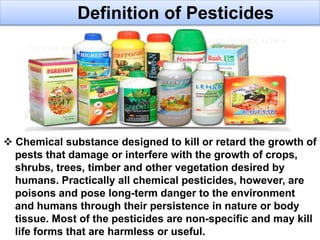
 Chemical substance designed to kill or retard the growth of
pests that damage or interfere with the growth of crops,
shrubs, trees, timber and other vegetation desired by
humans. Practically all chemical pesticides, however, are
poisons and pose long-term danger to the environment
and humans through their persistence in nature or body
tissue. Most of the pesticides are non-specific and may kill
life forms that are harmless or useful.
Definition of Pesticides
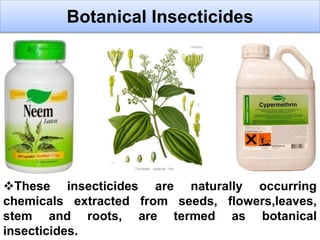
Botanical Insecticides
These insecticides are naturally occurring
chemicals extracted from seeds, flowers,leaves,
stem and roots, are termed as botanical
insecticides.
 Raw material availability
 Solvent types, plant species and part of plant
 Rapid degradation
 State registration
 Market opportunities for botanical pesticides
 Weather conditions
Factors Affecting Use of Botanical Pesticides
Advantages:-
 Often these plants also have other uses like household
insect or are plants with medicinal applications.
 Some of these products may be used shortly before
harvesting.
 Many of these products act very quickly inhibiting insect
feeding.
 Since most of these products have a stomach action and
are rapidly decomposed they may be more selective to
insect pests.
 Most of these compounds are not phytotoxic.
Advantages and Disadvantages of Botanical Pesticides
Disadvantages:-
 Most of these products are not truly pesticides since many
are merely insect deterrents and their effect is slow.
 They are rapidly degraded by UV light so that their residual
action is short.
 They are not necessarily available season long.
 There are no legal registrations establishing their use.
 Not all recommendations followed by growers have been
scientifically verified.
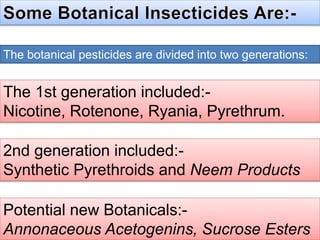
The botanical pesticides are divided into two generations:
2nd generation included:-
Synthetic Pyrethroids and Neem Products
The 1st generation included:-
Nicotine, Rotenone, Ryania, Pyrethrum.
Potential new Botanicals:-
Annonaceous Acetogenins, Sucrose Esters
The 1st generation included:-
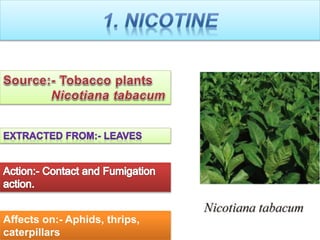
 Nicotine
 Rotenone
 Ryania
 Pyrethrum
Affects on:- Aphids, thrips,
caterpillars
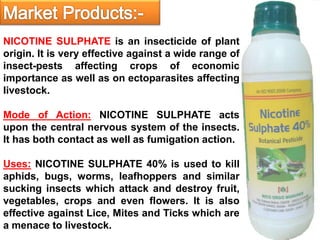
NICOTINE SULPHATE is an insecticide of plant
origin. It is very effective against a wide range of
insect-pests affecting crops of economic
importance as well as on ectoparasites affecting
livestock.
Mode of Action: NICOTINE SULPHATE acts
upon the central nervous system of the insects.
It has both contact as well as fumigation action.
Uses: NICOTINE SULPHATE 40% is used to kill
aphids, bugs, worms, leafhoppers and similar
sucking insects which attack and destroy fruit,
vegetables, crops and even flowers. It is also
effective against Lice, Mites and Ticks which are
a menace to livestock.
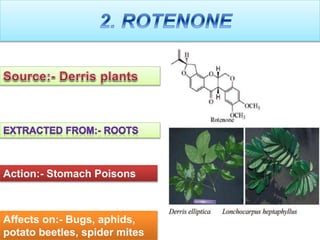
Affects on:- Bugs, aphids,
potato beetles, spider mites
Action:- Stomach Poisons
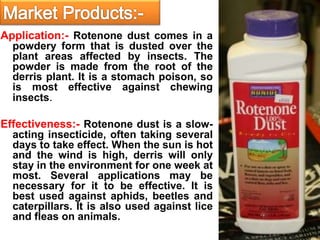
Application:- Rotenone dust comes in a
powdery form that is dusted over the
plant areas affected by insects. The
powder is made from the root of the
derris plant. It is a stomach poison, so
is most effective against chewing
insects.
Effectiveness:- Rotenone dust is a slow-
acting insecticide, often taking several
days to take effect. When the sun is hot
and the wind is high, derris will only
stay in the environment for one week at
most. Several applications may be
necessary for it to be effective. It is
best used against aphids, beetles and
caterpillars. It is also used against lice
and fleas on animals.
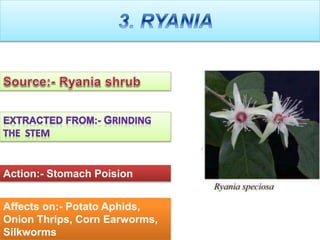
Affects on:- Potato Aphids,
Onion Thrips, Corn Earworms,
Silkworms
Action:- Stomach Poision
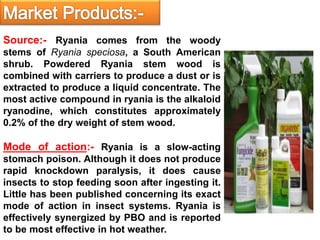
Source:- Ryania comes from the woody
stems of Ryania speciosa, a South American
shrub. Powdered Ryania stem wood is
combined with carriers to produce a dust or is
extracted to produce a liquid concentrate. The
most active compound in ryania is the alkaloid
ryanodine, which constitutes approximately
0.2% of the dry weight of stem wood.
Mode of action:- Ryania is a slow-acting
stomach poison. Although it does not produce
rapid knockdown paralysis, it does cause
insects to stop feeding soon after ingesting it.
Little has been published concerning its exact
mode of action in insect systems. Ryania is
effectively synergized by PBO and is reported
to be most effective in hot weather.
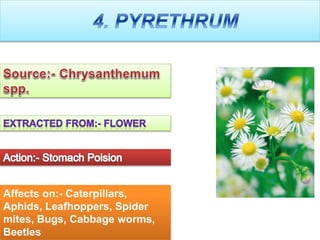
Affects on:- Caterpillars,
Aphids, Leafhoppers, Spider
mites, Bugs, Cabbage worms,
Beetles
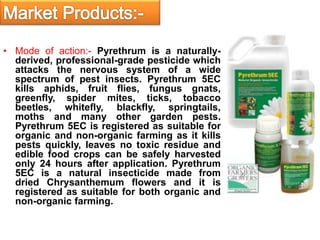
• Mode of action:- Pyrethrum is a naturally-
derived, professional-grade pesticide which
attacks the nervous system of a wide
spectrum of pest insects. Pyrethrum 5EC
kills aphids, fruit flies, fungus gnats,
greenfly, spider mites, ticks, tobacco
beetles, whitefly, blackfly, springtails,
moths and many other garden pests.
Pyrethrum 5EC is registered as suitable for
organic and non-organic farming as it kills
pests quickly, leaves no toxic residue and
edible food crops can be safely harvested
only 24 hours after application. Pyrethrum
5EC is a natural insecticide made from
dried Chrysanthemum flowers and it is
registered as suitable for both organic and
non-organic farming.
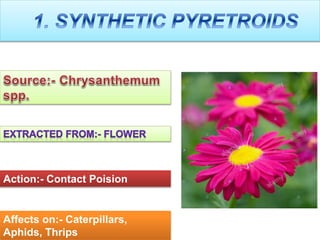
2nd generation included:-
Synthetic Pyrethroids
 Neem Products
Action:- Contact Poision
Affects on:- Caterpillars,
Aphids, Thrips
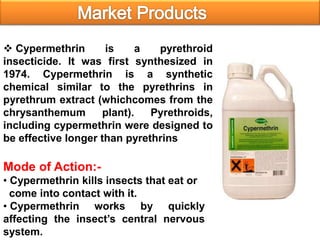
 Cypermethrin is a pyrethroid
insecticide. It was first synthesized in
1974. Cypermethrin is a synthetic
chemical similar to the pyrethrins in
pyrethrum extract (whichcomes from the
chrysanthemum plant). Pyrethroids,
including cypermethrin were designed to
be effective longer than pyrethrins
Mode of Action:-
• Cypermethrin kills insects that eat or
come into contact with it.
• Cypermethrin works by quickly
affecting the insect’s central nervous
system.
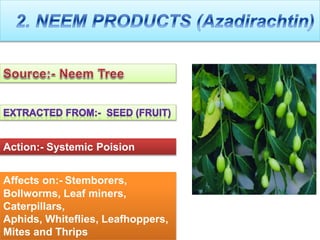
Action:- Systemic Poision
Affects on:- Stemborers,
Bollworms, Leaf miners,
Caterpillars,
Aphids, Whiteflies, Leafhoppers,
Mites and Thrips
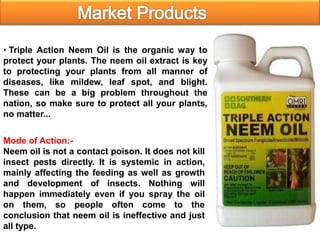
Mode of Action:-
Neem oil is not a contact poison. It does not kill
insect pests directly. It is systemic in action,
mainly affecting the feeding as well as growth
and development of insects. Nothing will
happen immediately even if you spray the oil
on them, so people often come to the
conclusion that neem oil is ineffective and just
all type.
• Triple Action Neem Oil is the organic way to
protect your plants. The neem oil extract is key
to protecting your plants from all manner of
diseases, like mildew, leaf spot, and blight.
These can be a big problem throughout the
nation, so make sure to protect all your plants,
no matter...
Potential new Botanicals:-
 Annonaceous Acetogenins
 Sucrose Esters
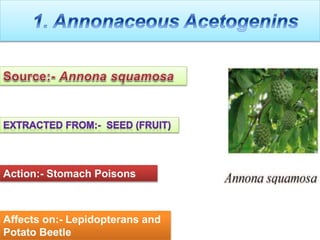
Action:- Stomach Poisons
Affects on:- Lepidopterans and
Potato Beetle
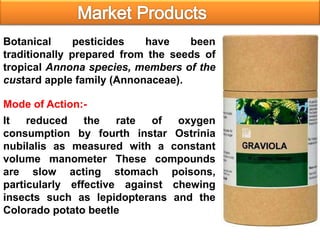
Botanical pesticides have been
traditionally prepared from the seeds of
tropical Annona species, members of the
custard apple family (Annonaceae).
It reduced the rate of oxygen
consumption by fourth instar Ostrinia
nubilalis as measured with a constant
volume manometer These compounds
are slow acting stomach poisons,
particularly effective against chewing
insects such as lepidopterans and the
Colorado potato beetle
Mode of Action:-
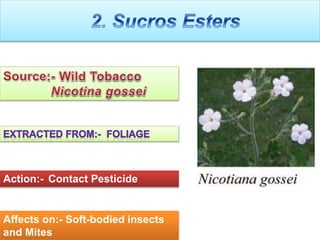
Action:- Contact Pesticide
Affects on:- Soft-bodied insects
and Mites
Mode of Action:-
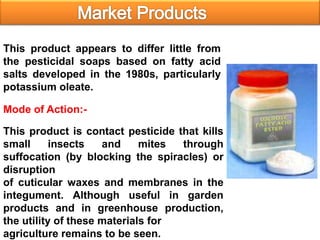
This product appears to differ little from
the pesticidal soaps based on fatty acid
salts developed in the 1980s, particularly
potassium oleate.
This product is contact pesticide that kills
small insects and mites through
suffocation (by blocking the spiracles) or
disruption
of cuticular waxes and membranes in the
integument. Although useful in garden
products and in greenhouse production,
the utility of these materials for
agriculture remains to be seen.
Thank You
Submitted To – Dr. Anita Mam

Botanical Insecticide Karamjeet 135021041

  • 1.
    Name – KaramjeetSingh Course – B.Sc Agriculure (Inte.) 8th Sem. Roll No. – 135021041 Subject – Insect Ecology and Integrated Pest Management Topic – Botanical Insecticide
  • 2.
     Chemical substancedesigned to kill or retard the growth of pests that damage or interfere with the growth of crops, shrubs, trees, timber and other vegetation desired by humans. Practically all chemical pesticides, however, are poisons and pose long-term danger to the environment and humans through their persistence in nature or body tissue. Most of the pesticides are non-specific and may kill life forms that are harmless or useful. Definition of Pesticides
  • 3.
    Botanical Insecticides These insecticidesare naturally occurring chemicals extracted from seeds, flowers,leaves, stem and roots, are termed as botanical insecticides.
  • 4.
     Raw materialavailability  Solvent types, plant species and part of plant  Rapid degradation  State registration  Market opportunities for botanical pesticides  Weather conditions Factors Affecting Use of Botanical Pesticides
  • 5.
    Advantages:-  Often theseplants also have other uses like household insect or are plants with medicinal applications.  Some of these products may be used shortly before harvesting.  Many of these products act very quickly inhibiting insect feeding.  Since most of these products have a stomach action and are rapidly decomposed they may be more selective to insect pests.  Most of these compounds are not phytotoxic. Advantages and Disadvantages of Botanical Pesticides
  • 6.
    Disadvantages:-  Most ofthese products are not truly pesticides since many are merely insect deterrents and their effect is slow.  They are rapidly degraded by UV light so that their residual action is short.  They are not necessarily available season long.  There are no legal registrations establishing their use.  Not all recommendations followed by growers have been scientifically verified.
  • 7.
    The botanical pesticidesare divided into two generations: 2nd generation included:- Synthetic Pyrethroids and Neem Products The 1st generation included:- Nicotine, Rotenone, Ryania, Pyrethrum. Potential new Botanicals:- Annonaceous Acetogenins, Sucrose Esters
  • 8.
    The 1st generationincluded:-  Nicotine  Rotenone  Ryania  Pyrethrum
  • 9.
    Affects on:- Aphids,thrips, caterpillars
  • 10.
    NICOTINE SULPHATE isan insecticide of plant origin. It is very effective against a wide range of insect-pests affecting crops of economic importance as well as on ectoparasites affecting livestock. Mode of Action: NICOTINE SULPHATE acts upon the central nervous system of the insects. It has both contact as well as fumigation action. Uses: NICOTINE SULPHATE 40% is used to kill aphids, bugs, worms, leafhoppers and similar sucking insects which attack and destroy fruit, vegetables, crops and even flowers. It is also effective against Lice, Mites and Ticks which are a menace to livestock.
  • 11.
    Affects on:- Bugs,aphids, potato beetles, spider mites Action:- Stomach Poisons
  • 12.
    Application:- Rotenone dustcomes in a powdery form that is dusted over the plant areas affected by insects. The powder is made from the root of the derris plant. It is a stomach poison, so is most effective against chewing insects. Effectiveness:- Rotenone dust is a slow- acting insecticide, often taking several days to take effect. When the sun is hot and the wind is high, derris will only stay in the environment for one week at most. Several applications may be necessary for it to be effective. It is best used against aphids, beetles and caterpillars. It is also used against lice and fleas on animals.
  • 13.
    Affects on:- PotatoAphids, Onion Thrips, Corn Earworms, Silkworms Action:- Stomach Poision
  • 14.
    Source:- Ryania comesfrom the woody stems of Ryania speciosa, a South American shrub. Powdered Ryania stem wood is combined with carriers to produce a dust or is extracted to produce a liquid concentrate. The most active compound in ryania is the alkaloid ryanodine, which constitutes approximately 0.2% of the dry weight of stem wood. Mode of action:- Ryania is a slow-acting stomach poison. Although it does not produce rapid knockdown paralysis, it does cause insects to stop feeding soon after ingesting it. Little has been published concerning its exact mode of action in insect systems. Ryania is effectively synergized by PBO and is reported to be most effective in hot weather.
  • 15.
    Affects on:- Caterpillars, Aphids,Leafhoppers, Spider mites, Bugs, Cabbage worms, Beetles
  • 16.
    • Mode ofaction:- Pyrethrum is a naturally- derived, professional-grade pesticide which attacks the nervous system of a wide spectrum of pest insects. Pyrethrum 5EC kills aphids, fruit flies, fungus gnats, greenfly, spider mites, ticks, tobacco beetles, whitefly, blackfly, springtails, moths and many other garden pests. Pyrethrum 5EC is registered as suitable for organic and non-organic farming as it kills pests quickly, leaves no toxic residue and edible food crops can be safely harvested only 24 hours after application. Pyrethrum 5EC is a natural insecticide made from dried Chrysanthemum flowers and it is registered as suitable for both organic and non-organic farming.
  • 17.
    2nd generation included:- SyntheticPyrethroids  Neem Products
  • 18.
    Action:- Contact Poision Affectson:- Caterpillars, Aphids, Thrips
  • 19.
     Cypermethrin isa pyrethroid insecticide. It was first synthesized in 1974. Cypermethrin is a synthetic chemical similar to the pyrethrins in pyrethrum extract (whichcomes from the chrysanthemum plant). Pyrethroids, including cypermethrin were designed to be effective longer than pyrethrins Mode of Action:- • Cypermethrin kills insects that eat or come into contact with it. • Cypermethrin works by quickly affecting the insect’s central nervous system.
  • 20.
    Action:- Systemic Poision Affectson:- Stemborers, Bollworms, Leaf miners, Caterpillars, Aphids, Whiteflies, Leafhoppers, Mites and Thrips
  • 21.
    Mode of Action:- Neemoil is not a contact poison. It does not kill insect pests directly. It is systemic in action, mainly affecting the feeding as well as growth and development of insects. Nothing will happen immediately even if you spray the oil on them, so people often come to the conclusion that neem oil is ineffective and just all type. • Triple Action Neem Oil is the organic way to protect your plants. The neem oil extract is key to protecting your plants from all manner of diseases, like mildew, leaf spot, and blight. These can be a big problem throughout the nation, so make sure to protect all your plants, no matter...
  • 22.
    Potential new Botanicals:- Annonaceous Acetogenins  Sucrose Esters
  • 23.
    Action:- Stomach Poisons Affectson:- Lepidopterans and Potato Beetle
  • 24.
    Botanical pesticides havebeen traditionally prepared from the seeds of tropical Annona species, members of the custard apple family (Annonaceae). It reduced the rate of oxygen consumption by fourth instar Ostrinia nubilalis as measured with a constant volume manometer These compounds are slow acting stomach poisons, particularly effective against chewing insects such as lepidopterans and the Colorado potato beetle Mode of Action:-
  • 25.
    Action:- Contact Pesticide Affectson:- Soft-bodied insects and Mites
  • 26.
    Mode of Action:- Thisproduct appears to differ little from the pesticidal soaps based on fatty acid salts developed in the 1980s, particularly potassium oleate. This product is contact pesticide that kills small insects and mites through suffocation (by blocking the spiracles) or disruption of cuticular waxes and membranes in the integument. Although useful in garden products and in greenhouse production, the utility of these materials for agriculture remains to be seen.
  • 27.
    Thank You Submitted To– Dr. Anita Mam