PRESENTED BY : SAURABH UMRAO   B.TECH 3’rd YEAR      (CHEMICAL ENGINEERING)    MNNIT ALLAHABAD Method of Producing Syngas from Gasification of Bagasse
NEED OF SYN-GAS   As the amount of fossil fuels available decreases and the cost of petroleum-based fuels increases, there is a greater need for alternative fuel sources. One promising process for biofuel production involves the formation of synthesis gas which can then be converted to useful compounds.
Syngas is formed by a variety of processes with sources ranging from commonly-used fossil fuels to completely renewable organic compounds. But the more efficient source for the production of syngas is bagasse as it is cheap & easily available. The main components of syngas are carbon monoxide, carbon dioxide, and hydrogen. Each of these components can be converted to valuable products.
Syngas is the direct end-product of the gasification process.  The energy density of Syngas is only about 50 percent that of natural gas and is therefore mostly suited for use in producing transportation fuels and other chemical products.  USES OF SYN-GAS
Synthesis gas is can also be used as an intermediary building block for the final production (synthesis) of various fuels such as synthetic natural gas, methanol and synthetic petroleum fuel.  In a purified state, the hydrogen component of Syngas can also be used to directly power hydrogen fuel cells for electricity generation.
Production of syngas with a high heating value or high  CO + H 2  content to be used as  a fuel for cogeneration in sugar industries. Using free fall reactor & packed bed reactor for almost complete conversion of bagasse to syngas with a little ash content. OBJECTIVE
India is second largest producer of sugar in world hence producing a huge amount of bagasse around 1.2 giga tone as a waste. Low economic state of sugar industry in India due to high consumption of power . Syngas is a ultimate  fuel  which can be used in I.C. Engines. CAUSE ANALYSIS
PROXIMATE ANALYSIS CONTENTS OF BAGASSE Element Sugarcane leaves (% w/w;dry)  Bagasse (% w/w;dry) Fixed carbon  14.9 20.1 Volatile 77.4 75.8 Ash content 7.7 4.2 Higher heating  value, MJ /kg 17.43 18.11
ULTIMATE ANALYSIS Element Sugarcane leaves (% w/w; dry)  Bagasse (% w/w; dry) Carbon  39.8 44.1 Hydrogen 5.5  5.26 Oxygen  46.8  44.4 Nitrogen 0.19 -
The rapid pyrolysis of the bagasse is conducted in the free-fall reactor . The char from the rapid pyrolysis is further pyrolyzed in nitrogen atmosphere in a thermo-balance with a slow heating rate (20°C/mm) up to 850°C . Gasification of char particles is done in packed bed reactor for the generation of syngas. PROPOSED IDEA
Now syngas can be used in furnace  for heating in sugar industries as well as to counter the need of power in these industries and even for other purposes. Syngas produced can also be used for  I.C. Engines.
PYROLYSIS  OF BAGASSE The rapid pyrolysis of the bagasse is conducted in the free-fall reactor . The bagasse samples are placed on a circular stainless steel net plate (sample holder). Nitrogen gas at atmosphere pressure passes downwards the column from the plate in which the biomass sample is placed.   MECHANISM INVOLVED
FREE FALL REACTOR
N 2  gas is passed to assure oxygen-free environment and to evacuate the produced gas during the treatment. Nitrogen flow of 2L/min is used in the pyrolysis. The gases produced during the thermo-chemical treatment are evacuated from the net plate downwards and cooled before exiting it. The char produced are evacuated from the net plate downwards and collected in the char hopper.
The residence time of the particles in the free fall reactor is not enough for the final pyrolysis. The char obtained by rapid pyrolysis contains a fraction that can be further volatilized by slow pyrolysis. So the char from the rapid pyrolysis is further pyrolyzed in nitrogen atmosphere in a thermo-balance with a slow heating rate (20°C/mm) up to 850°C  for the final conversion up to 57%.
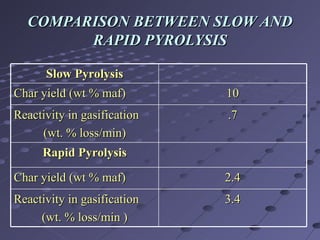
COMPARISON BETWEEN SLOW AND RAPID PYROLYSIS Slow Pyrolysis Char yield (wt % maf) 10 Reactivity in gasification (wt. % loss/min) .7 Rapid Pyrolysis Char yield (wt % maf) 2.4 Reactivity in gasification (wt. % loss/min ) 3.4
PRODUCTS OF PYROLYSIS Gaseous product CO 2 , H 2 , CO, CH 4 , C 2 H 2 , C 2 H 4 , C 2 H 6 ,Benzene etc . Liquid products Tar,  High Molecular Weight Hydrocarbons, Water . Solid products Char .
EFFECT OF TEMERATURE ON THE PYROLYSIS The temperature markedly influences the heating rate. The heat flux is proportional to the driving force & the temperature difference  between the particle and the environment. At higher temperature , the heat flux and the heating rate are higher. The higher heating rate results in decrease char yield.
Higher temperatures favor cracking of the hydrocarbons in the gaseous products and thus increase the yield of hydrogen. Higher temperature has also decreased the content of CO 2  in the gases and increased the content of CO . The char yield decreases when temperature is increased from 800°C  to 1000°C.
INFLUENCE OF PARTICLE SIZE IN   THE PYROLYSIS The size of the particles affects the heating rate. The heat flux and the heating rate are higher in small particles than in large particles. The higher heating rate decreases the char yield.
Smaller particle size has affected also the composition of the gas.  Smaller particle has favored the cracking of hydrocarbons with increases of hydrogen yield. In smaller particle the produced gas leaves the particle faster than the large particles.
EFFECT OF TEMPERATURE ON THE YIELD OF PRODUCTS OBTAINED BY RAPID PYROYSIS OF BAGASSE IN A FREE FALL REACTOR Particle Size,mm   0.5-0.86  0.86-1.0  Temperature, Deg. cent.   800  900  1000  800  900  1000  Gas yield , wt % maf   81.5  83.8  87.5  79.1  81.2  87.0  Tar yield, wt % maf   0.5  0.5  0.3  0.4  0.3  0.2  Char yield, wt % maf   5.0  4.7  4.1  6.6  5.5  4.7  Final slow pyrolysis Char yield after total pyrolysis, wt % maf  2.6  3.3  2.6  2.8  2.4  2.3  Char removed by slow pyrolysis, wt % maf  49  30  37  57  56  51 Reactivity,wt loss% min 1.8  1.5  1.8  3.1  3.4  3.0
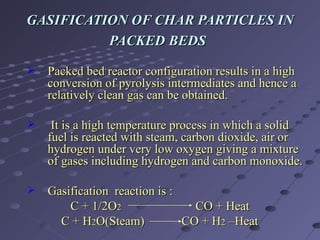
GASIFICATION OF CHAR PARTICLES IN PACKED BEDS   Packed bed reactor configuration results in a high conversion of pyrolysis intermediates and hence a relatively clean gas can be obtained.  It is a high temperature process in which a solid fuel is reacted with steam, carbon dioxide, air or hydrogen under very low oxygen giving a mixture of gases including hydrogen and carbon monoxide. Gasification  reaction is : C + 1/2O 2   CO + Heat C + H 2 O(Steam)  CO + H 2  –Heat
EXPERIMENTAL SET-UP FOR THE PACKED BED REACTOR
MECHANISM In the packed bed reactor the flame front moves upwards, towards the top from where air is being drawn and, eventually the front reaches the top.  Experiments are stopped when the flame front reaches the top.  The system is run at fixed flow rates and the upward rate of propagation of the flame front is measured. The exit gas composition is determined using on-line analyzer for hydrogen, carbon monoxide, carbon dioxide and oxygen.
TEMPERATURE PROFILE AT DIFFERENT LOCATIONS (FROM BOTTOM OF THE REACTOR) IN A PACKED BED AT A FLUX OF 0.06 KG/m2.S
TEMPERATURE PROFILE PREDICTION ALONG THE LENGTH OF THE REACTOR AT A FLUX OF 0.1 KG/m2.S
Now the temperature profile is further used to obtain the propagation front movement, i.e. velocity. It is observed that the glowing zone is approximately 25-35 mm deep (3-4 particle depth) and the peak temperature measured in the bed is in the range of 1000-1230 K depending upon the mass flux.  At low mass flux, i.e. below about 0.05 kg/m2.s, the gas is not combustible and the CO level is very low  (1 per cent).
In most of the cases, measured hydrogen in the gas is about 2.0-4.5 per cent. Finally from the blower we get a mixture of CO and H 2  (i.e. Syngas) which is filtered out and cool it by using cooler to maintain its temperature till 40 °C.  Then cool gas is send to engine from where electricity is generated.
Bagasse have high moisture content around 11 %  so it is need to be dried before  feeding in free fall reactor. It has low calorific value in comparison to coal gas. LIMITATIONS
Bagasse gasification is more efficient than direct combustion . However in spite of its potential ,the use of bagasse as a source of energy is not so common. A liter of liquid fuel can be saved with 4-5 kg. Of biomass. CONCLUSION
A Programme on Biomass Based Power Plants at Taluka Level. Report of the Task Force constituted by Ministry of Non-conventional Energy Sources, Government of India, New Delhi, (March 1995). Jain, Bio-Resource Gasification Sharing of Experiences; Book of Abstracts – BioResource 94 –Biomass Resources : a means to sustainable development, Bangalore, India 13 (October  1994). H. S. Mukunda, S. Dasappa, P. J. Patel, N. K. S. Rajan and U. Shrinivasa, Gasifiers and Combustors for biomass technology and field studies, Energy for Sustainable Development,  1( 3) , 27-38 (1994). Ph. Hasler and R. Buhler, Gasification of urban waste wood (allholtz); Report submitted to the International Energy Agency, Biomass Gasification Working Group, 1-35 (September 1994).   REFERENCES
Design and Development of 10-15 kW Gasifier Running on Loose Sugarcane Leaves. Final Project Report submitted to Ministry of Non-conventional Energy Sources (MNES), Government of India, New Delhi by Nimbkar Agricultural Research Institute (NARI), Phaltan, (May 1992). R. M. Jorapur, A. K. Rajvanshi, Development of a Sugarcane Leaf Gasifier for Electricity Generation, Biomass and Bioenergy,  8 , 91-98 (1995). A.K. Rajvanshi, M. S. Joshi, Development and operational experience with topless wood gasifier running a 3.75 kW diesel engine pumpset, Biomass  19 , 47-56 (1989). Use of Low Density Biomass Gasification System for Process Heat Applications in Metallurgical and Agro-based Industry; Final Project Report submitted to The Rockefeller Foundation, New York by Nimbkar Agricultural Research Institute (NARI), Phaltan, (January 1996).
THANK YOU

SYNGAS production

  • 1.
    PRESENTEDBY : SAURABH UMRAO B.TECH 3’rd YEAR (CHEMICAL ENGINEERING) MNNIT ALLAHABAD Method of Producing Syngas from Gasification of Bagasse
  • 2.
    NEED OF SYN-GAS As the amount of fossil fuels available decreases and the cost of petroleum-based fuels increases, there is a greater need for alternative fuel sources. One promising process for biofuel production involves the formation of synthesis gas which can then be converted to useful compounds.
  • 3.
    Syngas is formedby a variety of processes with sources ranging from commonly-used fossil fuels to completely renewable organic compounds. But the more efficient source for the production of syngas is bagasse as it is cheap & easily available. The main components of syngas are carbon monoxide, carbon dioxide, and hydrogen. Each of these components can be converted to valuable products.
  • 4.
    Syngas is thedirect end-product of the gasification process. The energy density of Syngas is only about 50 percent that of natural gas and is therefore mostly suited for use in producing transportation fuels and other chemical products. USES OF SYN-GAS
  • 5.
    Synthesis gas iscan also be used as an intermediary building block for the final production (synthesis) of various fuels such as synthetic natural gas, methanol and synthetic petroleum fuel. In a purified state, the hydrogen component of Syngas can also be used to directly power hydrogen fuel cells for electricity generation.
  • 6.
    Production of syngaswith a high heating value or high CO + H 2 content to be used as a fuel for cogeneration in sugar industries. Using free fall reactor & packed bed reactor for almost complete conversion of bagasse to syngas with a little ash content. OBJECTIVE
  • 7.
    India is secondlargest producer of sugar in world hence producing a huge amount of bagasse around 1.2 giga tone as a waste. Low economic state of sugar industry in India due to high consumption of power . Syngas is a ultimate fuel which can be used in I.C. Engines. CAUSE ANALYSIS
  • 8.
    PROXIMATE ANALYSIS CONTENTSOF BAGASSE Element Sugarcane leaves (% w/w;dry) Bagasse (% w/w;dry) Fixed carbon 14.9 20.1 Volatile 77.4 75.8 Ash content 7.7 4.2 Higher heating value, MJ /kg 17.43 18.11
  • 9.
    ULTIMATE ANALYSIS ElementSugarcane leaves (% w/w; dry) Bagasse (% w/w; dry) Carbon 39.8 44.1 Hydrogen 5.5 5.26 Oxygen 46.8 44.4 Nitrogen 0.19 -
  • 10.
    The rapid pyrolysisof the bagasse is conducted in the free-fall reactor . The char from the rapid pyrolysis is further pyrolyzed in nitrogen atmosphere in a thermo-balance with a slow heating rate (20°C/mm) up to 850°C . Gasification of char particles is done in packed bed reactor for the generation of syngas. PROPOSED IDEA
  • 11.
    Now syngas canbe used in furnace for heating in sugar industries as well as to counter the need of power in these industries and even for other purposes. Syngas produced can also be used for I.C. Engines.
  • 12.
    PYROLYSIS OFBAGASSE The rapid pyrolysis of the bagasse is conducted in the free-fall reactor . The bagasse samples are placed on a circular stainless steel net plate (sample holder). Nitrogen gas at atmosphere pressure passes downwards the column from the plate in which the biomass sample is placed. MECHANISM INVOLVED
  • 13.
  • 14.
    N 2 gas is passed to assure oxygen-free environment and to evacuate the produced gas during the treatment. Nitrogen flow of 2L/min is used in the pyrolysis. The gases produced during the thermo-chemical treatment are evacuated from the net plate downwards and cooled before exiting it. The char produced are evacuated from the net plate downwards and collected in the char hopper.
  • 15.
    The residence timeof the particles in the free fall reactor is not enough for the final pyrolysis. The char obtained by rapid pyrolysis contains a fraction that can be further volatilized by slow pyrolysis. So the char from the rapid pyrolysis is further pyrolyzed in nitrogen atmosphere in a thermo-balance with a slow heating rate (20°C/mm) up to 850°C for the final conversion up to 57%.
  • 16.
    COMPARISON BETWEEN SLOWAND RAPID PYROLYSIS Slow Pyrolysis Char yield (wt % maf) 10 Reactivity in gasification (wt. % loss/min) .7 Rapid Pyrolysis Char yield (wt % maf) 2.4 Reactivity in gasification (wt. % loss/min ) 3.4
  • 17.
    PRODUCTS OF PYROLYSISGaseous product CO 2 , H 2 , CO, CH 4 , C 2 H 2 , C 2 H 4 , C 2 H 6 ,Benzene etc . Liquid products Tar, High Molecular Weight Hydrocarbons, Water . Solid products Char .
  • 18.
    EFFECT OF TEMERATUREON THE PYROLYSIS The temperature markedly influences the heating rate. The heat flux is proportional to the driving force & the temperature difference between the particle and the environment. At higher temperature , the heat flux and the heating rate are higher. The higher heating rate results in decrease char yield.
  • 19.
    Higher temperatures favorcracking of the hydrocarbons in the gaseous products and thus increase the yield of hydrogen. Higher temperature has also decreased the content of CO 2 in the gases and increased the content of CO . The char yield decreases when temperature is increased from 800°C to 1000°C.
  • 20.
    INFLUENCE OF PARTICLESIZE IN THE PYROLYSIS The size of the particles affects the heating rate. The heat flux and the heating rate are higher in small particles than in large particles. The higher heating rate decreases the char yield.
  • 21.
    Smaller particle sizehas affected also the composition of the gas. Smaller particle has favored the cracking of hydrocarbons with increases of hydrogen yield. In smaller particle the produced gas leaves the particle faster than the large particles.
  • 22.
    EFFECT OF TEMPERATUREON THE YIELD OF PRODUCTS OBTAINED BY RAPID PYROYSIS OF BAGASSE IN A FREE FALL REACTOR Particle Size,mm 0.5-0.86 0.86-1.0 Temperature, Deg. cent. 800 900 1000 800 900 1000 Gas yield , wt % maf 81.5 83.8 87.5 79.1 81.2 87.0 Tar yield, wt % maf 0.5 0.5 0.3 0.4 0.3 0.2 Char yield, wt % maf 5.0 4.7 4.1 6.6 5.5 4.7 Final slow pyrolysis Char yield after total pyrolysis, wt % maf 2.6 3.3 2.6 2.8 2.4 2.3 Char removed by slow pyrolysis, wt % maf 49 30 37 57 56 51 Reactivity,wt loss% min 1.8 1.5 1.8 3.1 3.4 3.0
  • 23.
    GASIFICATION OF CHARPARTICLES IN PACKED BEDS Packed bed reactor configuration results in a high conversion of pyrolysis intermediates and hence a relatively clean gas can be obtained. It is a high temperature process in which a solid fuel is reacted with steam, carbon dioxide, air or hydrogen under very low oxygen giving a mixture of gases including hydrogen and carbon monoxide. Gasification reaction is : C + 1/2O 2 CO + Heat C + H 2 O(Steam) CO + H 2 –Heat
  • 24.
    EXPERIMENTAL SET-UP FORTHE PACKED BED REACTOR
  • 25.
    MECHANISM In thepacked bed reactor the flame front moves upwards, towards the top from where air is being drawn and, eventually the front reaches the top. Experiments are stopped when the flame front reaches the top. The system is run at fixed flow rates and the upward rate of propagation of the flame front is measured. The exit gas composition is determined using on-line analyzer for hydrogen, carbon monoxide, carbon dioxide and oxygen.
  • 26.
    TEMPERATURE PROFILE ATDIFFERENT LOCATIONS (FROM BOTTOM OF THE REACTOR) IN A PACKED BED AT A FLUX OF 0.06 KG/m2.S
  • 27.
    TEMPERATURE PROFILE PREDICTIONALONG THE LENGTH OF THE REACTOR AT A FLUX OF 0.1 KG/m2.S
  • 28.
    Now the temperatureprofile is further used to obtain the propagation front movement, i.e. velocity. It is observed that the glowing zone is approximately 25-35 mm deep (3-4 particle depth) and the peak temperature measured in the bed is in the range of 1000-1230 K depending upon the mass flux. At low mass flux, i.e. below about 0.05 kg/m2.s, the gas is not combustible and the CO level is very low (1 per cent).
  • 29.
    In most ofthe cases, measured hydrogen in the gas is about 2.0-4.5 per cent. Finally from the blower we get a mixture of CO and H 2 (i.e. Syngas) which is filtered out and cool it by using cooler to maintain its temperature till 40 °C. Then cool gas is send to engine from where electricity is generated.
  • 30.
    Bagasse have highmoisture content around 11 % so it is need to be dried before feeding in free fall reactor. It has low calorific value in comparison to coal gas. LIMITATIONS
  • 31.
    Bagasse gasification ismore efficient than direct combustion . However in spite of its potential ,the use of bagasse as a source of energy is not so common. A liter of liquid fuel can be saved with 4-5 kg. Of biomass. CONCLUSION
  • 32.
    A Programme onBiomass Based Power Plants at Taluka Level. Report of the Task Force constituted by Ministry of Non-conventional Energy Sources, Government of India, New Delhi, (March 1995). Jain, Bio-Resource Gasification Sharing of Experiences; Book of Abstracts – BioResource 94 –Biomass Resources : a means to sustainable development, Bangalore, India 13 (October 1994). H. S. Mukunda, S. Dasappa, P. J. Patel, N. K. S. Rajan and U. Shrinivasa, Gasifiers and Combustors for biomass technology and field studies, Energy for Sustainable Development, 1( 3) , 27-38 (1994). Ph. Hasler and R. Buhler, Gasification of urban waste wood (allholtz); Report submitted to the International Energy Agency, Biomass Gasification Working Group, 1-35 (September 1994). REFERENCES
  • 33.
    Design and Developmentof 10-15 kW Gasifier Running on Loose Sugarcane Leaves. Final Project Report submitted to Ministry of Non-conventional Energy Sources (MNES), Government of India, New Delhi by Nimbkar Agricultural Research Institute (NARI), Phaltan, (May 1992). R. M. Jorapur, A. K. Rajvanshi, Development of a Sugarcane Leaf Gasifier for Electricity Generation, Biomass and Bioenergy, 8 , 91-98 (1995). A.K. Rajvanshi, M. S. Joshi, Development and operational experience with topless wood gasifier running a 3.75 kW diesel engine pumpset, Biomass 19 , 47-56 (1989). Use of Low Density Biomass Gasification System for Process Heat Applications in Metallurgical and Agro-based Industry; Final Project Report submitted to The Rockefeller Foundation, New York by Nimbkar Agricultural Research Institute (NARI), Phaltan, (January 1996).
  • 34.