Biodiesel production from
algae

Group members
Shafiq uz zaman

2011-ch-379

Hamid Mukhtar

2011-ch-373

Zain ul shahidin

2011-ch-337

Kalim ahmed

2011-ch-376
Classification of energy
ENERGY SOURCE

Non Renewable
Energy

Renewable Energy

Solar
Wind

Traditional

Alternative

Hydro

Oil

Nuclear

Ocean

Gas

Tar Sands

Geothermal

Coal

Oil Shale

Biomass

Gas Hydrates
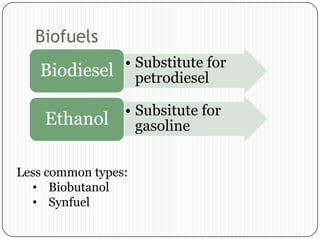
Biofuels

Biodiesel

• Substitute for
petrodiesel

Ethanol

• Subsitute for
gasoline

Less common types:
• Biobutanol
• Synfuel
Why the Interest In Biodiesel?
 Renewable Resource with the largest potential

to get us off the foreign oil supply

 National Energy Security is an achievable goal

with Algae Oil

 Environmental Enhancement through Zero

Sulfur and the sequestration of CO2

 Economics & Job Creation through keeping

the production of fuels inside the Pakistan
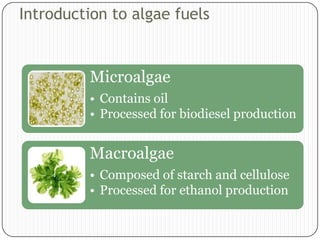
Introduction to algae fuels

Microalgae
• Contains oil
• Processed for biodiesel production

Macroalgae
• Composed of starch and cellulose
• Processed for ethanol production
Algae Oil yield Compared to other
Feedstocks
 Comparative Yields
 Soy Bean

50-65 Gallons Per Acre Per Year
 Camelina 150-400 Gallons Per Acre Per Year
 Palm
400-700 Gallons Per Acre Per Year
 Algae 2,000 to 20,000+ ?? Gallons Per Acre Per Year
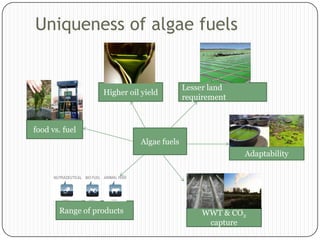
Uniqueness of algae fuels

Higher oil yield

Lesser land
requirement

food vs. fuel
Algae fuels
Adaptability

Range of products

WWT & CO2
capture
Lesser land requirement
 Algae is capable of producing 30 times more oil

per acre than the current crops now utilized for
the production of biofuels.
 Algae could produce up to 94,000 liters of oil per

acre, shrinking land requirements
Adaptability to a range of
environment
Grown under conditions which are unsuitable for
conventional crop production
(marine water, wastewater, open ponds)
Solve the food versus fuel problem
 Does not compete directly with crops grown for food
 Algae can make use of marine and waster water
 Some algae can be grown in desert regions
 Some algae can be grown in ocean environment
 Does not require expensive nutrients for growing
A wide range of fuel products
Biodiesel
Ethanol
Algae

Methane
Hydrogen
Integrated with CO2 capture
Additional Algae Oil Benefits:
 Can be Grown anywhere
 Non-polluting

 Zero Sulfur
 Releases Oxygen (can be captured and sold)
 Eats CO2 (a potentially valuable GHG offset)
 After the Oil is extracted the remaining presscake

(BioMass) is a highly valuable product
How Does Algae Produce Oil?
 Algae is a single cell organism
 Algae feeds on the Hydrogen from the H2O and the Carbon

from the CO2 and through the process of photosynthesis
produces Hydrocarbon Chains and releases Oxygen
 Most strains of the Green and Green-Blue Algae can double

their mass every 24hour growing cycle
 Different strains of Algae produce Algae Oil with slightly

different hydrocarbon chains
How to obtain fuel from algae?
 Picking up the best algae

 Growing the algae
 Harvesting
 Generating the fuel product
Choosing an Algae
 Important

characteristics of Algae
 High % of total biomass is

oil
 Maintains a high % of oil
even under stress
 Compatible with our
regional climate
Where To Grow It
 Extensions onto our water treatment plants
 Clean up our waste and generate fuel

 Agriculture runoff
 Exploit the county’s many farms and vineyards
 Water ponds
 Algae could well grow on salty water as well as soft water
How Is Algae Grown?
 There are 3 methodologies that are currently being used to grow Algae

– with a wide number of variations!
:
1st

Open system
Open Tanks
Pivot Ponds
Open Ponds
Light Pulse Systems
Open Raceway Ponds
2nd vertical systems (Vertigrow’s, Hanging Bags)
3rd Closed systems(photo
bioreactor)

Tubular PBR

Also referred as

Photo bioreactors(PBR)

Flat plate PBR
Bio reactor
 Bioreactors provide fast growth of algae

with the high contents of oil.
 Considerably reduces expenditures of labor &

eliminates complexities in service.

The system can work during long periods
without destruction of culture.

Light in a reactor is taken as much as it
considerably increases its productivity.


 Self-cleaning

Reactors represent closed, controlled,
automated systems.

The technological circuit of installation of a bioreactor
d

Oil
Extraction
From Algae
There are three well-known methods
to extract the oil from oilseeds, and
these methods should apply equally
well for algae too:

1. Expeller/Press
2. Hexane solvent oil extraction
3. Supercritical Fluid extraction
1.Pressing oil from the algae





Dry the algae and press the oil from it.
Can retrieve up to 70% of the oil.
While drying must prevent the algae
from becoming contaminated.
Cheapest and simplest method
2.Chemical Oil Extraction
 Use hexane solvents to remove the oil.
 Benzene could also be used.
 Must be careful when using.
 Removes oil out of almost all things.
 About 95% of total oil present in algae

could be extracted.
3.Super Critical Oil Extraction
 Most efficient method.
 Equipment need special containment and

pressure.
 Can extract almost 100% oil by itself.
 Uses carbon dioxide at critical pressure
and temperature (CO2 is almost a liquid).
 Rapid diffusion of the oil.

Zain qazi
Product generation via different
methods
 Biodiesel
 Ethanol
 Hydrogen
 Methane

 Electricity – where algae biomass is directly used

for combustion
 Other hydrocarbon fuel, such as JP-8 fuel,
gasoline, biobutanol etc.
Biodiesel from algae
Cultivation of Microalgae species

Harvesting of Microalgae

Extraction of Oil from Microalgae

Transesterification

Biodiesel
Ethanol from algae
Algae Biomass

Fermentation

Ethanol
Hydrogen(H2) from algae
Biomass

Gasification

Biogas Fermentation

Steam Reformation

H2

Dark Fermentation
Methane from algae
Algae Biomass

Anaerobic digestion

Methane
Conclusion
 Even with few challenges taken into consideration, algae

biofuel ’s natural advantages look to make it one of the
foremost players in the clean energy market
 Algae biofuel production holds future promise for developing

countries.
• More jobs
• Energy independence
Cost of the pilot project
 Aprox 20,000 to 25,000 in pakistani rupees.

Which include
 Algae cultivation requirements
 Algae drying method
 Algae oil extraction
Thank you!

Any question?

Biodiesel production from algae

  • 2.
    Biodiesel production from algae Groupmembers Shafiq uz zaman 2011-ch-379 Hamid Mukhtar 2011-ch-373 Zain ul shahidin 2011-ch-337 Kalim ahmed 2011-ch-376
  • 3.
    Classification of energy ENERGYSOURCE Non Renewable Energy Renewable Energy Solar Wind Traditional Alternative Hydro Oil Nuclear Ocean Gas Tar Sands Geothermal Coal Oil Shale Biomass Gas Hydrates
  • 4.
    Biofuels Biodiesel • Substitute for petrodiesel Ethanol •Subsitute for gasoline Less common types: • Biobutanol • Synfuel
  • 5.
    Why the InterestIn Biodiesel?  Renewable Resource with the largest potential to get us off the foreign oil supply  National Energy Security is an achievable goal with Algae Oil  Environmental Enhancement through Zero Sulfur and the sequestration of CO2  Economics & Job Creation through keeping the production of fuels inside the Pakistan
  • 6.
    Introduction to algaefuels Microalgae • Contains oil • Processed for biodiesel production Macroalgae • Composed of starch and cellulose • Processed for ethanol production
  • 7.
    Algae Oil yieldCompared to other Feedstocks  Comparative Yields  Soy Bean 50-65 Gallons Per Acre Per Year  Camelina 150-400 Gallons Per Acre Per Year  Palm 400-700 Gallons Per Acre Per Year  Algae 2,000 to 20,000+ ?? Gallons Per Acre Per Year
  • 8.
    Uniqueness of algaefuels Higher oil yield Lesser land requirement food vs. fuel Algae fuels Adaptability Range of products WWT & CO2 capture
  • 9.
    Lesser land requirement Algae is capable of producing 30 times more oil per acre than the current crops now utilized for the production of biofuels.  Algae could produce up to 94,000 liters of oil per acre, shrinking land requirements
  • 10.
    Adaptability to arange of environment Grown under conditions which are unsuitable for conventional crop production (marine water, wastewater, open ponds)
  • 11.
    Solve the foodversus fuel problem  Does not compete directly with crops grown for food  Algae can make use of marine and waster water  Some algae can be grown in desert regions  Some algae can be grown in ocean environment  Does not require expensive nutrients for growing
  • 12.
    A wide rangeof fuel products Biodiesel Ethanol Algae Methane Hydrogen
  • 13.
  • 14.
    Additional Algae OilBenefits:  Can be Grown anywhere  Non-polluting  Zero Sulfur  Releases Oxygen (can be captured and sold)  Eats CO2 (a potentially valuable GHG offset)  After the Oil is extracted the remaining presscake (BioMass) is a highly valuable product
  • 15.
    How Does AlgaeProduce Oil?  Algae is a single cell organism  Algae feeds on the Hydrogen from the H2O and the Carbon from the CO2 and through the process of photosynthesis produces Hydrocarbon Chains and releases Oxygen  Most strains of the Green and Green-Blue Algae can double their mass every 24hour growing cycle  Different strains of Algae produce Algae Oil with slightly different hydrocarbon chains
  • 16.
    How to obtainfuel from algae?  Picking up the best algae  Growing the algae  Harvesting  Generating the fuel product
  • 17.
    Choosing an Algae Important characteristics of Algae  High % of total biomass is oil  Maintains a high % of oil even under stress  Compatible with our regional climate
  • 18.
    Where To GrowIt  Extensions onto our water treatment plants  Clean up our waste and generate fuel  Agriculture runoff  Exploit the county’s many farms and vineyards  Water ponds  Algae could well grow on salty water as well as soft water
  • 19.
    How Is AlgaeGrown?  There are 3 methodologies that are currently being used to grow Algae – with a wide number of variations! :
  • 20.
  • 21.
  • 22.
  • 23.
  • 24.
  • 25.
  • 26.
    2nd vertical systems(Vertigrow’s, Hanging Bags)
  • 27.
    3rd Closed systems(photo bioreactor) TubularPBR Also referred as Photo bioreactors(PBR) Flat plate PBR
  • 28.
    Bio reactor  Bioreactorsprovide fast growth of algae with the high contents of oil.  Considerably reduces expenditures of labor & eliminates complexities in service. The system can work during long periods without destruction of culture.  Light in a reactor is taken as much as it considerably increases its productivity.   Self-cleaning Reactors represent closed, controlled, automated systems. 
  • 29.
    The technological circuitof installation of a bioreactor
  • 30.
  • 31.
    There are threewell-known methods to extract the oil from oilseeds, and these methods should apply equally well for algae too: 1. Expeller/Press 2. Hexane solvent oil extraction 3. Supercritical Fluid extraction
  • 32.
    1.Pressing oil fromthe algae     Dry the algae and press the oil from it. Can retrieve up to 70% of the oil. While drying must prevent the algae from becoming contaminated. Cheapest and simplest method
  • 33.
    2.Chemical Oil Extraction Use hexane solvents to remove the oil.  Benzene could also be used.  Must be careful when using.  Removes oil out of almost all things.  About 95% of total oil present in algae could be extracted.
  • 34.
    3.Super Critical OilExtraction  Most efficient method.  Equipment need special containment and pressure.  Can extract almost 100% oil by itself.  Uses carbon dioxide at critical pressure and temperature (CO2 is almost a liquid).  Rapid diffusion of the oil. Zain qazi
  • 35.
    Product generation viadifferent methods  Biodiesel  Ethanol  Hydrogen  Methane  Electricity – where algae biomass is directly used for combustion  Other hydrocarbon fuel, such as JP-8 fuel, gasoline, biobutanol etc.
  • 36.
    Biodiesel from algae Cultivationof Microalgae species Harvesting of Microalgae Extraction of Oil from Microalgae Transesterification Biodiesel
  • 37.
    Ethanol from algae AlgaeBiomass Fermentation Ethanol
  • 38.
    Hydrogen(H2) from algae Biomass Gasification BiogasFermentation Steam Reformation H2 Dark Fermentation
  • 39.
    Methane from algae AlgaeBiomass Anaerobic digestion Methane
  • 40.
    Conclusion  Even withfew challenges taken into consideration, algae biofuel ’s natural advantages look to make it one of the foremost players in the clean energy market  Algae biofuel production holds future promise for developing countries. • More jobs • Energy independence
  • 41.
    Cost of thepilot project  Aprox 20,000 to 25,000 in pakistani rupees. Which include  Algae cultivation requirements  Algae drying method  Algae oil extraction
  • 42.

Editor's Notes

  • #4 Although there are alternatives, they dun satisfy transportation needs….
  • #5 Biofuels (ethanol, etc…)
  • #7 Introduction to algae fuels