STUDY OF CONDENSER IN REFRIGERANTS
AND ITS DIFFERENT TYPE
DAFTER ALI SU/11-01-072024
AZIZ UR REHMAN SU/11-01-072021
PRESENTED
BY :
1
SARHAD UNIVERSITY OF SECIENCE & INFORMATION
TECHNOLOGY PESHAWAR (KPK)
CONTENTS
 INTRODUCTION
 OBJECTIVE
 TYPES OF CONDENSER
 GOVERNING EQUATIONS
 MODES OF HEAT TRANSFER
 TEST OF CONDENSER USING DIFFERENT
MATERIALS
2
INTRODUCTION
 Heat exchangers are used to transfer heat. Some
process like cooling, heating, condensation, boiling
or evaporation.
 Different heat exchangers are named according to
their application.
 For example, heat exchanger used for boiling
purposes are called boilers, similarly Heat
exchangers being used to condense are known as
condensers.
3
cont.…
 The condenser is a heat exchanger that usually rejects
all the heat from the system.
 The condenser accept hot , high –pressure refrigerant
usually a super heated gas, from the compressor.
 The condenser is usually air cooled by natural or forced
convection to increase the cooling effect of the
condenser.
4
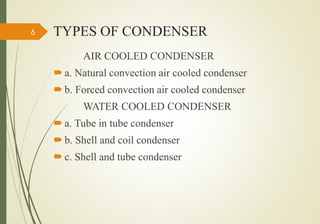
OBJECTIVES
 To select material for the condenser by studying of different
materials.
5
TYPES OF CONDENSER
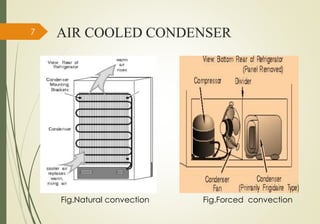
AIR COOLED CONDENSER
 a. Natural convection air cooled condenser
 b. Forced convection air cooled condenser
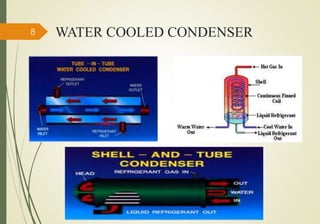
WATER COOLED CONDENSER
 a. Tube in tube condenser
 b. Shell and coil condenser
 c. Shell and tube condenser
6
AIR COOLED CONDENSER
Fig.Natural convection Fig.Forced convection
7
WATER COOLED CONDENSER8
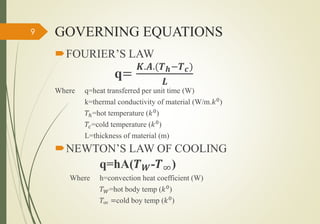
GOVERNING EQUATIONS
FOURIER’S LAW
q=
𝑲.𝑨.(𝑻 𝒉−𝑻 𝒄)
𝑳
Where q=heat transferred per unit time (W)
k=thermal conductivity of material (W/m.𝑘0)
𝑇ℎ=hot temperature (𝑘0
)
𝑇𝑐=cold temperature (𝑘0
)
L=thickness of material (m)
NEWTON’S LAW OF COOLING
q=hA(𝑻 𝑾-𝑻∞)
Where h=convection heat coefficient (W)
𝑇 𝑊=hot body temp (𝑘0)
𝑇∞ =cold boy temp (𝑘0)
9
Cont.…
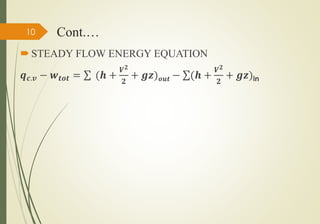
 STEADY FLOW ENERGY EQUATION
𝒒 𝒄.𝒗 − 𝒘 𝒕𝒐𝒕 = (𝒉 +
𝑽 𝟐
𝟐
+ 𝒈𝒛) 𝒐𝒖𝒕 − (𝒉 +
𝑽 𝟐
𝟐
+ 𝒈𝒛)in
10
MODES OF HEAT TRANSFER
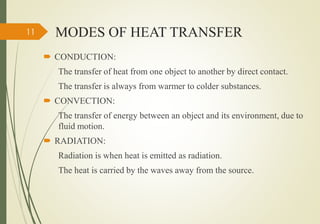
 CONDUCTION:
The transfer of heat from one object to another by direct contact.
The transfer is always from warmer to colder substances.
 CONVECTION:
The transfer of energy between an object and its environment, due to
fluid motion.
 RADIATION:
Radiation is when heat is emitted as radiation.
The heat is carried by the waves away from the source.
11
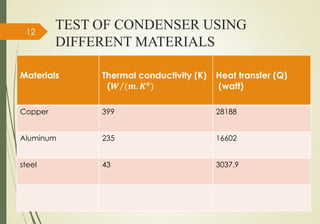
TEST OF CONDENSER USING
DIFFERENT MATERIALS
Materials Thermal conductivity (K)
( 𝑾 (𝒎. 𝑲 𝒐)
Heat transfer (Q)
(watt)
Copper 399 28188
Aluminum 235 16602
steel 43 3037.9
12
REFRENCE’S:
 Condensers & Evaporators (Lesson 22) from Version 1 ME, IIT Kharagpur
 B.Tech Thesis on (SHELL AND TUBE HEAT EXCHANGER DESIGN USING CFD TOOLS)
by Anil Kumar Samal
 A Comparative Study of the Effect of Variation of Inside Diameter of Condenser
and Mass Flow Rate on the Heat Transfer Coefficient in a Domestic Refrigerator.
By Rajesh Joshi et al Int. Journal of Engineering Research and Applications ISSN:
2248-9622, Vol. 4, Issue 2(Version 1), February 2014, pp.514-518 (www.ijera.com)
 Two-Phase Heat Transfer Coefficients of R134a Condensation in Vertical
Downward Flow at High Mass Flux by A.S. Dalkilic1 and S. Wongwises2 1Heat
and Thermodynamics Division, Department of Mechanical Engineering, Yildiz
Technical University, Yildiz, Istanbul 34349 2Fluid Mechanics, Thermal Engineering
and Multiphase Flow Research Lab. (FUTURE), Department of Mechanical
Engineering, King Mongkut’s University of Technology Thonburi, Bangmod,
Bangkok 10140 1Turkey 2Thailand
 An Improved and Extended General Correlation for Heat Transfer During
Condensation in Plain Tubes by M. Mohammed Shah, PhD, PE (VOLUME 15,
NUMBER 5 HVAC&R RESEARCH SEPTEMBER 2009)
13

STUDY OF CONDENSER AND ITS DIFFERENT TYPES

  • 1.
    STUDY OF CONDENSERIN REFRIGERANTS AND ITS DIFFERENT TYPE DAFTER ALI SU/11-01-072024 AZIZ UR REHMAN SU/11-01-072021 PRESENTED BY : 1 SARHAD UNIVERSITY OF SECIENCE & INFORMATION TECHNOLOGY PESHAWAR (KPK)
  • 2.
    CONTENTS  INTRODUCTION  OBJECTIVE TYPES OF CONDENSER  GOVERNING EQUATIONS  MODES OF HEAT TRANSFER  TEST OF CONDENSER USING DIFFERENT MATERIALS 2
  • 3.
    INTRODUCTION  Heat exchangersare used to transfer heat. Some process like cooling, heating, condensation, boiling or evaporation.  Different heat exchangers are named according to their application.  For example, heat exchanger used for boiling purposes are called boilers, similarly Heat exchangers being used to condense are known as condensers. 3
  • 4.
    cont.…  The condenseris a heat exchanger that usually rejects all the heat from the system.  The condenser accept hot , high –pressure refrigerant usually a super heated gas, from the compressor.  The condenser is usually air cooled by natural or forced convection to increase the cooling effect of the condenser. 4
  • 5.
    OBJECTIVES  To selectmaterial for the condenser by studying of different materials. 5
  • 6.
    TYPES OF CONDENSER AIRCOOLED CONDENSER  a. Natural convection air cooled condenser  b. Forced convection air cooled condenser WATER COOLED CONDENSER  a. Tube in tube condenser  b. Shell and coil condenser  c. Shell and tube condenser 6
  • 7.
    AIR COOLED CONDENSER Fig.Naturalconvection Fig.Forced convection 7
  • 8.
  • 9.
    GOVERNING EQUATIONS FOURIER’S LAW q= 𝑲.𝑨.(𝑻𝒉−𝑻 𝒄) 𝑳 Where q=heat transferred per unit time (W) k=thermal conductivity of material (W/m.𝑘0) 𝑇ℎ=hot temperature (𝑘0 ) 𝑇𝑐=cold temperature (𝑘0 ) L=thickness of material (m) NEWTON’S LAW OF COOLING q=hA(𝑻 𝑾-𝑻∞) Where h=convection heat coefficient (W) 𝑇 𝑊=hot body temp (𝑘0) 𝑇∞ =cold boy temp (𝑘0) 9
  • 10.
    Cont.…  STEADY FLOWENERGY EQUATION 𝒒 𝒄.𝒗 − 𝒘 𝒕𝒐𝒕 = (𝒉 + 𝑽 𝟐 𝟐 + 𝒈𝒛) 𝒐𝒖𝒕 − (𝒉 + 𝑽 𝟐 𝟐 + 𝒈𝒛)in 10
  • 11.
    MODES OF HEATTRANSFER  CONDUCTION: The transfer of heat from one object to another by direct contact. The transfer is always from warmer to colder substances.  CONVECTION: The transfer of energy between an object and its environment, due to fluid motion.  RADIATION: Radiation is when heat is emitted as radiation. The heat is carried by the waves away from the source. 11
  • 12.
    TEST OF CONDENSERUSING DIFFERENT MATERIALS Materials Thermal conductivity (K) ( 𝑾 (𝒎. 𝑲 𝒐) Heat transfer (Q) (watt) Copper 399 28188 Aluminum 235 16602 steel 43 3037.9 12
  • 13.
    REFRENCE’S:  Condensers &Evaporators (Lesson 22) from Version 1 ME, IIT Kharagpur  B.Tech Thesis on (SHELL AND TUBE HEAT EXCHANGER DESIGN USING CFD TOOLS) by Anil Kumar Samal  A Comparative Study of the Effect of Variation of Inside Diameter of Condenser and Mass Flow Rate on the Heat Transfer Coefficient in a Domestic Refrigerator. By Rajesh Joshi et al Int. Journal of Engineering Research and Applications ISSN: 2248-9622, Vol. 4, Issue 2(Version 1), February 2014, pp.514-518 (www.ijera.com)  Two-Phase Heat Transfer Coefficients of R134a Condensation in Vertical Downward Flow at High Mass Flux by A.S. Dalkilic1 and S. Wongwises2 1Heat and Thermodynamics Division, Department of Mechanical Engineering, Yildiz Technical University, Yildiz, Istanbul 34349 2Fluid Mechanics, Thermal Engineering and Multiphase Flow Research Lab. (FUTURE), Department of Mechanical Engineering, King Mongkut’s University of Technology Thonburi, Bangmod, Bangkok 10140 1Turkey 2Thailand  An Improved and Extended General Correlation for Heat Transfer During Condensation in Plain Tubes by M. Mohammed Shah, PhD, PE (VOLUME 15, NUMBER 5 HVAC&R RESEARCH SEPTEMBER 2009) 13