STEAM 
CONDENSERS
Definition 
 Condenser is a device in which steam is 
condensed to water at a pressure less than 
atmosphere. 
 Condensation can be done by removing heat 
from exhaust steam using circulating cooling 
water 
 A condenser is basically steam to water 
exchanger in which heat from exhaust steam 
is transferred to circulating cooling water
Function 
 To reduce the turbine exhaust pressure so as 
to increase the specific output and hence 
increase the plant efficiency and decrease the 
specific steam consumption. 
 To condense the exhaust steam from the 
turbine and reuse it as pure feed water in the 
boiler. Thus only make up water is required 
to compensate loss of water
Advantages of condensers in steam power plant 
1) High pressure ratio provides larger enthalpy drop 
2) Work output per kg of steam increases and hence 
specific steam consumption decreases 
3) Condensate can be reused as hot feed water to 
the boiler. This reduces the time of evaporation 
and hence fuel economy 
4) No feed water treatment is required and hence 
reduces the cost of the plant 
5) The formation of deposits in the boiler surface 
can be prevented with the use of condensate 
instead of feed water from outer sources
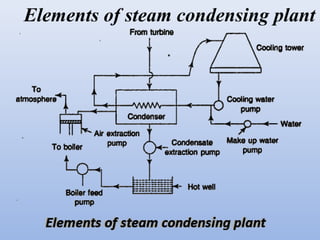
Elements of steam condensing plant 
1) Condenser 
2) Air extraction pump 
3) Condensate extraction pump 
4) Circulating cooling water pump 
5) Hot well 
6) Cooling tower 
7) Make up water pump 
8) Boiler feed pump
Elements of steam condensing plant
Classification of condensers 
1) Jet condensers (or) mixing type 
a) Parallel flow type (Low level) 
b)Counter flow type (High & Low levels) 
c) Ejector type 
2) Surface condensers (or) non-mixing type 
a)Down flow type 
b) Central flow type 
c) Inverted type 
d) Regenerative type 
e) Evaporation type
Jet Condenser Vs Surface Condenser 
Jet Condensers 
(Direct Contact type/Mixed type) 
Surface Condensers 
(Indirect Contact type/Non-Mixed type)
Comparison of jet & surface condensers 
Jet Condensers Surface Condensers 
1) Cooling water and steam are mixed up 
2) Low manufacturing cost 
3) Requires small floor space 
4) The condensate cannot be used as feed 
water to boiler unless it is free from 
impurities 
5) More power is required for air pump 
6) Less power is required for water pump 
7) Requires less quantity of cooling water 
8) The condensing plant is simple 
9) Less suitable for high capacity plants 
due to low vacuum efficiency 
10)Lower upkeep 
1) Cooling water & steam aren’t mixed up 
2) High manufacturing cost 
3) Requires large floor space 
4) The condensate can be used as feed 
water to boiler as it is not mixed with 
cooling water 
5) Less power is required for air pump 
6) More power is required for water pump 
7) Requires large quantity of cooling 
water 
8) The condensing plant is complicated 
9) More suitable for high capacity plants 
as vacuum efficiency is high 
10)Higher upkeep
Jet condensers 
 Jet condensers are used in small capacity 
units where clean fresh water is available in 
plenty. 
 In jet condensers, water is in direct contact 
with exhaust steam. Hence these are also 
called direct contact type (or) mixed type
Advantages & disadvantages of Jet condensers 
Advantages 
1) As a result of effective mixing, it requires less circulating 
cooling water 
2) Equipment is simple and occupy less space 
3) Maintenance is cheap 
Disadvantages 
1) Not suitable for higher capacities 
2) Condensate cannot be used as feed water to boiler 
3) Air leakages are more 
4) Requires larger air pump 
5) Less vacuum is maintained
Surface condensers 
 Surface condensers are used in large 
capacity plants 
 In surface condensers, exhaust steam and 
water do not mix together. Hence they are 
also called indirect contact type (or) non-mixed 
type
Advantages & disadvantages of surface condensers 
Advantages 
1) Can be used for large capacity plants 
2) High vacuum can be created 
3) Condensate is free from impurities and can be reused as 
feed water to boiler 
4) Impure water can also be used as cooling medium 
5) Air leakage is comparatively less, hence less power is 
required to operate air pump 
Disadvantages 
1) Design is complicated and costly 
2) High maintenance cost 
3) Occupies more space 
4) Requires more circulating water
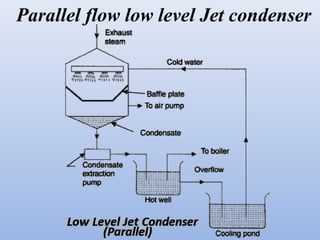
Parallel flow low level Jet condenser
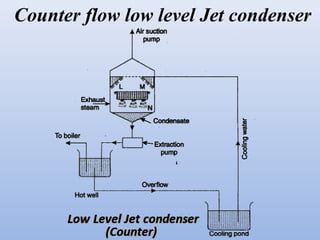
Counter flow low level Jet condenser
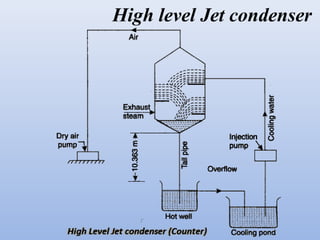
High level Jet condenser
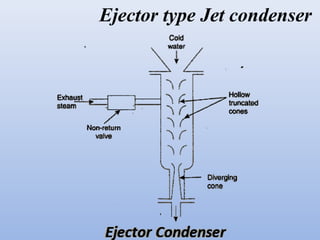
Ejector type Jet condenser
Down flow Surface condenser
Central flow Surface condenser
Inverted type Surface condenser 
 In this type of jet condensers, steam enters 
at the bottom of the shell and flows 
upwards. 
 Air extraction pump is placed at the top. 
 The condensate flows down and removed at 
the bottom where condensate pump is 
located.
Regenerative type Surface condenser 
 The condensers used in a regenerative method of heating 
the condensate are called regenerative type condensers. 
 In this type of condensers, the condensate after leaving 
the condenser is passed through the exhaust steam where 
the temperature is increased. 
 The condensate at high temperature can be reused as 
feed water to the boiler. 
 This increases the efficiency of the plant and minimise 
the fuel consumption.
Evaporative Surface condenser
Sources of air in Condenser 
1) Air leakage from atmosphere at the joints of 
the parts which are internally under a 
pressure less than atmosphere 
2) Air accompanied with steam from the 
boiler into which it enters dissolved with 
feed water 
3) In jet condensers, a little quantity of air 
accompanies the injection of water in which 
it is dissolved
Effects of air leakage in a condenser 
1) Lowered thermal efficiency 
2) Increased requirement of cooling water 
3) Reduced heat transfer 
4) Corrosion
Methods of obtaining maximum vacuum 
1) Air pump 
2) Steam air ejector 
3) De-aerated feed water 
4) Air tight joints
Vacuum Measurement
Vacuum Efficiency 
It is defined as the ratio of actual 
vacuum to the maximum obtainable 
vacuum. 
Vacuum efficiency = Actual vacuum 
Maximum 
obtainable 
vacuum 
ö 
æ 
Vacuum efficiency = Actual Vacuum 
Absolute 
- 
pressure 
of steam 
Barometer 
Pressure 
ö 
÷ ÷ ÷ ÷ ÷ 
ø 
æ 
ç ç ç ç ç 
è 
ö 
÷ ÷ 
ø 
æ 
ç ç 
è 
÷ ÷ ÷ ÷ ÷ 
ø 
ç ç ç ç ç 
è
Condenser Efficiency 
It is defined as the ratio of difference 
between the outlet and inlet temperatures 
of cooling water to the difference between 
the temperature corresponding to the 
vacuum in the condenser and inlet 
temperature of cooling water 
ö 
÷ ÷ ÷ 
ø 
Rise in temperature 
of cooling water 
- æ 
Inlet temperature 
ç ç ç 
è 
ö 
÷ ÷ ÷ ÷ ÷ 
ø 
Temperature 
æ 
ç ç ç ç ç 
è 
ö 
÷ ÷ ÷ 
ø 
æ 
ç ç ç 
è 
of cooling water 
corresponding 
to vacuum 
Condenser efficiency =
Edward’s Air Pump
Two Stage Air Ejector

Steam Condensers

  • 1.
  • 2.
    Definition  Condenseris a device in which steam is condensed to water at a pressure less than atmosphere.  Condensation can be done by removing heat from exhaust steam using circulating cooling water  A condenser is basically steam to water exchanger in which heat from exhaust steam is transferred to circulating cooling water
  • 3.
    Function  Toreduce the turbine exhaust pressure so as to increase the specific output and hence increase the plant efficiency and decrease the specific steam consumption.  To condense the exhaust steam from the turbine and reuse it as pure feed water in the boiler. Thus only make up water is required to compensate loss of water
  • 4.
    Advantages of condensersin steam power plant 1) High pressure ratio provides larger enthalpy drop 2) Work output per kg of steam increases and hence specific steam consumption decreases 3) Condensate can be reused as hot feed water to the boiler. This reduces the time of evaporation and hence fuel economy 4) No feed water treatment is required and hence reduces the cost of the plant 5) The formation of deposits in the boiler surface can be prevented with the use of condensate instead of feed water from outer sources
  • 5.
    Elements of steamcondensing plant 1) Condenser 2) Air extraction pump 3) Condensate extraction pump 4) Circulating cooling water pump 5) Hot well 6) Cooling tower 7) Make up water pump 8) Boiler feed pump
  • 6.
    Elements of steamcondensing plant
  • 7.
    Classification of condensers 1) Jet condensers (or) mixing type a) Parallel flow type (Low level) b)Counter flow type (High & Low levels) c) Ejector type 2) Surface condensers (or) non-mixing type a)Down flow type b) Central flow type c) Inverted type d) Regenerative type e) Evaporation type
  • 8.
    Jet Condenser VsSurface Condenser Jet Condensers (Direct Contact type/Mixed type) Surface Condensers (Indirect Contact type/Non-Mixed type)
  • 9.
    Comparison of jet& surface condensers Jet Condensers Surface Condensers 1) Cooling water and steam are mixed up 2) Low manufacturing cost 3) Requires small floor space 4) The condensate cannot be used as feed water to boiler unless it is free from impurities 5) More power is required for air pump 6) Less power is required for water pump 7) Requires less quantity of cooling water 8) The condensing plant is simple 9) Less suitable for high capacity plants due to low vacuum efficiency 10)Lower upkeep 1) Cooling water & steam aren’t mixed up 2) High manufacturing cost 3) Requires large floor space 4) The condensate can be used as feed water to boiler as it is not mixed with cooling water 5) Less power is required for air pump 6) More power is required for water pump 7) Requires large quantity of cooling water 8) The condensing plant is complicated 9) More suitable for high capacity plants as vacuum efficiency is high 10)Higher upkeep
  • 10.
    Jet condensers Jet condensers are used in small capacity units where clean fresh water is available in plenty.  In jet condensers, water is in direct contact with exhaust steam. Hence these are also called direct contact type (or) mixed type
  • 11.
    Advantages & disadvantagesof Jet condensers Advantages 1) As a result of effective mixing, it requires less circulating cooling water 2) Equipment is simple and occupy less space 3) Maintenance is cheap Disadvantages 1) Not suitable for higher capacities 2) Condensate cannot be used as feed water to boiler 3) Air leakages are more 4) Requires larger air pump 5) Less vacuum is maintained
  • 12.
    Surface condensers Surface condensers are used in large capacity plants  In surface condensers, exhaust steam and water do not mix together. Hence they are also called indirect contact type (or) non-mixed type
  • 13.
    Advantages & disadvantagesof surface condensers Advantages 1) Can be used for large capacity plants 2) High vacuum can be created 3) Condensate is free from impurities and can be reused as feed water to boiler 4) Impure water can also be used as cooling medium 5) Air leakage is comparatively less, hence less power is required to operate air pump Disadvantages 1) Design is complicated and costly 2) High maintenance cost 3) Occupies more space 4) Requires more circulating water
  • 14.
    Parallel flow lowlevel Jet condenser
  • 15.
    Counter flow lowlevel Jet condenser
  • 16.
    High level Jetcondenser
  • 17.
  • 18.
  • 19.
  • 20.
    Inverted type Surfacecondenser  In this type of jet condensers, steam enters at the bottom of the shell and flows upwards.  Air extraction pump is placed at the top.  The condensate flows down and removed at the bottom where condensate pump is located.
  • 21.
    Regenerative type Surfacecondenser  The condensers used in a regenerative method of heating the condensate are called regenerative type condensers.  In this type of condensers, the condensate after leaving the condenser is passed through the exhaust steam where the temperature is increased.  The condensate at high temperature can be reused as feed water to the boiler.  This increases the efficiency of the plant and minimise the fuel consumption.
  • 22.
  • 23.
    Sources of airin Condenser 1) Air leakage from atmosphere at the joints of the parts which are internally under a pressure less than atmosphere 2) Air accompanied with steam from the boiler into which it enters dissolved with feed water 3) In jet condensers, a little quantity of air accompanies the injection of water in which it is dissolved
  • 24.
    Effects of airleakage in a condenser 1) Lowered thermal efficiency 2) Increased requirement of cooling water 3) Reduced heat transfer 4) Corrosion
  • 25.
    Methods of obtainingmaximum vacuum 1) Air pump 2) Steam air ejector 3) De-aerated feed water 4) Air tight joints
  • 26.
  • 27.
    Vacuum Efficiency Itis defined as the ratio of actual vacuum to the maximum obtainable vacuum. Vacuum efficiency = Actual vacuum Maximum obtainable vacuum ö æ Vacuum efficiency = Actual Vacuum Absolute - pressure of steam Barometer Pressure ö ÷ ÷ ÷ ÷ ÷ ø æ ç ç ç ç ç è ö ÷ ÷ ø æ ç ç è ÷ ÷ ÷ ÷ ÷ ø ç ç ç ç ç è
  • 28.
    Condenser Efficiency Itis defined as the ratio of difference between the outlet and inlet temperatures of cooling water to the difference between the temperature corresponding to the vacuum in the condenser and inlet temperature of cooling water ö ÷ ÷ ÷ ø Rise in temperature of cooling water - æ Inlet temperature ç ç ç è ö ÷ ÷ ÷ ÷ ÷ ø Temperature æ ç ç ç ç ç è ö ÷ ÷ ÷ ø æ ç ç ç è of cooling water corresponding to vacuum Condenser efficiency =
  • 29.
  • 30.