CONDENSER
FUNCTION
• The function of the condenser is to transfer
heat that has been absorbed by the system to
the air or water.
CONDENSER
PURPOSE
• Thus the purpose of the condenser in the
refrigeration system is to remove heat from the
refrigerant vapor leaving the compressor (or
generator in case of absorption system) so that
the refrigerant will condense to its liquid state.
• This liquid refrigerant will then be able to achieve
the refrigerating effect in the evaporator.
CONDENSER
PURPOSE
• The condenser is a heat exchanger in a
refrigerating system.
• The condenser rejects heat which consists of
a. Heat absorbed by the evaporator
b. Heat from the energy input to the compressor
CONDENSER
PURPOSE
• The condenser is one of the important part of
the refrigeration system.
• The rate of heat transfer in condenser
depends upon:
a. Temperature difference
b. Material of construction
c. Types and quality of cooling medium
d. Surface condition
CONDENSER
OPERATION
• Refrigerant always leaves the compressor at a
temperature well above its saturation
(condensing) temperature.
• The refrigerant is thus in a superheated state.
• In the first part of the condenser, sensible
heat is removed.
• The vapor is cooled to its saturation
temperature.
CONDENSER
OPERATION
• After this, latent heat is removed when the vapor is
cooled.
• The size of the condenser is such that, the refrigerant
leaving the condenser is a saturated liquid at the
condensing temperature.
• In number of cases, the condenser heat transfer surface
area is great enough so that the liquid refrigerant is
subcooled before it leaves the condenser.
• The heat removed in the condenser is called the HEAT OF
REJECTION.
CONDENSER
AIR COOLED CONDENSER
a. Natural convection air
cooled condenser
b. Forced convection air
cooled condenser
WATER COOLED CONDENSER
a. Tube in tube condenser
b. Shell and coil condenser
c. Shell and tube condenser
CONDENSER
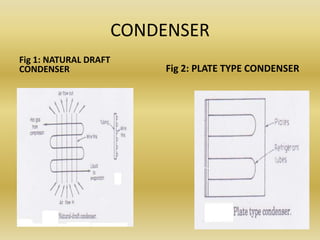
Fig 1: NATURAL DRAFT
CONDENSER Fig 2: PLATE TYPE CONDENSER
CONDENSER
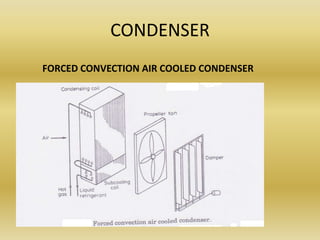
FORCED CONVECTION AIR COOLED CONDENSER
AIR COOLED CONDENSER
OPERATION
• This is the condenser in which the removal of heat is
done by air.
• These condensers are the most popular type used on
small commercial and domestic refrigeration and air
conditioning units.
• They consist of steel or copper tubing through which
the refrigerant flows.
• Tubes are usually provided with plate type fins to
increase the surface area for heat transfer.
AIR COOLED CONDENSER
OPERATION
• Except for very small domestic units, which
depends on gravity air circulation, heat transfer is
efficiently accomplished by forcing large
quantities of air through a condenser assembly.
• The quantity of air circulated is usually 30m3
/min/ton or refrigeration.
AIR COOLED CONDENSER
OPERATION
• There are two types of natural draft air-cooled
condensers.
• The TUBE and FIN type shown in figure 1 and the
plate type as shown in figure 2.
• The FIN spacing is quite wide to reduce dust
clogging.
AIR COOLED CONDENSER
OPERATION
• The fin spacing is wide to reduce clogging (TERSUMBAT)
of condenser by dust.
• The condenser with single row of tubing (BARISAN TIUB
TUNGGAL) provide the most efficient heat transfer.
• In small capacity refrigeration, single row condensers are
used.
• Like domestic refrigerators, freezers, water cooler etc.
• The circulation of air over an air cooled condenser may
be either by natural convection or by action of a fan or
blower.
AIR COOLED CONDENSER
Natural-draft condenser
a. Natural convection air
cooled condenser
b. Forced convection air
cooled condenser
Plate type condenser
a. Tube in tube condenser
b. Shell and coil condenser
c. Shell and tube condenser
AIR COOLED CONDENSER
DISADVANTAGES
i. It operates at a higher condensing temperature than
a water cooled condenser. The higher condensing
temperature causes the compressor to work more.
ii. Large condensing surface is required for air cooled
condenser as the air quantity circulated over the
condenser is low.
NATURAL CONVECTION AIR COOLED
CONDENSER
• In this type of condenser, the heat transfer from
the coil to the air is by natural convection.
• This type of condensers have very limited us.
• They are not capable of dissipating
(MELEPASKAN)large quantities of heat because
of the slow air movement over their surface.
• Because of this, relatively large surface are
required as compared to forced convection
condensers.
NATURAL CONVECTION AIR COOLED
CONDENSER
• This condenser is manufactured economically.
• It requires little maintenance.
• It is commonly used in domestic refrigerators.
• Fin spacing, if provided, is too wide in this type
of condenser.
• This is to reduce the possibility of the condenser
being foulded with dirt and lint wide fin spacing
also reduces, the resistance offered to free air
circulation.
NATURAL CONVECTION AIR COOLED
CONDENSER
• This type of condenser is quite compact and easy
to install and mount.
• Cleaning of tubes are quite simple.
• By lowing air over the finned surface.
• This type on condenser require no water and
present no problem of freezing in cold weather.
NATURAL CONVECTION AIR COOLED
CONDENSER
• Serious compressor problems can result if the
condenser gets dirty.
• The dirt will reduce the heat transfer rate and the
compressor head pressure can rise to damaging
levels.
• The condenser can usually be cleaned with a brush
and vacuum cleaner easily.
Use:
• These types of condensers are used only in small
capacity applications such as domestic refrigerators,
freezers, water cooler, and room air conditioner.
FORCED CONVECTION AIR COOLED
CONDENSER
• In this condenser, fan is used to force the air over
condenser coils to increase the heat transfer
capacity.
• The propeller type fan or the centrifugal type fan
may be used to move the air.
• The type of fan used depends on design factors
such as air resistance, noise level, space
requirements etc.
FORCED CONVECTION AIR COOLED
CONDENSER
• The forced air type of air cooled condenser is more
practical for larger capacities than the natural draft
type condenser.
• Air cooled condensers have the peculiar distinction
(PERBEZAAN YANG PELIK) of being able to deliver
increased capacity when it is not required.
• An air cooled condenser is designed sufficiently
(CUKUP) large to reject the required amount of heat
when the outside air design temperature is actual
outside air design temperature.
FORCED CONVECTION AIR COOLED
CONDENSER
• When outside air temperature drops, the
condenser is able to reject more heat.
• The cooling load in this case is less.
• But the condenser is able to reject more heat.
• This can create a problem on systems.
• The refrigerant system will have to run even
when the outside air temperature has dropped
significantly.

S3 Lec 2 (Condenser) Note

  • 1.
    CONDENSER FUNCTION • The functionof the condenser is to transfer heat that has been absorbed by the system to the air or water.
  • 2.
    CONDENSER PURPOSE • Thus thepurpose of the condenser in the refrigeration system is to remove heat from the refrigerant vapor leaving the compressor (or generator in case of absorption system) so that the refrigerant will condense to its liquid state. • This liquid refrigerant will then be able to achieve the refrigerating effect in the evaporator.
  • 3.
    CONDENSER PURPOSE • The condenseris a heat exchanger in a refrigerating system. • The condenser rejects heat which consists of a. Heat absorbed by the evaporator b. Heat from the energy input to the compressor
  • 4.
    CONDENSER PURPOSE • The condenseris one of the important part of the refrigeration system. • The rate of heat transfer in condenser depends upon: a. Temperature difference b. Material of construction c. Types and quality of cooling medium d. Surface condition
  • 5.
    CONDENSER OPERATION • Refrigerant alwaysleaves the compressor at a temperature well above its saturation (condensing) temperature. • The refrigerant is thus in a superheated state. • In the first part of the condenser, sensible heat is removed. • The vapor is cooled to its saturation temperature.
  • 6.
    CONDENSER OPERATION • After this,latent heat is removed when the vapor is cooled. • The size of the condenser is such that, the refrigerant leaving the condenser is a saturated liquid at the condensing temperature. • In number of cases, the condenser heat transfer surface area is great enough so that the liquid refrigerant is subcooled before it leaves the condenser. • The heat removed in the condenser is called the HEAT OF REJECTION.
  • 7.
    CONDENSER AIR COOLED CONDENSER a.Natural convection air cooled condenser b. Forced convection air cooled condenser WATER COOLED CONDENSER a. Tube in tube condenser b. Shell and coil condenser c. Shell and tube condenser
  • 8.
    CONDENSER Fig 1: NATURALDRAFT CONDENSER Fig 2: PLATE TYPE CONDENSER
  • 9.
  • 10.
    AIR COOLED CONDENSER OPERATION •This is the condenser in which the removal of heat is done by air. • These condensers are the most popular type used on small commercial and domestic refrigeration and air conditioning units. • They consist of steel or copper tubing through which the refrigerant flows. • Tubes are usually provided with plate type fins to increase the surface area for heat transfer.
  • 11.
    AIR COOLED CONDENSER OPERATION •Except for very small domestic units, which depends on gravity air circulation, heat transfer is efficiently accomplished by forcing large quantities of air through a condenser assembly. • The quantity of air circulated is usually 30m3 /min/ton or refrigeration.
  • 12.
    AIR COOLED CONDENSER OPERATION •There are two types of natural draft air-cooled condensers. • The TUBE and FIN type shown in figure 1 and the plate type as shown in figure 2. • The FIN spacing is quite wide to reduce dust clogging.
  • 13.
    AIR COOLED CONDENSER OPERATION •The fin spacing is wide to reduce clogging (TERSUMBAT) of condenser by dust. • The condenser with single row of tubing (BARISAN TIUB TUNGGAL) provide the most efficient heat transfer. • In small capacity refrigeration, single row condensers are used. • Like domestic refrigerators, freezers, water cooler etc. • The circulation of air over an air cooled condenser may be either by natural convection or by action of a fan or blower.
  • 14.
    AIR COOLED CONDENSER Natural-draftcondenser a. Natural convection air cooled condenser b. Forced convection air cooled condenser Plate type condenser a. Tube in tube condenser b. Shell and coil condenser c. Shell and tube condenser
  • 15.
    AIR COOLED CONDENSER DISADVANTAGES i.It operates at a higher condensing temperature than a water cooled condenser. The higher condensing temperature causes the compressor to work more. ii. Large condensing surface is required for air cooled condenser as the air quantity circulated over the condenser is low.
  • 16.
    NATURAL CONVECTION AIRCOOLED CONDENSER • In this type of condenser, the heat transfer from the coil to the air is by natural convection. • This type of condensers have very limited us. • They are not capable of dissipating (MELEPASKAN)large quantities of heat because of the slow air movement over their surface. • Because of this, relatively large surface are required as compared to forced convection condensers.
  • 17.
    NATURAL CONVECTION AIRCOOLED CONDENSER • This condenser is manufactured economically. • It requires little maintenance. • It is commonly used in domestic refrigerators. • Fin spacing, if provided, is too wide in this type of condenser. • This is to reduce the possibility of the condenser being foulded with dirt and lint wide fin spacing also reduces, the resistance offered to free air circulation.
  • 18.
    NATURAL CONVECTION AIRCOOLED CONDENSER • This type of condenser is quite compact and easy to install and mount. • Cleaning of tubes are quite simple. • By lowing air over the finned surface. • This type on condenser require no water and present no problem of freezing in cold weather.
  • 19.
    NATURAL CONVECTION AIRCOOLED CONDENSER • Serious compressor problems can result if the condenser gets dirty. • The dirt will reduce the heat transfer rate and the compressor head pressure can rise to damaging levels. • The condenser can usually be cleaned with a brush and vacuum cleaner easily. Use: • These types of condensers are used only in small capacity applications such as domestic refrigerators, freezers, water cooler, and room air conditioner.
  • 20.
    FORCED CONVECTION AIRCOOLED CONDENSER • In this condenser, fan is used to force the air over condenser coils to increase the heat transfer capacity. • The propeller type fan or the centrifugal type fan may be used to move the air. • The type of fan used depends on design factors such as air resistance, noise level, space requirements etc.
  • 21.
    FORCED CONVECTION AIRCOOLED CONDENSER • The forced air type of air cooled condenser is more practical for larger capacities than the natural draft type condenser. • Air cooled condensers have the peculiar distinction (PERBEZAAN YANG PELIK) of being able to deliver increased capacity when it is not required. • An air cooled condenser is designed sufficiently (CUKUP) large to reject the required amount of heat when the outside air design temperature is actual outside air design temperature.
  • 22.
    FORCED CONVECTION AIRCOOLED CONDENSER • When outside air temperature drops, the condenser is able to reject more heat. • The cooling load in this case is less. • But the condenser is able to reject more heat. • This can create a problem on systems. • The refrigerant system will have to run even when the outside air temperature has dropped significantly.