Steam Reforming: Tube Design
Gerard B. Hawkins
Managing Director
 The aim of this presentation is to
• Give an understanding of
◦ Tube design principles
◦ Tube manufacture
◦ Failure mechanisms
◦ Inspection techniques
WWW.GBHENTERPRISES.COM
• Based on predicted creep life of material
• Laboratory short-term test are performed for
each material
◦ time to rupture is evaluated for a range of
temperatures at constant stress
◦ a range of different stresses done
• All of the data for a given material can be represented in
one diagram by defining the Larson-Miller parameter, P,
as a function of time (t) and temperature (T)
• Data is analysed statistically and extrapolated to longer
time-scales
WWW.GBHENTERPRISES.COM
P (Larson-Miller Parameter)
RuptureStress(psi)
100,000
50,000
10,000
5,000
1,000
16 17 18 19 20 21 22 23 24 25 26
P = T (log (t) + K)
1000
where T = temperature
t = time
K = constant
WWW.GBHENTERPRISES.COM
• Process pressure (stress) is defined
• Get P from Larson-Miller curve for a given metallurgy
• From P, assuming a desired life (t) of typically 100,000
hours, a maximum allowable temperature (T) is defined
• Repeat calculation until satisfactory design achieved
• Do include some margin
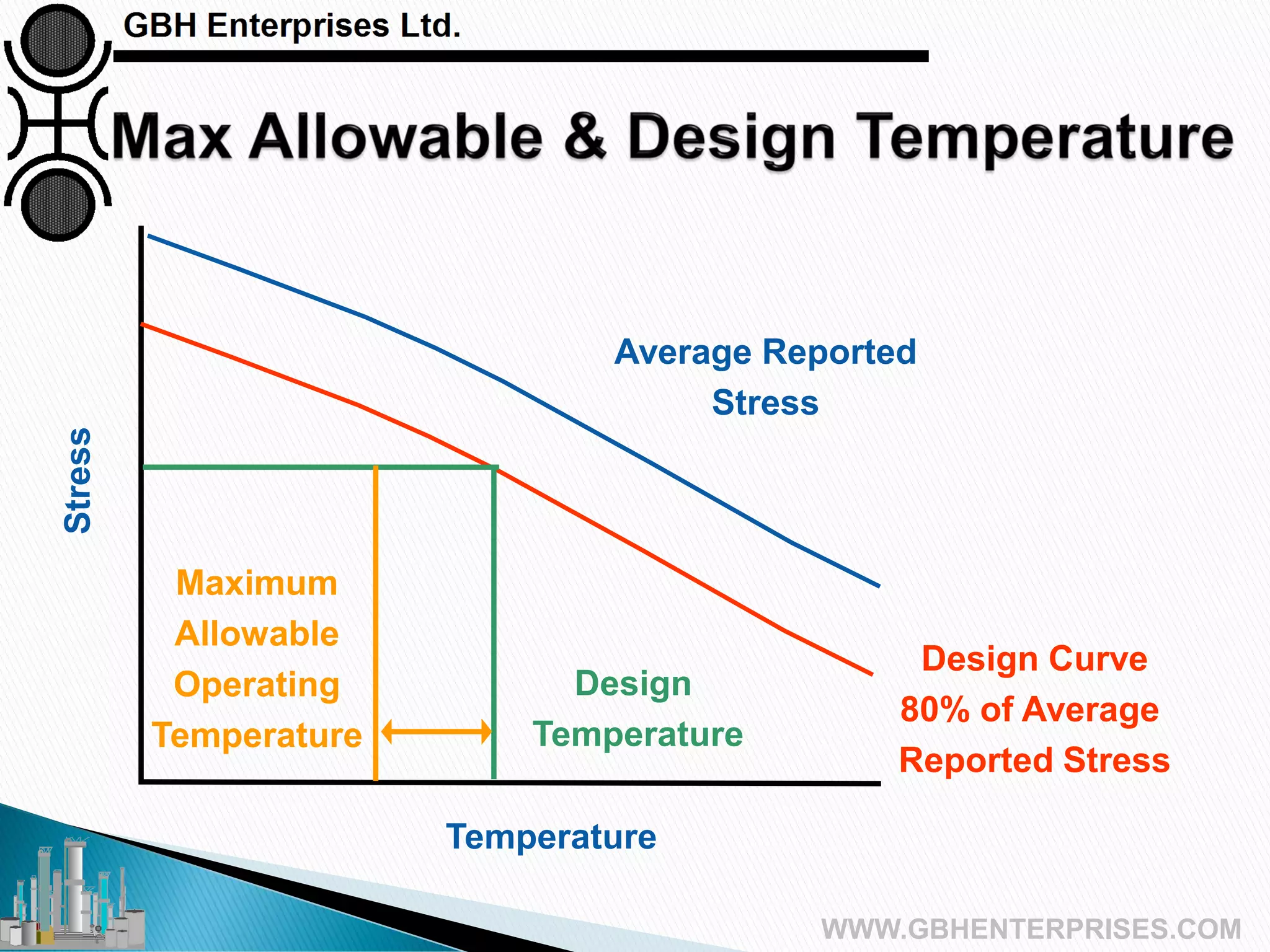
◦ Use 80% of the average stress
◦ Allow for 25°C difference between design temperature
and maximum allowable operating temperature
WWW.GBHENTERPRISES.COM
Average Reported
Stress
Design Curve
80% of Average
Reported Stress
Temperature
Stress
WWW.GBHENTERPRISES.COM
Temperature
Stress
Design Curve
80% of Average
Reported Stress
Average Reported
Stress
Design
Temperature
Maximum
Allowable
Operating
Temperature
WWW.GBHENTERPRISES.COM
• Tube life is usually 100,000 hours
• In reality statistics have been used
• Should expect 2% failure before 100,000
hours
• Provided tubes are operated at Maximum
Allowable Operating Temperature
WWW.GBHENTERPRISES.COM
850 900 950 1000 1050 1100
5
10
20
50
100
200
MeanTubeLife(Hoursx1000)
+20 Deg C
(1560) (1650) (1740) (1830) (1920)
Temperature °C or °F
(2010)
(+36 Deg F)
HK40 tubes
38 barg (550 psig) pressure
95 mm (3.75") bore
13.46 mm (0.53") wall thickness
15.3 N/mm2 (2218 psi) stress
WWW.GBHENTERPRISES.COM
HK40 Alloy HK40 20% Ni 25% Cr
IN519 Alloy IN519 24% Ni 24% Cr 1% Nb
36X Manaurite 36X (Pompey) 33% Ni 25% Cr 1% Nb
800H Incoloy 800H 31% Ni 21% Cr
600 Incoloy 600 72% Ni 15% Cr 1% Mn
H39W Alloy H39W (APV) 33% Ni 25% Cr 1% Nb
H39WM Paralloy H39WM 35% Ni 25% Cr 1% Nb + Ti
XM Manaurite XM 33% Ni 25% Cr 1% Nb + Ti
KHR35CT Kubota Heat Resistant 35% Ni 25% Cr 1% Nb + Ti 0.45%C
A304 Stainless Steel 8% Ni 18% Cr
800H and 600 are for GHR tubes
A304 is only suitable for Bayonet tubes.
WWW.GBHENTERPRISES.COM
700
720
740
760
780
800
820
840
860
880
900
920
940
960
980
1000
2
5
10
20
50
100
200
Temperature °C
Allowablestress(MN/m²)
hk40
in519
h39w
36x
xm
WWW.GBHENTERPRISES.COM
 Development of wrought stainless steel
• Historically “standard” material for the last 30
years
• Generally available
• Served industry well (reliable)
WWW.GBHENTERPRISES.COM
• Available for the last 30 years
• More expensive than HK40
• Choice of thinner tubes at same price, or longer
lives
• Typical names include H39W, 36X
WWW.GBHENTERPRISES.COM
• Most recent development
• Twice as strong as HK40
• Cost effective (not twice the price)
• Offers options of higher heat flux, increased
catalyst volume, fewer tubes, improved efficiency
or longer tube life
• Requires skill to produce
• Typical brands include H39WM, XM, KHR35CT
WWW.GBHENTERPRISES.COM
Low Carbon
Stainless
Wrought
Pipes
Add
Ni, Cr, C
Add
Nb
Improved
Carbides
Add
Microalloy
Additions
Improved
Carbides
1960 1975 1985
25/20
Cr/Ni
25/35/1
Cr/Ni/Nb
HP Mod
TUBES MADE BY CENTRIFUGAL CASTINGS
(High Carbon 0.4%)
25/35/1 plus
Cr/Ni/Nb
additions
CreepStrength
HK40 Microalloys
WWW.GBHENTERPRISES.COM
0
5
10
15
20
25
30
35
Tube Material
RuptureStrength(N/mm2)
0
5
10
15
20
Tube Material
MinimumSoundWallThickness(mm)
HK40 IN 519
HP Nb Mod HP Microalloy
0
0.002
0.004
0.006
0.008
0.01
0.012
Tube Material
CatalystVolume(m3/m)
Calculated to API RP 530
100,000 hour life at 900 Deg C
(1650 Deg F)
Based on 125.2mm (4.93") OD tube, 35.7 kg/cm2 (508psi) pressure
Pouring
Cup
Liquid Alloy In
Internal Coating
Liquid Stream
Drive Rollers
Solidified Tube
End Plate
Steel Mould
5-6 metres long
(Spinning at high speed)
Hollow Liquid Tube
formed by Centrifugal Forces
WWW.GBHENTERPRISES.COM
• Welds of different metallurgies are a source of weakness
• Tube material developments with resultant higher stresses
put more demands on welds
• PAW and EBW now increasingly available
– narrow welds
– no shrinkage
– flexibility in tube metallurgy (no consumable required)
• With HK40 welds weakest point
• Therefore placed welds away from peak heat flux
WWW.GBHENTERPRISES.COM
• Slow, sustained increase in length/diameter as
a result of stress at elevated temperature
• Culminates in rupture
WWW.GBHENTERPRISES.COM
• Normal “end-of-life” failures
– creep rupture
– weld cracking due to creep
• Overheating accelerates normal “end-of-life”
– over-firing
– flame impingement
• Thermal cycling also accelerates normal “end-of-
life”
WWW.GBHENTERPRISES.COM
• Thermal gradients
• Thermal shock
• Stress corrosion cracking
• Dissimilar weld cracking
• Tube support system
WWW.GBHENTERPRISES.COM
• If leak is small with no impingement on
neighbouring tube, continue running!
◦ But monitor regularly
• Replace tube
• Nip pigtails (but consider effect on remaining
tubes)
WWW.GBHENTERPRISES.COM
 NDT
–visual examination
–tube diameter (or circumference)
measurement
–ultrasonic attenuation
–radiography
–metallurgical examination
–LOTISTM
WWW.GBHENTERPRISES.COM
Exposure Time
CreepStrain
Damage Corresponding
Parameter Action in Plant
A - observe
B - observe, fix
inspection intervals
C - limited service until
replacement
D - plan immediate
replacement
C
D
Rupture
A
B
I, II, III:
Creep Ranges
WWW.GBHENTERPRISES.COM
• Prior to shut-down
–hot tubes, hot spots, leaks
• Bulges, distortion, scale, color, staining
–can indicate overheating
–adequate access (scaffolding) needed
• Use TV camera to look at bore
–cracking often starts in bore
WWW.GBHENTERPRISES.COM
• A useful, often undervalued method
• Tube diameters as cast can vary by up to 3 mm
• 1% growth (around 1 mm (40 thou)) significant
◦ HK40 - Bulge to 2-3% then fail
◦ HP Alloys - Bulge to 5-7% (less data) then fail
• Must have base-line readings
• Need to measure at same locations
◦ hot spot and max temp areas
• Tubes can go oval
• Need staging for access
WWW.GBHENTERPRISES.COM
10
5
4
2
6
3
6
1
7 8 9
Sketch of the inspection system
1 Inspected tube 6 Water chamber
2 Emitting probe 7 Ultrasonic pulser
3 Receiving probe 8 Amplifier
4 Probe assembly 9 Analog gate
5 Water feed 10 Recorder
X1 X2
WWW.GBHENTERPRISES.COM
• Excellent in principle
• Poor track record in practice
– tends to fail sound tubes
• Difficult to calibrate
• Best to use repeat tests
– look for deterioration
• Manufacturers recommend radiography of
suspect areas
• Scaffolding not needed
WWW.GBHENTERPRISES.COM
• Use in suspect areas
– hot spots and bulges
• Main benefit in butt weld inspection
• Time - consuming
◦ area sterilisation
• Limited to sampling
• Sensitivity
◦ accurate alignment
• catalyst removal
• Staging needed
WWW.GBHENTERPRISES.COM
• Eddy current measurement
◦ Similar crawler to ultrasound device
◦ No contact, uses AC coil/sensing coil
• Baseline readings recommended
• Issues
◦ Magnetic permeability variation in HP alloy
◦ Depth of penetration through wall less sensitive to
inner wall cracks
• Can also include OD measurement
WWW.GBHENTERPRISES.COM
• Capable of obtaining measurements
within 0.002” (0.05mm), allowing tube
diameters to be determined within
0.05%
• Tubes can be scanned quickly -
typically 3 minutes per tube
• Well proven and reliable equipment
◦ Used by the US military for over 20 years
◦ Proven in methanol plant reformers over
15 years
WWW.GBHENTERPRISES.COM
• GBHE experience from design and operation of
reformers can be used to interpret LOTIS creep
measurement data
• Assessment of remaining tube life
• Recommendations for adjusting process
conditions to optimise performance and life
• Recommendations for adjusting firing pattern to
compensate for differential creep
WWW.GBHENTERPRISES.COM
3.5
4
4.5
5
5.5
Axial Position (In)
TubeDiameter(In)
Good Tube Tube with Creep Damage
WWW.GBHENTERPRISES.COM
 Set up takes less than 30 minutes
 LOTIS can be used on horizontal tubes prior to installation
 No couplants (water or gel) required & no damage to the
tube
 Typically used on new tubes as a quality control check
and to establish a baseline
 Used at each catalyst change (4-5 years) to assess
damage and collect data for allow tube life prediction and
reformer tuning
 Can be used on aged tubes to compare creep with
baseline of top section
 Used on failed tubes to assess actual creep strain
WWW.GBHENTERPRISES.COM
 External inspection can be confused by rough tube
exterior
 Tube bowing can restrict access to external tube
crawlers
 Refractory can restrict access to external inspection
 External inspection tends to rely on careful
interpretation, which may be subjective
 LOTIS gives a precise measure of diameter
WWW.GBHENTERPRISES.COM
Steam Reforming - Tube Design

Steam Reforming - Tube Design

  • 1.
    Steam Reforming: TubeDesign Gerard B. Hawkins Managing Director
  • 2.
     The aimof this presentation is to • Give an understanding of ◦ Tube design principles ◦ Tube manufacture ◦ Failure mechanisms ◦ Inspection techniques WWW.GBHENTERPRISES.COM
  • 3.
    • Based onpredicted creep life of material • Laboratory short-term test are performed for each material ◦ time to rupture is evaluated for a range of temperatures at constant stress ◦ a range of different stresses done • All of the data for a given material can be represented in one diagram by defining the Larson-Miller parameter, P, as a function of time (t) and temperature (T) • Data is analysed statistically and extrapolated to longer time-scales WWW.GBHENTERPRISES.COM
  • 4.
    P (Larson-Miller Parameter) RuptureStress(psi) 100,000 50,000 10,000 5,000 1,000 1617 18 19 20 21 22 23 24 25 26 P = T (log (t) + K) 1000 where T = temperature t = time K = constant WWW.GBHENTERPRISES.COM
  • 5.
    • Process pressure(stress) is defined • Get P from Larson-Miller curve for a given metallurgy • From P, assuming a desired life (t) of typically 100,000 hours, a maximum allowable temperature (T) is defined • Repeat calculation until satisfactory design achieved • Do include some margin ◦ Use 80% of the average stress ◦ Allow for 25°C difference between design temperature and maximum allowable operating temperature WWW.GBHENTERPRISES.COM
  • 6.
    Average Reported Stress Design Curve 80%of Average Reported Stress Temperature Stress WWW.GBHENTERPRISES.COM
  • 7.
    Temperature Stress Design Curve 80% ofAverage Reported Stress Average Reported Stress Design Temperature Maximum Allowable Operating Temperature WWW.GBHENTERPRISES.COM
  • 8.
    • Tube lifeis usually 100,000 hours • In reality statistics have been used • Should expect 2% failure before 100,000 hours • Provided tubes are operated at Maximum Allowable Operating Temperature WWW.GBHENTERPRISES.COM
  • 9.
    850 900 9501000 1050 1100 5 10 20 50 100 200 MeanTubeLife(Hoursx1000) +20 Deg C (1560) (1650) (1740) (1830) (1920) Temperature °C or °F (2010) (+36 Deg F) HK40 tubes 38 barg (550 psig) pressure 95 mm (3.75") bore 13.46 mm (0.53") wall thickness 15.3 N/mm2 (2218 psi) stress WWW.GBHENTERPRISES.COM
  • 10.
    HK40 Alloy HK4020% Ni 25% Cr IN519 Alloy IN519 24% Ni 24% Cr 1% Nb 36X Manaurite 36X (Pompey) 33% Ni 25% Cr 1% Nb 800H Incoloy 800H 31% Ni 21% Cr 600 Incoloy 600 72% Ni 15% Cr 1% Mn H39W Alloy H39W (APV) 33% Ni 25% Cr 1% Nb H39WM Paralloy H39WM 35% Ni 25% Cr 1% Nb + Ti XM Manaurite XM 33% Ni 25% Cr 1% Nb + Ti KHR35CT Kubota Heat Resistant 35% Ni 25% Cr 1% Nb + Ti 0.45%C A304 Stainless Steel 8% Ni 18% Cr 800H and 600 are for GHR tubes A304 is only suitable for Bayonet tubes. WWW.GBHENTERPRISES.COM
  • 11.
  • 12.
     Development ofwrought stainless steel • Historically “standard” material for the last 30 years • Generally available • Served industry well (reliable) WWW.GBHENTERPRISES.COM
  • 13.
    • Available forthe last 30 years • More expensive than HK40 • Choice of thinner tubes at same price, or longer lives • Typical names include H39W, 36X WWW.GBHENTERPRISES.COM
  • 14.
    • Most recentdevelopment • Twice as strong as HK40 • Cost effective (not twice the price) • Offers options of higher heat flux, increased catalyst volume, fewer tubes, improved efficiency or longer tube life • Requires skill to produce • Typical brands include H39WM, XM, KHR35CT WWW.GBHENTERPRISES.COM
  • 15.
    Low Carbon Stainless Wrought Pipes Add Ni, Cr,C Add Nb Improved Carbides Add Microalloy Additions Improved Carbides 1960 1975 1985 25/20 Cr/Ni 25/35/1 Cr/Ni/Nb HP Mod TUBES MADE BY CENTRIFUGAL CASTINGS (High Carbon 0.4%) 25/35/1 plus Cr/Ni/Nb additions CreepStrength HK40 Microalloys WWW.GBHENTERPRISES.COM
  • 16.
    0 5 10 15 20 25 30 35 Tube Material RuptureStrength(N/mm2) 0 5 10 15 20 Tube Material MinimumSoundWallThickness(mm) HK40IN 519 HP Nb Mod HP Microalloy 0 0.002 0.004 0.006 0.008 0.01 0.012 Tube Material CatalystVolume(m3/m) Calculated to API RP 530 100,000 hour life at 900 Deg C (1650 Deg F) Based on 125.2mm (4.93") OD tube, 35.7 kg/cm2 (508psi) pressure
  • 17.
    Pouring Cup Liquid Alloy In InternalCoating Liquid Stream Drive Rollers Solidified Tube End Plate Steel Mould 5-6 metres long (Spinning at high speed) Hollow Liquid Tube formed by Centrifugal Forces WWW.GBHENTERPRISES.COM
  • 18.
  • 19.
    • Welds ofdifferent metallurgies are a source of weakness • Tube material developments with resultant higher stresses put more demands on welds • PAW and EBW now increasingly available – narrow welds – no shrinkage – flexibility in tube metallurgy (no consumable required) • With HK40 welds weakest point • Therefore placed welds away from peak heat flux WWW.GBHENTERPRISES.COM
  • 20.
    • Slow, sustainedincrease in length/diameter as a result of stress at elevated temperature • Culminates in rupture WWW.GBHENTERPRISES.COM
  • 21.
  • 22.
    • Normal “end-of-life”failures – creep rupture – weld cracking due to creep • Overheating accelerates normal “end-of-life” – over-firing – flame impingement • Thermal cycling also accelerates normal “end-of- life” WWW.GBHENTERPRISES.COM
  • 23.
    • Thermal gradients •Thermal shock • Stress corrosion cracking • Dissimilar weld cracking • Tube support system WWW.GBHENTERPRISES.COM
  • 24.
  • 25.
  • 26.
  • 27.
    • If leakis small with no impingement on neighbouring tube, continue running! ◦ But monitor regularly • Replace tube • Nip pigtails (but consider effect on remaining tubes) WWW.GBHENTERPRISES.COM
  • 28.
  • 29.
     NDT –visual examination –tubediameter (or circumference) measurement –ultrasonic attenuation –radiography –metallurgical examination –LOTISTM WWW.GBHENTERPRISES.COM
  • 30.
    Exposure Time CreepStrain Damage Corresponding ParameterAction in Plant A - observe B - observe, fix inspection intervals C - limited service until replacement D - plan immediate replacement C D Rupture A B I, II, III: Creep Ranges WWW.GBHENTERPRISES.COM
  • 31.
    • Prior toshut-down –hot tubes, hot spots, leaks • Bulges, distortion, scale, color, staining –can indicate overheating –adequate access (scaffolding) needed • Use TV camera to look at bore –cracking often starts in bore WWW.GBHENTERPRISES.COM
  • 32.
    • A useful,often undervalued method • Tube diameters as cast can vary by up to 3 mm • 1% growth (around 1 mm (40 thou)) significant ◦ HK40 - Bulge to 2-3% then fail ◦ HP Alloys - Bulge to 5-7% (less data) then fail • Must have base-line readings • Need to measure at same locations ◦ hot spot and max temp areas • Tubes can go oval • Need staging for access WWW.GBHENTERPRISES.COM
  • 33.
    10 5 4 2 6 3 6 1 7 8 9 Sketchof the inspection system 1 Inspected tube 6 Water chamber 2 Emitting probe 7 Ultrasonic pulser 3 Receiving probe 8 Amplifier 4 Probe assembly 9 Analog gate 5 Water feed 10 Recorder X1 X2 WWW.GBHENTERPRISES.COM
  • 34.
  • 35.
    • Excellent inprinciple • Poor track record in practice – tends to fail sound tubes • Difficult to calibrate • Best to use repeat tests – look for deterioration • Manufacturers recommend radiography of suspect areas • Scaffolding not needed WWW.GBHENTERPRISES.COM
  • 36.
    • Use insuspect areas – hot spots and bulges • Main benefit in butt weld inspection • Time - consuming ◦ area sterilisation • Limited to sampling • Sensitivity ◦ accurate alignment • catalyst removal • Staging needed WWW.GBHENTERPRISES.COM
  • 37.
    • Eddy currentmeasurement ◦ Similar crawler to ultrasound device ◦ No contact, uses AC coil/sensing coil • Baseline readings recommended • Issues ◦ Magnetic permeability variation in HP alloy ◦ Depth of penetration through wall less sensitive to inner wall cracks • Can also include OD measurement WWW.GBHENTERPRISES.COM
  • 38.
    • Capable ofobtaining measurements within 0.002” (0.05mm), allowing tube diameters to be determined within 0.05% • Tubes can be scanned quickly - typically 3 minutes per tube • Well proven and reliable equipment ◦ Used by the US military for over 20 years ◦ Proven in methanol plant reformers over 15 years WWW.GBHENTERPRISES.COM
  • 39.
    • GBHE experiencefrom design and operation of reformers can be used to interpret LOTIS creep measurement data • Assessment of remaining tube life • Recommendations for adjusting process conditions to optimise performance and life • Recommendations for adjusting firing pattern to compensate for differential creep WWW.GBHENTERPRISES.COM
  • 40.
    3.5 4 4.5 5 5.5 Axial Position (In) TubeDiameter(In) GoodTube Tube with Creep Damage WWW.GBHENTERPRISES.COM
  • 41.
  • 42.
     Set uptakes less than 30 minutes  LOTIS can be used on horizontal tubes prior to installation  No couplants (water or gel) required & no damage to the tube  Typically used on new tubes as a quality control check and to establish a baseline  Used at each catalyst change (4-5 years) to assess damage and collect data for allow tube life prediction and reformer tuning  Can be used on aged tubes to compare creep with baseline of top section  Used on failed tubes to assess actual creep strain WWW.GBHENTERPRISES.COM
  • 43.
     External inspectioncan be confused by rough tube exterior  Tube bowing can restrict access to external tube crawlers  Refractory can restrict access to external inspection  External inspection tends to rely on careful interpretation, which may be subjective  LOTIS gives a precise measure of diameter WWW.GBHENTERPRISES.COM