BIOHYDROGEN PRODUCTION
MITAL CHANDEGARA
BIOTECHNOLOGY
16
CONTENT
• Introduction
• Why hydrogen?
• Methods of hydrogen production
1) Physicochemical
2) Biological
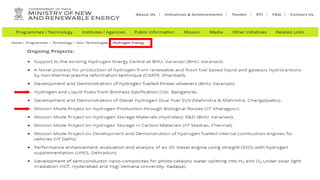
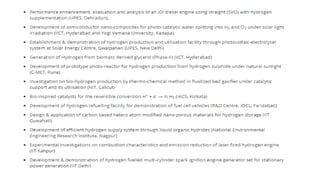
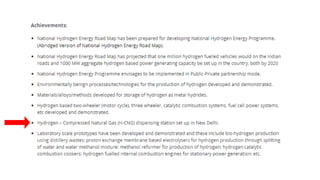
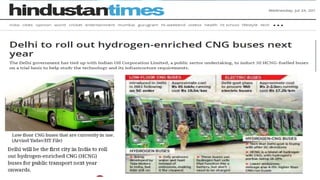
• Ongoing projects in India
• Reference
INTRODUCTION
• Biohydrogen
• Use of fossil fuel is increase (transportation , power & heat
generation)
• Increased CO₂ level
• Global warming ( climate change )
• Alternative option (environment friendly)
• Most abundant element on the earth (H₂O)
• Simplest one (1e +1p)
• Highest energy content(122kJ/g , 2.75 times higher
than HCs)
• Clean fuel (no green-house gas emission)
• Combustion of H₂ produce water
• Globally accepted as environmentally safe energy
recourse
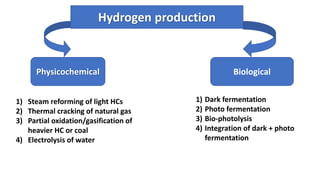
Hydrogen production
Physicochemical Biological
1) Steam reforming of light HCs
2) Thermal cracking of natural gas
3) Partial oxidation/gasification of
heavier HC or coal
4) Electrolysis of water
1) Dark fermentation
2) Photo fermentation
3) Bio-photolysis
4) Integration of dark + photo
fermentation
NEED OF BIOHYDROGEN
• Uses of hydrogen in different industries
(fertilizer = ammonia, oil refinery = hydrotreatment of crude oil for
sulphur removal)
• Global H₂ demand fulfilled by 1st 3 Pc method
(major drawback - high energy intensive & emits greenhouse gases)
DARK FERMENTATION
• Either obligate or facultative anaerobes are capable to utilize various
organic material as a substrates
• Occurs in ab of oxygen
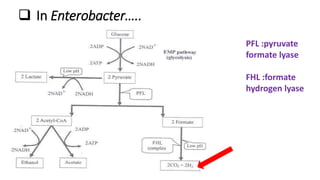
• Facultative anaerobes like Enterobacter , Citrobacter
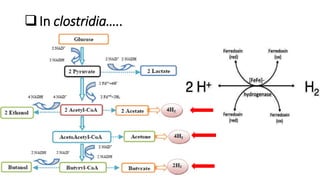
• Obligate anaerobes like clostridium
 In Enterobacter…..
PFL :pyruvate
formate lyase
FHL :formate
hydrogen lyase
In clostridia…..
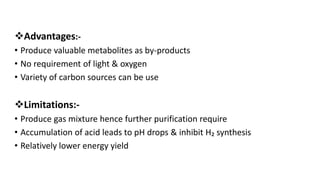
Advantages:-
• Produce valuable metabolites as by-products
• No requirement of light & oxygen
• Variety of carbon sources can be use
Limitations:-
• Produce gas mixture hence further purification require
• Accumulation of acid leads to pH drops & inhibit H₂ synthesis
• Relatively lower energy yield
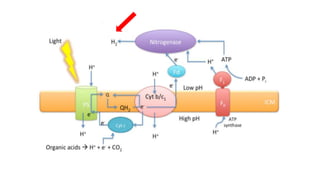
PHOTO FERMENTATION
• Photosynthetic bacteria (PNS bacteria such as Rhodopseudomonas &
Rhodobacter )
• Anaerobic condition
• Photosynthetic pigments
• Short chain organic acid utilization
• Light as source of energy
• Nitrogenase
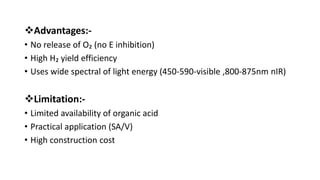
Advantages:-
• No release of O₂ (no E inhibition)
• High H₂ yield efficiency
• Uses wide spectral of light energy (450-590-visible ,800-875nm nIR)
Limitation:-
• Limited availability of organic acid
• Practical application (SA/V)
• High construction cost
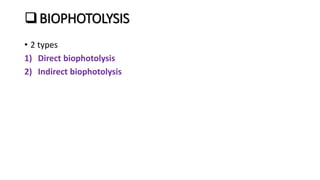
BIOPHOTOLYSIS
• 2 types
1) Direct biophotolysis
2) Indirect biophotolysis
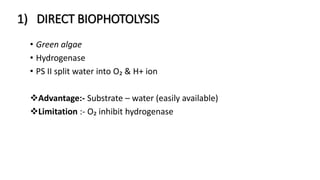
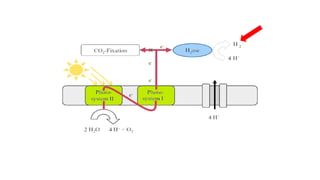
1) DIRECT BIOPHOTOLYSIS
• Green algae
• Hydrogenase
• PS II split water into O₂ & H+ ion
Advantage:- Substrate – water (easily available)
Limitation :- O₂ inhibit hydrogenase
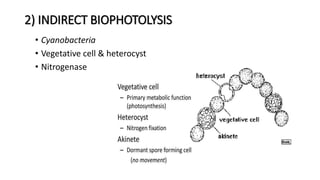
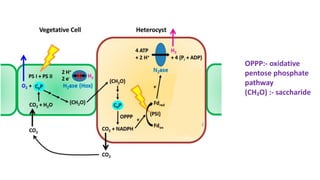
2) INDIRECT BIOPHOTOLYSIS
• Cyanobacteria
• Vegetative cell & heterocyst
• Nitrogenase
OPPP:- oxidative
pentose phosphate
pathway
(CH₂O) :- saccharide
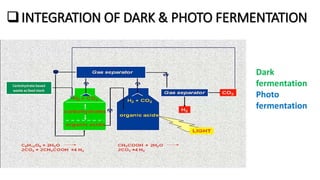
INTEGRATION OF DARK & PHOTO FERMENTATION
Dark
fermentation
Photo
fermentation
 Introduction to biofuels by D. M. Mousdale
 Production of biological hydrogen in india by Prof. Y K Yadav, Dr sachin kumar
& Raman Rao
 Review on recent developments in biological hydrogen production processes
by Debarata Das , Namita Khanna, T. Nejat Veziroğlu
 Review on outlook of fermentative hydrogen production techniques :- An
overview of dark, photo and integrated dark-photo approach to biomass by
Puranjan Mishra, S. Krishna, S. Rana & Lakhveer singh
 Ministry of new & renewable energy
Biohydrogen production

Biohydrogen production

  • 1.
  • 2.
    CONTENT • Introduction • Whyhydrogen? • Methods of hydrogen production 1) Physicochemical 2) Biological • Ongoing projects in India • Reference
  • 3.
    INTRODUCTION • Biohydrogen • Useof fossil fuel is increase (transportation , power & heat generation) • Increased CO₂ level • Global warming ( climate change ) • Alternative option (environment friendly)
  • 5.
    • Most abundantelement on the earth (H₂O) • Simplest one (1e +1p) • Highest energy content(122kJ/g , 2.75 times higher than HCs) • Clean fuel (no green-house gas emission) • Combustion of H₂ produce water • Globally accepted as environmentally safe energy recourse
  • 6.
    Hydrogen production Physicochemical Biological 1)Steam reforming of light HCs 2) Thermal cracking of natural gas 3) Partial oxidation/gasification of heavier HC or coal 4) Electrolysis of water 1) Dark fermentation 2) Photo fermentation 3) Bio-photolysis 4) Integration of dark + photo fermentation
  • 7.
    NEED OF BIOHYDROGEN •Uses of hydrogen in different industries (fertilizer = ammonia, oil refinery = hydrotreatment of crude oil for sulphur removal) • Global H₂ demand fulfilled by 1st 3 Pc method (major drawback - high energy intensive & emits greenhouse gases)
  • 8.
    DARK FERMENTATION • Eitherobligate or facultative anaerobes are capable to utilize various organic material as a substrates • Occurs in ab of oxygen • Facultative anaerobes like Enterobacter , Citrobacter • Obligate anaerobes like clostridium
  • 9.
     In Enterobacter….. PFL:pyruvate formate lyase FHL :formate hydrogen lyase
  • 10.
  • 11.
    Advantages:- • Produce valuablemetabolites as by-products • No requirement of light & oxygen • Variety of carbon sources can be use Limitations:- • Produce gas mixture hence further purification require • Accumulation of acid leads to pH drops & inhibit H₂ synthesis • Relatively lower energy yield
  • 12.
    PHOTO FERMENTATION • Photosyntheticbacteria (PNS bacteria such as Rhodopseudomonas & Rhodobacter ) • Anaerobic condition • Photosynthetic pigments • Short chain organic acid utilization • Light as source of energy • Nitrogenase
  • 14.
    Advantages:- • No releaseof O₂ (no E inhibition) • High H₂ yield efficiency • Uses wide spectral of light energy (450-590-visible ,800-875nm nIR) Limitation:- • Limited availability of organic acid • Practical application (SA/V) • High construction cost
  • 15.
    BIOPHOTOLYSIS • 2 types 1)Direct biophotolysis 2) Indirect biophotolysis
  • 16.
    1) DIRECT BIOPHOTOLYSIS •Green algae • Hydrogenase • PS II split water into O₂ & H+ ion Advantage:- Substrate – water (easily available) Limitation :- O₂ inhibit hydrogenase
  • 18.
    2) INDIRECT BIOPHOTOLYSIS •Cyanobacteria • Vegetative cell & heterocyst • Nitrogenase
  • 19.
  • 20.
    INTEGRATION OF DARK& PHOTO FERMENTATION Dark fermentation Photo fermentation
  • 26.
     Introduction tobiofuels by D. M. Mousdale  Production of biological hydrogen in india by Prof. Y K Yadav, Dr sachin kumar & Raman Rao  Review on recent developments in biological hydrogen production processes by Debarata Das , Namita Khanna, T. Nejat Veziroğlu  Review on outlook of fermentative hydrogen production techniques :- An overview of dark, photo and integrated dark-photo approach to biomass by Puranjan Mishra, S. Krishna, S. Rana & Lakhveer singh  Ministry of new & renewable energy