BioethanolRoselen, Wanxi, Eugenia 
CONTENTSWhat is bioethanol?Bioethanol ProductionFeedstocksFuel PropertiesApplicationAdvantagesDisadvantages and ConcernsEthanol ControversyComparison of Bioethanol and BiodieselCase study [Brazil]Future development
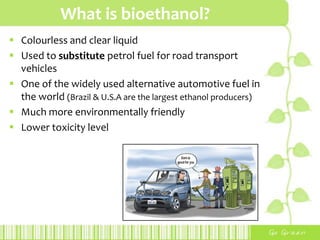
What is bioethanol?Colourless and clear liquid
Used to substitutepetrol fuel for road transport vehicles
One of the widely used alternative automotive fuel in the world (Brazil & U.S.A are the largest ethanol producers)
Much more environmentally friendly
Lower toxicity level Bioethanol ProductionWheat/Grains/Corn/Sugar-cane can be used to produce ethanol. (Basically, any plants that composed largely of sugars)Main method : Sugar fermentation3 methods of hydrolysis :(extraction of sugars out of bio-mass wastes)concentrated acid hydrolysisenzymatic hydrolysis dilute acid hydrolysis
Bioethanol Production(1) Concentrated Acid Hydrolysis~77% of sulfuric acid is added to the dried biomass to a 10% moisture content.Acid to be added in the ratio of 1/25 acid :1 biomass under 50°C. Dilute the acid to ~30% with water and reheat the mixture at100°C for an hour. Gel will be produced and pressed to discharge the acid sugar mixture.Separate the acid & sugar mixture by using a chromatographic column .
Bioethanol Production(2) Enzymatic Hydrolysis (Not popular)(3) Dilute Acid Hydrolysis oldest, simplest yet efficient methodhydrolyse the bio-mass to sucrose hemi-cellulose undergo hydrolysis with the addition of 7% of sulfuric acid under the temperature 190°C.to generate the more resistant cellulose portion, 4% of sulfuric acid is added at the temperature of 215°C
Bioethanol ProductionWet milling processcorn kernel is soaked in warm water proteins broken downstarch present in the corn is released (thus, softening the kernel for the milling process)microorganisms, fibre and starch products are produced. In the distillation process, ethanol is produced.
Bioethanol ProductionDry milling processClean and break down the corn kernel into fine particlesSugar solution is produced when the powder mixture (corn germ/starch and fibre) is broken down into sucrose by dilute acid or enzymes. Yeast is added to ferment the cooled mixture into ethanol.
Bioethanol ProductionSugar fermentationHydrolysis process breaks down the biomass cellulosic portion into sugar solutions which will then be fermented into ethanol.Yeast is added and heated to the solution.Invertase acts as a catalyst and convert the sucrose sugars into glucose and fructose. (both C6H12O6).
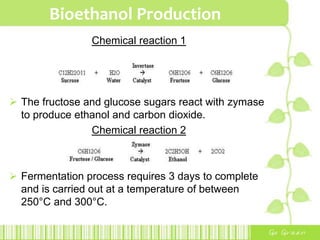
Bioethanol ProductionChemical reaction 1The fructose and glucose sugars react with zymase to produce ethanol and carbon dioxide.Chemical reaction 2Fermentation process requires 3 days to complete and is carried out at a temperature of between 250°C and 300°C.Bioethanol ProductionFractional Distillation ProcessAfter the sugar fermentation process, the ethanol still does contain a significant quantity of water which have to be removed.In the distillation process, both the water and ethanol mixture are boiled.Ethanol has a lower boiling point than water, therefore ethanol will be converted into the vapour state first  condensed and separated from water.
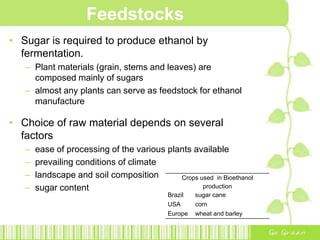
FeedstocksSugar is required to produce ethanol by fermentation. Plant materials (grain, stems and leaves) are composed mainly of sugarsalmost any plants can serve as feedstock for ethanol manufactureChoice of raw material depends on several factors ease of processing of the various plants availableprevailing conditions of climatelandscape and soil compositionsugar content
FeedstocksR&D activities on using lignocellulosic (woody materials) as feedstock Lignocellulosic biomass is more abundant and less expensive than food cropshigher net energy balanceaccrue up to 90% in greenhouse gas savings, much higher than the first generation of biofuelHowever, more difficult to convert to sugars due to their relatively inaccessible molecular structure
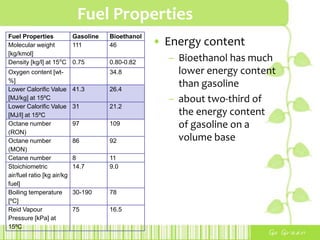
Fuel PropertiesEnergy contentBioethanol has much lower energy content than gasoline about two-third of the energy content of gasoline on a volume base
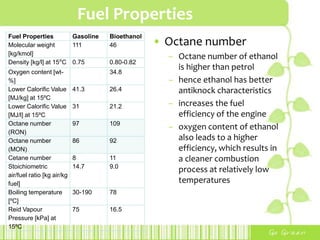
Fuel PropertiesOctane numberOctane number of ethanol is higher than petrolhence ethanol has better antiknock characteristicsincreases the fuel efficiency of the engineoxygen content of ethanol also leads to a higher efficiency, which results in a cleaner combustion process at relatively low temperatures
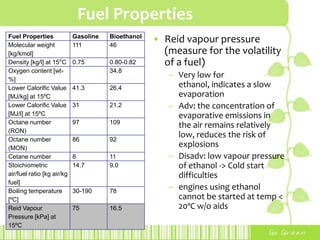
Fuel PropertiesReid vapour pressure (measure for the volatility of a fuel)Very low for ethanol, indicates a slow evaporationAdv: the concentration of evaporative emissions in the air remains relatively low, reduces the risk of explosionsDisadv: low vapour pressure of ethanol -> Cold start difficultiesengines using ethanol cannot be started at temp < 20ºC w/o aids
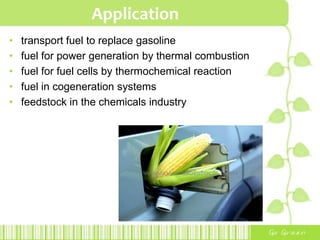
Applicationtransport fuel to replace gasolinefuel for power generation by thermal combustionfuel for fuel cells by thermochemical reactionfuel in cogeneration systemsfeedstock in the chemicals industry
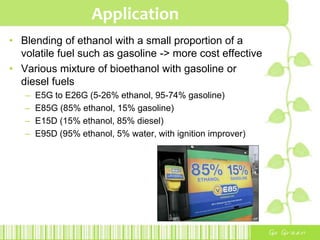
ApplicationBlending of ethanol with a small proportion of a volatile fuel such as gasoline -> more cost effective Various mixture of bioethanol with gasoline or diesel fuelsE5G to E26G (5-26% ethanol, 95-74% gasoline)E85G (85% ethanol, 15% gasoline)E15D (15% ethanol, 85% diesel)E95D (95% ethanol, 5% water, with ignition improver)
AdvantagesExhaust gases of ethanol are much cleanerit burns more cleanly as a result of more complete combustionGreenhousegases reduceethanol-blended fuels such as E85 (85% ethanol and 15% gasoline) reduce up to 37.1% of GHGsPositive energy balance, depending on the type of raw stock output of energy during the production is more than the inputAny plant can be use for production of bioethanolit only has to contain sugar and starchCarbon neutral the CO2 released in the bioethanol production process is the same amount as the one the crops previously absorbed during photosynthesis
AdvantagesDecrease in ozone formation The emissions produced by burning ethanol are less reactive with sunlight than those produced by burning gasoline, which results in a lower potential for forming ozoneRenewable energy resourceresult of conversion of the sun's energy into usable energyPhotosynthesis -> feedstocks grow -> processed into ethanolEnergy securityesp. Countries that do not have access to crude oil resourcesgrow crops for energy use and gain some economic freedomReduces the amount of high-octane additivesFuel spills are more easily biodegraded or diluted to non toxic concentrations
Disadvantages and ConcernsBiodiversityA large amount of arable land is required to grow crops, natural habitats would be destroyedFood vs. Fuel debatedue to the lucrative prices of bioethanol some farmers may sacrifice food crops for biofuel production which will increase food prices around the worldCarbon emissions (controversial) During production of bioethanol, huge amount of carbon dioxide is releasedEmission of GHGs from production of bioethanol  is comparable to the emissions of internal-combustion engines
Disadvantages and ConcernsNot as efficient as petroleumenergy content of the petrol is much higher than bioethanolits energy content is 70% of that of petrolEngines made for working on Bioethanolcannot be used for petrol or dieselDue to high octane number of bioethanol, they can be burned in the engines with much higher compression ratioUsed of phosphorous and nitrogen in the productionnegative effect on the environmentCold start difficultiespure ethanol is difficult to vaporise
Disadvantages and ConcernsTransportationethanol is hygroscopic, it absorbs water from the air and thus has high corrosion aggressivenessCan only be transported by auto transport or railroadMany older cars unequipped to handle even 10% ethanolNegatively affect electric fuel pumps by increasing internal wear and undesirable spark generation
Ethanol Controversy
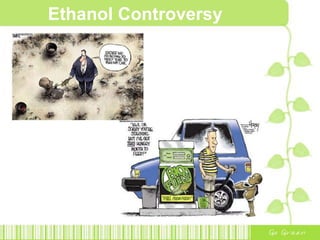
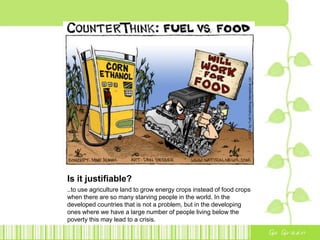
Is it justifiable?..to use agriculture land to grow energy crops instead of food crops when there are so many starving people in the world. In the developed countries that is not a problem, but in the developing ones where we have a large number of people living below the poverty this may lead to a crisis.
Ethanol ControversyIs burning biofuel more environmentally friendly than burning oil?Fact that producing biofuel is not a "green process“requires tractors and fertilisers and landWith the increase in biofuel production,  more forests will be chopped down to make room for biofuel, ↑ CO2Better alternative suggested by scientists..steer away from biofuel and focus on reforestation and maximising the efficiency of fossil fuels instead
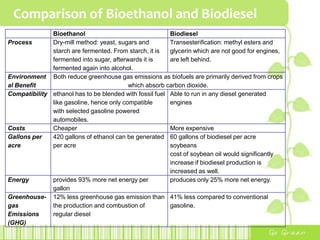
Comparison of Bioethanol and Biodiesel
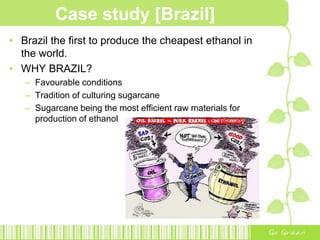
Case study [Brazil]Brazil the first to produce the cheapest ethanol in the world.WHY BRAZIL?Favourable conditionsTradition of culturing sugarcaneSugarcane being the most efficient raw materials for production of ethanol
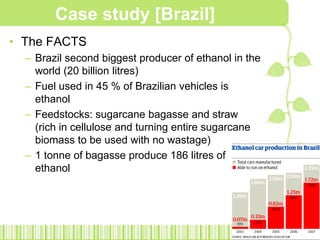
Case study [Brazil]The FACTSBrazil second biggest producer of ethanol in the world (20 billion litres)Fuel used in 45 % of Brazilian vehicles is ethanolFeedstocks: sugarcane bagasse and straw (rich in cellulose and turning entire sugarcane biomass to be used with no wastage)1 tonne of bagasse produce 186 litres of ethanol
Case study [Brazil]In 1930sBrazil’s ethanol industry startedGovernment directed sugarcane into ethanol productionMade addition of ethanol to gasoline compulsoryIn 1973International oil crisis doubled Brazil’s expenditure on oil importsGovernment was forced to consider alternative sources of energy to decrease its dependency and spending on fossil fuels.In 1975Increase ethanol production as a substitute for gasolineInvested in increasing agricultural productionModernising and expanding distilleriesEstablish new production plantsIntroduce subsidies to lower prices and reduce taxes for ethanol producers
Case study [Brazil]Over 15 years, production of ethanol escalated from 0.6 billion litres in 1975 to 11 billion litres in 1990.
Progress further with Bioethanol establishments:1975 to 1978One part of ethanol was added to four parts of gasoline.Additional processing stage to remove water from the fuel1979Production streamlined to focus on hydrous ethanolEthanol which contains 5% water that could be used in cars fuelled entirely by ethanolResearchers in Aerospace Technology in Sao Paulo, developed alloys to protect the internal parts of gasoline-powered engines and fuel tanks from corrosion by ethanol. 1986 to 1989, 90% of all new vehicles sold in the domestic market were ethanol-fuelled.Case study [Brazil]PROBLEMS faced:Waste!!VINASSE – a corrosive liquid byproduct of ethanol distillationBeing dumped in rivers causing environmental damageBagasse – leftover sugarcane fibre
Case study [Brazil]SOLUTIONS:Vinasse was found to be a good fertiliser.Transportation system was developedCombination of trucks, pipes and ducts to carry Vinasse from the distilleries to the fieldsBagasse was collectedProduce energy, building on existing methods of burning the bagasse to power steam turbines for electricity generationDeveloped cauldrons under greater pressureMore energy could be produced allowing ethanol plants to become more autonomous in terms of energyCONTRIBUTIONS IS TO KEEP ETHANOL PRODUCTION COSTS LOW
Case study [Brazil]Social impactsCreated jobs for locals (mainly in rural areas)Brazilian sugarcane industry has a particularly poor record in respecting worker’s rightsExpansion in sugar cane cultivation may increase food prices. This would leave the poor with a harder survival.Although the ethanol industry has greatly increased the wealth of the sugar and alcohol sector’s industries, the poor have to be the one handling the negative impacts.

Bioethanol

  • 1.
  • 2.
    CONTENTSWhat is bioethanol?BioethanolProductionFeedstocksFuel PropertiesApplicationAdvantagesDisadvantages and ConcernsEthanol ControversyComparison of Bioethanol and BiodieselCase study [Brazil]Future development
  • 3.
  • 4.
    Used to substitutepetrolfuel for road transport vehicles
  • 5.
    One of thewidely used alternative automotive fuel in the world (Brazil & U.S.A are the largest ethanol producers)
  • 6.
  • 7.
    Lower toxicity levelBioethanol ProductionWheat/Grains/Corn/Sugar-cane can be used to produce ethanol. (Basically, any plants that composed largely of sugars)Main method : Sugar fermentation3 methods of hydrolysis :(extraction of sugars out of bio-mass wastes)concentrated acid hydrolysisenzymatic hydrolysis dilute acid hydrolysis
  • 8.
    Bioethanol Production(1) ConcentratedAcid Hydrolysis~77% of sulfuric acid is added to the dried biomass to a 10% moisture content.Acid to be added in the ratio of 1/25 acid :1 biomass under 50°C. Dilute the acid to ~30% with water and reheat the mixture at100°C for an hour. Gel will be produced and pressed to discharge the acid sugar mixture.Separate the acid & sugar mixture by using a chromatographic column .
  • 9.
    Bioethanol Production(2) EnzymaticHydrolysis (Not popular)(3) Dilute Acid Hydrolysis oldest, simplest yet efficient methodhydrolyse the bio-mass to sucrose hemi-cellulose undergo hydrolysis with the addition of 7% of sulfuric acid under the temperature 190°C.to generate the more resistant cellulose portion, 4% of sulfuric acid is added at the temperature of 215°C
  • 10.
    Bioethanol ProductionWet millingprocesscorn kernel is soaked in warm water proteins broken downstarch present in the corn is released (thus, softening the kernel for the milling process)microorganisms, fibre and starch products are produced. In the distillation process, ethanol is produced.
  • 11.
    Bioethanol ProductionDry millingprocessClean and break down the corn kernel into fine particlesSugar solution is produced when the powder mixture (corn germ/starch and fibre) is broken down into sucrose by dilute acid or enzymes. Yeast is added to ferment the cooled mixture into ethanol.
  • 12.
    Bioethanol ProductionSugar fermentationHydrolysisprocess breaks down the biomass cellulosic portion into sugar solutions which will then be fermented into ethanol.Yeast is added and heated to the solution.Invertase acts as a catalyst and convert the sucrose sugars into glucose and fructose. (both C6H12O6).
  • 13.
    Bioethanol ProductionChemical reaction1The fructose and glucose sugars react with zymase to produce ethanol and carbon dioxide.Chemical reaction 2Fermentation process requires 3 days to complete and is carried out at a temperature of between 250°C and 300°C.Bioethanol ProductionFractional Distillation ProcessAfter the sugar fermentation process, the ethanol still does contain a significant quantity of water which have to be removed.In the distillation process, both the water and ethanol mixture are boiled.Ethanol has a lower boiling point than water, therefore ethanol will be converted into the vapour state first  condensed and separated from water.
  • 14.
    FeedstocksSugar is requiredto produce ethanol by fermentation. Plant materials (grain, stems and leaves) are composed mainly of sugarsalmost any plants can serve as feedstock for ethanol manufactureChoice of raw material depends on several factors ease of processing of the various plants availableprevailing conditions of climatelandscape and soil compositionsugar content
  • 15.
    FeedstocksR&D activities onusing lignocellulosic (woody materials) as feedstock Lignocellulosic biomass is more abundant and less expensive than food cropshigher net energy balanceaccrue up to 90% in greenhouse gas savings, much higher than the first generation of biofuelHowever, more difficult to convert to sugars due to their relatively inaccessible molecular structure
  • 16.
    Fuel PropertiesEnergy contentBioethanolhas much lower energy content than gasoline about two-third of the energy content of gasoline on a volume base
  • 17.
    Fuel PropertiesOctane numberOctanenumber of ethanol is higher than petrolhence ethanol has better antiknock characteristicsincreases the fuel efficiency of the engineoxygen content of ethanol also leads to a higher efficiency, which results in a cleaner combustion process at relatively low temperatures
  • 18.
    Fuel PropertiesReid vapourpressure (measure for the volatility of a fuel)Very low for ethanol, indicates a slow evaporationAdv: the concentration of evaporative emissions in the air remains relatively low, reduces the risk of explosionsDisadv: low vapour pressure of ethanol -> Cold start difficultiesengines using ethanol cannot be started at temp < 20ºC w/o aids
  • 19.
    Applicationtransport fuel toreplace gasolinefuel for power generation by thermal combustionfuel for fuel cells by thermochemical reactionfuel in cogeneration systemsfeedstock in the chemicals industry
  • 20.
    ApplicationBlending of ethanolwith a small proportion of a volatile fuel such as gasoline -> more cost effective Various mixture of bioethanol with gasoline or diesel fuelsE5G to E26G (5-26% ethanol, 95-74% gasoline)E85G (85% ethanol, 15% gasoline)E15D (15% ethanol, 85% diesel)E95D (95% ethanol, 5% water, with ignition improver)
  • 21.
    AdvantagesExhaust gases ofethanol are much cleanerit burns more cleanly as a result of more complete combustionGreenhousegases reduceethanol-blended fuels such as E85 (85% ethanol and 15% gasoline) reduce up to 37.1% of GHGsPositive energy balance, depending on the type of raw stock output of energy during the production is more than the inputAny plant can be use for production of bioethanolit only has to contain sugar and starchCarbon neutral the CO2 released in the bioethanol production process is the same amount as the one the crops previously absorbed during photosynthesis
  • 22.
    AdvantagesDecrease in ozoneformation The emissions produced by burning ethanol are less reactive with sunlight than those produced by burning gasoline, which results in a lower potential for forming ozoneRenewable energy resourceresult of conversion of the sun's energy into usable energyPhotosynthesis -> feedstocks grow -> processed into ethanolEnergy securityesp. Countries that do not have access to crude oil resourcesgrow crops for energy use and gain some economic freedomReduces the amount of high-octane additivesFuel spills are more easily biodegraded or diluted to non toxic concentrations
  • 23.
    Disadvantages and ConcernsBiodiversityAlarge amount of arable land is required to grow crops, natural habitats would be destroyedFood vs. Fuel debatedue to the lucrative prices of bioethanol some farmers may sacrifice food crops for biofuel production which will increase food prices around the worldCarbon emissions (controversial) During production of bioethanol, huge amount of carbon dioxide is releasedEmission of GHGs from production of bioethanol is comparable to the emissions of internal-combustion engines
  • 24.
    Disadvantages and ConcernsNotas efficient as petroleumenergy content of the petrol is much higher than bioethanolits energy content is 70% of that of petrolEngines made for working on Bioethanolcannot be used for petrol or dieselDue to high octane number of bioethanol, they can be burned in the engines with much higher compression ratioUsed of phosphorous and nitrogen in the productionnegative effect on the environmentCold start difficultiespure ethanol is difficult to vaporise
  • 25.
    Disadvantages and ConcernsTransportationethanolis hygroscopic, it absorbs water from the air and thus has high corrosion aggressivenessCan only be transported by auto transport or railroadMany older cars unequipped to handle even 10% ethanolNegatively affect electric fuel pumps by increasing internal wear and undesirable spark generation
  • 26.
  • 27.
    Is it justifiable?..touse agriculture land to grow energy crops instead of food crops when there are so many starving people in the world. In the developed countries that is not a problem, but in the developing ones where we have a large number of people living below the poverty this may lead to a crisis.
  • 28.
    Ethanol ControversyIs burningbiofuel more environmentally friendly than burning oil?Fact that producing biofuel is not a "green process“requires tractors and fertilisers and landWith the increase in biofuel production, more forests will be chopped down to make room for biofuel, ↑ CO2Better alternative suggested by scientists..steer away from biofuel and focus on reforestation and maximising the efficiency of fossil fuels instead
  • 29.
  • 30.
    Case study [Brazil]Brazilthe first to produce the cheapest ethanol in the world.WHY BRAZIL?Favourable conditionsTradition of culturing sugarcaneSugarcane being the most efficient raw materials for production of ethanol
  • 31.
    Case study [Brazil]TheFACTSBrazil second biggest producer of ethanol in the world (20 billion litres)Fuel used in 45 % of Brazilian vehicles is ethanolFeedstocks: sugarcane bagasse and straw (rich in cellulose and turning entire sugarcane biomass to be used with no wastage)1 tonne of bagasse produce 186 litres of ethanol
  • 32.
    Case study [Brazil]In1930sBrazil’s ethanol industry startedGovernment directed sugarcane into ethanol productionMade addition of ethanol to gasoline compulsoryIn 1973International oil crisis doubled Brazil’s expenditure on oil importsGovernment was forced to consider alternative sources of energy to decrease its dependency and spending on fossil fuels.In 1975Increase ethanol production as a substitute for gasolineInvested in increasing agricultural productionModernising and expanding distilleriesEstablish new production plantsIntroduce subsidies to lower prices and reduce taxes for ethanol producers
  • 33.
    Case study [Brazil]Over15 years, production of ethanol escalated from 0.6 billion litres in 1975 to 11 billion litres in 1990.
  • 34.
    Progress further withBioethanol establishments:1975 to 1978One part of ethanol was added to four parts of gasoline.Additional processing stage to remove water from the fuel1979Production streamlined to focus on hydrous ethanolEthanol which contains 5% water that could be used in cars fuelled entirely by ethanolResearchers in Aerospace Technology in Sao Paulo, developed alloys to protect the internal parts of gasoline-powered engines and fuel tanks from corrosion by ethanol. 1986 to 1989, 90% of all new vehicles sold in the domestic market were ethanol-fuelled.Case study [Brazil]PROBLEMS faced:Waste!!VINASSE – a corrosive liquid byproduct of ethanol distillationBeing dumped in rivers causing environmental damageBagasse – leftover sugarcane fibre
  • 35.
    Case study [Brazil]SOLUTIONS:Vinasse wasfound to be a good fertiliser.Transportation system was developedCombination of trucks, pipes and ducts to carry Vinasse from the distilleries to the fieldsBagasse was collectedProduce energy, building on existing methods of burning the bagasse to power steam turbines for electricity generationDeveloped cauldrons under greater pressureMore energy could be produced allowing ethanol plants to become more autonomous in terms of energyCONTRIBUTIONS IS TO KEEP ETHANOL PRODUCTION COSTS LOW
  • 36.
    Case study [Brazil]SocialimpactsCreated jobs for locals (mainly in rural areas)Brazilian sugarcane industry has a particularly poor record in respecting worker’s rightsExpansion in sugar cane cultivation may increase food prices. This would leave the poor with a harder survival.Although the ethanol industry has greatly increased the wealth of the sugar and alcohol sector’s industries, the poor have to be the one handling the negative impacts.