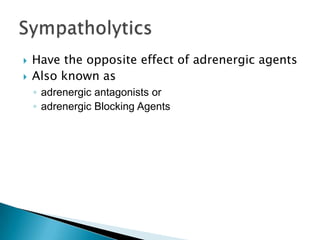

 Have the opposite effect of adrenergic agents
 Also known as
◦ adrenergic antagonists or
◦ adrenergic Blocking Agents
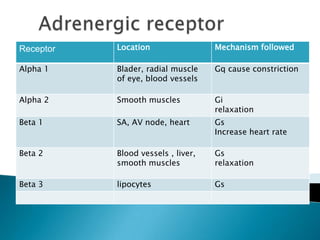
Receptor Location Mechanism followed
Alpha 1 Blader, radial muscle
of eye, blood vessels
Gq cause constriction
Alpha 2 Smooth muscles Gi
relaxation
Beta 1 SA, AV node, heart Gs
Increase heart rate
Beta 2 Blood vessels , liver,
smooth muscles
Gs
relaxation
Beta 3 lipocytes Gs
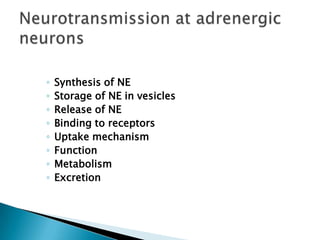
◦ Synthesis of NE
◦ Storage of NE in vesicles
◦ Release of NE
◦ Binding to receptors
◦ Uptake mechanism
◦ Function
◦ Metabolism
◦ Excretion
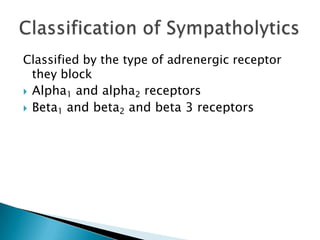
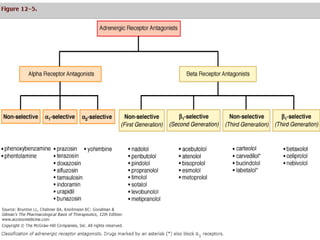
Classified by the type of adrenergic receptor
they block
 Alpha1 and alpha2 receptors
 Beta1 and beta2 and beta 3 receptors
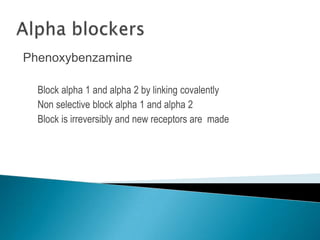
Phenoxybenzamine
Block alpha 1 and alpha 2 by linking covalently
Non selective block alpha 1 and alpha 2
Block is irreversibly and new receptors are made
CVS
Vasodilatation – arteriolar and venous
 BP
Magnitude dependent on symp. activity at that time
More in erect that in supine position
– postural hypotension
More marked if hypovolaemia is present
Baroreflex activation
– reflex tachycardia
– tends to oppose the fall by  HR and CO
OTHER EFFECT
↓contraction of trigone and sphincter
in blood vessels
 urine flow
insulin secretion from islet cells
(2 blockers)
Miosis
Nasal stuffiness
 adrenergic sweating
α1 – blockers : Clinical uses
Reduce blood pressure
Hypertensive emergencies
Long term treatment
Phaeochromocytoma
Vasodilatation
Peripheral vascular insufficiency
To reverse vasoconstrictor excess
Improve urine flow
Benign prostatic hyperplasia
α1 – blockers : Adverse effects
•Postural hypotension
( less with α1 selective - venodilatation is less)
•Reflex tachycardia ( less with α1 selective)
•Salt and water retention
•Nasal stuffiness
•Miosis
•Failure of ejaculation
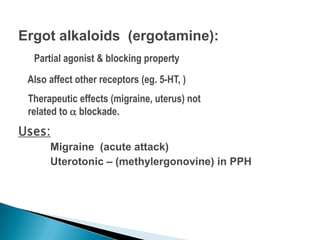
Ergot alkaloids (ergotamine):
Partial agonist & blocking property
Also affect other receptors (eg. 5-HT, )
Therapeutic effects (migraine, uterus) not
related to  blockade.
Uses:
Migraine (acute attack)
Uterotonic – (methylergonovine) in PPH
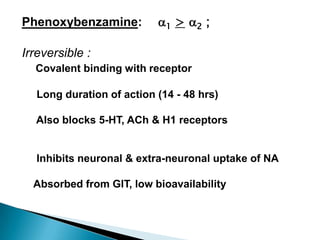
Phenoxybenzamine: 1 > 2 ;
Irreversible :
Covalent binding with receptor
Long duration of action (14 - 48 hrs)
Also blocks 5-HT, ACh & H1 receptors
Inhibits neuronal & extra-neuronal uptake of NA
Absorbed from GIT, low bioavailability
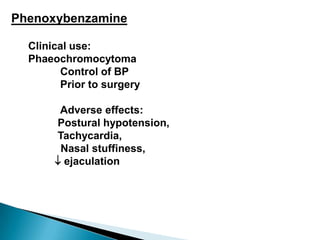
Clinical use:
Phaeochromocytoma
Control of BP
Prior to surgery
Adverse effects:
Postural hypotension,
Tachycardia,
Nasal stuffiness,
 ejaculation
Phenoxybenzamine
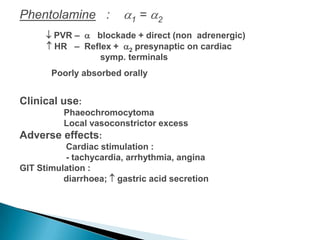
Phentolamine : 1 = 2
 PVR –  blockade + direct (non adrenergic)
 HR – Reflex + 2 presynaptic on cardiac
symp. terminals
Poorly absorbed orally
Clinical use:
Phaeochromocytoma
Local vasoconstrictor excess
Adverse effects:
Cardiac stimulation :
- tachycardia, arrhythmia, angina
GIT Stimulation :
diarrhoea;  gastric acid secretion
Tolazoline:
Similar to phentolamine
Slightly less potent
Better absorption from GIT
Rapidly excreted in urine
Limited clinical application:
peripheral vasospastic disease
1 Selective Agents
Prazosin & Terazosin: 1 >>>> 2
Effective in management of hypertension
Low affinity for 2
Relative absence of tachycardia
↓ Triglycerides & LDL, ↑ HDL (favourable)
Both are extensively metabolized by liver
Prazosin shows high 1st Pass effect (50%)
Oral absorption - good
Terazosin :Bioavailability >90%; >18 h action
Uses: Hypertension and BPH
Adverse effects
First dose effect
Postural hypotension
Salt & water retention ( long term use)
Tamsulosin
Selective α1 anatgonist
Has greater selectivity for α1A subtype
Has greater efficacy for BPH
Relatively smaller effects on blood vessels
Doxazosin:
Similar to Prazosin but longer t ½ (22 Hr)
Alfuzosin : similar to prazosin
Clinical Uses Of  Blockers
•Pheochromocytoma
•Hypertensive emergencies
•Chronic hypertension – non selective blockers
are not used
•Peripheral vascular diaease
– spastic (Raynauds), not morphological
•Local vasoconstrictor excess
– phentolamine useful- local infiltration
•Urinary obstruction – BPH
– prazosin, terazosin, tamsulosin
•CHF
α2- selective antagonists do not have any
recognised clinical use
 Block alpha & beta receptor sites
(nonselective)
 direct or indirect acting on the release of
norepinephrine and epinephrine
 Use - Cardiac arrthymias (HR), HTN (
cardiac output), angina (O2 demand)
 SE - CHF, bronchospasm, bradycardia,
wheezing
 Competative agonist
 Propanolol
 Acetabutol
 Sympatholytic
1 adrenergic antagonist
Class II antiarrhytmic
 Antihypertensive
Antianginal
Bronchoconstrictor
 Symptoms of overdose include extreme bradycardia, advanced
atrioventricular block, intraventricular conduction
defects, hypotension, severe congestive heart failure, seizures, and
in susceptible patients, bronchospasm, and hypoglycemia
 Sympatholytic
1 adrenergic antagonist
 Antihypertensive
Antiarrhythmic
Antianginal
Bronchoconstrictor
 Symptoms of an atenolol overdose include a slow heart
beat, shortness of
breath, fainting, dizziness, weakness, confusion, nause
a, and vomiting
 Sympatholytic
1 adrenergic antagonist
 Antihypertensive
Glaucoma medication
Bronchoconstrictor
 Predicted symptoms of overdose include
bradycardia, congestive heart failure, hypotension,
bronchospasm, and hypoglycemia.
 Sympatholytic
 adrenergic antagonist
 Treatment for heart failure
 Not expected to be toxic following
ingestion.
 Sympatholytic
 adrenergic antagonist
 Bronchoconstrictor
 Sympatholytic
1 adrenergic antagonist
 Antihypertensive
Heart failure medication
Bronchoconstrictor
 Sympatholytic
 adrenergic antagonist
 Antihypertensive
 Symptoms of overdose include abdominal
irritation, central nervous system
depression, coma, extremely slow
heartbeat, heart failure, lethargy, low blood
pressure, and wheezing
 Sympatholytic
 adrenergic antagonist
 Antihypertensive
Bronchoconstrictor
 Symptoms of overdose include
drowsiness, vertigo, headache, and
atriventricular block.
 www. wikipedia.com
 www. cvpharmacology.com
 www.about-pharmacology.com
 Goodman & Gilman’s the pharmacological
basis of therapeutics 12th edition
 Modern pharmacology with clinical
applications by Charles R.Craig, Robert
E.Stitzel 5th edition
 Textbook of medical physiology 11th edition
by Guyton & Hall
Sympatholytics

Sympatholytics

  • 2.
     Have theopposite effect of adrenergic agents  Also known as ◦ adrenergic antagonists or ◦ adrenergic Blocking Agents
  • 3.
    Receptor Location Mechanismfollowed Alpha 1 Blader, radial muscle of eye, blood vessels Gq cause constriction Alpha 2 Smooth muscles Gi relaxation Beta 1 SA, AV node, heart Gs Increase heart rate Beta 2 Blood vessels , liver, smooth muscles Gs relaxation Beta 3 lipocytes Gs
  • 4.
    ◦ Synthesis ofNE ◦ Storage of NE in vesicles ◦ Release of NE ◦ Binding to receptors ◦ Uptake mechanism ◦ Function ◦ Metabolism ◦ Excretion
  • 5.
    Classified by thetype of adrenergic receptor they block  Alpha1 and alpha2 receptors  Beta1 and beta2 and beta 3 receptors
  • 7.
    Phenoxybenzamine Block alpha 1and alpha 2 by linking covalently Non selective block alpha 1 and alpha 2 Block is irreversibly and new receptors are made
  • 8.
    CVS Vasodilatation – arteriolarand venous  BP Magnitude dependent on symp. activity at that time More in erect that in supine position – postural hypotension More marked if hypovolaemia is present Baroreflex activation – reflex tachycardia – tends to oppose the fall by  HR and CO
  • 9.
    OTHER EFFECT ↓contraction oftrigone and sphincter in blood vessels  urine flow insulin secretion from islet cells (2 blockers) Miosis Nasal stuffiness  adrenergic sweating
  • 10.
    α1 – blockers: Clinical uses Reduce blood pressure Hypertensive emergencies Long term treatment Phaeochromocytoma Vasodilatation Peripheral vascular insufficiency To reverse vasoconstrictor excess Improve urine flow Benign prostatic hyperplasia
  • 11.
    α1 – blockers: Adverse effects •Postural hypotension ( less with α1 selective - venodilatation is less) •Reflex tachycardia ( less with α1 selective) •Salt and water retention •Nasal stuffiness •Miosis •Failure of ejaculation
  • 12.
    Ergot alkaloids (ergotamine): Partialagonist & blocking property Also affect other receptors (eg. 5-HT, ) Therapeutic effects (migraine, uterus) not related to  blockade. Uses: Migraine (acute attack) Uterotonic – (methylergonovine) in PPH
  • 13.
    Phenoxybenzamine: 1 >2 ; Irreversible : Covalent binding with receptor Long duration of action (14 - 48 hrs) Also blocks 5-HT, ACh & H1 receptors Inhibits neuronal & extra-neuronal uptake of NA Absorbed from GIT, low bioavailability
  • 14.
    Clinical use: Phaeochromocytoma Control ofBP Prior to surgery Adverse effects: Postural hypotension, Tachycardia, Nasal stuffiness,  ejaculation Phenoxybenzamine
  • 15.
    Phentolamine : 1= 2  PVR –  blockade + direct (non adrenergic)  HR – Reflex + 2 presynaptic on cardiac symp. terminals Poorly absorbed orally Clinical use: Phaeochromocytoma Local vasoconstrictor excess Adverse effects: Cardiac stimulation : - tachycardia, arrhythmia, angina GIT Stimulation : diarrhoea;  gastric acid secretion
  • 16.
    Tolazoline: Similar to phentolamine Slightlyless potent Better absorption from GIT Rapidly excreted in urine Limited clinical application: peripheral vasospastic disease
  • 17.
    1 Selective Agents Prazosin& Terazosin: 1 >>>> 2 Effective in management of hypertension Low affinity for 2 Relative absence of tachycardia ↓ Triglycerides & LDL, ↑ HDL (favourable) Both are extensively metabolized by liver Prazosin shows high 1st Pass effect (50%) Oral absorption - good Terazosin :Bioavailability >90%; >18 h action Uses: Hypertension and BPH Adverse effects First dose effect Postural hypotension Salt & water retention ( long term use)
  • 18.
    Tamsulosin Selective α1 anatgonist Hasgreater selectivity for α1A subtype Has greater efficacy for BPH Relatively smaller effects on blood vessels Doxazosin: Similar to Prazosin but longer t ½ (22 Hr) Alfuzosin : similar to prazosin
  • 19.
    Clinical Uses Of Blockers •Pheochromocytoma •Hypertensive emergencies •Chronic hypertension – non selective blockers are not used •Peripheral vascular diaease – spastic (Raynauds), not morphological •Local vasoconstrictor excess – phentolamine useful- local infiltration •Urinary obstruction – BPH – prazosin, terazosin, tamsulosin •CHF α2- selective antagonists do not have any recognised clinical use
  • 20.
     Block alpha& beta receptor sites (nonselective)  direct or indirect acting on the release of norepinephrine and epinephrine  Use - Cardiac arrthymias (HR), HTN ( cardiac output), angina (O2 demand)  SE - CHF, bronchospasm, bradycardia, wheezing
  • 21.
     Competative agonist Propanolol  Acetabutol
  • 22.
     Sympatholytic 1 adrenergicantagonist Class II antiarrhytmic  Antihypertensive Antianginal Bronchoconstrictor  Symptoms of overdose include extreme bradycardia, advanced atrioventricular block, intraventricular conduction defects, hypotension, severe congestive heart failure, seizures, and in susceptible patients, bronchospasm, and hypoglycemia
  • 23.
     Sympatholytic 1 adrenergicantagonist  Antihypertensive Antiarrhythmic Antianginal Bronchoconstrictor  Symptoms of an atenolol overdose include a slow heart beat, shortness of breath, fainting, dizziness, weakness, confusion, nause a, and vomiting
  • 24.
     Sympatholytic 1 adrenergicantagonist  Antihypertensive Glaucoma medication Bronchoconstrictor  Predicted symptoms of overdose include bradycardia, congestive heart failure, hypotension, bronchospasm, and hypoglycemia.
  • 25.
     Sympatholytic  adrenergicantagonist  Treatment for heart failure  Not expected to be toxic following ingestion.
  • 26.
     Sympatholytic  adrenergicantagonist  Bronchoconstrictor
  • 27.
     Sympatholytic 1 adrenergicantagonist  Antihypertensive Heart failure medication Bronchoconstrictor
  • 28.
     Sympatholytic  adrenergicantagonist  Antihypertensive  Symptoms of overdose include abdominal irritation, central nervous system depression, coma, extremely slow heartbeat, heart failure, lethargy, low blood pressure, and wheezing
  • 29.
     Sympatholytic  adrenergicantagonist  Antihypertensive Bronchoconstrictor  Symptoms of overdose include drowsiness, vertigo, headache, and atriventricular block.
  • 30.
     www. wikipedia.com www. cvpharmacology.com  www.about-pharmacology.com  Goodman & Gilman’s the pharmacological basis of therapeutics 12th edition  Modern pharmacology with clinical applications by Charles R.Craig, Robert E.Stitzel 5th edition  Textbook of medical physiology 11th edition by Guyton & Hall