DEFINITION
“ excessive and undesirable reaction produced
by normal immune system.”
Hypersensitivity Type IV
General concept
Delayed type hypersensitivity (
takes 2 or 3 days to develop).
No antigen antibody mediated
response.
Cell mediated response.
Cells involved in Hypersensitivity
Type IV
T Lymphocytes : are further divided into
two types.
Helper T Cells (CD4)
Cytotoxic T Cells (CD8)
Antigen Recognition
 T cell fail to recognize antigen in the
absence of Antigen presentation.
 T cell receptor is restricted to recognize
antigenic peptide only when bound to the
appropriate molecule major histo
compatibility complex (MHC).
 This is called MHC restriction.
Two Categories of Antigen
Are processed and presented to T cell
by two different mechanism.
Exogenous Antigen
Endogenous Antigen
Exogenous Antigen
 Present MH class II.
 Are taken by the Antigen presenting cells (Dendritic
cells ; Macrophages).
Antigen Presenting Cells:
 Engulf the antigen by endocytosis.
 Endosome fuses with the Lysosome.
 So antigen is degraded into fragments.
 Display on cell surface by combining with MHCII
 Here they may be presented to CD4 helper T cells.
 CD4 helper T cells then become activated.
Function of Activated CD4 (Helper
T cells)
 Responsible for regulatory functions.
 Produce interleukin
 Interleukin 2 activates CD4 and CD8 also
called as T cell growth factor.
 Interleukin 4 and 5 are activator of B cells.
 Gamma Interferon activates macrophages;
NK cells; neutrophils.
Function of Activated CD4 (Helper
T cells)
Endogenous Antigen
Present MHC1 class.
Antigen present within the cell e.g, viral protein
in any infected cell are;
 Degraded into peptide fragment.
 Peptide fragment form a complex with MHC I.
 Displayed at the cell surface.
 Here they may recognize by CD8 ( Cytotoxic
Cell).
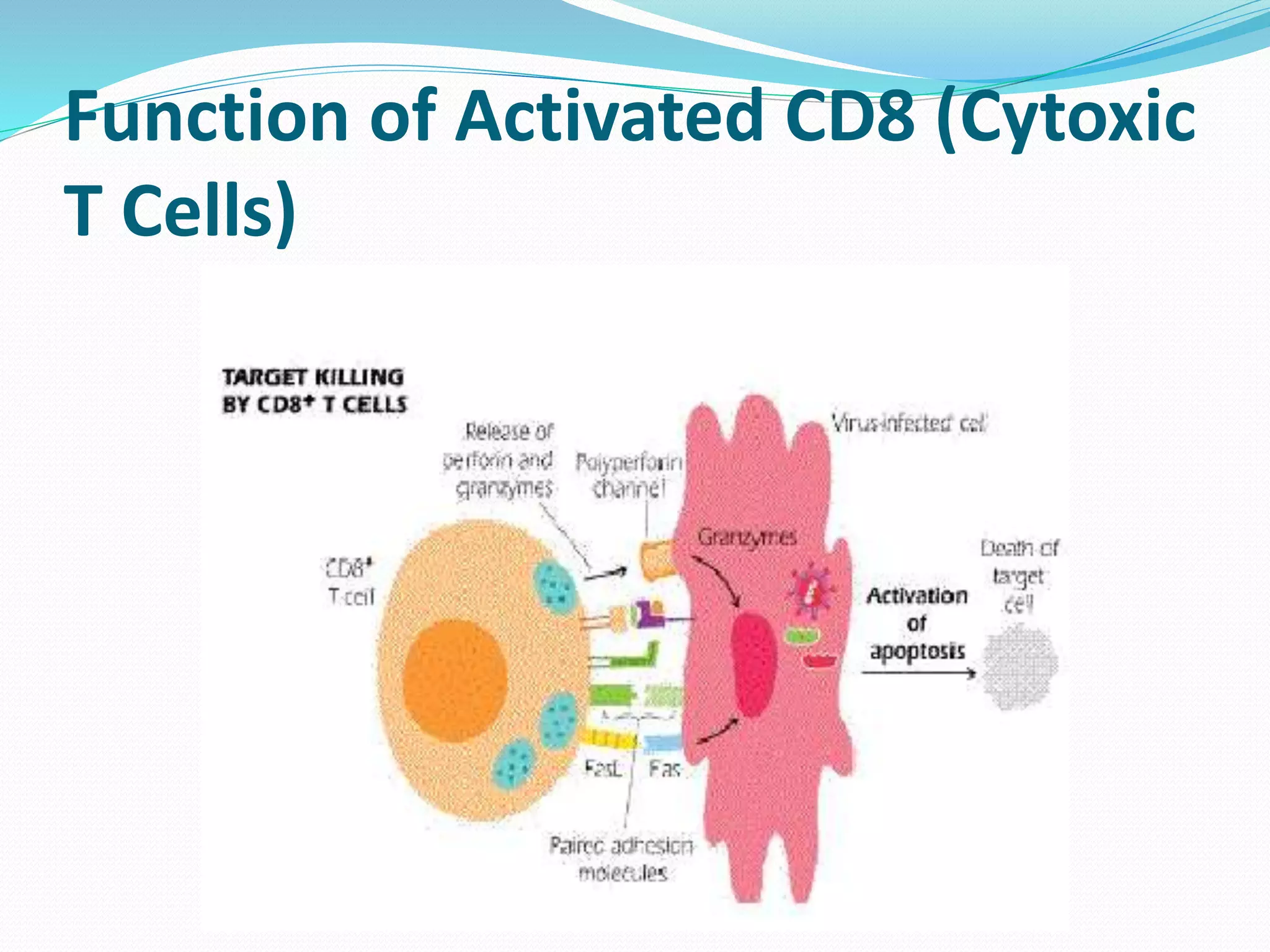
Function of Activated CD8 cell
Perforins: formation of channels
through the membrane.
Pore formation.
Cell content is lost.
Cell dies.
CD8 ( Cytotoxic T Cells)
Granzymes:
Proteases
Degrade protein in cell membrane loss
of cell content
Cell dies
Activation of CD8 (Cytotoxic T
Cells)
Function of Activated CD8 (Cytoxic
T Cells)

Hypersenstivrt 4

  • 2.
    DEFINITION “ excessive andundesirable reaction produced by normal immune system.”
  • 3.
    Hypersensitivity Type IV Generalconcept Delayed type hypersensitivity ( takes 2 or 3 days to develop). No antigen antibody mediated response. Cell mediated response.
  • 4.
    Cells involved inHypersensitivity Type IV T Lymphocytes : are further divided into two types. Helper T Cells (CD4) Cytotoxic T Cells (CD8)
  • 5.
    Antigen Recognition  Tcell fail to recognize antigen in the absence of Antigen presentation.  T cell receptor is restricted to recognize antigenic peptide only when bound to the appropriate molecule major histo compatibility complex (MHC).  This is called MHC restriction.
  • 6.
    Two Categories ofAntigen Are processed and presented to T cell by two different mechanism. Exogenous Antigen Endogenous Antigen
  • 7.
    Exogenous Antigen  PresentMH class II.  Are taken by the Antigen presenting cells (Dendritic cells ; Macrophages).
  • 8.
    Antigen Presenting Cells: Engulf the antigen by endocytosis.  Endosome fuses with the Lysosome.  So antigen is degraded into fragments.  Display on cell surface by combining with MHCII  Here they may be presented to CD4 helper T cells.  CD4 helper T cells then become activated.
  • 9.
    Function of ActivatedCD4 (Helper T cells)  Responsible for regulatory functions.  Produce interleukin  Interleukin 2 activates CD4 and CD8 also called as T cell growth factor.  Interleukin 4 and 5 are activator of B cells.  Gamma Interferon activates macrophages; NK cells; neutrophils.
  • 10.
    Function of ActivatedCD4 (Helper T cells)
  • 11.
    Endogenous Antigen Present MHC1class. Antigen present within the cell e.g, viral protein in any infected cell are;  Degraded into peptide fragment.  Peptide fragment form a complex with MHC I.  Displayed at the cell surface.  Here they may recognize by CD8 ( Cytotoxic Cell).
  • 12.
    Function of ActivatedCD8 cell Perforins: formation of channels through the membrane. Pore formation. Cell content is lost. Cell dies.
  • 13.
    CD8 ( CytotoxicT Cells) Granzymes: Proteases Degrade protein in cell membrane loss of cell content Cell dies
  • 14.
    Activation of CD8(Cytotoxic T Cells)
  • 15.
    Function of ActivatedCD8 (Cytoxic T Cells)