MODERATOR- Dr. Atul Bansal
PRESENTER: Dr. Richa Kumar
 Prevent interaction of endogenous neurotransmitter NE or
sympathomimetics with corresponding adrenergic receptors
 attenuation of sympathetic nervous system homeostatic
mechanisms
 Presynaptic agonism of alpha 2 receptors results in similar
attenuation of sympathetic outflow
 Bind specifically to alpha receptors and interfere with
catecholamine and sympathomimetic action
 Drug induced alpha blockade  heart and peripheral
vasculature
 Inhibitory action of Epinephrine on insulin secretion is
prevented
 Orthostatic hypotension, baroreceptor mediated reflex -
tachycardia and impotence are invariable S/E
 There is absence of beta blockade  maximum expression of
cardiac stimulation  tachycardia
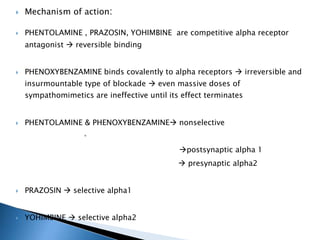
 Mechanism of action:
 PHENTOLAMINE , PRAZOSIN, YOHIMBINE are competitive alpha receptor
antagonist  reversible binding
 PHENOXYBENZAMINE binds covalently to alpha receptors  irreversible and
insurmountable type of blockade  even massive doses of
sympathomimetics are ineffective until its effect terminates
 PHENTOLAMINE & PHENOXYBENZAMINE nonselective

postsynaptic alpha 1
 presynaptic alpha2
 PRAZOSIN  selective alpha1
 YOHIMBINE  selective alpha2
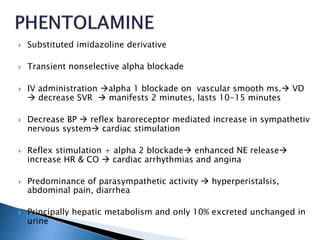
 Substituted imidazoline derivative
 Transient nonselective alpha blockade
 IV administration alpha 1 blockade on vascular smooth ms. VD
 decrease SVR  manifests 2 minutes, lasts 10-15 minutes
 Decrease BP  reflex baroreceptor mediated increase in sympathetiv
nervous system cardiac stimulation
 Reflex stimulation + alpha 2 blockade enhanced NE release
increase HR & CO  cardiac arrhythmias and angina
 Predominance of parasympathetic activity  hyperperistalsis,
abdominal pain, diarrhea
 Principally hepatic metabolism and only 10% excreted unchanged in
urine
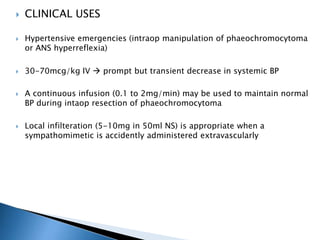
 CLINICAL USES
 Hypertensive emergencies (intraop manipulation of phaeochromocytoma
or ANS hyperreflexia)
 30-70mcg/kg IV  prompt but transient decrease in systemic BP
 A continuous infusion (0.1 to 2mg/min) may be used to maintain normal
BP during intaop resection of phaeochromocytoma
 Local infilteration (5-10mg in 50ml NS) is appropriate when a
sympathomimetic is accidently administered extravascularly
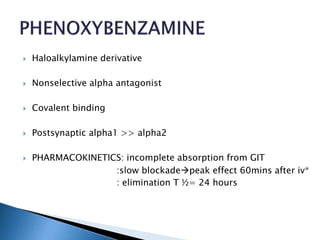
 Haloalkylamine derivative
 Nonselective alpha antagonist
 Covalent binding
 Postsynaptic alpha1 >> alpha2
 PHARMACOKINETICS: incomplete absorption from GIT
:slow blockadepeak effect 60mins after iv*
: elimination T ½= 24 hours
CVS EFFECTS:
 In supine, normotensive patient,no sympathetic stimulation minimal
changes in systemic BP
 Preexisting hypertension or hypovolemia orthostatic hypotension
 If impairment of compensatory VC  exaggerated BP decrease in
response to blood loss or vasodilatating drugs (volatile agents)
 Despite decrease in BP no decrease in CO or renal blood flow
 No change is cerebral or coronary vascular resistance
 Treatment in pregnancy  may cause neonatal hypotension and
respiratory depression in first 72 hours of life
NONCARDIAC EFFECTS:
 Prevents inhibitory action of NE on insulin secretion
 Catecholamines induced glycogenolysis and lipolysis is not altered
 Miosis as stimulation of radial fibres is prevented
 Sedation in chronic therapy
 Nasal stuffiness due to unopposed VD in mucous membranes
 CLINICAL USES:
 0.5-1.0 mg/kg orally preop. to control HTN in phaeochromocytoma
 Relieves Intense peripheral VC  expansion of IV volume (decrease in
hematocrit)
 Haemorrhagic shock intense VC tissue ischemia
 Raynauds disease
 Not favourable in intermittent claudication related peripheral vascular disease
 Selective antagonist
 Presynaptic alpha 2 blockade increased release of NE
 USED in orthostatic hypotension,impotence in male patients with
vascular, diabetic and vascular origin
 Readily crosses BBB
 Increased skeletal muscle activity and tremor
 Excessive doses: tachycardia, HTN, rhinorrhea, paresthesias and
dissociative states
 Alpha2 agonist stimulation decreases anesthetic requirement therefore
there is possible interaction of Yohimbine with volatile agents
DOXAZOCIN:
 selective postsynaptic alpha1 receptor antagonist
 Treatment of essential HTN & BPH
PRAZOSIN:
 Selective post-synaptic alpha1 receptor antagonist
 Dilates both arteries and veins
 Causes reflex tachycardia as alpha2 action is uninhibited
TERAZOSIN:
 Alpha1 antagonist
 BPH
TAMSULOSIN:
 Alpha1a antagonist
 BPH
 Side effects- orthostatic hypotension, vertigo and syncope
 Bind selectively to presynaptic alpha2 receptors negative
feedback decrease NE release  reduced sympathetic
outflow decrease in BP similar to alpha1 antagonists
 Alpha2 receptors mostly in CNS hypotension, analgesia ,
decrease secretions, sedation, anxiolysis
 Peripheral inhibition  decrease insulin release and increased
Glucagon release from pancreas.
 Selective for alpha2 receptors ,act competitively
 Withdrawl can lead to rebound effect elevation in HR & HTN
even to dangerous levels
 Dose dependent decrease in HR & BP
 Used to treat drug resistant HTN and tremors
 Partial agonist of alpha2
 Alpha1:alpha2 preference= 400:1
 Routes: oral, IV, transdermal
 Metabolised in liver
 T ½= 12-16 hours (extremely variable with any liver or kidney
dysfunction)
 Alpha2:Alpha1 = 1600:1
 Most commonly used in ICU & intraoperatively as sedative and
analgesic due to Central sympatholytic activity
 IV infusion 0.1-1.5 mcg/kg/min with terminal T ½ =2 hours
 Undergoes excessive biotransformation in liver and excreted
mostly in urine
 Protein binding + short T ½  physiological dependence
withdrawal phenomenon after only days of administration
tachycardia, HTN, anxiety
 Large bolus iv doses paradoxical HTN with decrease HR
 (0.125-1 mcg/kg over 3-5 minutes)
 Bind selectively to beta receptors
 Interfere with ability of catecholamines or sympathomimetics to
provoke beta receptors (heart, smooth ms. Of airway and blood vs. )
 For patients on beta antagonist therapy ,it should be continued
throughout periop period
 Propranolol is standard beta antagonist drug to which all beta
antagonists are compared.
MECHANISM OF ACTION:
 Competitive inhibition
 Reversible binding
 Causes rightward displacement of DRC for the agonist but slope remains
unchanged
 Chronic administration is associated with increase in number of brta
adrenergic receptors
 Beta receptors G protein coupled receptors+ +adenyl cyclase
cAMP+PK phosphorylates L-type voltage gated Ca++ & Troponin C
adrenergic stimulation
 In myocardium 80% beta 1 receptors 20% beta 2 receptors
 Beta1 blockade slows sinus rate, AV node conduction, decrease
inotropy activity> rest  decrease myocardial oxygen demand decrease
in ischemia during exercise decrease in HR increases diastolic perfusion
time may enhance myocardial perfusion
 Beta2 blockade enhances bronchospasm in patients with reactive airway
diseases
CLASSIFICATION:
 Nonselective beta action: propranolol, nadolol, timolol, pindolol
 Cardioselective: metoprolol, atenolol, acebutolol, betaxolol, esmolol,
bisoprolol
 suited in essential HTN,
 in asthma and patients with reactive airway disease,
 Less interference with carbohydrate matabolism
 Less chances of precipitating Raynaud’s phenomenon
 PARTIAL ANTAGONIST: gave intrinsic sympathomimetic
activity (+beta ,beta2 submaximally)
 Bradycardia and depression of contractility at rest are less
prominent
 Withdrawl is less likely to exaccerbate HTN / angina
 Plasma lipid profile is not/less worsoned
 Not effective in migraine prophylaxis
 Not suitable for secondary prophylaxis of MI
 PURE antagonist
 CVS EFFECTS:
 Negative chronotropic and inotropic effects
 Conduction speed is decreased and rate of spontaneous phase 4
depolarization is decreased  preexisting blocks can be
accentuated
 May impede left ventricular ejection due to unopposed alpha
mediated VC
 prevent chronotropic and inotropic effect of isoproterenol and
increase in HR caused by vasodilator drugs
 No detectable influence on cardiac stimulant effect of calcium,
glucagon and digitalis
 Enhance pressor effect of epinephrine
 Patients with peripheral vascular disease do not tolerate well the
peripheral vasoconstriction caused by beta2 blockade
 Development of cold hands and feet is common side effect of non
selective beta blockade
 Vasospasm associated with Raynaud’s disease is accentuated by
propranolol
 The principal anti dysryhthmic effect is to prevent dysrythmogenic effect
of endogenous catecholamines or sympathomimetics
 This is mainly due to decrease in sympathetic activity and little to do
with membrane stabilization
TREATMENT OF EXCESS MYOCARDIAL DEPRESSION CAUSED BY
BETA BLOCKADE:
 Initially: Atropine in incremental doses of 7 mcg /kg IV (blocks
vagal effects on heart )
 If atropine ineffective positive inotropic agents are to be used
eg isoproterenol (2-25 mcg/kg/min IV )
 Glucagon 1-10 mg IV followed by 5mg/hour
 Calcium chloride 250-1000 mg IV bradycardia unresponsive to
pharmacological therapy transvenous artificial cardiac
pacemaker is necessary
 Hemodylasis should be reserved to remove minimally protein
bound renally excreted beta adrenergic antagonists in patients
refractory to pharmacological therapy
AIRWAY RESISTANCE:
 Beta2 blockade increases airway resistance Bronchoconstriction
 Exaggerated in patients with COPD
METABOLISM:
 Alter carbohydrate and fat metabolism
 Tachycardia which is important warning sign of hypoglycemia is
blunted by beta blockade so non selective beta blockers are not
recommended in patients of DM on insulin or OHA
DISTRIBUTION OF EXTRACELLULAR POTASSIUM:
 Normally influenced by sympathetic system activity and insulin
 Specific beta2 +  intracellular movt. Of K+
 So beta blockade increases S.K +
INTERACTION WITH ANESTHETICS:
 Myocardial depression produced by inhaled or injected
anesthetics could be additive with depression produced by beta
antagonists but not as excessive to be unsafe can be used
perioperatively except in patients with TIMOLOL (extreme
bradycardia with inhaled anesthetics)
 Additive cardiovascular effects with beta antagonists:
 Greatest with Enflurane
 Least with Isoflurane
 Sevoflurane and desflurane also do not cause any additive effects
 C.O. and systemic blood pressure are similar with isoflurane with
or without beta antagonism
 Cardiovascular responses to high doses of opioids not altered
 In presence of excessive sympathetic system activity acute
administration of beta antagonist decreases BP and C.O.
NERVOUS SYSTEM
 May cross BBB to produce side effects
 Fatigue and lethargy
 Vivid dreams are frequent
 Peripheral paresthesias
FETUS:
 Can cross placenta
 Can cause bradycardia, hypotension, hypoglycemia
 Breast milk is also likely to contain beta antagonists administered
to mother
WITHDRAWL HYPERSENSITIVITY:
 Acute discontinuation excess sympathetic stimulation that
manifests in 24-48 hours
 This is due to upregulation of receptorsduring chronic therapy
 CLINICAL USES:
 Treatment of essential HTN (HR,CO,RENIN)
 Management of angina pectoris(HR, oxygen demand)
 Treatment of acute coronary syndrome (if not C/I)
 Perioperative beta adrenergic blockade (in risk group)
 Treatment of intraoperative MI ( esmolol, metoprolol, propranolol)
 Suppression of cardiac dysarryhthmias (esmolol, propranolol)
 Management of congestive heart failure (metoprolol,
carvedilol,bisoprolol)
 Prevention of excessive sympathetic nervous system activity(HOCM,
Phaeochromocytoma)
 Preoperative preparation of hyperthyroid patients
 CONTRAINDICATIONS OF BETA ANTAGONIST:
 ABSOLUTE: severe bradycardia, unstable left ventricular failure,
AV heart block
 RELATIVE: asthma or reactive airway disease, mental
depression, peripheral vascular disease
 Diabetes is not a contraindication (recognizing that signs of
hypoglycemia may be masked)
 Nonselective
 Lacks intrinsic sympathomimetic activity (pure antagonist)
 Equal beta1 and beta2 antagonism
 Standard drug to woth beta antagonists are compared
 Administered in stepwise increment until p[hysiological plasma conc.
Have been attained ( indicated by HR 55-60/min)
CARDIAC EFFECTS:
 Most important pharmacological effect is on heart
 Beta 1 blockade decrease in HR and myocardial contractility
decreased C.O.
 Effects on HR and C.O. prominent during exercise or in presence of
sympathetic nervous system activity
 HR slowing lasts longer than negative inotropic effect
 Concominant beta2 blockade decrease peripheral vascular resistance
 Can relieve myocardial ischemia
 Sodium retention may be associated due to intrarenal hemodynamic
changes (decrease C.O.)
 PK:
 Rapidly and completely absorbed in GIT
 Systemic availability limited by extensive hepatic first pass metabolism
 Oral dose (40-800mg/day) is greater than IV dose( 0.5-1.0mg every 5
minutes)
 PROTEIN BINDING:
 Extensively bound to plasma proteins (90-95%)
 Heparin + lipoprotein lipaseincrease in plasma FFA  decrease
plasma protein binding of propranolol
 METABOLISM
 Hepatic
 Active metabolite: 4 hydroxypropranolol, produced after oral
administration
 T ½ = 2-3 hours
 Elimination decreases in hepatic dysfunction further propanlol
decreases C.O. nad hepatic blood flow so further decrease in clearance
 No effect of renal dysfunction.
 CLEARANCE OF LOCAL ANAESTHETICS:
 Propranolol decreases clearance of amide LA by decreasing
hepatic blood flow and inhibiting metabolism in the liver
 Bupivacaine clearance is relatively insensitive to changes in
hepatic blood flow (low drug extraction ratio)
 Clearance of drugs with low extraction ratio is inversely
proportional to plasma protein binding
 Bupivacaine binding to alpha1 glycoprotein is increased by
propranolol (without altering conc of alpha1 glycoprotein) , thus
its decreased clearance systemic toxicity can be increased
CLEARANCE OF OPIOIDS:
 Pulmonary first pass uptake of fentanyl is substantially decreased in
patients being treated chronically with propranolol
 2-4 times more fentanyl enters circulation
 Reflecting one basic lipophilic amine( propranolol) inhibiting
pulmonary uptake od second lipophilic basic amine(fentanyl)
 Selective beta 1 adrenergic receptor
 Prevents inotropic and chronotropic responses to beta +
 BD, VD, metabolic effects of beta2 + remain intact less likely to cause
adverse effects in pts. With COPD or PVD or pts vulnerable to
hypoglycemia
 Selectivity is dose related:
 Large doses: may become non-selective ( beta 2 antagonism less than
propranolol, reversed by terbutaline)
 PK:
 Readily absorbed from GIT, offset by substantial first pass metabolism
 Low protein binding
 No active metabolite
 Two ral formulations: metoprolol tartarate, metoprolol succinate
 Elimination T ½ =2-3 hours
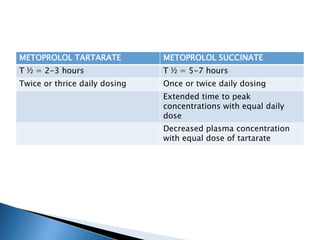
METOPROLOL TARTARATE METOPROLOL SUCCINATE
T ½ = 2-3 hours T ½ = 5-7 hours
Twice or thrice daily dosing Once or twice daily dosing
Extended time to peak
concentrations with equal daily
dose
Decreased plasma concentration
with equal dose of tartarate
 MOST SELECTIVE beta1 antagonist
 Desirable in patients who need sustained beta2 activity
 In patients at risk for CAD who must undergo non cardiac surgery, IV
atenolol treatment before and immediately after surgery f/b oral
therapy during remainder of hospitalization decreases mortality and
incidence of cardiovascular complications for as long as 2 years
 Periop atenolol in patients at high risk of CAD there is decrease in
myocardial ischemia
 Prolonged effect OD dose
 Does not enter CNS but fatigue and mental depression still occur
 Does not potentiate insulin induced hypoglycemia can be used with
caution in DM pts with HTN not controlled by other antihypertensives
 Rapid onset
 Short acting
 Selective beta1 adrenergic receptor antagonist
 Only IV
 0.5mg/kg initial dose over 60 seconds full therapeutic effect evident
in 5 minutes action cease within 10-30 minutes after administration is
discontinued intraoperative useful
 150mg IV administered 2minutes before DL and ETT  protection
against increase in HR & BP ( compared to fentanyl & lidocaine which do
not affect HR)
 Useful in phaeochromocytoma and perioperative management of
thyrotoxicosis, pregnancy induced HTN, epinephrine or cocaine induced
cardiotoxicity)
 Conversely, treatment of excessive sympathetic activity produced by
cocaine or systemic absorption of topical or subcutaneous epinephrine by
beta adrenergic blockade has been associated with fulminant pulmonary
edema and irreversible cardiovascular collapse
 So these conditions are more safely treated with vasodilator drug like
sodium nitroprusside or nitroglycerine
 Esmolol can blunt detrimental effects of catecholamine release during
anesthesia in patients with HOCM and in patients undergoing
hypercyanotic spells associated with TOF
 Esmolol is beta 1 selective  can unmask beta2 mediated VD of
epinephrine secreting tumors
 Patients chronically treated with beta blockers administration of
esmolol additional negative inotropic effects
 1mg/kg IV Esmolol f/b 250mcg/kg/minute significantly decreases
plasma conc. Of PROPOFOL required to prevent patient movt. In response
to surgical skin incision.
PK:
 available for IV administration
 PH 4.5-5.5 (commercial preparation) pain on injection
 compatible with commonly used IVF and NMBD
 Elimination T ½ = 9 minutes
 Rapid hydrolysis in plasma by esterases
 Independent of hepatic and renal clearance
 Evidence of short duration of action is return of HR to predrug
levels after 15 minutes of discontinuing the drug
 Poorly lipid soluble
LABETALOL
CARVEDILOL
 Unique
 Selective alpha1 and nonselective beta1 & beta2 adrenergic antagonist
effect
 Presynaptic alpha2 receptors are spared
 1/5th to 1/10th as potent as phentolamine to block alpha receptors
 1/3rd as potent as propranolol to block beta receptors
 Beta : alpha potency oral labetalol 3:1
IV labetalol7:1
 PK : Conjugation with glucuronic acid
5% drug recovered unchanged in urine
elimination T ½ =5-8 hours (prolonged in liver disease,unchanged in
renal dysfunction)
 CVS EFFECTS:
 alpha blockade decreases systemic vascular resistance decrease BP
 Beta blockade attenuates reflex tachycardia
 C.O. unchanged
 Vasodilatation is caused by alpha 1 blockade and beta2 agonist activity
 0.1-0.5 mg.kg IV labetolol  effect in 5-10 minutes
CLINICAL USES
 Hypertensive emergencies
 HTN associated with epinephrine overdose (submucosal injection during
surgical hemostasis)
Excessive doses 2mg/kg iv  excessive decrease in BP
Small doses 20-80mg  undesirable decrease in BP repeated doses can
be given every 10mins
 rebound HTN
 HTN in phaeochromocytoma
 Angina pectoris
 0.1-0.5mg/kg to attenuate increase HR and BP due to surgical stimulus
in anesthetised patient
 SIDE-EFFECTS:
 Most common: orthostatic hypotension
 Bronchospasm in suspected patients
 In case of prolonged therapy  fluid retention  therefore combined
with diuretics
 Nonselective
 No intrinsic beta agonist effect
 Oral administration extensively metabolized  products with weak
vasodilator activity
 Elimination T ½ 7-10 hours
 Extensive protein binding
 Use: mild to moderate congestive heart failure
Essential HTN
Sympatholytics

Sympatholytics

  • 1.
    MODERATOR- Dr. AtulBansal PRESENTER: Dr. Richa Kumar
  • 2.
     Prevent interactionof endogenous neurotransmitter NE or sympathomimetics with corresponding adrenergic receptors  attenuation of sympathetic nervous system homeostatic mechanisms  Presynaptic agonism of alpha 2 receptors results in similar attenuation of sympathetic outflow
  • 4.
     Bind specificallyto alpha receptors and interfere with catecholamine and sympathomimetic action  Drug induced alpha blockade  heart and peripheral vasculature  Inhibitory action of Epinephrine on insulin secretion is prevented  Orthostatic hypotension, baroreceptor mediated reflex - tachycardia and impotence are invariable S/E  There is absence of beta blockade  maximum expression of cardiac stimulation  tachycardia
  • 5.
     Mechanism ofaction:  PHENTOLAMINE , PRAZOSIN, YOHIMBINE are competitive alpha receptor antagonist  reversible binding  PHENOXYBENZAMINE binds covalently to alpha receptors  irreversible and insurmountable type of blockade  even massive doses of sympathomimetics are ineffective until its effect terminates  PHENTOLAMINE & PHENOXYBENZAMINE nonselective  postsynaptic alpha 1  presynaptic alpha2  PRAZOSIN  selective alpha1  YOHIMBINE  selective alpha2
  • 6.
     Substituted imidazolinederivative  Transient nonselective alpha blockade  IV administration alpha 1 blockade on vascular smooth ms. VD  decrease SVR  manifests 2 minutes, lasts 10-15 minutes  Decrease BP  reflex baroreceptor mediated increase in sympathetiv nervous system cardiac stimulation  Reflex stimulation + alpha 2 blockade enhanced NE release increase HR & CO  cardiac arrhythmias and angina  Predominance of parasympathetic activity  hyperperistalsis, abdominal pain, diarrhea  Principally hepatic metabolism and only 10% excreted unchanged in urine
  • 7.
     CLINICAL USES Hypertensive emergencies (intraop manipulation of phaeochromocytoma or ANS hyperreflexia)  30-70mcg/kg IV  prompt but transient decrease in systemic BP  A continuous infusion (0.1 to 2mg/min) may be used to maintain normal BP during intaop resection of phaeochromocytoma  Local infilteration (5-10mg in 50ml NS) is appropriate when a sympathomimetic is accidently administered extravascularly
  • 8.
     Haloalkylamine derivative Nonselective alpha antagonist  Covalent binding  Postsynaptic alpha1 >> alpha2  PHARMACOKINETICS: incomplete absorption from GIT :slow blockadepeak effect 60mins after iv* : elimination T ½= 24 hours
  • 9.
    CVS EFFECTS:  Insupine, normotensive patient,no sympathetic stimulation minimal changes in systemic BP  Preexisting hypertension or hypovolemia orthostatic hypotension  If impairment of compensatory VC  exaggerated BP decrease in response to blood loss or vasodilatating drugs (volatile agents)  Despite decrease in BP no decrease in CO or renal blood flow  No change is cerebral or coronary vascular resistance  Treatment in pregnancy  may cause neonatal hypotension and respiratory depression in first 72 hours of life
  • 10.
    NONCARDIAC EFFECTS:  Preventsinhibitory action of NE on insulin secretion  Catecholamines induced glycogenolysis and lipolysis is not altered  Miosis as stimulation of radial fibres is prevented  Sedation in chronic therapy  Nasal stuffiness due to unopposed VD in mucous membranes  CLINICAL USES:  0.5-1.0 mg/kg orally preop. to control HTN in phaeochromocytoma  Relieves Intense peripheral VC  expansion of IV volume (decrease in hematocrit)  Haemorrhagic shock intense VC tissue ischemia  Raynauds disease  Not favourable in intermittent claudication related peripheral vascular disease
  • 11.
     Selective antagonist Presynaptic alpha 2 blockade increased release of NE  USED in orthostatic hypotension,impotence in male patients with vascular, diabetic and vascular origin  Readily crosses BBB  Increased skeletal muscle activity and tremor  Excessive doses: tachycardia, HTN, rhinorrhea, paresthesias and dissociative states  Alpha2 agonist stimulation decreases anesthetic requirement therefore there is possible interaction of Yohimbine with volatile agents
  • 12.
    DOXAZOCIN:  selective postsynapticalpha1 receptor antagonist  Treatment of essential HTN & BPH PRAZOSIN:  Selective post-synaptic alpha1 receptor antagonist  Dilates both arteries and veins  Causes reflex tachycardia as alpha2 action is uninhibited TERAZOSIN:  Alpha1 antagonist  BPH TAMSULOSIN:  Alpha1a antagonist  BPH  Side effects- orthostatic hypotension, vertigo and syncope
  • 14.
     Bind selectivelyto presynaptic alpha2 receptors negative feedback decrease NE release  reduced sympathetic outflow decrease in BP similar to alpha1 antagonists  Alpha2 receptors mostly in CNS hypotension, analgesia , decrease secretions, sedation, anxiolysis  Peripheral inhibition  decrease insulin release and increased Glucagon release from pancreas.  Selective for alpha2 receptors ,act competitively  Withdrawl can lead to rebound effect elevation in HR & HTN even to dangerous levels
  • 15.
     Dose dependentdecrease in HR & BP  Used to treat drug resistant HTN and tremors  Partial agonist of alpha2  Alpha1:alpha2 preference= 400:1  Routes: oral, IV, transdermal  Metabolised in liver  T ½= 12-16 hours (extremely variable with any liver or kidney dysfunction)
  • 16.
     Alpha2:Alpha1 =1600:1  Most commonly used in ICU & intraoperatively as sedative and analgesic due to Central sympatholytic activity  IV infusion 0.1-1.5 mcg/kg/min with terminal T ½ =2 hours  Undergoes excessive biotransformation in liver and excreted mostly in urine  Protein binding + short T ½  physiological dependence withdrawal phenomenon after only days of administration tachycardia, HTN, anxiety  Large bolus iv doses paradoxical HTN with decrease HR  (0.125-1 mcg/kg over 3-5 minutes)
  • 18.
     Bind selectivelyto beta receptors  Interfere with ability of catecholamines or sympathomimetics to provoke beta receptors (heart, smooth ms. Of airway and blood vs. )  For patients on beta antagonist therapy ,it should be continued throughout periop period  Propranolol is standard beta antagonist drug to which all beta antagonists are compared.
  • 19.
    MECHANISM OF ACTION: Competitive inhibition  Reversible binding  Causes rightward displacement of DRC for the agonist but slope remains unchanged  Chronic administration is associated with increase in number of brta adrenergic receptors  Beta receptors G protein coupled receptors+ +adenyl cyclase cAMP+PK phosphorylates L-type voltage gated Ca++ & Troponin C adrenergic stimulation  In myocardium 80% beta 1 receptors 20% beta 2 receptors  Beta1 blockade slows sinus rate, AV node conduction, decrease inotropy activity> rest  decrease myocardial oxygen demand decrease in ischemia during exercise decrease in HR increases diastolic perfusion time may enhance myocardial perfusion  Beta2 blockade enhances bronchospasm in patients with reactive airway diseases
  • 20.
    CLASSIFICATION:  Nonselective betaaction: propranolol, nadolol, timolol, pindolol  Cardioselective: metoprolol, atenolol, acebutolol, betaxolol, esmolol, bisoprolol  suited in essential HTN,  in asthma and patients with reactive airway disease,  Less interference with carbohydrate matabolism  Less chances of precipitating Raynaud’s phenomenon
  • 21.
     PARTIAL ANTAGONIST:gave intrinsic sympathomimetic activity (+beta ,beta2 submaximally)  Bradycardia and depression of contractility at rest are less prominent  Withdrawl is less likely to exaccerbate HTN / angina  Plasma lipid profile is not/less worsoned  Not effective in migraine prophylaxis  Not suitable for secondary prophylaxis of MI  PURE antagonist
  • 22.
     CVS EFFECTS: Negative chronotropic and inotropic effects  Conduction speed is decreased and rate of spontaneous phase 4 depolarization is decreased  preexisting blocks can be accentuated  May impede left ventricular ejection due to unopposed alpha mediated VC  prevent chronotropic and inotropic effect of isoproterenol and increase in HR caused by vasodilator drugs  No detectable influence on cardiac stimulant effect of calcium, glucagon and digitalis  Enhance pressor effect of epinephrine
  • 23.
     Patients withperipheral vascular disease do not tolerate well the peripheral vasoconstriction caused by beta2 blockade  Development of cold hands and feet is common side effect of non selective beta blockade  Vasospasm associated with Raynaud’s disease is accentuated by propranolol  The principal anti dysryhthmic effect is to prevent dysrythmogenic effect of endogenous catecholamines or sympathomimetics  This is mainly due to decrease in sympathetic activity and little to do with membrane stabilization
  • 24.
    TREATMENT OF EXCESSMYOCARDIAL DEPRESSION CAUSED BY BETA BLOCKADE:  Initially: Atropine in incremental doses of 7 mcg /kg IV (blocks vagal effects on heart )  If atropine ineffective positive inotropic agents are to be used eg isoproterenol (2-25 mcg/kg/min IV )  Glucagon 1-10 mg IV followed by 5mg/hour  Calcium chloride 250-1000 mg IV bradycardia unresponsive to pharmacological therapy transvenous artificial cardiac pacemaker is necessary  Hemodylasis should be reserved to remove minimally protein bound renally excreted beta adrenergic antagonists in patients refractory to pharmacological therapy
  • 25.
    AIRWAY RESISTANCE:  Beta2blockade increases airway resistance Bronchoconstriction  Exaggerated in patients with COPD METABOLISM:  Alter carbohydrate and fat metabolism  Tachycardia which is important warning sign of hypoglycemia is blunted by beta blockade so non selective beta blockers are not recommended in patients of DM on insulin or OHA DISTRIBUTION OF EXTRACELLULAR POTASSIUM:  Normally influenced by sympathetic system activity and insulin  Specific beta2 +  intracellular movt. Of K+  So beta blockade increases S.K +
  • 26.
    INTERACTION WITH ANESTHETICS: Myocardial depression produced by inhaled or injected anesthetics could be additive with depression produced by beta antagonists but not as excessive to be unsafe can be used perioperatively except in patients with TIMOLOL (extreme bradycardia with inhaled anesthetics)  Additive cardiovascular effects with beta antagonists:  Greatest with Enflurane  Least with Isoflurane  Sevoflurane and desflurane also do not cause any additive effects  C.O. and systemic blood pressure are similar with isoflurane with or without beta antagonism  Cardiovascular responses to high doses of opioids not altered  In presence of excessive sympathetic system activity acute administration of beta antagonist decreases BP and C.O.
  • 27.
    NERVOUS SYSTEM  Maycross BBB to produce side effects  Fatigue and lethargy  Vivid dreams are frequent  Peripheral paresthesias FETUS:  Can cross placenta  Can cause bradycardia, hypotension, hypoglycemia  Breast milk is also likely to contain beta antagonists administered to mother WITHDRAWL HYPERSENSITIVITY:  Acute discontinuation excess sympathetic stimulation that manifests in 24-48 hours  This is due to upregulation of receptorsduring chronic therapy
  • 28.
     CLINICAL USES: Treatment of essential HTN (HR,CO,RENIN)  Management of angina pectoris(HR, oxygen demand)  Treatment of acute coronary syndrome (if not C/I)  Perioperative beta adrenergic blockade (in risk group)  Treatment of intraoperative MI ( esmolol, metoprolol, propranolol)  Suppression of cardiac dysarryhthmias (esmolol, propranolol)  Management of congestive heart failure (metoprolol, carvedilol,bisoprolol)  Prevention of excessive sympathetic nervous system activity(HOCM, Phaeochromocytoma)  Preoperative preparation of hyperthyroid patients
  • 29.
     CONTRAINDICATIONS OFBETA ANTAGONIST:  ABSOLUTE: severe bradycardia, unstable left ventricular failure, AV heart block  RELATIVE: asthma or reactive airway disease, mental depression, peripheral vascular disease  Diabetes is not a contraindication (recognizing that signs of hypoglycemia may be masked)
  • 30.
     Nonselective  Lacksintrinsic sympathomimetic activity (pure antagonist)  Equal beta1 and beta2 antagonism  Standard drug to woth beta antagonists are compared  Administered in stepwise increment until p[hysiological plasma conc. Have been attained ( indicated by HR 55-60/min) CARDIAC EFFECTS:  Most important pharmacological effect is on heart  Beta 1 blockade decrease in HR and myocardial contractility decreased C.O.  Effects on HR and C.O. prominent during exercise or in presence of sympathetic nervous system activity  HR slowing lasts longer than negative inotropic effect  Concominant beta2 blockade decrease peripheral vascular resistance  Can relieve myocardial ischemia  Sodium retention may be associated due to intrarenal hemodynamic changes (decrease C.O.)
  • 31.
     PK:  Rapidlyand completely absorbed in GIT  Systemic availability limited by extensive hepatic first pass metabolism  Oral dose (40-800mg/day) is greater than IV dose( 0.5-1.0mg every 5 minutes)  PROTEIN BINDING:  Extensively bound to plasma proteins (90-95%)  Heparin + lipoprotein lipaseincrease in plasma FFA  decrease plasma protein binding of propranolol  METABOLISM  Hepatic  Active metabolite: 4 hydroxypropranolol, produced after oral administration  T ½ = 2-3 hours  Elimination decreases in hepatic dysfunction further propanlol decreases C.O. nad hepatic blood flow so further decrease in clearance  No effect of renal dysfunction.
  • 32.
     CLEARANCE OFLOCAL ANAESTHETICS:  Propranolol decreases clearance of amide LA by decreasing hepatic blood flow and inhibiting metabolism in the liver  Bupivacaine clearance is relatively insensitive to changes in hepatic blood flow (low drug extraction ratio)  Clearance of drugs with low extraction ratio is inversely proportional to plasma protein binding  Bupivacaine binding to alpha1 glycoprotein is increased by propranolol (without altering conc of alpha1 glycoprotein) , thus its decreased clearance systemic toxicity can be increased
  • 33.
    CLEARANCE OF OPIOIDS: Pulmonary first pass uptake of fentanyl is substantially decreased in patients being treated chronically with propranolol  2-4 times more fentanyl enters circulation  Reflecting one basic lipophilic amine( propranolol) inhibiting pulmonary uptake od second lipophilic basic amine(fentanyl)
  • 34.
     Selective beta1 adrenergic receptor  Prevents inotropic and chronotropic responses to beta +  BD, VD, metabolic effects of beta2 + remain intact less likely to cause adverse effects in pts. With COPD or PVD or pts vulnerable to hypoglycemia  Selectivity is dose related:  Large doses: may become non-selective ( beta 2 antagonism less than propranolol, reversed by terbutaline)  PK:  Readily absorbed from GIT, offset by substantial first pass metabolism  Low protein binding  No active metabolite  Two ral formulations: metoprolol tartarate, metoprolol succinate  Elimination T ½ =2-3 hours
  • 35.
    METOPROLOL TARTARATE METOPROLOLSUCCINATE T ½ = 2-3 hours T ½ = 5-7 hours Twice or thrice daily dosing Once or twice daily dosing Extended time to peak concentrations with equal daily dose Decreased plasma concentration with equal dose of tartarate
  • 36.
     MOST SELECTIVEbeta1 antagonist  Desirable in patients who need sustained beta2 activity  In patients at risk for CAD who must undergo non cardiac surgery, IV atenolol treatment before and immediately after surgery f/b oral therapy during remainder of hospitalization decreases mortality and incidence of cardiovascular complications for as long as 2 years  Periop atenolol in patients at high risk of CAD there is decrease in myocardial ischemia  Prolonged effect OD dose  Does not enter CNS but fatigue and mental depression still occur  Does not potentiate insulin induced hypoglycemia can be used with caution in DM pts with HTN not controlled by other antihypertensives
  • 37.
     Rapid onset Short acting  Selective beta1 adrenergic receptor antagonist  Only IV  0.5mg/kg initial dose over 60 seconds full therapeutic effect evident in 5 minutes action cease within 10-30 minutes after administration is discontinued intraoperative useful  150mg IV administered 2minutes before DL and ETT  protection against increase in HR & BP ( compared to fentanyl & lidocaine which do not affect HR)  Useful in phaeochromocytoma and perioperative management of thyrotoxicosis, pregnancy induced HTN, epinephrine or cocaine induced cardiotoxicity)
  • 38.
     Conversely, treatmentof excessive sympathetic activity produced by cocaine or systemic absorption of topical or subcutaneous epinephrine by beta adrenergic blockade has been associated with fulminant pulmonary edema and irreversible cardiovascular collapse  So these conditions are more safely treated with vasodilator drug like sodium nitroprusside or nitroglycerine  Esmolol can blunt detrimental effects of catecholamine release during anesthesia in patients with HOCM and in patients undergoing hypercyanotic spells associated with TOF  Esmolol is beta 1 selective  can unmask beta2 mediated VD of epinephrine secreting tumors  Patients chronically treated with beta blockers administration of esmolol additional negative inotropic effects  1mg/kg IV Esmolol f/b 250mcg/kg/minute significantly decreases plasma conc. Of PROPOFOL required to prevent patient movt. In response to surgical skin incision.
  • 39.
    PK:  available forIV administration  PH 4.5-5.5 (commercial preparation) pain on injection  compatible with commonly used IVF and NMBD  Elimination T ½ = 9 minutes  Rapid hydrolysis in plasma by esterases  Independent of hepatic and renal clearance  Evidence of short duration of action is return of HR to predrug levels after 15 minutes of discontinuing the drug  Poorly lipid soluble
  • 40.
  • 41.
     Unique  Selectivealpha1 and nonselective beta1 & beta2 adrenergic antagonist effect  Presynaptic alpha2 receptors are spared  1/5th to 1/10th as potent as phentolamine to block alpha receptors  1/3rd as potent as propranolol to block beta receptors  Beta : alpha potency oral labetalol 3:1 IV labetalol7:1  PK : Conjugation with glucuronic acid 5% drug recovered unchanged in urine elimination T ½ =5-8 hours (prolonged in liver disease,unchanged in renal dysfunction)
  • 42.
     CVS EFFECTS: alpha blockade decreases systemic vascular resistance decrease BP  Beta blockade attenuates reflex tachycardia  C.O. unchanged  Vasodilatation is caused by alpha 1 blockade and beta2 agonist activity  0.1-0.5 mg.kg IV labetolol  effect in 5-10 minutes CLINICAL USES  Hypertensive emergencies  HTN associated with epinephrine overdose (submucosal injection during surgical hemostasis) Excessive doses 2mg/kg iv  excessive decrease in BP Small doses 20-80mg  undesirable decrease in BP repeated doses can be given every 10mins  rebound HTN  HTN in phaeochromocytoma  Angina pectoris  0.1-0.5mg/kg to attenuate increase HR and BP due to surgical stimulus in anesthetised patient
  • 43.
     SIDE-EFFECTS:  Mostcommon: orthostatic hypotension  Bronchospasm in suspected patients  In case of prolonged therapy  fluid retention  therefore combined with diuretics
  • 44.
     Nonselective  Nointrinsic beta agonist effect  Oral administration extensively metabolized  products with weak vasodilator activity  Elimination T ½ 7-10 hours  Extensive protein binding  Use: mild to moderate congestive heart failure Essential HTN