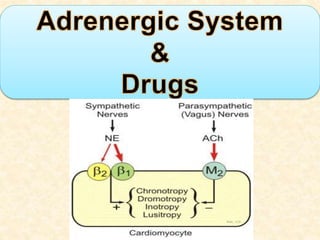
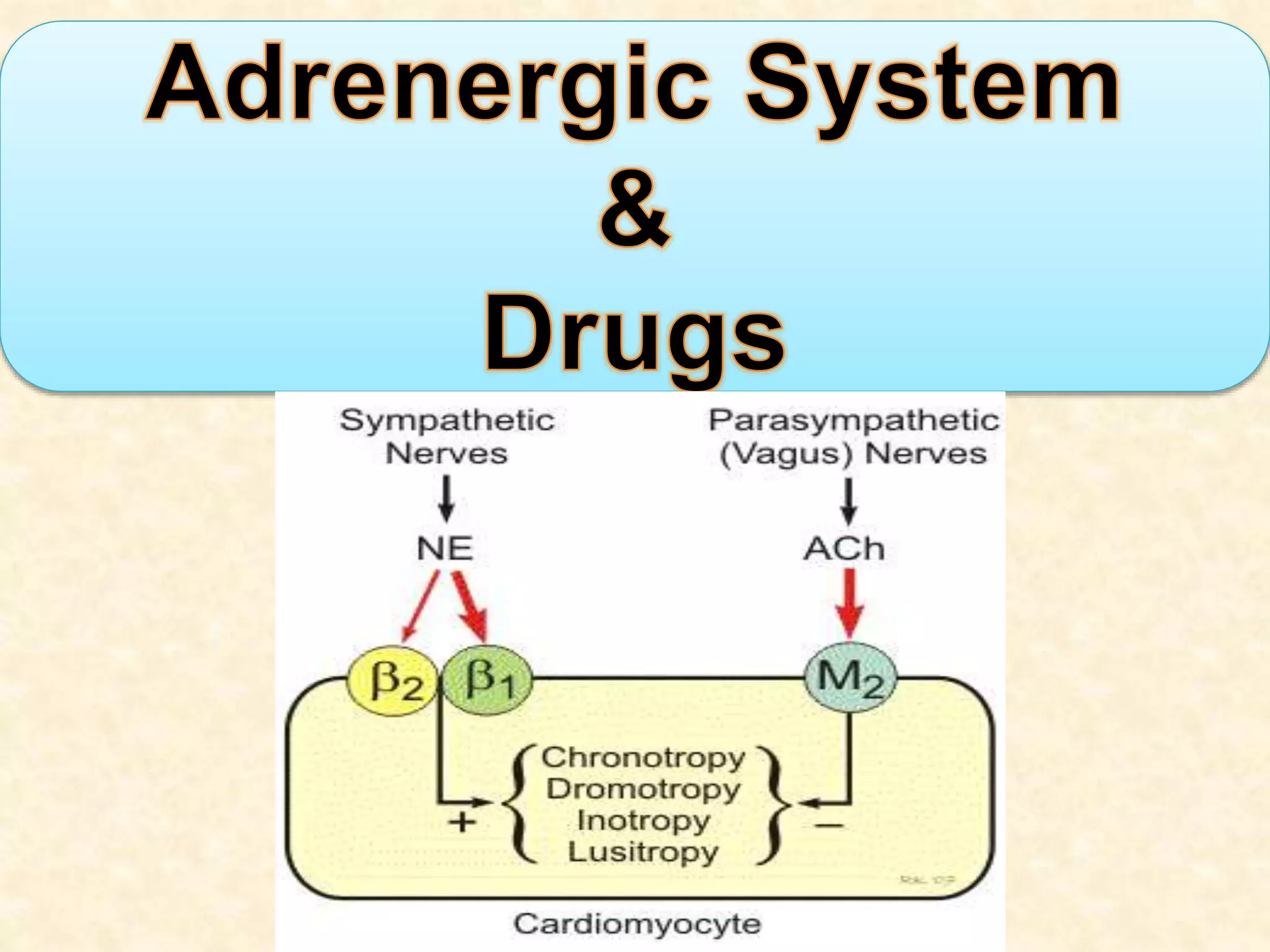
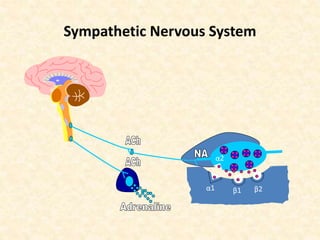

Sympathetic Nervous System
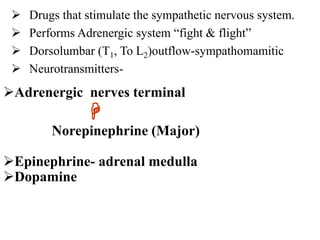
 Drugs that stimulate the sympathetic nervous system.
 Performs Adrenergic system “fight & flight”
 Dorsolumbar (T1, To L2)outflow-sympathomamitic
 Neurotransmitters-
Adrenergic nerves terminal

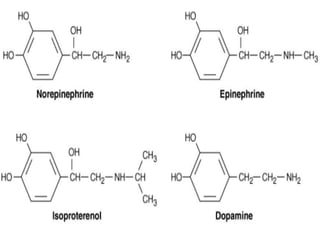
Norepinephrine (Major)
Epinephrine- adrenal medulla
Dopamine
Chemistry-
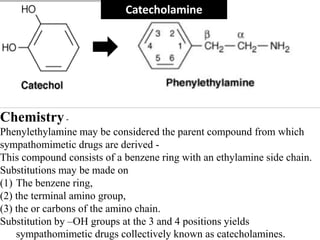
Phenylethylamine may be considered the parent compound from which
sympathomimetic drugs are derived -
This compound consists of a benzene ring with an ethylamine side chain.
Substitutions may be made on
(1) The benzene ring,
(2) the terminal amino group,
(3) the or carbons of the amino chain.
Substitution by –OH groups at the 3 and 4 positions yields
sympathomimetic drugs collectively known as catecholamines.
Catecholamine
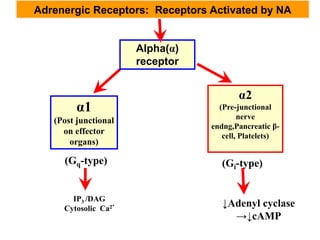
α2
(Pre-junctional
nerve
endng,Pancreatic β-
cell, Platelets)
Alpha(α)
receptor
Adrenergic Receptors: Receptors Activated by NA
α1
(Post junctional
on effector
organs)
(Gq-type) (Gi-type)
IP3 /DAG
Cytosolic Ca2⁺ ↓Adenyl cyclase
→↓cAMP
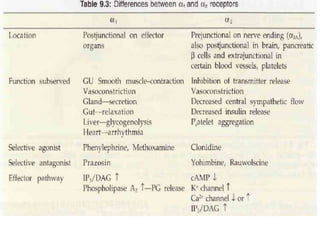
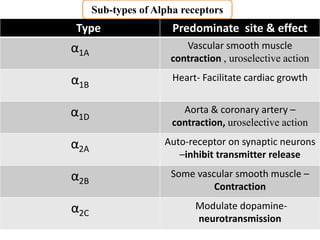
Type Predominate site & effect
α1A
Vascular smooth muscle
contraction , uroselective action
α1B
Heart- Facilitate cardiac growth
α1D
Aorta & coronary artery –
contraction, uroselective action
α2A
Auto-receptor on synaptic neurons
–inhibit transmitter release
α2B
Some vascular smooth muscle –
Contraction
α2C
Modulate dopamine-
neurotransmission
Sub-types of Alpha receptors
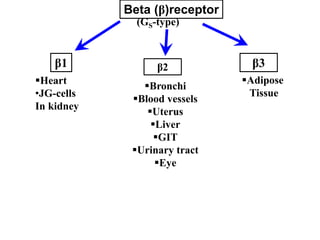
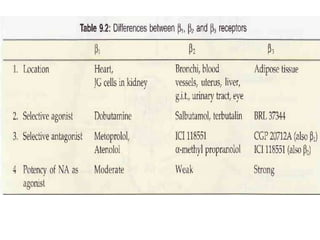
Beta (β)receptor
β1 β2 β3
(GS-type)
Heart
•JG-cells
In kidney
Bronchi
Blood vessels
Uterus
Liver
GIT
Urinary tract
Eye
Adipose
Tissue
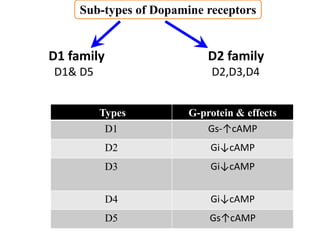
Sub-types of Dopamine receptors
Types G-protein & effects
D1 Gs-↑cAMP
D2 Gi↓cAMP
D3 Gi↓cAMP
D4 Gi↓cAMP
D5 Gs↑cAMP
D1 family
D1& D5
D2 family
D2,D3,D4
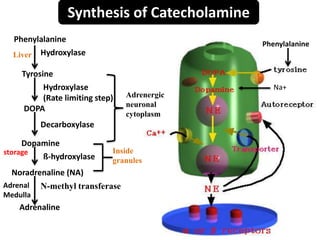
Synthesis of Catecholamine
Phenylalanine
Tyrosine
Phenylalanine
Hydroxylase
DOPA
Dopamine
Noradrenaline (NA)
Adrenaline
Hydroxylase
(Rate limiting step)
Decarboxylase
ß-hydroxylase
N-methyl transferase
Liver
Adrenergic
neuronal
cytoplasm
Inside
granules
Adrenal
Medulla
storage
Na+
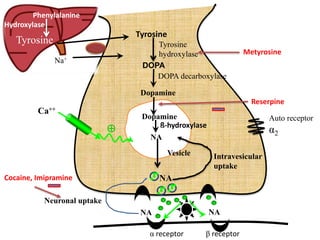
DOPA
Tyrosine
Ca++
NA
Dopamine
Vesicle
NA

α receptor
NA
β receptor
Tyrosine
Phenylalanine
Na+
Hydroxylase
Tyrosine
hydroxylase
DOPA decarboxylase
Dopamine
ß-hydroxylase
Auto receptor
α2
Intravesicular
uptake
NA
Neuronal uptake
Cocaine, Imipramine
Reserpine
Metyrosine
Synthesis:-
Catecholamine's are synthesized from the amino acid phenylalanine
Tyrosine is synthesized in liver by hydroxylation of phenylalanine.
The tyrosine is actively taken up in the adrenergic nerve terminal and
converted into dihydroxyphenylalanine(DOPA)
In the neuronal cytosol, tyrosine is converted to DOPA by tyrosine
hydroxylase. This is rate limiting step.
This enzyme is activated by the stimulation of sympathetic system or
adrenal medulla.
 DOPA to dopamine (DA) by DOPA decarboxylase.
Storage:-
Dopamine actively taken up into storage vesicle or granules
Conversion of dopamine to noradrenaline take place with the help of
dopamine-β-hydroxylase
NA is stored in synaptic vesicles or granules within the adrenergic
nerve terminal as a complex with ATP on a protein chromogranin
 Synthesis of NA occurs in all adrenergic neurons while synthesis of
adrenaline occur only in adrenal medullary cells
 In the adrenal medulla, NA is further converted to adrenaline by N-
methyltransferase.
 Small quantities of NA are released continuously into the synaptic
cleft and large quantities during nerve stimulation
Release:-
 On sympathetic nerve stimulation, nerve impulse is propagated cause release of NT
by the process of exocytosis in which there is influx of Ca++ ions
 Released Catecholamine acts on post synaptic adrenergic receptor to produced
response
 Most of the released NA is taken back into the adrenergic nerve terminals (neuronal
reuptake) which is either stored in the vesicles or inactivated by mitochondrial
monoamine oxidase (MAO) in the cytosol.
 Neuronal reuptake is the most important mechanism through which the termination
of action of NA takes place in the synaptic cleft.
 Small amount of NA from the synaptic cleft diffuses into circulation and gets
inactivated in liver by catechol-O-methyltransferase (COMT) and MAO.
 Small quantity of NA is transported into other tissues (extra-neuronal uptake).
 The main metabolite of catecholamines is vanillylmandelic acid (VMA). It is
excreted in urine.
Adrenaline, NA VMA
COMT & MAO
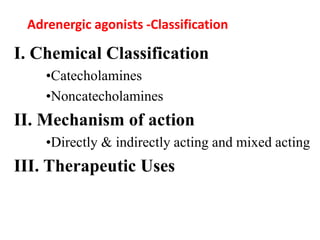
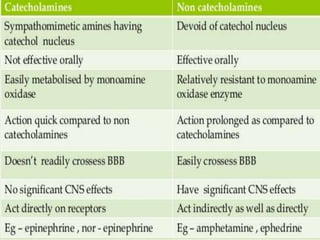
Adrenergic agonists -Classification
I. Chemical Classification
•Catecholamines
•Noncatecholamines
II. Mechanism of action
•Directly & indirectly acting and mixed acting
III. Therapeutic Uses
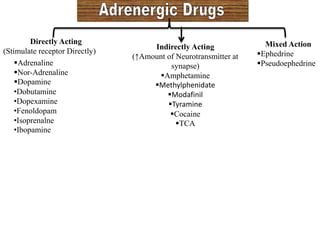
Directly Acting
(Stimulate receptor Directly)
Indirectly Acting
(↑Amount of Neurotransmitter at
synapse)
Amphetamine
Methylphenidate
Modafinil
Tyramine
Cocaine
TCA
Mixed Action
Ephedrine
Pseudoephedrine
Adrenaline
Nor-Adrenaline
Dopamine
•Dobutamine
•Dopexamine
•Fenoldopam
•Isoprenalne
•Ibopamine
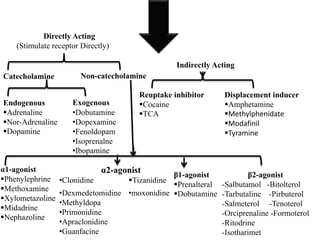
Catecholamine Non-catecholamine
Endogenous
Adrenaline
Nor-Adrenaline
Dopamine
Exogenous
•Dobutamine
•Dopexamine
•Fenoldopam
•Isoprenalne
•Ibopamine
α1-agonist
Phenylephrine
Methoxamine
Xylometazoline
Midadrine
Nephazoline
α2-agonist
•Clonidine Tizanidine
•Dexmedetomidine
•Methyldopa
•Primonidine
•Apraclonidine
•Guanfacine
•moxonidine
β1-agonist
Prenalteral
Dobutamine
β2-agonist
-Salbutamol -Bitolterol
-Tarbutaline -Pirbuterol
-Salmeterol -Tenoterol
-Orciprenaline -Formoterol
-Ritodrine
-Isotharimet
Reuptake inhibitor
Cocaine
TCA
Displacement inducer
Amphetamine
Methylphenidate
Modafinil
Tyramine
Directly Acting
(Stimulate receptor Directly)
Indirectly Acting
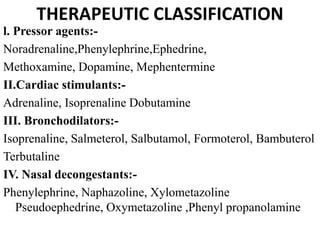
THERAPEUTIC CLASSIFICATION
l. Pressor agents:-
Noradrenaline,Phenylephrine,Ephedrine,
Methoxamine, Dopamine, Mephentermine
II.Cardiac stimulants:-
Adrenaline, Isoprenaline Dobutamine
III. Bronchodilators:-
Isoprenaline, Salmeterol, Salbutamol, Formoterol, Bambuterol
Terbutaline
IV. Nasal decongestants:-
Phenylephrine, Naphazoline, Xylometazoline
Pseudoephedrine, Oxymetazoline ,Phenyl propanolamine
V.CNS stimulants:- Amphetamine,
Methamphetamine, Dexamphetamine,
Methylphenidate
VI. Anorectics:-
Fenfluramine,
Sibutramine
Dexfenfluramine
VII. Uterine relaxant and vasodilators
Ritodrine, Isoxsuprine
Salbutamol
Terbutaline
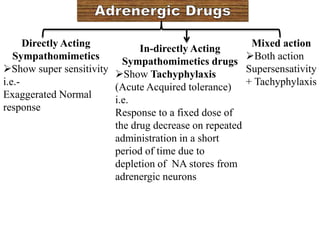
Directly Acting
Sympathomimetics
Show super sensitivity
i.e.-
Exaggerated Normal
response
In-directly Acting
Sympathomimetics drugs
Show Tachyphylaxis
(Acute Acquired tolerance)
i.e.
Response to a fixed dose of
the drug decrease on repeated
administration in a short
period of time due to
depletion of NA stores from
adrenergic neurons
Mixed action
Both action
Supersensativity
+ Tachyphylaxis
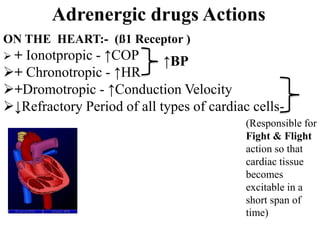
Adrenergic drugs Actions
ON THE HEART:- (ß1 Receptor )
 + Ionotpropic - ↑COP
+ Chronotropic - ↑HR
+Dromotropic - ↑Conduction Velocity
↓Refractory Period of all types of cardiac cells-
↑BP
(Responsible for
Fight & Flight
action so that
cardiac tissue
becomes
excitable in a
short span of
time)
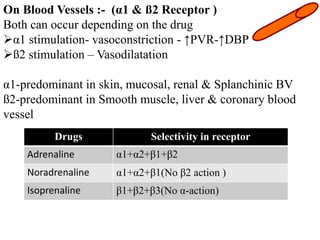
On Blood Vessels :- (α1 & ß2 Receptor )
Both can occur depending on the drug
α1 stimulation- vasoconstriction - ↑PVR-↑DBP
ß2 stimulation – Vasodilatation
α1-predominant in skin, mucosal, renal & Splanchinic BV
ß2-predominant in Smooth muscle, liver & coronary blood
vessel
Drugs Selectivity in receptor
Adrenaline α1+α2+β1+β2
Noradrenaline α1+α2+β1(No β2 action )
Isoprenaline β1+β2+β3(No α-action)
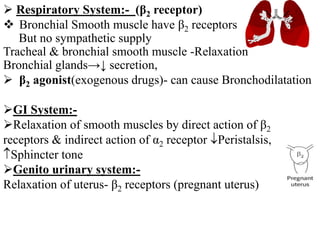
 Respiratory System:- (β2 receptor)
 Bronchial Smooth muscle have β2 receptors
But no sympathetic supply
Tracheal & bronchial smooth muscle -Relaxation
Bronchial glands→↓ secretion,
 β2 agonist(exogenous drugs)- can cause Bronchodilatation
GI System:-
Relaxation of smooth muscles by direct action of β2
receptors & indirect action of α2 receptor Peristalsis,
Sphincter tone
Genito urinary system:-
Relaxation of uterus- β2 receptors (pregnant uterus)
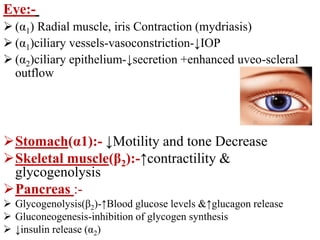
Eye:-
 (α1) Radial muscle, iris Contraction (mydriasis)
 (α1)ciliary vessels-vasoconstriction-↓IOP
 (α2)ciliary epithelium-↓secretion +enhanced uveo-scleral
outflow
Stomach(α1):- ↓Motility and tone Decrease
Skeletal muscle(β2):-↑contractility &
glycogenolysis
Pancreas :-
 Glycogenolysis(β2)-↑Blood glucose levels &↑glucagon release
 Gluconeogenesis-inhibition of glycogen synthesis
 ↓insulin release (α2)
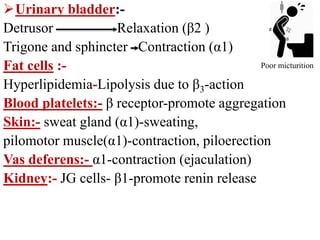
Urinary bladder:-
Detrusor Relaxation (β2 )
Trigone and sphincter Contraction (α1)
Fat cells :-
Hyperlipidemia-Lipolysis due to β3-action
Blood platelets:- β receptor-promote aggregation
Skin:- sweat gland (α1)-sweating,
pilomotor muscle(α1)-contraction, piloerection
Vas deferens:- α1-contraction (ejaculation)
Kidney:- JG cells- β1-promote renin release
Poor micturition
Adrenaline
• Acts on α1, α2,β1, β2, β3
• Actions-
• Heart-cardiac stimulant
• Blood vessels- skin & mucous membrane contain
α1-vasoconstriction. Also constricts renal,
mesenteric, pulmonary vessels.
• Dilates the blood vessels of skeletal muscle &
coronary (β2).
• IV- administration produces biphasic effect.
• Initial rise in BP is due α1( blood vessels) & β1( heart)
action (raise in systolic more than diastolic)
• Followed by fall in BP due to β2 mediated vasodilatation in
skeletal muscle.
• Administration of adrenaline after the α1 blocker produces
only fall in BP due to unopposed β2 action. This is referred
as “vasomotor reversal of Dale”
• Respiratory system- relaxes bronchial smooth muscle β2,
bronchodilator, inhibits the release of inflammatory mediators from
mast cells.
• Toxic doses of Adrenaline causes pulmonary edema.
• GIT- smooth muscle is relaxed
• Bladder- relaxes the detrusor muscle β2 & contracts the trigone
sphincter α1 (difficulty in urination)
• Causes hypokalemia by promoting K+ uptake into the skeletal muscle
cells. (β2)
• Eye-
• Mydriasis ( contraction of dilator pupillae through α 1)
• On topical application penetrates cornea poorly
• α 1- vasoconstriction of ciliary vessels- reduced aqueous
formation.
• α 2- reduced secretory activity of ciliary epithelium
• β2- ↑secretory activity of ciliary epithelium
• Metabolic effects-
• Adrenaline increases blood glucose by
- Stimulating hepatic glycogenolysis (β2)
- Reducing insulin secretion through α2
- Decreasing uptake of glucose by peripheral tissues.
Pharmacokinetics:-
- Rapid inactivation in GI mucosa & liver hence not suitable
for oral administration
- Doesn’t cross BBB
- Rapid absorption-IM route
- Liver-rich in MAO & COMT so, rapid metabolism
- Excretion-urine(small amount),
- large amount of NA, A in pt of phaeochromocytoma
Therapeutic use of adrenaline
⁕ Anaphylactic shock – (life-saving drug-DOC)
Features are –physiological antagonist of histamine
Dose- 0.3–0.5 mL of 1:1000 solution (1 mg/mL) IM
Advantage:-
1.Overcome hypotension- 1- vasoconstriction action
2.Overcome Bronchospasm- 2 effects- bronchodilation
3.1 effect increases cardiac output =BP.
4.Overcome Laryngospasm & further release of Histamines &
other mediators-2 effects due to stabilization of mast cell
membrane
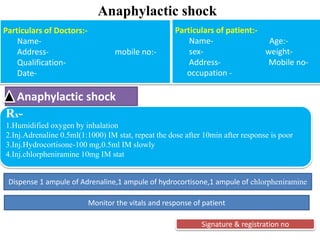
Anaphylactic shock
Particulars of Doctors:-
Name-
Address- mobile no:-
Qualification-
Date-
Particulars of patient:-
Name- Age:-
sex- weight-
Address- Mobile no-
occupation -
Rx-
1.Humidified oxygen by inhalation
2.Inj.Adrenaline 0.5ml(1:1000) IM stat, repeat the dose after 10min after response is poor
3.Inj.Hydrocortisone-100 mg,0.5ml IM slowly
4.Inj.chlorpheniramine 10mg IM stat
Anaphylactic shock
Dispense 1 ampule of Adrenaline,1 ampule of hydrocortisone,1 ampule of chlorpheniramine
Monitor the vitals and response of patient
Signature & registration no
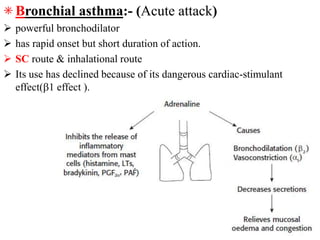
⁕ Bronchial asthma:- (Acute attack)
 powerful bronchodilator
 has rapid onset but short duration of action.
 SC route & inhalational route
 Its use has declined because of its dangerous cardiac-stimulant
effect(1 effect ).
⁕ Cardiac arrest:-
• IV route 1:10000 (0.1 mg/mL)+ other supportive measures
such as external cardiac massage
⁕ Prolongs the Duration of local anaesthesia:-
1. Slow absorption from the local site, which results in prolonged
duration of action of local anaesthesia.
2. ↓bleeding in the surgical field.
3. Slow absorption of LA reduces its systemic toxicity.
⁕ Controls Epistaxis &other capillary oozing:- (Topically)
 Due to its vasoconstrictor effect-acts as haemostatic/styptic agent.
 Control bleeding following tooth extraction and during surgical
procedures in nose, throat, larynx, etc.
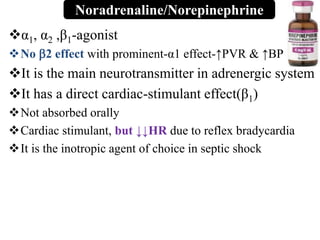
α1, α2 ,β1-agonist
No 2 effect with prominent-α1 effect-↑PVR & ↑BP
It is the main neurotransmitter in adrenergic system
It has a direct cardiac-stimulant effect(β1)
Not absorbed orally
Cardiac stimulant, but ↓↓HR due to reflex bradycardia
It is the inotropic agent of choice in septic shock
Noradrenaline/Norepinephrine
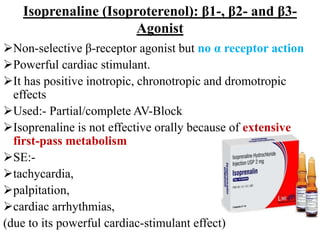
Isoprenaline (Isoproterenol): β1-, β2- and β3-
Agonist
Non-selective β-receptor agonist but no α receptor action
Powerful cardiac stimulant.
It has positive inotropic, chronotropic and dromotropic
effects
Used:- Partial/complete AV-Block
Isoprenaline is not effective orally because of extensive
first-pass metabolism
SE:-
tachycardia,
palpitation,
cardiac arrhythmias,
(due to its powerful cardiac-stimulant effect)
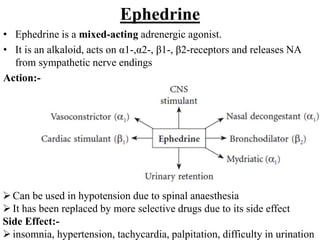
Ephedrine
• Ephedrine is a mixed-acting adrenergic agonist.
• It is an alkaloid, acts on α1-,α2-, β1-, β2-receptors and releases NA
from sympathetic nerve endings
Action:-
Can be used in hypotension due to spinal anaesthesia
It has been replaced by more selective drugs due to its side effect
Side Effect:-
insomnia, hypertension, tachycardia, palpitation, difficulty in urination
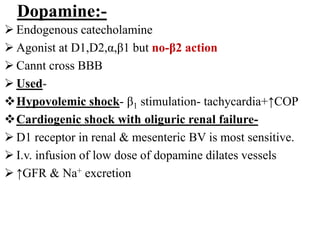
Dopamine:-
 Endogenous catecholamine
 Agonist at D1,D2,α,β1 but no-β2 action
 Cannt cross BBB
 Used-
Hypovolemic shock- β1 stimulation- tachycardia+↑COP
Cardiogenic shock with oliguric renal failure-
 D1 receptor in renal & mesenteric BV is most sensitive.
 I.v. infusion of low dose of dopamine dilates vessels
 ↑GFR & Na+ excretion
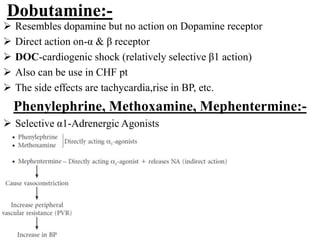
Dobutamine:-
 Resembles dopamine but no action on Dopamine receptor
 Direct action on-α & β receptor
 DOC-cardiogenic shock (relatively selective β1 action)
 Also can be use in CHF pt
 The side effects are tachycardia,rise in BP, etc.
Phenylephrine, Methoxamine, Mephentermine:-
 Selective α1-Adrenergic Agonists
 Fundoscopy- Phenylephrine-DOC only mydriasis is
required(no cycloplegia required)
 Also used as orally administered nasal decongestant
preparation
 Used to control of local bleeding (1% socked)
 Phenylephrine × paracetamol-banned in India
 Methoxamine-has weak β blocking action
 Mephentermine-Can be used to treat
 hypotension due to spinal anesthesia & surgical procedure
 Shock in MI
Amphetamine
• Indirect-acting sympathomimetic basic agent and has a potent CNS-
stimulant effect.
• Physical performance is greatly improved but temporarily and this
is misused by certain athletes.
• Drug with abuse potential
• The cardiac side effects are tachycardia, palpitation, hypertension,
angina and cardiac arrhythmias
Treatment of acute intoxication:-
1. Acidification of urine with ascorbic acid (vitamin C) promotes the
excretion of amphetamine,which is a basic drug.
2. Sedatives are effective to control CNS symptoms and sodium
nitroprusside for severe hypertension.
Uses:-
1. Narcolepsy:- It is a sleep disorder characterized by
recurrent episodes of uncontrollable desire for
sleep.
Amphetamine improves narcolepsy by its CNS-
stimulant effect.
2. As an anorexiant:-
↓body weight by suppressing hypothalamic feeding center
situated in lateral hypothalamus due to release of NA or DA
Rapid development of Tolerance
3. Attention-deficit hyperkinetic disorder:-
 Most common neurobehavioral disorder of
childhood characterized by problem with
attention, Impulsivity & excessive motor overactivity
leading to poor performance
 Catecholamines acts at cerebral cortex
 Amphetamine acts paradoxically and controls ADHD
 Methylphenidate preferred over amphetamine
 The main adverse effects are loss of appetite and insomnia.
 Methylphenidate(DOC) and dextroamphetamine are also
useful in this disorder.
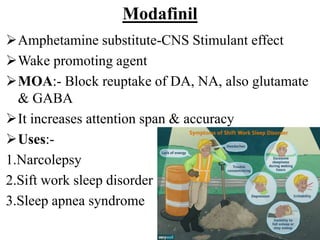
Modafinil
Amphetamine substitute-CNS Stimulant effect
Wake promoting agent
MOA:- Block reuptake of DA, NA, also glutamate
& GABA
It increases attention span & accuracy
Uses:-
1.Narcolepsy
2.Sift work sleep disorder
3.Sleep apnea syndrome
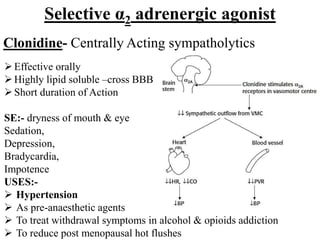
Selective α2 adrenergic agonist
Clonidine- Centrally Acting sympatholytics
Effective orally
Highly lipid soluble –cross BBB
Short duration of Action
SE:- dryness of mouth & eye
Sedation,
Depression,
Bradycardia,
Impotence
USES:-
 Hypertension
 As pre-anaesthetic agents
 To treat withdrawal symptoms in alcohol & opioids addiction
 To reduce post menopausal hot flushes
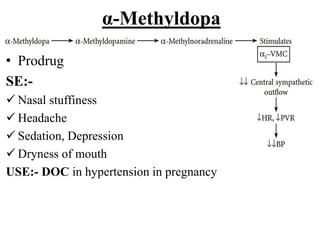
α-Methyldopa
• Prodrug
SE:-
 Nasal stuffiness
 Headache
 Sedation, Depression
 Dryness of mouth
USE:- DOC in hypertension in pregnancy
Nasal Decongestants
 Naphazoline,
 Oxymetazoline,
 Xylometazoline (topical)
 Pseudoephedrine (oral)
 phenylephrine (oral, topical) –α1 agonist(less potent)
MOA:- These drugs stimulate α-receptors and cause vasoconstriction in
the nasal mucous membrane, thus relieve nasal congestion.
Used:- Allergic rhinitis, common cold, sinusitis
SE:-
 Rhinitis medicamentosa- on prolong use.(loss of therapeutic effect-
rebound congestion)
 ↑BP
 Anosmia and local irritation
α2 agonist (more potent)
Bronchodilators & Uterine relaxants
 Selective β2 agonist cause bronchodilatation
Include-Salbutamol, Bitolterol Tarbutaline,Pirbuterol,Salmeterol,Tenoterol
Therapeutic uses:-
1. Bronchial asthma: administered by aerosol.
2. Premature labour: On oral or parenteral administration, salbutamol and terbutaline
relax pregnant uterus by interacting with β2-receptors; hence they are used to delay
premature labour.
3. Hyperkalaemia: Selective β2-agonists are useful in hyperkalaemia as they promote
the uptake of K+ into cells, especially into skeletal muscles.
Adverse effects of selective β -agonists
1. Tremor is due to the stimulation of β2-receptors of skeletal muscle.
2. Tachycardia and palpitation are due to stimulation of β1-receptors of heart.
3. Hyperglycaemia may occur in diabetics following parenteral administration of β2-
agonists.
4. Hypokalaemia is due to shift of K+ into cells.
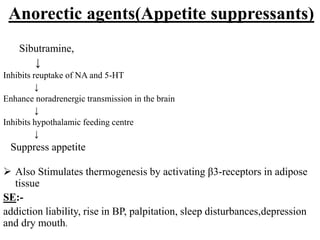
Anorectic agents(Appetite suppressants)
Sibutramine,
↓
Inhibits reuptake of NA and 5-HT
↓
Enhance noradrenergic transmission in the brain
↓
Inhibits hypothalamic feeding centre
↓
Suppress appetite
 Also Stimulates thermogenesis by activating β3-receptors in adipose
tissue
SE:-
addiction liability, rise in BP, palpitation, sleep disturbances,depression
and dry mouth.
Therapeutic Uses of Sympathomimetics
Drugs
1.Cardiac uses-
A.Cardiac arrest- iv.adrenaline
B. Partical/complete AV-Block-Isoprenaline
C.CHF-iv. Dopamine/dobutamine
2.Vascular uses:-
1.Hypotensive emergency-NA,phenylephrine,methoxamine
2.Chronic orthostatic/postural hypotension- oral ephedrine/midodrine
3.Shock:-
Anaphylactic shock- Adrenaline DOC
Cardiogenic shock- Dobutamine
Cardiogenic shock+ oliguric renal failure- Dopamine
Septic shock- NA
4.Along with LA:- Adrenaline+Lignocaine
5.Control local bleeding- Adrenaline, phenylephrine,
ephedrine
6.Nasal decongestant:- oxymetazoline, xylometazoline,
Naphazoline
7.Hypertension:-methyldopa-DOC in hypertension in
pregnancy (α2-agonists-auto receptor action)
8.Bronchial asthma & COPD- Salbutamol, Terbutaline,
Salmeterol, Formoterol
9.EYE:- As mydriatics-fundoscopy- phenylephrine
Glaucoma- open angle glaucoma-α2 agonist, Brimonidine
10.Tocolytic agents:- ritodrine, isoxsuprine, salbutamol
11.Allergic disorder- adrenaline being a physiological
antagonist of histamine
12.CNS:-
In obesity-sibutramine
Narcolepsy-amphetamine
ADHD-methylphenidate
13.Additional use:-
 Diarrhoea+diabetics- clonidine
 Treatment of narcotics & alcohol withdrawal-clonidine
 Sedatives in intensive care-dexmedetomidine
 Muscle relaxant-Tizanidine
 Parkinson disease & prolactinemia-Levodopa
Explain why:-
1.Clonidine can improve diarrhea in diabetics with
autonomic neuropathy
2.Clonidine is used as moderately potent antihypertensive
drug
3.Adrenaline is used in treatment of anaphylactic shock
but not in cardiogenic shock
4.Fenfluramine is used as anorectic agent over
amphetamine

Adrenergic system

  • 2.
  • 3.
     Drugs thatstimulate the sympathetic nervous system.  Performs Adrenergic system “fight & flight”  Dorsolumbar (T1, To L2)outflow-sympathomamitic  Neurotransmitters- Adrenergic nerves terminal  Norepinephrine (Major) Epinephrine- adrenal medulla Dopamine
  • 4.
    Chemistry- Phenylethylamine may beconsidered the parent compound from which sympathomimetic drugs are derived - This compound consists of a benzene ring with an ethylamine side chain. Substitutions may be made on (1) The benzene ring, (2) the terminal amino group, (3) the or carbons of the amino chain. Substitution by –OH groups at the 3 and 4 positions yields sympathomimetic drugs collectively known as catecholamines. Catecholamine
  • 6.
    α2 (Pre-junctional nerve endng,Pancreatic β- cell, Platelets) Alpha(α) receptor AdrenergicReceptors: Receptors Activated by NA α1 (Post junctional on effector organs) (Gq-type) (Gi-type) IP3 /DAG Cytosolic Ca2⁺ ↓Adenyl cyclase →↓cAMP
  • 8.
    Type Predominate site& effect α1A Vascular smooth muscle contraction , uroselective action α1B Heart- Facilitate cardiac growth α1D Aorta & coronary artery – contraction, uroselective action α2A Auto-receptor on synaptic neurons –inhibit transmitter release α2B Some vascular smooth muscle – Contraction α2C Modulate dopamine- neurotransmission Sub-types of Alpha receptors
  • 9.
    Beta (β)receptor β1 β2β3 (GS-type) Heart •JG-cells In kidney Bronchi Blood vessels Uterus Liver GIT Urinary tract Eye Adipose Tissue
  • 11.
    Sub-types of Dopaminereceptors Types G-protein & effects D1 Gs-↑cAMP D2 Gi↓cAMP D3 Gi↓cAMP D4 Gi↓cAMP D5 Gs↑cAMP D1 family D1& D5 D2 family D2,D3,D4
  • 12.
    Synthesis of Catecholamine Phenylalanine Tyrosine Phenylalanine Hydroxylase DOPA Dopamine Noradrenaline(NA) Adrenaline Hydroxylase (Rate limiting step) Decarboxylase ß-hydroxylase N-methyl transferase Liver Adrenergic neuronal cytoplasm Inside granules Adrenal Medulla storage Na+
  • 13.
    DOPA Tyrosine Ca++ NA Dopamine Vesicle NA  α receptor NA β receptor Tyrosine Phenylalanine Na+ Hydroxylase Tyrosine hydroxylase DOPAdecarboxylase Dopamine ß-hydroxylase Auto receptor α2 Intravesicular uptake NA Neuronal uptake Cocaine, Imipramine Reserpine Metyrosine
  • 14.
    Synthesis:- Catecholamine's are synthesizedfrom the amino acid phenylalanine Tyrosine is synthesized in liver by hydroxylation of phenylalanine. The tyrosine is actively taken up in the adrenergic nerve terminal and converted into dihydroxyphenylalanine(DOPA) In the neuronal cytosol, tyrosine is converted to DOPA by tyrosine hydroxylase. This is rate limiting step. This enzyme is activated by the stimulation of sympathetic system or adrenal medulla.  DOPA to dopamine (DA) by DOPA decarboxylase. Storage:- Dopamine actively taken up into storage vesicle or granules Conversion of dopamine to noradrenaline take place with the help of dopamine-β-hydroxylase NA is stored in synaptic vesicles or granules within the adrenergic nerve terminal as a complex with ATP on a protein chromogranin  Synthesis of NA occurs in all adrenergic neurons while synthesis of adrenaline occur only in adrenal medullary cells
  • 15.
     In theadrenal medulla, NA is further converted to adrenaline by N- methyltransferase.  Small quantities of NA are released continuously into the synaptic cleft and large quantities during nerve stimulation Release:-  On sympathetic nerve stimulation, nerve impulse is propagated cause release of NT by the process of exocytosis in which there is influx of Ca++ ions  Released Catecholamine acts on post synaptic adrenergic receptor to produced response  Most of the released NA is taken back into the adrenergic nerve terminals (neuronal reuptake) which is either stored in the vesicles or inactivated by mitochondrial monoamine oxidase (MAO) in the cytosol.  Neuronal reuptake is the most important mechanism through which the termination of action of NA takes place in the synaptic cleft.  Small amount of NA from the synaptic cleft diffuses into circulation and gets inactivated in liver by catechol-O-methyltransferase (COMT) and MAO.  Small quantity of NA is transported into other tissues (extra-neuronal uptake).  The main metabolite of catecholamines is vanillylmandelic acid (VMA). It is excreted in urine. Adrenaline, NA VMA COMT & MAO
  • 16.
    Adrenergic agonists -Classification I.Chemical Classification •Catecholamines •Noncatecholamines II. Mechanism of action •Directly & indirectly acting and mixed acting III. Therapeutic Uses
  • 17.
    Directly Acting (Stimulate receptorDirectly) Indirectly Acting (↑Amount of Neurotransmitter at synapse) Amphetamine Methylphenidate Modafinil Tyramine Cocaine TCA Mixed Action Ephedrine Pseudoephedrine Adrenaline Nor-Adrenaline Dopamine •Dobutamine •Dopexamine •Fenoldopam •Isoprenalne •Ibopamine
  • 18.
  • 19.
    THERAPEUTIC CLASSIFICATION l. Pressoragents:- Noradrenaline,Phenylephrine,Ephedrine, Methoxamine, Dopamine, Mephentermine II.Cardiac stimulants:- Adrenaline, Isoprenaline Dobutamine III. Bronchodilators:- Isoprenaline, Salmeterol, Salbutamol, Formoterol, Bambuterol Terbutaline IV. Nasal decongestants:- Phenylephrine, Naphazoline, Xylometazoline Pseudoephedrine, Oxymetazoline ,Phenyl propanolamine
  • 20.
    V.CNS stimulants:- Amphetamine, Methamphetamine,Dexamphetamine, Methylphenidate VI. Anorectics:- Fenfluramine, Sibutramine Dexfenfluramine VII. Uterine relaxant and vasodilators Ritodrine, Isoxsuprine Salbutamol Terbutaline
  • 22.
    Directly Acting Sympathomimetics Show supersensitivity i.e.- Exaggerated Normal response In-directly Acting Sympathomimetics drugs Show Tachyphylaxis (Acute Acquired tolerance) i.e. Response to a fixed dose of the drug decrease on repeated administration in a short period of time due to depletion of NA stores from adrenergic neurons Mixed action Both action Supersensativity + Tachyphylaxis
  • 23.
    Adrenergic drugs Actions ONTHE HEART:- (ß1 Receptor )  + Ionotpropic - ↑COP + Chronotropic - ↑HR +Dromotropic - ↑Conduction Velocity ↓Refractory Period of all types of cardiac cells- ↑BP (Responsible for Fight & Flight action so that cardiac tissue becomes excitable in a short span of time)
  • 24.
    On Blood Vessels:- (α1 & ß2 Receptor ) Both can occur depending on the drug α1 stimulation- vasoconstriction - ↑PVR-↑DBP ß2 stimulation – Vasodilatation α1-predominant in skin, mucosal, renal & Splanchinic BV ß2-predominant in Smooth muscle, liver & coronary blood vessel Drugs Selectivity in receptor Adrenaline α1+α2+β1+β2 Noradrenaline α1+α2+β1(No β2 action ) Isoprenaline β1+β2+β3(No α-action)
  • 25.
     Respiratory System:-(β2 receptor)  Bronchial Smooth muscle have β2 receptors But no sympathetic supply Tracheal & bronchial smooth muscle -Relaxation Bronchial glands→↓ secretion,  β2 agonist(exogenous drugs)- can cause Bronchodilatation GI System:- Relaxation of smooth muscles by direct action of β2 receptors & indirect action of α2 receptor Peristalsis, Sphincter tone Genito urinary system:- Relaxation of uterus- β2 receptors (pregnant uterus)
  • 26.
    Eye:-  (α1) Radialmuscle, iris Contraction (mydriasis)  (α1)ciliary vessels-vasoconstriction-↓IOP  (α2)ciliary epithelium-↓secretion +enhanced uveo-scleral outflow Stomach(α1):- ↓Motility and tone Decrease Skeletal muscle(β2):-↑contractility & glycogenolysis Pancreas :-  Glycogenolysis(β2)-↑Blood glucose levels &↑glucagon release  Gluconeogenesis-inhibition of glycogen synthesis  ↓insulin release (α2)
  • 27.
    Urinary bladder:- Detrusor Relaxation(β2 ) Trigone and sphincter Contraction (α1) Fat cells :- Hyperlipidemia-Lipolysis due to β3-action Blood platelets:- β receptor-promote aggregation Skin:- sweat gland (α1)-sweating, pilomotor muscle(α1)-contraction, piloerection Vas deferens:- α1-contraction (ejaculation) Kidney:- JG cells- β1-promote renin release Poor micturition
  • 28.
    Adrenaline • Acts onα1, α2,β1, β2, β3 • Actions- • Heart-cardiac stimulant • Blood vessels- skin & mucous membrane contain α1-vasoconstriction. Also constricts renal, mesenteric, pulmonary vessels. • Dilates the blood vessels of skeletal muscle & coronary (β2).
  • 29.
    • IV- administrationproduces biphasic effect. • Initial rise in BP is due α1( blood vessels) & β1( heart) action (raise in systolic more than diastolic) • Followed by fall in BP due to β2 mediated vasodilatation in skeletal muscle. • Administration of adrenaline after the α1 blocker produces only fall in BP due to unopposed β2 action. This is referred as “vasomotor reversal of Dale”
  • 30.
    • Respiratory system-relaxes bronchial smooth muscle β2, bronchodilator, inhibits the release of inflammatory mediators from mast cells. • Toxic doses of Adrenaline causes pulmonary edema. • GIT- smooth muscle is relaxed • Bladder- relaxes the detrusor muscle β2 & contracts the trigone sphincter α1 (difficulty in urination) • Causes hypokalemia by promoting K+ uptake into the skeletal muscle cells. (β2)
  • 31.
    • Eye- • Mydriasis( contraction of dilator pupillae through α 1) • On topical application penetrates cornea poorly • α 1- vasoconstriction of ciliary vessels- reduced aqueous formation. • α 2- reduced secretory activity of ciliary epithelium • β2- ↑secretory activity of ciliary epithelium
  • 32.
    • Metabolic effects- •Adrenaline increases blood glucose by - Stimulating hepatic glycogenolysis (β2) - Reducing insulin secretion through α2 - Decreasing uptake of glucose by peripheral tissues. Pharmacokinetics:- - Rapid inactivation in GI mucosa & liver hence not suitable for oral administration - Doesn’t cross BBB - Rapid absorption-IM route - Liver-rich in MAO & COMT so, rapid metabolism - Excretion-urine(small amount), - large amount of NA, A in pt of phaeochromocytoma
  • 33.
    Therapeutic use ofadrenaline ⁕ Anaphylactic shock – (life-saving drug-DOC) Features are –physiological antagonist of histamine Dose- 0.3–0.5 mL of 1:1000 solution (1 mg/mL) IM Advantage:- 1.Overcome hypotension- 1- vasoconstriction action 2.Overcome Bronchospasm- 2 effects- bronchodilation 3.1 effect increases cardiac output =BP. 4.Overcome Laryngospasm & further release of Histamines & other mediators-2 effects due to stabilization of mast cell membrane
  • 34.
    Anaphylactic shock Particulars ofDoctors:- Name- Address- mobile no:- Qualification- Date- Particulars of patient:- Name- Age:- sex- weight- Address- Mobile no- occupation - Rx- 1.Humidified oxygen by inhalation 2.Inj.Adrenaline 0.5ml(1:1000) IM stat, repeat the dose after 10min after response is poor 3.Inj.Hydrocortisone-100 mg,0.5ml IM slowly 4.Inj.chlorpheniramine 10mg IM stat Anaphylactic shock Dispense 1 ampule of Adrenaline,1 ampule of hydrocortisone,1 ampule of chlorpheniramine Monitor the vitals and response of patient Signature & registration no
  • 35.
    ⁕ Bronchial asthma:-(Acute attack)  powerful bronchodilator  has rapid onset but short duration of action.  SC route & inhalational route  Its use has declined because of its dangerous cardiac-stimulant effect(1 effect ).
  • 36.
    ⁕ Cardiac arrest:- •IV route 1:10000 (0.1 mg/mL)+ other supportive measures such as external cardiac massage ⁕ Prolongs the Duration of local anaesthesia:- 1. Slow absorption from the local site, which results in prolonged duration of action of local anaesthesia. 2. ↓bleeding in the surgical field. 3. Slow absorption of LA reduces its systemic toxicity. ⁕ Controls Epistaxis &other capillary oozing:- (Topically)  Due to its vasoconstrictor effect-acts as haemostatic/styptic agent.  Control bleeding following tooth extraction and during surgical procedures in nose, throat, larynx, etc.
  • 37.
    α1, α2 ,β1-agonist No2 effect with prominent-α1 effect-↑PVR & ↑BP It is the main neurotransmitter in adrenergic system It has a direct cardiac-stimulant effect(β1) Not absorbed orally Cardiac stimulant, but ↓↓HR due to reflex bradycardia It is the inotropic agent of choice in septic shock Noradrenaline/Norepinephrine
  • 38.
    Isoprenaline (Isoproterenol): β1-,β2- and β3- Agonist Non-selective β-receptor agonist but no α receptor action Powerful cardiac stimulant. It has positive inotropic, chronotropic and dromotropic effects Used:- Partial/complete AV-Block Isoprenaline is not effective orally because of extensive first-pass metabolism SE:- tachycardia, palpitation, cardiac arrhythmias, (due to its powerful cardiac-stimulant effect)
  • 39.
    Ephedrine • Ephedrine isa mixed-acting adrenergic agonist. • It is an alkaloid, acts on α1-,α2-, β1-, β2-receptors and releases NA from sympathetic nerve endings Action:- Can be used in hypotension due to spinal anaesthesia It has been replaced by more selective drugs due to its side effect Side Effect:- insomnia, hypertension, tachycardia, palpitation, difficulty in urination
  • 40.
    Dopamine:-  Endogenous catecholamine Agonist at D1,D2,α,β1 but no-β2 action  Cannt cross BBB  Used- Hypovolemic shock- β1 stimulation- tachycardia+↑COP Cardiogenic shock with oliguric renal failure-  D1 receptor in renal & mesenteric BV is most sensitive.  I.v. infusion of low dose of dopamine dilates vessels  ↑GFR & Na+ excretion
  • 41.
    Dobutamine:-  Resembles dopaminebut no action on Dopamine receptor  Direct action on-α & β receptor  DOC-cardiogenic shock (relatively selective β1 action)  Also can be use in CHF pt  The side effects are tachycardia,rise in BP, etc. Phenylephrine, Methoxamine, Mephentermine:-  Selective α1-Adrenergic Agonists
  • 42.
     Fundoscopy- Phenylephrine-DOConly mydriasis is required(no cycloplegia required)  Also used as orally administered nasal decongestant preparation  Used to control of local bleeding (1% socked)  Phenylephrine × paracetamol-banned in India  Methoxamine-has weak β blocking action  Mephentermine-Can be used to treat  hypotension due to spinal anesthesia & surgical procedure  Shock in MI
  • 43.
    Amphetamine • Indirect-acting sympathomimeticbasic agent and has a potent CNS- stimulant effect. • Physical performance is greatly improved but temporarily and this is misused by certain athletes. • Drug with abuse potential • The cardiac side effects are tachycardia, palpitation, hypertension, angina and cardiac arrhythmias Treatment of acute intoxication:- 1. Acidification of urine with ascorbic acid (vitamin C) promotes the excretion of amphetamine,which is a basic drug. 2. Sedatives are effective to control CNS symptoms and sodium nitroprusside for severe hypertension.
  • 44.
    Uses:- 1. Narcolepsy:- Itis a sleep disorder characterized by recurrent episodes of uncontrollable desire for sleep. Amphetamine improves narcolepsy by its CNS- stimulant effect. 2. As an anorexiant:- ↓body weight by suppressing hypothalamic feeding center situated in lateral hypothalamus due to release of NA or DA Rapid development of Tolerance
  • 45.
    3. Attention-deficit hyperkineticdisorder:-  Most common neurobehavioral disorder of childhood characterized by problem with attention, Impulsivity & excessive motor overactivity leading to poor performance  Catecholamines acts at cerebral cortex  Amphetamine acts paradoxically and controls ADHD  Methylphenidate preferred over amphetamine  The main adverse effects are loss of appetite and insomnia.  Methylphenidate(DOC) and dextroamphetamine are also useful in this disorder.
  • 46.
    Modafinil Amphetamine substitute-CNS Stimulanteffect Wake promoting agent MOA:- Block reuptake of DA, NA, also glutamate & GABA It increases attention span & accuracy Uses:- 1.Narcolepsy 2.Sift work sleep disorder 3.Sleep apnea syndrome
  • 47.
    Selective α2 adrenergicagonist Clonidine- Centrally Acting sympatholytics Effective orally Highly lipid soluble –cross BBB Short duration of Action SE:- dryness of mouth & eye Sedation, Depression, Bradycardia, Impotence USES:-  Hypertension  As pre-anaesthetic agents  To treat withdrawal symptoms in alcohol & opioids addiction  To reduce post menopausal hot flushes
  • 48.
    α-Methyldopa • Prodrug SE:-  Nasalstuffiness  Headache  Sedation, Depression  Dryness of mouth USE:- DOC in hypertension in pregnancy
  • 49.
    Nasal Decongestants  Naphazoline, Oxymetazoline,  Xylometazoline (topical)  Pseudoephedrine (oral)  phenylephrine (oral, topical) –α1 agonist(less potent) MOA:- These drugs stimulate α-receptors and cause vasoconstriction in the nasal mucous membrane, thus relieve nasal congestion. Used:- Allergic rhinitis, common cold, sinusitis SE:-  Rhinitis medicamentosa- on prolong use.(loss of therapeutic effect- rebound congestion)  ↑BP  Anosmia and local irritation α2 agonist (more potent)
  • 50.
    Bronchodilators & Uterinerelaxants  Selective β2 agonist cause bronchodilatation Include-Salbutamol, Bitolterol Tarbutaline,Pirbuterol,Salmeterol,Tenoterol Therapeutic uses:- 1. Bronchial asthma: administered by aerosol. 2. Premature labour: On oral or parenteral administration, salbutamol and terbutaline relax pregnant uterus by interacting with β2-receptors; hence they are used to delay premature labour. 3. Hyperkalaemia: Selective β2-agonists are useful in hyperkalaemia as they promote the uptake of K+ into cells, especially into skeletal muscles. Adverse effects of selective β -agonists 1. Tremor is due to the stimulation of β2-receptors of skeletal muscle. 2. Tachycardia and palpitation are due to stimulation of β1-receptors of heart. 3. Hyperglycaemia may occur in diabetics following parenteral administration of β2- agonists. 4. Hypokalaemia is due to shift of K+ into cells.
  • 51.
    Anorectic agents(Appetite suppressants) Sibutramine, ↓ Inhibitsreuptake of NA and 5-HT ↓ Enhance noradrenergic transmission in the brain ↓ Inhibits hypothalamic feeding centre ↓ Suppress appetite  Also Stimulates thermogenesis by activating β3-receptors in adipose tissue SE:- addiction liability, rise in BP, palpitation, sleep disturbances,depression and dry mouth.
  • 52.
    Therapeutic Uses ofSympathomimetics Drugs 1.Cardiac uses- A.Cardiac arrest- iv.adrenaline B. Partical/complete AV-Block-Isoprenaline C.CHF-iv. Dopamine/dobutamine 2.Vascular uses:- 1.Hypotensive emergency-NA,phenylephrine,methoxamine 2.Chronic orthostatic/postural hypotension- oral ephedrine/midodrine 3.Shock:- Anaphylactic shock- Adrenaline DOC Cardiogenic shock- Dobutamine Cardiogenic shock+ oliguric renal failure- Dopamine Septic shock- NA
  • 53.
    4.Along with LA:-Adrenaline+Lignocaine 5.Control local bleeding- Adrenaline, phenylephrine, ephedrine 6.Nasal decongestant:- oxymetazoline, xylometazoline, Naphazoline 7.Hypertension:-methyldopa-DOC in hypertension in pregnancy (α2-agonists-auto receptor action) 8.Bronchial asthma & COPD- Salbutamol, Terbutaline, Salmeterol, Formoterol 9.EYE:- As mydriatics-fundoscopy- phenylephrine Glaucoma- open angle glaucoma-α2 agonist, Brimonidine 10.Tocolytic agents:- ritodrine, isoxsuprine, salbutamol 11.Allergic disorder- adrenaline being a physiological antagonist of histamine
  • 54.
    12.CNS:- In obesity-sibutramine Narcolepsy-amphetamine ADHD-methylphenidate 13.Additional use:- Diarrhoea+diabetics- clonidine  Treatment of narcotics & alcohol withdrawal-clonidine  Sedatives in intensive care-dexmedetomidine  Muscle relaxant-Tizanidine  Parkinson disease & prolactinemia-Levodopa
  • 56.
    Explain why:- 1.Clonidine canimprove diarrhea in diabetics with autonomic neuropathy 2.Clonidine is used as moderately potent antihypertensive drug 3.Adrenaline is used in treatment of anaphylactic shock but not in cardiogenic shock 4.Fenfluramine is used as anorectic agent over amphetamine