

Prof. Amol B. Deore
Department of Pharmacology
MVP’s Institute of Pharmaceutical Sciences, Nashik
Parasympathetic division
The parasympathetic division typically act in opposition
of the sympathetic autonomic nervous system through
negative feedback control.
This action is a complementary response, causing a
balance of sympathetic and parasympathetic responses.
Overall, the parasympathetic outflow results in
conservation and restoration of energy, reduction in heart
rate and blood pressure, facilitation of digestion and
absorption of nutrients, and excretion of waste products.
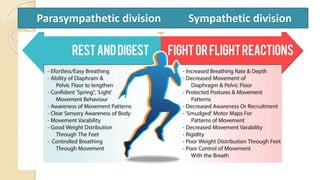
Parasympathetic division Sympathetic division
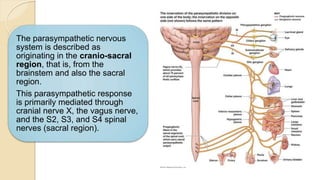
The parasympathetic nervous
system is described as
originating in the cranio-sacral
region, that is, from the
brainstem and also the sacral
region.
This parasympathetic response
is primarily mediated through
cranial nerve X, the vagus nerve,
and the S2, S3, and S4 spinal
nerves (sacral region).
PARASYMPATHETIC
NEUROTRANSMISSION
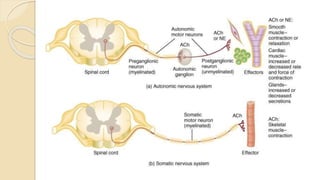
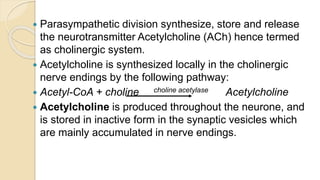
 Parasympathetic division synthesize, store and release
the neurotransmitter Acetylcholine (ACh) hence termed
as cholinergic system.
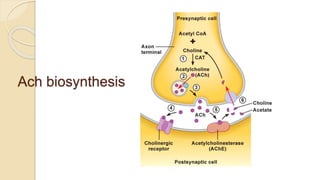
 Acetylcholine is synthesized locally in the cholinergic
nerve endings by the following pathway:
 Acetyl-CoA + choline choline acetylase Acetylcholine
 Acetylcholine is produced throughout the neurone, and
is stored in inactive form in the synaptic vesicles which
are mainly accumulated in nerve endings.
Ach biosynthesis
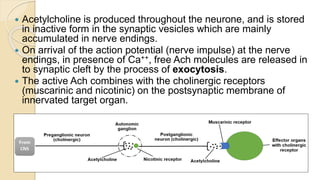
 Acetylcholine is produced throughout the neurone, and is stored
in inactive form in the synaptic vesicles which are mainly
accumulated in nerve endings.
 On arrival of the action potential (nerve impulse) at the nerve
endings, in presence of Ca++, free Ach molecules are released in
to synaptic cleft by the process of exocytosis.
 The active Ach combines with the cholinergic receptors
(muscarinic and nicotinic) on the postsynaptic membrane of
innervated target organ.
 This ACh binds to and activates the cholinergic receptor
on the postsynaptic membrane leading to the
depolarisation of this membrane. Thus the impulse is
transmitted across the synapse.
 The Ach release in synaptic cleft is rapidly hydrolysed by
the enzyme Acetylcholinesterase (AChE) within few
milliseconds. A part of choline is reabsorbed by nerve
endings and later reused in ACh synthesis.
 A pseudocholinesterase enzyme occurs in the plasma
and liver; serves to metabolize ingested esters and Ach.
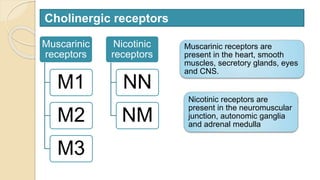
 There are two classes of cholinergic receptors –
muscarinic and nicotinic. Muscarinic receptors are
present in the heart, smooth muscles, secretory
glands, eyes and CNS. Three subtypes of muscarinic
receptors, M1 to M3.
 Nicotinic receptors are present in the neuromuscular
junction, autonomic ganglia and adrenal medulla.
 Two subtypes of nicotinic receptors are NM and NN. NM
receptors are present at the skeletal muscle end plate
and NN receptors at the autonomic ganglia and adrenal
Cholinergic receptors
Muscarinic
receptors
M1
M2
M3
Nicotinic
receptors
NN
NM
Cholinergic receptors
Muscarinic receptors are
present in the heart, smooth
muscles, secretory glands, eyes
and CNS.
Nicotinic receptors are
present in the neuromuscular
junction, autonomic ganglia
and adrenal medulla
PARASYMPATHOMIMETICS
(CHOLINERGICS DRUGS)
PARASYMPATHOMIMETICS
 These are drugs which produce actions similar to that
of Acetylcholine hence known as
parasympathomimetics.
 They act either by directly interacting with cholinergic
receptors or by increasing availability of Acetylcholine
at these sites.
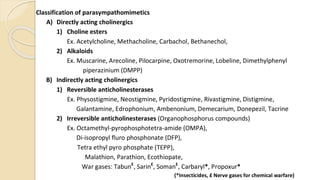
Classification of parasympathomimetics
A) Directly acting cholinergics
1) Choline esters
Ex. Acetylcholine, Methacholine, Carbachol, Bethanechol,
2) Alkaloids
Ex. Muscarine, Arecoline, Pilocarpine, Oxotremorine, Lobeline, Dimethylphenyl
piperazinium (DMPP)
B) Indirectly acting cholinergics
1) Reversible anticholinesterases
Ex. Physostigmine, Neostigmine, Pyridostigmine, Rivastigmine, Distigmine,
Galantamine, Edrophonium, Ambenonium, Demecarium, Donepezil, Tacrine
2) Irreversible anticholinesterases (Organophosphorus compounds)
Ex. Octamethyl-pyrophosphotetra-amide (OMPA),
Di-isopropyl fluro phosphonate (DFP),
Tetra ethyl pyro phosphate (TEPP),
Malathion, Parathion, Ecothiopate,
War gases: Tabun£
, Sarin£
, Soman£
, Carbaryl*, Propoxur*
(*Insecticides, £ Nerve gases for chemical warfare)
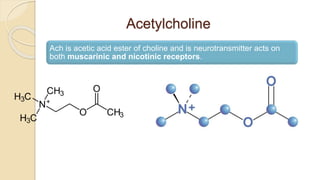
Acetylcholine
Ach is acetic acid ester of choline and is neurotransmitter acts on
both muscarinic and nicotinic receptors.
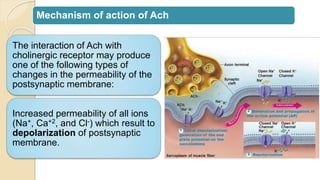
Mechanism of action of Ach
The interaction of Ach with
cholinergic receptor may produce
one of the following types of
changes in the permeability of the
postsynaptic membrane:
Increased permeability of all ions
(Na+, Ca+2, and Cl-) which result to
depolarization of postsynaptic
membrane.
Selective permeability changes to certain ions
(K and Cl) which produce stabilization or
hyperpolarization of postsynaptic membrane.
In general, depolarization increases cellular
activity and hyperpolarization decreases
cellular activity.
Pharmacological Actions
of Acetylcholine
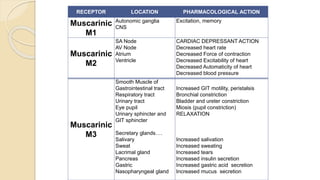
RECEPTOR LOCATION PHARMACOLOGICAL ACTION
Muscarinic
M1
Autonomic ganglia
CNS
Excitation, memory
Muscarinic
M2
SA Node
AV Node
Atrium
Ventricle
CARDIAC DEPRESSANT ACTION
Decreased heart rate
Decreased Force of contraction
Decreased Excitability of heart
Decreased Automaticity of heart
Decreased blood pressure
Muscarinic
M3
Smooth Muscle of
Gastrointestinal tract
Respiratory tract
Urinary tract
Eye pupil
Urinary sphincter and
GIT sphincter
Secretary glands….
Salivary
Sweat
Lacrimal gland
Pancreas
Gastric
Nasopharyngeal gland
Increased GIT motility, peristalsis
Bronchial constriction
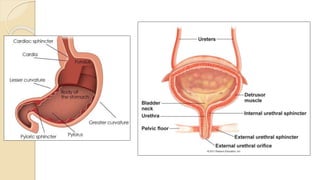
Bladder and ureter constriction
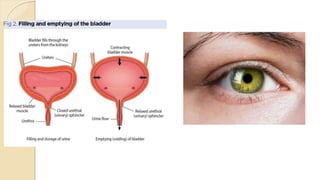
Miosis (pupil constriction)
RELAXATION
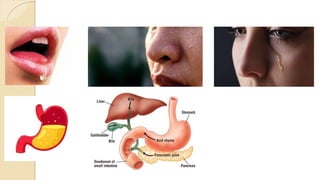
Increased salivation
Increased sweating
Increased tears
Increased insulin secretion
Increased gastric acid secretion
Increased mucus secretion
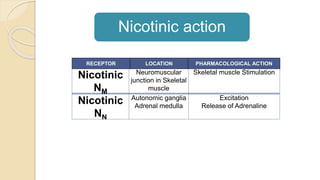
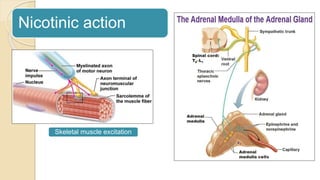
Nicotinic
NM
Neuromuscular
junction in Skeletal
muscle
Skeletal muscle Stimulation
Nicotinic
NN
Autonomic ganglia
Adrenal medulla
Excitation
Release of Adrenaline
RECEPTOR LOCATION PHARMACOLOGICAL ACTION
Nicotinic action
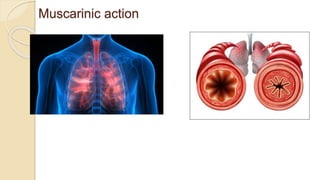
Muscarinic action
Nicotinic action
Skeletal muscle excitation
Therapeutic uses of Ach
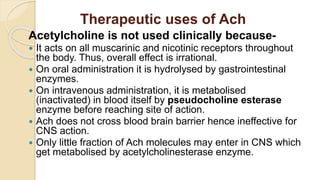
Acetylcholine is not used clinically because-
 It acts on all muscarinic and nicotinic receptors throughout
the body. Thus, overall effect is irrational.
 On oral administration it is hydrolysed by gastrointestinal
enzymes.
 On intravenous administration, it is metabolised
(inactivated) in blood itself by pseudocholine esterase
enzyme before reaching site of action.
 Ach does not cross blood brain barrier hence ineffective for
CNS action.
 Only little fraction of Ach molecules may enter in CNS which
get metabolised by acetylcholinesterase enzyme.
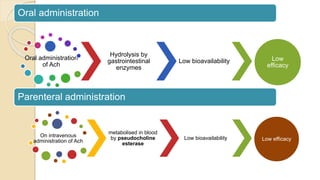
Oral administration
Oral administration
of Ach
Hydrolysis by
gastrointestinal
enzymes
Low bioavailability Low
efficacy
Parenteral administration
On intravenous
administration of Ach
metabolised in blood
by pseudocholine
esterase
Low bioavailability Low efficacy
DIRECTLY ACTING CHOLINERGICS
 Choline esters
Ex. Acetylcholine, Methacholine,
Carbachol Bethanechol,
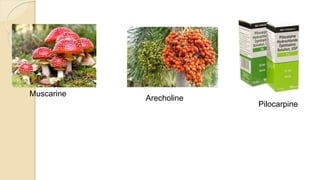
 Alkaloids
Ex. Muscarine, Arecoline, Pilocarpine
Muscarine
Arecholine
Pilocarpine
Mechanism of action
 These drugs stimulate cholinergic
receptors and preganglionic and
postganglionic nerve fibers.
Therapeutic uses
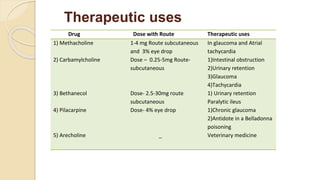
Drug Dose with Route Therapeutic uses
1) Methacholine
2) Carbamylcholine
3) Bethanecol
4) Pilacarpine
5) Arecholine
1-4 mg Route subcutaneous
and 3% eye drop
Dose – 0.25-5mg Route-
subcutaneous
Dose- 2.5-30mg route
subcutaneous
Dose- 4% eye drop
_
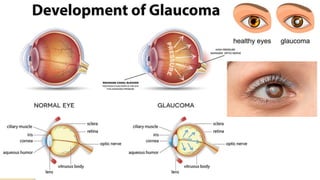
In glaucoma and Atrial
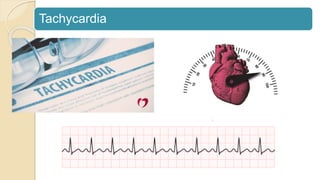
tachycardia
1)Intestinal obstruction
2)Urinary retention
3)Glaucoma
4)Tachycardia
1) Urinary retention
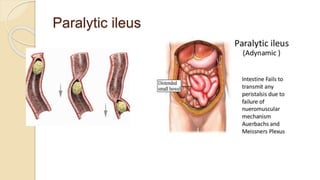
Paralytic ileus
1)Chronic glaucoma
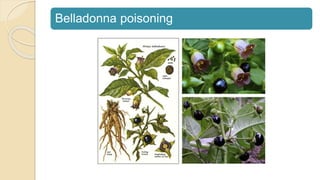
2)Antidote in a Belladonna
poisoning
Veterinary medicine
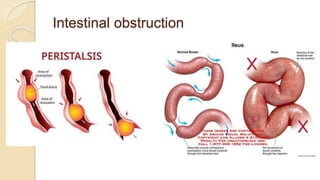
Intestinal obstruction
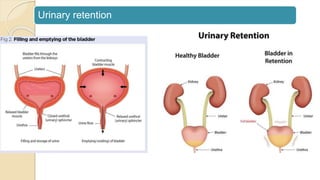
Urinary retention
Tachycardia
Paralytic ileus
Belladonna poisoning
INDIRECTLY ACTING CHOLINERGICS
Reversible anticholinesterases
 Ex. Physostigmine, Neostigmine,
Pyridostigmine, Rivastigmine, Distigmine,
Edrophonium, Galantamine
Mechanism of action
 Reversible anticholinesterases are the drugs that
competitively antagonise the
acetylcholinesterase (AchE) enzyme and prevent
the hydrolysis of Acetylcholine.
 Acetylcholinesterase causes metabolism
(hydrolysis) of Ach. Inhibition of AchE enzyme
increases both availability and duration of action
of acetylcholine.
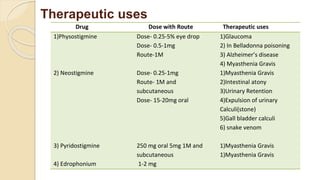
Therapeutic uses
Drug Dose with Route Therapeutic uses
1)Physostigmine
2) Neostigmine
3) Pyridostigmine
4) Edrophonium
Dose- 0.25-5% eye drop
Dose- 0.5-1mg
Route-1M
Dose- 0.25-1mg
Route- 1M and
subcutaneous
Dose- 15-20mg oral
250 mg oral 5mg 1M and
subcutaneous
1-2 mg
1)Glaucoma
2) In Belladonna poisoning
3) Alzheimer’s disease
4) Myasthenia Gravis
1)Myasthenia Gravis
2)Intestinal atony
3)Urinary Retention
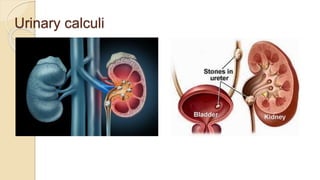
4)Expulsion of urinary
Calculi(stone)
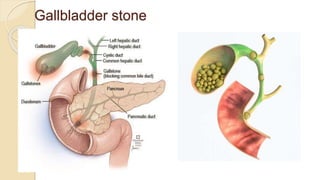
5)Gall bladder calculi
6) snake venom
1)Myasthenia Gravis
1)Myasthenia Gravis
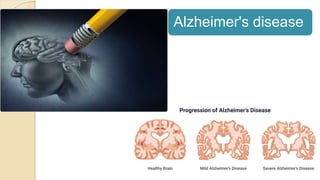
Alzheimer's disease
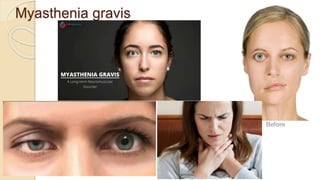
Myasthenia gravis
Urinary calculi
Gallbladder stone
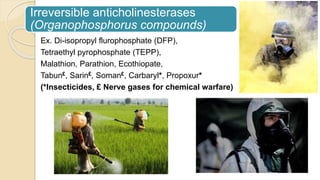
Ex. Di-isopropyl flurophosphate (DFP),
Tetraethyl pyrophosphate (TEPP),
Malathion, Parathion, Ecothiopate,
Tabun£, Sarin£, Soman£, Carbaryl*, Propoxur*
(*Insecticides, £ Nerve gases for chemical warfare)
Irreversible anticholinesterases
(Organophosphorus compounds)
Therapeutic uses
Organophosphorus compounds never used clinically.
They may be used for ophthalmic disorders in minute
concentrations.
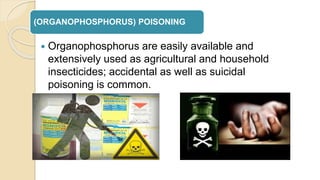
(ORGANOPHOSPHORUS) POISONING
 Organophosphorus are easily available and
extensively used as agricultural and household
insecticides; accidental as well as suicidal
poisoning is common.
SYMPTOMS
M1 receptors:
• Irritability, disorientation, unsteadiness, tremor, convulsions, coma
and death.
M2 receptors:
• Hypotension, bradycardia, circulatory collapse, cardiac arrhythmias.
M3 receptors:
• Irritation of eye, lacrimation, salivation, sweating, dehydration,
tracheo-bronchial secretions, bronchospasm, breathlessness,
tightness of chest, miosis, blurring of vision, colic, involuntary
defecation and urination.
NM receptors:
• Muscular fasciculation, weakness, and respiratory paralysis.
Death is generally due to respiratory failure and
coma.
Management of
Organophospharus poisoning
Decontamination measures
• The patient is removed from the site of
exposure of poison and placed in fresh air.
• The skin, eyes and mouth washed with soap
and water.
• Gastric lavage to remove the poison from the
stomach; induced by warm saline solution and
activated charcoal.
Supportive therapies
• The artificial respiration is given by ventilator to recover
from breathlessness.
• The normal saline solution and vasoconstrictors like
noradrenaline or dopamine are administered by IV infusion
to maintain blood pressure and to prevent circulatory
collapse (shock).
• Prophylactic antibiotics like ampicillin are given to prevent
infection.
• Diazepam is given to prevent convulsions.
Specific measures
• To counteract/ reverse the adverse effects, specific
antidotes are administered which are-
• Anticholinergic drugs like atropine sulphate (2mg
IV or IM) to be block muscarinic receptors in order
to counteract CNS effects and other complications.
• Acetylcholinesterase reactivators like pralidoxime,
oblidoxime, & pyruvalidoxime. They reactivate the
AchE enzyme at nicotinic receptor sites on skeletal
muscles (neuromuscular junction).
Acetylcholine is not used clinically because-
• It acts on all muscarinic and nicotinic receptors throughout
the body. Thus, overall effect is irrational.
• On oral administration it is hydrolysed by gastrointestinal
enzymes.
• On intravenous administration, it is metabolised
(inactivated) in blood itself by pseudocholine esterase
enzyme before reaching site of action.
• Ach does not cross blood brain barrier hence ineffective
for CNS action.
• Only little fraction of Ach molecules may enter in CNS
which get metabolised by acetylcholinesterase enzyme.
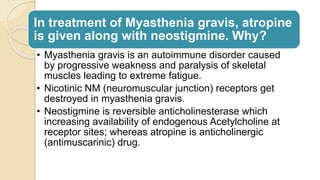
In treatment of Myasthenia gravis, atropine
is given along with neostigmine. Why?
• Myasthenia gravis is an autoimmune disorder caused
by progressive weakness and paralysis of skeletal
muscles leading to extreme fatigue.
• Nicotinic NM (neuromuscular junction) receptors get
destroyed in myasthenia gravis.
• Neostigmine is reversible anticholinesterase which
increasing availability of endogenous Acetylcholine at
receptor sites; whereas atropine is anticholinergic
(antimuscarinic) drug.
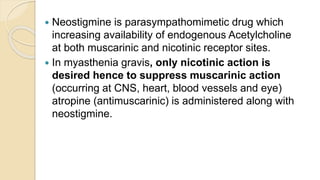
 Neostigmine is parasympathomimetic drug which
increasing availability of endogenous Acetylcholine
at both muscarinic and nicotinic receptor sites.
 In myasthenia gravis, only nicotinic action is
desired hence to suppress muscarinic action
(occurring at CNS, heart, blood vessels and eye)
atropine (antimuscarinic) is administered along with
neostigmine.
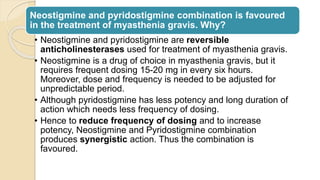
Neostigmine and pyridostigmine combination is favoured
in the treatment of myasthenia gravis. Why?
• Neostigmine and pyridostigmine are reversible
anticholinesterases used for treatment of myasthenia gravis.
• Neostigmine is a drug of choice in myasthenia gravis, but it
requires frequent dosing 15-20 mg in every six hours.
Moreover, dose and frequency is needed to be adjusted for
unpredictable period.
• Although pyridostigmine has less potency and long duration of
action which needs less frequency of dosing.
• Hence to reduce frequency of dosing and to increase
potency, Neostigmine and Pyridostigmine combination
produces synergistic action. Thus the combination is
favoured.
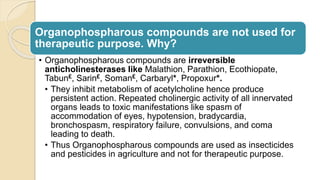
Organophospharous compounds are not used for
therapeutic purpose. Why?
• Organophospharous compounds are irreversible
anticholinesterases like Malathion, Parathion, Ecothiopate,
Tabun£, Sarin£, Soman£, Carbaryl*, Propoxur*.
• They inhibit metabolism of acetylcholine hence produce
persistent action. Repeated cholinergic activity of all innervated
organs leads to toxic manifestations like spasm of
accommodation of eyes, hypotension, bradycardia,
bronchospasm, respiratory failure, convulsions, and coma
leading to death.
• Thus Organophospharous compounds are used as insecticides
and pesticides in agriculture and not for therapeutic purpose.
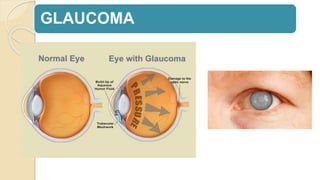
GLAUCOMA
Glaucoma is characterised by rise in intraocular
pressure (>21 mmHg) associated with damage to
the optic nerve in the back of the eye.
Optic nerve transmits information from the eye to
the brain. Without treatment, glaucoma can cause
total permanent blindness within a few years.
Treatment of glaucoma
• The miotics: these are cholinergic drugs when applied
topically constriction of the pupil and a fall in intraocular
pressure.
• Ex. Pilocarpine, Methacholine, Carbachol,
Physostigmine, DFP
• Beta adrenoceptor blockers: these drugs act by
lowering intraoccular pressure due to constriction of
pupil.
• Ex. Timolol
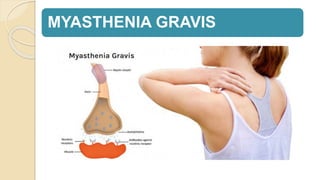
MYASTHENIA GRAVIS
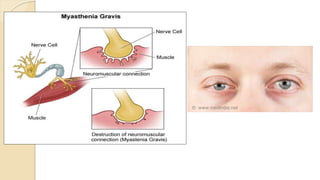
 Myasthenia gravis (MG) is a rare autoimmune disorder in
which antibodies form against acetylcholine nicotinic
postsynaptic receptors at the neuromuscular junction of
skeletal muscles.
 Myasthenia gravis is a neuromuscular disorder that
causes progressive weakness and fatigue in the skeletal
muscles, which are the muscles your body uses for
movement.
 It occurs when communication between nerve cells and
muscles becomes impaired.
 This impairment prevents crucial muscle contractions
from occurring, resulting in muscle weakness.
Symptoms of myasthenia
• Trouble talking
• Problems walking up stairs or lifting objects
• Facial paralysis
• Difficulty breathing because of muscle weakness
• Difficulty swallowing or chewing
• Fatigue
• Hoarse voice
• Drooping of eyelids
• Double vision
Treatment for Myasthenia Gravis
 There is no cure for MG. The goal of treatment is to
manage symptoms and control the activity of your
immune system.
 Corticosteroids and immunosuppressants can be
used to suppress the immune system. These
medications help minimize the abnormal immune
response that occurs in MG.
 Additionally, acetylcholinesterase inhibitors, such as
physostigmine, neostigmine, pyridostigmine can be
used to increase communication between nerves and
muscles.
Parasympathomimetics (Cholinergic drugs)

Parasympathomimetics (Cholinergic drugs)

  • 1.
    Prof. Amol B.Deore Department of Pharmacology MVP’s Institute of Pharmaceutical Sciences, Nashik
  • 2.
    Parasympathetic division The parasympatheticdivision typically act in opposition of the sympathetic autonomic nervous system through negative feedback control. This action is a complementary response, causing a balance of sympathetic and parasympathetic responses. Overall, the parasympathetic outflow results in conservation and restoration of energy, reduction in heart rate and blood pressure, facilitation of digestion and absorption of nutrients, and excretion of waste products.
  • 3.
  • 4.
    The parasympathetic nervous systemis described as originating in the cranio-sacral region, that is, from the brainstem and also the sacral region. This parasympathetic response is primarily mediated through cranial nerve X, the vagus nerve, and the S2, S3, and S4 spinal nerves (sacral region).
  • 5.
  • 7.
     Parasympathetic divisionsynthesize, store and release the neurotransmitter Acetylcholine (ACh) hence termed as cholinergic system.  Acetylcholine is synthesized locally in the cholinergic nerve endings by the following pathway:  Acetyl-CoA + choline choline acetylase Acetylcholine  Acetylcholine is produced throughout the neurone, and is stored in inactive form in the synaptic vesicles which are mainly accumulated in nerve endings.
  • 8.
  • 9.
     Acetylcholine isproduced throughout the neurone, and is stored in inactive form in the synaptic vesicles which are mainly accumulated in nerve endings.  On arrival of the action potential (nerve impulse) at the nerve endings, in presence of Ca++, free Ach molecules are released in to synaptic cleft by the process of exocytosis.  The active Ach combines with the cholinergic receptors (muscarinic and nicotinic) on the postsynaptic membrane of innervated target organ.
  • 10.
     This AChbinds to and activates the cholinergic receptor on the postsynaptic membrane leading to the depolarisation of this membrane. Thus the impulse is transmitted across the synapse.  The Ach release in synaptic cleft is rapidly hydrolysed by the enzyme Acetylcholinesterase (AChE) within few milliseconds. A part of choline is reabsorbed by nerve endings and later reused in ACh synthesis.  A pseudocholinesterase enzyme occurs in the plasma and liver; serves to metabolize ingested esters and Ach.
  • 11.
     There aretwo classes of cholinergic receptors – muscarinic and nicotinic. Muscarinic receptors are present in the heart, smooth muscles, secretory glands, eyes and CNS. Three subtypes of muscarinic receptors, M1 to M3.  Nicotinic receptors are present in the neuromuscular junction, autonomic ganglia and adrenal medulla.  Two subtypes of nicotinic receptors are NM and NN. NM receptors are present at the skeletal muscle end plate and NN receptors at the autonomic ganglia and adrenal Cholinergic receptors
  • 12.
    Muscarinic receptors M1 M2 M3 Nicotinic receptors NN NM Cholinergic receptors Muscarinic receptorsare present in the heart, smooth muscles, secretory glands, eyes and CNS. Nicotinic receptors are present in the neuromuscular junction, autonomic ganglia and adrenal medulla
  • 13.
  • 14.
    PARASYMPATHOMIMETICS  These aredrugs which produce actions similar to that of Acetylcholine hence known as parasympathomimetics.  They act either by directly interacting with cholinergic receptors or by increasing availability of Acetylcholine at these sites.
  • 15.
    Classification of parasympathomimetics A)Directly acting cholinergics 1) Choline esters Ex. Acetylcholine, Methacholine, Carbachol, Bethanechol, 2) Alkaloids Ex. Muscarine, Arecoline, Pilocarpine, Oxotremorine, Lobeline, Dimethylphenyl piperazinium (DMPP) B) Indirectly acting cholinergics 1) Reversible anticholinesterases Ex. Physostigmine, Neostigmine, Pyridostigmine, Rivastigmine, Distigmine, Galantamine, Edrophonium, Ambenonium, Demecarium, Donepezil, Tacrine 2) Irreversible anticholinesterases (Organophosphorus compounds) Ex. Octamethyl-pyrophosphotetra-amide (OMPA), Di-isopropyl fluro phosphonate (DFP), Tetra ethyl pyro phosphate (TEPP), Malathion, Parathion, Ecothiopate, War gases: Tabun£ , Sarin£ , Soman£ , Carbaryl*, Propoxur* (*Insecticides, £ Nerve gases for chemical warfare)
  • 16.
    Acetylcholine Ach is aceticacid ester of choline and is neurotransmitter acts on both muscarinic and nicotinic receptors.
  • 17.
    Mechanism of actionof Ach The interaction of Ach with cholinergic receptor may produce one of the following types of changes in the permeability of the postsynaptic membrane: Increased permeability of all ions (Na+, Ca+2, and Cl-) which result to depolarization of postsynaptic membrane.
  • 18.
    Selective permeability changesto certain ions (K and Cl) which produce stabilization or hyperpolarization of postsynaptic membrane. In general, depolarization increases cellular activity and hyperpolarization decreases cellular activity.
  • 19.
  • 20.
    RECEPTOR LOCATION PHARMACOLOGICALACTION Muscarinic M1 Autonomic ganglia CNS Excitation, memory Muscarinic M2 SA Node AV Node Atrium Ventricle CARDIAC DEPRESSANT ACTION Decreased heart rate Decreased Force of contraction Decreased Excitability of heart Decreased Automaticity of heart Decreased blood pressure Muscarinic M3 Smooth Muscle of Gastrointestinal tract Respiratory tract Urinary tract Eye pupil Urinary sphincter and GIT sphincter Secretary glands…. Salivary Sweat Lacrimal gland Pancreas Gastric Nasopharyngeal gland Increased GIT motility, peristalsis Bronchial constriction Bladder and ureter constriction Miosis (pupil constriction) RELAXATION Increased salivation Increased sweating Increased tears Increased insulin secretion Increased gastric acid secretion Increased mucus secretion
  • 21.
    Nicotinic NM Neuromuscular junction in Skeletal muscle Skeletalmuscle Stimulation Nicotinic NN Autonomic ganglia Adrenal medulla Excitation Release of Adrenaline RECEPTOR LOCATION PHARMACOLOGICAL ACTION Nicotinic action
  • 22.
  • 27.
  • 28.
    Therapeutic uses ofAch Acetylcholine is not used clinically because-  It acts on all muscarinic and nicotinic receptors throughout the body. Thus, overall effect is irrational.  On oral administration it is hydrolysed by gastrointestinal enzymes.  On intravenous administration, it is metabolised (inactivated) in blood itself by pseudocholine esterase enzyme before reaching site of action.  Ach does not cross blood brain barrier hence ineffective for CNS action.  Only little fraction of Ach molecules may enter in CNS which get metabolised by acetylcholinesterase enzyme.
  • 29.
    Oral administration Oral administration ofAch Hydrolysis by gastrointestinal enzymes Low bioavailability Low efficacy Parenteral administration On intravenous administration of Ach metabolised in blood by pseudocholine esterase Low bioavailability Low efficacy
  • 30.
    DIRECTLY ACTING CHOLINERGICS Choline esters Ex. Acetylcholine, Methacholine, Carbachol Bethanechol,  Alkaloids Ex. Muscarine, Arecoline, Pilocarpine
  • 31.
  • 32.
    Mechanism of action These drugs stimulate cholinergic receptors and preganglionic and postganglionic nerve fibers.
  • 33.
    Therapeutic uses Drug Dosewith Route Therapeutic uses 1) Methacholine 2) Carbamylcholine 3) Bethanecol 4) Pilacarpine 5) Arecholine 1-4 mg Route subcutaneous and 3% eye drop Dose – 0.25-5mg Route- subcutaneous Dose- 2.5-30mg route subcutaneous Dose- 4% eye drop _ In glaucoma and Atrial tachycardia 1)Intestinal obstruction 2)Urinary retention 3)Glaucoma 4)Tachycardia 1) Urinary retention Paralytic ileus 1)Chronic glaucoma 2)Antidote in a Belladonna poisoning Veterinary medicine
  • 34.
  • 35.
  • 37.
  • 38.
  • 39.
  • 41.
    INDIRECTLY ACTING CHOLINERGICS Reversibleanticholinesterases  Ex. Physostigmine, Neostigmine, Pyridostigmine, Rivastigmine, Distigmine, Edrophonium, Galantamine
  • 42.
    Mechanism of action Reversible anticholinesterases are the drugs that competitively antagonise the acetylcholinesterase (AchE) enzyme and prevent the hydrolysis of Acetylcholine.  Acetylcholinesterase causes metabolism (hydrolysis) of Ach. Inhibition of AchE enzyme increases both availability and duration of action of acetylcholine.
  • 43.
    Therapeutic uses Drug Dosewith Route Therapeutic uses 1)Physostigmine 2) Neostigmine 3) Pyridostigmine 4) Edrophonium Dose- 0.25-5% eye drop Dose- 0.5-1mg Route-1M Dose- 0.25-1mg Route- 1M and subcutaneous Dose- 15-20mg oral 250 mg oral 5mg 1M and subcutaneous 1-2 mg 1)Glaucoma 2) In Belladonna poisoning 3) Alzheimer’s disease 4) Myasthenia Gravis 1)Myasthenia Gravis 2)Intestinal atony 3)Urinary Retention 4)Expulsion of urinary Calculi(stone) 5)Gall bladder calculi 6) snake venom 1)Myasthenia Gravis 1)Myasthenia Gravis
  • 44.
  • 45.
  • 46.
  • 47.
  • 48.
    Ex. Di-isopropyl flurophosphate(DFP), Tetraethyl pyrophosphate (TEPP), Malathion, Parathion, Ecothiopate, Tabun£, Sarin£, Soman£, Carbaryl*, Propoxur* (*Insecticides, £ Nerve gases for chemical warfare) Irreversible anticholinesterases (Organophosphorus compounds)
  • 49.
    Therapeutic uses Organophosphorus compoundsnever used clinically. They may be used for ophthalmic disorders in minute concentrations.
  • 50.
    (ORGANOPHOSPHORUS) POISONING  Organophosphorusare easily available and extensively used as agricultural and household insecticides; accidental as well as suicidal poisoning is common.
  • 51.
    SYMPTOMS M1 receptors: • Irritability,disorientation, unsteadiness, tremor, convulsions, coma and death. M2 receptors: • Hypotension, bradycardia, circulatory collapse, cardiac arrhythmias. M3 receptors: • Irritation of eye, lacrimation, salivation, sweating, dehydration, tracheo-bronchial secretions, bronchospasm, breathlessness, tightness of chest, miosis, blurring of vision, colic, involuntary defecation and urination.
  • 52.
    NM receptors: • Muscularfasciculation, weakness, and respiratory paralysis. Death is generally due to respiratory failure and coma.
  • 53.
  • 54.
    Decontamination measures • Thepatient is removed from the site of exposure of poison and placed in fresh air. • The skin, eyes and mouth washed with soap and water. • Gastric lavage to remove the poison from the stomach; induced by warm saline solution and activated charcoal.
  • 55.
    Supportive therapies • Theartificial respiration is given by ventilator to recover from breathlessness. • The normal saline solution and vasoconstrictors like noradrenaline or dopamine are administered by IV infusion to maintain blood pressure and to prevent circulatory collapse (shock). • Prophylactic antibiotics like ampicillin are given to prevent infection. • Diazepam is given to prevent convulsions.
  • 56.
    Specific measures • Tocounteract/ reverse the adverse effects, specific antidotes are administered which are- • Anticholinergic drugs like atropine sulphate (2mg IV or IM) to be block muscarinic receptors in order to counteract CNS effects and other complications. • Acetylcholinesterase reactivators like pralidoxime, oblidoxime, & pyruvalidoxime. They reactivate the AchE enzyme at nicotinic receptor sites on skeletal muscles (neuromuscular junction).
  • 57.
    Acetylcholine is notused clinically because- • It acts on all muscarinic and nicotinic receptors throughout the body. Thus, overall effect is irrational. • On oral administration it is hydrolysed by gastrointestinal enzymes. • On intravenous administration, it is metabolised (inactivated) in blood itself by pseudocholine esterase enzyme before reaching site of action. • Ach does not cross blood brain barrier hence ineffective for CNS action. • Only little fraction of Ach molecules may enter in CNS which get metabolised by acetylcholinesterase enzyme.
  • 58.
    In treatment ofMyasthenia gravis, atropine is given along with neostigmine. Why? • Myasthenia gravis is an autoimmune disorder caused by progressive weakness and paralysis of skeletal muscles leading to extreme fatigue. • Nicotinic NM (neuromuscular junction) receptors get destroyed in myasthenia gravis. • Neostigmine is reversible anticholinesterase which increasing availability of endogenous Acetylcholine at receptor sites; whereas atropine is anticholinergic (antimuscarinic) drug.
  • 59.
     Neostigmine isparasympathomimetic drug which increasing availability of endogenous Acetylcholine at both muscarinic and nicotinic receptor sites.  In myasthenia gravis, only nicotinic action is desired hence to suppress muscarinic action (occurring at CNS, heart, blood vessels and eye) atropine (antimuscarinic) is administered along with neostigmine.
  • 60.
    Neostigmine and pyridostigminecombination is favoured in the treatment of myasthenia gravis. Why? • Neostigmine and pyridostigmine are reversible anticholinesterases used for treatment of myasthenia gravis. • Neostigmine is a drug of choice in myasthenia gravis, but it requires frequent dosing 15-20 mg in every six hours. Moreover, dose and frequency is needed to be adjusted for unpredictable period. • Although pyridostigmine has less potency and long duration of action which needs less frequency of dosing. • Hence to reduce frequency of dosing and to increase potency, Neostigmine and Pyridostigmine combination produces synergistic action. Thus the combination is favoured.
  • 61.
    Organophospharous compounds arenot used for therapeutic purpose. Why? • Organophospharous compounds are irreversible anticholinesterases like Malathion, Parathion, Ecothiopate, Tabun£, Sarin£, Soman£, Carbaryl*, Propoxur*. • They inhibit metabolism of acetylcholine hence produce persistent action. Repeated cholinergic activity of all innervated organs leads to toxic manifestations like spasm of accommodation of eyes, hypotension, bradycardia, bronchospasm, respiratory failure, convulsions, and coma leading to death. • Thus Organophospharous compounds are used as insecticides and pesticides in agriculture and not for therapeutic purpose.
  • 62.
  • 63.
    Glaucoma is characterisedby rise in intraocular pressure (>21 mmHg) associated with damage to the optic nerve in the back of the eye. Optic nerve transmits information from the eye to the brain. Without treatment, glaucoma can cause total permanent blindness within a few years.
  • 64.
    Treatment of glaucoma •The miotics: these are cholinergic drugs when applied topically constriction of the pupil and a fall in intraocular pressure. • Ex. Pilocarpine, Methacholine, Carbachol, Physostigmine, DFP • Beta adrenoceptor blockers: these drugs act by lowering intraoccular pressure due to constriction of pupil. • Ex. Timolol
  • 65.
  • 66.
     Myasthenia gravis(MG) is a rare autoimmune disorder in which antibodies form against acetylcholine nicotinic postsynaptic receptors at the neuromuscular junction of skeletal muscles.  Myasthenia gravis is a neuromuscular disorder that causes progressive weakness and fatigue in the skeletal muscles, which are the muscles your body uses for movement.  It occurs when communication between nerve cells and muscles becomes impaired.  This impairment prevents crucial muscle contractions from occurring, resulting in muscle weakness.
  • 68.
    Symptoms of myasthenia •Trouble talking • Problems walking up stairs or lifting objects • Facial paralysis • Difficulty breathing because of muscle weakness • Difficulty swallowing or chewing • Fatigue • Hoarse voice • Drooping of eyelids • Double vision
  • 69.
    Treatment for MyastheniaGravis  There is no cure for MG. The goal of treatment is to manage symptoms and control the activity of your immune system.  Corticosteroids and immunosuppressants can be used to suppress the immune system. These medications help minimize the abnormal immune response that occurs in MG.  Additionally, acetylcholinesterase inhibitors, such as physostigmine, neostigmine, pyridostigmine can be used to increase communication between nerves and muscles.