SYMPATHOLYTICS
Prof. Amol B. Deore
• Department of Pharmacology
• MVP’s Institute of Pharmaceutical Sciences, Nashik
SYMPATHOLYTICS
•Sympatholytic drugs (Adrenergic blockers) bind to
the adrenergic receptors and prevent the action of
adrenergic drugs.
•These are drugs which block the actions of
sympathetic division or catecholamines (adrenaline
and noradrenaline).
•They are competitive antagonists at both α and β
adrenergic receptors.
Adrenergic Receptors
•Adrenaline and noradrenaline are the
neurotransmitters release at the sympathetic post
ganglionic nerve endings.
•The adrenergic receptors are categorized into alpha
and beta adrenergic receptors. Adrenaline acts on both
alpha and beta receptors.
Alpha Sympatholytics
• Alpha adrenergic blocking agents
• Alpha receptor antagonists block the adrenergic
responses mediated through alpha adrenergic
receptors.
• Some of them have selectivity for α1 or α2 receptors.
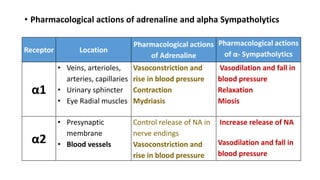
• Pharmacological actions of adrenaline and alpha Sympatholytics
Receptor Location
Pharmacological actions
of Adrenaline
Pharmacological actions
of α- Sympatholytics
α1
• Veins, arterioles,
arteries, capillaries
• Urinary sphincter
• Eye Radial muscles
Vasoconstriction and
rise in blood pressure
Contraction
Mydriasis
Vasodilation and fall in
blood pressure
Relaxation
Miosis
α2
• Presynaptic
membrane
• Blood vessels
Control release of NA in
nerve endings
Vasoconstriction and
rise in blood pressure
Increase release of NA
Vasodilation and fall in
blood pressure
Alpha sympatholytics
• Non-selective blockers
• Ex. Phenoxybenzamine, Phentolamine, tolazoline, ergotoxin,
ergotamine
• α1- selective blockers
• Ex. Prazosin, Terazocin, Doxazosin, Bunazosin, Alfuzosin,
Indoramine
• α2- selective blockers
• Ex. Yohimbine
Pharmacological actions of alpha sympatholytics
• The important effects of α receptor stimulation are α1
mediated vasoconstriction and α2- (presynaptic) receptor
mediated inhibition of NA release.
• α1-blockade—inhibits vasoconstriction --leading to
vasodilation and thereby ↓ BP. This fall in BP is opposed by
the baroreceptor reflexes which tend to ↑ heart rate and
cardiac output.
• α2-blockade—enhances release of NA which stimulates β
receptors (α are already blocked) - β1 stimulation in heart
results in tachycardia and increased cardiac output.
Selective α1-blockade—results in hypotension without significant tachycardia.
Selective α2-blockade—↑NA release resulting in hypertension.
α-blockade also results in miosis and nasal stuffiness.
α-blockade in the bladder and prostate leads to decreased resistance to the flow
of urine.
Therapeutic uses of alpha sympatholytics
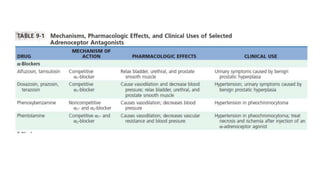
• Hypertension: Selective alpha -blockers like prazosin are used in
the treatment of hypertension. Phenoxybenzamine or
phentolamine can be used in hypertensive crisis.
• Pheochromocytoma: Pheochromocytoma is an adrenal medullary
tumour which secretes large amounts of catecholamines resulting
in hypertension. The tumour has to be removed surgically.
• Phenoxybenzamine and phentolamine are used for the
preoperative management of the patient and during the
operation. Inoperable cases are put on long-term treatment with
phenoxybenzamine.
Therapeutic uses of alpha sympatholytics
• Raynaud's disease: A patient with Raynaud's disease experiences
pain in the extremities, for example, the fingers, when temperatures
drop. In Raynaud's disease, smaller arteries that supply blood to your
skin undergo vasoconstriction, restrictive blood circulation to
affected areas.
• Migraines are severe, recurring, and painful headaches. Symptoms
may include nausea, vomiting, difficulty speaking, numbness or
tingling, and sensitivity to light and sound.
Raynauds disease
Therapeutic uses of alpha sympatholytics
• Frostbite may occur when skin is exposed to extreme cold, at
times combined with high winds, resulting in vasoconstriction. The
associated decrease in blood flow does not deliver sufficient heat
to the tissue to prevent the formation of ice crystals.
• Benign prostatic hypertrophy (BPH) Blockade of α1 receptors in
the bladder, prostate and urethra reduce resistance to urine
outflow. Prazosin, tamsulosin and alfuzosin are useful in patients
who cannot be operated upon.
Frostbite
Benign prostatic hypertrophy
Adverse effects of α-blockers
•Postural hypotension, palpitation, nasal stuffiness,
miosis, impaired ejaculation and impotence.
Postural hypotension— is when your blood pressure drops when you
go from lying down to sitting up, or from sitting to standing
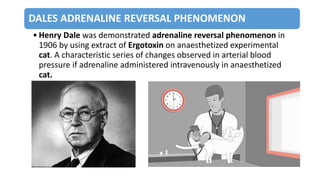
DALES ADRENALINE REVERSAL PHENOMENON
• Henry Dale was demonstrated adrenaline reversal phenomenon in
1906 by using extract of Ergotoxin on anaesthetized experimental
cat. A characteristic series of changes observed in arterial blood
pressure if adrenaline administered intravenously in anaesthetized
cat.
• We should also keep in mind that-
• At higher concentration, adrenaline acts on all receptors (α1, α2,
β1,β2, β3).
• But at lower concentration, adrenaline acts selectively on β2 –
receptors (because β2 are more sensitive)
Receptors Location
Pharmacological action of
Adrenaline
α1
Blood vessels (Veins, Arteries,
Arterioles, Capillaries)
Vasoconstrictions
(increases blood pressure)
β2 Blood vessels (Arteries)
Vasodilatation
(fall in blood pressure)
Phase 1:
• If adequate dose of adrenaline is given intravenously in anaesthetized
cat, then there will be rise in blood pressure due vasoconstriction
(α1, β2 effect). The cardiac output, heart rate, conduction velocity
and excitability of heart also increased. This is because initially the
concentration of adrenaline is high. So adrenaline will act on both α1,
β2 receptors.
• Within few second level of adrenaline will decrease due to its rapid
metabolism and neuronal re-uptake. At lower concentration only
action of β2 will predominant. So only fall in Blood pressure seen. So
at this level you can observe initially rise in blood pressure and then
after fall in blood pressure. This is called Biphasic response. (refer
figure)
Phase 2:
• After biphasic response, if we administer non-selective alpha
blocker-Ergotoxine intravenously in anaesthetized cat, then it
blocks the α1 receptors on blood vessels (veins, arteries,
arterioles, capillaries).
• Hence Ergotoxine shows vasodilation and fall in blood pressure
i.e. hypotensive action. (refer figure)
Phase 3:
• After alpha blocking action, if adequate dose of adrenaline is given
intravenously in same anaesthetized cat, then there will be fall in blood
pressure due vasodilation (β2 effect).
• This is because Ergotoxine already blocks the α1 receptors on blood
vessels. So adrenaline will act only on β2 receptors located on blood
vessels (arteries) to show vasodilation and fall in blood pressure i.e.
hypotensive action. (refer figure)
So as We have seen in adrenaline reversal phenomenon-
• 1. First give adrenaline and observe biphasic response
2. Second We give non-selective alpha blocker
3. At last We give adrenaline again and observe only
fall in BP due to unopposed β2 action.
Beta Sympatholytics
Beta Sympatholytics
• β-receptor blockers are the drugs which competitively
antagonise the actions of adrenaline on beta receptors
innervated organs.
Classification
• Non-selective blockers
• Ex. Propranolol, Nadolol, Pindolol, Timolol, Sotalol, Labetalol,
• β 1- selective blockers
• Ex. Metoprolol, Acebutolol, Atenolol, Esmolol, Bisoprolol
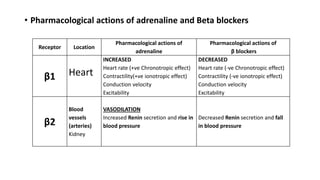
• Pharmacological actions of adrenaline and Beta blockers
Receptor Location
Pharmacological actions of
adrenaline
Pharmacological actions of
β blockers
β1 Heart
INCREASED
Heart rate (+ve Chronotropic effect)
Contractility(+ve ionotropic effect)
Conduction velocity
Excitability
DECREASED
Heart rate (-ve Chronotropic effect)
Contractility (-ve ionotropic effect)
Conduction velocity
Excitability
β2
Blood
vessels
(arteries)
Kidney
VASODILATION
Increased Renin secretion and rise in
blood pressure
Decreased Renin secretion and fall
in blood pressure
Mechanism of actions of
Beta-sympatholytics
• β blockers competitively block the actions of adrenaline on beta
receptors innervated organs especialy heart.
• β1 Blocking action reduces heart rate (-ve chronotropic effect),
myocardial contractility (-ve ionotropic effect), conduction velocity and
excitability of the heart.
• Beta blockers decrease myocardial oxygen consumption by decreasing
heart rate, blood pressure and contractility.
• β blockers also inhibit the Renin secretion from the kidney nephrons.
Thereby they produce vasodilation and fall in blood pressure.
• β blockers decrease outflow of the sympathetic impulses from
sympathetic nerves.
• β blockers produce resetting of baroreceptors on the aortic body on the
aorta.
• Therefore β blockers shows antihypertensive activity.
Therapeutic Uses
• Hypertension
• Angina Pectoris
• Cardiac arrythmia
• Myocardial infarction
• Pheochromocytoma
• Migraine
• Hyperthyroidism
• Glaucoma
• Anxiety
• Stage phobia/ audition phobia
• Public speacking phobia
CONTRAINDICATIONS
•Bronchial asthma, Bradycardia, COPD, Hypotension
•Thanking You

Sympatholytics.pptx

  • 1.
    SYMPATHOLYTICS Prof. Amol B.Deore • Department of Pharmacology • MVP’s Institute of Pharmaceutical Sciences, Nashik
  • 2.
    SYMPATHOLYTICS •Sympatholytic drugs (Adrenergicblockers) bind to the adrenergic receptors and prevent the action of adrenergic drugs. •These are drugs which block the actions of sympathetic division or catecholamines (adrenaline and noradrenaline). •They are competitive antagonists at both α and β adrenergic receptors.
  • 3.
    Adrenergic Receptors •Adrenaline andnoradrenaline are the neurotransmitters release at the sympathetic post ganglionic nerve endings. •The adrenergic receptors are categorized into alpha and beta adrenergic receptors. Adrenaline acts on both alpha and beta receptors.
  • 4.
    Alpha Sympatholytics • Alphaadrenergic blocking agents • Alpha receptor antagonists block the adrenergic responses mediated through alpha adrenergic receptors. • Some of them have selectivity for α1 or α2 receptors.
  • 5.
    • Pharmacological actionsof adrenaline and alpha Sympatholytics Receptor Location Pharmacological actions of Adrenaline Pharmacological actions of α- Sympatholytics α1 • Veins, arterioles, arteries, capillaries • Urinary sphincter • Eye Radial muscles Vasoconstriction and rise in blood pressure Contraction Mydriasis Vasodilation and fall in blood pressure Relaxation Miosis α2 • Presynaptic membrane • Blood vessels Control release of NA in nerve endings Vasoconstriction and rise in blood pressure Increase release of NA Vasodilation and fall in blood pressure
  • 6.
    Alpha sympatholytics • Non-selectiveblockers • Ex. Phenoxybenzamine, Phentolamine, tolazoline, ergotoxin, ergotamine • α1- selective blockers • Ex. Prazosin, Terazocin, Doxazosin, Bunazosin, Alfuzosin, Indoramine • α2- selective blockers • Ex. Yohimbine
  • 7.
    Pharmacological actions ofalpha sympatholytics • The important effects of α receptor stimulation are α1 mediated vasoconstriction and α2- (presynaptic) receptor mediated inhibition of NA release. • α1-blockade—inhibits vasoconstriction --leading to vasodilation and thereby ↓ BP. This fall in BP is opposed by the baroreceptor reflexes which tend to ↑ heart rate and cardiac output. • α2-blockade—enhances release of NA which stimulates β receptors (α are already blocked) - β1 stimulation in heart results in tachycardia and increased cardiac output.
  • 8.
    Selective α1-blockade—results inhypotension without significant tachycardia. Selective α2-blockade—↑NA release resulting in hypertension. α-blockade also results in miosis and nasal stuffiness. α-blockade in the bladder and prostate leads to decreased resistance to the flow of urine.
  • 9.
    Therapeutic uses ofalpha sympatholytics • Hypertension: Selective alpha -blockers like prazosin are used in the treatment of hypertension. Phenoxybenzamine or phentolamine can be used in hypertensive crisis. • Pheochromocytoma: Pheochromocytoma is an adrenal medullary tumour which secretes large amounts of catecholamines resulting in hypertension. The tumour has to be removed surgically. • Phenoxybenzamine and phentolamine are used for the preoperative management of the patient and during the operation. Inoperable cases are put on long-term treatment with phenoxybenzamine.
  • 10.
    Therapeutic uses ofalpha sympatholytics • Raynaud's disease: A patient with Raynaud's disease experiences pain in the extremities, for example, the fingers, when temperatures drop. In Raynaud's disease, smaller arteries that supply blood to your skin undergo vasoconstriction, restrictive blood circulation to affected areas. • Migraines are severe, recurring, and painful headaches. Symptoms may include nausea, vomiting, difficulty speaking, numbness or tingling, and sensitivity to light and sound.
  • 11.
  • 12.
    Therapeutic uses ofalpha sympatholytics • Frostbite may occur when skin is exposed to extreme cold, at times combined with high winds, resulting in vasoconstriction. The associated decrease in blood flow does not deliver sufficient heat to the tissue to prevent the formation of ice crystals. • Benign prostatic hypertrophy (BPH) Blockade of α1 receptors in the bladder, prostate and urethra reduce resistance to urine outflow. Prazosin, tamsulosin and alfuzosin are useful in patients who cannot be operated upon.
  • 13.
  • 14.
  • 16.
    Adverse effects ofα-blockers •Postural hypotension, palpitation, nasal stuffiness, miosis, impaired ejaculation and impotence. Postural hypotension— is when your blood pressure drops when you go from lying down to sitting up, or from sitting to standing
  • 17.
    DALES ADRENALINE REVERSALPHENOMENON • Henry Dale was demonstrated adrenaline reversal phenomenon in 1906 by using extract of Ergotoxin on anaesthetized experimental cat. A characteristic series of changes observed in arterial blood pressure if adrenaline administered intravenously in anaesthetized cat.
  • 18.
    • We shouldalso keep in mind that- • At higher concentration, adrenaline acts on all receptors (α1, α2, β1,β2, β3). • But at lower concentration, adrenaline acts selectively on β2 – receptors (because β2 are more sensitive) Receptors Location Pharmacological action of Adrenaline α1 Blood vessels (Veins, Arteries, Arterioles, Capillaries) Vasoconstrictions (increases blood pressure) β2 Blood vessels (Arteries) Vasodilatation (fall in blood pressure)
  • 19.
    Phase 1: • Ifadequate dose of adrenaline is given intravenously in anaesthetized cat, then there will be rise in blood pressure due vasoconstriction (α1, β2 effect). The cardiac output, heart rate, conduction velocity and excitability of heart also increased. This is because initially the concentration of adrenaline is high. So adrenaline will act on both α1, β2 receptors. • Within few second level of adrenaline will decrease due to its rapid metabolism and neuronal re-uptake. At lower concentration only action of β2 will predominant. So only fall in Blood pressure seen. So at this level you can observe initially rise in blood pressure and then after fall in blood pressure. This is called Biphasic response. (refer figure)
  • 20.
    Phase 2: • Afterbiphasic response, if we administer non-selective alpha blocker-Ergotoxine intravenously in anaesthetized cat, then it blocks the α1 receptors on blood vessels (veins, arteries, arterioles, capillaries). • Hence Ergotoxine shows vasodilation and fall in blood pressure i.e. hypotensive action. (refer figure)
  • 22.
    Phase 3: • Afteralpha blocking action, if adequate dose of adrenaline is given intravenously in same anaesthetized cat, then there will be fall in blood pressure due vasodilation (β2 effect). • This is because Ergotoxine already blocks the α1 receptors on blood vessels. So adrenaline will act only on β2 receptors located on blood vessels (arteries) to show vasodilation and fall in blood pressure i.e. hypotensive action. (refer figure)
  • 23.
    So as Wehave seen in adrenaline reversal phenomenon- • 1. First give adrenaline and observe biphasic response 2. Second We give non-selective alpha blocker 3. At last We give adrenaline again and observe only fall in BP due to unopposed β2 action.
  • 24.
  • 25.
    Beta Sympatholytics • β-receptorblockers are the drugs which competitively antagonise the actions of adrenaline on beta receptors innervated organs. Classification • Non-selective blockers • Ex. Propranolol, Nadolol, Pindolol, Timolol, Sotalol, Labetalol, • β 1- selective blockers • Ex. Metoprolol, Acebutolol, Atenolol, Esmolol, Bisoprolol
  • 26.
    • Pharmacological actionsof adrenaline and Beta blockers Receptor Location Pharmacological actions of adrenaline Pharmacological actions of β blockers β1 Heart INCREASED Heart rate (+ve Chronotropic effect) Contractility(+ve ionotropic effect) Conduction velocity Excitability DECREASED Heart rate (-ve Chronotropic effect) Contractility (-ve ionotropic effect) Conduction velocity Excitability β2 Blood vessels (arteries) Kidney VASODILATION Increased Renin secretion and rise in blood pressure Decreased Renin secretion and fall in blood pressure
  • 27.
    Mechanism of actionsof Beta-sympatholytics
  • 28.
    • β blockerscompetitively block the actions of adrenaline on beta receptors innervated organs especialy heart. • β1 Blocking action reduces heart rate (-ve chronotropic effect), myocardial contractility (-ve ionotropic effect), conduction velocity and excitability of the heart. • Beta blockers decrease myocardial oxygen consumption by decreasing heart rate, blood pressure and contractility.
  • 29.
    • β blockersalso inhibit the Renin secretion from the kidney nephrons. Thereby they produce vasodilation and fall in blood pressure. • β blockers decrease outflow of the sympathetic impulses from sympathetic nerves. • β blockers produce resetting of baroreceptors on the aortic body on the aorta. • Therefore β blockers shows antihypertensive activity.
  • 30.
    Therapeutic Uses • Hypertension •Angina Pectoris • Cardiac arrythmia • Myocardial infarction • Pheochromocytoma • Migraine • Hyperthyroidism • Glaucoma • Anxiety • Stage phobia/ audition phobia • Public speacking phobia
  • 31.
  • 32.