CALCIUM CHANNEL BLOCKERS
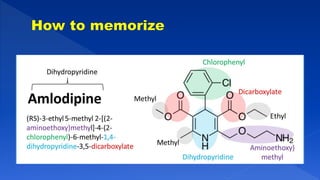
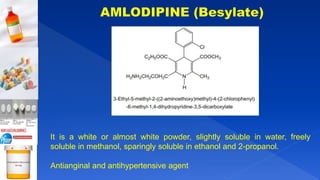
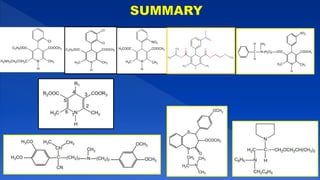
 Amlodipine
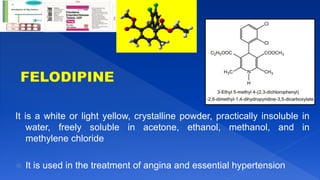
 Felodipine
 Nifedipine
 Nimodipine
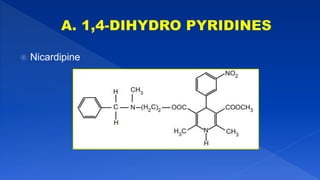
 Nicardipine
 Verapamil
 Diltiazem hydrochloride
 Bepridil hydrochloride
 Introduction
 Mechanism of action
 Individual drugs
 SAR
 Metabolism
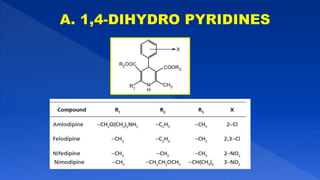
a. 1,4-Dihydro Pyridines
 Amlodipine
 Felodipine
 Nifedipine
 Nimodipine
 Nicardipine
b. Diphenyl alkylamines Verapamil
c. Benzothiazepine derivatives Diltiazem hydrochloride
d. Diamino propanol ethers
Second-Generation Alkyl Amine Type Bepridil hydrochloride
Four types of Ca2+ channels (L, N, P, and T)
 L-type are responsible for normal myocardial contractility and for vascular smooth muscle contractility.
 N-type are restricted to neurons where they function in neurotransmitter release.
P/Q-type signifies cerebellar Purkinje cells, it is also one of high-voltage-gated calcium channels
T-type calcium channels are not normally present in the adult myocardium, but are prominent in
conducting – low voltage (R type)
 Calcium channel blockers act on the Calcium channel
receptors, block the release of calcium. L-type calcium channel
(LTCC) inhibitors
 Calcium interaction with a protein calmodulin to form calcium
calmodulin complex is decreased
 This leads to the decreased activation of myosin light chain
phosphorylation, which promotes muscle contraction by interacting
between actin and myosin
https://youtu.be/pjbEHeNPeYQ
MODE OF ACTION
 Nicardipine
It is a white or almost white powder, slightly soluble in water, freely
soluble in methanol, sparingly soluble in ethanol and 2-propanol.
Antianginal and antihypertensive agent
It is a white or light yellow, crystalline powder, practically insoluble in
water, freely soluble in acetone, ethanol, methanol, and in
methylene chloride
 It is used in the treatment of angina and essential hypertension
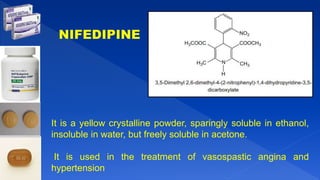
It is a yellow crystalline powder, sparingly soluble in ethanol,
insoluble in water, but freely soluble in acetone.
It is used in the treatment of vasospastic angina and
hypertension
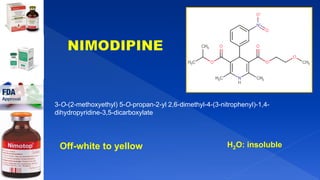
3-O-(2-methoxyethyl) 5-O-propan-2-yl 2,6-dimethyl-4-(3-nitrophenyl)-1,4-
dihydropyridine-3,5-dicarboxylate
Off-white to yellow H2O: insoluble
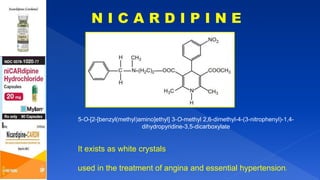
It exists as white crystals
used in the treatment of angina and essential hypertension.
5-O-[2-[benzyl(methyl)amino]ethyl] 3-O-methyl 2,6-dimethyl-4-(3-nitrophenyl)-1,4-
dihydropyridine-3,5-dicarboxylate
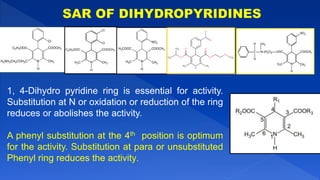
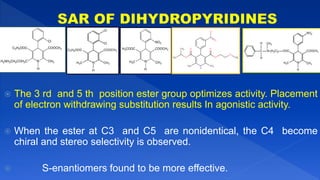
1, 4-Dihydro pyridine ring is essential for activity.
Substitution at N or oxidation or reduction of the ring
reduces or abolishes the activity.
A phenyl substitution at the 4th position is optimum
for the activity. Substitution at para or unsubstituted
Phenyl ring reduces the activity.
 The 3 rd and 5 th position ester group optimizes activity. Placement
of electron withdrawing substitution results In agonistic activity.
 When the ester at C3 and C5 are nonidentical, the C4 become
chiral and stereo selectivity is observed.
 S-enantiomers found to be more effective.
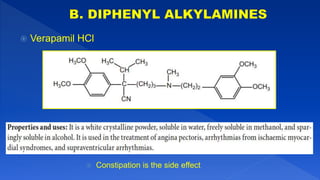
 Verapamil HCl
 Constipation is the side effect
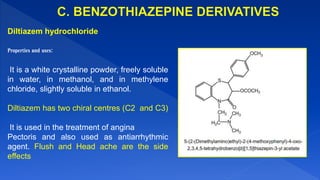
Diltiazem hydrochloride
Properties and uses:
It is a white crystalline powder, freely soluble
in water, in methanol, and in methylene
chloride, slightly soluble in ethanol.
Diltiazem has two chiral centres (C2 and C3)
It is used in the treatment of angina
Pectoris and also used as antiarrhythmic
agent. Flush and Head ache are the side
effects
Exists as white crystals
Vasodilator and antianginal agent.
Bepridil
hydrochloride
 Prehepatic first-pass metabolism by CYP3A4 enzyme – oral
 Verapamil, low Bioavailability of 20% - 35%
 Dilitiazem 40%-67%, nicardipine 35%, nifedipine 45%-70%,
amlodipine 64%-90%
 Verapamil is metabolized by CYP3A4 - N-demethylation - nor
verapamil - 20% of the activity of verapamil
O-demethylation (CYP2D6) into inactive metabolites
 Diltiazem - diacetyl derivative 25%-50% active
 Diltiazem undergoes N-demethylation by CYP3A4
O-demethylation by CYP2D6
 Major metabolites are detected after oral and continuous intravenous
administration
 No metabolites are detected in rapid intravenous administration
 N-demethylation - nor verapamil
 Diltiazem - diacetyl derivative