Pharmacology & Therapeutics IA
Course no.412-T
Course title: Pharmacology and Therapeutics-IA
Course Code: 412-T (AFN)
Course Instructor: Ms. SIDRA ZUBAIR
Autonomic
Nervous System
Drugs acting on
Sympathetic Nervous
System
Sympatholytics
Learning Objectives
After completing this topic students should be able to:
 Explicate the adrenergic antagonists
 Describe the α-adrenergic blocking agents (therapeutics uses &
adverse effects)
 Explain the adverse effects commonly observed with non-selective α-
adrenergic blocking agents
 Describe the β-adrenergic blocking agents (therapeutics uses &
adverse effects)
 Explicate the adverse effects commonly observed in individuals
treated with propranolol
Overview of the lecture content
 ADRENERGIC ANTAGONISTS
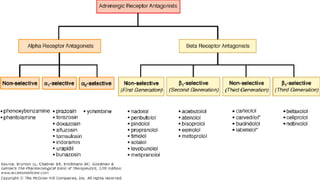
 CLASSIFICATIONS OF ADRENERGIC
ANTAGONISTS
 α - ADRENERGIC BLOCKING AGENTS
 β - ADRENERGIC BLOCKING AGENTS
Alpha Blockers
α ADRENERGIC BLOCKING DRUGS
•These drugs inhibit adrenergic responses mediated through the α adrenergic
receptors without effecting those mediated through β receptors.
Non-Selective α Adrenergic Antagonists:
Phenoxybenzamine & Phentolamine
 Referred to as "classical" α blockers
 Phenoxybenzamine:-Non-selective (α1 & α2), irreversible, non-
competitive.
 Phentolamine:- Non-selective (α1 & α2), reversible, competitive
 Postural hypotension is a prominent feature.
 Can precipitate cardiac arrhythmias.
Therapeutic Uses
Pheochromocytoma
• Phenoxybenzamine is often used in preparing the patient for
surgery
• Controls episodes of severe HTN and minimizes other ADRs of
catecholamines
Dose: 40-120 mg given in two or three divided portions.
Useful for the treatment of hypertensive crises that follow withdrawal
of clonidine or ingestion of tyramine-containing foods during the use
of non- selective MAO inhibitors.
Toxicity and Adverse Effects
Hypotension -major adverse effect
Alarming tachycardia, cardiac arrhythmias, and ischemic
cardiac events, including myocardial infarction
Phentolamine should be used with caution in patients with a
history of peptic ulcer
Prazosin
Well absorbed orally ; bioavailability is 50-70%.
Initial dose 1 mg, usually given at bedtime, Peak concentrations within 1-3 hours after oral
dose.
A maximal effect generally is observed with a total daily dose of 20 mg in patients with
hypertension
Uses- HTN, BPH.
S/E- orthostatic hypotension, syncope, nasal congestion "first dose response"
Selective α Adrenergic Antagonists
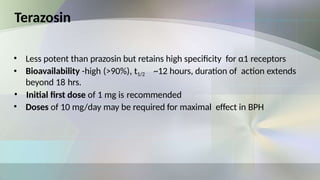
Terazosin
• Less potent than prazosin but retains high specificity for α1 receptors
• Bioavailability -high (>90%), t1/2 ~12 hours, duration of action extends
beyond 18 hrs.
• Initial first dose of 1 mg is recommended
• Doses of 10 mg/day may be required for maximal effect in BPH
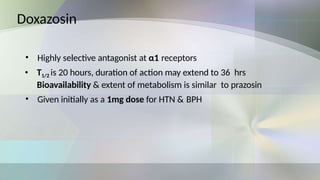
Doxazosin
• Highly selective antagonist at α1 receptors
• T1/2 is 20 hours, duration of action may extend to 36 hrs
Bioavailability & extent of metabolism is similar to prazosin
• Given initially as a 1mg dose for HTN & BPH
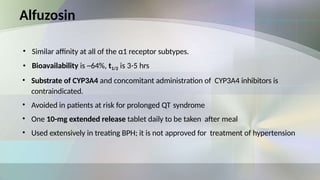
Alfuzosin
• Similar affinity at all of the α1 receptor subtypes.
• Bioavailability is ~64%, t1/2 is 3-5 hrs
• Substrate of CYP3A4 and concomitant administration of CYP3A4 inhibitors is
contraindicated.
• Avoided in patients at risk for prolonged QT syndrome
• One 10-mg extended release tablet daily to be taken after meal
• Used extensively in treating BPH; it is not approved for treatment of hypertension
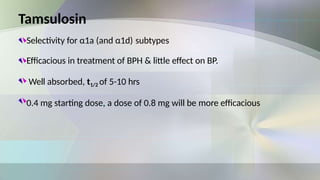
Tamsulosin
Selectivity for α1a (and α1d) subtypes
Efficacious in treatment of BPH & little effect on BP.
Well absorbed, t1/2 of 5-10 hrs
0.4 mg starting dose, a dose of 0.8 mg will be more efficacious
Silodosin
Selectivity for the α1a, over the α1b adrenergic receptor.
Approved for the treatment of BPH and is reported, as is tamsulosin, to
have lesser effects on BP.
Adverse effects
Marked postural hypotension & syncope seen 30-90 mins after an initial dose
of prazosin & 2-6 hours after an initial dose of doxazosin
Nonspecific ADRs- headache, dizziness & asthenia.
α 2 Receptor Antagonists
Yohimbine
Competitive antagonist
Useful for diabetic neuropathy and in the treatment of postural
hypotension
Approved in veterinary medicine for the reversal of xylazine
anesthesia
Ketanserin- blocks α 1 receptors .
Urapidil- a novel, selective α1 receptor antagonist.
role in the treatment of hypertension remains to be determined.
Bunazosin-1-selective antagonist ,useful in hypertension.
Beta blockers
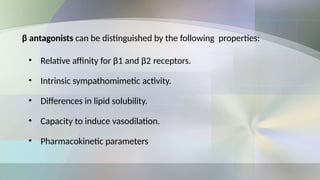
β antagonists can be distinguished by the following properties:
• Relative affinity for β1 and β2 receptors.
• Intrinsic sympathomimetic activity.
• Differences in lipid solubility.
• Capacity to induce vasodilation.
• Pharmacokinetic parameters
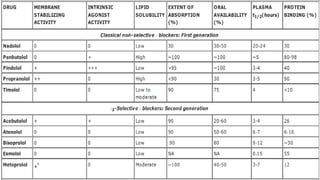
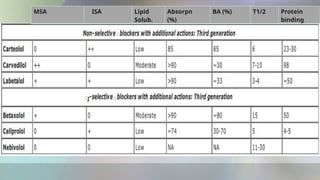
MSA ISA Lipid
Solub.
Absorpn
(%)
BA (%) T1/2 Protein
binding
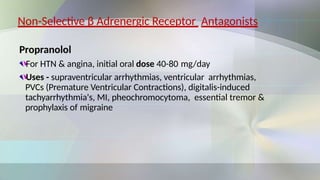
Non-Selective β Adrenergic Receptor Antagonists
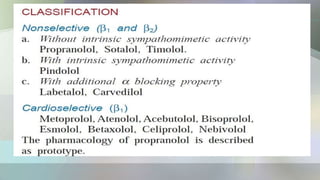
Propranolol
For HTN & angina, initial oral dose 40-80 mg/day
Uses - supraventricular arrhythmias, ventricular arrhythmias,
PVCs (Premature Ventricular Contractions), digitalis-induced
tachyarrhythmia's, MI, pheochromocytoma, essential tremor &
prophylaxis of migraine
Nadolol
Long-acting antagonist with equal affinity for 1 and 2 receptors
Distinguishing characteristic of nadolol is its relatively long t1/2.
Timolol
A potent, non-selective β receptor antagonist.
Interestingly, the ocular formulation of timolol used for the treatment of
glaucoma, may be extensively absorbed systemically
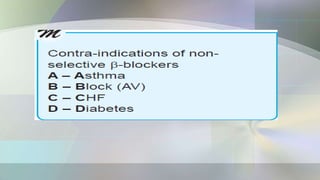
Adverse effects can occur in susceptible patients, such as those with asthma
or congestive heart failure.
Pindolol
• with intrinsic sympathomimetic activity.
• Used to treat angina and hypertension.
• Preferred as antihypertensive in indivisual with diminished cardiac
reserve or propensity to bradycardia.
β1 selective adrenergic receptor antagonists
Metoprolol
• Devoid of ISA and MSA Significant first-pass metabolism
• Uses: essential HTN, Angina, tachycardia, CHF, Adjunct to treat
hyperthyroidism.
Atenolol
• Very hydrophilic
• Initial dose is 50 mg/day OD may be ↑100 mg
• Less CNS s/e than other β blockers and less bronchoconstriction
Esmolol
• Rapid onset ,short duration Also class 2 antirrhythmic
Slow iv injection
• Used during surgeries to prevent or treat tachycardia And SVT
• Useful in severe post op HTN
• AHA/ACC recommends against using esmolol in patients already on β blockers,
bradycardiac pts and decompensated heart failure pts.
Betaxolol
Mainly used in glaucoma to ↓IOP by↓ production of aqueous humor
Acebutalol
Have lipophilic properties
Used for HTN, arrhythmias, MI, Smith Magenis syndrome
Bisoprolol
Higher β1 selectivity than others except Nebivolol
Used in HTN ,CHF
Well tolerated
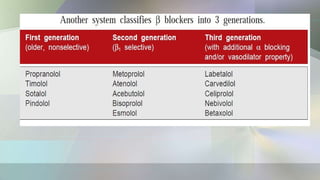
Labetalol
Selective Alpha1 and Nonselective Beta Blocker
↓ BP by ↓ SVR (alpha1)
Vasodilation via α1 blockade & partial beta2 agonist activity
↓ HR by attenuating reflex tachy via β Blockade
Unchanged C.O.
S/e – postural hypotension
Bucindolol
↑ LV systolic EF, ↓PR hence ↓afterload
↑plasma HDL
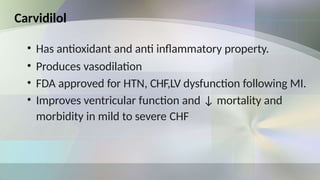
Carvidilol
• Has antioxidant and anti inflammatory property.
• Produces vasodilation
• FDA approved for HTN, CHF,LV dysfunction following MI.
• Improves ventricular function and ↓ mortality and
morbidity in mild to severe CHF
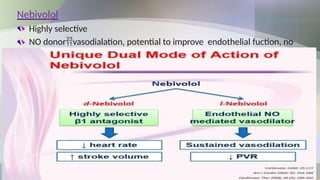
Nebivolol
Highly selective
NO donorvasodialation, potential to improve endothelial fuction, no
deleterious effect on lipid profile & carbohydrate metabolism
Use: HTN, CHF
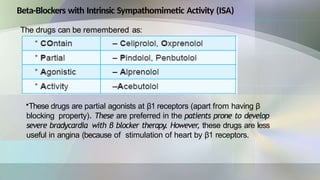
Beta-Blockers with Intrinsic Sympathomimetic Activity (ISA)
The drugs can be remembered as:
•These drugs are partial agonists at β1 receptors (apart from having β
blocking property). These are preferred in the patients prone to develop
severe bradycardia with β blocker therapy. However, these drugs are less
useful in angina (because of stimulation of heart by β1 receptors.
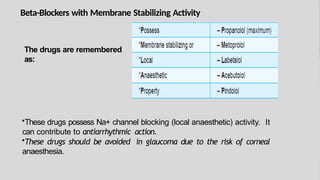
Beta-Blockers with Membrane Stabilizing Activity
The drugs are remembered
as:
•These drugs possess Na+ channel blocking (local anaesthetic) activity. It
can contribute to antiarrhythmic action.
•These drugs should be avoided in glaucoma due to the risk of corneal
anaesthesia.
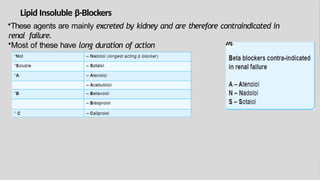
Lipid Insoluble β-Blockers
•These agents are mainly excreted by kidney and are therefore contraindicated in
renal failure.
•Most of these have long duration of action
Therapeutic Uses
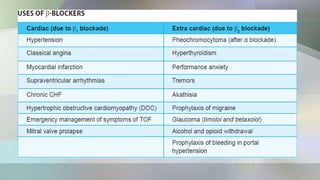
Cardiovascular Diseases
Hypertension, Angina, Acute Coronary Syndromes & Congestive Heart
Failure
Hypertension
One of the 1st choice drugs because of good pt acceptability &
cardioprotective potential
Myocardial Infarction
Many trials- β receptor antagonists administered during the early
phases of acute MI & continued long- term may ↓ mortality by ~25%
Angina pectoris
Act by ↓ cardiac work & O2 consumption
C/I in variant angina
Congestive Heart Failure
A number RCTs (randomised control trials) shows certain β receptor
antagonists are highly effective for pts with all grades of heart failure
secondary to left ventricular systolic dysfunction
Glaucoma
• Useful for open-angle glaucoma
e.g.Carteolol, betaxolol, levobunolol, metipranolol, timolol and levobetaxolol
• Have an onset in ~30 mins with a duration of 12-24 hrs
• systemic absorption can lead to adverse cardiovascular and pulmonary effects in
susceptible patients
• Caution- pts at risk for adverse systemic effects of β receptor antagonists
• Betaxolol- most effective antiglaucoma drug at reducing Na+/Ca2+ influx.
Other Uses
• Propranolol, timolol, and metoprolol are
effective for the prophylaxis of migraine
• Propranolol- effective in controlling acute panic
symptoms in individuals who are required to
perform in public or in other anxiety-provoking
situations.
• Propranolol also may be useful in the treatment
of essential tremor.
Adverse Effects and Precautions
On Cardiovascular System
β receptor antagonists may induce congestive heart failure in
susceptible patients.
Life-threatening bradyarrhythmias.
Symptoms of peripheral vascular disease may worsen.
Abrupt discontinuation of receptor antagonists after long-term
treatment can exacerbate angina and may increase the risk of sudden
death.
Pulmonary function
May cause a life-threatening increase in airway resistance.
CNS
Fatigue, sleep disturbances (including insomnia and nightmares), & depression.
Metabolism
Should be used with great caution in patients with diabetes who are prone to
hypoglycemic reactions
Overdosage
Hypotension, bradycardia, prolonged AV conduction times, and
widened QRS complexes are common manifestations of overdosage.
 Basic & clinical pharmacology, Katzung 15th edition
 “ The pharmacological basis of therapeutics”
Goodman and Gilman( 12th edition )
 “Principles of pharmacology” S. K. Sharma, (2nd edition)
References

ADRENERGIC_BLOCKERS(sympatholytics)..._Lecture_3.pptx

  • 1.
    Pharmacology & TherapeuticsIA Course no.412-T Course title: Pharmacology and Therapeutics-IA Course Code: 412-T (AFN) Course Instructor: Ms. SIDRA ZUBAIR
  • 2.
  • 3.
  • 4.
  • 5.
    Learning Objectives After completingthis topic students should be able to:  Explicate the adrenergic antagonists  Describe the α-adrenergic blocking agents (therapeutics uses & adverse effects)  Explain the adverse effects commonly observed with non-selective α- adrenergic blocking agents  Describe the β-adrenergic blocking agents (therapeutics uses & adverse effects)  Explicate the adverse effects commonly observed in individuals treated with propranolol
  • 6.
    Overview of thelecture content  ADRENERGIC ANTAGONISTS  CLASSIFICATIONS OF ADRENERGIC ANTAGONISTS  α - ADRENERGIC BLOCKING AGENTS  β - ADRENERGIC BLOCKING AGENTS
  • 8.
  • 9.
    α ADRENERGIC BLOCKINGDRUGS •These drugs inhibit adrenergic responses mediated through the α adrenergic receptors without effecting those mediated through β receptors.
  • 10.
    Non-Selective α AdrenergicAntagonists: Phenoxybenzamine & Phentolamine  Referred to as "classical" α blockers  Phenoxybenzamine:-Non-selective (α1 & α2), irreversible, non- competitive.  Phentolamine:- Non-selective (α1 & α2), reversible, competitive  Postural hypotension is a prominent feature.  Can precipitate cardiac arrhythmias.
  • 11.
    Therapeutic Uses Pheochromocytoma • Phenoxybenzamineis often used in preparing the patient for surgery • Controls episodes of severe HTN and minimizes other ADRs of catecholamines Dose: 40-120 mg given in two or three divided portions. Useful for the treatment of hypertensive crises that follow withdrawal of clonidine or ingestion of tyramine-containing foods during the use of non- selective MAO inhibitors.
  • 12.
    Toxicity and AdverseEffects Hypotension -major adverse effect Alarming tachycardia, cardiac arrhythmias, and ischemic cardiac events, including myocardial infarction Phentolamine should be used with caution in patients with a history of peptic ulcer
  • 13.
    Prazosin Well absorbed orally; bioavailability is 50-70%. Initial dose 1 mg, usually given at bedtime, Peak concentrations within 1-3 hours after oral dose. A maximal effect generally is observed with a total daily dose of 20 mg in patients with hypertension Uses- HTN, BPH. S/E- orthostatic hypotension, syncope, nasal congestion "first dose response" Selective α Adrenergic Antagonists
  • 14.
    Terazosin • Less potentthan prazosin but retains high specificity for α1 receptors • Bioavailability -high (>90%), t1/2 ~12 hours, duration of action extends beyond 18 hrs. • Initial first dose of 1 mg is recommended • Doses of 10 mg/day may be required for maximal effect in BPH
  • 15.
    Doxazosin • Highly selectiveantagonist at α1 receptors • T1/2 is 20 hours, duration of action may extend to 36 hrs Bioavailability & extent of metabolism is similar to prazosin • Given initially as a 1mg dose for HTN & BPH
  • 16.
    Alfuzosin • Similar affinityat all of the α1 receptor subtypes. • Bioavailability is ~64%, t1/2 is 3-5 hrs • Substrate of CYP3A4 and concomitant administration of CYP3A4 inhibitors is contraindicated. • Avoided in patients at risk for prolonged QT syndrome • One 10-mg extended release tablet daily to be taken after meal • Used extensively in treating BPH; it is not approved for treatment of hypertension
  • 17.
    Tamsulosin Selectivity for α1a(and α1d) subtypes Efficacious in treatment of BPH & little effect on BP. Well absorbed, t1/2 of 5-10 hrs 0.4 mg starting dose, a dose of 0.8 mg will be more efficacious
  • 18.
    Silodosin Selectivity for theα1a, over the α1b adrenergic receptor. Approved for the treatment of BPH and is reported, as is tamsulosin, to have lesser effects on BP.
  • 19.
    Adverse effects Marked posturalhypotension & syncope seen 30-90 mins after an initial dose of prazosin & 2-6 hours after an initial dose of doxazosin Nonspecific ADRs- headache, dizziness & asthenia.
  • 20.
    α 2 ReceptorAntagonists Yohimbine Competitive antagonist Useful for diabetic neuropathy and in the treatment of postural hypotension Approved in veterinary medicine for the reversal of xylazine anesthesia
  • 21.
    Ketanserin- blocks α1 receptors . Urapidil- a novel, selective α1 receptor antagonist. role in the treatment of hypertension remains to be determined. Bunazosin-1-selective antagonist ,useful in hypertension.
  • 22.
  • 23.
    β antagonists canbe distinguished by the following properties: • Relative affinity for β1 and β2 receptors. • Intrinsic sympathomimetic activity. • Differences in lipid solubility. • Capacity to induce vasodilation. • Pharmacokinetic parameters
  • 27.
    MSA ISA Lipid Solub. Absorpn (%) BA(%) T1/2 Protein binding
  • 28.
    Non-Selective β AdrenergicReceptor Antagonists Propranolol For HTN & angina, initial oral dose 40-80 mg/day Uses - supraventricular arrhythmias, ventricular arrhythmias, PVCs (Premature Ventricular Contractions), digitalis-induced tachyarrhythmia's, MI, pheochromocytoma, essential tremor & prophylaxis of migraine
  • 29.
    Nadolol Long-acting antagonist withequal affinity for 1 and 2 receptors Distinguishing characteristic of nadolol is its relatively long t1/2. Timolol A potent, non-selective β receptor antagonist. Interestingly, the ocular formulation of timolol used for the treatment of glaucoma, may be extensively absorbed systemically Adverse effects can occur in susceptible patients, such as those with asthma or congestive heart failure.
  • 30.
    Pindolol • with intrinsicsympathomimetic activity. • Used to treat angina and hypertension. • Preferred as antihypertensive in indivisual with diminished cardiac reserve or propensity to bradycardia.
  • 31.
    β1 selective adrenergicreceptor antagonists Metoprolol • Devoid of ISA and MSA Significant first-pass metabolism • Uses: essential HTN, Angina, tachycardia, CHF, Adjunct to treat hyperthyroidism. Atenolol • Very hydrophilic • Initial dose is 50 mg/day OD may be ↑100 mg • Less CNS s/e than other β blockers and less bronchoconstriction
  • 32.
    Esmolol • Rapid onset,short duration Also class 2 antirrhythmic Slow iv injection • Used during surgeries to prevent or treat tachycardia And SVT • Useful in severe post op HTN • AHA/ACC recommends against using esmolol in patients already on β blockers, bradycardiac pts and decompensated heart failure pts. Betaxolol Mainly used in glaucoma to ↓IOP by↓ production of aqueous humor
  • 33.
    Acebutalol Have lipophilic properties Usedfor HTN, arrhythmias, MI, Smith Magenis syndrome Bisoprolol Higher β1 selectivity than others except Nebivolol Used in HTN ,CHF Well tolerated
  • 34.
    Labetalol Selective Alpha1 andNonselective Beta Blocker ↓ BP by ↓ SVR (alpha1) Vasodilation via α1 blockade & partial beta2 agonist activity ↓ HR by attenuating reflex tachy via β Blockade Unchanged C.O. S/e – postural hypotension Bucindolol ↑ LV systolic EF, ↓PR hence ↓afterload ↑plasma HDL
  • 35.
    Carvidilol • Has antioxidantand anti inflammatory property. • Produces vasodilation • FDA approved for HTN, CHF,LV dysfunction following MI. • Improves ventricular function and ↓ mortality and morbidity in mild to severe CHF
  • 36.
    Nebivolol Highly selective NO donorvasodialation,potential to improve endothelial fuction, no deleterious effect on lipid profile & carbohydrate metabolism Use: HTN, CHF
  • 38.
    Beta-Blockers with IntrinsicSympathomimetic Activity (ISA) The drugs can be remembered as: •These drugs are partial agonists at β1 receptors (apart from having β blocking property). These are preferred in the patients prone to develop severe bradycardia with β blocker therapy. However, these drugs are less useful in angina (because of stimulation of heart by β1 receptors.
  • 39.
    Beta-Blockers with MembraneStabilizing Activity The drugs are remembered as: •These drugs possess Na+ channel blocking (local anaesthetic) activity. It can contribute to antiarrhythmic action. •These drugs should be avoided in glaucoma due to the risk of corneal anaesthesia.
  • 40.
    Lipid Insoluble β-Blockers •Theseagents are mainly excreted by kidney and are therefore contraindicated in renal failure. •Most of these have long duration of action
  • 41.
    Therapeutic Uses Cardiovascular Diseases Hypertension,Angina, Acute Coronary Syndromes & Congestive Heart Failure Hypertension One of the 1st choice drugs because of good pt acceptability & cardioprotective potential
  • 42.
    Myocardial Infarction Many trials-β receptor antagonists administered during the early phases of acute MI & continued long- term may ↓ mortality by ~25% Angina pectoris Act by ↓ cardiac work & O2 consumption C/I in variant angina
  • 43.
    Congestive Heart Failure Anumber RCTs (randomised control trials) shows certain β receptor antagonists are highly effective for pts with all grades of heart failure secondary to left ventricular systolic dysfunction
  • 44.
    Glaucoma • Useful foropen-angle glaucoma e.g.Carteolol, betaxolol, levobunolol, metipranolol, timolol and levobetaxolol • Have an onset in ~30 mins with a duration of 12-24 hrs • systemic absorption can lead to adverse cardiovascular and pulmonary effects in susceptible patients • Caution- pts at risk for adverse systemic effects of β receptor antagonists • Betaxolol- most effective antiglaucoma drug at reducing Na+/Ca2+ influx.
  • 45.
    Other Uses • Propranolol,timolol, and metoprolol are effective for the prophylaxis of migraine • Propranolol- effective in controlling acute panic symptoms in individuals who are required to perform in public or in other anxiety-provoking situations. • Propranolol also may be useful in the treatment of essential tremor.
  • 47.
    Adverse Effects andPrecautions On Cardiovascular System β receptor antagonists may induce congestive heart failure in susceptible patients. Life-threatening bradyarrhythmias. Symptoms of peripheral vascular disease may worsen. Abrupt discontinuation of receptor antagonists after long-term treatment can exacerbate angina and may increase the risk of sudden death.
  • 48.
    Pulmonary function May causea life-threatening increase in airway resistance. CNS Fatigue, sleep disturbances (including insomnia and nightmares), & depression. Metabolism Should be used with great caution in patients with diabetes who are prone to hypoglycemic reactions
  • 49.
    Overdosage Hypotension, bradycardia, prolongedAV conduction times, and widened QRS complexes are common manifestations of overdosage.
  • 50.
     Basic &clinical pharmacology, Katzung 15th edition  “ The pharmacological basis of therapeutics” Goodman and Gilman( 12th edition )  “Principles of pharmacology” S. K. Sharma, (2nd edition) References