Adrenergic Antagonists
(Sympatholytics)
Lecture 14
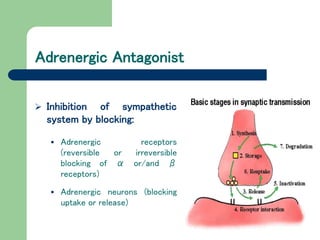
Adrenergic Antagonist
 Inhibition of sympathetic
system by blocking:
 Adrenergic receptors
(reversible or irreversible
blocking of α or/and β
receptors)
 Adrenergic neurons (blocking
uptake or release)
Adrenergic Blocking Drugs
 These drugs competitively inhibit α and β
receptor sites.
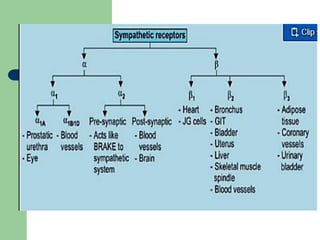
 α receptors, α1, α2.
 One group of drugs is specific for both β1 and
β2 receptors.
 One group is specific for β1 receptors.
 One group is specific for both α and β
receptors.
26
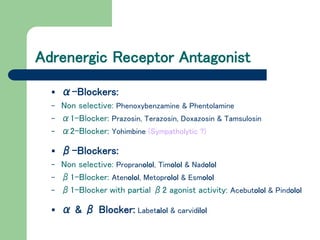
Adrenergic Receptor Antagonist
 α-Blockers:
- Non selective: Phenoxybenzamine & Phentolamine
- α1-Blocker: Prazosin, Terazosin, Doxazosin & Tamsulosin
- α2-Blocker: Yohimbine (Sympatholytic ?)
 β-Blockers:
- Non selective: Propranolol, Timolol & Nadolol
- β1-Blocker: Atenolol, Metoprolol & Esmolol
- β1-Blocker with partial β2 agonist activity: Acebutolol & Pindolol
 α & β Blocker: Labetalol & carvidilol
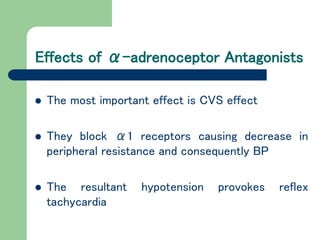
Effects of α-adrenoceptor Antagonists
 The most important effect is CVS effect
 They block α1 receptors causing decrease in
peripheral resistance and consequently BP
 The resultant hypotension provokes reflex
tachycardia
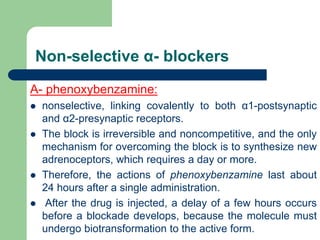
Non-selective α- blockers
A- phenoxybenzamine:
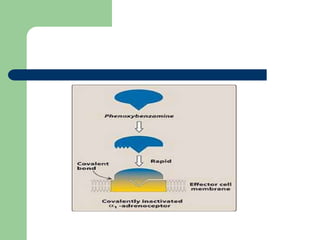
 nonselective, linking covalently to both α1-postsynaptic
and α2-presynaptic receptors.
 The block is irreversible and noncompetitive, and the only
mechanism for overcoming the block is to synthesize new
adrenoceptors, which requires a day or more.
 Therefore, the actions of phenoxybenzamine last about
24 hours after a single administration.
 After the drug is injected, a delay of a few hours occurs
before a blockade develops, because the molecule must
undergo biotransformation to the active form.
 Actions:
 Cardiovascular effects:
 By blocking α1 receptors, phenoxybenzamine prevents
vasoconstriction of peripheral blood vessels by endogenous
catecholamines.
 The decreased peripheral resistance provokes a reflex
tachycardia, arrhythmia, and even ischemic cardiac events.
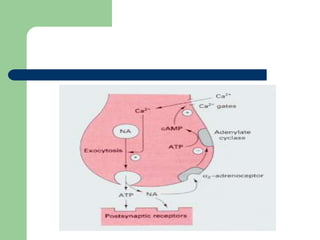
 Furthermore, the ability to block presynaptic inhibitory α2
receptors in the heart can contribute to an increased cardiac
output. [Note: These receptors when blocked will result in
more norepinephrine release, which stimulates β1 receptors
on the heart to increase cardiac output].
 Thus, the drug has been unsuccessful in maintaining
lowered blood pressure in hypertension.
 Therapeutic uses: Phenoxybenzamine is
used in the treatment of pheochromocytoma, a
catecholaminesecreting tumor of cells derived
from the adrenal medulla.
 Adverse effects: Phenoxybenzamine can
cause postural hypotension, and reflex
tachycardia.
Non-selective α- blockers
B- phentolamine, Tolazoline
 In contrast to phenoxybenzamine, phentolamine
produces a competitive block of α1 and α2 receptors.
 The drug's action lasts for approximately 4 hours after
a single administration.
 Like phenoxybenzamine, it produces postural
hypotension
 Phentolamine-induced reflex cardiac stimulation and
tachycardia
 Phentolamine is also used for the short-term
management of pheochromocytoma.
 Tolazoline is used for pulmonary hypertension of the
newborn.
 They are used for hypertensive crisis associated with
clonidine withdrawal
 So For non selective α-antagonists, the main differences
between phenoxybenzamine and phentolamine are:
 Phenoxybenzamine is a prodrug that takes few hrs for
biotransformation while phentolamine is not a prodrug
 Phenoxybenzamine bind covalently (irreversible binding) to α
receptors and so the activity last for about 28 hrs. On the other
hand, phentolamine is competitive blocker (reversible binding), so
the activity last for 4hr.
Selective α1-blockers
A- Prazosin, terazosin, doxazosin.
Cardiovascular effects:
 All of these agents decrease peripheral
vascular resistance and lower arterial blood
pressure by causing the relaxation of both
arterial and venous smooth muscle.
 These drugs, unlike phenoxybenzamine and
phentolamine, cause minimal changes in
cardiac output; thus The hypotensive effect is
more dramatic than non selective
Therapeutic uses:
 Hypertension: They are used alone or in combination
with other antihypertensive drugs
 They improve rather than worsen lipid profile and
glucose-insulin metabolism
 In the treatment of congestive heart failure (CHF) as
other vasodilators
Adverse effects:
 dizziness, a lack of energy, nasal congestion,
headache, drowsiness, and orthostatic
hypotension
 the first dose of these drugs produces an
exaggerated orthostatic hypotensive response
that can result in syncope (fainting). This
action, termed a first-dose effect, may be
minimized by adjusting the first dose to one-
third or one-fourth of the normal dose and by
giving the drug at bedtime.
Selective α1a-blockers
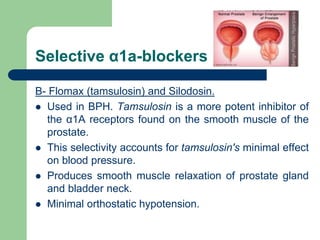
B- Flomax (tamsulosin) and Silodosin.
 Used in BPH. Tamsulosin is a more potent inhibitor of
the α1A receptors found on the smooth muscle of the
prostate.
 This selectivity accounts for tamsulosin's minimal effect
on blood pressure.
 Produces smooth muscle relaxation of prostate gland
and bladder neck.
 Minimal orthostatic hypotension.
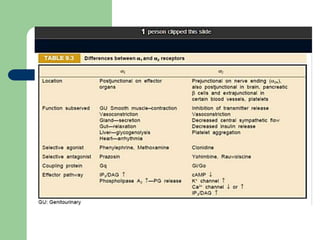
Selective α2- blockers
 Yohimbine blocks α2 causing increase in
sympathetic flow and so BP.
 It is sometimes used as a sexual stimulant.
Orthostatic hypotension
 Orthostatic hypotension is a problem with prazosin
analogs and to a lesser extent tamsulosin.
Significantly, orthostatsis is a problem that can be
seen with any vasodilator that affects the tone on
venous smooth muscle.
 This would include, organic nitrates, hydralazine,
clonidine, minixodil and the many drugs.
 Orthostatic hypotension or postural hypotension
occurs when systemic arterial blood pressure falls by
more than 20 mmHg upon standing.
 In this situation, cerebral perfusion falls and
an individual may become light headed, dizzy
or fatality may occur.
 In changing from the supine to the standing
position, gravity tends to cause blood to pool
in the lower extremities. However, several
reflexes, including sympathetically mediated
venoconstriction minimize this pooling and
maintain cerebral perfusion. If these reflex
actions do not occur, then orthostatic
hypotension could result.
 By blocking the α1-receptors associated with
venous smooth muscle, prazosin-like drugs,
inhibit the sympathetically mediated
vasoconstriction associated with postural
changes. Hence, orthostatic hypotension can
occur.
 Drugs like clonidine cause orthostasis due to
its CNS actions that block the sympathetic
reflexes.
 Vasodilators such as nitrates, minoxidil,
hydralazine or impotence medications cause
orthostasis because of their actions directly
on the vasculature.
 https://quizlet.com/377276297/adrenergic-
antagonists-flash-cards/
 https://youtu.be/41Xloc_vvX8
Pharmacology
Pharmacology
Pharmacology

Pharmacology

  • 1.
  • 2.
    Adrenergic Antagonist  Inhibitionof sympathetic system by blocking:  Adrenergic receptors (reversible or irreversible blocking of α or/and β receptors)  Adrenergic neurons (blocking uptake or release)
  • 3.
    Adrenergic Blocking Drugs These drugs competitively inhibit α and β receptor sites.  α receptors, α1, α2.  One group of drugs is specific for both β1 and β2 receptors.  One group is specific for β1 receptors.  One group is specific for both α and β receptors. 26
  • 5.
    Adrenergic Receptor Antagonist α-Blockers: - Non selective: Phenoxybenzamine & Phentolamine - α1-Blocker: Prazosin, Terazosin, Doxazosin & Tamsulosin - α2-Blocker: Yohimbine (Sympatholytic ?)  β-Blockers: - Non selective: Propranolol, Timolol & Nadolol - β1-Blocker: Atenolol, Metoprolol & Esmolol - β1-Blocker with partial β2 agonist activity: Acebutolol & Pindolol  α & β Blocker: Labetalol & carvidilol
  • 6.
    Effects of α-adrenoceptorAntagonists  The most important effect is CVS effect  They block α1 receptors causing decrease in peripheral resistance and consequently BP  The resultant hypotension provokes reflex tachycardia
  • 7.
    Non-selective α- blockers A-phenoxybenzamine:  nonselective, linking covalently to both α1-postsynaptic and α2-presynaptic receptors.  The block is irreversible and noncompetitive, and the only mechanism for overcoming the block is to synthesize new adrenoceptors, which requires a day or more.  Therefore, the actions of phenoxybenzamine last about 24 hours after a single administration.  After the drug is injected, a delay of a few hours occurs before a blockade develops, because the molecule must undergo biotransformation to the active form.
  • 9.
     Actions:  Cardiovasculareffects:  By blocking α1 receptors, phenoxybenzamine prevents vasoconstriction of peripheral blood vessels by endogenous catecholamines.  The decreased peripheral resistance provokes a reflex tachycardia, arrhythmia, and even ischemic cardiac events.  Furthermore, the ability to block presynaptic inhibitory α2 receptors in the heart can contribute to an increased cardiac output. [Note: These receptors when blocked will result in more norepinephrine release, which stimulates β1 receptors on the heart to increase cardiac output].  Thus, the drug has been unsuccessful in maintaining lowered blood pressure in hypertension.
  • 10.
     Therapeutic uses:Phenoxybenzamine is used in the treatment of pheochromocytoma, a catecholaminesecreting tumor of cells derived from the adrenal medulla.  Adverse effects: Phenoxybenzamine can cause postural hypotension, and reflex tachycardia.
  • 11.
    Non-selective α- blockers B-phentolamine, Tolazoline  In contrast to phenoxybenzamine, phentolamine produces a competitive block of α1 and α2 receptors.  The drug's action lasts for approximately 4 hours after a single administration.  Like phenoxybenzamine, it produces postural hypotension  Phentolamine-induced reflex cardiac stimulation and tachycardia  Phentolamine is also used for the short-term management of pheochromocytoma.
  • 12.
     Tolazoline isused for pulmonary hypertension of the newborn.  They are used for hypertensive crisis associated with clonidine withdrawal
  • 13.
     So Fornon selective α-antagonists, the main differences between phenoxybenzamine and phentolamine are:  Phenoxybenzamine is a prodrug that takes few hrs for biotransformation while phentolamine is not a prodrug  Phenoxybenzamine bind covalently (irreversible binding) to α receptors and so the activity last for about 28 hrs. On the other hand, phentolamine is competitive blocker (reversible binding), so the activity last for 4hr.
  • 15.
    Selective α1-blockers A- Prazosin,terazosin, doxazosin. Cardiovascular effects:  All of these agents decrease peripheral vascular resistance and lower arterial blood pressure by causing the relaxation of both arterial and venous smooth muscle.  These drugs, unlike phenoxybenzamine and phentolamine, cause minimal changes in cardiac output; thus The hypotensive effect is more dramatic than non selective
  • 17.
    Therapeutic uses:  Hypertension:They are used alone or in combination with other antihypertensive drugs  They improve rather than worsen lipid profile and glucose-insulin metabolism  In the treatment of congestive heart failure (CHF) as other vasodilators
  • 18.
    Adverse effects:  dizziness,a lack of energy, nasal congestion, headache, drowsiness, and orthostatic hypotension  the first dose of these drugs produces an exaggerated orthostatic hypotensive response that can result in syncope (fainting). This action, termed a first-dose effect, may be minimized by adjusting the first dose to one- third or one-fourth of the normal dose and by giving the drug at bedtime.
  • 19.
    Selective α1a-blockers B- Flomax(tamsulosin) and Silodosin.  Used in BPH. Tamsulosin is a more potent inhibitor of the α1A receptors found on the smooth muscle of the prostate.  This selectivity accounts for tamsulosin's minimal effect on blood pressure.  Produces smooth muscle relaxation of prostate gland and bladder neck.  Minimal orthostatic hypotension.
  • 20.
    Selective α2- blockers Yohimbine blocks α2 causing increase in sympathetic flow and so BP.  It is sometimes used as a sexual stimulant.
  • 21.
    Orthostatic hypotension  Orthostatichypotension is a problem with prazosin analogs and to a lesser extent tamsulosin. Significantly, orthostatsis is a problem that can be seen with any vasodilator that affects the tone on venous smooth muscle.  This would include, organic nitrates, hydralazine, clonidine, minixodil and the many drugs.  Orthostatic hypotension or postural hypotension occurs when systemic arterial blood pressure falls by more than 20 mmHg upon standing.
  • 22.
     In thissituation, cerebral perfusion falls and an individual may become light headed, dizzy or fatality may occur.  In changing from the supine to the standing position, gravity tends to cause blood to pool in the lower extremities. However, several reflexes, including sympathetically mediated venoconstriction minimize this pooling and maintain cerebral perfusion. If these reflex actions do not occur, then orthostatic hypotension could result.
  • 23.
     By blockingthe α1-receptors associated with venous smooth muscle, prazosin-like drugs, inhibit the sympathetically mediated vasoconstriction associated with postural changes. Hence, orthostatic hypotension can occur.  Drugs like clonidine cause orthostasis due to its CNS actions that block the sympathetic reflexes.  Vasodilators such as nitrates, minoxidil, hydralazine or impotence medications cause orthostasis because of their actions directly on the vasculature.
  • 24.