
SUN-SCREEN
PREPARATIONS
Dr. Prashant L. Pingale
Associate Professor,
Dept. of Pharmaceutics,
GES’s Sir Dr. M. S. Gosavi College of
Pharm. Edu. and Research,
Nashik-422005
Definition
• Sunscreen (also known as sunblock or suntan
lotion is a lotion, spray, gel or other topical
product that absorbs or reflects the sun's
ultraviolet (UV) radiation and protects the skin.
INTRODUCTION
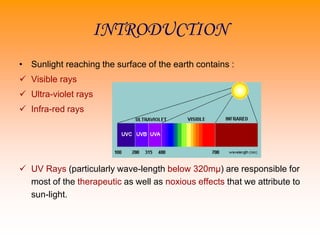
• Sunlight reaching the surface of the earth contains :
 Visible rays
 Ultra-violet rays
 Infra-red rays
 UV Rays (particularly wave-length below 320mµ) are responsible for
most of the therapeutic as well as noxious effects that we attribute to
sun-light.
SKIN - DAMAGE
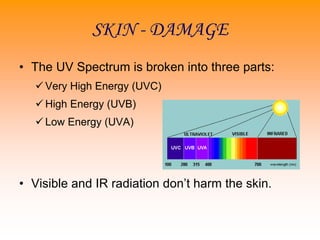
• The UV Spectrum is broken into three parts:
 Very High Energy (UVC)
 High Energy (UVB)
 Low Energy (UVA)
• Visible and IR radiation don’t harm the skin.
SKIN-DAMAGE II
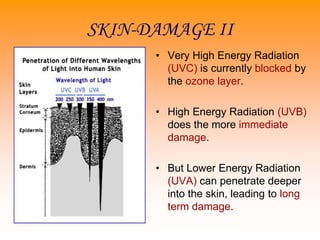
• Very High Energy Radiation
(UVC) is currently blocked by
the ozone layer.
• High Energy Radiation (UVB)
does the more immediate
damage.
• But Lower Energy Radiation
(UVA) can penetrate deeper
into the skin, leading to long
term damage.
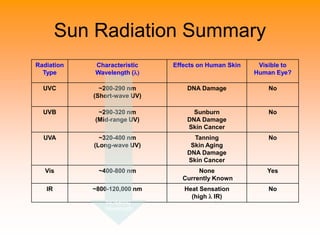
Radiation
Type
Characteristic
Wavelength (l)
Effects on Human Skin Visible to
Human Eye?
UVC ~200-290 nm
(Short-wave UV)
DNA Damage No
UVB ~290-320 nm
(Mid-range UV)
Sunburn
DNA Damage
Skin Cancer
No
UVA ~320-400 nm
(Long-wave UV)
Tanning
Skin Aging
DNA Damage
Skin Cancer
No
Vis ~400-800 nm None
Currently Known
Yes
IR ~800-120,000 nm Heat Sensation
(high l IR)
No
Sun Radiation Summary
Increasing
Wavelength
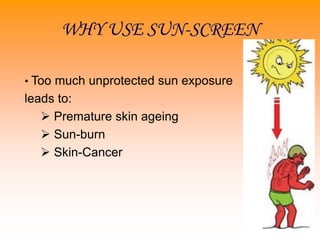
WHY USE SUN-SCREEN
• Too much unprotected sun exposure
leads to:
 Premature skin ageing
 Sun-burn
 Skin-Cancer
PRINCIPLE OF EFFECTIVENESS OF
SUN-SCREENS
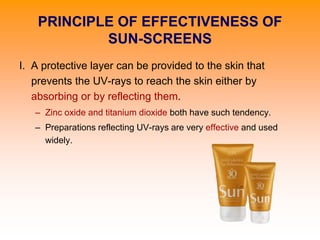
I. A protective layer can be provided to the skin that
prevents the UV-rays to reach the skin either by
absorbing or by reflecting them.
– Zinc oxide and titanium dioxide both have such tendency.
– Preparations reflecting UV-rays are very effective and used
widely.
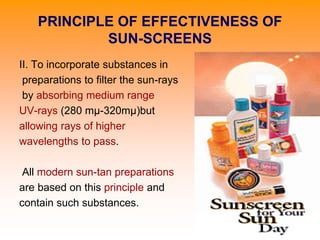
II. To incorporate substances in
preparations to filter the sun-rays
by absorbing medium range
UV-rays (280 mµ-320mµ)but
allowing rays of higher
wavelengths to pass.
All modern sun-tan preparations
are based on this principle and
contain such substances.
PRINCIPLE OF EFFECTIVENESS OF
SUN-SCREENS
UV filters (Three types)
• Organic chemical:
– compounds that absorb ultraviolet light
– oxybenzone
• Inorganic particulates:
– that reflect, scatter, and absorb UV light
– titanium dioxide, zinc oxide
• Organic particulates:
– that mostly absorb light like organic chemical compounds, but contain
multiple chromophores,
– may reflect and scatter a fraction of light like inorganic particulates,
– Tinosorb M
III. Biologically effective substances
can be used effectively to prevent
symptoms of inflammation with-out
reduction of tanning.
– Sunlight liberates histamine in the
the tissues-anti histaminic substances
avoid inflammation.
• HC’s and FC’s are useful in treating sun-burn
but not recommended in sun-tan preparation.
PRINCIPLE OF EFFECTIVENESS OF
SUN-SCREENS
IV. Substances that cause or accelerate tanning of the skin
can be applied.
– Dioxyacetone causes tanning by forming a brown complex with
the keratin of the corneal layer.
– 8-methoxypsoralene when taken 10-20 mg internally 2 hours
before exposure to the sun, accelerates tanning and avoids sun-
burn.
PRINCIPLE OF EFFECTIVENESS OF
SUN-SCREENS
IDEAL SUN-SCREEN CHARACTERS
 Absorb light preferentially over the range of 280 - 320mµ.
 Resistance to water
 Be stable to heat, light and perspiration.
 Preferably odorless, if mild odor: accepted by user.
 Be non-toxic, non-irritant, non- sensitizing
 Capable of retaining sunscreening property for several hours.
 Stable under condition of use.
 Non- stain
 Not be rapidly absorbed.
 Be neutral.
 Be rapidly soluble in suitable vehicles.
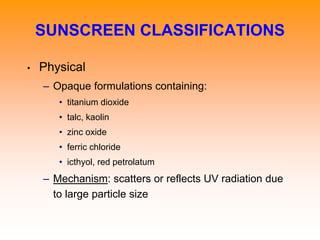
SUNSCREEN CLASSIFICATIONS
• Physical
– Opaque formulations containing:
• titanium dioxide
• talc, kaolin
• zinc oxide
• ferric chloride
• icthyol, red petrolatum
– Mechanism: scatters or reflects UV radiation due
to large particle size
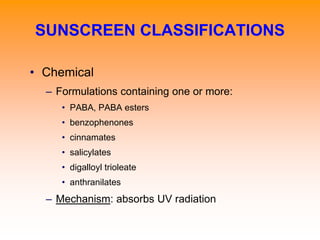
• Chemical
– Formulations containing one or more:
• PABA, PABA esters
• benzophenones
• cinnamates
• salicylates
• digalloyl trioleate
• anthranilates
– Mechanism: absorbs UV radiation
SUNSCREEN CLASSIFICATIONS
SUNSCREEN AGENTS
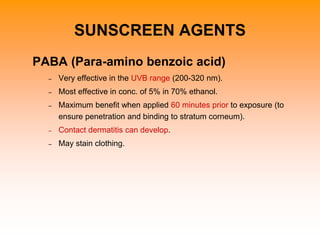
PABA (Para-amino benzoic acid)
– Very effective in the UVB range (200-320 nm).
– Most effective in conc. of 5% in 70% ethanol.
– Maximum benefit when applied 60 minutes prior to exposure (to
ensure penetration and binding to stratum corneum).
– Contact dermatitis can develop.
– May stain clothing.
SUNSCREEN AGENTS
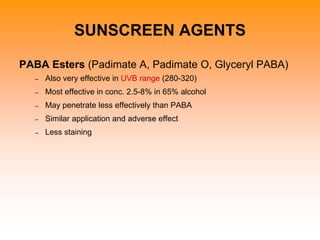
PABA Esters (Padimate A, Padimate O, Glyceryl PABA)
– Also very effective in UVB range (280-320)
– Most effective in conc. 2.5-8% in 65% alcohol
– May penetrate less effectively than PABA
– Similar application and adverse effect
– Less staining
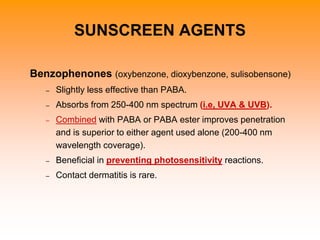
Benzophenones (oxybenzone, dioxybenzone, sulisobensone)
– Slightly less effective than PABA.
– Absorbs from 250-400 nm spectrum (i.e, UVA & UVB).
– Combined with PABA or PABA ester improves penetration
and is superior to either agent used alone (200-400 nm
wavelength coverage).
– Beneficial in preventing photosensitivity reactions.
– Contact dermatitis is rare.
SUNSCREEN AGENTS
SUNSCREEN AGENTS
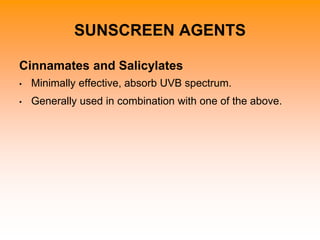
Cinnamates and Salicylates
• Minimally effective, absorb UVB spectrum.
• Generally used in combination with one of the above.
SUNSCREEN AGENTS
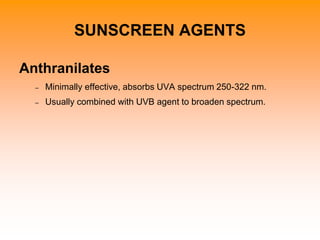
Anthranilates
– Minimally effective, absorbs UVA spectrum 250-322 nm.
– Usually combined with UVB agent to broaden spectrum.
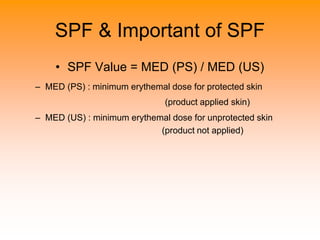
SPF & Important of SPF
• SPF Value = MED (PS) / MED (US)
– MED (PS) : minimum erythemal dose for protected skin
(product applied skin)
– MED (US) : minimum erythemal dose for unprotected skin
(product not applied)
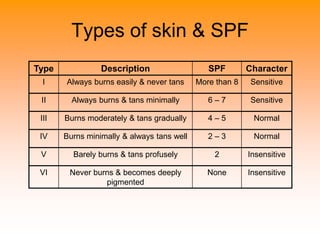
Types of skin & SPF
Type Description SPF Character
I Always burns easily & never tans More than 8 Sensitive
II Always burns & tans minimally 6 – 7 Sensitive
III Burns moderately & tans gradually 4 – 5 Normal
IV Burns minimally & always tans well 2 – 3 Normal
V Barely burns & tans profusely 2 Insensitive
VI Never burns & becomes deeply
pigmented
None Insensitive
CONTD.
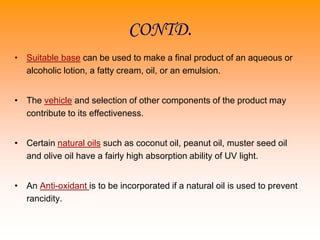
• Suitable base can be used to make a final product of an aqueous or
alcoholic lotion, a fatty cream, oil, or an emulsion.
• The vehicle and selection of other components of the product may
contribute to its effectiveness.
• Certain natural oils such as coconut oil, peanut oil, muster seed oil
and olive oil have a fairly high absorption ability of UV light.
• An Anti-oxidant is to be incorporated if a natural oil is used to prevent
rancidity.
GENERAL PROCEDURE FOR
MANUFACTURING
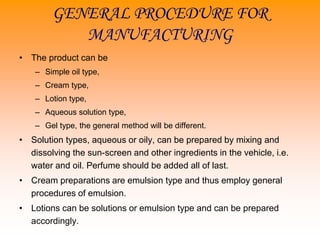
• The product can be
– Simple oil type,
– Cream type,
– Lotion type,
– Aqueous solution type,
– Gel type, the general method will be different.
• Solution types, aqueous or oily, can be prepared by mixing and
dissolving the sun-screen and other ingredients in the vehicle, i.e.
water and oil. Perfume should be added all of last.
• Cream preparations are emulsion type and thus employ general
procedures of emulsion.
• Lotions can be solutions or emulsion type and can be prepared
accordingly.
EVALUATION
• Some special tests are also necessary for these types
of products:
• Spectrophotometric evaluation.
• Erythemal damage
• Sun-screen index
• In-vivo skin testing
EVALUATION
1. SPECTROPHOTOMETRIC EVALUATION:
This is basically to evaluate the UV radiation
absorption ability of the sun-screen compounds.
Using a UV Spectrophotometer and taking specific
concentration of the substance on the preparation,
molar extinction coefficient or absorbency can be
determined and compared with any other standard
substance.
2.ERYTHEMAL DAMAGE:
It is important to estimate the erythemally effective
radiation or E-vitons/sq.cm., transmitted by a sun-tan
preparation.
The erythemal energy is the product of the solar energy
transmitted through the film of sun-tan preparation and
the effectiveness factor at that wave-length
EVALUATION
3. SUN-SCREEN INDEX:
This is evaluation of the relative screening activity of the
sun-screen compounds.
This is measurement of EXTINCTION CO-EFFICIENT (E
1%
0.1cm) at 308mµ and comparison with other.
308 mµ is the peak wavelength for effective sun-burn.
EVALUATION
4. IN-VIVO SKIN TESTING:
• This is a direct test on animal skin, particularly rabbit, the site
normally used is either back-side as this sites have maximum
sensitivity.
• Preparations are applied on a specific site and exposed to radiation
along with a control unprotected site, for a specified period of time.
• The effects are observed at the end of the period.
• Several factors or variables are to be taken care of during the test as
they may influence the results.
• Such variables or factors are radiation source, size of the test field,
etc.
ADVANCES IN SUN-SCREENS
1. Nano-sun screen.
2. Sun sport.
3. Sun-screen sprays.
4. Roll-on sun screen.
5. Sun-screen for children.
Nanosized
ZnO particles
Large ZnO
particles
Sunscreen preparations

Sunscreen preparations

  • 1.
    SUN-SCREEN PREPARATIONS Dr. Prashant L.Pingale Associate Professor, Dept. of Pharmaceutics, GES’s Sir Dr. M. S. Gosavi College of Pharm. Edu. and Research, Nashik-422005
  • 2.
    Definition • Sunscreen (alsoknown as sunblock or suntan lotion is a lotion, spray, gel or other topical product that absorbs or reflects the sun's ultraviolet (UV) radiation and protects the skin.
  • 3.
    INTRODUCTION • Sunlight reachingthe surface of the earth contains :  Visible rays  Ultra-violet rays  Infra-red rays  UV Rays (particularly wave-length below 320mµ) are responsible for most of the therapeutic as well as noxious effects that we attribute to sun-light.
  • 4.
    SKIN - DAMAGE •The UV Spectrum is broken into three parts:  Very High Energy (UVC)  High Energy (UVB)  Low Energy (UVA) • Visible and IR radiation don’t harm the skin.
  • 5.
    SKIN-DAMAGE II • VeryHigh Energy Radiation (UVC) is currently blocked by the ozone layer. • High Energy Radiation (UVB) does the more immediate damage. • But Lower Energy Radiation (UVA) can penetrate deeper into the skin, leading to long term damage.
  • 6.
    Radiation Type Characteristic Wavelength (l) Effects onHuman Skin Visible to Human Eye? UVC ~200-290 nm (Short-wave UV) DNA Damage No UVB ~290-320 nm (Mid-range UV) Sunburn DNA Damage Skin Cancer No UVA ~320-400 nm (Long-wave UV) Tanning Skin Aging DNA Damage Skin Cancer No Vis ~400-800 nm None Currently Known Yes IR ~800-120,000 nm Heat Sensation (high l IR) No Sun Radiation Summary Increasing Wavelength
  • 7.
    WHY USE SUN-SCREEN •Too much unprotected sun exposure leads to:  Premature skin ageing  Sun-burn  Skin-Cancer
  • 8.
    PRINCIPLE OF EFFECTIVENESSOF SUN-SCREENS I. A protective layer can be provided to the skin that prevents the UV-rays to reach the skin either by absorbing or by reflecting them. – Zinc oxide and titanium dioxide both have such tendency. – Preparations reflecting UV-rays are very effective and used widely.
  • 9.
    II. To incorporatesubstances in preparations to filter the sun-rays by absorbing medium range UV-rays (280 mµ-320mµ)but allowing rays of higher wavelengths to pass. All modern sun-tan preparations are based on this principle and contain such substances. PRINCIPLE OF EFFECTIVENESS OF SUN-SCREENS
  • 10.
    UV filters (Threetypes) • Organic chemical: – compounds that absorb ultraviolet light – oxybenzone • Inorganic particulates: – that reflect, scatter, and absorb UV light – titanium dioxide, zinc oxide • Organic particulates: – that mostly absorb light like organic chemical compounds, but contain multiple chromophores, – may reflect and scatter a fraction of light like inorganic particulates, – Tinosorb M
  • 11.
    III. Biologically effectivesubstances can be used effectively to prevent symptoms of inflammation with-out reduction of tanning. – Sunlight liberates histamine in the the tissues-anti histaminic substances avoid inflammation. • HC’s and FC’s are useful in treating sun-burn but not recommended in sun-tan preparation. PRINCIPLE OF EFFECTIVENESS OF SUN-SCREENS
  • 12.
    IV. Substances thatcause or accelerate tanning of the skin can be applied. – Dioxyacetone causes tanning by forming a brown complex with the keratin of the corneal layer. – 8-methoxypsoralene when taken 10-20 mg internally 2 hours before exposure to the sun, accelerates tanning and avoids sun- burn. PRINCIPLE OF EFFECTIVENESS OF SUN-SCREENS
  • 13.
    IDEAL SUN-SCREEN CHARACTERS Absorb light preferentially over the range of 280 - 320mµ.  Resistance to water  Be stable to heat, light and perspiration.  Preferably odorless, if mild odor: accepted by user.  Be non-toxic, non-irritant, non- sensitizing  Capable of retaining sunscreening property for several hours.  Stable under condition of use.  Non- stain  Not be rapidly absorbed.  Be neutral.  Be rapidly soluble in suitable vehicles.
  • 14.
    SUNSCREEN CLASSIFICATIONS • Physical –Opaque formulations containing: • titanium dioxide • talc, kaolin • zinc oxide • ferric chloride • icthyol, red petrolatum – Mechanism: scatters or reflects UV radiation due to large particle size
  • 15.
    • Chemical – Formulationscontaining one or more: • PABA, PABA esters • benzophenones • cinnamates • salicylates • digalloyl trioleate • anthranilates – Mechanism: absorbs UV radiation SUNSCREEN CLASSIFICATIONS
  • 16.
    SUNSCREEN AGENTS PABA (Para-aminobenzoic acid) – Very effective in the UVB range (200-320 nm). – Most effective in conc. of 5% in 70% ethanol. – Maximum benefit when applied 60 minutes prior to exposure (to ensure penetration and binding to stratum corneum). – Contact dermatitis can develop. – May stain clothing.
  • 17.
    SUNSCREEN AGENTS PABA Esters(Padimate A, Padimate O, Glyceryl PABA) – Also very effective in UVB range (280-320) – Most effective in conc. 2.5-8% in 65% alcohol – May penetrate less effectively than PABA – Similar application and adverse effect – Less staining
  • 18.
    Benzophenones (oxybenzone, dioxybenzone,sulisobensone) – Slightly less effective than PABA. – Absorbs from 250-400 nm spectrum (i.e, UVA & UVB). – Combined with PABA or PABA ester improves penetration and is superior to either agent used alone (200-400 nm wavelength coverage). – Beneficial in preventing photosensitivity reactions. – Contact dermatitis is rare. SUNSCREEN AGENTS
  • 19.
    SUNSCREEN AGENTS Cinnamates andSalicylates • Minimally effective, absorb UVB spectrum. • Generally used in combination with one of the above.
  • 20.
    SUNSCREEN AGENTS Anthranilates – Minimallyeffective, absorbs UVA spectrum 250-322 nm. – Usually combined with UVB agent to broaden spectrum.
  • 21.
    SPF & Importantof SPF • SPF Value = MED (PS) / MED (US) – MED (PS) : minimum erythemal dose for protected skin (product applied skin) – MED (US) : minimum erythemal dose for unprotected skin (product not applied)
  • 22.
    Types of skin& SPF Type Description SPF Character I Always burns easily & never tans More than 8 Sensitive II Always burns & tans minimally 6 – 7 Sensitive III Burns moderately & tans gradually 4 – 5 Normal IV Burns minimally & always tans well 2 – 3 Normal V Barely burns & tans profusely 2 Insensitive VI Never burns & becomes deeply pigmented None Insensitive
  • 23.
    CONTD. • Suitable basecan be used to make a final product of an aqueous or alcoholic lotion, a fatty cream, oil, or an emulsion. • The vehicle and selection of other components of the product may contribute to its effectiveness. • Certain natural oils such as coconut oil, peanut oil, muster seed oil and olive oil have a fairly high absorption ability of UV light. • An Anti-oxidant is to be incorporated if a natural oil is used to prevent rancidity.
  • 24.
    GENERAL PROCEDURE FOR MANUFACTURING •The product can be – Simple oil type, – Cream type, – Lotion type, – Aqueous solution type, – Gel type, the general method will be different. • Solution types, aqueous or oily, can be prepared by mixing and dissolving the sun-screen and other ingredients in the vehicle, i.e. water and oil. Perfume should be added all of last. • Cream preparations are emulsion type and thus employ general procedures of emulsion. • Lotions can be solutions or emulsion type and can be prepared accordingly.
  • 25.
    EVALUATION • Some specialtests are also necessary for these types of products: • Spectrophotometric evaluation. • Erythemal damage • Sun-screen index • In-vivo skin testing
  • 26.
    EVALUATION 1. SPECTROPHOTOMETRIC EVALUATION: Thisis basically to evaluate the UV radiation absorption ability of the sun-screen compounds. Using a UV Spectrophotometer and taking specific concentration of the substance on the preparation, molar extinction coefficient or absorbency can be determined and compared with any other standard substance.
  • 27.
    2.ERYTHEMAL DAMAGE: It isimportant to estimate the erythemally effective radiation or E-vitons/sq.cm., transmitted by a sun-tan preparation. The erythemal energy is the product of the solar energy transmitted through the film of sun-tan preparation and the effectiveness factor at that wave-length
  • 28.
    EVALUATION 3. SUN-SCREEN INDEX: Thisis evaluation of the relative screening activity of the sun-screen compounds. This is measurement of EXTINCTION CO-EFFICIENT (E 1% 0.1cm) at 308mµ and comparison with other. 308 mµ is the peak wavelength for effective sun-burn.
  • 29.
    EVALUATION 4. IN-VIVO SKINTESTING: • This is a direct test on animal skin, particularly rabbit, the site normally used is either back-side as this sites have maximum sensitivity. • Preparations are applied on a specific site and exposed to radiation along with a control unprotected site, for a specified period of time. • The effects are observed at the end of the period. • Several factors or variables are to be taken care of during the test as they may influence the results. • Such variables or factors are radiation source, size of the test field, etc.
  • 30.
    ADVANCES IN SUN-SCREENS 1.Nano-sun screen. 2. Sun sport. 3. Sun-screen sprays. 4. Roll-on sun screen. 5. Sun-screen for children. Nanosized ZnO particles Large ZnO particles