
PREFILLED
SYRINGES
✓ What are prefilled syringes?
✓ Purpose of prefills
✓ Types of PFS systems
✓ Materials used for the preparation of PFS
✓ Filling process in PFS
✓ Sterilization of prefilled syringes
✓ Steps to use prefilled syringes
✓ Advantages & Disadvantages
✓ Factors Responsible for Growth of Prefilled Syringes
✓ Marketed Products
CONTENTS…..
2
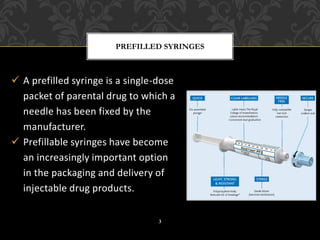
✓ A prefilled syringe is a single-dose
packet of parental drug to which a
needle has been fixed by the
manufacturer.
✓ Prefillable syringes have become
an increasingly important option
in the packaging and delivery of
injectable drug products.
PREFILLED SYRINGES
3
✓ The prefilled syringe provides two major purposes to the
administration of a drug.
✓ The first is primary packaging. The purpose of the primary package
is to assure that there is no adverse effect on the identity,
strength, quality, purity or potency of the drug over its shelf life.
✓ Second, a prefillable syringe is a delivery system designed to
administer the appropriate amount of the medicament to the
patient.
PURPOSE
4
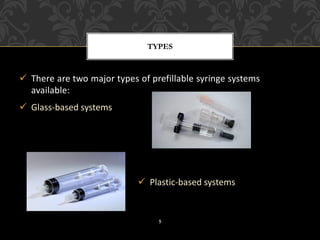
✓ There are two major types of prefillable syringe systems
available:
✓ Glass-based systems
TYPES
✓ Plastic-based systems
5
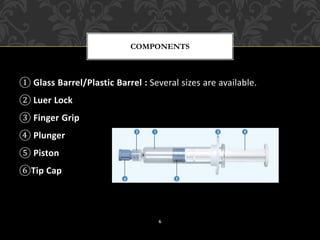
① Glass Barrel/Plastic Barrel : Several sizes are available.
② Luer Lock
③ Finger Grip
④ Plunger
⑤ Piston
⑥Tip Cap
COMPONENTS
6
✓ Traditionally, a prefillable syringe barrel has been made from
glass tubing.
✓ These glass tubes are transformed by heat into the barrel that is
used to hold the drug product.
✓ Syringe manufacturers typically form and process the glass and
purchase the complementing elastomeric components (e.g.,
plungers, tip caps, needle shields) that complete the primary
package from an elastomeric closure manufacturer.
GLASS BASED SYSTEM
7
✓ Health care practitioners’ long history of familiarity with the
product.
✓ The majority of prefilled syringes in the marketplace, are
glass with elastomeric components
✓ There are multiple proven suppliers.
BENEFITS OF GLASS SYSTEM
8
✓ Breakage
✓ Dimensional variation
✓ Potential surface reactivity
✓ Particulate contamination
✓ Adhesive or other potential leachables
✓ Inconsistent application of silicone oil (added for
functionality)
DRAWBACKS
9
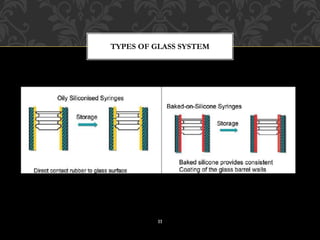
✓ Oil siliconised syringes: In this type of prefilled syringe
system there is direct contact of rubber to glass surface
leads overtime to higher break out forces and leads to
chances of contamination.
✓ Baked on silicone syringes: In this baked on silicone syringes
provide consistent coating of the glass barrel Wales. Break
out forces stay low during storage.
TYPES OF GLASS SYSTEM
10
TYPES OF GLASS SYSTEM
11
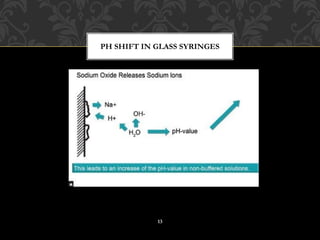
✓ The shift in pH occurs because of use of type I glass
(borosilicate glass) used in prefilled syringes manufacturing.
✓ Around the beginning of cooling phase at 5800c, sodium
oxide is forms and remains in glass.
✓ During storage, sodium ions are released into the water for
injection and increase the concentration of hydroxide ions,
thus increasing alkalinity.
✓ This causes change in pH in syringes.
PH SHIFT IN GLASS SYRINGES
12
PH SHIFT IN GLASS SYRINGES
13
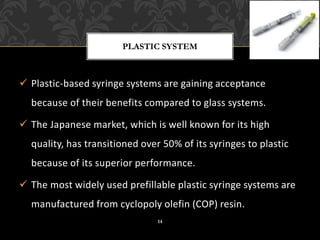
✓ Plastic-based syringe systems are gaining acceptance
because of their benefits compared to glass systems.
✓ The Japanese market, which is well known for its high
quality, has transitioned over 50% of its syringes to plastic
because of its superior performance.
✓ The most widely used prefillable plastic syringe systems are
manufactured from cyclopoly olefin (COP) resin.
PLASTIC SYSTEM
14
✓ Break resistance
✓ Design flexibility
✓ Decreased surface reactivity
✓ Less absorption/adsorption of the drug
✓ Compatible with high or low pH
BENEFITS OF PLASTIC SYSTEM
15
✓ Cyclo olefin polymer (COP)
✓ Cyclo olefin co polymer (COC)
TYPES OF PLASTIC SYSTEM
16
✓ Major properties:
✓ Low water absorbency
✓ High transparency
✓ Low specific gravity
✓ High heat resistance
✓ Low impurities
COC PLASTIC SYSTEM
17
✓ Major properties:
✓ Clear amorphous copolymers based on cyclic and
✓ Linear olefins.
✓ These materials form a family of engineering resins
✓ That exhibit a unique combination of properties,
✓ Including high transparency, low density, excellent
✓ Moisture barrier capabilities, and resistance to
✓ Aqueous and polar organic media.
✓ Topas® COC is being used for pre-filled syringes,
✓ Needleless injectors and other drug delivery systems
COP PLASTIC SYSTEM
18
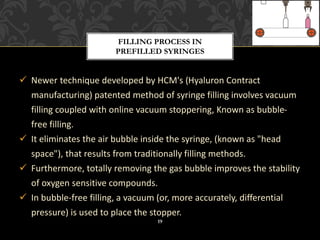
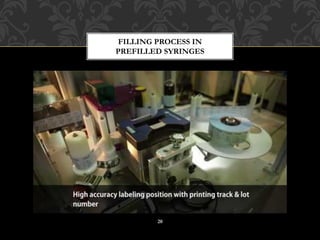
✓ Newer technique developed by HCM's (Hyaluron Contract
manufacturing) patented method of syringe filling involves vacuum
filling coupled with online vacuum stoppering, Known as bubble-
free filling.
✓ It eliminates the air bubble inside the syringe, (known as "head
space"), that results from traditionally filling methods.
✓ Furthermore, totally removing the gas bubble improves the stability
of oxygen sensitive compounds.
✓ In bubble-free filling, a vacuum (or, more accurately, differential
pressure) is used to place the stopper.
FILLING PROCESS IN
PREFILLED SYRINGES
19
FILLING PROCESS IN
PREFILLED SYRINGES
20
✓ Sterilization of prefilled syringe is mainly done by autoclaving or by
ionizing radiation.
✓ Autoclave is not suitable of glass prefilled syringes and normal
plastics, as there occurs a pH shift in glass syringes during autoclave
sterilization process.
✓ Mainly used method of sterilization is ionizing radiations.
✓ Gamma sterilization has proved to be an efficient means of
sterilizing prefilled syringes.
✓ Ionizing radiation has the advantage of sterilization the syringe
plungers while they remain in their packaging.
STERILIZATION OF PREFILLED
SYRINGES
21
✓ Step 1: Verify the label on prefilled syringe as it may be serious if
wrongly injected.
✓ Step 2: Take out the syringe cap and needle cap without touching
the needle tip to prevent the contamination of the syringe.
✓ Step 3: Insert the needle. Manually inserting a needle into skin can
be the most challenging element of self injection.
✓ Step 4: Once injection is completed, the patient must dispose the
used syringe.
STEPS TO USE PREFILLED
SYRINGES
22
✓ The first prefilled syringes were made of polypropylene.
✓ The advantages of prefilled syringes are:
✓ Patient related:
✓ Ease of convenience & use for health care professionals and patients
compared to a traditional vial packaging system
✓ Reduced risk of dosage error and contamination
✓ Greater efficiency
✓ Improved sterility assurance
✓ Enhance product differentiation
ADVANTAGES
23
✓ Market related:
✓ Reduced therapy and injection costs
✓ Increased market preference
✓ 20% API savings vs. vial filling
ADVANTAGES
24
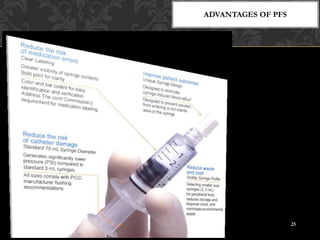
ADVANTAGES OF PFS
25
✓ These are complex medical devices
✓ Needle stick injuries
✓ Additional protection required
DISADVANTAGES
26
✓ KINFERON®: recombinant interferon product
✓ Strengths: 3, 5, 6 MIU/ml
✓ Indications: Acute & chronic
✓ hepatitis(type-B&C)leukemia,
✓ Malignant melanoma,
✓ Renal cell carcinoma,
✓ Ovary carinoma etc.,
✓ Route: IM, SC, intralesional
MARKETED PRODUCTS
27
✓ AVONEX® :
✓ (Interferon beta-1a)
✓ Strenght:30mcg
✓ Category: anti-viral
✓ Route: IM
MARKETED PRODUCTS
28
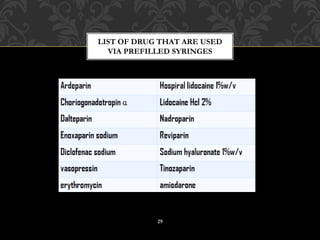
LIST OF DRUG THAT ARE USED
VIA PREFILLED SYRINGES
29
QUESTIONS???
Prefilled syringes

Prefilled syringes

  • 1.
  • 2.
    ✓ What areprefilled syringes? ✓ Purpose of prefills ✓ Types of PFS systems ✓ Materials used for the preparation of PFS ✓ Filling process in PFS ✓ Sterilization of prefilled syringes ✓ Steps to use prefilled syringes ✓ Advantages & Disadvantages ✓ Factors Responsible for Growth of Prefilled Syringes ✓ Marketed Products CONTENTS….. 2
  • 3.
    ✓ A prefilledsyringe is a single-dose packet of parental drug to which a needle has been fixed by the manufacturer. ✓ Prefillable syringes have become an increasingly important option in the packaging and delivery of injectable drug products. PREFILLED SYRINGES 3
  • 4.
    ✓ The prefilledsyringe provides two major purposes to the administration of a drug. ✓ The first is primary packaging. The purpose of the primary package is to assure that there is no adverse effect on the identity, strength, quality, purity or potency of the drug over its shelf life. ✓ Second, a prefillable syringe is a delivery system designed to administer the appropriate amount of the medicament to the patient. PURPOSE 4
  • 5.
    ✓ There aretwo major types of prefillable syringe systems available: ✓ Glass-based systems TYPES ✓ Plastic-based systems 5
  • 6.
    ① Glass Barrel/PlasticBarrel : Several sizes are available. ② Luer Lock ③ Finger Grip ④ Plunger ⑤ Piston ⑥Tip Cap COMPONENTS 6
  • 7.
    ✓ Traditionally, aprefillable syringe barrel has been made from glass tubing. ✓ These glass tubes are transformed by heat into the barrel that is used to hold the drug product. ✓ Syringe manufacturers typically form and process the glass and purchase the complementing elastomeric components (e.g., plungers, tip caps, needle shields) that complete the primary package from an elastomeric closure manufacturer. GLASS BASED SYSTEM 7
  • 8.
    ✓ Health carepractitioners’ long history of familiarity with the product. ✓ The majority of prefilled syringes in the marketplace, are glass with elastomeric components ✓ There are multiple proven suppliers. BENEFITS OF GLASS SYSTEM 8
  • 9.
    ✓ Breakage ✓ Dimensionalvariation ✓ Potential surface reactivity ✓ Particulate contamination ✓ Adhesive or other potential leachables ✓ Inconsistent application of silicone oil (added for functionality) DRAWBACKS 9
  • 10.
    ✓ Oil siliconisedsyringes: In this type of prefilled syringe system there is direct contact of rubber to glass surface leads overtime to higher break out forces and leads to chances of contamination. ✓ Baked on silicone syringes: In this baked on silicone syringes provide consistent coating of the glass barrel Wales. Break out forces stay low during storage. TYPES OF GLASS SYSTEM 10
  • 11.
    TYPES OF GLASSSYSTEM 11
  • 12.
    ✓ The shiftin pH occurs because of use of type I glass (borosilicate glass) used in prefilled syringes manufacturing. ✓ Around the beginning of cooling phase at 5800c, sodium oxide is forms and remains in glass. ✓ During storage, sodium ions are released into the water for injection and increase the concentration of hydroxide ions, thus increasing alkalinity. ✓ This causes change in pH in syringes. PH SHIFT IN GLASS SYRINGES 12
  • 13.
    PH SHIFT INGLASS SYRINGES 13
  • 14.
    ✓ Plastic-based syringesystems are gaining acceptance because of their benefits compared to glass systems. ✓ The Japanese market, which is well known for its high quality, has transitioned over 50% of its syringes to plastic because of its superior performance. ✓ The most widely used prefillable plastic syringe systems are manufactured from cyclopoly olefin (COP) resin. PLASTIC SYSTEM 14
  • 15.
    ✓ Break resistance ✓Design flexibility ✓ Decreased surface reactivity ✓ Less absorption/adsorption of the drug ✓ Compatible with high or low pH BENEFITS OF PLASTIC SYSTEM 15
  • 16.
    ✓ Cyclo olefinpolymer (COP) ✓ Cyclo olefin co polymer (COC) TYPES OF PLASTIC SYSTEM 16
  • 17.
    ✓ Major properties: ✓Low water absorbency ✓ High transparency ✓ Low specific gravity ✓ High heat resistance ✓ Low impurities COC PLASTIC SYSTEM 17
  • 18.
    ✓ Major properties: ✓Clear amorphous copolymers based on cyclic and ✓ Linear olefins. ✓ These materials form a family of engineering resins ✓ That exhibit a unique combination of properties, ✓ Including high transparency, low density, excellent ✓ Moisture barrier capabilities, and resistance to ✓ Aqueous and polar organic media. ✓ Topas® COC is being used for pre-filled syringes, ✓ Needleless injectors and other drug delivery systems COP PLASTIC SYSTEM 18
  • 19.
    ✓ Newer techniquedeveloped by HCM's (Hyaluron Contract manufacturing) patented method of syringe filling involves vacuum filling coupled with online vacuum stoppering, Known as bubble- free filling. ✓ It eliminates the air bubble inside the syringe, (known as "head space"), that results from traditionally filling methods. ✓ Furthermore, totally removing the gas bubble improves the stability of oxygen sensitive compounds. ✓ In bubble-free filling, a vacuum (or, more accurately, differential pressure) is used to place the stopper. FILLING PROCESS IN PREFILLED SYRINGES 19
  • 20.
  • 21.
    ✓ Sterilization ofprefilled syringe is mainly done by autoclaving or by ionizing radiation. ✓ Autoclave is not suitable of glass prefilled syringes and normal plastics, as there occurs a pH shift in glass syringes during autoclave sterilization process. ✓ Mainly used method of sterilization is ionizing radiations. ✓ Gamma sterilization has proved to be an efficient means of sterilizing prefilled syringes. ✓ Ionizing radiation has the advantage of sterilization the syringe plungers while they remain in their packaging. STERILIZATION OF PREFILLED SYRINGES 21
  • 22.
    ✓ Step 1:Verify the label on prefilled syringe as it may be serious if wrongly injected. ✓ Step 2: Take out the syringe cap and needle cap without touching the needle tip to prevent the contamination of the syringe. ✓ Step 3: Insert the needle. Manually inserting a needle into skin can be the most challenging element of self injection. ✓ Step 4: Once injection is completed, the patient must dispose the used syringe. STEPS TO USE PREFILLED SYRINGES 22
  • 23.
    ✓ The firstprefilled syringes were made of polypropylene. ✓ The advantages of prefilled syringes are: ✓ Patient related: ✓ Ease of convenience & use for health care professionals and patients compared to a traditional vial packaging system ✓ Reduced risk of dosage error and contamination ✓ Greater efficiency ✓ Improved sterility assurance ✓ Enhance product differentiation ADVANTAGES 23
  • 24.
    ✓ Market related: ✓Reduced therapy and injection costs ✓ Increased market preference ✓ 20% API savings vs. vial filling ADVANTAGES 24
  • 25.
  • 26.
    ✓ These arecomplex medical devices ✓ Needle stick injuries ✓ Additional protection required DISADVANTAGES 26
  • 27.
    ✓ KINFERON®: recombinantinterferon product ✓ Strengths: 3, 5, 6 MIU/ml ✓ Indications: Acute & chronic ✓ hepatitis(type-B&C)leukemia, ✓ Malignant melanoma, ✓ Renal cell carcinoma, ✓ Ovary carinoma etc., ✓ Route: IM, SC, intralesional MARKETED PRODUCTS 27
  • 28.
    ✓ AVONEX® : ✓(Interferon beta-1a) ✓ Strenght:30mcg ✓ Category: anti-viral ✓ Route: IM MARKETED PRODUCTS 28
  • 29.
    LIST OF DRUGTHAT ARE USED VIA PREFILLED SYRINGES 29
  • 30.