SUNSCREENS
- Greeks - olive oil
- Egyptians - extracts of rice, jasmine, and lupine plants
- Early synthetic sunscreens emulsion containing benzyl
salicylate and benzyl cinnamat - 1928.
- First major commercial product -1936, introduced by
founder of L'Oreal , Eugène Schueller
- 1944 - Benjamin Green - Red Vet Pet (red veterinary
petrolatum) red, sticky substance similar to petroleum jelly
-In 1946, Franz Greiter first modern sunscreen -
Gletscher Crème (Glacier Cream)
- In 1974, Greiter introduced "sun protection factor" (SPF)
worldwide standard for measuring effectiveness of sunscreen
Photoprotective agents
protect skin by preventing and minimizing damaging
effects of UV rays of natural light.
Alter UV-Radiation effects on skin by
absorption and/or reflection
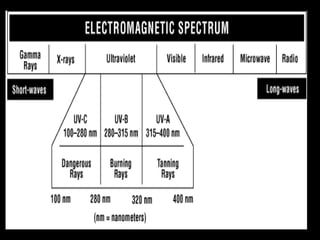
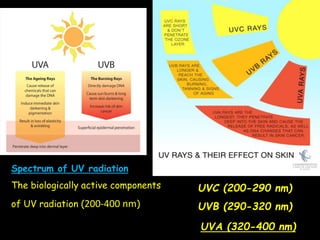
Spectrum of UV radiation
The biologically active components
of UV radiation (200-400 nm)
UVC (200-290 nm)
UVB (290-320 nm)
UVA (320-400 nm)
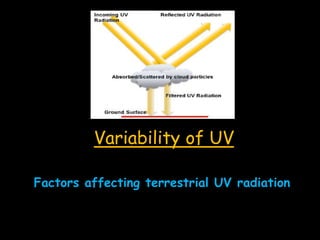
Variability of UV
Factors affecting terrestrial UV radiation
Time of study -Diurnal variation UVR. max at noon.
20%-30% of UVR - 11 am & 1 pm; 75% -9 am & 3 pm
Season – Max. in summer, min. winter
Altitude - A 1-km ↑ - 10%-25% ↑ in UVR
Surface reflection - The albedo of various surfaces cause
variation in local UVR
Cloud cover - Scattered clouds little effect on surface UVR
and complete high cloud cover ↓es by about 50%
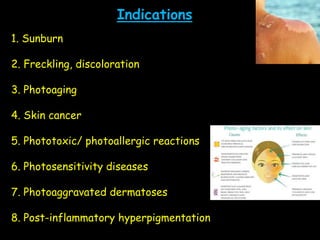
Indications
1. Sunburn
2. Freckling, discoloration
3. Photoaging
4. Skin cancer
5. Phototoxic/ photoallergic reactions
6. Photosensitivity diseases
7. Photoaggravated dermatoses
8. Post-inflammatory hyperpigmentation
Characteristics of an ideal sunscreen
• A combination of physical and chemical agents
• Broad spectrum
• Cosmetically elegant
• Substantive
• Non-irritant
• Hypoallergenic
• Non-comedogenic
• Economical
CLASSIFICATION
OF
SUNSCREENS
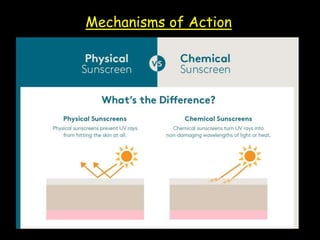
Mechanisms of Action
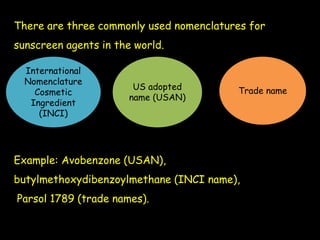
There are three commonly used nomenclatures for
sunscreen agents in the world.
Example: Avobenzone (USAN),
butylmethoxydibenzoylmethane (INCI name),
Parsol 1789 (trade names).
International
Nomenclature
Cosmetic
Ingredient
(INCI)
US adopted
name (USAN)
Trade name
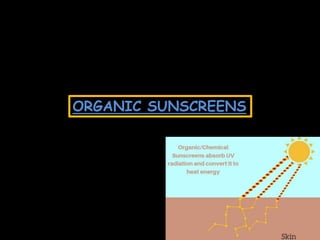
ORGANIC SUNSCREENS
Organic UV filters absorb UV radiation
Once UV filter absorbs energy, it moves from a low-
energy ground state to a high-energy excited state.
From excited state, any of following 3 processes occur,
depending on ability of filter to process absorbed
energy
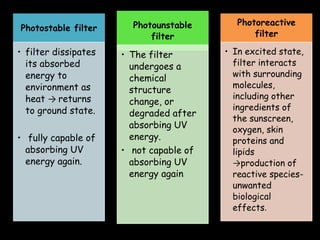
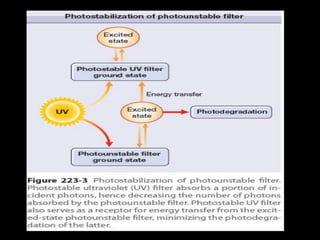
Photostable filter
• filter dissipates
its absorbed
energy to
environment as
heat → returns
to ground state.
• fully capable of
absorbing UV
energy again.
Photounstable
filter
• The filter
undergoes a
chemical
structure
change, or
degraded after
absorbing UV
energy.
• not capable of
absorbing UV
energy again
Photoreactive
filter
• In excited state,
filter interacts
with surrounding
molecules,
including other
ingredients of
the sunscreen,
oxygen, skin
proteins and
lipids
→production of
reactive species-
unwanted
biological
effects.
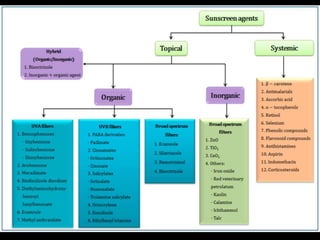
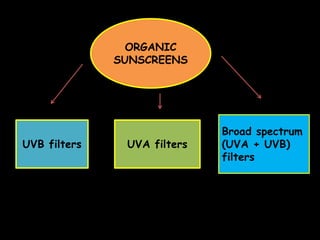
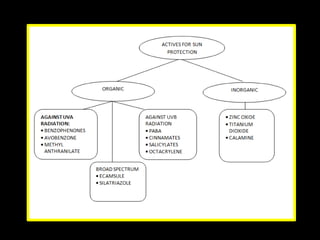
ORGANIC
SUNSCREENS
UVB filters UVA filters
Broad spectrum
(UVA + UVB)
filters
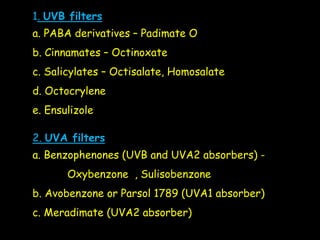
1. UVB filters
a. PABA derivatives – Padimate O
b. Cinnamates – Octinoxate
c. Salicylates – Octisalate, Homosalate
d. Octocrylene
e. Ensulizole
2. UVA filters
a. Benzophenones (UVB and UVA2 absorbers) -
Oxybenzone , Sulisobenzone
b. Avobenzone or Parsol 1789 (UVA1 absorber)
c. Meradimate (UVA2 absorber)
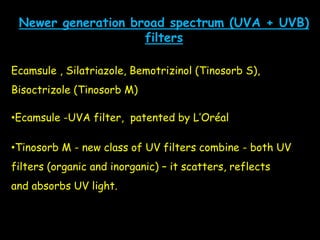
Newer generation broad spectrum (UVA + UVB)
filters
Ecamsule , Silatriazole, Bemotrizinol (Tinosorb S),
Bisoctrizole (Tinosorb M)
•Ecamsule -UVA filter, patented by L’Oréal
•Tinosorb M - new class of UV filters combine - both UV
filters (organic and inorganic) – it scatters, reflects
and absorbs UV light.
ULTRAVIOLET B BLOCKERS
Para-aminobenzoic acid
•first chemical sunscreens
•limitations – alcoholic vehicle, staining of clothes, ADR
•Ester derivatives, padimate O or octyl dimethyl PABA
assoc. with greater compatibility , lower potential for
staining and ADR
•Padimate O - most potent UV-B absorber.
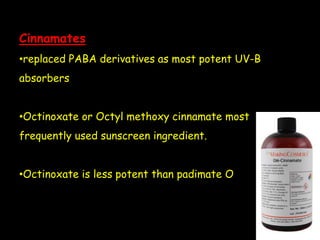
Cinnamates
•replaced PABA derivatives as most potent UV-B
absorbers
•Octinoxate or Octyl methoxy cinnamate most
frequently used sunscreen ingredient.
•Octinoxate is less potent than padimate O
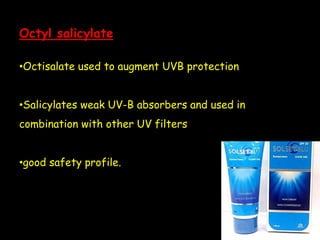
Octyl salicylate
•Octisalate used to augment UVB protection
•Salicylates weak UV-B absorbers and used in
combination with other UV filters
•good safety profile.
Octocrylene
•used in combination with other UV absorbers to
achieve higher SPF formulas
•in combination such as avobenzone, add to
overall stability of these ingredients
in a specific formula
Phenyl benzimidazole sulfonic acid/
Ensulizole
•water soluble
•lighter and less oily, such as daily use cosmetic
moisturizers.
•It is a selective UV-B filter, allowing almost all UV-
A transmission.
ULTRAVIOLET-A BLOCKERS
Benzophenone
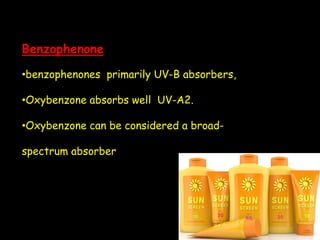
•benzophenones primarily UV-B absorbers,
•Oxybenzone absorbs well UV-A2.
•Oxybenzone can be considered a broad-
spectrum absorber
Anthranilate
•weak UV-B filters and absorb in UV-A2 portion of
spectrum
•less effective than benzophenones , less widely used.
Avobenzone
•provides superior protection through the UV-A range,
including UV-A1
•concerns regarding its photostability and
its potential to degrade other sunscreen ingredients.
Terephthalylidene dicamphor sulfonic acid or
Mexoryl SX
•protection within the near UV-A range (320- to 340-
nm)
•it is water soluble and less water resistant
Bisethylhexyloxyphenol methoxy phenyl
triazene
broadband sunscreen filter lends photostability to
avobenzone containing sunscreens.
INORGANIC SUNSCREENS
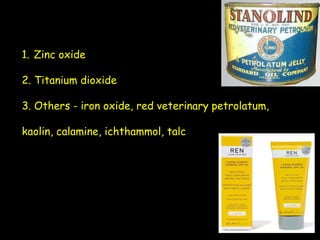
1. Zinc oxide
2. Titanium dioxide
3. Others - iron oxide, red veterinary petrolatum,
kaolin, calamine, ichthammol, talc
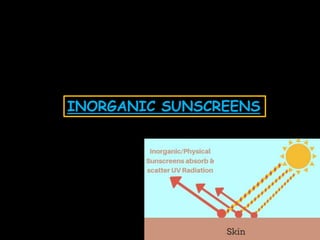
Inorganic agents function by reflecting, scattering
or absorbing UV radiation.
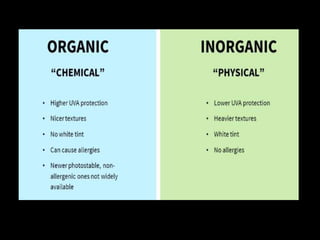
Their opaque nature and
“whitening effect” - disadvantages,
minimized by use of micronized or ultrafine
particles.
SYSTEMIC PHOTOPROTECTIVE
AGENTS
- β-carotene, Antimalarials, Ascorbic acid,
-α-tocopherols (vitamins A, C, and E), retinol,
-Selenium, green tea polyphenols, PABA,
-Indomethacin, corticosteroids
SUNSCREEN-RELATED INDICES
The efficacy of a
product is related to
its SPF and
Substantivity
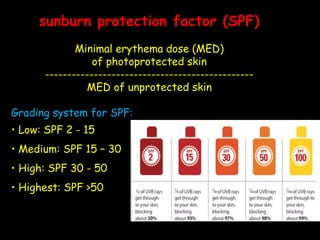
sunburn protection factor (SPF)
Minimal erythema dose (MED)
of photoprotected skin
-----------------------------------------------
MED of unprotected skin
Grading system for SPF:
• Low: SPF 2 - 15
• Medium: SPF 15 – 30
• High: SPF 30 - 50
• Highest: SPF >50
•Important - aware -good SPF value will not protect
skin from entire UV spectrum.
•In 2007, FDA proposed expansion of SPF changed to
“sunburn protection factor” to indicate - index of
protection against sunburn or UVB-induced erythema,
does not imply UVA or broad spectrum protection.
Substantivity:
• Sweat-resistant: protects upto 30 mins of continuous
heavy perspiration
• Water-resistant: protects upto 40 mins of continuous
water exposure
• Waterproof: protects for upto 80 mins of continuous
water exposure
PABA and its esters demonstrate more resistance to
sweating and/or water immersion than other chemical
sunscreens
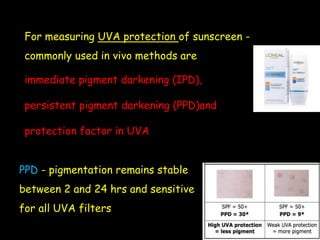
For measuring UVA protection of sunscreen -
commonly used in vivo methods are
immediate pigment darkening (IPD),
persistent pigment darkening (PPD)and
protection factor in UVA
PPD - pigmentation remains stable
between 2 and 24 hrs and sensitive
for all UVA filters
UVA protection indices
Japanese standard (persistent pigment darkening)
UVA protection factor (UVA PF)
UVA dose that induces persistent pigment
darkening 2 to 24 hrs after exposure in
sunscreen protected skin
------------------------------------------------------------
UVA dose that induces persistent pigment
darkening 2 to 24 hrs after exposure in
unprotected skin
Broadspectrum protective effect evaluated-
spectrophotometry – assesses critical wavelength
value(wavelength below which 90% of sunscreen’s UV
absorbency occurs measured at 290 to 400 nm)
broad-spectrum sunscreens should have critical
wavelength of ˃370 nm and a PPD in UVA greater than 4.
Immune protection factor (IPF)
•Ability to prevent UV-induced immunosuppression
• assessed by ability - inhibit either sensitization or
elicitation of delayed-type HS reactions to allergens
such as dinitrochlorobenzene (DNCB) , nickel
• IPF - correlates better with UVA-protectiveness of
a sunscreen than with its SPF
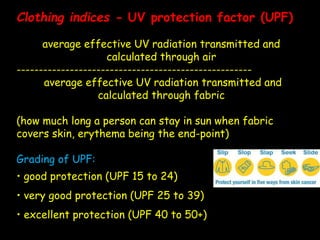
Clothing indices - UV protection factor (UPF)
average effective UV radiation transmitted and
calculated through air
-----------------------------------------------------
average effective UV radiation transmitted and
calculated through fabric
(how much long a person can stay in sun when fabric
covers skin, erythema being the end-point)
Grading of UPF:
• good protection (UPF 15 to 24)
• very good protection (UPF 25 to 39)
• excellent protection (UPF 40 to 50+)
Group 1: Polyester, best UV absorber
Group 2: Wool, silk and nylon
Group 3: Cotton and rayon (cellulosic
fibers), poorest absorbers
UV absorbers
Factors that affect UPF of a fabric-
1. Tightly woven thicker fibers - better UPF.
2. Washing ↑ UPF( shrinkage ),hydration ↓.
3. Fabrics prone to stretch - lower UPF
4. Chemical treatment -bleaching agents results in
attenuation of UV rays.
5. Colored fabric - greater UPF.
6. Greater distance of fabric from skin- photoprotection.
Sunglass standards
• Luminous transmittance
Amount of light
transmitted through a sunglass lens (e.g. lens with
20% luminous transmittance allows 20% of light to
pass through it)
• The Australian Standard (AS/NZS 1067:2003)
classifies sunglasses and fashion spectacles
based on the amount of UV radiation that passes
through the lenses
SUNSCREEN-RELATED DEFINITIONS
Critical wavelength: wavelength below which
90% of sunscreen’s UV absorbency occurs
Broad spectrum sunscreen: Critical wavelength > 370 nm
AND UVA protection factor > 4
Water-resistant sunscreen: Maintains label SPF value
after two sequential immersions in water for 20 min (40
min)
Very water-resistant sunscreen: Maintains label SPF
value after four sequential immersions in water for 20
min
SUNSCREEN APPLICATION
The ideal sunscreen should have a high SPF
rating, be well tolerated, cosmetically pleasant,
non-toxic, equally effective against UVA and UVB,
photostable, water-resistant and inexpensive
RECOMMENDATIONS FOR SUNSCREEN
APPLICATION
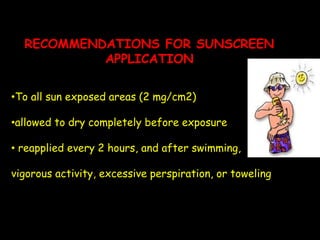
•To all sun exposed areas (2 mg/cm2)
•allowed to dry completely before exposure
• reapplied every 2 hours, and after swimming,
vigorous activity, excessive perspiration, or toweling
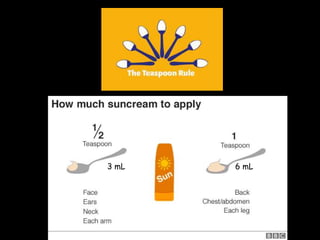
3 mL 6 mL
•Individuals do not apply enough to
achieve adequate protection
•only 20-50% of required amount used
by most
•To cover the average 1.73 m2 adult,
approx 35ml required
•Using adequate amount (2 mg/cm2)
provides greater sun protection than
using an inadequate amount of a
sunscreen with a higher SPF rating.
DEBATABLE ISSUES
Sunscreen use in infants
•not known to be hazardous, not recommended for
infants ˂ 6 months
•recommended that aminobenzoic acid should be
avoided in children ˂ 6 months
Contact dermatitis
•Most common cause oxybenzone
•Sunscreens -contain aminobenzoic acid and its esters
(PABA), cinnamates and oxybenzone cause
photosensitivity reactions.
•A new nitrosamine - NPABAO was found in certain
sunscreens containing padimate-O.
•Nitrosamines themselves carcinogenic but uncertain
whether this is present in sufficient quantities in
sunscreens to be of concern
Nanosized particles
• range in size from 1-100 nm.
•Microfine forms ZnO and TiO2 particle size of 20-
50 nm.
• inorganic sunscreens more cosmetically acceptable
(less whitening )
•In recent years, nanoparticles can induce free radical
formation in presence of UV radiation
•However studies show particles remain on surface of
skin or s.corneum, hence safe for human use.
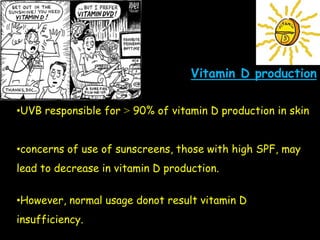
Vitamin D production
•UVB responsible for ˃ 90% of vitamin D production in skin
•concerns of use of sunscreens, those with high SPF, may
lead to decrease in vitamin D production.
•However, normal usage donot result vitamin D
insufficiency.
Hormonal effects
Oxybenzone, avobenzone, octinoxate, padimate O
-estrogenic/anti-androgenic properties in animal
studies
-endocrine effects remain controversial, warranting
further human studies.
PHOTOPROTECTION FOR HAIR
•1⁰ photoaging effect of sunlight on hair →
oxymelanin production → lightening of hair + disulphide
bond disruption → physical weakening of hair shaft.
• shampoos, conditioners and hairstyling products-
photoprotection.
•The degree of protection – minimal
• thicker application result better photoprotection-
difficult - massive surface area
•A better approach - use of clothing, such as a cap, hat,
scarf or umbrella.
NEW SUNSCREEN TECHNOLOGIES
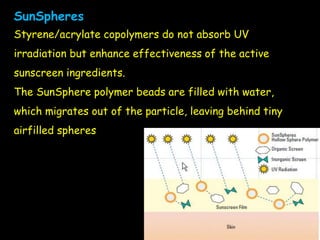
SunSpheres
Styrene/acrylate copolymers do not absorb UV
irradiation but enhance effectiveness of the active
sunscreen ingredients.
The SunSphere polymer beads are filled with water,
which migrates out of the particle, leaving behind tiny
airfilled spheres
Microencapsulation
Active sunscreen ingredients entrapped within a
silica shell→ allergic or irritant reactions to
active ingredient minimized, and incompatible
sunscreen ingredients can be safely combined,
without loss of efficacy.
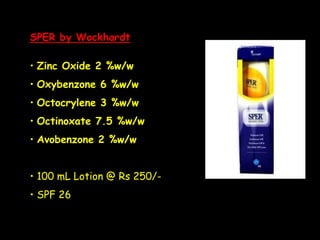
SPER by Wockhardt
• Zinc Oxide 2 %w/w
• Oxybenzone 6 %w/w
• Octocrylene 3 %w/w
• Octinoxate 7.5 %w/w
• Avobenzone 2 %w/w
• 100 mL Lotion @ Rs 250/-
• SPF 26
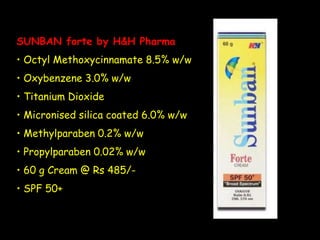
SUNBAN forte by H&H Pharma
• Octyl Methoxycinnamate 8.5% w/w
• Oxybenzene 3.0% w/w
• Titanium Dioxide
• Micronised silica coated 6.0% w/w
• Methylparaben 0.2% w/w
• Propylparaben 0.02% w/w
• 60 g Cream @ Rs 485/-
• SPF 50+
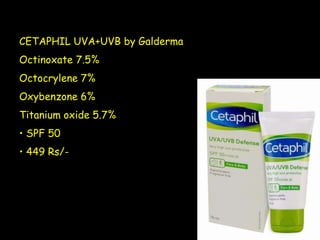
CETAPHIL UVA+UVB by Galderma
Octinoxate 7.5%
Octocrylene 7%
Oxybenzone 6%
Titanium oxide 5.7%
• SPF 50
• 449 Rs/-
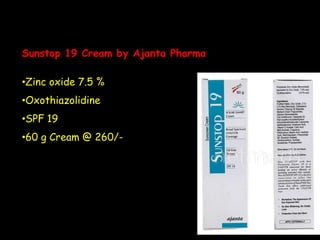
Sunstop 19 Cream by Ajanta Pharma
•Zinc oxide 7.5 %
•Oxothiazolidine
•SPF 19
•60 g Cream @ 260/-
FUTURE TRENDS IN PHOTOPROTECTION
•Antioxidants - caffeic acid, poly podium
leukotomes, zinc, polyphenolic compounds, isoflavone,
N-acetylcysteine and butyrated hydroxytoluene
(synthetic antioxidant)
•Calcitriol and citrus , free radical scavengers.
• Plant oligosaccharides and genistein - prevention of UV
induced immunosuppression
GUIDELINES FOR PHOTOPROTECTION
• Avoid direct sun exposure - 10 AM and 4 PM
• Seek shade to shelter from DSE
• Wear protective clothing, hats, and sunglasses
• Apply sunscreen - exposed skin - outdoors
• Use sunscreen with SPF ≥ 30 labeled as Broad spectrum
• Use adequate sunscreen to cover exposed skin
• Apply sunscreen 15 minutes before
• Use a water resistant sunscreen if going to swim or perspire
heavily
• Re-apply sunscreen every 2 hours or after swimming or
excessive sweating
• Spray sunscreens -applied liberally to achieve rated SPF
Sunscreens
Sunscreens

Sunscreens

  • 1.
  • 2.
    - Greeks -olive oil - Egyptians - extracts of rice, jasmine, and lupine plants - Early synthetic sunscreens emulsion containing benzyl salicylate and benzyl cinnamat - 1928. - First major commercial product -1936, introduced by founder of L'Oreal , Eugène Schueller
  • 3.
    - 1944 -Benjamin Green - Red Vet Pet (red veterinary petrolatum) red, sticky substance similar to petroleum jelly -In 1946, Franz Greiter first modern sunscreen - Gletscher Crème (Glacier Cream) - In 1974, Greiter introduced "sun protection factor" (SPF) worldwide standard for measuring effectiveness of sunscreen
  • 4.
    Photoprotective agents protect skinby preventing and minimizing damaging effects of UV rays of natural light. Alter UV-Radiation effects on skin by absorption and/or reflection
  • 6.
    Spectrum of UVradiation The biologically active components of UV radiation (200-400 nm) UVC (200-290 nm) UVB (290-320 nm) UVA (320-400 nm)
  • 7.
    Variability of UV Factorsaffecting terrestrial UV radiation
  • 8.
    Time of study-Diurnal variation UVR. max at noon. 20%-30% of UVR - 11 am & 1 pm; 75% -9 am & 3 pm Season – Max. in summer, min. winter Altitude - A 1-km ↑ - 10%-25% ↑ in UVR Surface reflection - The albedo of various surfaces cause variation in local UVR Cloud cover - Scattered clouds little effect on surface UVR and complete high cloud cover ↓es by about 50%
  • 9.
    Indications 1. Sunburn 2. Freckling,discoloration 3. Photoaging 4. Skin cancer 5. Phototoxic/ photoallergic reactions 6. Photosensitivity diseases 7. Photoaggravated dermatoses 8. Post-inflammatory hyperpigmentation
  • 10.
    Characteristics of anideal sunscreen • A combination of physical and chemical agents • Broad spectrum • Cosmetically elegant • Substantive • Non-irritant • Hypoallergenic • Non-comedogenic • Economical
  • 11.
  • 12.
  • 15.
    There are threecommonly used nomenclatures for sunscreen agents in the world. Example: Avobenzone (USAN), butylmethoxydibenzoylmethane (INCI name), Parsol 1789 (trade names). International Nomenclature Cosmetic Ingredient (INCI) US adopted name (USAN) Trade name
  • 16.
  • 17.
    Organic UV filtersabsorb UV radiation Once UV filter absorbs energy, it moves from a low- energy ground state to a high-energy excited state. From excited state, any of following 3 processes occur, depending on ability of filter to process absorbed energy
  • 18.
    Photostable filter • filterdissipates its absorbed energy to environment as heat → returns to ground state. • fully capable of absorbing UV energy again. Photounstable filter • The filter undergoes a chemical structure change, or degraded after absorbing UV energy. • not capable of absorbing UV energy again Photoreactive filter • In excited state, filter interacts with surrounding molecules, including other ingredients of the sunscreen, oxygen, skin proteins and lipids →production of reactive species- unwanted biological effects.
  • 20.
    ORGANIC SUNSCREENS UVB filters UVAfilters Broad spectrum (UVA + UVB) filters
  • 21.
    1. UVB filters a.PABA derivatives – Padimate O b. Cinnamates – Octinoxate c. Salicylates – Octisalate, Homosalate d. Octocrylene e. Ensulizole 2. UVA filters a. Benzophenones (UVB and UVA2 absorbers) - Oxybenzone , Sulisobenzone b. Avobenzone or Parsol 1789 (UVA1 absorber) c. Meradimate (UVA2 absorber)
  • 22.
    Newer generation broadspectrum (UVA + UVB) filters Ecamsule , Silatriazole, Bemotrizinol (Tinosorb S), Bisoctrizole (Tinosorb M) •Ecamsule -UVA filter, patented by L’Oréal •Tinosorb M - new class of UV filters combine - both UV filters (organic and inorganic) – it scatters, reflects and absorbs UV light.
  • 23.
  • 24.
    Para-aminobenzoic acid •first chemicalsunscreens •limitations – alcoholic vehicle, staining of clothes, ADR •Ester derivatives, padimate O or octyl dimethyl PABA assoc. with greater compatibility , lower potential for staining and ADR •Padimate O - most potent UV-B absorber.
  • 25.
    Cinnamates •replaced PABA derivativesas most potent UV-B absorbers •Octinoxate or Octyl methoxy cinnamate most frequently used sunscreen ingredient. •Octinoxate is less potent than padimate O
  • 26.
    Octyl salicylate •Octisalate usedto augment UVB protection •Salicylates weak UV-B absorbers and used in combination with other UV filters •good safety profile.
  • 27.
    Octocrylene •used in combinationwith other UV absorbers to achieve higher SPF formulas •in combination such as avobenzone, add to overall stability of these ingredients in a specific formula
  • 28.
    Phenyl benzimidazole sulfonicacid/ Ensulizole •water soluble •lighter and less oily, such as daily use cosmetic moisturizers. •It is a selective UV-B filter, allowing almost all UV- A transmission.
  • 29.
  • 30.
    Benzophenone •benzophenones primarily UV-Babsorbers, •Oxybenzone absorbs well UV-A2. •Oxybenzone can be considered a broad- spectrum absorber
  • 31.
    Anthranilate •weak UV-B filtersand absorb in UV-A2 portion of spectrum •less effective than benzophenones , less widely used. Avobenzone •provides superior protection through the UV-A range, including UV-A1 •concerns regarding its photostability and its potential to degrade other sunscreen ingredients.
  • 32.
    Terephthalylidene dicamphor sulfonicacid or Mexoryl SX •protection within the near UV-A range (320- to 340- nm) •it is water soluble and less water resistant Bisethylhexyloxyphenol methoxy phenyl triazene broadband sunscreen filter lends photostability to avobenzone containing sunscreens.
  • 33.
  • 34.
    1. Zinc oxide 2.Titanium dioxide 3. Others - iron oxide, red veterinary petrolatum, kaolin, calamine, ichthammol, talc
  • 35.
    Inorganic agents functionby reflecting, scattering or absorbing UV radiation. Their opaque nature and “whitening effect” - disadvantages, minimized by use of micronized or ultrafine particles.
  • 36.
    SYSTEMIC PHOTOPROTECTIVE AGENTS - β-carotene,Antimalarials, Ascorbic acid, -α-tocopherols (vitamins A, C, and E), retinol, -Selenium, green tea polyphenols, PABA, -Indomethacin, corticosteroids
  • 37.
  • 38.
    The efficacy ofa product is related to its SPF and Substantivity
  • 39.
    sunburn protection factor(SPF) Minimal erythema dose (MED) of photoprotected skin ----------------------------------------------- MED of unprotected skin Grading system for SPF: • Low: SPF 2 - 15 • Medium: SPF 15 – 30 • High: SPF 30 - 50 • Highest: SPF >50
  • 40.
    •Important - aware-good SPF value will not protect skin from entire UV spectrum. •In 2007, FDA proposed expansion of SPF changed to “sunburn protection factor” to indicate - index of protection against sunburn or UVB-induced erythema, does not imply UVA or broad spectrum protection.
  • 41.
    Substantivity: • Sweat-resistant: protectsupto 30 mins of continuous heavy perspiration • Water-resistant: protects upto 40 mins of continuous water exposure • Waterproof: protects for upto 80 mins of continuous water exposure PABA and its esters demonstrate more resistance to sweating and/or water immersion than other chemical sunscreens
  • 42.
    For measuring UVAprotection of sunscreen - commonly used in vivo methods are immediate pigment darkening (IPD), persistent pigment darkening (PPD)and protection factor in UVA PPD - pigmentation remains stable between 2 and 24 hrs and sensitive for all UVA filters
  • 43.
    UVA protection indices Japanesestandard (persistent pigment darkening) UVA protection factor (UVA PF) UVA dose that induces persistent pigment darkening 2 to 24 hrs after exposure in sunscreen protected skin ------------------------------------------------------------ UVA dose that induces persistent pigment darkening 2 to 24 hrs after exposure in unprotected skin
  • 44.
    Broadspectrum protective effectevaluated- spectrophotometry – assesses critical wavelength value(wavelength below which 90% of sunscreen’s UV absorbency occurs measured at 290 to 400 nm) broad-spectrum sunscreens should have critical wavelength of ˃370 nm and a PPD in UVA greater than 4.
  • 45.
    Immune protection factor(IPF) •Ability to prevent UV-induced immunosuppression • assessed by ability - inhibit either sensitization or elicitation of delayed-type HS reactions to allergens such as dinitrochlorobenzene (DNCB) , nickel • IPF - correlates better with UVA-protectiveness of a sunscreen than with its SPF
  • 46.
    Clothing indices -UV protection factor (UPF) average effective UV radiation transmitted and calculated through air ----------------------------------------------------- average effective UV radiation transmitted and calculated through fabric (how much long a person can stay in sun when fabric covers skin, erythema being the end-point) Grading of UPF: • good protection (UPF 15 to 24) • very good protection (UPF 25 to 39) • excellent protection (UPF 40 to 50+)
  • 47.
    Group 1: Polyester,best UV absorber Group 2: Wool, silk and nylon Group 3: Cotton and rayon (cellulosic fibers), poorest absorbers
  • 48.
    UV absorbers Factors thataffect UPF of a fabric- 1. Tightly woven thicker fibers - better UPF. 2. Washing ↑ UPF( shrinkage ),hydration ↓. 3. Fabrics prone to stretch - lower UPF 4. Chemical treatment -bleaching agents results in attenuation of UV rays. 5. Colored fabric - greater UPF. 6. Greater distance of fabric from skin- photoprotection.
  • 49.
    Sunglass standards • Luminoustransmittance Amount of light transmitted through a sunglass lens (e.g. lens with 20% luminous transmittance allows 20% of light to pass through it) • The Australian Standard (AS/NZS 1067:2003) classifies sunglasses and fashion spectacles based on the amount of UV radiation that passes through the lenses
  • 50.
  • 51.
    Critical wavelength: wavelengthbelow which 90% of sunscreen’s UV absorbency occurs Broad spectrum sunscreen: Critical wavelength > 370 nm AND UVA protection factor > 4 Water-resistant sunscreen: Maintains label SPF value after two sequential immersions in water for 20 min (40 min) Very water-resistant sunscreen: Maintains label SPF value after four sequential immersions in water for 20 min
  • 52.
    SUNSCREEN APPLICATION The idealsunscreen should have a high SPF rating, be well tolerated, cosmetically pleasant, non-toxic, equally effective against UVA and UVB, photostable, water-resistant and inexpensive
  • 53.
    RECOMMENDATIONS FOR SUNSCREEN APPLICATION •Toall sun exposed areas (2 mg/cm2) •allowed to dry completely before exposure • reapplied every 2 hours, and after swimming, vigorous activity, excessive perspiration, or toweling
  • 54.
  • 55.
    •Individuals do notapply enough to achieve adequate protection •only 20-50% of required amount used by most •To cover the average 1.73 m2 adult, approx 35ml required •Using adequate amount (2 mg/cm2) provides greater sun protection than using an inadequate amount of a sunscreen with a higher SPF rating.
  • 56.
  • 57.
    Sunscreen use ininfants •not known to be hazardous, not recommended for infants ˂ 6 months •recommended that aminobenzoic acid should be avoided in children ˂ 6 months
  • 58.
    Contact dermatitis •Most commoncause oxybenzone •Sunscreens -contain aminobenzoic acid and its esters (PABA), cinnamates and oxybenzone cause photosensitivity reactions.
  • 59.
    •A new nitrosamine- NPABAO was found in certain sunscreens containing padimate-O. •Nitrosamines themselves carcinogenic but uncertain whether this is present in sufficient quantities in sunscreens to be of concern
  • 60.
    Nanosized particles • rangein size from 1-100 nm. •Microfine forms ZnO and TiO2 particle size of 20- 50 nm. • inorganic sunscreens more cosmetically acceptable (less whitening ) •In recent years, nanoparticles can induce free radical formation in presence of UV radiation •However studies show particles remain on surface of skin or s.corneum, hence safe for human use.
  • 61.
    Vitamin D production •UVBresponsible for ˃ 90% of vitamin D production in skin •concerns of use of sunscreens, those with high SPF, may lead to decrease in vitamin D production. •However, normal usage donot result vitamin D insufficiency.
  • 62.
    Hormonal effects Oxybenzone, avobenzone,octinoxate, padimate O -estrogenic/anti-androgenic properties in animal studies -endocrine effects remain controversial, warranting further human studies.
  • 63.
    PHOTOPROTECTION FOR HAIR •1⁰photoaging effect of sunlight on hair → oxymelanin production → lightening of hair + disulphide bond disruption → physical weakening of hair shaft. • shampoos, conditioners and hairstyling products- photoprotection. •The degree of protection – minimal • thicker application result better photoprotection- difficult - massive surface area •A better approach - use of clothing, such as a cap, hat, scarf or umbrella.
  • 64.
  • 65.
    SunSpheres Styrene/acrylate copolymers donot absorb UV irradiation but enhance effectiveness of the active sunscreen ingredients. The SunSphere polymer beads are filled with water, which migrates out of the particle, leaving behind tiny airfilled spheres
  • 66.
    Microencapsulation Active sunscreen ingredientsentrapped within a silica shell→ allergic or irritant reactions to active ingredient minimized, and incompatible sunscreen ingredients can be safely combined, without loss of efficacy.
  • 67.
    SPER by Wockhardt •Zinc Oxide 2 %w/w • Oxybenzone 6 %w/w • Octocrylene 3 %w/w • Octinoxate 7.5 %w/w • Avobenzone 2 %w/w • 100 mL Lotion @ Rs 250/- • SPF 26
  • 68.
    SUNBAN forte byH&H Pharma • Octyl Methoxycinnamate 8.5% w/w • Oxybenzene 3.0% w/w • Titanium Dioxide • Micronised silica coated 6.0% w/w • Methylparaben 0.2% w/w • Propylparaben 0.02% w/w • 60 g Cream @ Rs 485/- • SPF 50+
  • 69.
    CETAPHIL UVA+UVB byGalderma Octinoxate 7.5% Octocrylene 7% Oxybenzone 6% Titanium oxide 5.7% • SPF 50 • 449 Rs/-
  • 70.
    Sunstop 19 Creamby Ajanta Pharma •Zinc oxide 7.5 % •Oxothiazolidine •SPF 19 •60 g Cream @ 260/-
  • 71.
    FUTURE TRENDS INPHOTOPROTECTION •Antioxidants - caffeic acid, poly podium leukotomes, zinc, polyphenolic compounds, isoflavone, N-acetylcysteine and butyrated hydroxytoluene (synthetic antioxidant) •Calcitriol and citrus , free radical scavengers. • Plant oligosaccharides and genistein - prevention of UV induced immunosuppression
  • 72.
    GUIDELINES FOR PHOTOPROTECTION •Avoid direct sun exposure - 10 AM and 4 PM • Seek shade to shelter from DSE • Wear protective clothing, hats, and sunglasses • Apply sunscreen - exposed skin - outdoors • Use sunscreen with SPF ≥ 30 labeled as Broad spectrum • Use adequate sunscreen to cover exposed skin • Apply sunscreen 15 minutes before • Use a water resistant sunscreen if going to swim or perspire heavily • Re-apply sunscreen every 2 hours or after swimming or excessive sweating • Spray sunscreens -applied liberally to achieve rated SPF