
Polymers in Controlled Release DDS
Dr. Prashant L. Pingale
Associate Professor, Dept. of Pharmaceutics
GES’s Sir Dr. M. S. Gosavi College of Pharm. Edu. & Research,
Nashik-422005, INDIA
Content…
 Introduction,
 Classification,
 Properties,
 Advantages and
 Application of polymers in formulation of controlled release drug delivery
systems
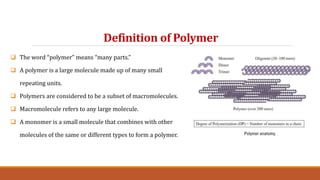
Definition of Polymer
 The word “polymer” means “many parts.”
 A polymer is a large molecule made up of many small
repeating units.
 Polymers are considered to be a subset of macromolecules.
 Macromolecule refers to any large molecule.
 A monomer is a small molecule that combines with other
molecules of the same or different types to form a polymer.
Controlled Drug Delivery System
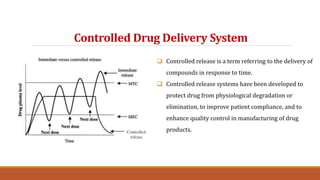
 Controlled release is a term referring to the delivery of
compounds in response to time.
 Controlled release systems have been developed to
protect drug from physiological degradation or
elimination, to improve patient compliance, and to
enhance quality control in manufacturing of drug
products.
Significance of Polymers in CRDDS
 In the field of drug delivery, polymers are becoming increasingly significant.
 Polymers are the major tool for controlling the medication release rate from the formulation.
 Polymers can be used to conceal the flavor of a medicine, improve its stability, and change its
release properties.
 In medicine and other fields, biodegradable materials are used.
 Biodegradable polymers have become more popular in recent years.
Classification of Polymers
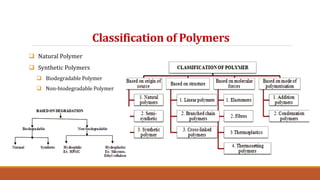
 Natural Polymer
 Synthetic Polymers
 Biodegradable Polymer
 Non-biodegradable Polymer
Natural Polymer
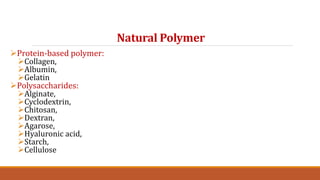
Protein-based polymer:
Collagen,
Albumin,
Gelatin
Polysaccharides:
Alginate,
Cyclodextrin,
Chitosan,
Dextran,
Agarose,
Hyaluronic acid,
Starch,
Cellulose
Synthetic Polymers
Biodegradable Polymer
 Polyester: Poly lactic acid, Poly glycolic acid, Poly hydroxyl butyrate, Polyester,
Polycaprolactone, Poly lactide-co-glycolide (PLGA), Poly diaxonone
 Polyanhydride: Poly adepic acid, Poly sebacic acid, Poly terpthalic acid
 Polyamides: Poly amino acid, Poly imino carbonate
 Phosphorous based polymer: Polyphosphates, Poly phosphonates, Poly Phosphazenes
 Others: Poly cyanoacrylates, Poly urethanes, Poly ortho ester, Polyacetals etc.
Synthetic Polymers
Non-Biodegradable polymers
 Cellulose derivative: Carboxy methyl cellulose, Ethyl cellulose, Cellulose acetate, hydroxyl
propyl methyl cellulose.
 Silicons: Polydimethyl siloxane, Colloidal silica, Polymethacrylate, Polymethyl methacrylate
 Others: Poly vinyl pyrolidine, Ethyl vinyl acetate, Poloxamine etc.
Biodegradable Polymer
 From a toxicological standpoint, biodegradable macromolecules are
unquestionably preferable.
 Natural polymers and their modified derivatives (e.g. starch, cellulose) as well as
synthetic polymers (e.g. polyacrylamides, polyacrylates, and polyethyleneglycol)
are utilised in the technology of prolonged release medication formulation.
 In order to build a good medication delivery system, the polymer matrix must be
chosen carefully.
Biodegradable Polymer
 Degradable polymers are favoured for medication delivery applications since
they do not require surgical removal.
 They disintegrate into smaller, more absorbable molecules, therefore it's crucial
to ensure sure the monomers are not hazardous.
 Polylactide (PLA) and Poly Lactide co Glycolide (PLGA) are the most commonly
utilised polymers for this application.
 These polymers have been utilised in biomedical applications for over 20 years
and are biodegradable, biocompatible, and non-toxic.
Non-Biodegradable Polymers
 Non-degradable polymers have the primary disadvantage of requiring surgery to
remove them from the body once the medication has been depleted.
 As a result, non-biodegradable polymers can only be used if the implant can be
easily removed.
Advantages of polymers in CRDDS
 Controlled medication delivery has become one of the most demanding and rapidly growing
scientific fields in the last four decades.
 Polymers are the most promising option for controlled drug administration because of their
attractive, flexible features and ease of production at industrial scale, and potential for
further modification.
 Polymer therapeutics include linear or branched polymer chains that act as a bioactive
molecule, such as polymeric drugs, or as an inert carrier for a drug.
 Polymers play an important part in the advancement of drug delivery technology by offering
long repetitive dose and coordinated release of medicines.
Advantages of polymers in CRDDS
 The following properties are used to classify the polymers for medication delivery:
 Source: A polymer might be synthetic, natural, or a mix of the two.
 Chemical nature: polyester, polyanhydride, protein-based, cellulose derivatives, and so on
can all be used.
 Backbone stability: either biodegradable or nonbiodegradable polymers exist.
 Solubility: The polymer can be either hydrophilic or hydrophobic in nature.
 However, each of the above characteristics has its own set of constraints, such as the fact
that natural polymers, while abundant and biodegradable, are difficult to copy and purify.
 Synthetic polymers have a high immunogenicity, which prevents them from being used
for lengthy periods of time.
Advantages of polymers in CRDDS
 There are several advantages to using a polymer as an inert carrier to which a drug can be
conjugated.
 Rheumatoid arthritis, diabetes, hepatitis B and C, cancer, and ischemia have all been
targeted with polymer conjugates.
 More advanced multifunctional polymer-based drug delivery systems are being proposed.
 In the past two decades, the arena of polymer therapeutics and the design of polymer-drug
conjugates has seen expanding very rapidly.
 This is a critical for the persistent growth of this field and will continue to harvest
accomplishment in the synthesis of novel biopharmaceuticals.
Application of polymers in formulation of
controlled release drug delivery systems
 The Ocuserts System:
 The use of conventional drug delivery systems, such as drops
and ointments, to transport therapeutic agents to the eye for
the treatment of eye problems (e.g., glaucoma), is an
inefficient process.
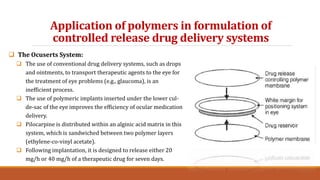
 The use of polymeric implants inserted under the lower cul-
de-sac of the eye improves the efficiency of ocular medication
delivery.
 Pilocarpine is distributed within an alginic acid matrix in this
system, which is sandwiched between two polymer layers
(ethylene-co-vinyl acetate).
 Following implantation, it is designed to release either 20
mg/h or 40 mg/h of a therapeutic drug for seven days.
Application of polymers in formulation of
controlled release drug delivery systems
 Transdermal Patches:
 Transdermal medication delivery entails the drug
diffusing through the skin and eventually being
absorbed into the systemic circulation.
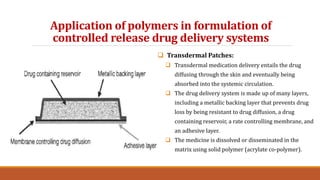
 The drug delivery system is made up of many layers,
including a metallic backing layer that prevents drug
loss by being resistant to drug diffusion, a drug
containing reservoir, a rate controlling membrane, and
an adhesive layer.
 The medicine is dissolved or disseminated in the
matrix using solid polymer (acrylate co-polymer).
Polymers in controlled release Drug Delivery System

Polymers in controlled release Drug Delivery System

  • 1.
    Polymers in ControlledRelease DDS Dr. Prashant L. Pingale Associate Professor, Dept. of Pharmaceutics GES’s Sir Dr. M. S. Gosavi College of Pharm. Edu. & Research, Nashik-422005, INDIA
  • 2.
    Content…  Introduction,  Classification, Properties,  Advantages and  Application of polymers in formulation of controlled release drug delivery systems
  • 3.
    Definition of Polymer The word “polymer” means “many parts.”  A polymer is a large molecule made up of many small repeating units.  Polymers are considered to be a subset of macromolecules.  Macromolecule refers to any large molecule.  A monomer is a small molecule that combines with other molecules of the same or different types to form a polymer.
  • 4.
    Controlled Drug DeliverySystem  Controlled release is a term referring to the delivery of compounds in response to time.  Controlled release systems have been developed to protect drug from physiological degradation or elimination, to improve patient compliance, and to enhance quality control in manufacturing of drug products.
  • 5.
    Significance of Polymersin CRDDS  In the field of drug delivery, polymers are becoming increasingly significant.  Polymers are the major tool for controlling the medication release rate from the formulation.  Polymers can be used to conceal the flavor of a medicine, improve its stability, and change its release properties.  In medicine and other fields, biodegradable materials are used.  Biodegradable polymers have become more popular in recent years.
  • 6.
    Classification of Polymers Natural Polymer  Synthetic Polymers  Biodegradable Polymer  Non-biodegradable Polymer
  • 7.
  • 8.
    Synthetic Polymers Biodegradable Polymer Polyester: Poly lactic acid, Poly glycolic acid, Poly hydroxyl butyrate, Polyester, Polycaprolactone, Poly lactide-co-glycolide (PLGA), Poly diaxonone  Polyanhydride: Poly adepic acid, Poly sebacic acid, Poly terpthalic acid  Polyamides: Poly amino acid, Poly imino carbonate  Phosphorous based polymer: Polyphosphates, Poly phosphonates, Poly Phosphazenes  Others: Poly cyanoacrylates, Poly urethanes, Poly ortho ester, Polyacetals etc.
  • 9.
    Synthetic Polymers Non-Biodegradable polymers Cellulose derivative: Carboxy methyl cellulose, Ethyl cellulose, Cellulose acetate, hydroxyl propyl methyl cellulose.  Silicons: Polydimethyl siloxane, Colloidal silica, Polymethacrylate, Polymethyl methacrylate  Others: Poly vinyl pyrolidine, Ethyl vinyl acetate, Poloxamine etc.
  • 10.
    Biodegradable Polymer  Froma toxicological standpoint, biodegradable macromolecules are unquestionably preferable.  Natural polymers and their modified derivatives (e.g. starch, cellulose) as well as synthetic polymers (e.g. polyacrylamides, polyacrylates, and polyethyleneglycol) are utilised in the technology of prolonged release medication formulation.  In order to build a good medication delivery system, the polymer matrix must be chosen carefully.
  • 11.
    Biodegradable Polymer  Degradablepolymers are favoured for medication delivery applications since they do not require surgical removal.  They disintegrate into smaller, more absorbable molecules, therefore it's crucial to ensure sure the monomers are not hazardous.  Polylactide (PLA) and Poly Lactide co Glycolide (PLGA) are the most commonly utilised polymers for this application.  These polymers have been utilised in biomedical applications for over 20 years and are biodegradable, biocompatible, and non-toxic.
  • 12.
    Non-Biodegradable Polymers  Non-degradablepolymers have the primary disadvantage of requiring surgery to remove them from the body once the medication has been depleted.  As a result, non-biodegradable polymers can only be used if the implant can be easily removed.
  • 13.
    Advantages of polymersin CRDDS  Controlled medication delivery has become one of the most demanding and rapidly growing scientific fields in the last four decades.  Polymers are the most promising option for controlled drug administration because of their attractive, flexible features and ease of production at industrial scale, and potential for further modification.  Polymer therapeutics include linear or branched polymer chains that act as a bioactive molecule, such as polymeric drugs, or as an inert carrier for a drug.  Polymers play an important part in the advancement of drug delivery technology by offering long repetitive dose and coordinated release of medicines.
  • 14.
    Advantages of polymersin CRDDS  The following properties are used to classify the polymers for medication delivery:  Source: A polymer might be synthetic, natural, or a mix of the two.  Chemical nature: polyester, polyanhydride, protein-based, cellulose derivatives, and so on can all be used.  Backbone stability: either biodegradable or nonbiodegradable polymers exist.  Solubility: The polymer can be either hydrophilic or hydrophobic in nature.  However, each of the above characteristics has its own set of constraints, such as the fact that natural polymers, while abundant and biodegradable, are difficult to copy and purify.  Synthetic polymers have a high immunogenicity, which prevents them from being used for lengthy periods of time.
  • 15.
    Advantages of polymersin CRDDS  There are several advantages to using a polymer as an inert carrier to which a drug can be conjugated.  Rheumatoid arthritis, diabetes, hepatitis B and C, cancer, and ischemia have all been targeted with polymer conjugates.  More advanced multifunctional polymer-based drug delivery systems are being proposed.  In the past two decades, the arena of polymer therapeutics and the design of polymer-drug conjugates has seen expanding very rapidly.  This is a critical for the persistent growth of this field and will continue to harvest accomplishment in the synthesis of novel biopharmaceuticals.
  • 16.
    Application of polymersin formulation of controlled release drug delivery systems  The Ocuserts System:  The use of conventional drug delivery systems, such as drops and ointments, to transport therapeutic agents to the eye for the treatment of eye problems (e.g., glaucoma), is an inefficient process.  The use of polymeric implants inserted under the lower cul- de-sac of the eye improves the efficiency of ocular medication delivery.  Pilocarpine is distributed within an alginic acid matrix in this system, which is sandwiched between two polymer layers (ethylene-co-vinyl acetate).  Following implantation, it is designed to release either 20 mg/h or 40 mg/h of a therapeutic drug for seven days.
  • 17.
    Application of polymersin formulation of controlled release drug delivery systems  Transdermal Patches:  Transdermal medication delivery entails the drug diffusing through the skin and eventually being absorbed into the systemic circulation.  The drug delivery system is made up of many layers, including a metallic backing layer that prevents drug loss by being resistant to drug diffusion, a drug containing reservoir, a rate controlling membrane, and an adhesive layer.  The medicine is dissolved or disseminated in the matrix using solid polymer (acrylate co-polymer).