Sunscreens
Presented By
Simran
M.Pharmacy 2nd sem
GGSCOP, YNR
Introduction
 Sunscreen (also known as sunblock or suntan lotion is a lotion, spray, gel or other
topical product that absorbs or reflects the sun’s ultraviolet (UV) radiation and
protects the skin.
 Using lotions, creams, or gel that contain sunscreens can help protect the skin
from premature aging and damage that may lead to skin cancer.
Ideal sun-screen characteristics
 Absorb light preferentially over the range of 280-320nm.
 Resistance to water
 Be stable to heat, light and perspiration.
 Preferably odorless, if mild odor: accepted by user
 Be non-toxic, non-irritant, non-sensitizing
 Capable of retaining sun screening property for several hours
 Non-stain
 Not be rapidly absorbed.
 Be neutral
 Be rapidly soluble in suitable vehicles.
Sun Protection
 Protection from sunlight is often equated with use of sunscreens, but this approach
is too narrow, and protection should consist of : avoiding overexposure to
sunlight, using sunscreens, and wearing protective clothing.
 Solar ultraviolet (UV) radiation influences the skin, causing aging, sunburns,
precancerous and cancerous lesions, and immunosuppression.
 Sun protection is essential to skin can prevent about 90% of non melanoma skin
cancers and 80% of melanomas are associated with exposure to UV radiation
from the skin.
 UV radiation comprises of 3 categories depending on wavelengths are:
 UVA: low energy
 ranges between 320 to 400 nm
 most responsible radiation for immediate tanning or darkening of the skin due to excess
production of melanin in the epidermis
 UVB: high energy
 ranges between 280 to 320 nm
 known as burning rays as they are 1000 times more capable of causing sunburn than UV-A
 UVC: Very high energy
 ranges between 200 to 280 nm
 filtered by stratospheric ozone layers so less effective and hazardous
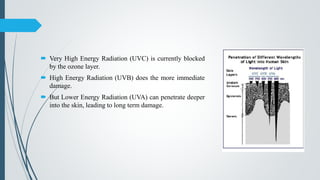
 Very High Energy Radiation (UVC) is currently blocked
by the ozone layer.
 High Energy Radiation (UVB) does the more immediate
damage.
 But Lower Energy Radiation (UVA) can penetrate deeper
into the skin, leading to long term damage.
Mechanism of photoreaction
Photo-oxidative mechanism depending on light-driven reactive oxygen species
(ROS) generation is now accepted to cause skin photoaging and photo
carcinogenesis.
• UVA rays mediated photo-oxidative damage effectively reaches
through the upper layers of skin into the human dermis and
dermal capillary system
• Substantial protein and lipid oxidation occurs in human skin
epidermis and dermis.
• Together with a significant depletion of enzymatic and non-
enzymatic antioxidants in the stratum corneum epidermis and
dermis.
Why use sun-screen?
 Too much unprotected sun exposure leads to:
 Premature skin aging
 Sun-burn
 Skin cancer
Sunscreen classifications
 Physical
 - opaque formulations containing:
 titanium dioxide- UV filter- it helps protect skin by blocking absorption of the sun’s
UV light
 talc, kaolin- lubricant
 zinc oxide- work by scattering the sun’s rays, which prevents damaging UV radiation
from getting to the skin.
 Ferric chloride- increase the absorption and protection against visible light and UVA
radiation.
 Ichthyol, red petrolatum- treatment of skin blemishes, redness or itching associated
with various skin disorders.
Mechanism: scatters or reflects uv radiation due to large particle size.
Sunscreen classifications
 Chemical
 - Formulations containing one or more:
 PABA, PABA ester- can absorb ultraviolet (UV) rays
 benzophenone- absorbs and scatters the sun’s harmful ultraviolet (UV) rays.
 Cinnamate- flavouring or fragrance, also good UVB absorbers
 salicylate- weakly absorbing UVB filters.
 digalloyl trioleate- anti-oxidizing
 Anthranilates- sunscreen agent and as an ultraviolet light absorber.
 Mechanism: absorbs UV radiation
Sunscreen agents
 PABA (Para-amino benzoic acid)
 Very effective in the UV range (200-320 m).
 Most effective in conc of 5% in 70% ethanol
 Maximum benefit when applied 60 minutes prior to exposure to ensure
penetration and binding to stratum corneum.
 Contact dermatitis can develop
 May stain clothing
Sunscreen agents
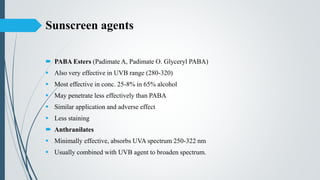
 PABA Esters (Padimate A, Padimate O. Glyceryl PABA)
 Also very effective in UVB range (280-320)
 Most effective in conc. 25-8% in 65% alcohol
 May penetrate less effectively than PABA
 Similar application and adverse effect
 Less staining
 Anthranilates
 Minimally effective, absorbs UVA spectrum 250-322 nm
 Usually combined with UVB agent to broaden spectrum.
Sunscreen agents
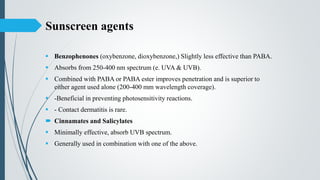
 Benzophenones (oxybenzone, dioxybenzone,) Slightly less effective than PABA.
 Absorbs from 250-400 nm spectrum (e. UVA & UVB).
 Combined with PABA or PABA ester improves penetration and is superior to
either agent used alone (200-400 mm wavelength coverage).
 -Beneficial in preventing photosensitivity reactions.
 - Contact dermatitis is rare.
 Cinnamates and Salicylates
 Minimally effective, absorb UVB spectrum.
 Generally used in combination with one of the above.
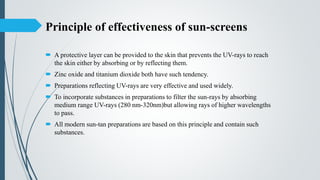
Principle of effectiveness of sun-screens
 A protective layer can be provided to the skin that prevents the UV-rays to reach
the skin either by absorbing or by reflecting them.
 Zinc oxide and titanium dioxide both have such tendency.
 Preparations reflecting UV-rays are very effective and used widely.
 To incorporate substances in preparations to filter the sun-rays by absorbing
medium range UV-rays (280 nm-320nm)but allowing rays of higher wavelengths
to pass.
 All modern sun-tan preparations are based on this principle and contain such
substances.
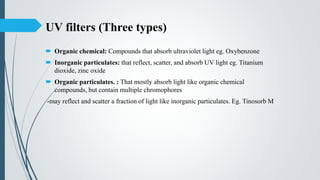
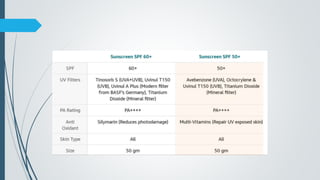
UV filters (Three types)
 Organic chemical: Compounds that absorb ultraviolet light eg. Oxybenzone
 Inorganic particulates: that reflect, scatter, and absorb UV light eg. Titanium
dioxide, zinc oxide
 Organic particulates. : That mostly absorb light like organic chemical
compounds, but contain multiple chromophores
-may reflect and scatter a fraction of light like inorganic particulates. Eg. Tinosorb M
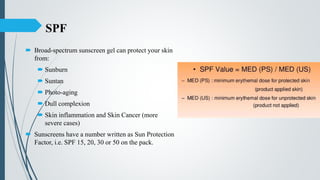
Sun protection factor (SPF)
 The term “sun protection factor” was adopted by the FDA to describe the effectiveness of
Sunscreen.
 SPF is a measure of how much solar energy (UV radiation) is required to produce sunburn on
protected skin
 The presence of sunscreen relative to the amount of solar energy required to produce sunburn
an unprotected skin.
 As the SPF value increases, sunburn protection increases SPFdefined as the UV energy
required in producing a minimal erythemal dose (MED) on protected skin, divided by the UV
energy required to produce a MED on unprotected skin
SPF
 Broad-spectrum sunscreen gel can protect your skin
from:
 Sunburn
 Suntan
 Photo-aging
 Dull complexion
 Skin inflammation and Skin Cancer (more
severe cases)
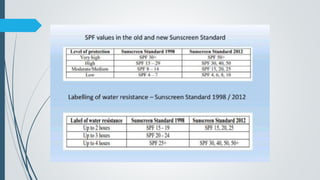
 Sunscreens have a number written as Sun Protection
Factor, i.e. SPF 15, 20, 30 or 50 on the pack.
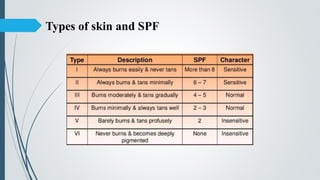
Types of skin and SPF
Regulatory aspects
 Sunscreens are evaluated generally one of following method and labeling conditions as per
countries guidelines.
 US-FDA Method
 The FDA proposal measures in-vitro UV transmittance through a sunscreen film using the
critical wavelength method. Sunscreen products offering primarily UVB protection would have
a critical wavelength less than 320nm, whereas those providing both UVB and UVA protection
would have critical wavelengths between 320 and 400nm. FDA requires that sunscreen products
have a critical wavelength of at least 370nm (the mean value must be equal to or greater than
370nm) to be labeled as providing “broad spectrum” UVA and UVB protection.
 UK method of boot star rating The UK method, called as Boots star rating system, also measures
the UV transmittance through a sunscreen film. The substrate for measurement is abraded PMMA
plates. The ratio between the mean UVA and UVB absorbance measured before and after
irradiation of the sunscreen products is calculated.
 Australia Australian standard (AS) method uses spectrophotometer for measurements of the solar
radiation transmitted by a sunscreen product to yield a percentage of UVA radiation absorbed by
the product. According to this test, a product is designated as a long wave protector only if it
transmits less than 10% of the incoming UV radiation between 320 and 360 nm.
 India Indian being Asian population comes under Type–IV skin pattern which burns minimally
and tans easily. Freckles are rare but still use of sunscreen is necessary to avoid tan. Indian
regulations date from the Indian Drug and Cosmetic Act (1940) as amended from time to time
considers sunscreens as cosmetics. Bureau of Indian Standards (BIS), a participating member of
the ISO, sets the relevant cosmetic product standards. Key points are stability data is (similar to
Australia) must and there is no maximum SPF rating for sunscreens.
 Japan: Japan Cosmetic Industry Association (JCIA) provides self regulated standards.
JCIA is a signatory to the COLIPA International SPF test method and JCIA has adopted
ISO standards as they are published. For SPF, ISO 24444 is accepted. In Japan, for UVA,
in-vivo testing is required and labelling is according to ratings of Protection Grade of
UVA (PA) i.e PA +, PA++ and PA +++. Additionally, PA++++ was also added from 1st
January 2013.
 China Sunscreens are regulated under the Hygienic Standard for Cosmetics 2007.
Currently sunscreens can only be labeled up to SPF 30+. The product must be labeled in
Chinese language and have a Chinese name. Water resistance norms should be followed if
labelled.
Thank you!!!

Sunscreen, Classifications, Sun Protection Factor(SPF), Regulatory aspects

  • 1.
  • 2.
    Introduction  Sunscreen (alsoknown as sunblock or suntan lotion is a lotion, spray, gel or other topical product that absorbs or reflects the sun’s ultraviolet (UV) radiation and protects the skin.  Using lotions, creams, or gel that contain sunscreens can help protect the skin from premature aging and damage that may lead to skin cancer.
  • 3.
    Ideal sun-screen characteristics Absorb light preferentially over the range of 280-320nm.  Resistance to water  Be stable to heat, light and perspiration.  Preferably odorless, if mild odor: accepted by user  Be non-toxic, non-irritant, non-sensitizing  Capable of retaining sun screening property for several hours  Non-stain  Not be rapidly absorbed.  Be neutral  Be rapidly soluble in suitable vehicles.
  • 4.
    Sun Protection  Protectionfrom sunlight is often equated with use of sunscreens, but this approach is too narrow, and protection should consist of : avoiding overexposure to sunlight, using sunscreens, and wearing protective clothing.  Solar ultraviolet (UV) radiation influences the skin, causing aging, sunburns, precancerous and cancerous lesions, and immunosuppression.  Sun protection is essential to skin can prevent about 90% of non melanoma skin cancers and 80% of melanomas are associated with exposure to UV radiation from the skin.
  • 5.
     UV radiationcomprises of 3 categories depending on wavelengths are:  UVA: low energy  ranges between 320 to 400 nm  most responsible radiation for immediate tanning or darkening of the skin due to excess production of melanin in the epidermis  UVB: high energy  ranges between 280 to 320 nm  known as burning rays as they are 1000 times more capable of causing sunburn than UV-A  UVC: Very high energy  ranges between 200 to 280 nm  filtered by stratospheric ozone layers so less effective and hazardous
  • 6.
     Very HighEnergy Radiation (UVC) is currently blocked by the ozone layer.  High Energy Radiation (UVB) does the more immediate damage.  But Lower Energy Radiation (UVA) can penetrate deeper into the skin, leading to long term damage.
  • 7.
    Mechanism of photoreaction Photo-oxidativemechanism depending on light-driven reactive oxygen species (ROS) generation is now accepted to cause skin photoaging and photo carcinogenesis. • UVA rays mediated photo-oxidative damage effectively reaches through the upper layers of skin into the human dermis and dermal capillary system • Substantial protein and lipid oxidation occurs in human skin epidermis and dermis. • Together with a significant depletion of enzymatic and non- enzymatic antioxidants in the stratum corneum epidermis and dermis.
  • 8.
    Why use sun-screen? Too much unprotected sun exposure leads to:  Premature skin aging  Sun-burn  Skin cancer
  • 9.
    Sunscreen classifications  Physical - opaque formulations containing:  titanium dioxide- UV filter- it helps protect skin by blocking absorption of the sun’s UV light  talc, kaolin- lubricant  zinc oxide- work by scattering the sun’s rays, which prevents damaging UV radiation from getting to the skin.  Ferric chloride- increase the absorption and protection against visible light and UVA radiation.  Ichthyol, red petrolatum- treatment of skin blemishes, redness or itching associated with various skin disorders. Mechanism: scatters or reflects uv radiation due to large particle size.
  • 10.
    Sunscreen classifications  Chemical - Formulations containing one or more:  PABA, PABA ester- can absorb ultraviolet (UV) rays  benzophenone- absorbs and scatters the sun’s harmful ultraviolet (UV) rays.  Cinnamate- flavouring or fragrance, also good UVB absorbers  salicylate- weakly absorbing UVB filters.  digalloyl trioleate- anti-oxidizing  Anthranilates- sunscreen agent and as an ultraviolet light absorber.  Mechanism: absorbs UV radiation
  • 11.
    Sunscreen agents  PABA(Para-amino benzoic acid)  Very effective in the UV range (200-320 m).  Most effective in conc of 5% in 70% ethanol  Maximum benefit when applied 60 minutes prior to exposure to ensure penetration and binding to stratum corneum.  Contact dermatitis can develop  May stain clothing
  • 12.
    Sunscreen agents  PABAEsters (Padimate A, Padimate O. Glyceryl PABA)  Also very effective in UVB range (280-320)  Most effective in conc. 25-8% in 65% alcohol  May penetrate less effectively than PABA  Similar application and adverse effect  Less staining  Anthranilates  Minimally effective, absorbs UVA spectrum 250-322 nm  Usually combined with UVB agent to broaden spectrum.
  • 13.
    Sunscreen agents  Benzophenones(oxybenzone, dioxybenzone,) Slightly less effective than PABA.  Absorbs from 250-400 nm spectrum (e. UVA & UVB).  Combined with PABA or PABA ester improves penetration and is superior to either agent used alone (200-400 mm wavelength coverage).  -Beneficial in preventing photosensitivity reactions.  - Contact dermatitis is rare.  Cinnamates and Salicylates  Minimally effective, absorb UVB spectrum.  Generally used in combination with one of the above.
  • 14.
    Principle of effectivenessof sun-screens  A protective layer can be provided to the skin that prevents the UV-rays to reach the skin either by absorbing or by reflecting them.  Zinc oxide and titanium dioxide both have such tendency.  Preparations reflecting UV-rays are very effective and used widely.  To incorporate substances in preparations to filter the sun-rays by absorbing medium range UV-rays (280 nm-320nm)but allowing rays of higher wavelengths to pass.  All modern sun-tan preparations are based on this principle and contain such substances.
  • 15.
    UV filters (Threetypes)  Organic chemical: Compounds that absorb ultraviolet light eg. Oxybenzone  Inorganic particulates: that reflect, scatter, and absorb UV light eg. Titanium dioxide, zinc oxide  Organic particulates. : That mostly absorb light like organic chemical compounds, but contain multiple chromophores -may reflect and scatter a fraction of light like inorganic particulates. Eg. Tinosorb M
  • 16.
    Sun protection factor(SPF)  The term “sun protection factor” was adopted by the FDA to describe the effectiveness of Sunscreen.  SPF is a measure of how much solar energy (UV radiation) is required to produce sunburn on protected skin  The presence of sunscreen relative to the amount of solar energy required to produce sunburn an unprotected skin.  As the SPF value increases, sunburn protection increases SPFdefined as the UV energy required in producing a minimal erythemal dose (MED) on protected skin, divided by the UV energy required to produce a MED on unprotected skin
  • 17.
    SPF  Broad-spectrum sunscreengel can protect your skin from:  Sunburn  Suntan  Photo-aging  Dull complexion  Skin inflammation and Skin Cancer (more severe cases)  Sunscreens have a number written as Sun Protection Factor, i.e. SPF 15, 20, 30 or 50 on the pack.
  • 18.
  • 22.
    Regulatory aspects  Sunscreensare evaluated generally one of following method and labeling conditions as per countries guidelines.  US-FDA Method  The FDA proposal measures in-vitro UV transmittance through a sunscreen film using the critical wavelength method. Sunscreen products offering primarily UVB protection would have a critical wavelength less than 320nm, whereas those providing both UVB and UVA protection would have critical wavelengths between 320 and 400nm. FDA requires that sunscreen products have a critical wavelength of at least 370nm (the mean value must be equal to or greater than 370nm) to be labeled as providing “broad spectrum” UVA and UVB protection.
  • 23.
     UK methodof boot star rating The UK method, called as Boots star rating system, also measures the UV transmittance through a sunscreen film. The substrate for measurement is abraded PMMA plates. The ratio between the mean UVA and UVB absorbance measured before and after irradiation of the sunscreen products is calculated.  Australia Australian standard (AS) method uses spectrophotometer for measurements of the solar radiation transmitted by a sunscreen product to yield a percentage of UVA radiation absorbed by the product. According to this test, a product is designated as a long wave protector only if it transmits less than 10% of the incoming UV radiation between 320 and 360 nm.  India Indian being Asian population comes under Type–IV skin pattern which burns minimally and tans easily. Freckles are rare but still use of sunscreen is necessary to avoid tan. Indian regulations date from the Indian Drug and Cosmetic Act (1940) as amended from time to time considers sunscreens as cosmetics. Bureau of Indian Standards (BIS), a participating member of the ISO, sets the relevant cosmetic product standards. Key points are stability data is (similar to Australia) must and there is no maximum SPF rating for sunscreens.
  • 25.
     Japan: JapanCosmetic Industry Association (JCIA) provides self regulated standards. JCIA is a signatory to the COLIPA International SPF test method and JCIA has adopted ISO standards as they are published. For SPF, ISO 24444 is accepted. In Japan, for UVA, in-vivo testing is required and labelling is according to ratings of Protection Grade of UVA (PA) i.e PA +, PA++ and PA +++. Additionally, PA++++ was also added from 1st January 2013.  China Sunscreens are regulated under the Hygienic Standard for Cosmetics 2007. Currently sunscreens can only be labeled up to SPF 30+. The product must be labeled in Chinese language and have a Chinese name. Water resistance norms should be followed if labelled.
  • 26.