
Microencapsulation
Dr. Prashant L. Pingale
Associate Professor, Dept. of Pharmaceutics
GES’s Sir Dr. M. S. Gosavi College of Pharm. Edu. & Research,
Nashik-422005, INDIA
Contents as per Syllabus
• Definition,
• Advantages & disadvantages,
• Microspheres/microcapsules,
• Microparticles,
• Methods of microencapsulation,
• Applications
2
Introduction
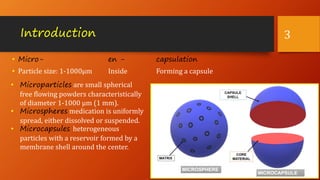
• Micro- en - capsulation
• Particle size: 1-1000μm Inside Forming a capsule
• Microparticles are small spherical
free flowing powders characteristically
of diameter 1-1000 µm (1 mm).
• Microspheres medication is uniformly
spread, either dissolved or suspended.
• Microcapsules heterogeneous
particles with a reservoir formed by a
membrane shell around the center.
3
Definition
• Microencapsulation is described as a process of enclosing micron sized particles of
solids or droplets of liquids or gasses in an inert shell, which in turn isolates and
protects them from the external environment as well as control the drug release profile.
• Microencapsulated particle is having diameter between 1-1000 µm which differ them
from other technologies such as nanotechnology and macroparticle in their morphology
and internal structure.
4
Definition
• Microencapsulation may be defined as the process of surrounding or enveloping one
substance within another substance on a very small scale, yielding capsules ranging
from less than one micron to several hundred microns in size.
• A substance or Pharmaceutical material is encapsulated over the surface of solid,
droplet of liquid and dispersion of medium is known has Microencapsulation.
• It is mean of applying thin coating to small particle of solid or droplet of liquid &
dispersion.
5
Composition
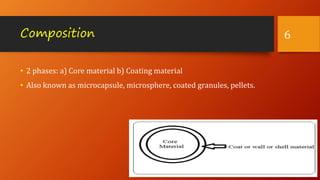
• 2 phases: a) Core material b) Coating material
• Also known as microcapsule, microsphere, coated granules, pellets.
6
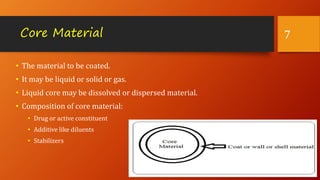
Core Material
• The material to be coated.
• It may be liquid or solid or gas.
• Liquid core may be dissolved or dispersed material.
• Composition of core material:
• Drug or active constituent
• Additive like diluents
• Stabilizers
7
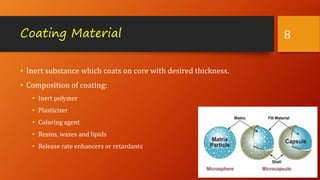
Coating Material
• Inert substance which coats on core with desired thickness.
• Composition of coating:
• Inert polymer
• Plasticizer
• Coloring agent
• Resins, waxes and lipids
• Release rate enhancers or retardants
8
The ideal characteristics of coating material are
• stabilization of core material
• inert toward active ingredients
• controlled release under specific conditions
• pliable, tasteless, stable and non-hygroscopic
• low viscosity
• soluble in an aqueous media or solvent
• should be flexible, brittle, hard, thin etc
9
Reasons for microencapsulation
• To make the formulation sustained or controlled release.
• To mask the taste & odour of bitter drugs.
• A mean of separating incompatible materials.
• The drugs, which are sensitive to oxygen, moisture or light, can be stabilized by
microencapsulation
• For converting liquid into free flowing powders.
• To prevent the gastric irritation of certain drugs.
• Water solubility or dispersability.
10
Advantages
• Formulation of controlled release and sustained release
formulations.
• Protection of the active agent or core material from
environment
• Liquids and gases can be changed in to solids in the form of
microcapsules.
• Surface and colloidal properties of some active agents can be
altered.
11
Advantages
• Masking bitter taste.
• Ex: Ofloxacin
• Conversion of liquid to pseudo solid.
• Ex: Eprazinone
• Environmental protection.
• Ex: Vit.A.Palmitate.
• Reduction of hygroscopicity.
• Ex: NaCl
• Reduction of vaporization of volatile drugs.
• Ex: Methyl salicylate
• Prevention of incompatibilities among drugs.
• Ex: Aspirin & Chlorpheniramine maleate
12
Disadvantages
• Microencapsulation techniques are of high cost.
• This causes reduction in Shelf life of hygroscopic drugs .
• Different dosage forms like tablets , capsules ,lozenges can not be encapsulated by
single microencapsulation process.
• Coating may not be uniform this can effect release pattern of a drug in the body.
• Possible cross reaction between core and shell material.
• Difficulties to achieve continuous and uniform film.
• Shelf life of hygroscopicity drugs is reduced.
• More productive costs.
• More skills and knowledge required.
• These sorts of doses should not be fractured or bitten.
13
Synonyms of Microcapsules
• Microcapsule,
• Microsphere,
• Microspanules,
• Microsperules,
• Microbeads,
• Microballones,
• Microgranules,
• Coated Granules,
• Pellets,
• Seeds,
• Spanules.
14
Microspheres
• Microspheres are defined as solid, spherical particles ranging in size from
1- 1000 µm, made up of polymeric, waxy or other protective materials.
• Spherical drug carriers are preferred over rods, cylinder, slabs, etc as they
could be injected into body in a suitable vehicle using hypodermic needle.
15
History
• The concept of packaging microscopic quantities materials within
microspheres dates to the 1930s: “the work of Bungenberg de Jong and co-
workers on the entrapment of substances within coacervates”.
• In the early 1950s Barrett K. Green developed the microencapsulation that
used the process of phase-separation coacervation.
16
Material Used
• Synthetic polymers:
• Non-biodegradable polymers
• Poly methyl methacrylate
(PMMA),
• Acrolein,
• Glycidyl methacrylate,
• Epoxy polymers
• Biodegradable polymers
• Lactides,
• Glycolides & their co polymers,
• Poly alkyl cyanoacrylates,
• Poly anhydrides
17
• Natural polymers:
Proteins: Albumin, Gelatin, and Collagen
Carbohydrates: Agarose, Carrageenan, Chitosan, Starch
Chemically modified carbohydrates: Poly dextran, Poly starch
Criteria for selection of method of preparation
• The ability to incorporate reasonably high concentrations of the drug.
• Stability of the preparation after synthesis with a clinically acceptable shelf life.
• Controlled particle size and dispersability in aqueous vehicles for injection.
• Release of active reagent with a good control over a wide time scale.
• Susceptibility to chemical modification
18
Method of Preparation
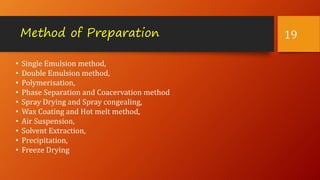
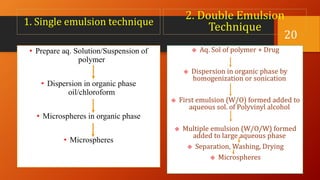
• Single Emulsion method,
• Double Emulsion method,
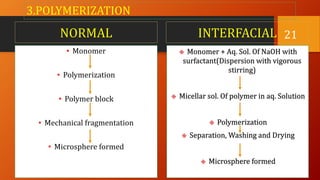
• Polymerisation,
• Phase Separation and Coacervation method
• Spray Drying and Spray congealing,
• Wax Coating and Hot melt method,
• Air Suspension,
• Solvent Extraction,
• Precipitation,
• Freeze Drying
19
1. Single emulsion technique
• Prepare aq. Solution/Suspension of
polymer
• Dispersion in organic phase
oil/chloroform
• Microspheres in organic phase
• Microspheres
20
3.POLYMERIZATION
• Monomer
• Polymerization
• Polymer block
• Mechanical fragmentation
• Microsphere formed
21
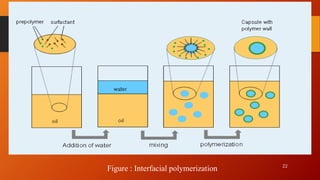
22
Figure : Interfacial polymerization
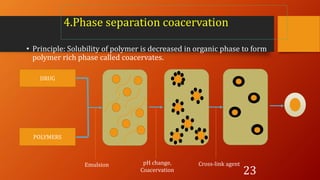
4.Phase separation coacervation
• Principle: Solubility of polymer is decreased in organic phase to form
polymer rich phase called coacervates.
23
DRUG
POLYMERS
Emulsion pH change,
Coacervation
Cross-link agent
24
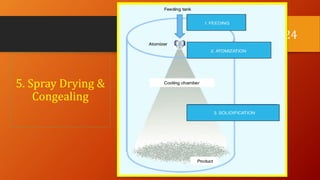
5. Spray Drying &
Congealing
25
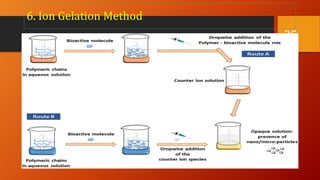
6. Ion Gelation Method
Air Suspension
• The air suspension coating process was invented by Professor Dale E. Wurster while at
the Department of Pharmacy, University of Wisconsin.
• Air suspension apparatus consists of different sections such as control panel, coating
chamber, air distribution plate, nozzle for applying film coatings.
• Within the coating chamber of air suspension apparatus particles are suspended on an
upward moving air stream.
• In the coating zone, coating material is applied by spraying to the moving core particles.
• The design and operating parameters of the chamber affect the recirculating flow of the
core particles through the coating zone.
26
Air Suspension
• The core material receives an increment of coating material, usually a
polymer solution during each pass through the coating zone.
• The cyclic process is repeated until desired coating thickness is
achieved.
• The supporting air stream helps to dry the product during
encapsulation.
• Air suspension techniques are generally applicable only to encapsulate
the solid core materials.
• The rate of drug release from the microcapsules was highly dependent
on the encapsulating materials.
27
Core material in Microsphere/microcapsulation
• Liquid Core Material
• Perfumes, Solvents, Vegetable Oils, Pesticides, Dyes, Catalysts,
Bleaches, Cosmetics, Insecticides, Sugars, Salts, Acids,
Pigments, Fungicides, Nutrients
• Solid Core Material
• Dextrins, Bases, Herbicides, Pharmaceuticals, Biocides,
Minerals
28
Coating material
• Water Soluble resins
• Gellatin
• Starch
• Hydroxyethylcellulose
• Polyvinylpyrrolidine
29
Water insoluble resins
• Ethyl Cellulose
• Polyethylene
• Polyamide
• Polymethacrylate
Waxes and resins
• Paraffin
• Beeswax
• Stearic acid
• Steryl Alcohol
Enteric resins
• Cellulose Acetate Pthalate
• Shellac
• Zein
APPLICATIONS
Vaccine delivery
In Gene delivery
In Oral drug delivery
Transdermal delivery system
Using a microparticulate carrier to target
Microspheres targeting monoclonal antibodies
Chemical embolism
Imaging
30