Nasopulmonary Drug Delivery
System
Dr. Prashant L. Pingale
Associate Professor, Dept. of Pharmaceutics
GES’s Sir Dr. M. S. Gosavi College of Pharm. Edu. & Research,
Nashik-422005, INDIA
Content
• Introduction to nasal and pulmonary routes of drug delivery,
• Formulation of:
• Inhalers (dry powder and metered dose),
• Nasal sprays,
• Nebulizers.
Nasal Drug Delivery
Introduction
 In ancient times the Indian Ayurvedic system of medicines used nasal route for
administration of drug and the process is called as “Nasya”
 Intranasal drug delivery is now recognized to be a useful and reliable alternative to
oral and parenteral routes.
 Undoubtedly, the intranasal administration of medicines for the symptomatic relief
and prevention or treatment of topical nasal conditions has been widely used for a
long period of time.
 However, recently, the nasal mucosa has seriously emerged as a therapeutically viable
route for the systemic drug delivery.
Introduction
 In general, among the primary targets for intranasal administration are
pharmacologically active compounds with poor stability in gastrointestinal fluids,
poor intestinal absorption and/or extensive hepatic first-pass elimination, such as
peptides, proteins and polar drugs.
 The nasal delivery seems to be a favorable way to circumvent the obstacles for blood-
brain barrier (BBB) allowing the direct drug delivery in the biophase of central
nervous system (CNS)-active compounds.
 It has also been considered to the administration of vaccines.
 The pulmonary and nasal delivery of biologics is intuitively attractive; it is an easy,
non-invasive administration route with readily targetable portals - the mouth and the
nostrils.
Advantages
 Hepatic first pass metabolism avoided.
 Rapid drug absorption and quick onset of action.
 Bioavailability of larger drug molecules can be improved by means of
absorption enhancer.
 BA for smaller drug molecules is good.
 Convenient for long term therapy, compared to parenteral medication.
 Drugs possessing poor stability G.I.T fluids given by nasal route.
 Easy and convenient.
 Easily administered to unconscious patients.
Disadvantages
 Pathologic conditions such as cold or allergies may alter significantly the nasal
bioavailability.
 The histological toxicity of absorption enhancers used in nasal drug delivery
system is not yet clearly established.
 Relatively inconvenient to patients when compared to oral delivery systems
since there is a possibility of nasal irritation.
 Nasal cavity provides smaller absorption surface area when compared to GIT.
Anatomy & Physiology of Nasal Cavity
 The nasal cavity consists three main regions:
1) Nasal vestibule
2) Respiratory region
 major drug absorption.
 15-20 % of the respiratory cells covered by layer of long
 cilia size 2-4 μm.
3) Olfactory region
 small area in the roof of the nasal cavity of about 10 cm2
 drug is exposed to neurons thus facilitate it across the cerebro-spinal fluid.
 Normal pH of the nasal secretions in adult - 5.5-6.5.
 Infants and young children - 5.0-6.7.
 Nasal cavity is covered with a mucous membrane.
 Mucus secretion is composed of 95% of water, 2% of mucin, 1% of salts, 1% of other proteins
like albumin, lysozyme and lactoferrin and 1% of lipids.
Parts of Nasal Cavity
Mechanism of Drug Absorption
 Paracellular(intercellular) Slow and passive absorption of peptides and proteins
associated with intercellular spaces and tight junctions.
 Transcellular: Transport of lipophilic drugs passive diffusion/active transport.
 Transcytotic: Particle is taken into a vesicle and transferred to the cell.
Mucoadhesive Nasal Drug Delivery
Potential for nasal and pulmonary delivery of biologics
Peptides • Therapies for diseases of
the respiratory tract
• Systemic delivery via the
lung or nose
• Brain delivery via the nose
• Immunization
Proteins
Stem
cells
Microbial
therapy
DNA and
RNA
therapies
Antibodies
Formulation Approaches
 Nasal gels
 Nasal Drops
 Nasal sprays
 Nasal Powder
 Liposome
 Microspheres
Pulmonary Drug Delivery System
Introduction: Pulmonary Drug Delivery System
 The respiratory tract is one of the oldest routes used for the administration of
drugs.
 Over the past decades inhalation therapy has established itself as a valuable
tool in the local therapy of pulmonary diseases such as asthma or COPD
(Chronic Obstructive Pulmonary Disease).
 This type of drug application in the therapy of these diseases is a clear form of
targeted drug delivery.
 Currently, over 25 drug substances are marketed as inhalation aerosol
products for local pulmonary effects and about the same number of drugs are
in different stages of clinical development.
Introduction: Pulmonary Drug Delivery System
 The drug used for asthma and COPD e.g. β2-agonists such as salbutamol
(albuterol), Terbutaline formoterol, corticosteroids such as budesonide, Flixotide
or beclomethasone and mast-cell stabilizers such as sodium cromoglycate or
nedocromil.
 The latest and probably one of the most promising applications of pulmonary
drug administration is
 Its use to achieve systemic absorption of the administered drug substances.
 Particularly for those drug substances that exhibit a poor bioavailability when
administered by the oral route, as for example peptides or proteins, the
respiratory tract might be a convenient port of entry.
Advantages
 It is needle free pulmonary delivery.
 It requires low and fraction of oral dose.
 Pulmonary drug delivery having very negligible side effects since rest of body
is not exposed to drug.
 Onset of action is very quick with pulmonary drug delivery.
 Degradation of drug by liver is avoided in pulmonary drug delivery.
Disadvantages
 Stability of drug in vivo.
 Transport.
 Targeting specificity.
 Drug irritation and toxicity.
 Immunogenicity of proteins
 Drug retention and clearance.
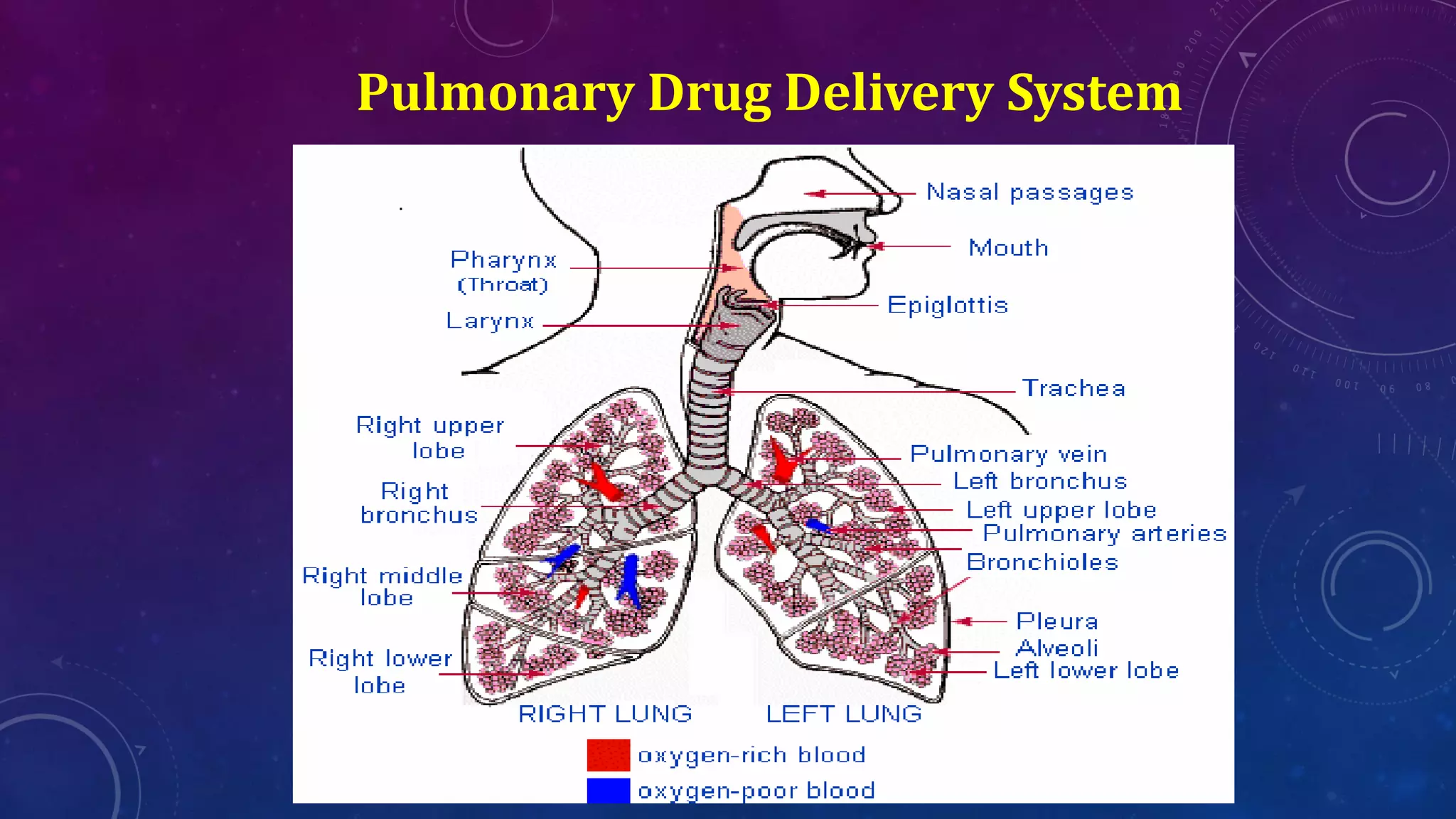
The Respiratory Tract
 The human respiratory system is a complicated organ system
of very close structure–function relationships.
 The system consisted of two regions:
 The conducting airway
 The respiratory region.
 The airway is further divided into many folds: nasal cavity and
the associated sinuses, and the nasopharynx, oropharynx,
larynx, trachea, bronchi, and bronchioles.
 The respiratory region consists of respiratory bronchioles,
alveolar ducts, and alveolar sacs
 The human respiratory tract is a branching system of air
channels with approximately 23 bifurcations from the mouth
to the alveoli.
 The major task of the lungs is gas exchange, by adding oxygen
to, and removing carbon dioxide from the blood passing the
pulmonary capillary bed.
Nasal sprays
 Both solution and suspension formulations can be formulated into nasal
sprays.
 Due to the availability of metered dose pumps and actuators, a nasal spray
can deliver an exact dose from 25 to 200 μm.
 The particles size and morphology (for suspensions) of the drug and
viscosity of the formulation determine the choice of pump and actuator
assembly.
Types of nasal sprays and their benefits
 Steroid nasal sprays
 A steroid nasal spray is an effective way of treating common nasal conditions.
 In fact in cases of persistent, moderate or severe allergic rhinitis it is the first line of
treatment.
 A steroid nasal spray,​ if used as prescribed, will not cause a rebound effect or
dependency.
 It works topically on the nasal lining and is safe even if a small amount is swallowed and
enters the bloodstream.
Types of nasal sprays and their benefits
 Saline sprays and rinses
 Saline rinses and sprays are a safe and effective option for long-term relief of the
symptoms of allergic rhinitis and chronic sinusitis.
 These rinses and sprays use a salt solution to flush out the nasal cavity, which relieves
nasal congestion.
 Menthol nasal sprays
 A nasal spray with menthol-containing compounds can also be used for the
temporary relief of nasal congestion.
 This type of nasal spray works by acting on the menthol receptor in the nose but
doesn’t actually relieve nasal congestion, even though the patient may feel better.
Dry Powder Inhalers
 A dry powder inhaler (DPI) is a breath-activated device that aerosolizes a set dose of
micronized drug in the solid state on an airstream.
 The DPI provides certain advantages regarding drug stability, ease of handling, and
range of possible dose weights to be administered.
 A dry-powder inhaler (DPI) is a device that delivers medication to the lungs in the
form of a dry powder.
 DPIs are commonly used to treat respiratory diseases such as asthma, bronchitis,
emphysema and COPD although DPIs (such as Inhalable insulin) have also been used
in the treatment of diabetes mellitus.
 DPIs are an alternative to the aerosol-based inhalers commonly called metered-dose
inhaler (or MDI).
 The DPIs may require some procedure to allow a measured dose of powder to be ready for the
patient to take.
 The medication is commonly held either in a capsule for manual loading or in a proprietary
form inside the inhaler.
 Once loaded or actuated, the operator puts the mouthpiece of the inhaler into their mouth and
takes a sharp, deep inhalation (ensuring that the medication reaches the lower parts of the
lungs), holding their breath for 5–10 seconds.
 There are a variety of such devices.
 The dose that can be delivered is typically less than a few tens of milligrams in a single breath
since larger powder doses may lead to provocation of cough.
Dry Powder Inhalers
 Breath-actuated
 Spacer not necessary
 No need to hold breath after inhalation
 Portable
 No propellant
 Less need for patient co-ordination.
 Less formulation problems.
Basic technique for using a DPI
 Exhale away from device
 Put mouthpiece in your mouth
 Breathe in quickly
Advantages of DPI
 Dependency on patient’s inspiratory flow rate and profile.
 Device resistance and other design issues.
 Greater potential problems in dose uniformity.
 More expensive than pressurized metered dose inhalers.
 Not available worldwide
 Adequate inspiratory flow required for medication delivery
 May result in high pharyngeal deposition
 Humidity potentially causes powder clumping and reduced
dispersal of fine particle mass
Disadvantages of DPI
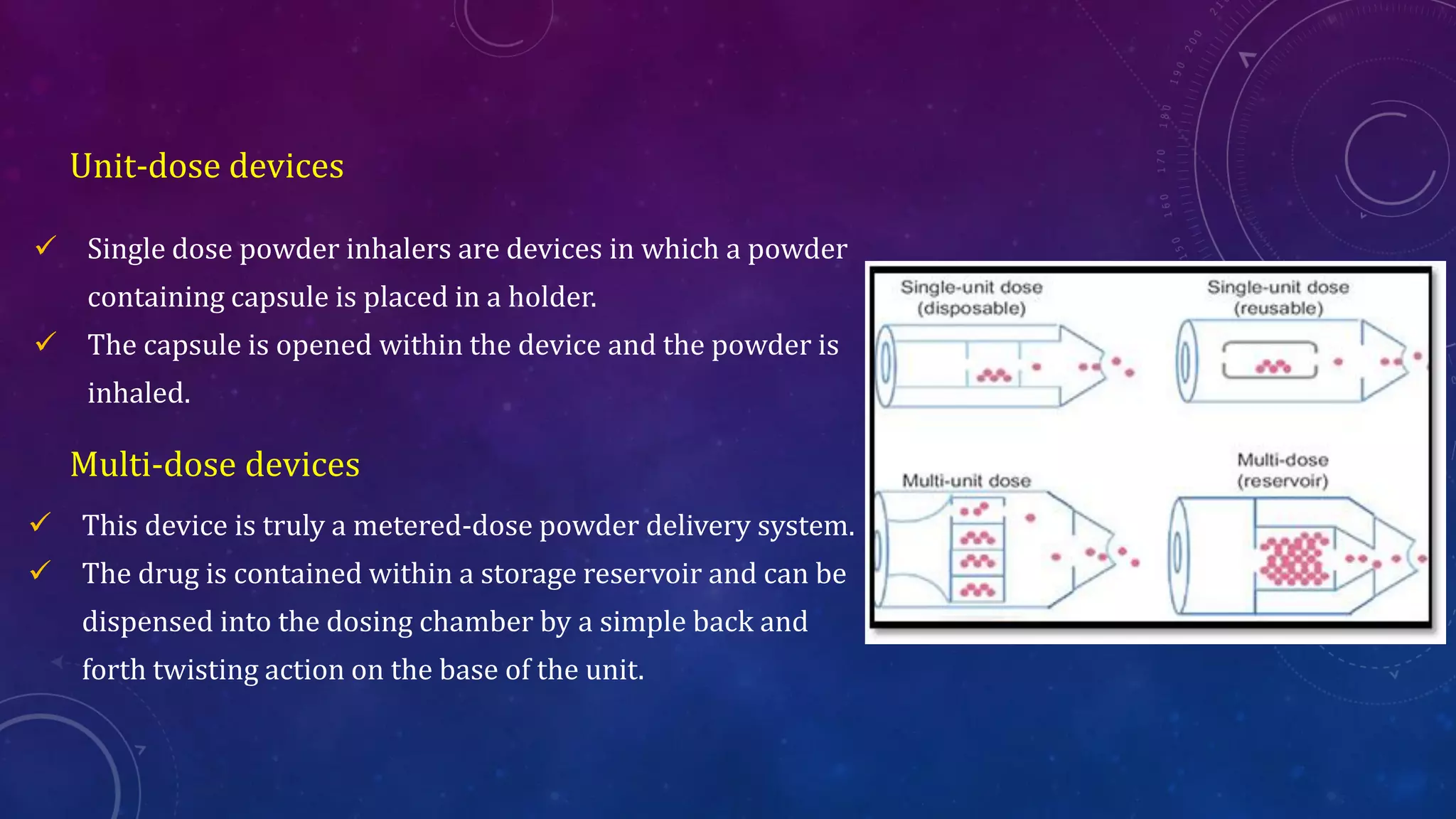
Multi-dose devices
 This device is truly a metered-dose powder delivery system.
 The drug is contained within a storage reservoir and can be
dispensed into the dosing chamber by a simple back and
forth twisting action on the base of the unit.
 Single dose powder inhalers are devices in which a powder
containing capsule is placed in a holder.
 The capsule is opened within the device and the powder is
inhaled.
Unit-dose devices
Marketed Products-DPI
 Aerolizer®
 Diskus®
 Ellipta™
 Flexhaler®
 Handihaler®
 Neohaler®
 Pressair™
 Rotahaler®
 Turbuhaler®
 Twisthaler®
Marketed Products DPI
Metered Dose Inhalers
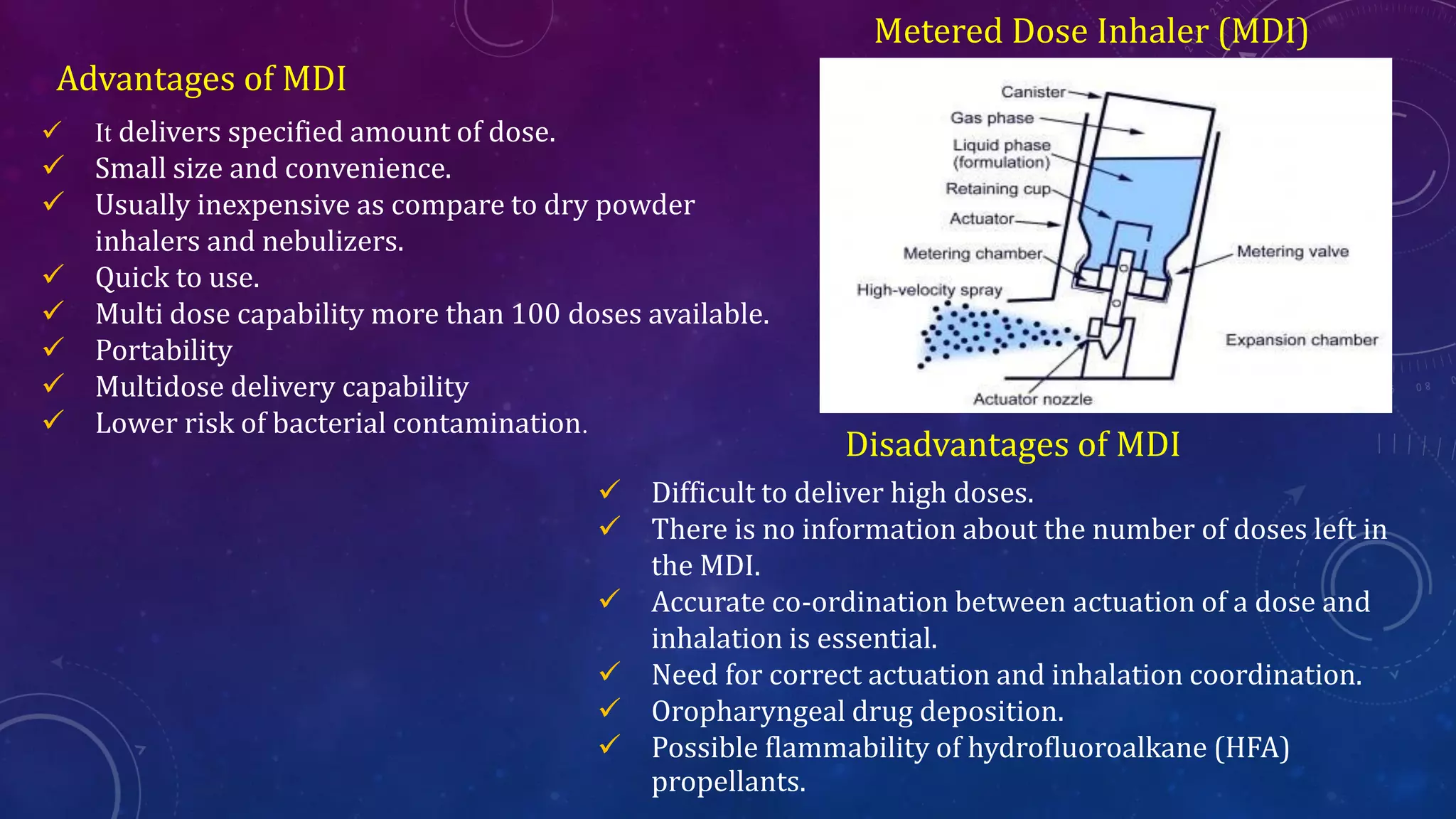
 Inhaled respiratory medications are often taken by using a device called a
metered dose inhaler, or MDI.
 The MDI is a pressurized canister of medicine in a plastic holder with a
mouthpiece.
 When sprayed, it gives a reliable, consistent dose of medication.
 A metered-dose inhaler is a small, hand-held device filled with medicine.
 It helps deliver a certain amount of medicine through the mouth and into the
lungs.
 It is commonly used to treat breathing difficulties related to asthma, chronic
obstructive pulmonary disease (COPD), and other respiratory problems.
 It delivers specified amount of dose.
 Small size and convenience.
 Usually inexpensive as compare to dry powder
inhalers and nebulizers.
 Quick to use.
 Multi dose capability more than 100 doses available.
 Portability
 Multidose delivery capability
 Lower risk of bacterial contamination.
Advantages of MDI
 Difficult to deliver high doses.
 There is no information about the number of doses left in
the MDI.
 Accurate co-ordination between actuation of a dose and
inhalation is essential.
 Need for correct actuation and inhalation coordination.
 Oropharyngeal drug deposition.
 Possible flammability of hydrofluoroalkane (HFA)
propellants.
Disadvantages of MDI
Metered Dose Inhaler (MDI)
Difference in MDI and DPI- Formulation Perspective
MDI DPI
Comparison in MDI and DPI
Marketed Products MDI
Nasopulmonary Drug Delivery System

Nasopulmonary Drug Delivery System

  • 1.
    Nasopulmonary Drug Delivery System Dr.Prashant L. Pingale Associate Professor, Dept. of Pharmaceutics GES’s Sir Dr. M. S. Gosavi College of Pharm. Edu. & Research, Nashik-422005, INDIA
  • 2.
    Content • Introduction tonasal and pulmonary routes of drug delivery, • Formulation of: • Inhalers (dry powder and metered dose), • Nasal sprays, • Nebulizers.
  • 3.
  • 4.
    Introduction  In ancienttimes the Indian Ayurvedic system of medicines used nasal route for administration of drug and the process is called as “Nasya”  Intranasal drug delivery is now recognized to be a useful and reliable alternative to oral and parenteral routes.  Undoubtedly, the intranasal administration of medicines for the symptomatic relief and prevention or treatment of topical nasal conditions has been widely used for a long period of time.  However, recently, the nasal mucosa has seriously emerged as a therapeutically viable route for the systemic drug delivery.
  • 5.
    Introduction  In general,among the primary targets for intranasal administration are pharmacologically active compounds with poor stability in gastrointestinal fluids, poor intestinal absorption and/or extensive hepatic first-pass elimination, such as peptides, proteins and polar drugs.  The nasal delivery seems to be a favorable way to circumvent the obstacles for blood- brain barrier (BBB) allowing the direct drug delivery in the biophase of central nervous system (CNS)-active compounds.  It has also been considered to the administration of vaccines.  The pulmonary and nasal delivery of biologics is intuitively attractive; it is an easy, non-invasive administration route with readily targetable portals - the mouth and the nostrils.
  • 6.
    Advantages  Hepatic firstpass metabolism avoided.  Rapid drug absorption and quick onset of action.  Bioavailability of larger drug molecules can be improved by means of absorption enhancer.  BA for smaller drug molecules is good.  Convenient for long term therapy, compared to parenteral medication.  Drugs possessing poor stability G.I.T fluids given by nasal route.  Easy and convenient.  Easily administered to unconscious patients.
  • 7.
    Disadvantages  Pathologic conditionssuch as cold or allergies may alter significantly the nasal bioavailability.  The histological toxicity of absorption enhancers used in nasal drug delivery system is not yet clearly established.  Relatively inconvenient to patients when compared to oral delivery systems since there is a possibility of nasal irritation.  Nasal cavity provides smaller absorption surface area when compared to GIT.
  • 8.
    Anatomy & Physiologyof Nasal Cavity
  • 9.
     The nasalcavity consists three main regions: 1) Nasal vestibule 2) Respiratory region  major drug absorption.  15-20 % of the respiratory cells covered by layer of long  cilia size 2-4 μm. 3) Olfactory region  small area in the roof of the nasal cavity of about 10 cm2  drug is exposed to neurons thus facilitate it across the cerebro-spinal fluid.  Normal pH of the nasal secretions in adult - 5.5-6.5.  Infants and young children - 5.0-6.7.  Nasal cavity is covered with a mucous membrane.  Mucus secretion is composed of 95% of water, 2% of mucin, 1% of salts, 1% of other proteins like albumin, lysozyme and lactoferrin and 1% of lipids. Parts of Nasal Cavity
  • 10.
    Mechanism of DrugAbsorption  Paracellular(intercellular) Slow and passive absorption of peptides and proteins associated with intercellular spaces and tight junctions.  Transcellular: Transport of lipophilic drugs passive diffusion/active transport.  Transcytotic: Particle is taken into a vesicle and transferred to the cell.
  • 11.
  • 12.
    Potential for nasaland pulmonary delivery of biologics Peptides • Therapies for diseases of the respiratory tract • Systemic delivery via the lung or nose • Brain delivery via the nose • Immunization Proteins Stem cells Microbial therapy DNA and RNA therapies Antibodies
  • 13.
    Formulation Approaches  Nasalgels  Nasal Drops  Nasal sprays  Nasal Powder  Liposome  Microspheres
  • 14.
  • 15.
    Introduction: Pulmonary DrugDelivery System  The respiratory tract is one of the oldest routes used for the administration of drugs.  Over the past decades inhalation therapy has established itself as a valuable tool in the local therapy of pulmonary diseases such as asthma or COPD (Chronic Obstructive Pulmonary Disease).  This type of drug application in the therapy of these diseases is a clear form of targeted drug delivery.  Currently, over 25 drug substances are marketed as inhalation aerosol products for local pulmonary effects and about the same number of drugs are in different stages of clinical development.
  • 16.
    Introduction: Pulmonary DrugDelivery System  The drug used for asthma and COPD e.g. β2-agonists such as salbutamol (albuterol), Terbutaline formoterol, corticosteroids such as budesonide, Flixotide or beclomethasone and mast-cell stabilizers such as sodium cromoglycate or nedocromil.  The latest and probably one of the most promising applications of pulmonary drug administration is  Its use to achieve systemic absorption of the administered drug substances.  Particularly for those drug substances that exhibit a poor bioavailability when administered by the oral route, as for example peptides or proteins, the respiratory tract might be a convenient port of entry.
  • 17.
    Advantages  It isneedle free pulmonary delivery.  It requires low and fraction of oral dose.  Pulmonary drug delivery having very negligible side effects since rest of body is not exposed to drug.  Onset of action is very quick with pulmonary drug delivery.  Degradation of drug by liver is avoided in pulmonary drug delivery.
  • 18.
    Disadvantages  Stability ofdrug in vivo.  Transport.  Targeting specificity.  Drug irritation and toxicity.  Immunogenicity of proteins  Drug retention and clearance.
  • 19.
    The Respiratory Tract The human respiratory system is a complicated organ system of very close structure–function relationships.  The system consisted of two regions:  The conducting airway  The respiratory region.  The airway is further divided into many folds: nasal cavity and the associated sinuses, and the nasopharynx, oropharynx, larynx, trachea, bronchi, and bronchioles.  The respiratory region consists of respiratory bronchioles, alveolar ducts, and alveolar sacs  The human respiratory tract is a branching system of air channels with approximately 23 bifurcations from the mouth to the alveoli.  The major task of the lungs is gas exchange, by adding oxygen to, and removing carbon dioxide from the blood passing the pulmonary capillary bed.
  • 20.
    Nasal sprays  Bothsolution and suspension formulations can be formulated into nasal sprays.  Due to the availability of metered dose pumps and actuators, a nasal spray can deliver an exact dose from 25 to 200 μm.  The particles size and morphology (for suspensions) of the drug and viscosity of the formulation determine the choice of pump and actuator assembly.
  • 21.
    Types of nasalsprays and their benefits  Steroid nasal sprays  A steroid nasal spray is an effective way of treating common nasal conditions.  In fact in cases of persistent, moderate or severe allergic rhinitis it is the first line of treatment.  A steroid nasal spray,​ if used as prescribed, will not cause a rebound effect or dependency.  It works topically on the nasal lining and is safe even if a small amount is swallowed and enters the bloodstream.
  • 22.
    Types of nasalsprays and their benefits  Saline sprays and rinses  Saline rinses and sprays are a safe and effective option for long-term relief of the symptoms of allergic rhinitis and chronic sinusitis.  These rinses and sprays use a salt solution to flush out the nasal cavity, which relieves nasal congestion.  Menthol nasal sprays  A nasal spray with menthol-containing compounds can also be used for the temporary relief of nasal congestion.  This type of nasal spray works by acting on the menthol receptor in the nose but doesn’t actually relieve nasal congestion, even though the patient may feel better.
  • 23.
    Dry Powder Inhalers A dry powder inhaler (DPI) is a breath-activated device that aerosolizes a set dose of micronized drug in the solid state on an airstream.  The DPI provides certain advantages regarding drug stability, ease of handling, and range of possible dose weights to be administered.  A dry-powder inhaler (DPI) is a device that delivers medication to the lungs in the form of a dry powder.  DPIs are commonly used to treat respiratory diseases such as asthma, bronchitis, emphysema and COPD although DPIs (such as Inhalable insulin) have also been used in the treatment of diabetes mellitus.
  • 24.
     DPIs arean alternative to the aerosol-based inhalers commonly called metered-dose inhaler (or MDI).  The DPIs may require some procedure to allow a measured dose of powder to be ready for the patient to take.  The medication is commonly held either in a capsule for manual loading or in a proprietary form inside the inhaler.  Once loaded or actuated, the operator puts the mouthpiece of the inhaler into their mouth and takes a sharp, deep inhalation (ensuring that the medication reaches the lower parts of the lungs), holding their breath for 5–10 seconds.  There are a variety of such devices.  The dose that can be delivered is typically less than a few tens of milligrams in a single breath since larger powder doses may lead to provocation of cough. Dry Powder Inhalers
  • 25.
     Breath-actuated  Spacernot necessary  No need to hold breath after inhalation  Portable  No propellant  Less need for patient co-ordination.  Less formulation problems. Basic technique for using a DPI  Exhale away from device  Put mouthpiece in your mouth  Breathe in quickly Advantages of DPI  Dependency on patient’s inspiratory flow rate and profile.  Device resistance and other design issues.  Greater potential problems in dose uniformity.  More expensive than pressurized metered dose inhalers.  Not available worldwide  Adequate inspiratory flow required for medication delivery  May result in high pharyngeal deposition  Humidity potentially causes powder clumping and reduced dispersal of fine particle mass Disadvantages of DPI
  • 26.
    Multi-dose devices  Thisdevice is truly a metered-dose powder delivery system.  The drug is contained within a storage reservoir and can be dispensed into the dosing chamber by a simple back and forth twisting action on the base of the unit.  Single dose powder inhalers are devices in which a powder containing capsule is placed in a holder.  The capsule is opened within the device and the powder is inhaled. Unit-dose devices
  • 27.
    Marketed Products-DPI  Aerolizer® Diskus®  Ellipta™  Flexhaler®  Handihaler®  Neohaler®  Pressair™  Rotahaler®  Turbuhaler®  Twisthaler®
  • 28.
  • 29.
    Metered Dose Inhalers Inhaled respiratory medications are often taken by using a device called a metered dose inhaler, or MDI.  The MDI is a pressurized canister of medicine in a plastic holder with a mouthpiece.  When sprayed, it gives a reliable, consistent dose of medication.  A metered-dose inhaler is a small, hand-held device filled with medicine.  It helps deliver a certain amount of medicine through the mouth and into the lungs.  It is commonly used to treat breathing difficulties related to asthma, chronic obstructive pulmonary disease (COPD), and other respiratory problems.
  • 30.
     It deliversspecified amount of dose.  Small size and convenience.  Usually inexpensive as compare to dry powder inhalers and nebulizers.  Quick to use.  Multi dose capability more than 100 doses available.  Portability  Multidose delivery capability  Lower risk of bacterial contamination. Advantages of MDI  Difficult to deliver high doses.  There is no information about the number of doses left in the MDI.  Accurate co-ordination between actuation of a dose and inhalation is essential.  Need for correct actuation and inhalation coordination.  Oropharyngeal drug deposition.  Possible flammability of hydrofluoroalkane (HFA) propellants. Disadvantages of MDI Metered Dose Inhaler (MDI)
  • 31.
    Difference in MDIand DPI- Formulation Perspective
  • 32.
  • 33.