SEMINAR ON
PREPARATION AND EVALUATION OF
MOISTURIZING CREAM
Presented by
AYAN PAL
M.PHARM,2nd SEM
ROLL NO-15920320008
DEPARTMENT OF PHARMACEUTICS
CALCUTTA INSTITUTE OF PHARMACEUTICAL
TECHNOLOGY AND A.H.S, ULUBERIA, HOWRAH
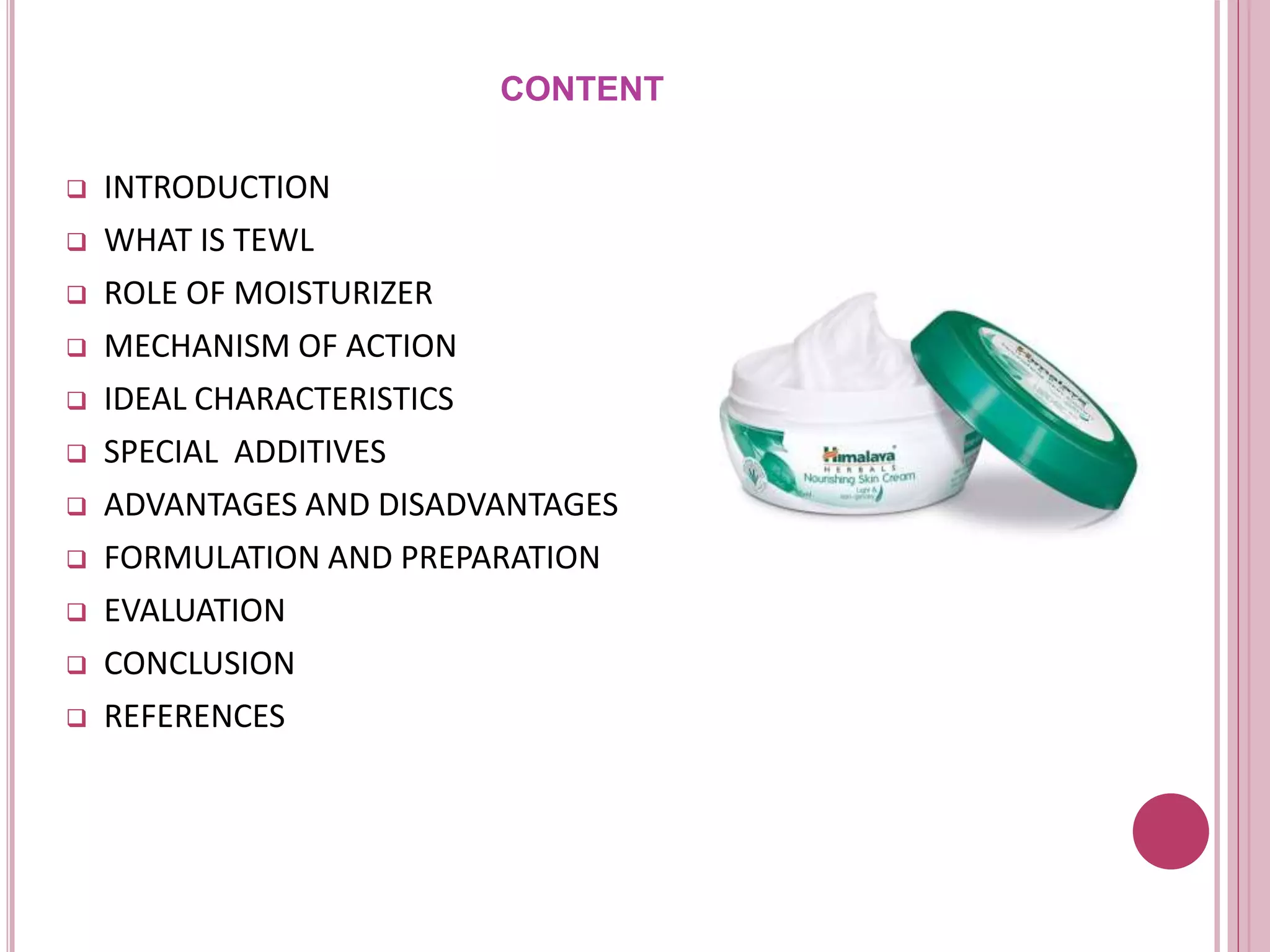
CONTENT
 INTRODUCTION
 WHAT IS TEWL
 ROLE OF MOISTURIZER
 MECHANISM OF ACTION
 IDEAL CHARACTERISTICS
 SPECIAL ADDITIVES
 ADVANTAGES AND DISADVANTAGES
 FORMULATION AND PREPARATION
 EVALUATION
 CONCLUSION
 REFERENCES
INTRODUCTION
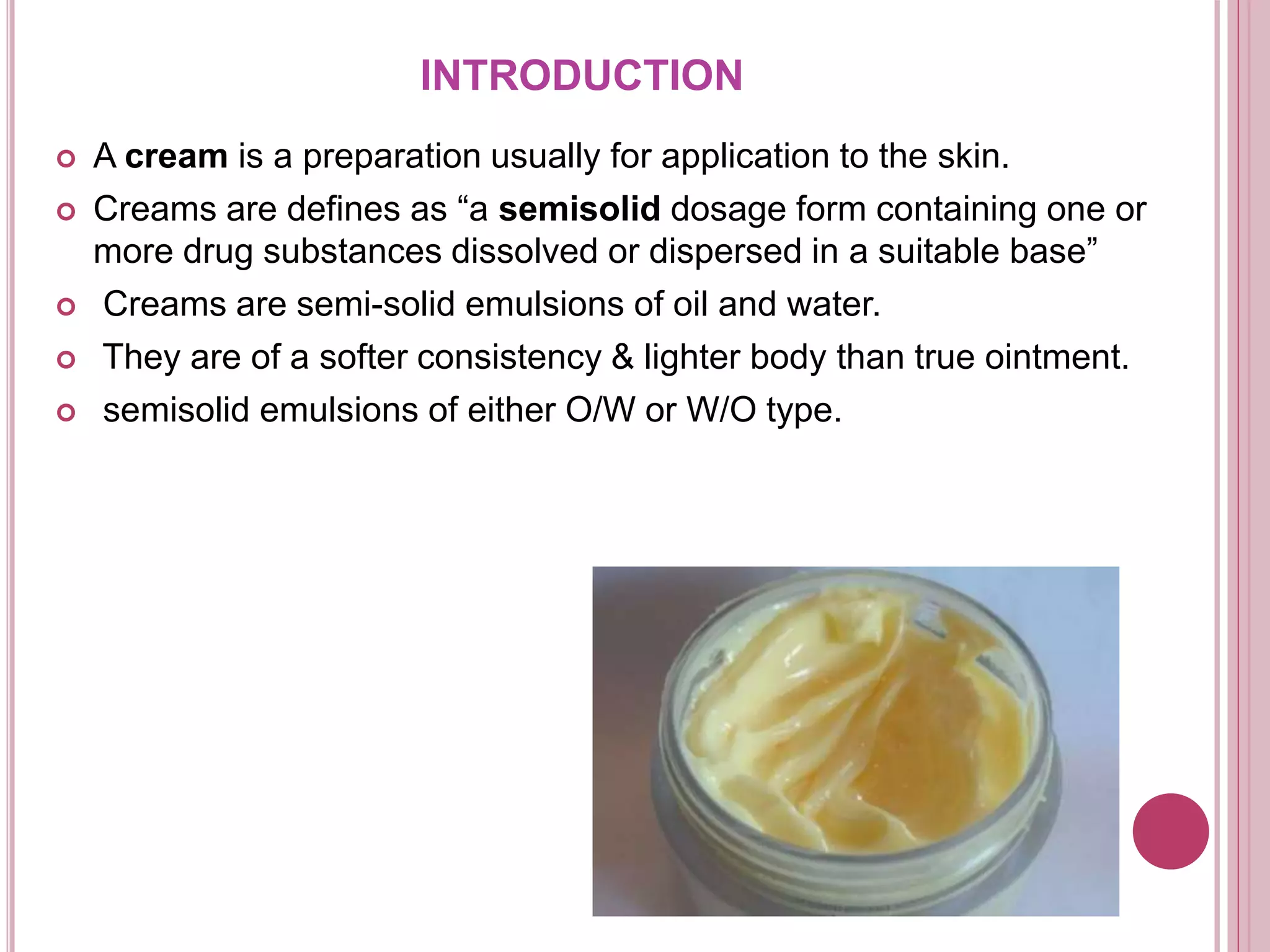
 A cream is a preparation usually for application to the skin.
 Creams are defines as “a semisolid dosage form containing one or
more drug substances dissolved or dispersed in a suitable base”
 Creams are semi-solid emulsions of oil and water.
 They are of a softer consistency & lighter body than true ointment.
 semisolid emulsions of either O/W or W/O type.
MOISTURIZING CREAM
 Moisturizer is a cosmetic preparation used for protecting,
moisturizing, and lubricating the skin.
 These are creams which restore water(moisture) to the stratum
corneum.
 Water contained in the cream is lost by evaporation when the
cream is applied to the body.
 Moisturizers are complex mixtures of chemical agents often
occlusive help hold water in the skin after application,
humectants attract moisture and emollients help smooth the
skin.
CLASIFICATION
 There are four main types of moisturizers depending
on their mechanism of action.
1) Emollients
2) Humectants
3) Occlusives
4) Protein rejuvenators
1. Emollients:
 They are mainly lipids and oils, which hydrate and improve the skin
softness, flexibility, and smoothness.
 Eg: Cholesterol, squalene, fatty acids, fatty alcohols,
pseudoceramides
2. Humectants:
 They are basically hygroscopic compounds which mean they attract
water from two sources, from the dermis into the epidermis and in
humid conditions from the environment.
 Eg: Glycerol, propylene glycol, panthenol sorbitol, urea, alpha
hydroxy acids, hyaluronic acid
3.Occlusives:
 Oils and waxes which form an inert layer on the skin and physically
block transepidermal water loss.
 eg: Petrolatum, beeswax mineral oil, silicones, lanolin, zinc oxide
CONTINUE
4.Protein rejuvenators
 Small molecular weight proteins thought to help is skin
rejuvenation by replenishing essential proteins.
 Eg: Collagen, elastin, keratin
VARIOUS TYPES OF MOISTURIZING CREAM
CARE FOR DRY SKIN
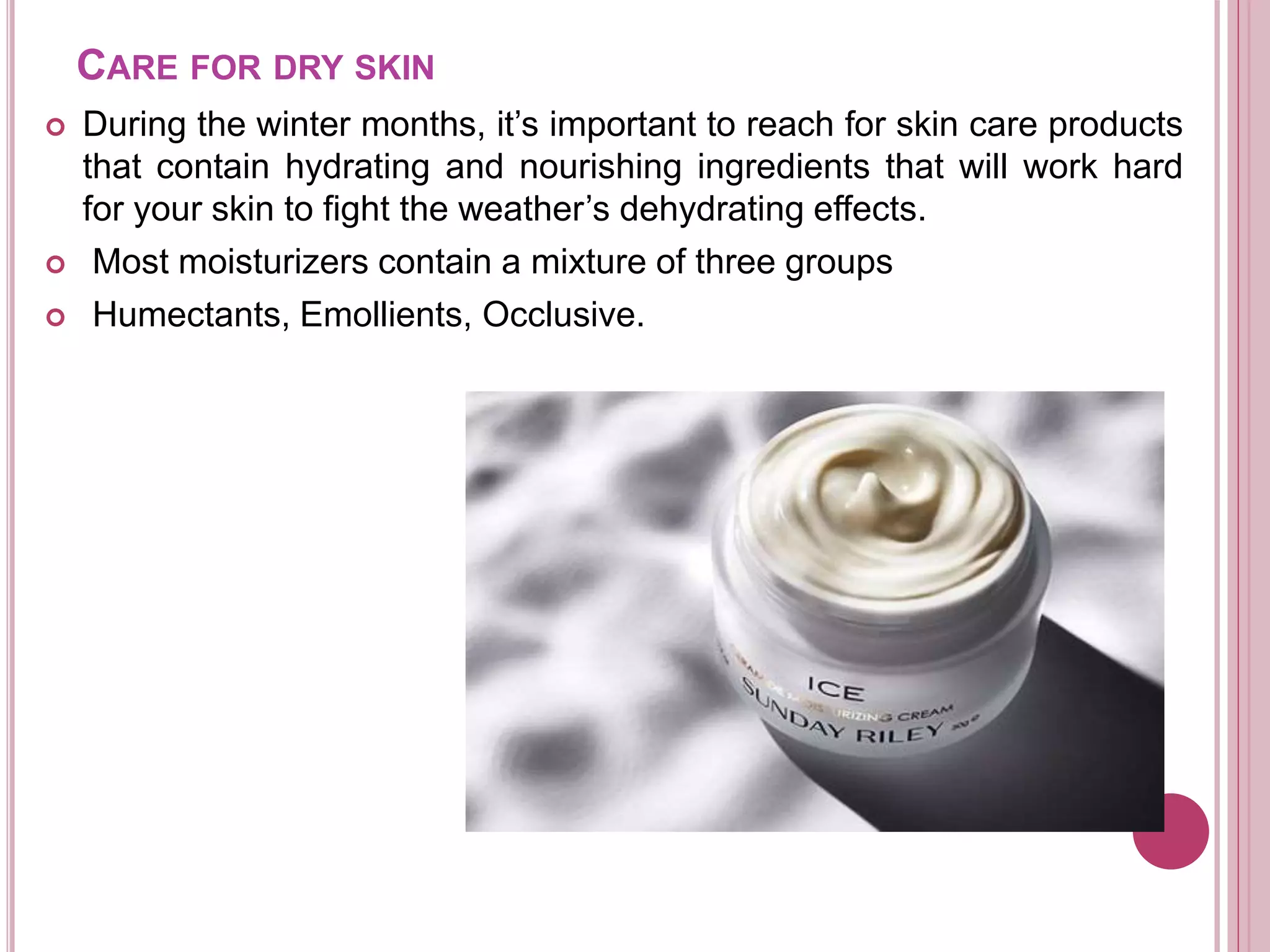
 During the winter months, it’s important to reach for skin care products
that contain hydrating and nourishing ingredients that will work hard
for your skin to fight the weather’s dehydrating effects.
 Most moisturizers contain a mixture of three groups
 Humectants, Emollients, Occlusive.
WHAT IS TRANS-EPIDERMAL WATER LOSS (TEWL)
 When water passes from the dermis through the epidermis and
evaporate from the skin’s surface, this known as transepidermal
water loss.
 As the it is in large scale causes dry skin.
 To maintain desirable levels of TEWL your skin needs both hydration
and moisturization.
 Hydration refers to water content of skin and this can be imparting
with the agents known Humectants.
ROLE OF MOISTURIZERS
Moisturizing action :
 This is the most vital action by which they increase the water content of the
SC. Hydration smoothens the skin surface by flattening the “valleys”
between the skin contour ridges. It also makes the skin surface soft, more
extensible, and pliable. The moisturizing action of emollients is evident
maximum 30 min - 1hrs after their use and usually lasts for 4 hrs.
Anti-inflammatory action :
 Many moisturizers inhibit the production of pro-inflammatory prostanoids
by blocking cyclooxygenase activity thus have a soothing effect on inflamed
regions.
Antimicrobial action:
 Act against skin surface microbes.
CONTINUE
Antimitotic action :
 Moisturizers containing mineral oils have low-grade anti-mitotic
action on the epidermis and thus are useful in inflammatory
dermatitis, where there is increased epidermal mitotic.
Antipruritic action :
 This reducing the itching. Further more, cooling effect evaporation of
water from the skin surface after using water based moisturizers has
antipruritic effect.
Protective action :
 These days sunscreens with variable sun protection factor are
incorporated in the moisturizers providing additional sun protection.
MECHANISIM OF ACTION
 In the human body, water constantly evaporates from the deeper
layers of the skin through an effect known as transepidermal water
loss.
 By regulating its water content, human skin naturally maintains a dry,
easily shed surface as a barrier against pathogens, dirt, or damage,
while protecting itself from drying out and becoming brittle and rigid.
The ability to retain moisture depends on the lipid bilayer between
the corneocytes.
 Moisturizers modify the rate of water loss, with active ingredients of
moisturizers falling into one of two categories: occlusives
and humectants.
 Occlusives form a coating on the surface of the skin, keeping
moisture from escaping. The more occlusive the formulation, the
greater the effect. Ointments are more occlusive than aqueous
creams, which are more occlusive than lotion.Water loss through the
skin is normally about 4–8 g/(m²⋅h).
CONTINUE
 A layer of petrolatum applied to normal skin can reduce that loss by
50–75% for several hours. Oils naturally produced by the human
body moisturize through this same mechanism.
 Humectants absorb water. They can absorb this water from the air
and moisturize the skin when the humidity is greater than 70%, but
more commonly they draw water from the dermis into the epidermis,
making skin dryer.
 Moisturizers often contain water, which acts as a temporary
hydration agent and as a way for the absorption of some
components and evaporation of the moisturizer.
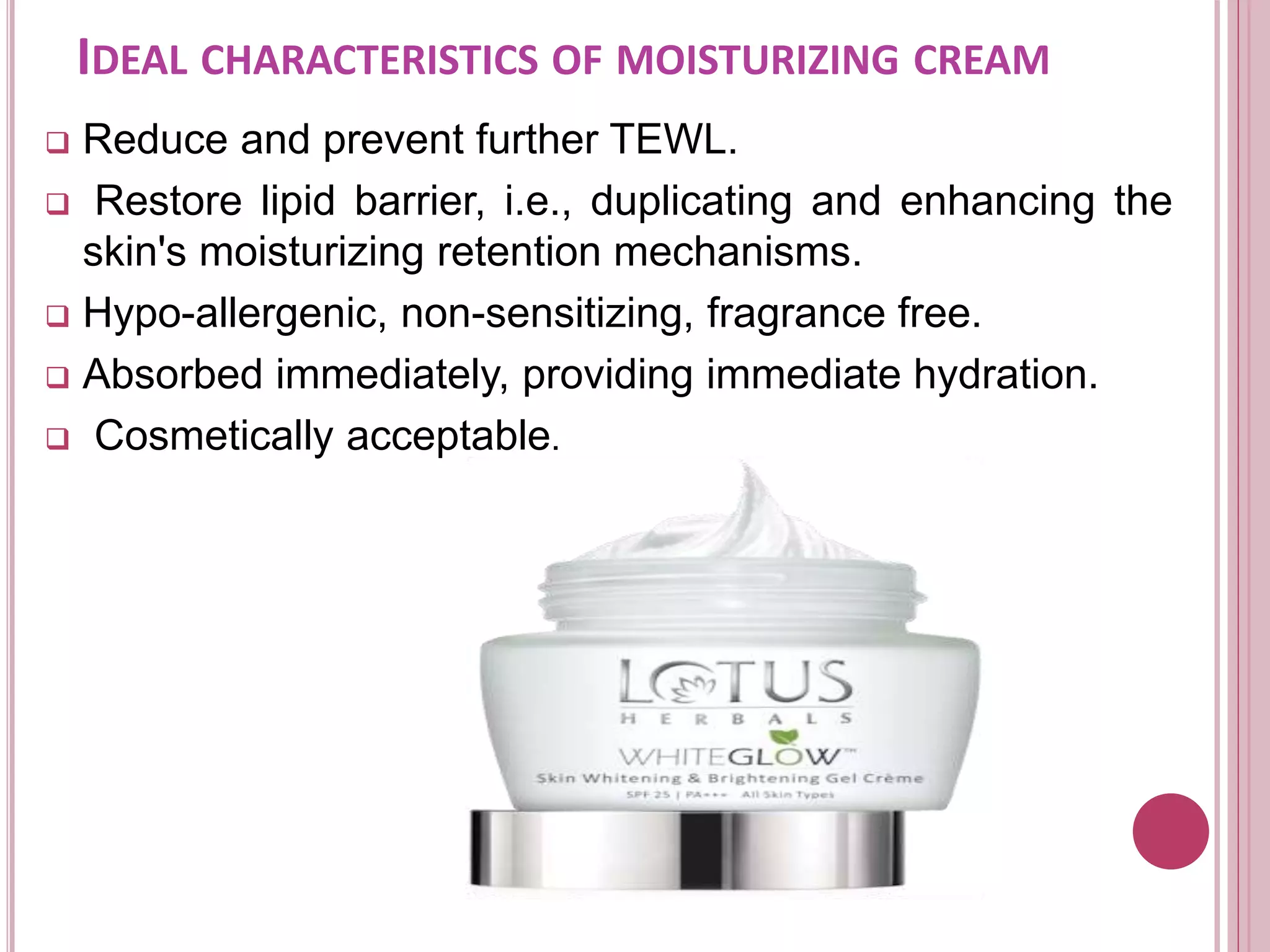
IDEAL CHARACTERISTICS OF MOISTURIZING CREAM
 Reduce and prevent further TEWL.
 Restore lipid barrier, i.e., duplicating and enhancing the
skin's moisturizing retention mechanisms.
 Hypo-allergenic, non-sensitizing, fragrance free.
 Absorbed immediately, providing immediate hydration.
 Cosmetically acceptable.
SPECIAL ADDITIVES IN MOISTURIZERS
1. Botanical substances:Herbal products are being used in topical
preparations since time immemorial. Natural ingredients on the skin like
Aloe(Aloe barbadensis Miller leaf extract),Allantoin(comfrey root) are use
in moisturizing cream.
2. Antioxidants: Are the agents which inhibit oxidation of ingredients by
reacting with free radicals and blocking the chain reaction. Typical
antioxidants are tocopherols (Vitamin E), butylated hydroxytoluene, and
alkyl gallates.
3. Chelating agents: Citric acid, tartaric acid ethylenediaminetetraacetic acid,
and its salts have limited antioxidant activity themselves, but enhance the
efficacy of antioxidants by reacting with heavy metal ions.
4. Vitamins:There have been poorly substantiated claims of skin
rejuvenation by the addition of Vitamins such as A, C, and E. They
should be in water soluble form.
CONTINUE
5.Fragrances and coloring agents: Added more for their cosmetic enhancement
rather than any actual role as moisturizers. They may vary from cinnamic
acid, cinnamates, menthol, benzoin resin, etc. Coloring agents impart subtle
hues and other optical effects leading to more acceptance although at times
can lead to irritant dermatitis.
6. Preservatives: They are meant to kill or inhibit the growth of microorganisms
inadvertently introduced during use or manufacturing.
7. Emulsifying agents: The most commonly used ones are Laureth 4 and 9,
ethylene glycol monostearate, octoxinols, and nonoxinols. Liposomes
dispersion is the newer technique which delivers the active ingredients into
the epidermis for enhanced action.
ADVANTAGES OF USING MOISTURIZING CREAM
1. Moisturizing reduces the chances of skin problems.
2. Moisturizing can reduce the appearance of other blemishes.
3. Moisturizing helps your skin stay young.
4. Moisturizing fights wrinkles.
5. It’s the perfect end to a hot shower.
6. Non-irritating when applied to the skin.
7. Easily water washable.
8. Less greasy compared to ointment.
9. Easy to spread on the skin's surface.
DISADVANTAGES OF USING MOISTURIZING CREAM
1. Stability is not as good as ointment.
2. They are less hydrophobic than other semi- solid preparation, so risk
of contamination is high than the others.
3. Skin irritation of contact dermatitis may occur due to the drug and /
excipients.
4. Poor permeability of some drugs through the skin Possibility of
allergic reactions.
5. Can be used only for drugs which require very small plasma
concentration for action.
FORMMUATION
Sl.NO Ingredients Quantity for 100 g (%)
1 Stearic acid 4.0%
2 Liquid paraffain 8.0%
3 Lanolin 1.0%
4 Glyceryl monostearate 3.0%
5 Glycerin 4.0%
6 Propylene glycol 4.0%
7 Isopropyl myristate 2.0%
8 Triethanolamine 0.2%
9 Methyl paraben 0.03%
10 Propyl paraben 0.07%
11 Perfume and preservative q.s
12 Water to make 100.0%
PREPARATION OF MOISTURIZING CREAM
 Moisturizing cream formulation extemporaneously that showed no visible signs of physical
instability such as cracking, creaming, phase inversion and/or bleeding of the cream base from
the container. Physical instability was evaluated immediately after manufacture and then
twenty-four (24) hours after manufacture and storage at room temperature (25 °C).
 Initial formulation development was undertaken on batches of only 25 g and any formulation
that showed signs of physical instability immediately and/or after twenty-four (24) hours of
storage at room temperature (25 °C) was considered unsuitable and therefore not considered
for further investigation.
 Moisturizing cream formulation were developed from a prototype moisturizing cream
formulation based on triethanolamine using stearic acid and sunflower wax alone and in
combination of both. Oil in water emulsion cream was prepared by initially melting sunflower
wax at 70-80 °C and to the molten mass added stearic acid, liquid paraffin, lanoline, glyceryl
monostearate.
 Aqueous phase along with propylene glycol, isopropyl myristate, triethanolamine, glycerin and
water heated at same temperature as oil phase. Both the phases were mixed slowly with
continuous stirring to form the homogenous dispersion. Perfume was added when the
temperature downs at 35 °C. Preservatives added in the water phase before mixing.
EVALUATION
1. pH measurement:
 The pH of the 10 % w/v cream suspension was determined at 25 °C using a
pH meter, standardized using pH 4.0 and 7.0 standard buffers before use
and average of triplicates were determined.
2. Spreadability:
 The spreadability of test samples was determined using the following
technique: 0.5 g test formulation was placed within a circle of 1 cm diameter
pre-marked on a glass plate over which a second glass plate was placed. A
weight of 500 g was allowed to rest on the upper glass plate for 5 min.
3. Viscosity:
 Brookfield Synchro-Lectric Viscometer (Model RVT) with helipath stand was
used for rheological studies. The sample (50 g) was placed in a beaker and
was allowed to equilibrate for 5 min before measuring the dial reading using
a T-D spindle at 10, 20,30,50,60,100 rpm. At each speed, the corresponding
dial reading on the viscometer was noted.
4. Thermal stability
 Thermal stability (at 20 °C, 30 °C and 40 °C) of the prepared formulations
was determined according to Indian standard guideline.
CONTINUE
5. Measurement of particle size:
 A laser diffraction particle size analyzer (Mastersizer Hydro 2000 MU,
Malvern Instruments) was employed for measuring the globule size
distribution of the emulsion droplets. Briefly, the sample was
dispersed in 0.2 micron filtered distilled water to obtain an
obscuration of 5-15 %.
6. In vitro occlusivity test:
 The test was performed by placing 10 g of distilled water in each
beaker and closing the open end with Whatman filter paper (0.45
pore size) on the upper surface of which 200 mg of the sample was
evenly distributed. These beakers were then placed at 37±2
°C/607±5% RH for 48 h.
The occlusion factor F was calculated as-
F=(A-B)A ×100
CONCLUSION
 Till date choosing, the right moisturizer is still a matter of trial and
error. As the population ages and we turn into an urbanized
makeover worldwide, the need of Moisturizers will be ever
increasing. The key to future moisturizer therapy will be to tailor
specific agents to specific dermatological needs.
 This review helps provide a fundamental understanding of the
physiochemical and psychological effects of the use of moisturizers.
Knowing the in and out of the actives and their interactions with the
skin will help better usage and efficacy of the available moisturizers.
REFERENCES
 Seth A., Kaur T., Malhotra S., ‘‘Gambhir M. Moisturizers: The Slippery
Road’’. Indian J Dermatol 2016;61:279-87
 Wilkinson JB, Moore RJ. ‘‘ Harry’s Cosmeticology ’’the 7th Edition,1990;
Chemical Publishing,Company,INC,NewYork,pp.66
 Maru DA.,Lahoti RS. ‘‘ FORMULATION AND EVALUATION OF MOISTURIZING
CREAM CONTAINING SUNFLOWER WAX’’. International Journal of Pharmacy
and Pharmaceutical Sciences. Vol 10, Issue 11, 2018.
 Flynn TC, Petros J, Clark RE. Dry skin and moisturizers. Clin Dermatol2001;
19:387-92.
 PP Sharma. Cosmetics-formulation, manufacturing and quality control, Cap.
VII. 5th edition Vandana Publications, Delhi, India; 2014. p. 181-91.
 Clarke MT. Rheological additives. In:Laba D. editor. Rheological properties of
cosmetic and toiletries. New York: Marcel Dekker; 1993. p. 55-152.
 Baird. Analysisof creams and lotions. In: Henry MD. editor. Manualof
cosmetic analysis. USA; 1997. p. 32-3.
Moisturizing cream ppt

Moisturizing cream ppt

  • 1.
    SEMINAR ON PREPARATION ANDEVALUATION OF MOISTURIZING CREAM Presented by AYAN PAL M.PHARM,2nd SEM ROLL NO-15920320008 DEPARTMENT OF PHARMACEUTICS CALCUTTA INSTITUTE OF PHARMACEUTICAL TECHNOLOGY AND A.H.S, ULUBERIA, HOWRAH
  • 2.
    CONTENT  INTRODUCTION  WHATIS TEWL  ROLE OF MOISTURIZER  MECHANISM OF ACTION  IDEAL CHARACTERISTICS  SPECIAL ADDITIVES  ADVANTAGES AND DISADVANTAGES  FORMULATION AND PREPARATION  EVALUATION  CONCLUSION  REFERENCES
  • 3.
    INTRODUCTION  A creamis a preparation usually for application to the skin.  Creams are defines as “a semisolid dosage form containing one or more drug substances dissolved or dispersed in a suitable base”  Creams are semi-solid emulsions of oil and water.  They are of a softer consistency & lighter body than true ointment.  semisolid emulsions of either O/W or W/O type.
  • 4.
    MOISTURIZING CREAM  Moisturizeris a cosmetic preparation used for protecting, moisturizing, and lubricating the skin.  These are creams which restore water(moisture) to the stratum corneum.  Water contained in the cream is lost by evaporation when the cream is applied to the body.  Moisturizers are complex mixtures of chemical agents often occlusive help hold water in the skin after application, humectants attract moisture and emollients help smooth the skin.
  • 5.
    CLASIFICATION  There arefour main types of moisturizers depending on their mechanism of action. 1) Emollients 2) Humectants 3) Occlusives 4) Protein rejuvenators
  • 6.
    1. Emollients:  Theyare mainly lipids and oils, which hydrate and improve the skin softness, flexibility, and smoothness.  Eg: Cholesterol, squalene, fatty acids, fatty alcohols, pseudoceramides 2. Humectants:  They are basically hygroscopic compounds which mean they attract water from two sources, from the dermis into the epidermis and in humid conditions from the environment.  Eg: Glycerol, propylene glycol, panthenol sorbitol, urea, alpha hydroxy acids, hyaluronic acid 3.Occlusives:  Oils and waxes which form an inert layer on the skin and physically block transepidermal water loss.  eg: Petrolatum, beeswax mineral oil, silicones, lanolin, zinc oxide
  • 7.
    CONTINUE 4.Protein rejuvenators  Smallmolecular weight proteins thought to help is skin rejuvenation by replenishing essential proteins.  Eg: Collagen, elastin, keratin
  • 8.
    VARIOUS TYPES OFMOISTURIZING CREAM
  • 9.
    CARE FOR DRYSKIN  During the winter months, it’s important to reach for skin care products that contain hydrating and nourishing ingredients that will work hard for your skin to fight the weather’s dehydrating effects.  Most moisturizers contain a mixture of three groups  Humectants, Emollients, Occlusive.
  • 10.
    WHAT IS TRANS-EPIDERMALWATER LOSS (TEWL)  When water passes from the dermis through the epidermis and evaporate from the skin’s surface, this known as transepidermal water loss.  As the it is in large scale causes dry skin.  To maintain desirable levels of TEWL your skin needs both hydration and moisturization.  Hydration refers to water content of skin and this can be imparting with the agents known Humectants.
  • 11.
    ROLE OF MOISTURIZERS Moisturizingaction :  This is the most vital action by which they increase the water content of the SC. Hydration smoothens the skin surface by flattening the “valleys” between the skin contour ridges. It also makes the skin surface soft, more extensible, and pliable. The moisturizing action of emollients is evident maximum 30 min - 1hrs after their use and usually lasts for 4 hrs. Anti-inflammatory action :  Many moisturizers inhibit the production of pro-inflammatory prostanoids by blocking cyclooxygenase activity thus have a soothing effect on inflamed regions. Antimicrobial action:  Act against skin surface microbes.
  • 12.
    CONTINUE Antimitotic action : Moisturizers containing mineral oils have low-grade anti-mitotic action on the epidermis and thus are useful in inflammatory dermatitis, where there is increased epidermal mitotic. Antipruritic action :  This reducing the itching. Further more, cooling effect evaporation of water from the skin surface after using water based moisturizers has antipruritic effect. Protective action :  These days sunscreens with variable sun protection factor are incorporated in the moisturizers providing additional sun protection.
  • 13.
    MECHANISIM OF ACTION In the human body, water constantly evaporates from the deeper layers of the skin through an effect known as transepidermal water loss.  By regulating its water content, human skin naturally maintains a dry, easily shed surface as a barrier against pathogens, dirt, or damage, while protecting itself from drying out and becoming brittle and rigid. The ability to retain moisture depends on the lipid bilayer between the corneocytes.  Moisturizers modify the rate of water loss, with active ingredients of moisturizers falling into one of two categories: occlusives and humectants.  Occlusives form a coating on the surface of the skin, keeping moisture from escaping. The more occlusive the formulation, the greater the effect. Ointments are more occlusive than aqueous creams, which are more occlusive than lotion.Water loss through the skin is normally about 4–8 g/(m²⋅h).
  • 14.
    CONTINUE  A layerof petrolatum applied to normal skin can reduce that loss by 50–75% for several hours. Oils naturally produced by the human body moisturize through this same mechanism.  Humectants absorb water. They can absorb this water from the air and moisturize the skin when the humidity is greater than 70%, but more commonly they draw water from the dermis into the epidermis, making skin dryer.  Moisturizers often contain water, which acts as a temporary hydration agent and as a way for the absorption of some components and evaporation of the moisturizer.
  • 15.
    IDEAL CHARACTERISTICS OFMOISTURIZING CREAM  Reduce and prevent further TEWL.  Restore lipid barrier, i.e., duplicating and enhancing the skin's moisturizing retention mechanisms.  Hypo-allergenic, non-sensitizing, fragrance free.  Absorbed immediately, providing immediate hydration.  Cosmetically acceptable.
  • 16.
    SPECIAL ADDITIVES INMOISTURIZERS 1. Botanical substances:Herbal products are being used in topical preparations since time immemorial. Natural ingredients on the skin like Aloe(Aloe barbadensis Miller leaf extract),Allantoin(comfrey root) are use in moisturizing cream. 2. Antioxidants: Are the agents which inhibit oxidation of ingredients by reacting with free radicals and blocking the chain reaction. Typical antioxidants are tocopherols (Vitamin E), butylated hydroxytoluene, and alkyl gallates. 3. Chelating agents: Citric acid, tartaric acid ethylenediaminetetraacetic acid, and its salts have limited antioxidant activity themselves, but enhance the efficacy of antioxidants by reacting with heavy metal ions. 4. Vitamins:There have been poorly substantiated claims of skin rejuvenation by the addition of Vitamins such as A, C, and E. They should be in water soluble form.
  • 17.
    CONTINUE 5.Fragrances and coloringagents: Added more for their cosmetic enhancement rather than any actual role as moisturizers. They may vary from cinnamic acid, cinnamates, menthol, benzoin resin, etc. Coloring agents impart subtle hues and other optical effects leading to more acceptance although at times can lead to irritant dermatitis. 6. Preservatives: They are meant to kill or inhibit the growth of microorganisms inadvertently introduced during use or manufacturing. 7. Emulsifying agents: The most commonly used ones are Laureth 4 and 9, ethylene glycol monostearate, octoxinols, and nonoxinols. Liposomes dispersion is the newer technique which delivers the active ingredients into the epidermis for enhanced action.
  • 18.
    ADVANTAGES OF USINGMOISTURIZING CREAM 1. Moisturizing reduces the chances of skin problems. 2. Moisturizing can reduce the appearance of other blemishes. 3. Moisturizing helps your skin stay young. 4. Moisturizing fights wrinkles. 5. It’s the perfect end to a hot shower. 6. Non-irritating when applied to the skin. 7. Easily water washable. 8. Less greasy compared to ointment. 9. Easy to spread on the skin's surface.
  • 19.
    DISADVANTAGES OF USINGMOISTURIZING CREAM 1. Stability is not as good as ointment. 2. They are less hydrophobic than other semi- solid preparation, so risk of contamination is high than the others. 3. Skin irritation of contact dermatitis may occur due to the drug and / excipients. 4. Poor permeability of some drugs through the skin Possibility of allergic reactions. 5. Can be used only for drugs which require very small plasma concentration for action.
  • 20.
    FORMMUATION Sl.NO Ingredients Quantityfor 100 g (%) 1 Stearic acid 4.0% 2 Liquid paraffain 8.0% 3 Lanolin 1.0% 4 Glyceryl monostearate 3.0% 5 Glycerin 4.0% 6 Propylene glycol 4.0% 7 Isopropyl myristate 2.0% 8 Triethanolamine 0.2% 9 Methyl paraben 0.03% 10 Propyl paraben 0.07% 11 Perfume and preservative q.s 12 Water to make 100.0%
  • 21.
    PREPARATION OF MOISTURIZINGCREAM  Moisturizing cream formulation extemporaneously that showed no visible signs of physical instability such as cracking, creaming, phase inversion and/or bleeding of the cream base from the container. Physical instability was evaluated immediately after manufacture and then twenty-four (24) hours after manufacture and storage at room temperature (25 °C).  Initial formulation development was undertaken on batches of only 25 g and any formulation that showed signs of physical instability immediately and/or after twenty-four (24) hours of storage at room temperature (25 °C) was considered unsuitable and therefore not considered for further investigation.  Moisturizing cream formulation were developed from a prototype moisturizing cream formulation based on triethanolamine using stearic acid and sunflower wax alone and in combination of both. Oil in water emulsion cream was prepared by initially melting sunflower wax at 70-80 °C and to the molten mass added stearic acid, liquid paraffin, lanoline, glyceryl monostearate.  Aqueous phase along with propylene glycol, isopropyl myristate, triethanolamine, glycerin and water heated at same temperature as oil phase. Both the phases were mixed slowly with continuous stirring to form the homogenous dispersion. Perfume was added when the temperature downs at 35 °C. Preservatives added in the water phase before mixing.
  • 22.
    EVALUATION 1. pH measurement: The pH of the 10 % w/v cream suspension was determined at 25 °C using a pH meter, standardized using pH 4.0 and 7.0 standard buffers before use and average of triplicates were determined. 2. Spreadability:  The spreadability of test samples was determined using the following technique: 0.5 g test formulation was placed within a circle of 1 cm diameter pre-marked on a glass plate over which a second glass plate was placed. A weight of 500 g was allowed to rest on the upper glass plate for 5 min. 3. Viscosity:  Brookfield Synchro-Lectric Viscometer (Model RVT) with helipath stand was used for rheological studies. The sample (50 g) was placed in a beaker and was allowed to equilibrate for 5 min before measuring the dial reading using a T-D spindle at 10, 20,30,50,60,100 rpm. At each speed, the corresponding dial reading on the viscometer was noted. 4. Thermal stability  Thermal stability (at 20 °C, 30 °C and 40 °C) of the prepared formulations was determined according to Indian standard guideline.
  • 23.
    CONTINUE 5. Measurement ofparticle size:  A laser diffraction particle size analyzer (Mastersizer Hydro 2000 MU, Malvern Instruments) was employed for measuring the globule size distribution of the emulsion droplets. Briefly, the sample was dispersed in 0.2 micron filtered distilled water to obtain an obscuration of 5-15 %. 6. In vitro occlusivity test:  The test was performed by placing 10 g of distilled water in each beaker and closing the open end with Whatman filter paper (0.45 pore size) on the upper surface of which 200 mg of the sample was evenly distributed. These beakers were then placed at 37±2 °C/607±5% RH for 48 h. The occlusion factor F was calculated as- F=(A-B)A ×100
  • 24.
    CONCLUSION  Till datechoosing, the right moisturizer is still a matter of trial and error. As the population ages and we turn into an urbanized makeover worldwide, the need of Moisturizers will be ever increasing. The key to future moisturizer therapy will be to tailor specific agents to specific dermatological needs.  This review helps provide a fundamental understanding of the physiochemical and psychological effects of the use of moisturizers. Knowing the in and out of the actives and their interactions with the skin will help better usage and efficacy of the available moisturizers.
  • 25.
    REFERENCES  Seth A.,Kaur T., Malhotra S., ‘‘Gambhir M. Moisturizers: The Slippery Road’’. Indian J Dermatol 2016;61:279-87  Wilkinson JB, Moore RJ. ‘‘ Harry’s Cosmeticology ’’the 7th Edition,1990; Chemical Publishing,Company,INC,NewYork,pp.66  Maru DA.,Lahoti RS. ‘‘ FORMULATION AND EVALUATION OF MOISTURIZING CREAM CONTAINING SUNFLOWER WAX’’. International Journal of Pharmacy and Pharmaceutical Sciences. Vol 10, Issue 11, 2018.  Flynn TC, Petros J, Clark RE. Dry skin and moisturizers. Clin Dermatol2001; 19:387-92.  PP Sharma. Cosmetics-formulation, manufacturing and quality control, Cap. VII. 5th edition Vandana Publications, Delhi, India; 2014. p. 181-91.  Clarke MT. Rheological additives. In:Laba D. editor. Rheological properties of cosmetic and toiletries. New York: Marcel Dekker; 1993. p. 55-152.  Baird. Analysisof creams and lotions. In: Henry MD. editor. Manualof cosmetic analysis. USA; 1997. p. 32-3.