PILOT PLANT SCALE UP FOR SVPS
Dr. Prashant L. Pingale
Associate Professor,
GES’s Sir Dr. M. S. Gosavi College of Pharm. Edu. and Research, Nashik-422005
Plant, pilot plant and scale up
• Plant: It is a place were the 5 M’s like money, material, man, method and
machine are brought together for the manufacturing of the products.
• Pilot Plant: It is the part of the pharmaceutical industry where a lab scale
formula is transformed into a viable product by development of liable and
practical procedure of manufacture.
• Scale-up: The art for designing of prototype using the data obtained from the
pilot plant model.
2
What is pilot plant scale up?
• In the pilot plant, a formulae is transformed into a viable product by the
development of a reliable and practical method of manufacturing.
• Pilot plant is the intermediate plant between the laboratory scale and the
production plant.
3
Objectives of scale-up
• To try the process on a model of proposed plant before committing large sum of money on a
production unit.
• Examination of the formula to determine it’s ability to withstand Batch-scale and process
modification.
• Evaluation and Validation for process and equipments.
• To identify the critical features of the process.
• Guidelines for production and process controls.
• To provide master manufacturing formula with instructions for manufacturing procedure.
• To avoid the scale-up problems.
4
Steps in scale-up
✓ Define product economics based on projected market size and competitive selling and provide guidance for
allowable manufacturing costs
✓ Conduct laboratory studies and scale-up planning at the same time
✓ Define key rate-controlling steps in the proposed process
✓ Conduct preliminary larger-than-laboratory studies with equipment to be used in rate-controlling step to aid
in plant design
✓ Design and construct a pilot plant including provisions for process and environmental controls, cleaning and
sanitizing systems, packaging and waste handling systems, and meeting regulatory agency requirements
✓ Evaluate pilot plant results (product and process) including process Economics to make any corrections and a
decision on whether or not to proceed with a full scale plant development
5
Purpose of conducting Pilot Plant Studies
✓To evaluate the effect on the process of a large scale of operation and to collect
other data so that a good design of a larger unit may be made with a high
probability of commercial success.
✓To find and examine all products or waste which may not be seen in
laboratory scale.
✓By the use of pilot plant, it is possible to minimize the wastes, hence better
yield of prescribed dosage form.
6
A pilot plant can be used for…
• Evaluating the results of laboratory studies and making product and process
corrections and improvements.
• Producing small quantities of product for sensory, chemical, microbiological
evaluations, limited market testing or furnishing samples to potential
customers, shelf-life and storage stability studies.
• Providing data that can be used in making a decision on whether or not to
proceed to a full-scale production process; and in the case of a positive decision,
designing and constructing a full-size plant or modifying an existing plant.
7
Pilot plant scale-up: Injectables
• The majority of the parenteral solutions requiring a variety of equipments for
liquid mixing, filtration, transfer and related activities.
• Most of the equipments are composed of stainless steel, with glass lined
vessels employed for preparation of formulations sensitive to iron and other
metal ions.
• The vessels can be equipped with external jackets for heating and/or cooling
and various types of agitators, depending upon the mixing requirements.
8
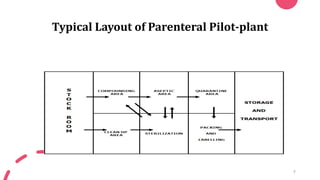
Typical Layout of Parenteral Pilot-plant
9
Working area of a parenteral pilot plant
• Incoming goods are stored in special areas for Quarantine, Released and
Rejected status.
• A cold room is available for storage of temperature-sensitive products.
• Entrance into the warehouse and production areas is restricted to personnel.
• The route for final products is separated from the incoming goods.
• Storage of final products is done in designated areas in the warehouse.
• Sampling and weighing of the raw material is performed in a dedicated
sampling area and a central weighing suite, respectively.
10
Warehousing
• All samples should be aseptically taken, which mandates unidirectional airflow and
full operator gowning.
• These measures reduces the potential for contamination ingress into materials that
are yet to receive any processing at any site.
• First the materials are passed through class 100,000 i.e. grade D environment for
presterilization.
• Transfer of materials are carried out in air-locks to avoid cross contamination.
• The preparation areas are supplied with HEPA filters.
• There should be more than 20 air changes per hour.
• The preparation place is Class 100 area.
11
Compounding area
• In this area formulation is compounded.
• Cabinets and counters are made up of stainless steel.
• They should fit tightly to walls so that there are no void spaces where dirt
can accumulate.
• The ceiling walls and floor should be constructed of impervious materials
so that moisture will run off.
12
Aseptic area
• The ceiling walls, floor must be sealed so that they can be washed and
sanitized with disinfectant.
• The filling of the formulations is performed in a class 100 environment.
• Air locks serve as a transition points between one environment and another.
• They are fitted with the UV lights, spray systems or other devices that may be
effectively utilized to prevent contamination of the materials.
13
HEPA filters
• HEPA filters, by definition, remove at least 99.97% of Airborne particles
0.3 micrometers (µm) in diameter.
• HEPA filters are composed of a mat of randomly arranged fibers.
• These fibers are typically composed of fiberglass and possess diameters
between 0.5 and 2.0 micron.
• The air space between HEPA filter fibers is much greater than 0.3 μm.
14
Types of parenteral dosage form: Solutions
• Solutions of drug are suitable for parenteral administration are referred as
injections.
• They are manufactured by dissolving the drug and suitable excipients, adjusting the
pH, filtration through 0.22µm membrane and autoclaving the final product.
• These are of two types:
• Large Volume Parenterals (LVP)
• Small Volume Parenterals (SVP)
15
Types of parenteral dosage form: Suspensions
• Suspensions is one of the most difficult parenteral dosage form.
• It can be injected through a 18 to 21 gauge needle.
• Formulation consists of active ingredients suspended in aqueous solution.
• Two methods are used to prepare parenteral suspension:
• Sterile vehicle & powders are combined aseptically.
• Sterile solutions are combined and the crystals formed in-situ.
• Penicillin G procaine injectable suspension USP
• Sterile Testosterone injectable suspension USP
16
Problems associated with suspensions
• Syringeability: It refers to the handling characteristics of a suspension
while drawing and manipulating it in a syringe.
• Injectability: It refers to the properties of the suspension during
injection.
17
Types of parenteral dosage form: Emulsions
• Emulsions is a dispersion of two or more immiscible liquids.
• It includes following types:
• Water-in-oil emulsions of allergenic extracts (subcutaneously)
• Oil-in-water sustained-release depot preparations (intramuscularly)
18
Types of parenteral dosage form: Dry Powder
• Many drugs are physically or chemically unstable and hence formulated as
dry powders, which can be reconstituted in solution by addition of water.
• Sometimes it may be an aqueous suspension such as ampicillin trihydrate and
spectinomycin hydrochloride.
19

Pilot plant scale up for Small Volume Parenterals

  • 1.
    PILOT PLANT SCALEUP FOR SVPS Dr. Prashant L. Pingale Associate Professor, GES’s Sir Dr. M. S. Gosavi College of Pharm. Edu. and Research, Nashik-422005
  • 2.
    Plant, pilot plantand scale up • Plant: It is a place were the 5 M’s like money, material, man, method and machine are brought together for the manufacturing of the products. • Pilot Plant: It is the part of the pharmaceutical industry where a lab scale formula is transformed into a viable product by development of liable and practical procedure of manufacture. • Scale-up: The art for designing of prototype using the data obtained from the pilot plant model. 2
  • 3.
    What is pilotplant scale up? • In the pilot plant, a formulae is transformed into a viable product by the development of a reliable and practical method of manufacturing. • Pilot plant is the intermediate plant between the laboratory scale and the production plant. 3
  • 4.
    Objectives of scale-up •To try the process on a model of proposed plant before committing large sum of money on a production unit. • Examination of the formula to determine it’s ability to withstand Batch-scale and process modification. • Evaluation and Validation for process and equipments. • To identify the critical features of the process. • Guidelines for production and process controls. • To provide master manufacturing formula with instructions for manufacturing procedure. • To avoid the scale-up problems. 4
  • 5.
    Steps in scale-up ✓Define product economics based on projected market size and competitive selling and provide guidance for allowable manufacturing costs ✓ Conduct laboratory studies and scale-up planning at the same time ✓ Define key rate-controlling steps in the proposed process ✓ Conduct preliminary larger-than-laboratory studies with equipment to be used in rate-controlling step to aid in plant design ✓ Design and construct a pilot plant including provisions for process and environmental controls, cleaning and sanitizing systems, packaging and waste handling systems, and meeting regulatory agency requirements ✓ Evaluate pilot plant results (product and process) including process Economics to make any corrections and a decision on whether or not to proceed with a full scale plant development 5
  • 6.
    Purpose of conductingPilot Plant Studies ✓To evaluate the effect on the process of a large scale of operation and to collect other data so that a good design of a larger unit may be made with a high probability of commercial success. ✓To find and examine all products or waste which may not be seen in laboratory scale. ✓By the use of pilot plant, it is possible to minimize the wastes, hence better yield of prescribed dosage form. 6
  • 7.
    A pilot plantcan be used for… • Evaluating the results of laboratory studies and making product and process corrections and improvements. • Producing small quantities of product for sensory, chemical, microbiological evaluations, limited market testing or furnishing samples to potential customers, shelf-life and storage stability studies. • Providing data that can be used in making a decision on whether or not to proceed to a full-scale production process; and in the case of a positive decision, designing and constructing a full-size plant or modifying an existing plant. 7
  • 8.
    Pilot plant scale-up:Injectables • The majority of the parenteral solutions requiring a variety of equipments for liquid mixing, filtration, transfer and related activities. • Most of the equipments are composed of stainless steel, with glass lined vessels employed for preparation of formulations sensitive to iron and other metal ions. • The vessels can be equipped with external jackets for heating and/or cooling and various types of agitators, depending upon the mixing requirements. 8
  • 9.
    Typical Layout ofParenteral Pilot-plant 9
  • 10.
    Working area ofa parenteral pilot plant • Incoming goods are stored in special areas for Quarantine, Released and Rejected status. • A cold room is available for storage of temperature-sensitive products. • Entrance into the warehouse and production areas is restricted to personnel. • The route for final products is separated from the incoming goods. • Storage of final products is done in designated areas in the warehouse. • Sampling and weighing of the raw material is performed in a dedicated sampling area and a central weighing suite, respectively. 10
  • 11.
    Warehousing • All samplesshould be aseptically taken, which mandates unidirectional airflow and full operator gowning. • These measures reduces the potential for contamination ingress into materials that are yet to receive any processing at any site. • First the materials are passed through class 100,000 i.e. grade D environment for presterilization. • Transfer of materials are carried out in air-locks to avoid cross contamination. • The preparation areas are supplied with HEPA filters. • There should be more than 20 air changes per hour. • The preparation place is Class 100 area. 11
  • 12.
    Compounding area • Inthis area formulation is compounded. • Cabinets and counters are made up of stainless steel. • They should fit tightly to walls so that there are no void spaces where dirt can accumulate. • The ceiling walls and floor should be constructed of impervious materials so that moisture will run off. 12
  • 13.
    Aseptic area • Theceiling walls, floor must be sealed so that they can be washed and sanitized with disinfectant. • The filling of the formulations is performed in a class 100 environment. • Air locks serve as a transition points between one environment and another. • They are fitted with the UV lights, spray systems or other devices that may be effectively utilized to prevent contamination of the materials. 13
  • 14.
    HEPA filters • HEPAfilters, by definition, remove at least 99.97% of Airborne particles 0.3 micrometers (µm) in diameter. • HEPA filters are composed of a mat of randomly arranged fibers. • These fibers are typically composed of fiberglass and possess diameters between 0.5 and 2.0 micron. • The air space between HEPA filter fibers is much greater than 0.3 μm. 14
  • 15.
    Types of parenteraldosage form: Solutions • Solutions of drug are suitable for parenteral administration are referred as injections. • They are manufactured by dissolving the drug and suitable excipients, adjusting the pH, filtration through 0.22µm membrane and autoclaving the final product. • These are of two types: • Large Volume Parenterals (LVP) • Small Volume Parenterals (SVP) 15
  • 16.
    Types of parenteraldosage form: Suspensions • Suspensions is one of the most difficult parenteral dosage form. • It can be injected through a 18 to 21 gauge needle. • Formulation consists of active ingredients suspended in aqueous solution. • Two methods are used to prepare parenteral suspension: • Sterile vehicle & powders are combined aseptically. • Sterile solutions are combined and the crystals formed in-situ. • Penicillin G procaine injectable suspension USP • Sterile Testosterone injectable suspension USP 16
  • 17.
    Problems associated withsuspensions • Syringeability: It refers to the handling characteristics of a suspension while drawing and manipulating it in a syringe. • Injectability: It refers to the properties of the suspension during injection. 17
  • 18.
    Types of parenteraldosage form: Emulsions • Emulsions is a dispersion of two or more immiscible liquids. • It includes following types: • Water-in-oil emulsions of allergenic extracts (subcutaneously) • Oil-in-water sustained-release depot preparations (intramuscularly) 18
  • 19.
    Types of parenteraldosage form: Dry Powder • Many drugs are physically or chemically unstable and hence formulated as dry powders, which can be reconstituted in solution by addition of water. • Sometimes it may be an aqueous suspension such as ampicillin trihydrate and spectinomycin hydrochloride. 19