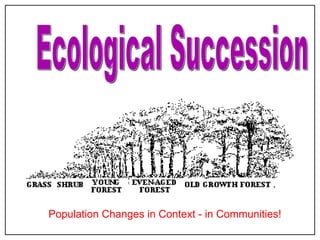
Ecological Succession Population Changes in Context - in Communities!
Succession Defined: The gradual, sequential change in the relative abundances of the dominant species in a biological community following a disturbance… Primary succession : beginning from an abiotic environment following a cataclysmic disturbance Secondary succession : beginning from a major disturbance, but all forms of life are not destroyed
Primary or Secondary? Volcanic Island
Primary or Secondary? 1988 Fires in Yellowstone NP
Primary or Secondary? Old Parking Lot
Primary or Secondary? Glacial Retreat
Primary or Secondary? Old Farm
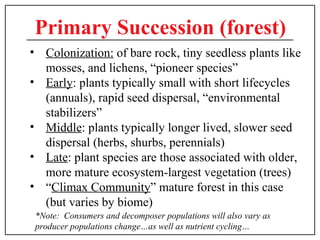
Primary Succession (forest) Colonization:  of bare rock, tiny seedless plants like mosses, and lichens, “pioneer species” Early : plants typically small with short lifecycles (annuals), rapid seed dispersal, “environmental stabilizers” Middle : plants typically longer lived, slower seed dispersal (herbs, shurbs, perennials)  Late : plant species are those associated with older, more mature ecosystem-largest vegetation (trees) “ Climax Community ” mature forest in this case (but varies by biome) *Note:  Consumers and decomposer populations will also vary as producer populations change…as well as nutrient cycling…
Research on Primary Succession
 
Research on Secondary Succession
Hutcheson Memorial Forest Center (NJ) Old Field Secondary Succession1962-1995
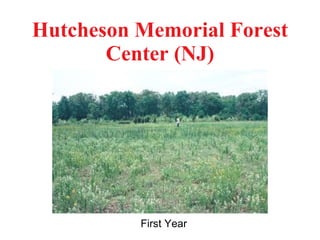
Hutcheson Memorial Forest Center (NJ) First Year
Hutcheson Memorial Forest Center (NJ) Fifth Year
Hutcheson Memorial Forest Center (NJ) Tenth Year
Hutcheson Memorial Forest Center (NJ) Twentieth Year
Hutcheson Memorial Forest Center (NJ) Twenty-Eighth Year
Changes in Biodiversity
© 2003 John Wiley and Sons Publishers
Succession in Aquatic Ecosystems © 2003 John Wiley and Sons Publishers
Succession in a Pond 1960s to 1990s
Is a Climax Community Always Inevitable? New research suggests that we  cannot  always project the course of a given succession or view it as preordained Communities are always subject to disturbances and we cannot always know the outcome Disturbances can be beneficial for communities…
The Intermediate Disturbance Hypothesis Hypothesis: Communities that experience  fairly frequent but moderate disturbances  have the greatest species diversity Reasoning: Moderate disturbances are large enough to create openings for colonizing species in disturbed areas, but mild and infrequent enough to allow the survival of some mature species in undisturbed areas
‘ General Ecology’, D.T. Krohne
Ecotones Disturbances often create  ecotones , but they also exist as natural transitions between biomes or ecosystems An  ecotone  is a transition area between two adjacent ecological communities a sharp boundary or a gradual blending effect particularly significant for mobile animals, as they can exploit more than one set of habitats within a short distance this can produce an  edge effect  along the boundary line, with the area  possibly  displaying a greater than usual diversity of species
Edge Effects Disturbances can fragment ecosystems and create  edge effects An  edge effect  describes the differing abiotic and biotic conditions that exist at a border between contrasting environments in an ecosystem the increased light, greater wind and temperature extremes and lower humidity at the boundaries of fragments favor some plant species over others (native colonizing species or invasive species) this can make the combination of species present near the boundary different from that inside the fragment (more diverse or less depending on the factors)
Remember This Edge Effect? Kudzu at DCEP
Habitat Fragmentation
Bibliography http://www.ecostudies.org/bss/index.html http://www.lifeinfreshwater.org.uk/Web%20pages/ponds/Succession%20Intro.htm

Succession

  • 1.
    Ecological Succession PopulationChanges in Context - in Communities!
  • 2.
    Succession Defined: Thegradual, sequential change in the relative abundances of the dominant species in a biological community following a disturbance… Primary succession : beginning from an abiotic environment following a cataclysmic disturbance Secondary succession : beginning from a major disturbance, but all forms of life are not destroyed
  • 3.
    Primary or Secondary?Volcanic Island
  • 4.
    Primary or Secondary?1988 Fires in Yellowstone NP
  • 5.
    Primary or Secondary?Old Parking Lot
  • 6.
    Primary or Secondary?Glacial Retreat
  • 7.
  • 8.
    Primary Succession (forest)Colonization: of bare rock, tiny seedless plants like mosses, and lichens, “pioneer species” Early : plants typically small with short lifecycles (annuals), rapid seed dispersal, “environmental stabilizers” Middle : plants typically longer lived, slower seed dispersal (herbs, shurbs, perennials) Late : plant species are those associated with older, more mature ecosystem-largest vegetation (trees) “ Climax Community ” mature forest in this case (but varies by biome) *Note: Consumers and decomposer populations will also vary as producer populations change…as well as nutrient cycling…
  • 9.
  • 10.
  • 11.
  • 12.
    Hutcheson Memorial ForestCenter (NJ) Old Field Secondary Succession1962-1995
  • 13.
    Hutcheson Memorial ForestCenter (NJ) Old Field Secondary Succession1962-1995
  • 14.
    Hutcheson Memorial ForestCenter (NJ) First Year
  • 15.
    Hutcheson Memorial ForestCenter (NJ) Fifth Year
  • 16.
    Hutcheson Memorial ForestCenter (NJ) Tenth Year
  • 17.
    Hutcheson Memorial ForestCenter (NJ) Twentieth Year
  • 18.
    Hutcheson Memorial ForestCenter (NJ) Twenty-Eighth Year
  • 19.
  • 20.
    © 2003 JohnWiley and Sons Publishers
  • 21.
    © 2003 JohnWiley and Sons Publishers
  • 22.
    Succession in AquaticEcosystems © 2003 John Wiley and Sons Publishers
  • 23.
    Succession in aPond 1960s to 1990s
  • 24.
    Is a ClimaxCommunity Always Inevitable? New research suggests that we cannot always project the course of a given succession or view it as preordained Communities are always subject to disturbances and we cannot always know the outcome Disturbances can be beneficial for communities…
  • 25.
    The Intermediate DisturbanceHypothesis Hypothesis: Communities that experience fairly frequent but moderate disturbances have the greatest species diversity Reasoning: Moderate disturbances are large enough to create openings for colonizing species in disturbed areas, but mild and infrequent enough to allow the survival of some mature species in undisturbed areas
  • 26.
  • 27.
    Ecotones Disturbances oftencreate ecotones , but they also exist as natural transitions between biomes or ecosystems An ecotone is a transition area between two adjacent ecological communities a sharp boundary or a gradual blending effect particularly significant for mobile animals, as they can exploit more than one set of habitats within a short distance this can produce an edge effect along the boundary line, with the area possibly displaying a greater than usual diversity of species
  • 28.
    Edge Effects Disturbancescan fragment ecosystems and create edge effects An edge effect describes the differing abiotic and biotic conditions that exist at a border between contrasting environments in an ecosystem the increased light, greater wind and temperature extremes and lower humidity at the boundaries of fragments favor some plant species over others (native colonizing species or invasive species) this can make the combination of species present near the boundary different from that inside the fragment (more diverse or less depending on the factors)
  • 29.
    Remember This EdgeEffect? Kudzu at DCEP
  • 30.
  • 31.

Editor's Notes

  • #21 Fig 10.8 Graphs showing changes in biomass and diversity with succession.
  • #22 Fig 10.9 (a) Hypothesized changes in soil nitrogen during the course of soil development. (b) Change in total soil phosphorus over time with soil development. (Source : P. M. Vitousek and P. S. White, 1981, “Process Studies in Forest Succession,” in D. C. West, H. H. Shugart, and D. B. Botkin, eds. Forest Succession: Concepts and Applications [New York: Springer-Verlag, 1981], Figure 17.1, p. 269.)
  • #23 Fig 10.7 Diagram of bog succession. Open water (a) is transformed through formation of a floating mat of sedge and deposition of sediments (b) into wetland forest (c).