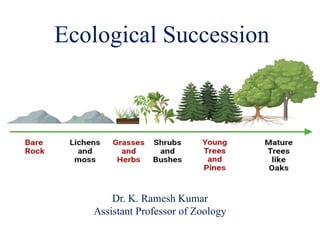
Ecological Succession
Dr. K. Ramesh Kumar
Assistant Professor of Zoology
Ecological Succession
• The observed process of change in the species structure of an ecological
community over a period of time.
• According to Smith (1965), ecological succession can be defined as “an orderly
and progressive replacement of one community by another till the development of
a stable community in that area”
• Ecosystem are constantly changing. Ecological succession is a gradual process of
change and replacement of the types of species in a community.
• Each new community makes it harder for the previous community to survive.
• The communities in any area are not stable. They are changing into other forms of
communities from time to time.
• Thus in a particular area one community may be replaced by another community or
by a series of communities.
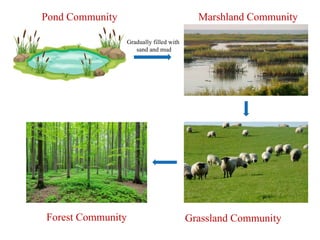
Pond Community Marshland Community
Grassland Community
Forest Community
Gradually filled with
sand and mud
• Ecological succession is directional and predictable.
• The succession is caused due to the modification of the physical environment.
• There is an increase in structural complexity during succession.
• The kinds of animals and plants change continuously with succession.
• The diversity of species tends to increase with succession.
• The microorganisms and heterotrophic animal reach their maximum diversity in the
later stages of succession.
• The biomass increases, as biomass increases, many new habitat niches are created.
• The succession of a community can be compared to the embryogenesis of an
organisms.
• In the development of a community, a series of communities develop and they replace
one another in an orderly sequence until the stable community is produced.
• Sere: Various developmental stages of a community
• Seral stage: Each stages
• Pioneer community: First seral stage
• Climax community: Final stable community
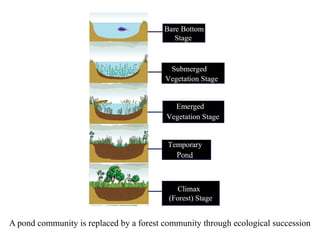
A pond community is replaced by a forest community through ecological succession
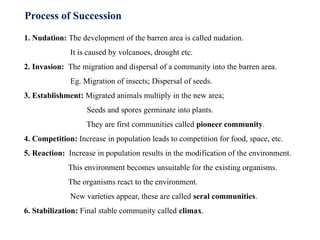
Process of Succession
1. Nudation: The development of the barren area is called nudation.
It is caused by volcanoes, drought etc.
2. Invasion: The migration and dispersal of a community into the barren area.
Eg. Migration of insects; Dispersal of seeds.
3. Establishment: Migrated animals multiply in the new area;
Seeds and spores germinate into plants.
They are first communities called pioneer community.
4. Competition: Increase in population leads to competition for food, space, etc.
5. Reaction: Increase in population results in the modification of the environment.
This environment becomes unsuitable for the existing organisms.
The organisms react to the environment.
New varieties appear, these are called seral communities.
6. Stabilization: Final stable community called climax.
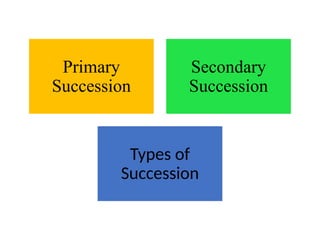
Primary
Succession
Secondary
Succession
Types of
Succession
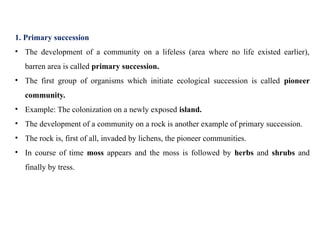
1. Primary succession
• The development of a community on a lifeless (area where no life existed earlier),
barren area is called primary succession.
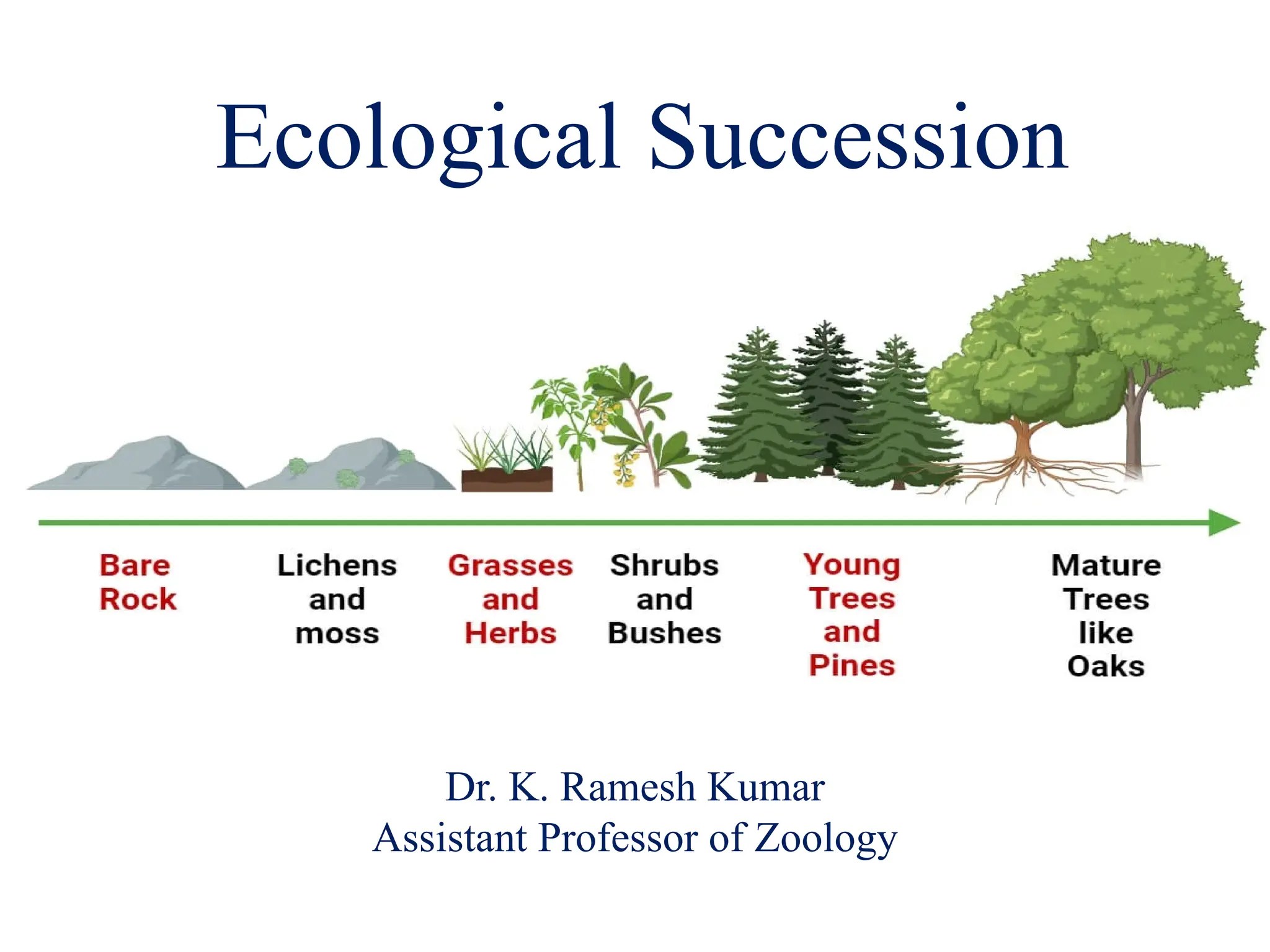
• The first group of organisms which initiate ecological succession is called pioneer
community.
• Example: The colonization on a newly exposed island.
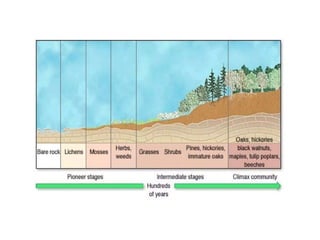
• The development of a community on a rock is another example of primary succession.
• The rock is, first of all, invaded by lichens, the pioneer communities.
• In course of time moss appears and the moss is followed by herbs and shrubs and
finally by tress.
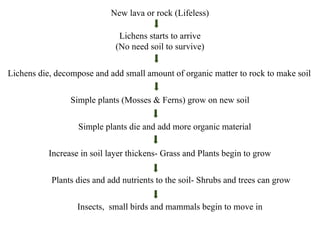
New lava or rock (Lifeless)
Lichens starts to arrive
(No need soil to survive)
Simple plants (Mosses & Ferns) grow on new soil
Lichens die, decompose and add small amount of organic matter to rock to make soil
Simple plants die and add more organic material
Increase in soil layer thickens- Grass and Plants begin to grow
Plants dies and add nutrients to the soil- Shrubs and trees can grow
Insects, small birds and mammals begin to move in
2. Secondary succession
• The development of a community in an area which is already occupied by a well
development community, is called secondary succession.
• It is the process by which one community replaces another community which has been
partially or totally destroyed, might be by natural process such as flood, earthquake etc.
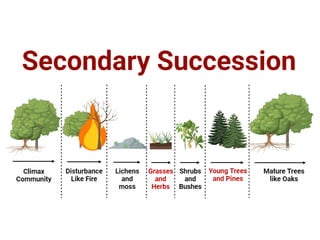
• This secondary succession is initiated by an event (Eg. Forest fire)
• Eg. The development of communities in cut-over forests, abandoned crop lands and
ploughed fields are examples of secondary succession.
• Further, based on the dominating species in the community, succession is classified into
two types, namely autotrophic succession and heterotrophic succession.
3. Autotrophic Succession
• It is characterized by the dominance of autotrophic organisms (plants). The succession
begin predominantly in inorganic environments.
4. Autotrophic Succession
• It is characterized by the dominance of heterotrophic organisms (animals). The
succession begins in organic environments.
Climax Community
• A climax community is a mature, stable community that is the final stage of
ecological succession.
• This type of community remains the same through out the time, if it not
disturbed.
• There are three main concepts of climax:
1. Monoclimax theory:
This theory concept was proposed by Clements.
Each climatic or geographical region has only one climax community.
2. Polyclimax theory:
This theory was proposed by Tansley.
Each area is occupied by many climax communities.
They are controlled by environmental factors (soil moisture, soil nutrients etc.)
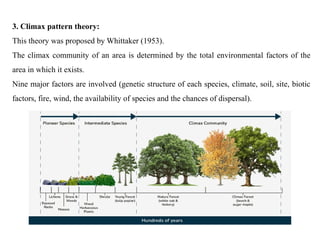
3. Climax pattern theory:
This theory was proposed by Whittaker (1953).
The climax community of an area is determined by the total environmental factors of the
area in which it exists.
Nine major factors are involved (genetic structure of each species, climate, soil, site, biotic
factors, fire, wind, the availability of species and the chances of dispersal).
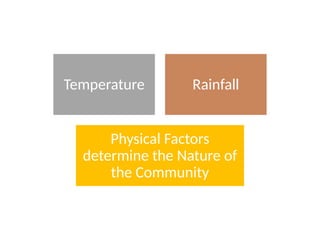
Temperature Rainfall
Physical Factors
determine the Nature of
the Community
Threats to Succession
• Grass and shrubs plays major role in intermediate stages, but often considered as
weed and bush.
• Without these intermediate stages, the disturbed habitat cannot return to forest.
• Clearing the land for garden and agriculture.
• Re-structure and disrupting a previously stabilized ecosystem.
• Climate change.
Patterns of Succession
1. Xerarch or xerosere: When succession begins on a dry place.
Succession starting on rocks.
Pioneer organism: Lichens
2. Hydrarch or hydrosere: When succession begins in water.
Succession starting from pond.
Pioneer organism: Plankton
3. Mesarch or mesosere: Intermediate between xerarch and hydrarch
Succession occurs in places with moisture.
Significance of Succession
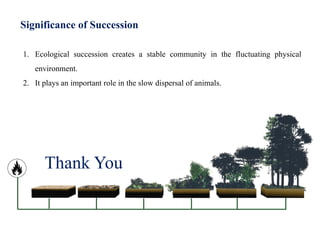
1. Ecological succession creates a stable community in the fluctuating physical
environment.
2. It plays an important role in the slow dispersal of animals.
Thank You

Ecological Succession-Process, types, patterns & Significance.pptx

  • 1.
    Ecological Succession Dr. K.Ramesh Kumar Assistant Professor of Zoology
  • 2.
    Ecological Succession • Theobserved process of change in the species structure of an ecological community over a period of time. • According to Smith (1965), ecological succession can be defined as “an orderly and progressive replacement of one community by another till the development of a stable community in that area” • Ecosystem are constantly changing. Ecological succession is a gradual process of change and replacement of the types of species in a community. • Each new community makes it harder for the previous community to survive. • The communities in any area are not stable. They are changing into other forms of communities from time to time. • Thus in a particular area one community may be replaced by another community or by a series of communities.
  • 3.
    Pond Community MarshlandCommunity Grassland Community Forest Community Gradually filled with sand and mud
  • 4.
    • Ecological successionis directional and predictable. • The succession is caused due to the modification of the physical environment. • There is an increase in structural complexity during succession. • The kinds of animals and plants change continuously with succession. • The diversity of species tends to increase with succession. • The microorganisms and heterotrophic animal reach their maximum diversity in the later stages of succession. • The biomass increases, as biomass increases, many new habitat niches are created. • The succession of a community can be compared to the embryogenesis of an organisms. • In the development of a community, a series of communities develop and they replace one another in an orderly sequence until the stable community is produced. • Sere: Various developmental stages of a community • Seral stage: Each stages • Pioneer community: First seral stage • Climax community: Final stable community
  • 5.
    A pond communityis replaced by a forest community through ecological succession
  • 6.
    Process of Succession 1.Nudation: The development of the barren area is called nudation. It is caused by volcanoes, drought etc. 2. Invasion: The migration and dispersal of a community into the barren area. Eg. Migration of insects; Dispersal of seeds. 3. Establishment: Migrated animals multiply in the new area; Seeds and spores germinate into plants. They are first communities called pioneer community. 4. Competition: Increase in population leads to competition for food, space, etc. 5. Reaction: Increase in population results in the modification of the environment. This environment becomes unsuitable for the existing organisms. The organisms react to the environment. New varieties appear, these are called seral communities. 6. Stabilization: Final stable community called climax.
  • 7.
  • 8.
    1. Primary succession •The development of a community on a lifeless (area where no life existed earlier), barren area is called primary succession. • The first group of organisms which initiate ecological succession is called pioneer community. • Example: The colonization on a newly exposed island. • The development of a community on a rock is another example of primary succession. • The rock is, first of all, invaded by lichens, the pioneer communities. • In course of time moss appears and the moss is followed by herbs and shrubs and finally by tress.
  • 9.
    New lava orrock (Lifeless) Lichens starts to arrive (No need soil to survive) Simple plants (Mosses & Ferns) grow on new soil Lichens die, decompose and add small amount of organic matter to rock to make soil Simple plants die and add more organic material Increase in soil layer thickens- Grass and Plants begin to grow Plants dies and add nutrients to the soil- Shrubs and trees can grow Insects, small birds and mammals begin to move in
  • 11.
    2. Secondary succession •The development of a community in an area which is already occupied by a well development community, is called secondary succession. • It is the process by which one community replaces another community which has been partially or totally destroyed, might be by natural process such as flood, earthquake etc. • This secondary succession is initiated by an event (Eg. Forest fire) • Eg. The development of communities in cut-over forests, abandoned crop lands and ploughed fields are examples of secondary succession. • Further, based on the dominating species in the community, succession is classified into two types, namely autotrophic succession and heterotrophic succession.
  • 13.
    3. Autotrophic Succession •It is characterized by the dominance of autotrophic organisms (plants). The succession begin predominantly in inorganic environments. 4. Autotrophic Succession • It is characterized by the dominance of heterotrophic organisms (animals). The succession begins in organic environments.
  • 14.
    Climax Community • Aclimax community is a mature, stable community that is the final stage of ecological succession. • This type of community remains the same through out the time, if it not disturbed. • There are three main concepts of climax: 1. Monoclimax theory: This theory concept was proposed by Clements. Each climatic or geographical region has only one climax community. 2. Polyclimax theory: This theory was proposed by Tansley. Each area is occupied by many climax communities. They are controlled by environmental factors (soil moisture, soil nutrients etc.)
  • 15.
    3. Climax patterntheory: This theory was proposed by Whittaker (1953). The climax community of an area is determined by the total environmental factors of the area in which it exists. Nine major factors are involved (genetic structure of each species, climate, soil, site, biotic factors, fire, wind, the availability of species and the chances of dispersal).
  • 16.
  • 17.
    Threats to Succession •Grass and shrubs plays major role in intermediate stages, but often considered as weed and bush. • Without these intermediate stages, the disturbed habitat cannot return to forest. • Clearing the land for garden and agriculture. • Re-structure and disrupting a previously stabilized ecosystem. • Climate change.
  • 18.
    Patterns of Succession 1.Xerarch or xerosere: When succession begins on a dry place. Succession starting on rocks. Pioneer organism: Lichens 2. Hydrarch or hydrosere: When succession begins in water. Succession starting from pond. Pioneer organism: Plankton 3. Mesarch or mesosere: Intermediate between xerarch and hydrarch Succession occurs in places with moisture.
  • 19.
    Significance of Succession 1.Ecological succession creates a stable community in the fluctuating physical environment. 2. It plays an important role in the slow dispersal of animals. Thank You