Ecological Succession
Presented by:
SHER KHAN
M.Sc. II Semester
Deptt. Of Zoology
Shia P.G. College , Lucknow
What is Ecological Succession?
• Natural areas are subject to disturbances of
many kinds.
• Humans and natural disturbances such as
storms and fires, hurricane, earthquake etc.,
• Such disturbances have existed so long that
animals and plants have adapted tothem and
benefit from their occurrence
If fundamental requirements are available for
life areas on earth without life are soon filled
with living things.
•The Ecosystem undergo series of patterns of
development called ecological succession.
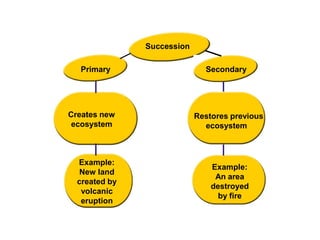
•There are two types of succession
– Primary succession
– Secondary succession
Succession
Example:
New land
created by
volcanic
eruption
Example:
An area
destroyed
by fire
Primary Secondary
Restores previous
ecosystem
Creates new
ecosystem
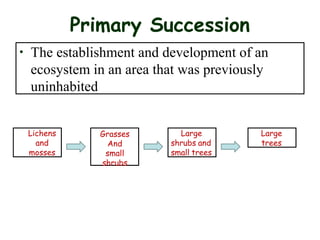
Primary Succession
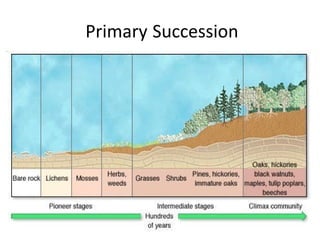
• The establishment and development of an
ecosystem in an area that was previously
uninhabited
Lichens
and
mosses
Grasses
And
small
shrubs
Large
shrubs and
small trees
Large
trees
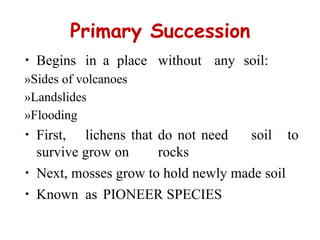
Primary Succession
• Begins in a place without any soil:
»Sides of volcanoes
»Landslides
»Flooding
• First, lichens that do not need soil to
survive grow on rocks
• Next, mosses grow to hold newly made soil
• Known as PIONEER SPECIES
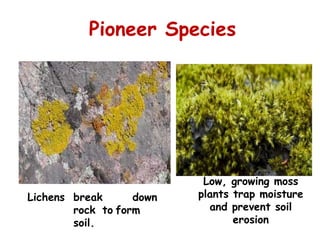
Pioneer Species
Lichens break down
rock to form
soil.
Low, growing moss
plants trap moisture
and prevent soil
erosion
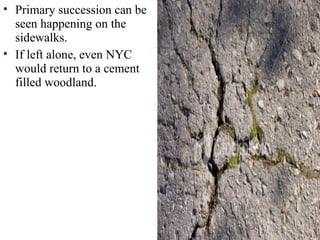
• Primary succession can be
seen happening on the
sidewalks.
• If left alone, even NYC
would return to a cement
filled woodland.
Primary Succession
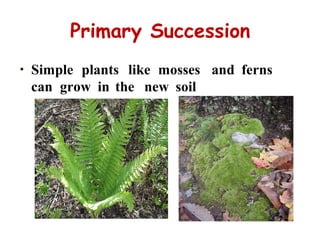
• Simple plants like mosses and ferns
can grow in the new soil
Primary Succession
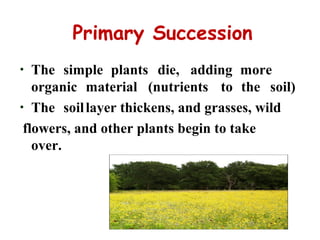
• The simple plants die, adding more
organic material (nutrients to the soil)
• The soillayer thickens, and grasses, wild
flowers, and other plants begin to take
over.
Primary Succession
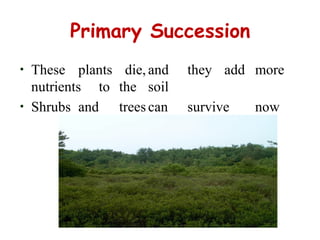
• These plants die, and they add more
nutrients to the soil
• Shrubs and treescan survive now
6/5/03 M-DCC / PCB 2340C 20
Primary Succession
Secondary Succession
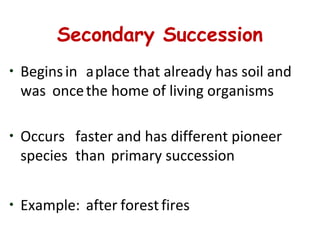
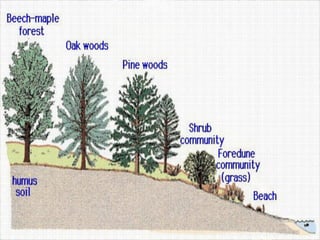
• Beginsin aplace that already has soil and
was oncethe home of living organisms
• Occurs faster and has different pioneer
species than primary succession
• Example: after forest fires
Secondary Succession
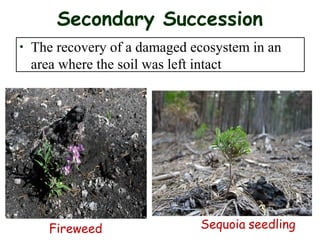
• The recovery of a damaged ecosystem in an
area where the soil was left intact
Sequoia seedlingFireweed
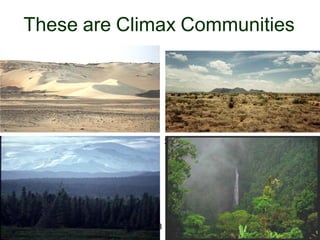
The Climax Community
• A climax community is a mature, stable community
that is the final stage of ecological succession. In an
ecosystem with a climax community, the conditions
continue to be suitable for all the members of the
community.
•Any particular region has its own set of climax species,
which are the plants that are best adapted for the area
and will persist after succession has finished, until
another disturbance clears the area.
6/5/03 M-DCC / PC
B
2340C 48
These are Climax Communities
Rain6fa/5ll/ M-DCC / PCB 1203-
49 20-30+
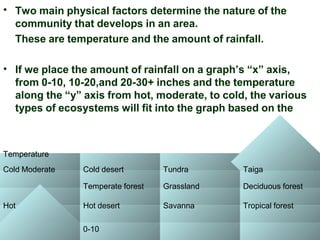
• Two main physical factors determine the nature of the
community that develops in an area.
These are temperature and the amount of rainfall.
• If we place the amount of rainfall on a graph’s “x” axis,
from 0-10, 10-20,and 20-30+ inches and the temperature
along the “y” axis from hot, moderate, to cold, the various
types of ecosystems will fit into the graph based on the
conditions that they require.
0-10
Temperature
Cold Moderate Cold desert
Temperate forest
Tundra
Grassland
Taiga
Deciduous forest
Hot Hot desert Savanna Tropical forest
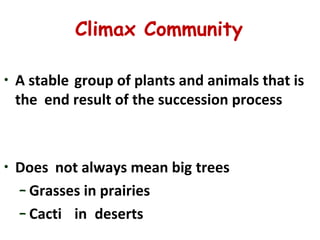
Climax Community
• A stable group of plants and animals that is
the end result of the succession process
• Does not always mean big trees
– Grasses in prairies
– Cacti in deserts
Thank You

Ecological succession4

  • 1.
    Ecological Succession Presented by: SHERKHAN M.Sc. II Semester Deptt. Of Zoology Shia P.G. College , Lucknow
  • 2.
    What is EcologicalSuccession? • Natural areas are subject to disturbances of many kinds. • Humans and natural disturbances such as storms and fires, hurricane, earthquake etc., • Such disturbances have existed so long that animals and plants have adapted tothem and benefit from their occurrence
  • 3.
    If fundamental requirementsare available for life areas on earth without life are soon filled with living things. •The Ecosystem undergo series of patterns of development called ecological succession. •There are two types of succession – Primary succession – Secondary succession
  • 4.
    Succession Example: New land created by volcanic eruption Example: Anarea destroyed by fire Primary Secondary Restores previous ecosystem Creates new ecosystem
  • 5.
    Primary Succession • Theestablishment and development of an ecosystem in an area that was previously uninhabited Lichens and mosses Grasses And small shrubs Large shrubs and small trees Large trees
  • 6.
    Primary Succession • Beginsin a place without any soil: »Sides of volcanoes »Landslides »Flooding • First, lichens that do not need soil to survive grow on rocks • Next, mosses grow to hold newly made soil • Known as PIONEER SPECIES
  • 7.
    Pioneer Species Lichens breakdown rock to form soil. Low, growing moss plants trap moisture and prevent soil erosion
  • 8.
    • Primary successioncan be seen happening on the sidewalks. • If left alone, even NYC would return to a cement filled woodland.
  • 9.
    Primary Succession • Simpleplants like mosses and ferns can grow in the new soil
  • 10.
    Primary Succession • Thesimple plants die, adding more organic material (nutrients to the soil) • The soillayer thickens, and grasses, wild flowers, and other plants begin to take over.
  • 11.
    Primary Succession • Theseplants die, and they add more nutrients to the soil • Shrubs and treescan survive now
  • 12.
    6/5/03 M-DCC /PCB 2340C 20 Primary Succession
  • 13.
    Secondary Succession • Beginsinaplace that already has soil and was oncethe home of living organisms • Occurs faster and has different pioneer species than primary succession • Example: after forest fires
  • 15.
    Secondary Succession • Therecovery of a damaged ecosystem in an area where the soil was left intact Sequoia seedlingFireweed
  • 16.
    The Climax Community •A climax community is a mature, stable community that is the final stage of ecological succession. In an ecosystem with a climax community, the conditions continue to be suitable for all the members of the community. •Any particular region has its own set of climax species, which are the plants that are best adapted for the area and will persist after succession has finished, until another disturbance clears the area.
  • 17.
    6/5/03 M-DCC /PC B 2340C 48 These are Climax Communities
  • 18.
    Rain6fa/5ll/ M-DCC /PCB 1203- 49 20-30+ • Two main physical factors determine the nature of the community that develops in an area. These are temperature and the amount of rainfall. • If we place the amount of rainfall on a graph’s “x” axis, from 0-10, 10-20,and 20-30+ inches and the temperature along the “y” axis from hot, moderate, to cold, the various types of ecosystems will fit into the graph based on the conditions that they require. 0-10 Temperature Cold Moderate Cold desert Temperate forest Tundra Grassland Taiga Deciduous forest Hot Hot desert Savanna Tropical forest
  • 19.
    Climax Community • Astable group of plants and animals that is the end result of the succession process • Does not always mean big trees – Grasses in prairies – Cacti in deserts
  • 20.