Ecosystems
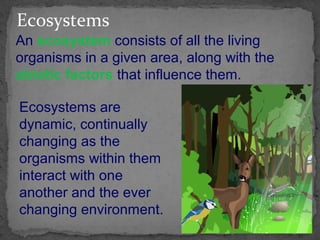
An ecosystem consists of all the living
organisms in a given area, along with the
abiotic factors that influence them.
Ecosystems are
dynamic, continually
changing as the
organisms within them
interact with one
another and the ever
changing environment.
Ecosystems
Ecosystems are dynamic, continually
changing as the organisms within them
interact with one another and the ever
changing environment.
Energy and nutrients
generally flow between
organisms within the
same ecosystem, and
little is lost to the
outside.
Biotic and abiotic factors
An ecosystem is formed of biotic and abiotic
components.
Biological organisms are part of their
ecosystem’s biotic component. The organisms
within an ecosystem
all affect one another,
acting as either an
energy source, or a
competitor.
Biotic and abiotic factors
The abiotic
component is the
non-biological part of
an ecosystem. This
includes the climate,
light level and
rainfall.
Some abiotic factors, such as the dirt, can be
altered by the presence of organisms.
 Organism – complex system of organs that

function as a whole
One FJH student

 Population – group of same species that live

together in a same area for the same time, they
compete for food, mates, and nesting place
All FJH students

 Communities – All the populations of different

species that live and interact in an area, different
population in a community depend on each
other
FISD all schools in Friendswood
 Ecosystem – community of organisms

and its abiotic environment, how
organisms interact with each other,
climate, and soil affect organisms
The city of Friendswood

 Biome – A biome is a large area on the

Earth's surface that is defined by the
types of animals and plants living there.
A biome can be partially defined by the
local climate patterns.

 Biosphere – whole area of Earth

where life exists includes, every
ecosystem
Earth
Succession
Succession
Succession is the
gradual change in a
community over time.
During succession
the organisms within
an ecosystem
change its abiotic
conditions.
This allows better
adapted organisms to
colonize the area,
replacing its current
inhabitants.

Primary succession occurs when
organisms colonize a lifeless habitat.

Secondary succession occurs
when organisms recolonize
a devastated
ecosystem.
A series of predictable changes that

occur in a community over time due to
events in the environment.
The changes may happen suddenly
or very slowly.
 The series of changes that occur in an

area where no ecosystem previously
existed.

 Eventually,

primary
succession
will lead to
equilibrium.
Primary Succession – the
series of changes that
occur in an area where no
ecosystem previously
existed.
An area of rock

uncovered by a
melting ice sheet
A new island formed
by the eruption of an
undersea volcano
Human made ponds
The first species

to populate an
area are the
pioneer species.

They break up rock

and begin soil
formation
Primary Succession
•Soil starts to form as lichens and

the forces of weather and erosion
help break down rocks into smaller
pieces
•When lichens die, they
decompose, adding small amounts
of organic matter to the rock to
make soil
A combination of
fungus and algae
Lichen pictures
Mosses break down rock
and add more soil
Grasses and small
plants – protect the
soil and add more
nutrients
•The simple plants die, adding more

organic material
•The soil layer thickens, and grasses,
wildflowers, and other plants begin to
take over
•These plants die, and they add

more nutrients to the soil
•Shrubs and trees can survive now

http://www.rowan.edu
•Insects, small birds, and mammals have

begun to move in
•What was once bare rock now supports
a variety of life

http://www.rowan.edu
Larger plants with deep roots
continue to break up rock and
make more soil.
A diverse forest ecosystem
takes hundreds of years
1. Ground is solid rock
2. Rock begins to weather, pioneer

species begin
3. Weeds and grasses grow in soil making thicker, richer soil
4. Eventually trees and shrubs sprout community of organisms develops
5. Ecosystem reaches equilibrium
Reaching a stable community
can take centuries.
Equilibrium
Secondary Succession
The series of

changes that occur
after a disturbance
in an existing
ecosystem.
It can occur more

rapidly than
primary succession.
Secondary Succession
Begins in a place that already has

soil and was once the home of
living organisms
Occurs faster and has different
pioneer species than primary
succession
Natural disturbances:
Fires, hurricanes,
and tornadoes

Human disturbances:
A pasture
abandoned by a
farmer
Logging, or mining
Secondary Succession –
The series of changes that
occur after a disturbance
in an existing ecosystem.
1. Varies depending on the type of
2.

3.
4.
5.

disturbance
A disturbed area returns to its
previous condition, eventually reaches
equilibrium
Soil and seeds are already present
Organisms move in
There is a quick recovery of the
ecosystem
Climax Community
•A stable group of plants and

animals that is the end result of
the succession process
•Does not always mean big trees
– Grasses in prairies
– Cacti in deserts

• Equilibrium restored
• State of balance
• No sudden changes

in community
Secondary succession usually
requires less time to form a
climax community, since soil is
already in place.
Succession Review
What
happens
to the
ecosyste
m
Length of
Time
Example

Primary
Creates a new
ecosystem

Secondary
Restores a
previous
ecosystem

May take a long time
to reach equilibrium

A shorter time to
reach equilibrium

New land created by
An area
volcanic eruption
destroyed by fire
Equilibrium
How do primary and secondary succession help
maintain equilibrium in an ecosystem?
Answer:
By fostering stability, over time, in the number and
species of organisms in a community.
What is a pioneer species?

Answer:
The first species to populate an area.
Identify two natural disturbances and
two human disturbances that can
result in secondary succession.
Answer:
Natural Disturbances: fire, hurricanes,
volcanoes, tornadoes. Human
Disturbances: farming, logging,
mining.
Grass poking through the cracks in the
sidewalk is an example of succession. Is
this primary or secondary succession?
Answer:
Secondary Succession; before the
sidewalk was built, an ecosystem
existed there.
Primary Succession occurs where no

previous ecosystem exists and
establishes equilibrium.
Secondary succession occurs after a

disturbance restores equilibrium.

Succession notes 2013

  • 1.
    Ecosystems An ecosystem consistsof all the living organisms in a given area, along with the abiotic factors that influence them. Ecosystems are dynamic, continually changing as the organisms within them interact with one another and the ever changing environment.
  • 2.
    Ecosystems Ecosystems are dynamic,continually changing as the organisms within them interact with one another and the ever changing environment. Energy and nutrients generally flow between organisms within the same ecosystem, and little is lost to the outside.
  • 3.
    Biotic and abioticfactors An ecosystem is formed of biotic and abiotic components. Biological organisms are part of their ecosystem’s biotic component. The organisms within an ecosystem all affect one another, acting as either an energy source, or a competitor.
  • 4.
    Biotic and abioticfactors The abiotic component is the non-biological part of an ecosystem. This includes the climate, light level and rainfall. Some abiotic factors, such as the dirt, can be altered by the presence of organisms.
  • 5.
     Organism –complex system of organs that function as a whole One FJH student  Population – group of same species that live together in a same area for the same time, they compete for food, mates, and nesting place All FJH students  Communities – All the populations of different species that live and interact in an area, different population in a community depend on each other FISD all schools in Friendswood
  • 6.
     Ecosystem –community of organisms and its abiotic environment, how organisms interact with each other, climate, and soil affect organisms The city of Friendswood  Biome – A biome is a large area on the Earth's surface that is defined by the types of animals and plants living there. A biome can be partially defined by the local climate patterns.  Biosphere – whole area of Earth where life exists includes, every ecosystem Earth
  • 7.
  • 8.
    Succession Succession is the gradualchange in a community over time. During succession the organisms within an ecosystem change its abiotic conditions. This allows better adapted organisms to colonize the area, replacing its current inhabitants. Primary succession occurs when organisms colonize a lifeless habitat. Secondary succession occurs when organisms recolonize a devastated ecosystem.
  • 9.
    A series ofpredictable changes that occur in a community over time due to events in the environment. The changes may happen suddenly or very slowly.
  • 11.
     The seriesof changes that occur in an area where no ecosystem previously existed.  Eventually, primary succession will lead to equilibrium.
  • 12.
    Primary Succession –the series of changes that occur in an area where no ecosystem previously existed.
  • 13.
    An area ofrock uncovered by a melting ice sheet A new island formed by the eruption of an undersea volcano Human made ponds
  • 14.
    The first species topopulate an area are the pioneer species. They break up rock and begin soil formation
  • 15.
    Primary Succession •Soil startsto form as lichens and the forces of weather and erosion help break down rocks into smaller pieces •When lichens die, they decompose, adding small amounts of organic matter to the rock to make soil
  • 16.
  • 19.
  • 20.
    Mosses break downrock and add more soil
  • 21.
    Grasses and small plants– protect the soil and add more nutrients
  • 22.
    •The simple plantsdie, adding more organic material •The soil layer thickens, and grasses, wildflowers, and other plants begin to take over
  • 23.
    •These plants die,and they add more nutrients to the soil •Shrubs and trees can survive now http://www.rowan.edu
  • 24.
    •Insects, small birds,and mammals have begun to move in •What was once bare rock now supports a variety of life http://www.rowan.edu
  • 25.
    Larger plants withdeep roots continue to break up rock and make more soil. A diverse forest ecosystem takes hundreds of years
  • 26.
    1. Ground issolid rock 2. Rock begins to weather, pioneer species begin 3. Weeds and grasses grow in soil making thicker, richer soil 4. Eventually trees and shrubs sprout community of organisms develops 5. Ecosystem reaches equilibrium
  • 28.
    Reaching a stablecommunity can take centuries.
  • 29.
  • 31.
    Secondary Succession The seriesof changes that occur after a disturbance in an existing ecosystem. It can occur more rapidly than primary succession.
  • 32.
    Secondary Succession Begins ina place that already has soil and was once the home of living organisms Occurs faster and has different pioneer species than primary succession
  • 34.
    Natural disturbances: Fires, hurricanes, andtornadoes Human disturbances: A pasture abandoned by a farmer Logging, or mining
  • 35.
    Secondary Succession – Theseries of changes that occur after a disturbance in an existing ecosystem.
  • 37.
    1. Varies dependingon the type of 2. 3. 4. 5. disturbance A disturbed area returns to its previous condition, eventually reaches equilibrium Soil and seeds are already present Organisms move in There is a quick recovery of the ecosystem
  • 38.
    Climax Community •A stablegroup of plants and animals that is the end result of the succession process •Does not always mean big trees – Grasses in prairies – Cacti in deserts • Equilibrium restored • State of balance • No sudden changes in community
  • 39.
    Secondary succession usually requiresless time to form a climax community, since soil is already in place.
  • 41.
  • 42.
    What happens to the ecosyste m Length of Time Example Primary Createsa new ecosystem Secondary Restores a previous ecosystem May take a long time to reach equilibrium A shorter time to reach equilibrium New land created by An area volcanic eruption destroyed by fire
  • 44.
  • 45.
    How do primaryand secondary succession help maintain equilibrium in an ecosystem? Answer: By fostering stability, over time, in the number and species of organisms in a community.
  • 46.
    What is apioneer species? Answer: The first species to populate an area.
  • 47.
    Identify two naturaldisturbances and two human disturbances that can result in secondary succession. Answer: Natural Disturbances: fire, hurricanes, volcanoes, tornadoes. Human Disturbances: farming, logging, mining.
  • 48.
    Grass poking throughthe cracks in the sidewalk is an example of succession. Is this primary or secondary succession? Answer: Secondary Succession; before the sidewalk was built, an ecosystem existed there.
  • 49.
    Primary Succession occurswhere no previous ecosystem exists and establishes equilibrium. Secondary succession occurs after a disturbance restores equilibrium.

Editor's Notes

  • #4 Teacher notes Students could be asked to discuss the key biotic and abiotic factors affecting the reef environment shown in the picture. How is it different than an open water ecosystem? Can they think of any instances where organisms have adjusted the abiotic conditions in this context? Photo credit (shark on a coral reef): © 2009 Shutterstock, Specta
  • #5 Teacher notes Students could be asked to discuss the key biotic and abiotic factors affecting the reef environment shown in the picture. How is it different than an open water ecosystem? Can they think of any instances where organisms have adjusted the abiotic conditions in this context? Photo credit (shark on a coral reef): © 2009 Shutterstock, Specta
  • #9 Photo credit (lichen on a lava flow): © 2009 Shutterstock, Patricia Hoffmeester Photo credit (burnt woodland): © 2009 Shutterstock, Dven