Community Ecology Chapter 54 Jeff Jewett American College of Sofia Version 1.0 May 20 th , 2010
Community  A group of populations (each population is one species) living close enough together to interact
Interspecific Interactions Occur between individuals of DIFFERENT species Competition - /- Predation / Herbivory  +/ - Symbiosis Parasitism +/- Commensalism  +/0 Mutualism  +/+
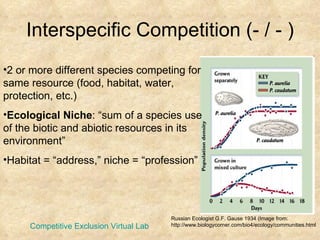
Interspecific Competition (- / - ) Russian Ecologist G.F. Gause 1934 (Image from: http://www.biologycorner.com/bio4/ecology/communities.html 2 or more different species competing for same resource (food, habitat, water, protection, etc.) Ecological Niche : “sum of a species use of the biotic and abiotic resources in its environment”  Habitat = “address,” niche = “profession” Competitive Exclusion Virtual Lab
Competitive Exclusion Principle  2 species  cannot  occupy the same niche in same community at the same time One will win, the other will die, migrate, or adapt C.E.P. leads to  Resource Partitioning
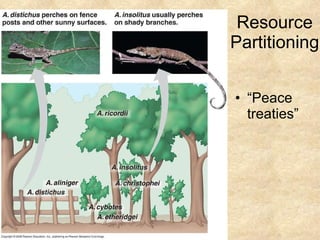
Resource Partitioning “Peace treaties”
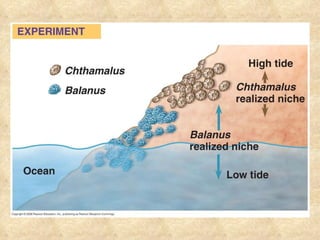
Interspecific Competition,  Continued Resource Partitioning  – differentiation of niches to allow similar species to coexist in a community (space, behavior, temporal) Fundamental niche  – the niche a species could theoretically occupy, without competitors Realized niche  – the niche a species  actually  occupies, with competitors
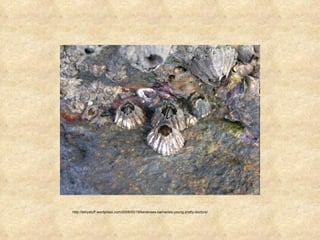
http://terrystuff.wordpress.com/2008/03/19/keratoses-barnacles-young-pretty-doctors/
 
 
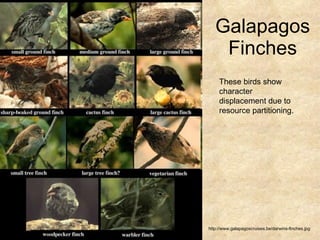
Body changes as a result of resource partitioning Character Displacement
Galapagos Finches http://www.galapagoscruises.be/darwins-finches.jpg These birds show character displacement due to resource partitioning.
Predation Includes  herbivory   plants have defense chemicals, spines, thorns Predators: binocular vision, prey: monocular vision Camouflage Mimicry Warning (“aposematic”) coloration Predator-Prey Animation  (NortonBooks) http://www.biologycorner.com/bio4/ecology/communities.html DANGER!
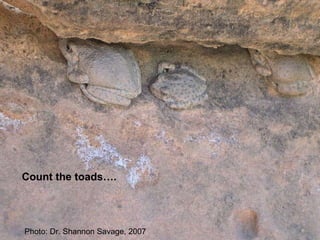
Photo: Dr. Shannon Savage, 2007 Count the toads….
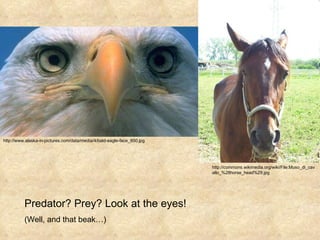
http://www.alaska-in-pictures.com/data/media/4/bald-eagle-face_850.jpg http://commons.wikimedia.org/wiki/File:Muso_di_cavallo_%28horse_head%29.jpg Predator? Prey? Look at the eyes!  (Well, and that beak…)
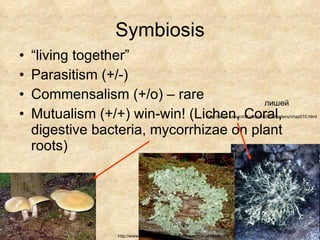
Symbiosis “ living together” Parasitism (+/-) Commensalism (+/o) – rare Mutualism (+/+) win-win! (Lichen, Coral, digestive bacteria, mycorrhizae on plant roots) http://www.saburchill.com/ans02/chapters/chap010.html лишей  http://www.nearctica.com/ecology/pops/mutual.htm#coral
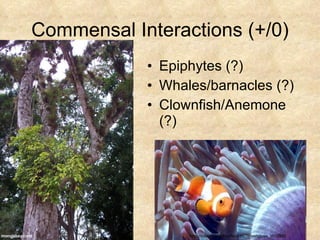
Commensal Interactions (+/0) Epiphytes (?) Whales/barnacles (?) Clownfish/Anemone (?) http://tolweb.org/treehouses/?treehouse_id=3390
54.2 Species Diversity What makes a healthy ecosystem? Species richness (# species) Relative abundance (proportion)
Food Webs
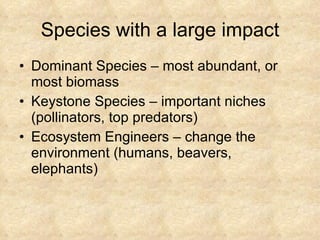
Species with a large impact Dominant Species – most abundant, or most biomass Keystone Species – important niches (pollinators, top predators) Ecosystem Engineers – change the environment (humans, beavers, elephants)
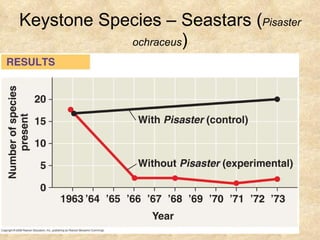
Keystone Species – Seastars ( Pisaster ochraceus )
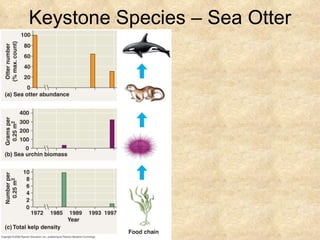
Keystone Species – Sea Otter
Regulates snowmelt runoff Reduces soil erosion Facilitates other plant growth FOOD! – squirrels, birds, bears Pinus Albicaulis :   Subalpine keystone species
54.3 Disturbance & Succession Disturbance – an event that changes a community by removing organisms or altering resource availability Fire, storm, human activity, drought, overgrazing, flood
Disturbance & Succession Primary Succession Secondary Succession (ACS Campus) Climax Community Non-equilibrium model (everything’s always changing!) Intermediate disturbance hypothesis
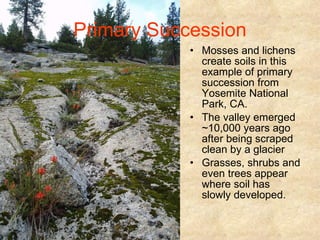
Primary Succession Mosses and lichens create soils in this example of primary succession from Yosemite National Park, CA. The valley emerged ~10,000 years ago after being scraped clean by a glacier  Grasses, shrubs and even trees appear where soil has slowly developed.
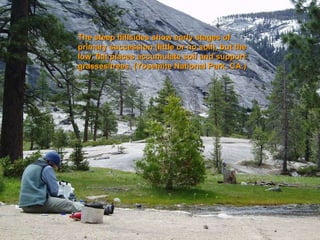
The steep hillsides show early stages of primary succession (little or no soil), but the low, flat places accumulate soil and support grasses/trees. (Yosemite National Park, CA.)
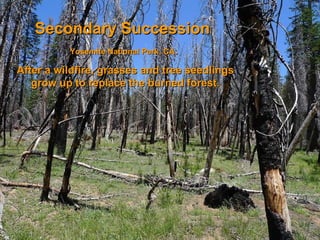
Secondary Succession   Yosemite National Park, CA .  After a wildfire, grasses and tree seedlings grow up to replace the burned forest.
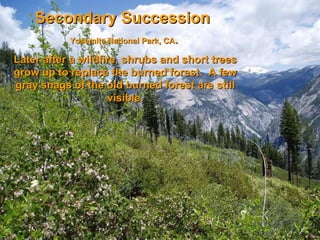
Secondary Succession   Yosemite National Park, CA .  Later after a wildfire, shrubs and short trees grow up to replace the burned forest.  A few gray snags of the old burned forest are still visible.
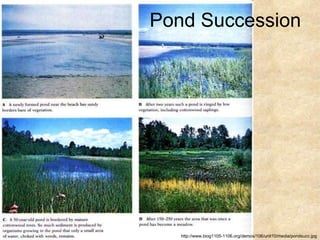
Pond Succession http://www.biog1105-1106.org/demos/106/unit10/media/pondsucc.jpg
Biogeography & Community Diversity Hot & wet = more species (rainforests!) Equatorial regions – more than polar or temperate (older, friendlier climate) Larger area – support a higher number of species

Community ecology

  • 1.
    Community Ecology Chapter54 Jeff Jewett American College of Sofia Version 1.0 May 20 th , 2010
  • 2.
    Community Agroup of populations (each population is one species) living close enough together to interact
  • 3.
    Interspecific Interactions Occurbetween individuals of DIFFERENT species Competition - /- Predation / Herbivory +/ - Symbiosis Parasitism +/- Commensalism +/0 Mutualism +/+
  • 4.
    Interspecific Competition (-/ - ) Russian Ecologist G.F. Gause 1934 (Image from: http://www.biologycorner.com/bio4/ecology/communities.html 2 or more different species competing for same resource (food, habitat, water, protection, etc.) Ecological Niche : “sum of a species use of the biotic and abiotic resources in its environment” Habitat = “address,” niche = “profession” Competitive Exclusion Virtual Lab
  • 5.
    Competitive Exclusion Principle 2 species cannot occupy the same niche in same community at the same time One will win, the other will die, migrate, or adapt C.E.P. leads to Resource Partitioning
  • 6.
  • 7.
    Interspecific Competition, Continued Resource Partitioning – differentiation of niches to allow similar species to coexist in a community (space, behavior, temporal) Fundamental niche – the niche a species could theoretically occupy, without competitors Realized niche – the niche a species actually occupies, with competitors
  • 8.
  • 9.
  • 10.
  • 11.
    Body changes asa result of resource partitioning Character Displacement
  • 12.
    Galapagos Finches http://www.galapagoscruises.be/darwins-finches.jpgThese birds show character displacement due to resource partitioning.
  • 13.
    Predation Includes herbivory plants have defense chemicals, spines, thorns Predators: binocular vision, prey: monocular vision Camouflage Mimicry Warning (“aposematic”) coloration Predator-Prey Animation (NortonBooks) http://www.biologycorner.com/bio4/ecology/communities.html DANGER!
  • 14.
    Photo: Dr. ShannonSavage, 2007 Count the toads….
  • 15.
  • 16.
    Symbiosis “ livingtogether” Parasitism (+/-) Commensalism (+/o) – rare Mutualism (+/+) win-win! (Lichen, Coral, digestive bacteria, mycorrhizae on plant roots) http://www.saburchill.com/ans02/chapters/chap010.html лишей http://www.nearctica.com/ecology/pops/mutual.htm#coral
  • 17.
    Commensal Interactions (+/0)Epiphytes (?) Whales/barnacles (?) Clownfish/Anemone (?) http://tolweb.org/treehouses/?treehouse_id=3390
  • 18.
    54.2 Species DiversityWhat makes a healthy ecosystem? Species richness (# species) Relative abundance (proportion)
  • 19.
  • 20.
    Species with alarge impact Dominant Species – most abundant, or most biomass Keystone Species – important niches (pollinators, top predators) Ecosystem Engineers – change the environment (humans, beavers, elephants)
  • 21.
    Keystone Species –Seastars ( Pisaster ochraceus )
  • 22.
  • 23.
    Regulates snowmelt runoffReduces soil erosion Facilitates other plant growth FOOD! – squirrels, birds, bears Pinus Albicaulis : Subalpine keystone species
  • 24.
    54.3 Disturbance &Succession Disturbance – an event that changes a community by removing organisms or altering resource availability Fire, storm, human activity, drought, overgrazing, flood
  • 25.
    Disturbance & SuccessionPrimary Succession Secondary Succession (ACS Campus) Climax Community Non-equilibrium model (everything’s always changing!) Intermediate disturbance hypothesis
  • 26.
    Primary Succession Mossesand lichens create soils in this example of primary succession from Yosemite National Park, CA. The valley emerged ~10,000 years ago after being scraped clean by a glacier Grasses, shrubs and even trees appear where soil has slowly developed.
  • 27.
    The steep hillsidesshow early stages of primary succession (little or no soil), but the low, flat places accumulate soil and support grasses/trees. (Yosemite National Park, CA.)
  • 28.
    Secondary Succession Yosemite National Park, CA . After a wildfire, grasses and tree seedlings grow up to replace the burned forest.
  • 29.
    Secondary Succession Yosemite National Park, CA . Later after a wildfire, shrubs and short trees grow up to replace the burned forest. A few gray snags of the old burned forest are still visible.
  • 30.
  • 31.
    Biogeography & CommunityDiversity Hot & wet = more species (rainforests!) Equatorial regions – more than polar or temperate (older, friendlier climate) Larger area – support a higher number of species

Editor's Notes

  • #14 bottom is a milk snake (not poisonous), top is coral snake (very poisonous)
  • #17 Parasites can affect reproduction, survival, density. Mechanical parasites (cloud forests epiphytes) Coral reefs usually occur in nutrient poor waters and must be shallow enough for sunlight to reach them. Contained between the cells of the coral polyp cylinder are single-celled green algae called dinoflagellates. The coral polyp and the dinoflagellates form a complex mutualistic relationship. The coral polyp sweeps organic material from the water and metabolizes this material forming carbon dioxide and nitrogenous wastes. The dinoflagellates use the carbon dioxide and nitrogenous wastes in photosynthesis to form oxygen and sugars that are in turn used by the coral polyps as well as the dinoflagellates in their metabolism, reforming the carbon dioxide and nitrogenous wastes. This cyclical exchange of nutrients, oxygen, and carbon dioxide is beneficial to both the coral polyps and the dinoflagellates, a mutualistic relationship. (www.nearctica.com)